
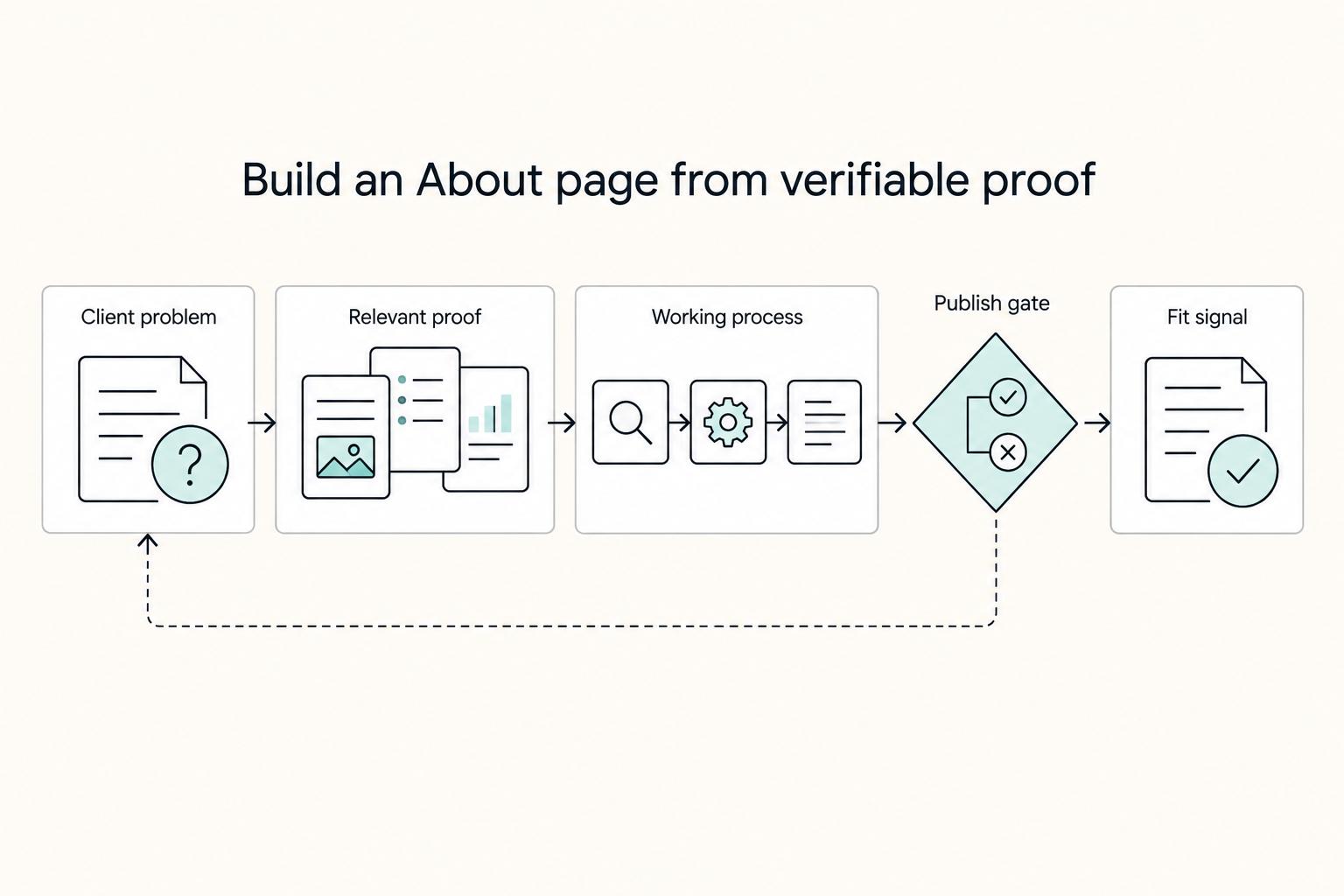
Quick Answer
Start by writing your freelance about me page for buyer decisions, not biography depth. Lead with who you help, what you deliver, and why your process is trustworthy, then support each claim with concrete proof such as a sample, LinkedIn profile, or clear operating boundary. Keep one primary CTA, state response expectations, and make sure your page promises match your real contract, revision, and invoicing setup.
Why Your About Me Page Shapes Client Quality Before the First Call#
Step 1 Treat the page as a filter, not a biography#
Your About page shapes who reaches out, what they expect, and how awkward that first call feels. If it attracts the wrong people, you can spend billable time on generic inquiries that were never a fit.
This is not just a copywriting exercise. It is about making your website do some of the sorting before your inbox fills up. If you want your site to attract clients instead of relying on cold outreach, this page needs to signal professional readiness quickly. A good About page does not just sound nice. It helps the right buyer self-select.
Step 2 Balance trust with specificity#
The tension is simple: be personal enough to feel credible and human, but specific enough that a reader can decide fit or not fit quickly. Most weak pages miss one side of that balance. They either read like a life story with no clear offer, or like a stripped-down resume with no sense of how you actually work.
Use this check as you draft: can a new visitor tell what you do, who you help, and what to do next? If not, the page is still too vague. A common failure mode is trying to sound broad so you do not turn anyone away. In practice, that brings in low-context inquiries, unclear project asks, and first calls that go nowhere.
If you are a specialist, say so early. If your work is broader, lead with service scope and working style so buyers can judge fit without guessing. That choice can do more for client quality than adding another personal anecdote.
Step 3 Write a page you can support operationally#
The goal is not a clever bio. It is a page that matches how your business actually runs: your service scope, how inquiries start, and the tone of your CTA. If the page sounds polished but your real process says something else, trust can drop as soon as a client asks practical questions.
By the end of this guide, you should have a publish-ready draft, a short verification checklist, and language that reflects how you really work.
Before you publish, run one practical test: read the page as if you were screening a freelancer for the first time. Would you understand the offer, know whether to inquire, and have a realistic sense of how the engagement starts? If not, fix that before you worry about polish. The next step is gathering the proof and operating details that make your claims believable.
For a step-by-step walkthrough, see Build a Freelance Press Page Clients Can Verify.
What to prepare before you write a single line#
Before you draft, collect only the proof and operating details you can actually stand behind. Your About page can shape a potential client's first impression before you ever speak, so weak prep usually turns into vague claims and mismatched expectations.
Step 1 Gather evidence you can point to#
Build a tight evidence pack: recent results, one relevant sample, your current service scope, and your LinkedIn profile. The goal is not volume. It is giving a reader enough proof to judge fit quickly.
Use one check before writing: can each claim connect to something real you already have, like a sample, a result you can describe, or a public profile line? If your LinkedIn positioning and site positioning conflict, resolve that first.
Step 2 Pull the documents that reflect how you work#
Open the documents you already use with clients, such as your revision policy, standard contract, and recent invoice terms. Use them as your alignment check so your page reflects how engagements actually run.
Focus on the terms that shape expectations most. If the page sounds flexible but your documents are stricter, trust usually drops in the first real conversation.
Step 3 Write only business facts you can safely claim#
Turn your basics into short, plain statements: your niche, your offer, and your business status. Keep only the lines you can support through your profile, sample, or existing client documents.
If a statement is hard to support, cut it or soften it before publishing. Related: How to Write a 'Work Made for Hire' Clause Correctly.
Lock your positioning so the page speaks to the right buyer#
Your positioning should help the right buyer recognize their problem and trust your way of working within a few lines. If they have to decode who you help or how you work, the page is too broad.
Step 1 Define the buyer by problem and buying context#
Define the buyer by the problem they need solved and the situation that makes them ready to buy. Skip broad labels unless they change the work in a real way.
Write one sentence that answers:
- What problem are they trying to solve?
- What buying context are they in when they arrive on your page?
Treat this as a tailored message, not copy that could fit anyone.
Step 2 Choose your lead based on specialization#
Use a simple rule:
- If your work is specialist, lead with your niche and the outcomes you are known for.
- If your work is generalist, lead with process reliability, communication clarity, and service scope.
Problem-solving should sit at the center of your positioning, and your copy should match how you actually deliver work. If your process has clear boundaries, say that clearly instead of sounding open-ended.
Step 3 Draft a 2-line statement that reduces buyer risk#
Draft a short positioning statement that connects expertise to risk reduction:
"I help [buyer in context] solve [specific problem]. My work reduces [timeline, communication, or scope] risk through [clear process or boundaries]."
Then cut bio details aggressively. Keep personal details only when they improve fit or trust; if they do not help a buyer decide, remove them.
Build trust signals that sound human but read like professional proof#
Your About page should read like proof, not a resume-style bio. The goal is to help a buyer move from "what you do" to "can I trust you?" through clear, specific, evidence-backed statements.
Step 1 Replace self-description with proof-backed claims#
Use claims a buyer can verify with a sample, project context, or operating detail from how you actually work. Trust is built through clarity, specificity, evidence, and tone.
| Don't write | Do write | What proves it |
|---|---|---|
| "I'm a strategic copywriter." | "I write launch and website copy for B2B SaaS teams with tight review cycles." | Portfolio sample plus client/project context |
| "I'm easy to work with." | "Projects run with defined revision rounds and direct communication, so feedback stays structured." | Your revision policy |
| "I'm professional and reliable." | "My contract defines scope, deliverables, and out-of-scope work before drafting starts." | Your standard contract |
| "I've worked with great brands." | "I've supported teams that needed clearer messaging before launch, rebrand, or handoff." | Named case study if public, or anonymized project context |
Quick check: if you remove the adjectives, does your page still show why someone should trust you?
Step 2 Balance three kinds of evidence#
Use a mix of proof types: one relevant portfolio example, clear client context, and one operating detail from your revision policy or contract.
Start with work that matches the projects you want. Add context around team type, project moment, and your role. If details are confidential, keep wording general but concrete, for example, "pre-launch website messaging" or "email sequence rewrite for a service repositioning." Then add one line on how work is run in practice, such as defined revision rounds or scoped deliverables.
Step 3 Add boundaries that increase trust#
Clear boundaries make it easier for qualified buyers to say yes. State three items in plain language:
- Your response window, based on your real communication practice
- Project fit criteria, including work type or engagement model
- What is out of scope, especially common add-ons that create scope creep
If strategy and execution are separate, say that. If extra revision rounds, rush work, live calls, or ongoing support are outside your standard scope, name that early so expectations are aligned.
Your About page works better when your offer is equally clear. How to Create a High-Converting Freelance Services Page can help.
Draft the page in this order so each block earns the next click#
Use a fixed sequence so each block answers the next question and moves a buyer toward inquiry.
| Page block | What to include |
|---|---|
| Headline | What you do and who it is for |
| Who you help, then a proof snapshot | Client type, team stage, or project moment you serve best, plus one or two relevant examples and what you owned |
| Working style | Communication flow, feedback handling, scope definition, and what happens after kickoff |
| Boundaries | Fit criteria, response timing, and what is outside normal scope |
| CTA | How to inquire, what to send, and when they should expect a reply |
Step 1 Write the headline first#
Start with one clear line: what you do and who it is for. Keep it specific enough to scan in one pass, and cut clever phrasing that hides the offer.
Quick check: would a new visitor understand what you do, who you help, and how to start?
Step 2 Add who you help, then a proof snapshot#
State fit right after the headline: the client type, team stage, or project moment you serve best. Then add a compact proof snapshot with one or two relevant examples, including what kind of work it was and what you owned.
Add a concise credibility strip with:
- A link to your LinkedIn profile
- One or two selected portfolio links or project examples
- One brief line that confirms current practice, not full resume history
Quick check: would a new visitor understand what you do, who you help, and how to start?
Step 3 Explain your working style using real operating details#
Describe how projects run in practice, based on your actual revision policy, contract terms, and communication habits. Cover communication flow, feedback handling, scope definition, and what happens after kickoff.
Quick check: would a new visitor understand what you do, who you help, and how to start?
Step 4 State boundaries clearly#
Name your fit criteria, response timing, and what is outside normal scope. Keep boundaries plain and consistent with how you already work so expectations are clear before inquiry.
Quick check: would a new visitor understand what you do, who you help, and how to start?
Step 5 End with one practical call to action#
Close with one CTA that tells people exactly how to inquire, what to send, and when they should expect a reply.
Include:
- Preferred inquiry path (email or form)
- What to include (project type, timeline, budget range, relevant links)
- Expected response window
Final check: would a new visitor understand what you do, who you help, and how to start?
Related reading: How to Create a Signature Talk for Your Freelance Expertise.
Add compliance and business clarity without sounding legalistic#
Add one short business-facts block after your CTA. The point is simple: reduce buyer doubt with facts you can verify, not legal-sounding language.
Step 1 State only business facts you can verify#
Use plain details you already use in invoicing or onboarding: business status, invoicing location, billing currency, and whether cross-border tax handling can vary by client location. If you work internationally, say treatment varies by jurisdiction instead of trying to summarize rules on-page.
| Business fact | Example wording |
|---|---|
| Business status | Independent freelancer |
| Invoicing location | Based in [country]. |
| Billing currency | Invoices issued in [currency]. |
| Cross-border tax treatment | Depends on client location and engagement structure, with details confirmed during contracting. |
A clean pattern is: "Independent freelancer based in [country]. Invoices issued in [currency]. Cross-border tax treatment depends on client location and engagement structure, with details confirmed during contracting."
Quick check: every line should match how you actually invoice and contract today.
Step 2 Keep legal language high-level and move detail to the contract#
If you reference legal terms, keep them scoped: say that payment terms, confidentiality, ownership, and IP are defined in the contract, including a Work Made for Hire clause when applicable. Keep clause-level detail out of the About page.
Also use terms carefully. "Employment contract" and "contract of employment" refer to an employer-employee agreement, so they are usually the wrong label for freelance work. On this page, "contract" or "service agreement" is typically clearer.
Failure mode: the page promises ownership, tax, or compliance outcomes that your contract states differently.
Step 3 Add jurisdiction caveats and protect client privacy#
If location changes the answer, say so directly. If you reference something like the Georgia 1% Tax Regime, label it as jurisdiction-specific rather than universal.
Use privacy-safe proof snippets when names are confidential, and avoid exposing private client details in examples or testimonials.
Final check: the page should show professional readiness without reading like legal advice. Put detailed nuance in the contract, and keep this section clear.
If you use a separate hire me page, Create a Freelance Hire Me Page That Qualifies Better Clients shows how to keep qualification consistent.
Choose one CTA path and remove everything that weakens it#
Make your next step unmistakable: use one primary CTA on this page and trim copy that pulls attention away from it.
Step 1 Pick one primary path#
Choose one main ask for this page: inquiry form, booking link, or email intake. Keep any other contact options secondary so the primary action stays clear.
Quick check: if someone scans for a few seconds, they should still know exactly how to start.
Step 2 Choose the path that matches your real intake flow#
Pick the CTA that reflects how you actually begin client work. If your first step needs structured project details, use a path that collects them. If your first step is a direct conversation, use a path built for that.
Avoid mixing paths that imply different first steps.
Step 3 Keep CTA language aligned with your boundaries#
Your CTA, intake prompt, service scope, and revision policy should describe the same working model. If one part suggests open-ended requests but another sets tight limits, tighten the wording until they match.
Treat this as a clarity and consistency pass, not a performance guarantee.
Fix the mistakes that make About pages feel generic or risky#
Once your CTA is set, edit with one goal: remove anything that does not help a buyer decide fit quickly and confidently.
Step 1 Cut biography lines that do not help a buyer decide#
Start with a simple filter: keep only lines that clarify what you do, who you help, how you work, and what the next step is.
If a personal detail does not change a client decision, trim it. Keep background context only when it directly supports your offer or audience fit.
Verification checkpoint: after a 10-second skim, a reader should be able to answer what you do, who it is for, and what happens next.
Step 2 Replace soft adjectives with proof a client can evaluate#
Lead with observable details instead of vague descriptors. If you use words like "strategic" or "reliable," pair them with concrete working terms such as response windows, revision boundaries, kickoff requirements, approval points, or contract scope.
A clean edit pass: highlight adjectives and ask what evidence sits next to each one. If nothing concrete is attached, rewrite or remove it.
Step 3 Match the page to your real operations and adapt outside templates carefully#
Your About page should match the client experience you actually run. Align page language with your inquiry flow, proposal, contract, invoice process, timeline, and working style so expectations stay consistent.
Use outside examples from Medium, YouTube channel creators, Reddit, r/freelanceWriters, Elna Cain, or Chad Vee as structure prompts, not copy to paste. Final wording should reflect your own buyer, offer model, and delivery process.
For questions that do not belong on the About page, Build a Freelance FAQ Page That Pre-Qualifies Clients is the better place to answer them.
Publish with confidence using this final checklist#
Publish when your page and your real process match. This final check helps you avoid missed steps and over-editing.
| Final check | What to confirm |
|---|---|
| Offer and proof | Clear buyer-facing headline, specific service scope, proof-backed claims, defined working style, visible CTA |
| Operational match | Page claims match your contract, revision policy, and invoice process |
| Business and tax wording | Compliance-safe wording for business status and tax status, with jurisdiction caveats where needed |
| Conversion path | One primary conversion path, no contradictory offers, no unverifiable claims |
- Read it like a buyer, not the author.
Make the offer scannable first: a clear buyer-facing headline, specific service scope, proof-backed claims, defined working style, and one visible CTA. A reader should quickly understand what you do, who you help, what is out of scope, and how to start.
- Match page promises to how you actually work.
Compare the page against your contract, revision policy, and invoice process before publishing. Remove any line that overpromises or conflicts with how projects start, how revisions are handled, or how payment works.
- Keep business and tax wording accurate and limited.
Use compliance-safe wording for business status and tax status, with jurisdiction caveats where needed. Keep detailed legal and tax terms in your contract instead of expanding them on the page.
- Use one primary conversion path.
Choose one main CTA and remove competing offers, contradictions, and unverifiable claims. Finish with a copyedit for grammar, style, and consistency, then stop when the page is clear and trustworthy.
Use this as your final yes-or-no check before publishing:
- Clear buyer-facing headline, specific service scope, proof-backed claims, defined working style, visible CTA
- Page claims match your contract, revision policy, and invoice process
- Compliance-safe wording for business status and tax status, with jurisdiction caveats where needed
- One primary conversion path, no contradictory offers, no unverifiable claims
Next, make sure your supporting pages do the rest of the qualification work: How to Create a High-Converting Freelance Services Page and Build a Freelance FAQ Page That Pre-Qualifies Clients.
Frequently Asked Questions
What should a freelance about me page include to convert visitors into qualified leads?
Include the core details a client needs to understand you before your work: what you do, who you help, how you work, and proof of capability. A clear next step also helps. After a quick skim, someone should be able to tell what they could hire you for and how to start.
How long should an About Me page be for a service-based freelance website?
There is no universal ideal length, so do not optimize for a word-count target. Make it long enough to answer buyer questions without forcing them through a life story. If a paragraph does not help a potential client evaluate scope, trust, or next steps, cut it.
How personal is too personal on an About page?
Personal detail is useful when it explains your niche, perspective, or way of working. It becomes too much when it asks the reader to care about context that does not change a hiring decision. If the detail would not belong next to your offer, portfolio, or CTA, it probably does not belong here either.
Do I need case studies or credentials if I am a newer freelancer?
You need proof of capability, but it does not have to be a formal case study or a big-name credential. If you do not have client work yet, create self-initiated samples in the niche you want to serve. Prospective clients still need to see that you can do the work. The failure mode is claiming expertise without any sample, process detail, or visible artifact to back it up.
Should I include contract, invoicing, or tax details on the page?
This guide does not establish a required legal, invoicing, or tax disclosure list for an About page. Keep this page focused on who you help and proof of capability, and keep detailed terms in your contract or invoicing documents.
What should I avoid saying if I cannot publicly share client details?
Avoid naming clients, results, or internal context you are not allowed to disclose. You can still describe the type of project, industry, deliverable, or problem solved in privacy-safe language. The red flag is writing proof so vaguely that it sounds invented, or so specifically that it exposes confidential information.
How often should I update my About page as my service scope changes?
Update it whenever your offer, niche, or way of working changes enough that a client would get the wrong impression. If the page no longer reflects what you currently do, update it before sending new traffic there.
Try a related tool
Researched and edited by the Gruv editorial team. Gruv builds cross-border billing, payouts, and finance-operations software for global businesses.
Sources
Includes 1 external source outside the trusted-domain allowlist.
- chicago.gov/content/dam/city/sites/oerj/fy26-equity-repo...trusted
- cs.princeton.edu/courses/archive/spring18/cos226/assignments/...trusted
- downloads.cs.stanford.edu/nlp/data/jiwei/data/vocab_wiki.txttrusted
- irs.gov/pub/irs-access/p2104_accessible.pdftrusted
- lcc.edu/registrar/_documents/courses/2011-12-course-...trusted
- mit.edu/~ecprice/wordlist.100000trusted
- oag.ca.gov/sites/all/files/agweb/pdfs/privacy/ccpa-comm...trusted
- 6figurecreative.com/how-freelancers-can-use-the-rule-of-7-to-eth...external
Educational content only. Not legal, tax, or financial advice.
Related Posts

Georgia 1% Tax for Entrepreneurs Without Filing Surprises
Treat Georgia's 1% tax path as a compliance question first and a rate discussion second. The goal is a setup you can defend under review, not a shortcut that fails at filing time.

How to Manage Multiple Freelance Projects Without Losing Your Mind
If this feels hard, the issue is often not your craft. It is a lack of operating control: too many open commitments, a calendar filled with delivery blocks, an inbox setting priorities, and tasks that feel urgent because no clear next action exists.

How to Write a 'Work Made for Hire' Clause Correctly
If you are using a U.S.-law contract, start here. A **work made for hire clause** is only reliable when it fits **17 U.S.C. Section 101** and, for commissioned work, is documented in a **written instrument signed by both parties**.