
Quick Answer
Start with one buyer decision, then draft your case study from verifiable proof. Set 1-5 goals, map each major claim to observed, client-confirmed, or inferred evidence, and keep the narrative in problem, process, and results order. Before publishing, run a gate: substantiate, soften, or remove every strong line, then check NDA, DPA, and SOW limits. Finally, adapt one approved master for your website, proposals, and sales calls.
Build Case Studies That Win Trust Before They Sell#
A case study should help a buyer make a decision, not just feel good about your work. Treat it as decision evidence: a detailed account of a business problem, the solution you delivered, and the results that followed. The strongest versions use client-centered proof, documented facts, and a clear challenge-solution-results structure. They do not lead with praise, drift into product-centered copy, or make vague claims that sound like promotion.
A simple test helps here: could a cautious buyer inspect the story and see why your approach was credible? A testimonial can support that, but it is still lighter proof than a full narrative. If you stop at a quick quote, you leave the stronger sales asset unused.
Before You Start#
Step 1. Name the reader and decision. Write one sentence that says who this is for and what you want them to conclude. Checkpoint: Someone new can quickly tell whether the story is relevant to their problem.
Step 2. Set clear, realistic goals. Make each goal answer a business question, such as proving execution, showing how you handled constraints, or clarifying fit. Checkpoint: Every goal links to a buyer concern, not a vague storytelling aim.
Step 3. Map evidence before narrative. List what proves the challenge, the solution, and the outcome. Start with a detailed client interview, then gather any quantitative data you can support. Checkpoint: Each major claim points to interview evidence, a client-confirmed statement, or a measurable result.
Step 4. Show risk and uncertainty. Name constraints, tradeoffs, or limits instead of sanding them off. Checkpoint: The draft does not overstate confidence where proof is thin.
| Check | Pass signal | Fail signal | How to fix fast |
|---|---|---|---|
| Problem clarity | The client problem is obvious early | You open with your process or credentials | Rewrite the first lines around the client challenge |
| Proof strength | Claims tie to interview notes or numbers | The draft leans on adjectives and fluff | Replace soft claims with evidence or cut them |
| Risk visibility | Constraints and tradeoffs are named | The story sounds frictionless and overpolished | Add what was hard, limited, or still uncertain |
Once this trust layer is in place, think about where the story needs to do its job: on your site, in proposals, and in sales conversations.
What Should You Prepare Before You Write?#
Strong case studies are usually won or lost in prep, not in prose. If you define scope early and collect usable evidence first, the draft becomes clearer and easier to trust.
Before You Start#
Step 1. Define the reader, your goals, and your format limits. Write one line for who this is for, what they should learn, and your 1-5 realistic goals. Keep the goal count tight, because adding more goals usually increases complexity and reduces clarity.
Verification: You can name the audience in one sentence, you know your length/format limits, and you can flag any jargon that needs plain-language explanation.
Step 2. Build your working notes from the case record. Pull your project materials and notes into one working set, then highlight relevant facts and mark the key problem. Focus on what you can actually verify, not what sounds good in hindsight.
Verification: Each major point in your outline links back to a specific note, record, or client-confirmed detail you can retrieve quickly.
Step 3. Pressure-test the solution logic before drafting prose. Review the evidence, including pros and cons, and confirm the solution holds up on support rather than preference. If support is thin, narrow or qualify the claim now.
Verification: Outcome statements are traceable to your notes, and unsupported claims are downgraded, clarified, or removed.
Step 4. Run a gap and consistency pass. Read the outline or rough draft aloud to catch weak transitions, missing proof, and internal contradictions. This usually surfaces gaps faster than silent review.
Verification: A cautious reader can follow challenge, solution, and outcome without hitting "How do you know that?" at key points.
| Prep input | Why it matters | Verification checkpoint | Failure risk if missing | Fix before drafting |
|---|---|---|---|---|
| Audience, goals, and format limits | Keeps the piece focused and readable | You have 1-5 goals and clear constraints | Scope creep and muddy narrative | Cut goals and restate reader + decision |
| Case notes and key facts | Anchors the story in evidence | Facts are highlighted and key problems marked | Vague claims and timeline drift | Rebuild sequence from your notes |
| Solution support (pros/cons + evidence) | Prevents preference-based conclusions | Claims are supported, qualified, or removed | Overconfident recommendations | Tighten claim strength to available proof |
| Gap/inconsistency check | Catches weak logic before full draft | Read-aloud pass completed | Late-stage rewrites and credibility gaps | Fix transitions and fill missing support now |
If you want to see how these prep inputs get used after publication, see A Guide to Using Case Studies to Win Freelance Clients. With prep complete, the next step is choosing the format that fits your sales context.
For a step-by-step walkthrough, see How to Write a Book Proposal for a Nonfiction Book.
Which Case Study Format Fits the Deal You Want to Close?#
Pick your format based on the decision you need to unlock at this buyer stage, not on what is easiest to draft. The job is to remove one real objection with the least friction.
- Step 1. Name the buyer stage and the blocked decision.
Write one sentence that identifies the primary reader and the exact decision this case study should support. Usually, that decision is whether you understand the problem, whether your method is credible, or whether your recommendation feels safe to approve.
- Step 2. Choose the asset type for that stage.
Use a proof card when you need to earn initial interest fast. Use a full narrative when a reader is actively comparing options and needs context. Use a proposal-ready version when reviewers need rationale, tradeoffs, and a clear approval path.
- Step 3. Set proof depth before you draft.
Use observed for what you can directly show, client-confirmed for what the client has verified, and inferred for your interpretation. If a key result is only inferred, either qualify it clearly or do not use it as the core of a decision-stage asset.
- Step 4. Lock scope.
Decide what stays out before you write: side stories, extra services, internal detail, and speculative causality. If a major claim cannot be tied to a note, screenshot, number, or client confirmation, cut it or soften it.
| Format | Buyer stage | Primary reader | Decision this format supports | Minimum proof standard | What to exclude |
|---|---|---|---|---|---|
| Proof card | Early | Prospect scanning options | "This is relevant enough to discuss" | At least one observed or client-confirmed result | Long backstory and broad claims |
| Full narrative | Mid | Active evaluator | "This approach is credible in a similar situation" | Observed sequence, plus client-confirmed outcome where available | Irrelevant company history and unrelated service detail |
| Proposal-ready version | Late | Decision-maker or reviewer group | "This is defensible to approve" | Observed facts, client-confirmed results, and clearly labeled inferences | Marketing filler and unsupported certainty |
Once this format choice is set, repurposing is straightforward because your website, proposal, and sales call assets can all draw from one approved core. That is where this connects directly to conversion flow on your services page.
The Five Step Operating Framework for Writing a Compelling Case Study#
Once you choose the right format, focus on control, not flair. You are building a structured document a buyer can inspect, follow, and trust.
Use the five steps below as execution checkpoints: one action, one output, one verification line.
Step 1. Define the business question. Write one sentence that names the reader, the decision they need to make, what is at stake, and what success looks like. Do this before any narrative drafting. Output: A decision sentence at the top of your draft. Verification: Another person can read it and state exactly what this case study should help approve, compare, or de-risk.
Step 2. Capture context and rejected paths. Document starting conditions, constraints, and at least one alternative path you did not choose, with a short why. A simple "project alternatives" section is enough. Output: A context block with constraints and alternative-path rationale. Verification: A skeptical reader can see why your final path was chosen over a plausible alternative.
Step 3. Reconstruct execution with evidence labels. Write the sequence in order, and label major claims as observed, client-confirmed, or inferred. Treat these as house labels for clarity, not an external standard. Output: A chronological draft where each major point maps to source material. Verification: You can point every strong claim to a note, screenshot, message, number, or client approval.
Before you finalize wording, run a version checkpoint: confirm you are using the latest approved materials. Updates to permissions, numbers, screenshots, or client language can invalidate earlier phrasing.
Step 4. Separate facts from interpretation. Keep proven details and interpretation distinct, and use conservative wording when certainty is limited.
| Evidence label | What you can say directly | What needs caution | Safe wording pattern |
|---|---|---|---|
| observed | What changed, what you shipped, what you directly saw | Why it happened | "We observed..." / "The process changed from X to Y." |
| client-confirmed | Outcomes the client explicitly verified | Impact beyond what they confirmed | "The client confirmed..." / "According to the client..." |
| inferred | Your interpretation of cause or significance | Any hard claim presented as settled fact | "This suggests..." / "One likely reason is..." / "A plausible interpretation is..." |
Output: A results section that keeps evidence and interpretation separate. Verification: If you remove inferred lines, the case still stands on observed and client-confirmed support.
Step 5. Close with ranked recommendations. End with next actions ranked by implementation effort and risk. Put the lowest-effort, lowest-risk move first, then higher-effort or higher-risk moves with conditions for when they make sense. Output: A prioritized next-steps block. Verification: The reader can identify what to do now, what needs more proof, and what should wait.
If your close gives a practical action someone can take this week, your master draft is ready to distribute. Then adapt it into site, proposal, and sales assets through A Guide to Using Case Studies to Win Freelance Clients.
Related: How to Write Compelling Case Studies for Your Portfolio.
How Do You Write a Strong Case Study When Metrics Are Thin?#
When hard outcomes are incomplete, write for credibility, not inflated ROI. In practice, that usually means attribution is limited, outcomes are still maturing, or data quality is mixed, so strong numeric claims would overreach.
You can still produce a strong case study. Treat it like a case analysis: separate facts from interpretation, show what changed, and state uncertainty plainly.
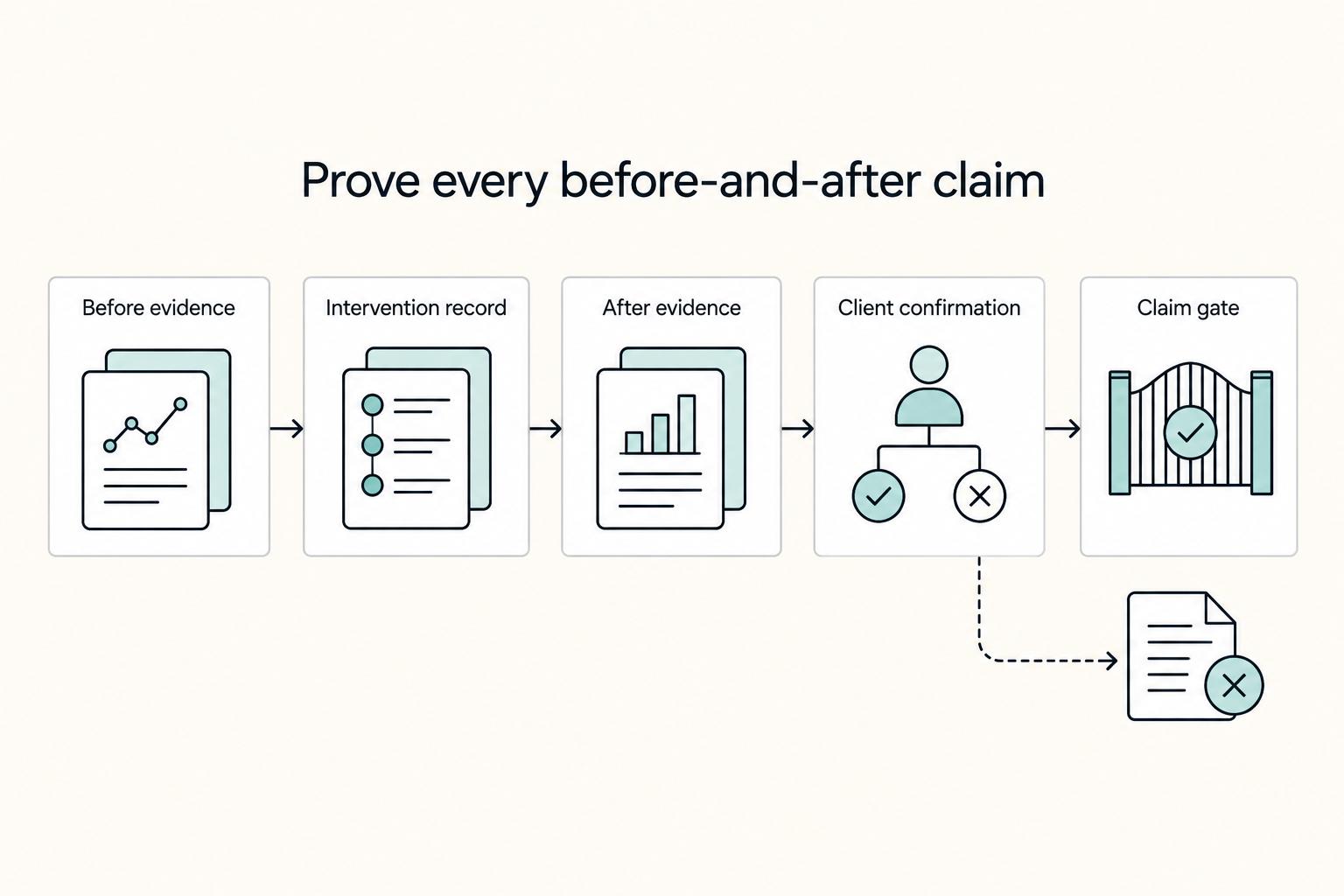
Build a before-and-after evidence checklist#
Use signals you can verify through records, approvals, direct observation, or client confirmation.
| Signal | Before | After | How to verify |
|---|---|---|---|
| Workflow quality | repeated revisions, unclear handoffs, unclear ownership, inconsistent deliverables | fewer revision loops, clearer approvals, cleaner handoffs, more consistent outputs | dated note, version history, approval message, or client-confirmed record |
| Decision speed | stalled approvals, repeated clarification meetings, slow signoff | faster approvals, fewer rounds to choose a direction, fewer review blockers | dated note, version history, approval message, or client-confirmed record |
| Error reduction | recurring corrections, rework, escalations, preventable misunderstandings | fewer fixes, fewer escalations, less backtracking | dated note, version history, approval message, or client-confirmed record |
For each before/after line, confirm you can point to a dated note, version history, approval message, or client-confirmed record.
Match your wording to your evidence#
Keep each sentence no stronger than the proof behind it.
| Evidence class | What qualifies | Confidence level | Reader-safe wording |
|---|---|---|---|
| observed | Changes you directly saw in drafts, process, approvals, or delivery | High | "We observed..." / "The process changed from X to Y." |
| client-confirmed | Outcomes or process changes the client verified in writing or review | Medium to high | "The client confirmed..." / "According to the client..." |
| inferred | Your interpretation of why a change mattered or what likely caused it | Moderate to low | "This suggests..." / "One likely explanation is..." / "A plausible interpretation is..." |
If you do not have direct analytics access, or the client has not verified a number, do not present that claim as settled fact.
Run a claim-review gate before you publish#
For each strong statement, answer three questions in writing: What happened? How do you know? What remains uncertain? Then decide:
| Decision | Use when | Evidence basis |
|---|---|---|
| Publish | the claim is observed or client-confirmed and traceable to current records | observed or client-confirmed; traceable to current records |
| Soften | the claim depends on interpretation, partial verification, or limited attribution | interpretation, partial verification, or limited attribution |
| Remove | you cannot tie it to a record, client confirmation, or clearly labeled inference | no record, client confirmation, or clearly labeled inference |
This gate keeps your case study persuasive without overstating what the evidence can support.
How Do You Protect Confidential Data and Still Sound Credible?#
You stay credible by showing your method, not by exposing private identifiers. Before you publish, review each line as a gate decision: if a claim depends on identity, account, or restricted compliance detail to sound convincing, redact it or remove it.
Classify each detail before you edit prose#
Start with a quick inventory of notes, screenshots, exports, and draft copy, then assign each item to one class.
| Class | What you can keep | What you must transform | What you must remove |
|---|---|---|---|
| Public | Problem type, workflow steps, broad timeline, anonymized outcomes | "Acme Corp" -> "a B2B SaaS company"; "Head of Ops" -> "operations lead" | Anything that is not actually public or not contract-safe |
| Masked | Role context, tool category, sequence of decisions | Names -> ID codes; exact dates -> broader time windows; exact location/deal detail -> generalized context | Combined details that could re-identify a person, client, or account |
| Prohibited | None in published copy | None | Names, Social Security numbers, credit card or other account data, and employee/customer personal identifiers |
Your standard is simple: the reader should understand what changed, but not be able to trace it to a specific person or account.
Separate safe process detail from restricted identifiers#
Safe to describe: what you reviewed, what was approved, what control changed, and how decisions were documented. Never publish: raw identifiers, payment-linked fields, or restricted source material.
If you need internal traceability while drafting, use ID-code substitution in working notes and keep the key outside the case study. If restricted files are moved, removed, or transmitted during review, keep them encrypted.
Run a pre-publish agreement check for every claim#
For each claim, screenshot, or excerpt, check the full governing set together: NDA, DPA, SOW, and any applicable program/reporting documents. If you reference a tax or reporting framework, keep wording process-level and neutral, for example: "Prepared reporting documentation under [framework] and validated it against the governing terms."
Then make one decision per item:
- Approve: evidence-backed, anonymized, and agreement-safe.
- Redact: useful logic, but identifiers or sensitive compliance detail need masking.
- Remove: cannot be published safely without confidential facts.
Turn One Case Study Into Website Proposal and Sales Call Assets#
Use one canonical case-study file as your source of truth, then repurpose it for each channel. That keeps your claims stable, avoids version drift, and makes it easier to move buyers forward with the right asset at the right stage.
Step 1. Govern one master file before repurposing. Keep your approved narrative, claim wording boundaries, and evidence labels in one place. If you use observed, client-confirmed, and interpretation, keep those labels visible on each meaningful claim.
Use a simple internal rule:
observed: supported by what you directly documented (notes, deliverables, screenshots, before/after records)client-confirmed: explicitly confirmed by the client in writing or interviewinterpretation: your reasoned explanation of why the result mattered
In downstream assets, anchor core claims to observed, add client-confirmed when client voice improves trust, and use interpretation only as context, not as sole proof for a key claim.
Step 2. Match asset format to buyer decision stage. One-pagers, case studies, proposal excerpts, and call prompts do different jobs. Keep proof depth and CTA intent aligned to that job.
| Asset type | Buyer decision stage | Required proof depth | CTA intent |
|---|---|---|---|
| One-pager or proof summary | Early, often after demo/discovery | Light to medium | Keep momentum and make internal sharing easy |
| Website case study page | Mid-stage evaluation | Medium to high | Move to the next relevant page or contact step |
| Proposal excerpt | Late-stage scope/risk review | High, decision-relevant proof | Confirm scope, constraints, or plan |
| Sales call prompts | Live objection handling | Selective, high-confidence proof | Secure next step or decision |
Keep one limit explicit: a single case study is one customer story, so do not present it as universal proof.
Step 3. Treat MoR, Virtual Accounts, and Payouts as optional inserts. Use these blocks only when they are relevant to the engagement and verified in your master file. If a module is not relevant to the engagement, leave it out.
Step 4. Add progression links and run a consistency check. Give each variant one next action that matches intent. For website flow, link naturally to How to Create a High-Converting Freelance Services Page. For proposal and call variants, ask for the next concrete decision.
Before publishing or sharing, compare variants side by side and verify five items match the approved source: problem, method, result, limits, and CTA. If any version claims stronger outcomes, broader scope, or more certainty than the canonical file, revise it first.
Common Mistakes and Recovery Moves That Save the Draft#
When a draft starts drifting, treat each mistake as a single recovery decision. Identify the failure, apply one fix, then verify the evidence before the line appears on your website, proposal, or sales call version.
Rebuild the decision trail when your story feels generic#
If your case study sounds polished but thin, you are probably hiding the decisions. You build trust when you show what triggered a choice, which option you took, and what tradeoff came with it.
Run this check on every major move in the story: trigger, choice, consequence. If one is missing, the proof point is not ready.
| Failure pattern (before) | Why trust drops | Recovery move (after) |
|---|---|---|
| You present results as a clean success arc with no hard choices | It reads like marketing language, not real work | Add the decision point: options considered, choice made, and risk managed |
| You highlight the near-term win and skip the likely cost | Readers sense a short-term fix with longer-term cost you are not naming | State the tradeoff directly, including what may be constrained later |
| You flatten a messy engagement into one tidy method | The narrative no longer matches how the work happened | Rebuild the timeline from source material and show the real sequence |
Do not discard messy inputs. A scattered pile of notes, screenshots, and partial drafts is still usable evidence inventory once you log what each item actually proves.
Validate every claim before you polish it#
Do not make unsupported lines sound better. For each meaningful claim, pick one action: substantiate, soften, or remove.
Substantiate when you can point to proof. Soften when the direction is fair but certainty is too strong. Remove when you cannot verify it without guessing. Then label each claim as observed, client-confirmed, or inferred before repurposing.
Treat raw, unedited AI output as draft material only. It can include incorrect content, formatting issues, broken links, or confident wording that outruns evidence. If a sentence sounds strong but has no source note, no approval trail, and no direct observation behind it, park it.
Run one publish gate for confidentiality and cross-border accuracy#
Before publishing, sort sensitive or context-heavy lines into exactly three buckets:
| Bucket | Criteria |
|---|---|
| State as fact | verified, non-identifying, and contextually accurate |
| State with qualification | depends on client wording, timing, local context, or inference |
| Remove or hold until verified | could identify the client, expose protected detail, or overstate a jurisdiction-specific point |
This gate keeps you from over-disclosing and from over-generalizing one market example into a universal claim. If you cannot safely disclose a single client, use a composite case study and say that clearly.
Keep a maintenance loop after approval#
Your draft can decay after publication as versions diverge. Prevent that with a short loop you actually run.
Keep a revision log with date, changed sentence, reason, and supporting source. Ask a non-subject-matter reader to flag anything unclear on first read. Then run a final consistency check across website, proposal, and sales-call versions so the problem, method, result, limits, and CTA still match the approved master.
If one channel sounds more certain than the others, fix that stronger claim first.
Related reading: How to Write a Good README for a Software Project.
Run the Audit Ready Checklist and Publish With Confidence#
Publish only after all five gates pass. Your final check is not just polish; it is proof, privacy control, and a clear audit trail of what you approved.
Use these five final gates#
Step 1. Set the publishing goal. State the reader, the decision this version should support, and the asset type (website, proposal, or sales call). Pass when: You can capture all three in one line.
Step 2. Verify meaningful claims against records. Review the draft line by line and match each important claim to notes, emails, screenshots, exports, or direct observation, then keep that mapping in your working trail. Pass when: Each key claim is substantiated, softened, or removed.
Step 3. Confirm permissions and privacy controls. Re-check what is approved to share, then remove or generalize details that could identify the client beyond that approval. Pass when: Shared details match approval scope, and sensitive details are masked or cut.
Step 4. Run readability with internal and outside review. Use internal review to catch gaps, then add an outside reviewer for an unbiased read before finalizing length and read-time fit. Pass when: A fresh reader can follow the problem, choice, and outcome without clarification.
Step 5. Check publish and promote consistency. Compare your website version, proposal excerpt, and sales summary against the same approved master before distribution. Pass when: Facts, caveats, and confidence level match across every channel.
| QA gate | Common failure signal | Recovery move |
|---|---|---|
| Goal | The section is clear but does not help a decision | Rewrite the opening around one reader and one decision |
| Claims | Strong outcomes appear without supporting records | Add record mapping, soften certainty, or remove the line |
| Permissions and privacy | A detail can still identify the client | Mask, generalize, or replace the detail |
| Readability | Internal reviewers follow it, outside readers do not | Use outside review feedback and tighten transitions |
| Publish and promote | One channel sounds more certain than another | Re-align all variants to the approved master |
Publish only when claims, confidentiality controls, and cross-channel consistency all pass. If you want help adapting that approved master into client-facing assets without changing the facts, read A Guide to Using Case Studies to Win Freelance Clients.
Frequently Asked Questions
What is the best structure for a case study?
Start with a brief opening that states the problem and the outcome in 1 to 2 sentences, then move through problem, process, and results. In the process section, show the key choice points and, where relevant, why alternatives were rejected or not feasible. If a detail does not connect to the solution or to the measurement you are discussing, cut it.
How long should a case study be for freelancers?
Use the shortest version that still lets a reader understand the problem, your method, and the result. A case study is often no more than a few pages, but do not turn that into a rigid rule because requirements can vary by context and discipline.
Should I focus more on the problem, process, or results?
Keep all three, then shift emphasis based on the decision your reader needs to make. If they need to judge your thinking, expand the process and include alternatives with pros and cons. If they mainly need a faster read, keep the setup tight while still showing the core problem, approach, and outcome.
How can I write a case study if I do not have strong metrics?
Use qualitative proof, but state uncertainty plainly. Tie each important line to evidence you can point to from your analysis notes and highlighted facts. If you cannot support a sentence as a hard result, qualify it or remove it.
How do I get client permission and still protect confidential details?
Do not assume there is a single permission workflow. Treat the client, publisher, or program requirements as controlling, and include only details you are clearly allowed to share. When in doubt, generalize identifying specifics and keep the focus on the problem, choices, and outcome.
How do I validate claims before publishing?
Annotate before you polish. Take notes, highlight relevant facts, underline key problems, and identify who or what is responsible. Finish by checking for gaps or inconsistencies, then read the draft out loud because inconsistencies are often easier to hear than to spot on screen.
How can I repurpose one case study for my website, proposals, and sales calls?
Do not assume there is a prescribed channel-specific template. If you repurpose one case study, keep the underlying facts consistent and adapt the format to each brief or context. If you want examples of packaging options, read A Guide to Using Case Studies to Win Freelance Clients.
What if a client, publisher, or program wants a different format?
Treat their brief as the controlling format requirement, because case study expectations change by context and discipline. Keep your evidence pack the same, but rearrange the presentation to match the requested structure. That way you stay flexible on format without getting loose on proof.
Try a related tool
Researched and edited by the Gruv editorial team. Gruv builds cross-border billing, payouts, and finance-operations software for global businesses.
Sources
- cdc.gov/nceh/clearwriting/case_study_guide.htmltrusted
- communicate.gse.harvard.edu/file_url/256trusted
- digitalcommons.odu.edu/cgi/viewcontent.cgitrusted
- dot.ca.gov/programs/environmental-analysis/standard-env...trusted
- fema.gov/sites/default/files/2020-07/Continuity-Risk-...trusted
- ftc.gov/business-guidance/resources/protecting-perso...trusted
- home.treasury.gov/system/files/136/SLFRF-Compliance-and-Report...trusted
- irs.gov/pub/irs-pdf/p1075.pdftrusted
Educational content only. Not legal, tax, or financial advice.
Related Posts

Georgia 1% Tax for Entrepreneurs Without Filing Surprises
Treat Georgia's 1% tax path as a compliance question first and a rate discussion second. The goal is a setup you can defend under review, not a shortcut that fails at filing time.

Use Case Studies to Win Better-Fit Freelance Clients
The point of case studies is not to sound impressive. It is to help a buyer approve you faster by lowering the risk they feel when hiring an outside specialist. When your proof is vague, scattered, or hard to verify, clients often default to someone whose work feels easier to trust.

How to Create a High-Converting Freelance Services Page
If you want fewer renegotiation loops, treat your page as a qualification tool, not a polished brochure. The goal is not more inquiries for their own sake. It is fewer vague inquiries that turn into messy delivery.