
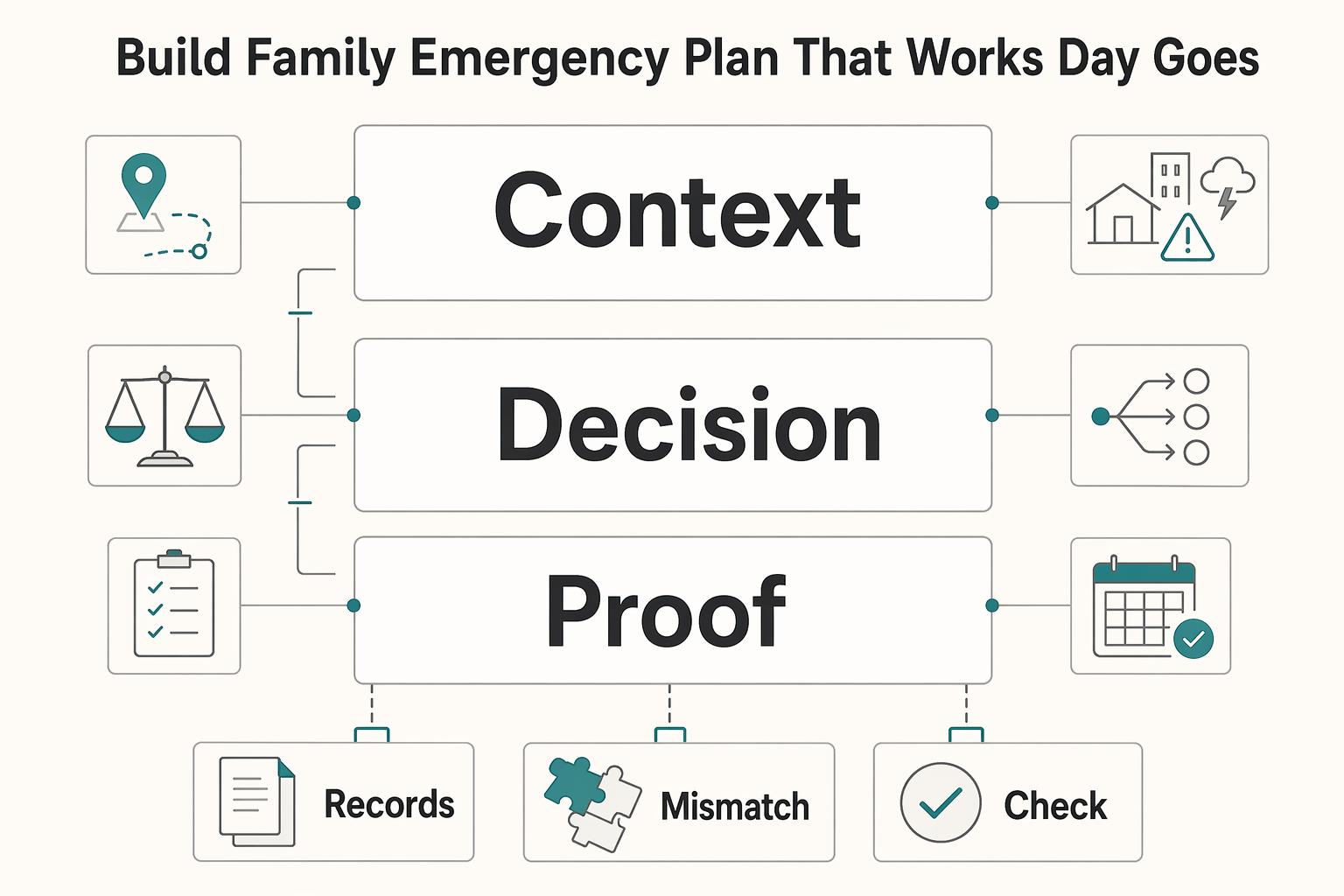
Quick Answer
Start by creating a family emergency plan with five concrete decisions: alert source, shelter rule, evacuation route, communication order, and reunion points. Put those choices in a Household Emergency Plan Template, then add role owners, backups, and essential records so someone else can act if you are unavailable. Use official warnings from local authorities to switch between sheltering and evacuation, and verify the plan with a timed drill instead of assuming it will work.
Build a family emergency plan that works when your day goes sideways#
You do not need a big preparedness project to protect your household and your client work. You need a usable first draft you can build in a focused sitting, then keep current with short check-ins so it still works when a normal day suddenly stops being normal.
That pressure is sharper if you work for yourself. An emergency does not just interrupt family life. It can break your routine, cut off communication, and put delivery commitments at risk at the same time. If a child needs pickup, a building has to be evacuated, or local conditions make travel unsafe, you are making home decisions and business decisions in the same hour. A good family emergency plan cuts that pileup by turning guesswork into a few clear choices.
The scope here is narrow on purpose. This guide covers concrete household decisions and documentation. It focuses on who to contact, where to meet, when to leave, when to shelter, what records to keep handy, and who handles which action if you are working, traveling, or unavailable. It is not a broad discussion of disaster theory, institutional response, or legal rights. That matters because vague preparedness advice often feels useful until you actually need it.
There is also a practical reason to write things down instead of assuming you will figure it out live. Ready.gov guidance notes that in some disasters, professional help may be delayed for hours or even days. That does not mean you should plan like a responder. It means your household should be able to make the first decisions without waiting for perfect conditions or perfect information.
Use public guidance as your baseline, not as background reading you admire and never apply. For example, a Ready.gov emergency-planning guide says its views represent the collective expertise of the federal agencies issuing it. At the same time, public guidance is still guidance. Ready.gov's CERT material says it is informational and not legal advice, so keep your plan practical and local instead of treating it like a compliance document.
One early recommendation matters more than it sounds. Do not let the plan live only in your head or only in one app on one phone. That is a common failure point. Before you move on, make sure at least one other adult or trusted contact can open the document, and verify that your household knows where the latest copy lives. If nobody else can find it without calling you, the plan is not ready.
From here, the work is simple. Gather the facts you will actually use, make the key decisions in plain language, and keep the document light enough that you will update it.
For a step-by-step walkthrough, see How to Create a Meal Plan to Save Time and Money.
What to prepare before you start#
Prepare one working set before you draft: one document based on a Household Emergency Plan Template, plus the records and settings you will use to make decisions.
Ready.gov frames Step 1 as putting a plan together by discussing key questions, including how your household will receive emergency alerts and warnings, and how you will contact one another and reconnect if separated. Start from your current family emergency communication plan so you can update it directly instead of rebuilding from memory.
Gather these items first:
- your current communication plan
- IDs you may need to reference
- insurance contacts
- a current medication list
- key local numbers for Emergency Management, EMS, and law enforcement
- local radio stations and local television alert channels your household would check
- each person's emergency alert and warning settings on their phone
If time is tight, finish contact and evacuation decisions first, then fill in secondary details.
Step 1 set your risk triggers for sheltering or evacuating#
Make this decision rule explicit now: follow official emergency alerts and warnings for whether your household evacuates or shelters in place. If official instructions are to evacuate, use your evacuation route. If travel is unsafe or officials direct people to stay indoors, activate your shelter plan.
Write one trigger rule your household can execute fast#
Keep it short and assign roles so action does not depend on debate.
"Primary trigger source: local Emergency Management and official emergency alerts and warnings. If instructions say evacuate now, we evacuate. If travel is unsafe or instructions are to stay indoors, we shelter at Home Location 1."
Set:
- One primary person to confirm the trigger source
- One backup if that person is unavailable
- A verification check (not a vote)
Set two reunion points, not one#
Ready.gov notes that families may be separated in a disaster and should plan how to reconnect. It also recommends a meeting place that is familiar and easy to find. Use both:
- A nearby meeting point if local access is still open
- An out-of-neighborhood meeting point if roads or access fail
Be specific about each location so no one has to guess under stress.
Add hazard notes and action owners#
Use brief, risk-informed notes tied to a named person for each scenario.
| Scenario | Trigger note | Action owner |
|---|---|---|
| Fire | If official alerts direct evacuation, evacuate. If officials direct sheltering or travel is unsafe, shelter. | Name primary + backup |
| Severe weather | If official warnings direct sheltering or travel is unsafe, shelter. If official alerts direct evacuation, evacuate. | Name primary + backup |
| Earthquake | If travel is unsafe, shelter first and monitor official instructions. If authorities advise evacuation, switch to evacuation. | Name primary + backup |
Set three checkpoints in the plan:
- Who confirms the trigger from local Emergency Management or official alerts
- Who sends the first family message
- Where status is logged (one shared place with name, time, location, and condition)
Step 2 build a communication tree that survives device and network failure#
Build a fixed contact sequence now so your household can act without debating channels during an incident.
Write the contact order in tiers#
Use one shared order and keep it short:
| Tier | Use when | Action |
|---|---|---|
| Primary phone | First contact attempt | Try each person's main number first |
| Backup app | If phone contact fails | Switch to one preselected messaging app |
| Out-of-area contact | Next escalation step | Send status to one person outside your immediate area who can relay updates |
| Offline fallback | If direct contact is still unreliable | Switch to your reunification rule and follow local official updates, including local radio or local television if that is part of your plan |
- Primary phone
Try each person's main number first.
- Backup app
If phone contact fails, switch to one preselected messaging app.
- Out-of-area contact
Send status to one person outside your immediate area who can relay updates.
- Offline fallback
If direct contact is still unreliable, switch to your reunification rule and follow local official updates (including local radio or local television, if that is part of your plan).
Set the no-reply switch rule#
Define the response window in advance. If there is no reply by that window, stop repeated contact attempts and move to your reunification protocol at the predefined location. Use different windows only when the scenario clearly justifies it.
Assign owners and protect the shared copy#
Assign message ownership so one missed call does not stall decisions:
- One owner for children and school/caregiver coordination.
- One owner for older relatives or anyone needing extra check-ins.
- One owner for pet coordination.
Name one backup for each owner. In shared copies, keep only the personal details needed to act, and avoid unnecessary sensitive identifiers (for example, full Social Security numbers).
Choose format redundancy on purpose#
Decide how you will maintain both speed and resilience: digital access for day-to-day use, plus a printed backup for outage conditions. Before moving on, run one quick test: if one person loses their phone, can everyone else still follow the order and reunify without extra instructions?
Step 3 build your household evidence pack and go-bag list#
Build this step as two linked pieces: one evidence pack for critical details, and one portable bag for supplies you can carry out quickly. Keeping records and supplies separate makes updates easier and reduces delays when you need to act fast.
Start with the pack, then build the bag. The pack is the shared reference someone else can use under stress. The bag is the physical kit.
Build one pack someone else could use#
Make the pack readable and usable by another adult if you are unreachable. Include the practical details your household already relies on, such as:
- medical assistance contacts, current medication details, and first aid instructions you already use
- notes on emergency medical supplies, including what stays at home and what goes in the portable bag
- insurance and claim contact paths your household may need
- pet records and transport details your household may need
Use a simple test: could another person use this pack to make key calls, explain medication needs, and move people or pets without guessing? If not, tighten it until the next action is obvious.
Keep one kit baseline, then add household-specific needs#
Use one clear baseline: prepare to manage on your own for at least three days, with two kits, one for staying put and one portable kit for leaving quickly. For water, plan at least one gallon per person per day, and account for cases where children, nursing mothers, or sick people may need more. For food, store at least a three-day supply of non-perishable items.
Prioritize water, food, and clean air first, then add a first aid kit for common emergency injuries like cuts and burns. If you already use an American Red Cross emergency kit checklist, use it to supplement this baseline, not replace it.
For short disruption windows, pack hygiene items and other household-specific essentials only to the level you can realistically carry and use. Before finalizing, lift the bag. If it is too heavy to move quickly, it is not yet a practical portable kit. Then date the pack and set review triggers for major household changes.
Related reading: How to Plan a Multi-Day Hiking Trip.
Step 4 assign role ownership for home days, office days, and travel days#
Your plan is usable only when each role has a clear owner. Assign one primary and one backup for each role, then set ownership by scenario so home days, office days, and travel days do not rely on the same person by default.
Ready.gov's core warning is practical: your family may be separated during a disaster, so reconnection has to be planned in advance. That is why role ownership should follow real-world availability, not job titles inside the household.
Match roles to the day, not just the household#
Keep the same role list across scenarios, and only switch who owns each role.
| Role | Home day owner | Office day owner | Travel day owner | Verification note |
|---|---|---|---|---|
| Children or dependent care | Primary adult at home | Closest available adult or caregiver | Pre-assigned proxy | Confirm care handoff and reunion plan |
| Evidence pack and key documents | Adult nearest storage location | Adult returning home first | Proxy with access instructions | Confirm pack location and shared access |
| Neighbor coordination | Person with strongest local contact | Same, unless unreachable | Proxy or nearby relative | Confirm one working contact method |
| Household access information for responders | Adult on site | Adult who can relay entry details | Proxy with entry notes | Confirm access instructions are current |
Use one quick test: can the backup do the job without calling the primary for missing details? If not, the role is not fully assigned yet.
Build in whole-community planning#
Role ownership should explicitly include children, people with access and functional needs, and households with pets or service animals. That follows whole-community planning principles and the expectation that families and caregivers are active partners, not afterthoughts.
Avoid assigning critical tasks to "everyone." Name one decision-maker and one backup so action starts quickly under stress.
Add a work-side trigger if you freelance#
When family safety actions begin, your business needs a lightweight bridge. Decide who sends a short client update, who pauses active deadlines, and what backup operation starts while household actions are underway.
If you travel often, pre-assign a proxy and document handoff rules in the same file as your contact list. Note when proxy control starts, how they access the current plan, and which decisions they can make immediately. For the business side, pair this step with your separate disaster recovery plan for your freelance business.
For the business continuity side, see How to Create a Disaster Recovery Plan for a SaaS Business.
Step 5 run a 20-minute drill and fix failure points immediately#
Test the plan as a short, timed sequence, then fix gaps while they are fresh. The goal is not a perfect performance. The goal is to expose where your Household Emergency Plan Template is unclear, outdated, or missing details.
Run the drill in order with one person prompting each step:
- Alert received
Start from a realistic alert scenario. Confirm the person on duty can identify the alert and state the first action.
- Decision made
Make a clear choice: shelter or evacuate. Treat debate caused by missing facts as a planning gap to fix, not as a failed drill. Your plan should guide action but still be adaptable to the real situation.
- First communication sent
Send the first real message, or draft the exact message text. Confirm who gets contacted first, which channel to use, and when to switch to a backup method.
- Reunification confirmed
Finish only when everyone can state the primary meeting point, backup meeting point, and who confirms arrivals.
Use a simple score after each run:
| Check | What good looks like | Red flag |
|---|---|---|
| Speed | Key actions happen without long pauses | People stop to search for numbers, addresses, or instructions |
| Clarity | Owners know who decides and what happens next | Two people assume the other is acting |
| Missing information | The template includes usable, specific details | A field exists, but the detail needed in the moment is missing |
Capture failure points explicitly. Common examples include outdated phone numbers, unclear meeting points, incomplete medical assistance details, missing pet transport notes, or a backup owner who cannot find key plan materials.
Patch the plan the same day when possible: update the template, add a visible review date, and replace old copies (shared folder and common-area print copy). Keep the plan easy to access and review it periodically for accuracy. Set the next household quiz now, using a six-month cadence to keep everyone ready.
Common mistakes that make plans fail and how to recover#
Plans usually fail in predictable ways: no ownership, vague actions, unverified details, and no bridge to your work communication.
| Mistake | Recovery |
|---|---|
| The plan is a one-time file | Assign a visible owner and next update |
| Steps are too vague to use under stress | Turn them into clear decision rules |
| The checklist looks good but has not been tested | Verify with real actions |
| The household plan and work reality are disconnected | Add one short client-update protocol |
- Mistake: the plan is a one-time file. Recovery: assign a visible owner and next update.
Preparedness guidance treats maintenance as part of the plan, so add one clear line for who updates it next and where the current copy lives. Then verify the basics: can that person open the latest version and confirm key contact details are current?
- Mistake: steps are too vague to use under stress. Recovery: turn them into clear decision rules.
Replace phrases like "stay safe" or "leave if needed" with short trigger-based instructions tied to alerts and warnings. If people debate wording instead of taking action, the step still needs to be rewritten.
- Mistake: the checklist looks good but has not been tested. Recovery: verify with real actions.
Outdated plans and inaccurate contacts are a common weakness, so each drill should include at least one real contact attempt and one real movement decision. If a number fails, treat it as wrong until fixed. If two people assume the other is deciding, clarify leadership roles.
- Mistake: the household plan and work reality are disconnected. Recovery: add one short client-update protocol.
After the household decision, send one brief message with the reason for delay and when the next update will come. Keep it short so it supports the plan instead of competing with it.
Your copy-paste checklist for the next 60 minutes#
Treat this as an execution block: leave with a completed plan, verified essentials, and one drill logged.
| Task | What to complete |
|---|---|
| Lock the five core decisions first | Write your alert source, shelter trigger, evacuation route, communication tree, and reunion locations in plain language |
| Complete contacts before checking supplies | Fill in current contacts for EMS, law enforcement, local Emergency Management, insurance, and medical support, and add where your important records are stored |
| Pack and verify essentials | Review your emergency preparedness kit and confirm first aid items, medications, and emergency medical supplies are available where your plan says they are |
| Assign owners and backups by scenario | For home, work, and travel situations, assign a primary owner and a backup for key actions and include who handles work-continuity communication if needed |
| Run one short drill now, then update immediately | Trigger a simple scenario, make the shelter-or-evacuate call, send the first message, confirm reunification steps, and fix failures before you end the session |
- Lock the five core decisions first.
In your Household Emergency Plan Template, write your alert source, shelter trigger, evacuation route, communication tree, and reunion locations in plain language. Keep each line action-ready so anyone in the household can follow it under stress.
- Complete contacts before checking supplies.
Fill in current contacts for EMS, law enforcement, local Emergency Management, insurance, and medical support. Add where your important records are stored so they can be found quickly; FEMA's EFFAK is built around organizing and securing key documents.
- Pack and verify essentials.
Review your emergency preparedness kit using a checklist format, then confirm first aid items, medications, and emergency medical supplies are actually available where your plan says they are. If you have pets, include species, license number, microchip number, and veterinarian details.
- Assign owners and backups by scenario.
For home, work, and travel situations, assign a primary owner and a backup for key actions (dependents, meds/documents, pet transport, first status message). Set roles in a way your household can realistically execute, and include who handles work-continuity communication if needed.
- Run one short drill now, then update immediately.
Trigger a simple scenario, make the shelter-or-evacuate call, send the first message, and confirm reunification steps. Log every failure in the same document and fix it before you end the session so the plan stays current.
Related: A Freelancer's Guide to the US-Australia Tax Treaty.
Frequently Asked Questions
What are the five essential parts of a family emergency plan?
A practical five-part structure is: how you receive emergency alerts and warnings, how you contact each other if separated, where you reunite, which local emergency response resources and information channels you rely on, and how you document and maintain the plan. This is not a universal legal checklist, but it aligns with the core planning elements in public guidance.
What information should be documented in a household emergency plan template?
Start with names, phone numbers, contact steps, and a family meeting place that is familiar and easy to find, since Ready.gov notes your family may not be together if a disaster strikes. Then add local emergency response resources such as fire, EMS, and law enforcement, plus the local radio and television sources you will use for updates. Include medical-readiness items like first aid and emergency medical supplies, pet details such as species, license number, microchip number, and veterinarian information, and the fields for "Date Plan was updated" and "Next scheduled plan update."
How should a family decide between sheltering in place and evacuation?
Use official emergency alerts and warnings and directions from local authorities in the moment, and make sure your plan clearly states where your household will check for those instructions first.
How often should we review and update our plan?
Use the update fields in the household template as your baseline discipline: record when the plan was updated and set the next scheduled update. Any time key contact, pet, or medical details change, revise the plan and refresh those fields so the document stays current.
How do we adapt the plan for children, pets, and medical needs?
Keep children’s instructions short and concrete: where to go, who picks them up, and who they contact if separated. For pets, document the exact identifying details the template asks for, especially species, license number, microchip number, and veterinarian information. For medical needs, record first-aid readiness and the emergency medical supplies your household needs on hand.
What should independent professionals include so client work can continue during a family emergency?
Add a small continuity section focused on continuation of essential functions, and tailor it to your real work requirements. In practice, that means naming who sends client updates, what can pause immediately, where current deadlines and key files are tracked, and what your next update promise will be. If your household plan is solid but your client communication plan is missing, you can still create avoidable business fallout.
Try a related tool
Researched and edited by the Gruv editorial team. Gruv builds cross-border billing, payouts, and finance-operations software for global businesses.
Sources
- bannockcounty.gov/wp-content/uploads/2021/11/Family-Emergency-...trusted
- cdph.ca.gov/Programs/EPO/Pages/PrepareanEmergencySupplyK...trusted
- clark.wa.gov/sites/default/files/dept/files/public-health...trusted
- dhs.gov/prepare-my-family-disastertrusted
- dph.illinois.gov/content/dam/soi/en/web/idph/publications/idp...trusted
- fema.gov/sites/default/files/2020-06/apa_planning-for...trusted
- fema.gov/sites/default/files/2020-07/developing-maint...trusted
- in.gov/health/files/AHLAEmergency_Preparedness_Chec...trusted
Educational content only. Not legal, tax, or financial advice.
Related Posts
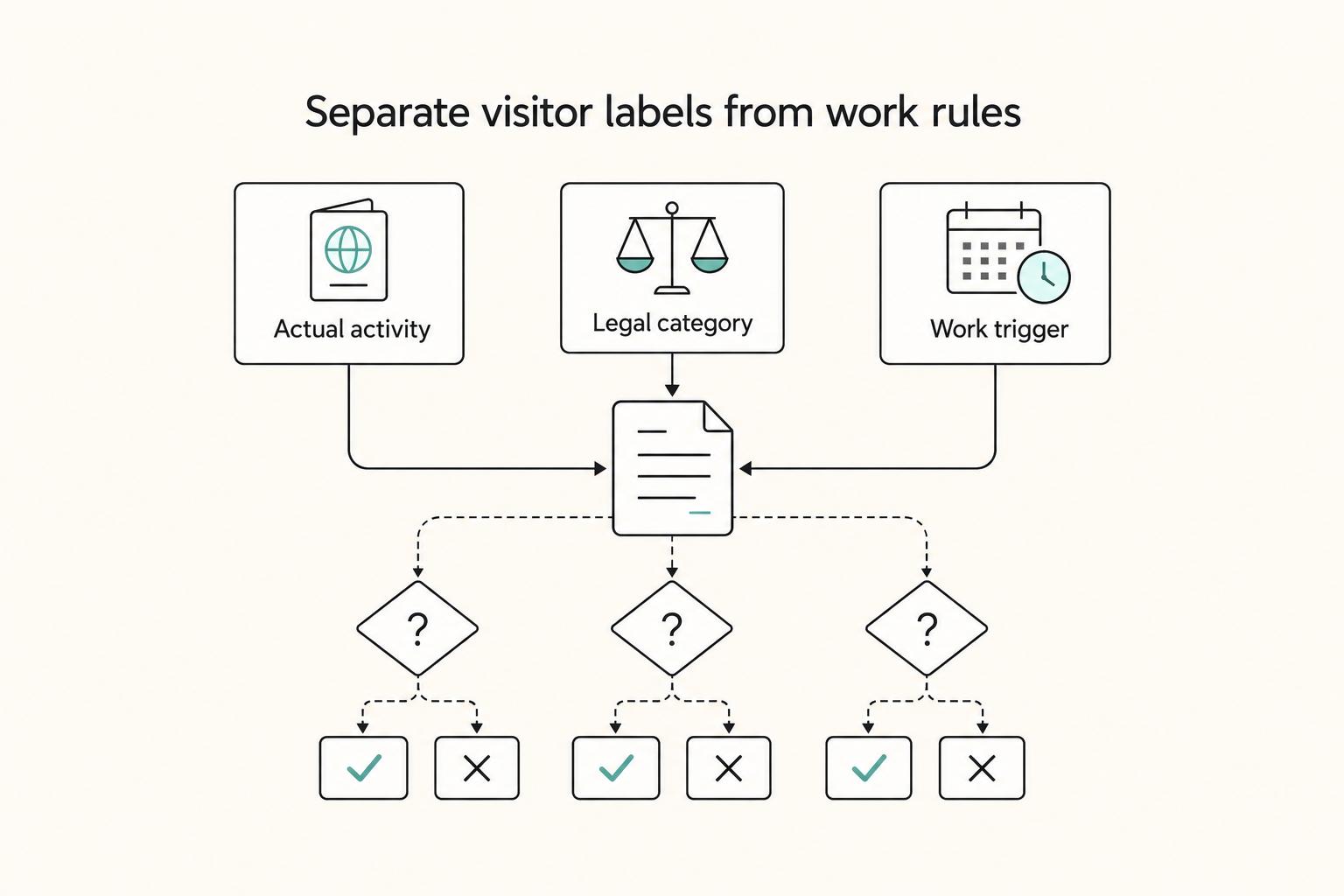
Canada Digital Nomad Visa Planning for Visitor Status and Work Permits
The phrase `canada digital nomad visa` is useful for search, but misleading if you treat it like a legal category. It is shorthand for existing Canadian status options, mainly visitor status and work permit rules, not a standalone visa stream with its own fixed process. That difference is not just technical. It changes how you should plan the trip, describe your purpose at entry, and organize your records before you leave.
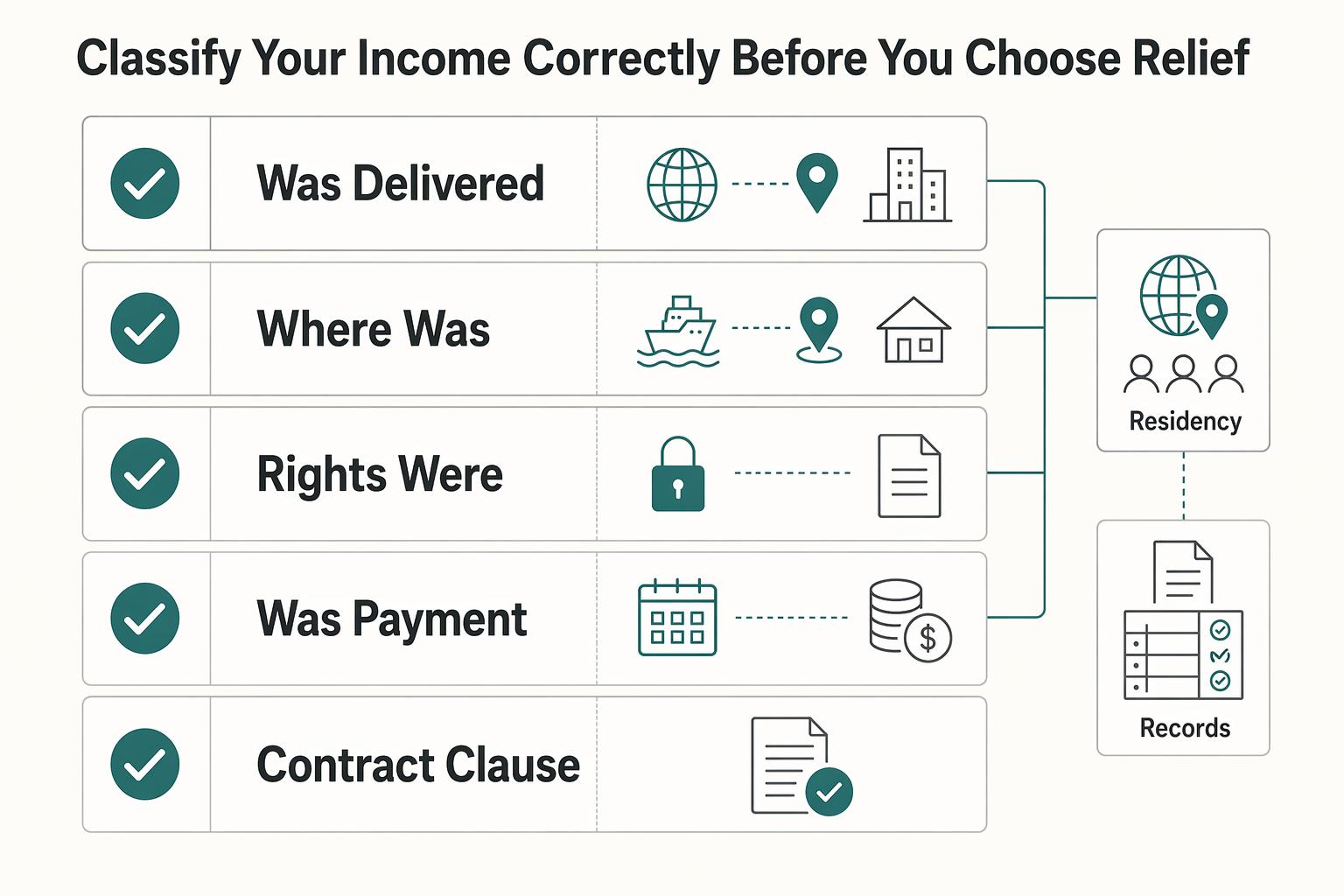
A Freelancer's Guide to the US-Australia Tax Treaty
If you freelance across borders, a defensible tax position is usually the fastest route to a clean filing. The order matters: lock down the facts, test the treaty treatment, then map the filings and relief choices. If you reverse that order, it is easy to optimize for an answer that falls apart once someone asks for support.
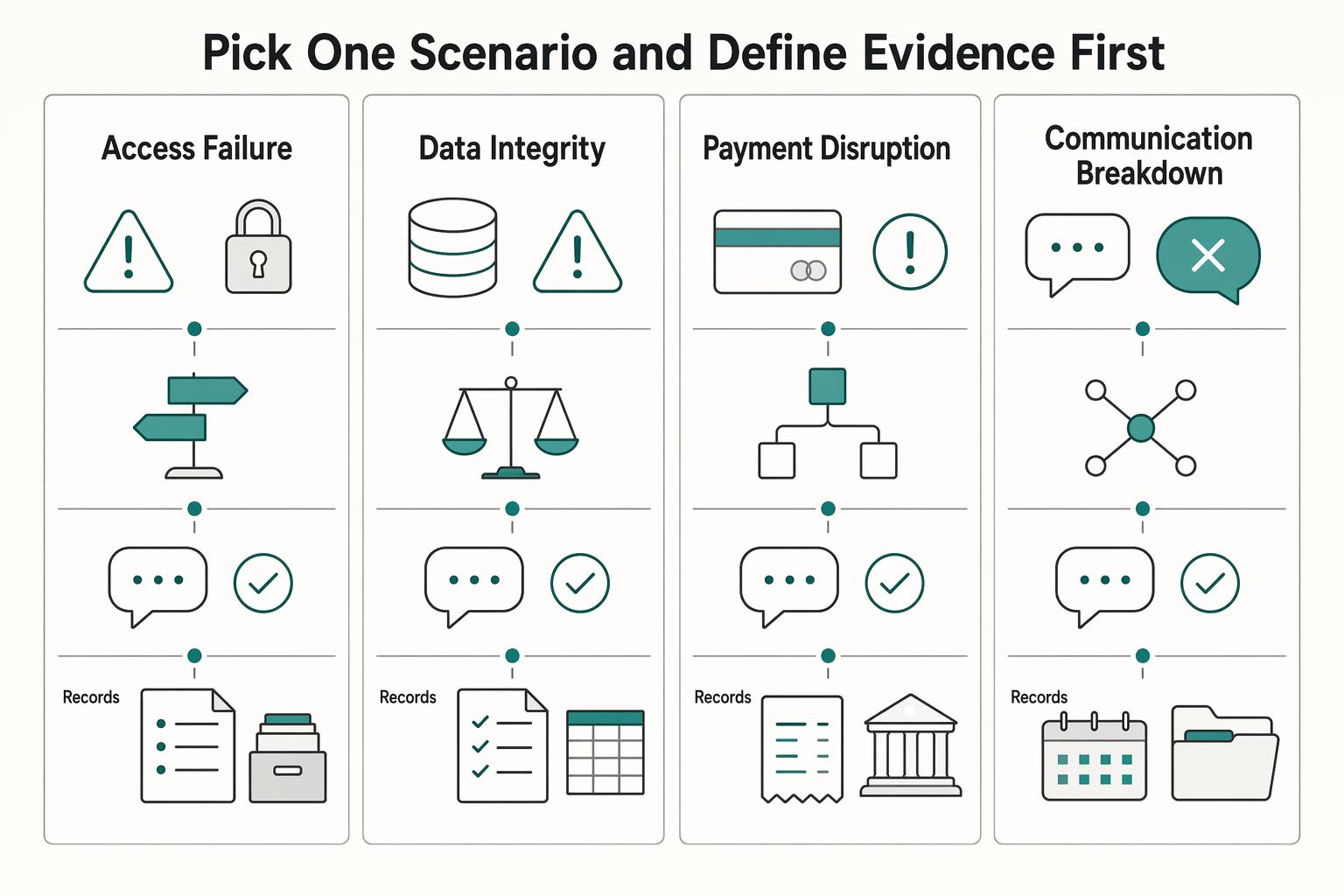
How to Create a Disaster Recovery Plan for Your Freelance Business
Build this as a baseline to create a freelance disaster recovery plan you can run under pressure: clear recovery targets, a restore order, client-ready messages, and one restore proof record. This helps reduce improvisation during an outage.