
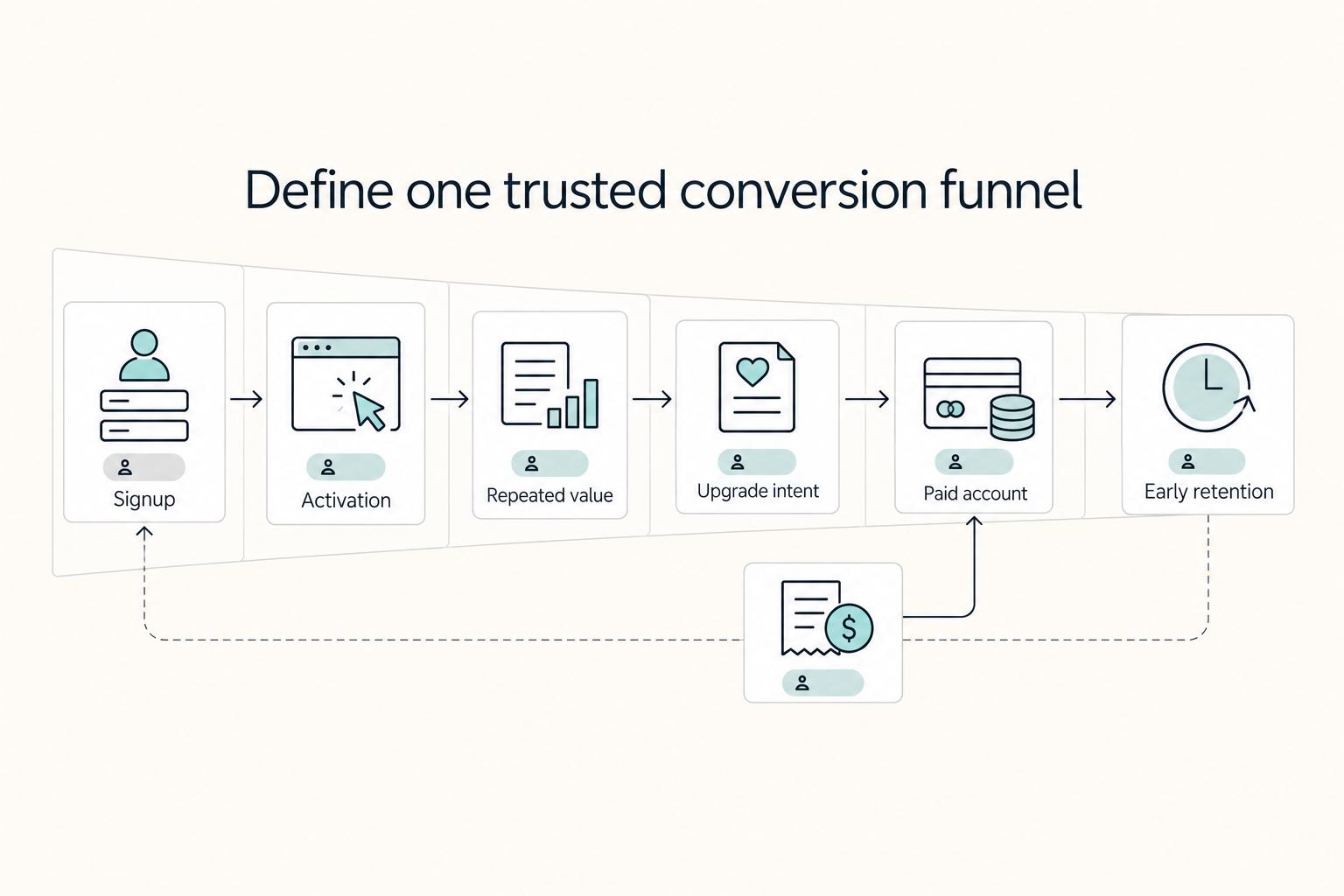
Quick Answer
Start by treating freemium to paid conversion funnel platform implementation as an operating decision across product, finance, and revenue, not a pricing-page edit. Lock Free tier and Premium tier boundaries in writing, pick one trigger model per segment, and instrument stage events from signup through early retention. Then run preregistered tests with explicit rollback rules. Scale only after upgrade lift, retention quality, and unit economics all hold together.
Map the Free-to-Paid Funnel#
Treat freemium as an operating choice, not a pricing page edit. A strong freemium to paid conversion funnel platform implementation starts with shared judgment across product, finance, and revenue. Align on what the free user must be able to accomplish, what the paid buyer is actually purchasing, and which numbers will decide whether the model is healthy.
That matters because freemium conversion is easy to describe and easy to misread. On the surface, it is just moving users from a free tier to a paid subscription. In practice, the harder job is making sure the free tier creates real initial value without giving away so much that the premium tier stops feeling like a meaningful upgrade. If free users never reach first value, you do not have a conversion problem yet. You have a product access problem.
The focus here is B2B platform execution, where package boundaries, sales assist, and margin discipline all affect the outcome. That is different from copying advice from YouTube explainers or lifting subscription tactics from the App Store and Google Play without direct B2B validation. Mobile is a huge market with its own logic. Global in-app purchase revenue across iOS and Google Play reached $150 billion in 2024, up 13% year over year, which is exactly why those norms can distort platform decisions rather than clarify them.
The rest of this guide follows a simple path. First, define the free tier and premium tier around real customer value, not internal preferences or arbitrary limits. Then test whether the upgrade path produces durable economics, not just a prettier dashboard. Unit economics means looking at revenue and cost on a per-unit basis. Your checkpoint is not only "did users upgrade?" but also "did they retain, did support cost stay sensible, and does the paid motion still make financial sense by segment?"
One verification rule will show up throughout: product analytics and finance reporting should reconcile on the same upgrade events and timing before you scale anything. If those views disagree, pause. A common failure mode is treating a conversion lift as success before retention and unit economics confirm the gain. The current SaaS environment rewards efficient product-led growth and better operations, not growth at any cost. That is why this guide treats conversion quality, retention, and margin as one package, not as separate conversations.
If you keep that lens, the next decisions get clearer. Your job is not to force more users through a paywall. It is to design a free-to-paid path that both the product team can defend and the finance team can sign off on.
Related: Reverse Trials for B2B Platforms: Why Giving Full Access First Converts More Paid Accounts.
What to prepare before you change pricing#
Do not change pricing until you have three controls in place: a shared baseline, trustworthy instrumentation, and written decision rights. Without those, you cannot tell whether any conversion lift is real, durable, or margin-positive.
| Control | What to set up | Key detail |
|---|---|---|
| Shared baseline | Build one baseline document and treat it as the source of truth | Map current freemium funnel stages, owner by stage, and known friction points from free use to paid intent |
| Evidence pack | Combine activation behavior, upgrade paths, sales-assist touches, and recurring support-ticket themes | Validate core events with event name, timestamp, and distinct ID, and keep taxonomy stable enough for period-over-period comparison |
| Decision rights | Set decision rights in writing with a RACI-style matrix | Product owns in-app experience, pricing/revenue owns package boundaries, and finance signs off on margin and payback assumptions |
| Comparison guardrails | Set comparison guardrails before benchmarks enter the room | Pressure-test any benchmark against your buyer, contract motion, and conversion path |
- Build one baseline document and treat it as the source of truth.
Map your current freemium funnel stages, owner by stage, and known friction points from free use to paid intent. Use the same document as your tracking strategy: for each stage, define the event name, required properties, and open instrumentation gaps. If ownership or stage definitions are unclear, fix that before pricing tests.
- Pull an evidence pack before debating packages or price points.
Combine activation behavior, upgrade paths, sales-assist touches, and recurring support-ticket themes. Then validate event integrity: core events should be captured consistently with event name, timestamp, and distinct ID, and your taxonomy should be stable enough for period-over-period comparison. If those checks fail, treat results as directional, not decision-grade.
- Set decision rights in writing.
Use a RACI-style matrix so responsibilities are explicit before launch. A practical split is often: product owns in-app experience, pricing/revenue owns package boundaries, and finance signs off on margin and payback assumptions. The exact split can vary; the requirement is clear accountability.
- Set comparison guardrails before benchmarks enter the room.
In B2B, many buyers prefer a rep-free path, but pricing design still needs both product-led and human-assisted routes where they improve outcomes. Do not import mobile subscription norms, including iOS, or creator-style examples like CodeLucky as your default pricing logic for B2B SaaS. Pressure-test any benchmark against your buyer, contract motion, and conversion path.
If you want a deeper dive, read The Freemium-to-Paid Conversion Guide for Platform Operators.
Define free tier value and premium upgrade boundaries#
Set your free and paid boundaries in writing before you change price. If free users cannot reach first meaningful value on their own, demand gets blocked too early. If paid value is only more volume, upgrade intent will stay weak.
Write the Free tier contract#
Create a one-page Free tier contract that states the core outcome, the limits users will hit, and what stays usable without sales.
Use public plans as clarity checks, not templates. Dropbox Basic pairs a usable outcome with a hard limit (2 GB). Zapier's Free plan does the same with an operational cap (100 tasks per month). The point is simple: users should understand both value and boundary up front.
Your Free tier contract should answer:
- What job can a new account complete end to end?
- What exact cap creates upgrade pressure later?
- What must remain self-serve so buyers can evaluate without rep help?
Verification point: review product data and support threads together. If free users stall before useful value or need manual help to get there, free scope is too narrow.
Write the Premium tier contract#
Create a separate one-page Premium tier contract for advanced outcomes, reliability controls, and operational capabilities buyers will pay for.
Be explicit about differentiated paid value. More seats, storage, or usage can belong in paid packaging, but volume alone is often not enough to justify price expansion. Paid value should map to stronger control, lower operational risk, or team-level outcomes.
Verification point: check whether a finance, ops, or team lead would see the paid tier as solving a broader business need, not just removing a cap.
Pressure test both contracts#
Pressure-test both contracts against real buying behavior. Gartner reported on June 25, 2025, that 61% of B2B buyers prefer an overall rep-free buying experience, so free must stand on its own. Gartner also warns that self-service digital purchases are more likely to lead to purchase regret, so paid upgrade decisions still need clear context.
Use this rule:
- If users cannot reach value alone, expand free scope.
- If paid value is only extra volume, add differentiated paid capabilities before raising price.
Use Dropbox and Zapier as clarity checks: do your limits read as plainly as "2 GB" or "100 tasks per month"? If LinkedIn comes up, use it as pattern inspiration only, not as a boundary model without evidence from your own usage, support, and upgrade data. For more on payment mechanics, see Getting Paid on Upwork Without Cashflow Surprises.
Choose your upgrade trigger model#
Use one primary upgrade trigger per segment. Mixing a usage cap, feature lock, and reverse trial in the same motion usually weakens the upgrade story and makes results harder to interpret.
Compare trigger models against buyer intent#
Choose the trigger based on why that segment pays, then document the tradeoffs before rollout.
| Trigger model | Best fit | Conversion speed | Support burden | Implementation complexity | Risk of attracting low-fit free users |
|---|---|---|---|---|---|
| Usage-based paywall | When the value metric matches how customers realize value | Usually depends on how quickly users reach meaningful usage | Review billing and threshold questions early | Requires clear metering and billing logic | Lower when the metric feels value-linked; higher when it feels arbitrary |
| Feature gate | When buyers pay for control, compliance, security, admin, or governance | Can be fast when the locked capability is already a buying requirement | Review pre-sales and entitlement questions | Requires clear entitlement boundaries | Moderate if many free users will never need the gated capability |
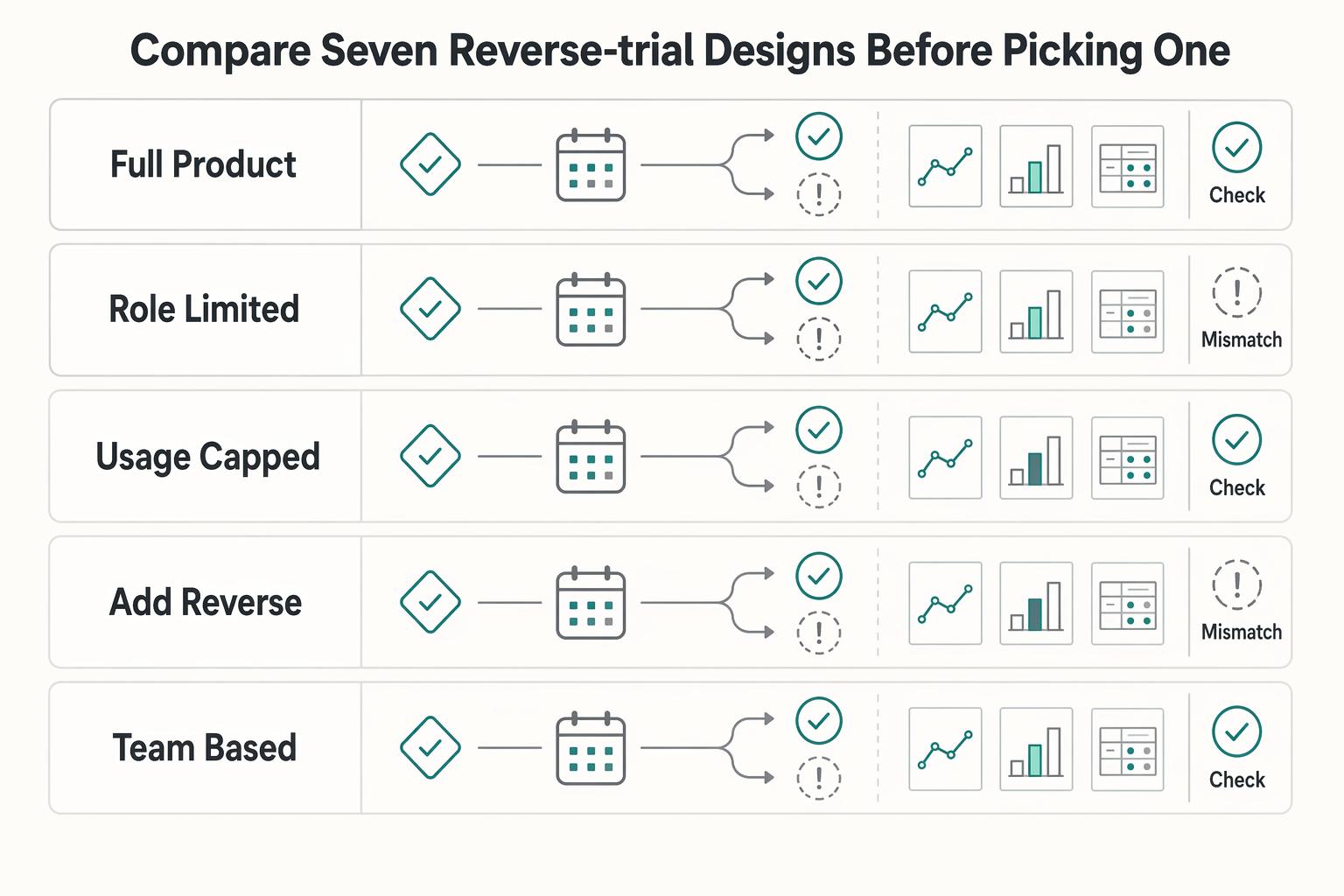
| Reverse trial | When users need hands-on premium workflow access before they can evaluate paid value | Can convert quickly when users reach premium value during trial access | Plan downgrade, expiry, and re-upgrade messaging clearly | Requires reliable timed access changes and downgrade states | Higher if broad premium access pulls in curiosity traffic without fit |
If usage is tightly tied to delivered value, prioritize a usage-based paywall. If the buyer's reason to pay is control or compliance, prioritize a feature gate. Use a reverse trial when premium value is hard to evaluate without direct experience, then downgrade to freemium with clear re-upgrade prompts.
Assign one primary trigger per segment#
Write the primary trigger into each segment brief and keep it explicit.
- Choose Usage-based paywall when growth in usage reflects growth in realized value. The core tradeoff is value alignment versus forecast stability.
- Choose Feature gate when the paid reason is advanced control or administration. A concrete paid-boundary pattern is gating advanced security/admin capabilities such as SSO, SCIM, and advanced privacy features.
- Choose Reverse trial when users must experience premium workflows first, then move to freemium unless they upgrade.
Instrument before rollout#
Instrument the trigger before launch: paywall encounter, upgrade intent, and the exact trigger condition (usage threshold crossed, premium feature clicked, or trial ended). For reverse trials, track whether users actually reached premium workflows before expiry. If they did not, fix onboarding before changing pricing.
You might also find this useful: Freemium vs. Paid Tiers: Which Pricing Model Works for Payment Platforms?.
Map funnel stages, events, and ownership across teams#
Map the funnel before you interpret conversion performance. If product, finance, and sales use different definitions for "upgrade" or "converted," your conversion story will change by team instead of by reality.
Put the stage order in one shared document#
Define one stage sequence and make every metric follow it. Funnel conversion analysis depends on users completing defined events in a specified order, so avoid shortcut views that jump from signup to paid conversion.
Use this sequence as your default operating map: signup, activation, repeated value, upgrade intent, paywall encounter, assisted touch, paid conversion, early retention. For each stage, define:
- the exact event name
- the entry rule for when a user or account counts in that stage
- the owner who approves definition changes
Keep user-level and account-level logic distinct. Signup and activation can be user events, while paid conversion is often an account or workspace event that finance can reconcile to billing.
Verification checkpoint: sample recent accounts and confirm timestamp order against your stage map. If an account can "convert" before upgrade intent or paywall encounter is logged, fix definitions before using the metric.
Build a shared event taxonomy and handoff rules#
Use one shared event taxonomy so teams interpret the same events and properties the same way. The practical goal is consistent definitions plus explicit ownership dependencies and handoff points.
| Stage | Must-have event or property | Primary handoff point | Operating artifact |
|---|---|---|---|
| Signup | account_created or user_signed_up; source property | Product to analytics | Decision log |
| Activation | first meaningful value event | Product to growth/revenue | Weekly metrics review |
| Repeated value | repeated core value event; count/frequency property | Product to pricing owner | Experiment register |
| Upgrade intent | pricing page viewed, premium feature clicked, threshold crossed | Product to sales/revops for high intent accounts | Weekly metrics review |
| Paywall encounter | paywall shown; trigger type property | Product to support and revenue | Escalation path |
| Assisted touch | demo booked, sales contact created, qualified assist flag | Sales/revops to product | Decision log |
| Paid conversion | billing start, contract accepted, paid status confirmed | Finance sign-off on definition | Weekly metrics review |
| Early retention | paid account active in your chosen early window | Product and finance joint review | Experiment register |
Add weekly verification checkpoints#
Add verification before rollout so the funnel is trusted enough for pricing and growth decisions.
| Checkpoint | What to confirm | Note |
|---|---|---|
| Event integrity | Required events and properties are present, ordered, and tied to valid account IDs | Spot-check raw payloads, not only dashboards |
| Attribution sanity | Compare key event metrics across attribution models side by side | Account for the November 2023 removal of first click, linear, time decay, and position-based models in GA when reviewing older reporting logic |
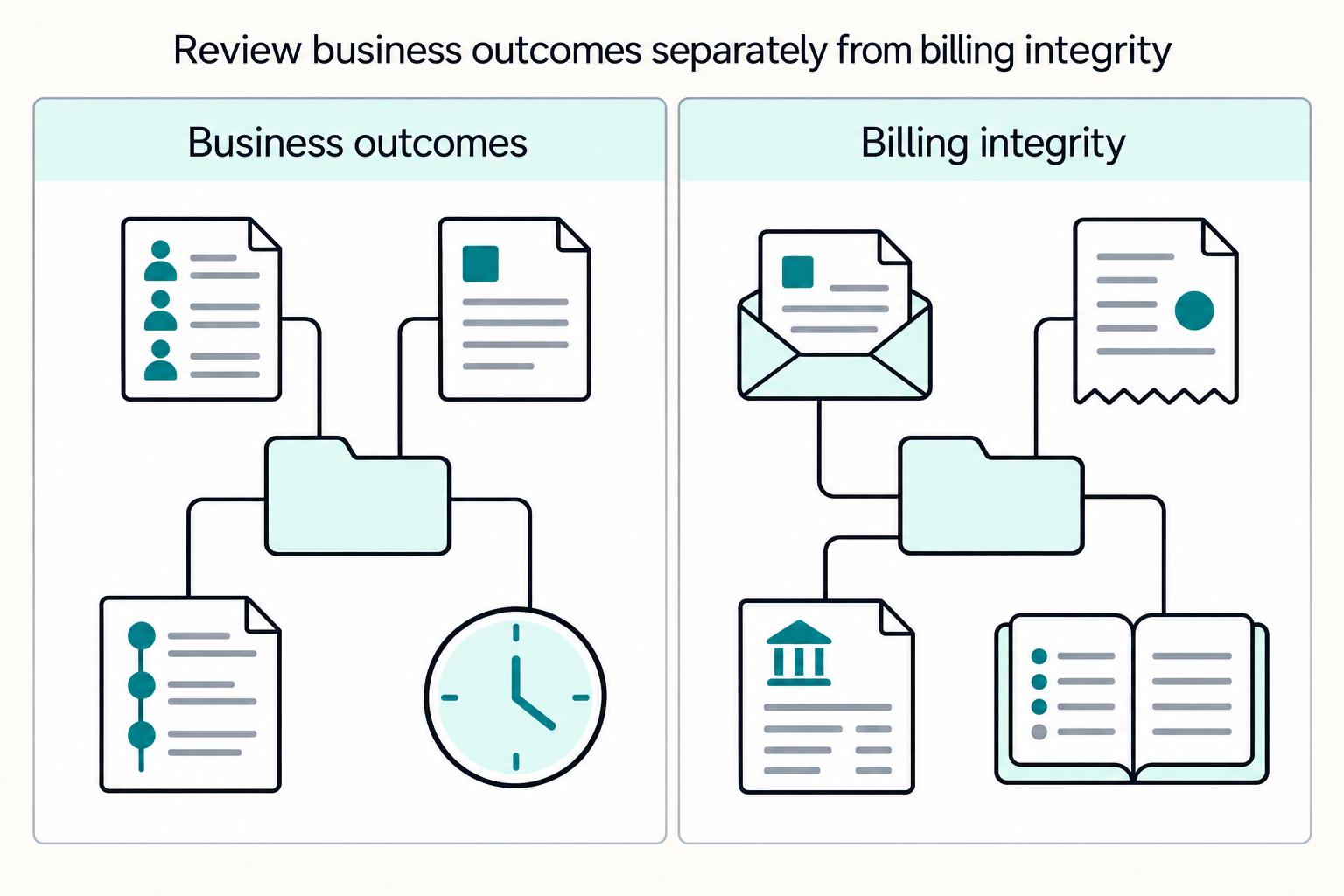
| Product vs finance reconciliation | Run a fixed weekly reconciliation between product-reported paid conversions and finance-recognized paid accounts | This catches double counting, delayed data, and timing distortion early |
- Event integrity
Confirm required events and properties are present, ordered, and tied to valid account IDs. Spot-check raw payloads, not only dashboards.
- Attribution sanity
Compare key event metrics across attribution models side by side to see how model choice changes channel valuation. If you use GA, account for the November 2023 removal of first click, linear, time decay, and position-based models when reviewing older reporting logic.
- Product vs finance reconciliation
Run a fixed weekly reconciliation between product-reported paid conversions and finance-recognized paid accounts. This is an operating control, not a formal requirement, and it catches double counting, delayed data, and timing distortion early.
Document escalation paths with the checks: missing taxonomy, naming drift, double-counted upgrades, and delayed data that obscures true conversion timing. If one appears, pause interpretation, fix definitions, then resume experiments.
Build both product-led and human-assisted conversion paths#
Keep self-serve as the primary conversion path, and route human assist only when account intent or buying complexity justifies the extra cost.
Design the self-serve path first#
Build the in-product upgrade path first, then treat assisted conversion as a routed exception. Product-led growth works when product usage drives conversion, so users should be able to understand and complete the upgrade path without rep intervention.
Use the moments you already mapped, such as upgrade intent, paywall encounter, and assisted touch. At each point, show the next step clearly so users know what to do now and what changes after upgrade.
Verification point: review recent self-serve upgrades and confirm the event trail is clean from intent to payment without manual intervention. If most self-serve wins still require support threads, ad hoc demos, or invoice workarounds, the product path is not carrying conversion.
Route human help by segment#
Route assist by segment, not by gut feel. Segments based on metadata and product usage are the right unit for deciding who stays self-serve and who gets human help.
| Signal | Likely meaning | Route |
|---|---|---|
| Fast activation, repeated value, quick upgrade after prompts | Comfortable buying through product | Keep in self-serve |
| Repeated non-progress behavior after key actions | Needs explanation or setup help | Offer assisted path |
| Procurement or implementation complexity for a high-value account | Buying motion is too complex for pure self-serve | Route to sales or success |
Do not use a single signal as a hard rule. Repeated paywall views can indicate intent, confusion, or budget friction. Start with in-app guidance for repeated non-progress behavior, then escalate to a person when the account also fits a high-value or complex buying pattern.
Write routing copy that explains the next step#
Make routing copy operational and specific so users know exactly what happens next. Avoid vague prompts like "contact us for more" or broad, generic claims.
Keep ownership clear across product, sales, and finance. For each assisted route, attach a short evidence pack with segment label, recent product behavior, and procurement context so teams can see why the route happened and what should happen next. If a segment consistently needs human help for basic onboarding, treat it as a pricing or packaging signal, not only a staffing issue.
For a step-by-step walkthrough, see How to Calculate the Cash Conversion Cycle for a Service Business.
Track the metrics that decide go or no-go#
Define your go/no-go rule before you read results. Keep the scorecard short, and pair product lift with finance guardrails so you do not scale a funnel that looks better in analytics than in unit economics.
Use a compact metric stack by segment#
Track one short stack by segment, not just in aggregate: activation rate, paywall hit rate, upgrade rate, time-to-upgrade, and early paid retention. Activation rate is an early read on whether users reached initial value or hit friction first.
Treat paywall hits as a signal, not a win by themselves. Higher paywall exposure can reflect healthy usage, or repeated collisions with unclear packaging. For each segment and trigger type (Usage-based paywall, Feature gate, Reverse trial), check whether higher paywall exposure is followed by higher upgrade rate and stable early paid retention. If that link is missing, you likely have friction, not intent.
Do not blend self-serve and assisted outcomes into one average. That can hide whether the product path is converting or whether reps are compensating for weak packaging.
Add finance checks before you call a win#
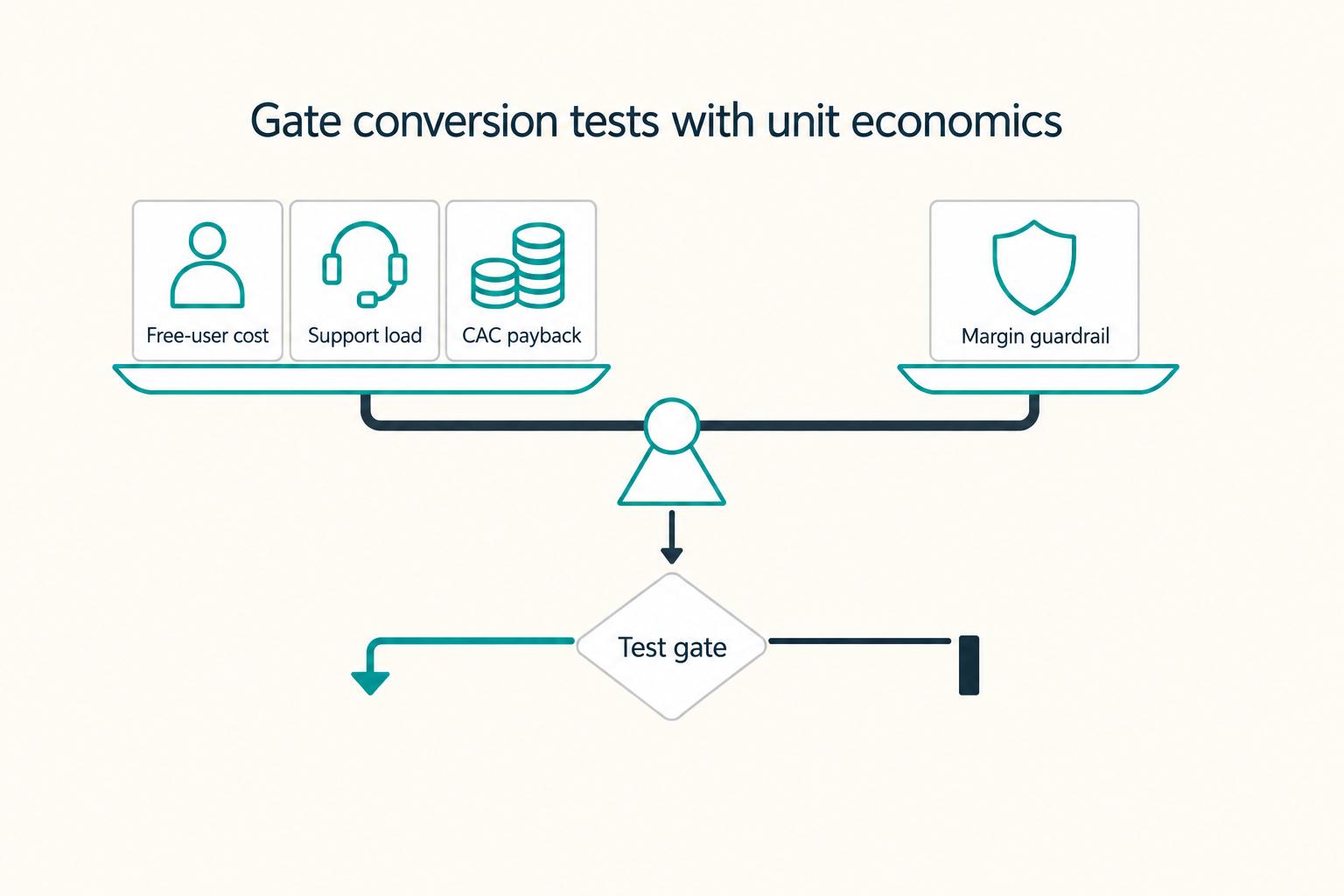
Do not call a test a win on conversion rate alone. Add gross margin impact, support cost per converted account, and CAC payback sensitivity by trigger type to the same decision review.
CAC payback period is the time needed to recover new-customer acquisition spend, and it belongs in the core dashboard with your conversion metrics. A trigger can raise upgrades while also adding support-heavy customers or service load that erodes margin. Include an evidence pack per experiment: segment, trigger type, assisted touches, support tickets tied to the conversion path, and the first retention read for new paid accounts. If finance cannot reconcile conversion gains to margin and payback assumptions, it is not a go decision yet.
Preregister the experiment and stopping rules#
Use a fixed experiment cadence, and preregister each test before launch. That means a time-stamped, read-only plan with hypothesis, primary metric, guardrail metrics, sample window, and stopping rules.
This prevents fast decisions from degrading experiment quality. In one cited analysis of 28,304 experiments, only 20% reached 95% statistical significance, while 70-80% were inconclusive or stopped early. Write the decision rule in plain language before launch: if upgrade rate rises but early paid retention declines or margin worsens, roll back and redesign trigger logic before scaling. Do not make permanent pricing changes from a single positive read.
Common implementation mistakes and how to recover#
If conversion lift is inconsistent, the issue is usually benchmark fit, tier boundaries, or channel mix, not button copy.
Step 1. Re-segment anything copied from mobile subscription playbooks. App Store and Google Play tactics are built for in-app digital purchases and subscriptions, which do not map cleanly to many B2B buying motions. Re-segment by how each account actually buys: self-serve, manager-approved, or sales-assisted. Then compare upgrade rate, time-to-upgrade, and early paid retention by route. If sales keeps rescuing "self-serve" accounts, your routing logic is misaligned.
Step 2. Tighten the paid boundary without slowing first value. A too-generous Free tier is a documented freemium failure mode, so keep first value fast but move durable operational control into Premium. A practical warning sign is cohorted free-to-paid conversion below 5% over a year. If usage and paywall exposure rise while upgrades stay weak, your boundary is likely unclear rather than compelling.
Step 3. Rebalance Product-led growth and Human-assisted growth with explicit routing rules. Do not force every segment into pure self-serve: Gartner reports strong rep-free preference (75%) and also higher purchase-regret risk in self-service digital purchases. Route high-intent stalled accounts into assisted paths using explicit triggers, then log route source, assisted touches, and retention in finance-usable reporting. That discipline matters because reporting gaps are where forecasts unravel; as Joshua Tripp (President and CFO, PayPal Giving Fund) puts it, teams need "a much-higher-quality and up-to-date system, with clean data and new functionality that we can rely on to support the business."
Conclusion and copy-paste launch checklist#
If you want this launch to hold up under finance review, keep it boring in the right places. Use one primary trigger model per segment, locked plan boundaries, a real Tracking Plan, and experiment rules written before anyone sees results. Teams often do not get into trouble because they lack ideas. They get into trouble because they lack definition, ownership, and rollback discipline.
| Checklist item | What to lock | Verification |
|---|---|---|
| Choose one upgrade trigger per segment | Use a single primary route for each segment: Usage-based paywall, Feature gate, or Reverse trial | A PM, pricing owner, and revenue lead should all describe the same trigger in the same words |
| Lock the Free tier and Premium tier contracts before testing | Write Free as the core outcome users can achieve and the limits they will hit; write Premium as the advanced outcomes, controls, or operational capability that justify payment | If free users cannot reach first meaningful value, expand free scope; if paid is just more volume, add differentiated paid capability first |
| Ship the Tracking Plan and ownership map before you touch pricing | Name events for signup, activation, repeated value, paywall encounter, assisted touch, paid conversion, and early retention, plus a clear owner for each stage | Product analytics and finance should be able to reconcile paid conversions weekly without manually reclassifying records |
| Run the first experiment with a primary metric and guardrails already set | Define the primary metric, guardrails, success, rollback, and what counts as damage before launch | Guardrails can include weaker early paid retention, higher support cost per converted account, or margin deterioration |
| Scale only when quality holds, not just when upgrades rise | Keep the gate tied to conversion quality, early paid retention, and margin together | If one metric improves while the others weaken, pause, diagnose the trigger logic, and rerun before broad rollout |
- Choose one upgrade trigger per segment.
Pick a single primary route for each segment: Usage-based paywall when price should scale with consumption value, Feature gate when buyers pay for controls or capabilities, or Reverse trial when people need to experience paid workflows before downgrade. Avoid launching with all three mixed inside one segment and calling it flexibility. Verification point: a PM, pricing owner, and revenue lead should all describe the same trigger in the same words.
- Lock the Free tier and Premium tier contracts before testing.
Write the Free tier contract as the core outcome users can achieve and the limits they will hit. Write the Premium tier contract as the advanced outcomes, controls, or operational capability that justify payment. If free users cannot reach first meaningful value, expand free scope. If paid is just "more volume," urgency can be weaker unless you add differentiated paid capability first. A common risk here is letting sales rescue accounts that only look promising because the boundary between free and paid is still fuzzy.
- Ship the Tracking Plan and ownership map before you touch pricing.
Twilio Segment defines a Tracking Plan as the event and property spec you intend to collect, and its guidance is explicit: pick a naming convention and stick to it, without dynamic event names. In practice, that means you should have named events for signup, activation, repeated value, paywall encounter, assisted touch, paid conversion, and early retention, plus a clear owner for each stage. Verification point: product analytics and finance should be able to reconcile paid conversions weekly without manually reclassifying records.
- Run the first experiment with a primary metric and guardrails already set.
Optimizely's standard is useful here: every experiment needs at least one metric, and the primary metric is the one that proves or disproves the hypothesis. Pair that with guardrails, because a test can lift one number while hurting the product or user experience elsewhere. For this first cycle, define success, define rollback, and document what would count as damage, such as weaker early paid retention, higher support cost per converted account, or margin deterioration.
- Scale only when quality holds, not just when upgrades rise.
A higher upgrade rate is not enough to expand the change across segments. Keep the gate tied to conversion quality, early paid retention, and margin together. That is especially important in a market where retention is under pressure; recent benchmark context showing 101% NRR is a reminder that keeping and expanding paid accounts is not automatic. If one metric improves while the others weaken, pause, diagnose the trigger logic, and rerun before broad rollout.
If you need a second pass on your checklist, use this test: could a new operator open your docs and tell what is free, what is paid, what event proves movement, who owns each stage, and what sends the change back? If not, you are not ready to scale.
Frequently Asked Questions
What is the minimum viable freemium-to-paid funnel a platform should implement first?
Start with one clean path: signup, activation, repeated value, paywall encounter, upgrade, and early paid retention. Add one assisted route only for clearly stalled, high-intent accounts. If product events and finance records cannot be reconciled weekly, your funnel is still too loose to trust.
When should we choose a usage-based paywall instead of a feature gate?
Choose usage-based pricing when consumption closely tracks customer value, because it keeps entry friction lower and lets spend rise as usage grows. Stripe notes that usage-based pricing aligns costs with value, and nearly 30% of SaaS companies preferred it in 2023. If value is tied more to access to specific capabilities than to variable consumption, a feature gate is usually the clearer trigger.
Where does a reverse trial outperform a standard free tier in B2B SaaS?
Public guidance does not provide a universal cutoff for where reverse trials beat standard free tiers across B2B SaaS segments. A reverse trial starts users with paid features and moves them to freemium when the trial ends, and it is often framed as combining trial conversion strength with freemium continuity. If users cannot hit meaningful value before downgrade, results are often noisy rather than decisive.
Which metrics should finance trust first when product reports conversion improvements?
Trust the metrics that reconcile across teams first: paid conversions, early paid retention by segment, plus sales-contact intent and product usage in product-led sales motions. Amplitude’s guidance is to review freemium and free-trial metrics weekly, with cadence matched to how quickly users reach value. If product shows higher upgrades but finance sees weak retained paid accounts, treat the lift as unproven.
How do we add human-assisted conversion without eroding unit economics?
Add it only after explicit signals such as "talk to sales" requests and product-usage patterns that show stalled progress after key actions. Then track route source, assisted touches, and retained paid accounts, not just closed-won upgrades. A common failure mode is letting reps rescue accounts that should have converted self-serve, which hides a weak paid boundary and quietly raises cost.
Why do mobile subscription benchmarks often mislead platform teams?
Many public guides are written for app subscriptions or app-based businesses, not broader B2B platform procurement contexts. That does not make mobile benchmarks useless, but it does limit what they can prove for a platform team. Use them for message timing or paywall design ideas, not as direct evidence for your packaging or route-to-paid choices.
What parts of public freemium guidance are still unknown or under-specified?
The biggest gap is segment-specific decision rules. Public sources do not give a universal cutoff for when a usage-based paywall beats a feature gate, or when a reverse trial beats a standard free tier across all B2B SaaS motions. You still need your own evidence pack: activation events, paywall hits, sales-contact intent, converted-account retention, and weekly reconciliation between analytics and finance.
Try a related tool
Researched and edited by the Gruv editorial team. Gruv builds cross-border billing, payouts, and finance-operations software for global businesses.
Sources
Includes 7 external sources outside the trusted-domain allowlist.
- stripe.com/resources/more/usage-based-pricing-for-saas-...trusted
- a16z.com/how-to-optimize-your-free-tier-freemiumexternal
- adapty.io/blog/freemium-to-premium-conversion-techniquesexternal
- amplitude.com/blog/reverse-trialexternal
- amplitude.com/explore/data/event-taxonomyexternal
- atlassian.com/work-management/project-management/raci-chartexternal
- docs.mixpanel.com/docs/tracking-best-practices/tracking-planexternal
- dropbox.com/basicexternal
Educational content only. Not legal, tax, or financial advice.
Related Posts
The Freemium-to-Paid Conversion Guide for Platform Operators
Freemium works best when growth and monetization are designed together. Most teams agree they want more users. The friction starts when product wants lower signup resistance, revenue wants clearer upgrade paths, and finance sees free users consuming support, infrastructure, and development capacity without direct revenue.
Reverse Trials for B2B Platforms That Convert More Paid Accounts
Treat a reverse trial as a monetization decision, not a short-term growth play. If your B2B platform cannot support a clean downgrade, clear plan boundaries, and reliable billing and entitlement changes, more full-access signups may not help much.
Freemium vs Paid Tiers for Payment Platforms
For a payment platform, this is not an abstract free versus paid debate. The real question is whether freemium or paid tiers create the customer mix you want at a cost and revenue pace your business can sustain. In practice, the choice comes down to growth quality, support load, and when monetization starts.