
Quick Answer
Define the free plan and paid benefit, test offer timing against user behavior, and measure the same account cohort over a fixed window. A higher conversion rate is useful only when retention and contribution also support the change. Review existing free-access promises, trial terms and the confirmed billing and entitlement state before rollout.
What drives freemium-to-paid conversion#
Freemium works best when growth and monetization are designed together. Most teams agree they want more users. The friction starts when product wants lower signup resistance, revenue wants clearer upgrade paths, and finance sees free users consuming support, infrastructure, and development capacity without direct revenue.
That is why freemium has to be more than a pricing page or a late-stage upsell campaign. In simple terms, freemium means basic product access is free while stronger capabilities are paid. The model can grow your user base quickly, but turning free users into paying customers is where execution gets hard. If you leave the free tier too open or too generous, low conversion is a common outcome.
The goal of this guide is to connect Product-Led Growth (PLG) motions to unit economics and day-to-day operating reality. That means you do not judge success by top-of-funnel signups alone. You look at whether free users reach value, whether the product creates a real reason to upgrade, and whether the cost of serving the free tier stays within a range your business can absorb. If your team is still celebrating account creation while ignoring support load, usage costs, or weak paid intent, fix that first.
A strong approach starts with clear feature differentiation. Free users should get enough utility to experience the product. Paid plans need to deliver a visible step up in outcome, not just a vague promise of "more." Common upgrade levers are well established: advanced features, priority support, and higher usage limits. The question is not whether to use those levers, but where to place them so the free tier drives activation instead of becoming a permanent low-margin service layer.
There is also a trust issue here. Push the paywall too early and you can hurt adoption. Leave everything open-ended and you can teach users to expect ongoing value for free. The middle ground is behavior-based prompting tied to real product use. Later sections get into timing and segmentation, but the core rule is simple: users should understand why they are being asked to upgrade, and the upgrade should feel connected to value they have already experienced.
If you want a deeper dive, read A Guide to Product-Led Growth (PLG) for SaaS Startups.
What a freemium conversion strategy actually includes#
| Area | What to define |
|---|---|
| Free vs. paid boundary | What the free tier includes vs. what is paid |
| Signup and upgrade path | How you reduce sign-up friction while still creating a clear upgrade path |
| Upgrade incentives | Advanced features, priority support, or higher usage limits |
| Free-tier cost pressure | How you monitor server, support, and development resources consumed by free users |
Free access should let a user complete a useful task. Paid access should solve a visible next need, such as more volume, collaboration or advanced administration. Test whether users understand that difference before changing the boundary.
Document the top upgrade triggers and free-tier cost drivers before launch. For implementation detail, see How to Implement a Freemium-to-Paid Conversion Funnel on Your Platform.
Decide what stays free and what moves behind paid access#
Start with a boundary that supports useful free access and a distinct paid outcome. Treat costly free features as candidates for limits or packaging tests, not an automatic reason to withdraw them. Consider referral value and existing promises as well as direct upgrades; explain material changes and provide an appropriate transition.
Build the boundary table#
Keep this as an operating table, not a pricing-page debate, so product, revenue, support, and finance apply the same rules.
| Subscription plan | What the user gets | What moves behind paid access | Usage limits | Priority support rule | Intended outcome |
|---|---|---|---|---|---|
| Free | Core utility that reduces signup friction and helps users experience product value | Differentiated outcomes, advanced controls, higher-volume use, or service-heavy features | Explicit hard cap | No priority support | Activation |
| Paid | Clear outcome improvements, more capacity, and upgrade-motivating features | Highest-cost service layers or advanced admin functions can remain for higher paid tiers | Higher allowances than free, stated clearly | Defined paid support channel where relevant | Monetization |
| Higher-tier paid | Highest-scale usage, advanced controls, and support-intensive needs | Keep tier value explicit, not vague | Highest or custom limits | Priority support where support burden justifies it | Expansion and margin protection |
For each row, record the product event tied to activation or monetization, the limit owner, and the cost driver, for example support load or infrastructure usage.
Use cost and intent to break ties#
When placement is unclear, use two checks:
- Does this help activation?
- Does this create a credible upgrade reason?
A capability can support activation, retention, referrals or a distinct paid need. Identify that contribution and its cost before deciding to keep, cap or move it. Avoid making a previously promised free capability paid without reviewing the affected users and transition terms.
Use examples as pattern, not template#
Spotify, Dropbox, and Slack show that freemium can build a large user base and create upgrade paths. They are not templates for your exact boundary decisions. Use the underlying logic instead: free should lower friction, and paid should map to clear feature differentiation, higher usage allowances, or support advantages.
Record each free feature’s intended role, including activation, retention, referrals or paid differentiation, alongside its cost and any existing commitments. If its contribution is unclear, gather usage and cohort evidence before re-scoping it.
Time onboarding, paywalls, and trials around real activation signals#
Use behavior-based prompt timing as an experiment hypothesis. An activation event, limit hit or premium-feature attempt may indicate a useful upgrade moment; it does not establish willingness to pay. Show the price and exact benefit before asking for commitment.
| Motion | Timing | Use when |
|---|---|---|
| Onboarding | Onboarding first, value proof second | If a user never activates, suppress upgrade pressure and fix onboarding friction first |
| Paywall | After activation when a user hits a clear usage limit | Name the exact limit increase or advanced feature they need next |
| Free trial | Only when user actions show readiness; timebound and creates urgency through potential feature loss | If a user reaches activation but stalls on deeper use, trigger a targeted trial tied to the premium capability |
A paid-feature trial provides time-limited access to specified capabilities while a freemium plan provides ongoing limited access. State trial duration, post-trial access, any billing requirement and cancellation path. Test timing without relying on confusing loss-of-access pressure.
Define the proposed behavior rules before the experiment. Treat the following as hypotheses to test for your users:
- If a user reaches activation but stalls on deeper use, trigger a targeted trial tied to the premium capability that extends the value they already saw.
- If a user reaches activation and then hits a clear usage limit, show a paywall that names the exact limit increase or advanced feature they need next.
- If a user never activates, suppress upgrade pressure and fix onboarding friction first.
Use behavior as the trigger#
Before launch, verify your event logic: activation must fire reliably, "stall" must be defined in product terms, and each offer must map to the behavior that triggered it. If your instrumentation is noisy, your timing decisions will be noisy too.
Be careful with early paywall pressure. Short-term lift in clicks or starts is not enough to prove strategy quality on its own. Validate against downstream retention quality and support burden before scaling what looks like a win.
Let CRM reinforce, not interrupt#
Use Customer Relationship Management (CRM) nudges after activation events, not as generic blasts. Tie each message to what the user just completed, then show the premium next step plus the limit or outcome difference that makes paid relevant.
Keep the operating brief simple: activation event, stall condition, offer type, CRM audience rule, owner, and success metric. If activated and never-activated users receive the same upgrade message, fix the targeting before you rewrite the copy.
Segment free users by buying intent, not by activity volume alone#
Segment free users by buying intent signals, not raw activity volume. The users you should upsell first are those showing clear movement toward paid value: repeated high-value actions, team invites, integration attempts, and repeated usage-limit hits.
Your CRM should follow that intent logic. A lower-activity user who invites teammates or attempts an integration can be closer to paid than a high-activity user who never reaches a meaningful outcome. If both cohorts get the same upsell sequence, targeting noise rises quickly.
Treat invite, integration and limit-hit signals as hypotheses about intent. Compare each signal with actual paid starts and subsequent retention before using it to expand targeting.
Use a simple decision rule. If a segment repeatedly hits Usage limits, prioritize pricing and packaging tests. If a segment rarely nears limits, prioritize Onboarding, activation, and feature discovery before adding more paywall pressure.
Trigger matrix#
| Segment signal | What it likely means | Best next offer |
|---|---|---|
| Repeated limit hits on a core action | Ongoing need has outgrown free capacity | Upgrade prompt or paywall tied to that exact limit |
| Team invites or shared workspace setup | Multi-user intent and possible expansion | Sales assist for larger accounts, or a plan-upgrade path |
| Integration attempt or premium-feature click after activation | Deeper workflow intent, but proof may still be needed | Targeted Free trial for that premium capability |
| Low activity and no activation | Weak value discovery, not clear pricing resistance | No prompt; route back to onboarding support |
Execution quality depends on signal quality. Verify that a "limit hit" is a real blocked attempt, and that invite or integration events are genuine user actions rather than test behavior. If those events are noisy, segmentation looks precise in reporting but performs poorly in production.
Also watch conversion-quality tradeoffs. Aggressive prompts to weak-intent cohorts can increase support load and complicate pipeline handling, especially in free-user-heavy motions. Keep a short segment evidence pack: qualifying events, threshold logic, CRM audience rule, suppression rule, offer type, and owner.
Set unit economics guardrails before chasing conversion lift#
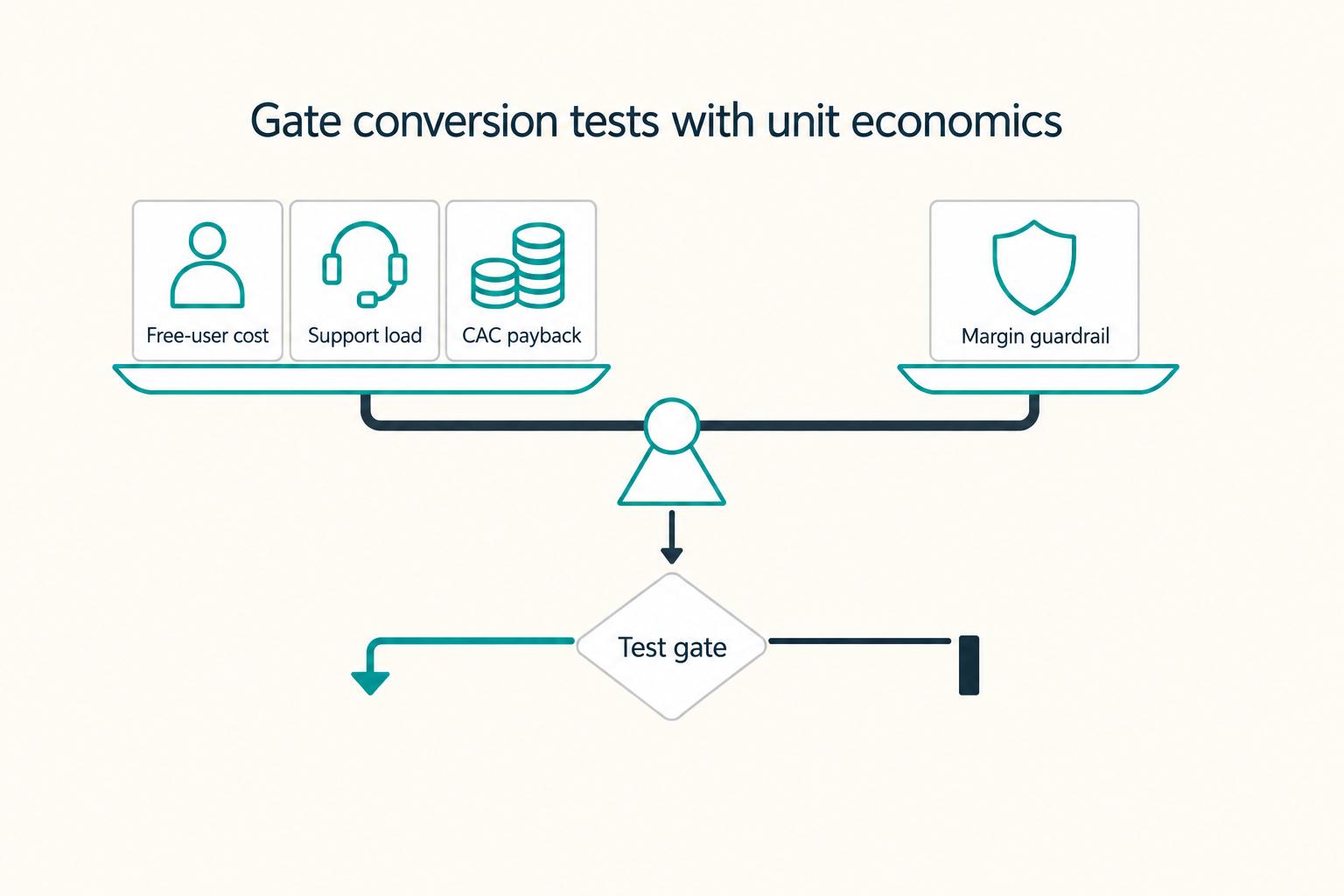
Set hard unit-economics guardrails before you run conversion tests, or a higher free-to-paid rate can still hurt margin. If you cannot define acceptable cost-to-serve per free user, support load, and CAC payback, you are scaling risk, not just growth.
Set a cost ceiling and an observation window before testing. Track the whole acquisition cohort, including people who never pay, so a lift among selected converters does not hide the cost of serving everyone else.
Check whether a conversion lift improves contribution#
Here is a hypothetical comparison over one fixed window. Of 10,000 eligible free accounts, 400 pay $20 during the window: $8,000 revenue. Paid-service costs of $5 per payer total $2,000. If the cohort’s free-service costs are $4,000, contribution is $2,000 before acquisition and fixed costs.
A variant converts 500 of the same number of eligible accounts: $10,000 revenue and $2,500 paid-service costs. If the longer or richer free experience costs $6,000, contribution is $1,500. Conversion improved from 4% to 5%, but contribution fell $500. Count each service cost once and compare retention before choosing a winner.
Where practical, assign eligible accounts randomly to control and variant and keep acquisition source, follow-up window and other material changes stable. Randomize at the account or workspace level when users share billing. A before-and-after comparison can guide a test, but seasonality or traffic mix may explain the change.
Set the guardrails before the experiment#
Require every monetization test to clear three measures: free-tier cost to serve, support load, and CAC payback. The goal is not a perfect model. It is a clear keep-scaling rule and a clear stop rule.
| Guardrail | What to track | Decision use |
|---|---|---|
| Cost to serve per free user | Infrastructure, third-party usage, and recurring servicing cost tied to free accounts | If conversion rises but free-user cost rises faster, tighten free-tier boundaries or cap costly features |
| Support load from free users | Ticket volume, chat volume, and resolution effort for free-tier issues | If upsell changes add more support cost than margin, reduce onboarding friction or move high-burden features behind paid |
| CAC payback | Acquisition cost for the whole relevant cohort, allocated per acquired paid account, divided by monthly paid contribution under stated assumptions | Treat targets such as payback under 12 months as guardrail examples, not universal rules |
If your product and finance teams use different cost definitions, your free tier will look healthier than it is. Keep one short evidence pack per test: cost components, cohort dates, landed paid plans, and payback assumption.
Measure conversion quality, not just the rate#
A higher conversion rate only helps if converted users retain and produce acceptable margin. Split early and later converters into separate cohorts, because blended rates can hide weak economics.
Use the same time window for comparable cohorts. Later converters have had less time to produce paid revenue, so mark immature retention and payback estimates clearly. Longer evaluation is not by itself evidence of poor quality.
Use a stop rule you can enforce: if conversion rises but churn worsens or free-tier servicing cost damages margin, pause rollout and rework tier boundaries, paywall design, or onboarding before scaling acquisition. This keeps UX and engineering changes tied to business economics instead of vanity metrics.
A conversion rate needs a population and a window. Report paid accounts divided by eligible free accounts for a defined cohort, then show retained paid accounts over a fixed follow-up period. User-level, account-level, trial-only and all-signup rates are different measures; unlike percentages are not necessarily conflicting evidence.
Align product, finance, and revenue teams on one operating cadence#
Run one shared monetization review cadence across product, finance, and revenue, and end each review with a single ship-or-stop decision. Without that, freemium work creates local wins and global confusion.
The shared review should connect product changes, user value and the full cost of acquisition and service. Keep the definitions fixed so each team can assess the same experiment.
| Team | Primary ownership | What they should bring to review |
|---|---|---|
| Product | Activation and Paywall UX | Where users hit value, where they stall, and what changed in onboarding or upgrade prompts |
| Finance | Unit economics thresholds | Free-tier cost-to-serve, support burden, payback assumptions, and plan-level gross margin by Subscription plan |
| Revenue | CRM targeting and offer sequencing | Which segments received which offer, message timing, and whether trials or upgrade prompts matched buying intent |
Keep the common scorecard short: activation rate, trial-to-paid, free-tier cost-to-serve, and plan-level gross margin by Subscription plan. If you are actively testing packaging or paywalls, review these on a fixed weekly cadence and use one definition and cohort window per metric so teams are not comparing mismatched cuts.
Use a lightweight decision log for every pricing or packaging change:
- change made, affected segment, and affected Subscription plan
- upside hypothesis and named downside risk
- launch date, owner, review date, and rollback trigger
- evidence used, including cohort cut and cost assumptions
Before launch, name who approves the experiment and its limits. Evaluate paid starts, retained paid revenue and costs together. Do not ship a broad packaging change on upgrade clicks alone.
Implement conversion flows in Gruv with compliance and traceability intact#
Connect upgrade requests to billing and access decisions. Confirm which plan, trial or paid entitlement should be active, which account owns it, and which billing record supports it. Verify the supported Gruv workflow and records for the specific implementation.
| Control | What to confirm | Rule or evidence |
|---|---|---|
| Event trail | Which tenant changed, which plan changed, and what billing outcome followed | Map internal intent to provider object references and the verified billing/access state |
| Policy gates | Identity/business checks, payout eligibility, and market/program availability before customer-facing promises | Check current docs and sales-confirmed coverage |
| Safe retries | Upgrades, billing calls, and payout-triggered events can be retried without duplicate financial outcomes | Enforce idempotent handling; keep status logs, reconciliation exports, provider references, and available invoice/payment history |
Use the tenant as the anchor. If a tenant is the purchased SaaS instance or resource group a customer uses, your records should consistently show which tenant changed, which plan changed, and what billing outcome followed. That discipline matters even more in multitenant architecture, where pricing tiers, usage patterns, and consumption rates shape both technical design and commercial outcomes.
Keep the event trail complete#
Link the internal upgrade intent to the provider’s customer, subscription, invoice and payment references where applicable. Provider and app identifiers need not be identical. A successful checkout redirect or click is not proof that the intended access is active.
Put policy gates before monetization#
For cross-border flows, confirm policy gates before triggering billing, payouts, or market-specific offers. Check current docs and sales-confirmed coverage for identity or business checks, payout eligibility, and market or program availability before publishing customer-facing promises. Coverage varies by country and program, so keep copy and support guidance aligned with what is actually supported.
Make retries safe and repeatable#
Use a stable key for retries of the same billing intent, and deduplicate received events. Reconcile uncertain requests with the provider before submitting a new intent. Event delivery can be repeated or out of order, so verify the current subscription and entitlement state before changing access. Keep logs and financial references for investigation.
Frequently Asked Questions
What is a freemium conversion strategy in practical operator terms?
A freemium conversion strategy defines the ongoing free plan, paid value, offer timing and measurement. It includes feature and usage boundaries, upgrade and trial rules, and the cohort measures used to assess paid revenue, retention and cost. State any future changes to free access transparently rather than promise an unconditional “free forever” plan.
What should be free versus paid in a platform Subscription plan?
Keep free access useful and paid value distinct. Use feature and usage limits as testable packaging choices. Account for support and infrastructure costs, activation, retention and referral value; review existing promises and transition terms before moving a free capability into a paid plan.
When should we trigger a Paywall versus offer a Free trial?
There is no single evidence-backed timing threshold here for paywall versus trial. In practice, test both after clear activation and demand for more scope, volume, or advanced capability, then keep the path that improves retained paid conversion for your segments.
What conversion rate should we expect, and how should we use benchmark ranges safely?
Do not anchor on a universal benchmark; do not assume one applies to your situation. A safer read is internal: compare activation-to-paid, trial-to-paid, and retained paid conversion by segment, plan, and acquisition source. If an outside range helps at all, treat it as directional only and verify it against your own unit economics, not as a target you promise to investors or the board.
How do we prevent free-tier cost bloat while still supporting Product-Led Growth (PLG)?
Measure the cohort’s free-service costs and paid contribution over the same period. Inspect costly actions and support effort, then test limits or packaging changes with retention and referral guardrails. Confirm the change addresses the cost driver rather than simply move work into support.
Which user behaviors should drive Behavioral segmentation for upsell timing?
Prioritize signals that suggest buying intent, not just raw activity. Good candidates are repeated high-value usage, sustained demand near rate limits, and repeated attempts to use advanced features gated to paid tiers. If someone never gets near those moments, fix onboarding first. If they keep hitting limits or trying paid-only capabilities, present an upgrade path or short trial and test which path retains better.
Try a related tool
Researched and edited by the Gruv editorial team. Gruv builds cross-border billing, payouts, and finance-operations software for global businesses.
Sources
Includes 1 external source outside the trusted-domain allowlist.
Educational content only. Not legal, tax, or financial advice.
Related Posts
Build a Product-Led Growth System for Your SaaS Startup
Treat your growth motion as a set of owned decisions and control checks, not a pile of experiments. If you are building a product-led SaaS business, first decide who owns each growth choice. Then decide what signal they can trust and what must be checked before you scale it.
How to Implement a Freemium-to-Paid Conversion Funnel on Your Platform
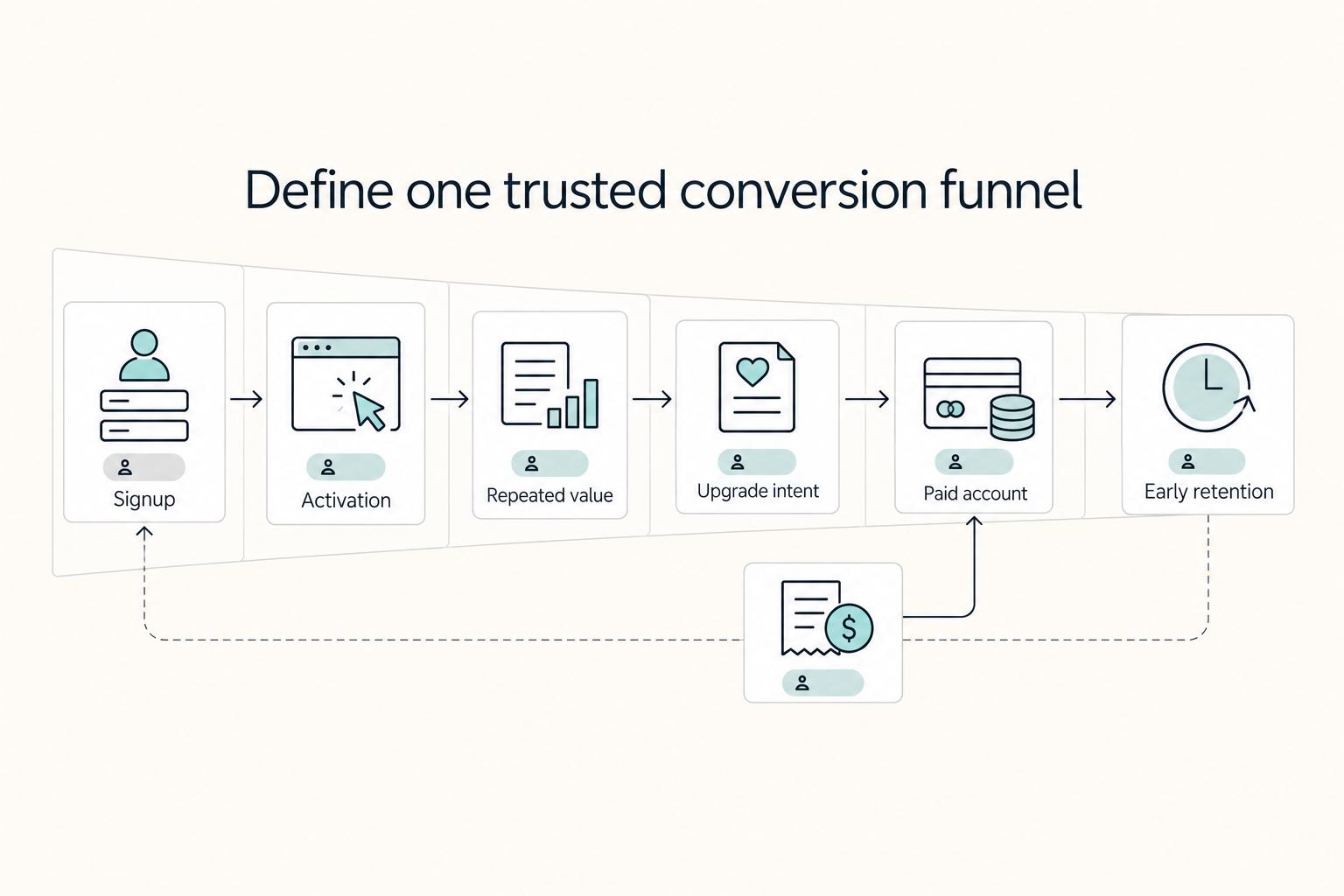
Treat freemium as an operating choice, not a pricing page edit. A strong **freemium to paid conversion funnel platform implementation** starts with shared judgment across product, finance, and revenue. Align on what the free user must be able to accomplish, what the paid buyer is actually purchasing, and which numbers will decide whether the model is healthy.

Build a Freelance Sales Funnel You Can Run in One Hour a Week
Start smaller than you want. Your freelance sales funnel should survive a normal delivery week, not a rare week when you happen to have extra energy. If you cannot maintain it without pushing client work aside, it is not usable yet.