
Quick Answer
Start by running product-led growth saas as an operating system with owned decisions, not isolated experiments. Pick Free Trial or Freemium with written reversal criteria, then track activation, PQL quality, free-to-paid conversion, and retention on one shared scorecard. Use a staged rollout that locks event taxonomy, idempotent handling, and reconciliation before you widen acquisition. Expand only when sampled records can be traced from product behavior to billing outcomes and exception owners are clear.
Stop guessing your PLG strategy and run it like an operating system#
Treat your growth motion as a set of owned decisions and control checks, not a pile of experiments. If you are building a product-led SaaS business, first decide who owns each growth choice. Then decide what signal they can trust and what must be checked before you scale it.
Product-led growth means the product does the work of attracting, converting, and retaining users. That sounds simple until self-serve onboarding, pricing, and finance start pulling in different directions. The fix is not more brainstorming. It is a short list of decisions you lock early and review on a steady cadence.
| Operating layer | Decision owner | Input signal | Control check |
|---|---|---|---|
| Growth model | Founder or GM | Time to first value, support load, sales involvement, early conversion pattern | Confirm what is free, what is paid, when pricing appears, and which usage signals predict conversion |
| Measurement | Product lead with finance input | Signup to first meaningful action path, activation drop-off, free-to-paid movement, retention trend | Verify event names, map every step from signup to first meaningful action, and check that billing and usage totals can be compared |
| Market readiness gates | Founder with finance or legal review | Customer location, entity type, payment flow, tax footprint | For each new market, verify relevant customer verification, billing, and tax requirements for your offer and customer type. Keep this as a fresh market-by-market review, not a copied global template |
A useful first checkpoint is activation speed. If users cannot reach a meaningful action quickly, pricing tweaks will not rescue you. Current PLG thinking is pushing time to value toward under 60 seconds. Map the path from signup to first meaningful action and look for friction that makes people leave before they experience value.
The other early call is how tightly you control free access. Many teams are moving away from open-ended free access toward time-boxed trials, usage caps, or value gates. You do not need to pick the right model forever today. You do need one clear rule set so you can tell whether the product is working or the packaging is muddying the signal.
Here is what goes wrong in practice. You open self-serve signups in two new regions. Adoption looks strong, and product events show healthy usage. Then finance sees invoice counts that do not line up cleanly with aggregated usage, while market-specific tax treatment and customer verification expectations differ.
You prevent that by doing two boring things early. Compare usage, signup, and invoicing outputs on a regular schedule. Keep a simple market checklist that names the country, customer type, and product before you turn on paid conversion there.
That discipline matters because the next step is agreeing on terms. Before you pick tactics, you need shared definitions for activation, PQL, conversion, and value so your decisions stay consistent.
Build the right mental model before you pick tactics#
Set shared definitions first, or your tactics will scale confusion instead of results. In PLG, strategy is your theory of how you win, not a list of activities. That means choosing priorities, naming tradeoffs, and making sure every team uses the same decision rules.
You want to avoid two common failures: doing everything at once, and assuming the product will sell itself without cross-functional execution around the self-serve journey.
| Concept | What decision it should control | Ownership lens | What to do next |
|---|---|---|---|
| PLG | Whether the product is actually driving acquisition, conversion, and expansion | Make this cross-functional, not product-only | Write down which conversion moments must happen in-product, and which motions you will intentionally not pursue |
| PQL | Which in-product behavior should trigger follow-up, routing, or support | Product, sales, and success should agree on qualification logic | Pick a short list of meaningful behaviors, then manually review recent examples before you automate alerts |
| ACV | How you compare performance across the segments you use internally | Assign one clear owner internally before using it in decisions | Define your segment labels first, then review results by segment so unlike motions are not mixed |
Qualify PQLs by behavior quality and segment context#
Treat PQL as behavior quality plus context, not just activity volume. First, check whether the user reached meaningful value in product. Then check whether that behavior matches the segment and buying context you are evaluating.
A quick control: sample recent PQLs by hand. If many "qualified" users only did shallow setup activity, tighten your criteria.
If your operating flow includes product events, API/webhooks, a system of record, ledger reporting, and revenue recognition logic, keep the definitions aligned across those steps. When these drift, teams can read the same account differently and make conflicting decisions.
Operator checks before you launch tactics#
| Check | What to confirm |
|---|---|
| Activation event by persona | Name one activation event per core persona and write a plain-English definition next to it |
| Product clarity rating | Rate from 1 to 10 how clearly the product is the obvious choice for that user, then note what blocks a higher score |
| Ownership map | Document who owns PLG decisions, PQL review, and segment-level reporting |
| End-to-end trace | Trace one customer path end to end and verify the same story appears in each system you rely on |
For a step-by-step walkthrough, see How to Build a 'Glocal' Marketing Strategy for Your SaaS Product.
Is your SaaS actually ready for PLG right now?#
Do not scale until every readiness gate has a named owner and written closure criteria. In a product-led motion, signups only show intake volume. They do not prove users reached value, converted, or stayed.
Run this as a strict yes-or-no review, and lock your definitions first so teams do not talk past each other. Activation is the first in-product behavior that shows meaningful value. PQL is a user or account whose behavior is strong enough to justify follow-up. Business outcome is the downstream commercial result you track, such as paid conversion, retention, or expansion.
| Gate | Required evidence for "yes" | Decision owner | If "no," do this now |
|---|---|---|---|
| Activation | Self-serve onboarding gets users to one agreed activation event without hand-holding; a recent manual sample confirms it reflects real value, not a shallow click | Product lead | Simplify onboarding and tighten the activation definition until recent sessions show meaningful value reached |
| Instrumentation | A tracking plan exists for key events, and each event is tied to a decision, not just a dashboard tile | Product + data owner | Pause rollout, fix event names and mappings, then retest on live user paths |
| Commercial linkage | You can trace activation to PQL status and to at least one business outcome (for example, paid conversion or retention) | GM or revenue owner | Reconcile product events with billing and customer records before adding more acquisition spend |
| Risk gate | Tracking-plan events connect to finance and compliance handoffs where needed, with unresolved requirements marked as verification-required until confirmed | Operations or finance owner | Document missing review points before launch so growth does not outrun controls |
Before launch, trace one recent account from signup to activation, then through billing state and finance reporting. If that story breaks at any point, you are not ready. In 2026, time-to-value pressure is moving toward under 60 seconds, so slow activation is not a minor issue; it is a growth tax.
With readiness locked, move to packaging decisions next. That is where teams often muddy the signal by moving too fast.
Should you start with Free Trial or Freemium for your model?#
Start with Free Trial when users can reach clear value quickly and you need a faster read on buying intent. Start with Freemium when value appears through repeated use and you can support a larger non-paying base without heavy support.
This is an operating decision, not a branding choice. It directly affects user quality, support demand, upgrade flow, and free-to-paid conversion quality. If the model is wrong, you usually see it in weak conversion quality, not just higher signup volume.
Use this rule: choose a trial when limited-time full access helps users decide, and choose freemium when ongoing usage creates the aha moment over time. Before launch, write your activation path and post-signup conversion triggers so decisions stay tied to behavior.
| Decision lens | Free Trial is stronger when | Freemium is stronger when | Qualifying signal to verify | Primary risk | Owner | Switch trigger |
|---|---|---|---|---|---|---|
| Time-to-value | Users can reach meaningful value quickly with full access | Users need longer exploration before value is obvious | Review recent sessions and confirm where the aha moment happens | Trial ends before value is reached, so intent looks weaker than it is | Product lead | If activated users consistently need extra time or convert only after extensions, test freemium for that segment |
| ACV and sales motion | You need tighter qualification before sales or success time is spent | You want broader self-serve entry and longer nurture | Compare activation behavior to deal progression or self-serve conversion by segment | Freemium brings low-intent volume, or trial filters out too much learning | GM or revenue owner | If higher-value segments need guided evaluation, move them to trial or sales-assisted entry first |
| Onboarding and support load | Setup is simple enough for users to reach value with minimal help | Ongoing light usage teaches the product better than a short deadline | Track first-session friction and support demand | Both models underperform when onboarding and in-app upgrade nudges are weak | Product + support owner | If free usage drives support load without upgrade movement, tighten freemium limits or move that segment to trial |
| Conversion quality | Early behavior is enough to identify serious buyers | Deeper usage is a better buying signal than early behavior | Define exact product actions that qualify outreach | Team optimizes for signups instead of qualified behavior | Growth or lifecycle owner | If trial conversions are noisy, re-score by product behavior and use freemium only where usage predicts fit |
| Cross-border monetization | You want checkout earlier in the lifecycle | You want adoption before payment details | Define checkout responsibility, tax handling model, and whether Merchant of Record fits your paid flow | Billing ownership and tax handling break at conversion time | Finance or ops owner | If paid activation stalls at checkout, simplify checkout ownership before scaling |
Two guardrails: do not copy famous PLG playbooks unless your product has single-player value, instant utility, and a natural usage loop; and remember PLG does not always require a free offer. If neither model produces clean activation and qualified demand, the problem may be fit, not packaging.
Keep the choice reversible#
Treat your first choice as provisional and predefine the switch protocol:
| Switch element | Details |
|---|---|
| Evidence trigger | Persistent activated-but-not-converting users, rising support load without upgrade movement, or repeated extra-time requests in trial |
| Approval | Product lead and revenue owner approve together; finance or ops approves when checkout ownership or tax handling changes |
| Rollout scope | Roll out by segment |
| Higher-touch segments | Update onboarding, in-app upgrade prompts, and sales handoff first |
| Lower-friction self-serve segments | Update plan limits, upgrade triggers, and nurture timing first |
Tettra is a practical reminder: it started with a 15-day trial and later moved to freemium when the trial model was hard to scale. Keep the same discipline in your motion: choose deliberately, validate with behavior, and switch only on persistent segment-level evidence. Related: How to Create a Sales Funnel for Your Freelance Services.
Which metrics matter first and what should own each number?#
After you pick trial or freemium, keep your scorecard tight: start with activation, PQL quality, free-to-paid conversion, and retention. This gives you a shared reporting language and helps you avoid tracking too many low-precision metrics.
Activation is your first gate. If users never complete your activation actions, they are unlikely to retain or convert. Define activation as explicit in-product events, then lock one counting rule and use it consistently: (users who completed activation actions / total signups) × 100.
Use the ownership model below as your operating default, and keep definitions synchronized across Product, Marketing, Sales, Customer Success, and Finance before each review cycle.
| Metric | Primary owner | Shared partners | Source-of-truth system | Escalation path when it slips |
|---|---|---|---|---|
| Activation | Product | Marketing, Customer Success | Product analytics event stream | Validate event firing and activation logic first, then review onboarding friction and signup-source fit |
| PQL quality | Product | Sales, Marketing | Product analytics + CRM | Recheck PQL event criteria and CRM handoff rules, then audit reject reasons before increasing outreach |
| Free-to-paid conversion | Revenue owner | Product, Marketing, Finance | Billing records + CRM | Inspect upgrade flow friction, then confirm paid accounts reconcile to billing records before scaling |
| Retention | Customer Success | Product, Finance | Subscription/billing data + product usage | Review early churn cohorts, failed renewals, and post-sale activation gaps, then assign corrective owners |
Keep handoffs strict so numbers stay trustworthy. A PQL should count only when the product event rule is met and the account is present in CRM. Free-to-paid should count only when Finance can reconcile the account to an actual billing record, not just an upgrade click.
Run the same weekly cadence every cycle:
- Reconcile tracking logic before performance discussion.
- Review each metric by segment, not as one blended average.
- Log one owner action for each metric that moved materially.
- Record one explicit risk flag for the next cycle.
Treat external benchmarks as secondary. Use your own segment baselines first, then add verified comparators later if they improve decisions.
Related reading: How to Choose a Tech Stack for Your SaaS Product.
Execute a 90-day compliance-aware PLG rollout without breaking operations#
Run your rollout in three 30-day gates, and only advance when data quality, monetization quality, and compliance scope are all holding. If those signals drift, pause and fix the system before you add more volume.
Use this order: lock controls first, test growth second, formalize exceptions third. That keeps you from scaling layer drift, where signup volume rises while pipeline quality or monetization quality falls.
| Sprint window | Objective | Required controls | Key growth tests | Owner | Readiness signal |
|---|---|---|---|---|---|
| Days 1 to 30 | Make core records trustworthy | Freeze your lifecycle event taxonomy, enforce idempotent write handling, and keep one reconciliation view across product, CRM, and billing. | Limit to QA and controlled internal paths. | Product owner + Finance partner | You can trace sampled records end to end and explain every mismatch. |
| Days 31 to 60 | Validate monetization without quality loss | Keep one template system with controlled variant logic, and review product, sales, and support signals in one operating loop. | Test by segment; judge outcomes on activation, PQL quality, free-to-paid conversion, and retention, not clicks alone. | Growth lead + Product + Support | A variant improves qualified conversion without reconciliation breaks or support-quality deterioration. |
| Days 61 to 90 | Formalize exceptions and scope checks | Define exception types, required evidence, disposition path, and approval owners; map where KYC/KYB/AML/tax review may apply and mark local thresholds as verification-required until confirmed. | Expand only where review ownership and evidence handling are already in place. | Operations/Finance lead + Legal input as needed | Each exception type has clear ownership and history, and launch checks include scope review before release. |
Use evidence, not meeting sentiment, to pass each gate. Every week, sample records and follow them from product event to account state to billing outcome before discussing growth wins.
Weekly operator checklist#
| Weekly check | What to verify |
|---|---|
| Metric reconciliation | Reconcile activation, PQL quality, free-to-paid conversion, and retention before the growth review; confirm no metric moved because a definition changed quietly |
| Retry/replay audit | Audit duplicate and missing records in retry/replay paths; resolve any paid-state record that does not reconcile to billing truth |
| Segment review | Review performance by segment with the metric owners; if signup volume rises while quality falls, pause acquisition changes and inspect qualification logic first |
| Support and sales feedback | Bring support and sales feedback into the same review cycle so free-tier stagnation and sales-assist-needed accounts are visible early |
| Scope recheck | Recheck KYC/KYB/AML/tax scope whenever you add markets, flows, or account types; keep jurisdiction-specific triggers as "verify current local rule" until confirmed |
| Exception log | Log every exception with owner, reason, evidence status, and next action; recurring exceptions become product or policy backlog items |
A practical scenario#
You launch a new self-serve plan and open a new market in the same month. Signups climb, but your team finds duplicate upgrade outcomes in retry paths, and support is handling business-verification requests without a standard evidence checklist.
The right move is to hold expansion at the current gate, fix idempotent handling, and re-establish one reconciled upgrade truth across systems. Then formalize exception evidence requirements and keep local legal triggers in verification-required status until current rules are confirmed. That preserves PLG speed without letting data or compliance drift.
How do you keep PLG fast while staying audit-ready across borders?#
You keep PLG fast across borders by scaling only when your operating controls are already keeping pace. In practice, that means tightening onboarding, billing, and customer-success handoffs first, then expanding with clear plans for cross-border payments and localization.
Do not treat signup completion as your go signal on its own. Use milestone-based onboarding KPIs that show users are reaching real product value, and block expansion when exceptions are piling up without owners.
Make each handoff traceable and owned#
For any flow that can affect revenue, invoicing, identity review, or a hold, keep one trace map your team can review quickly. If your flow includes app activity, external tool events, transaction or case references, and internal records, connect them so each handoff is visible and assigned.
A practical split is straightforward: Product or Engineering owns request and event logging, Operations owns exception handling and follow-up, and Finance owns invoice and ledger-level outcomes. If an artifact is missing or ownership is unclear, treat it as a launch blocker.
Run a weekly spot check on a small sample of cross-border upgrades, refunds, and flagged accounts. Confirm the same story appears across account ID, timestamps, plan state, invoice or receipt records, and review notes.
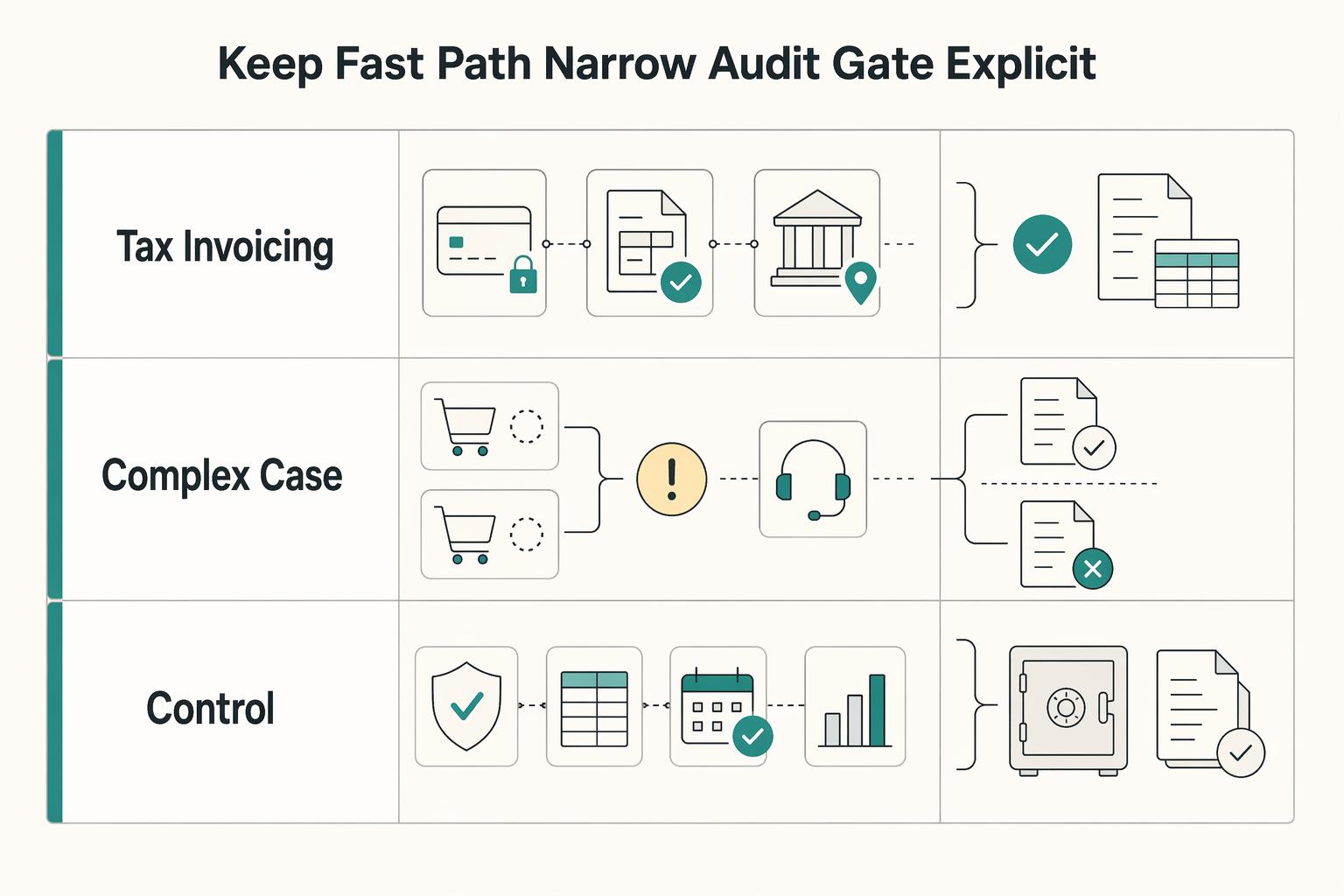
Keep the fast path narrow and the audit gate explicit#
| Area | Fast path | Audit gate | Owner |
|---|---|---|---|
| Tax and invoicing | Use one approved invoicing setup per market with localized customer-facing billing language | Verify document output, record retention, and posting path before launch | Finance with Ops |
| Identity | Keep low-friction signup where your program and market support it | Route changed account types, unusual geography, or incomplete records to review before sensitive actions continue | Ops with Product |
| Financial-crime controls | Keep standard monitoring and alert intake running from day one | Escalate flagged activity to manual review with a recorded decision and owner | Finance or Ops |
Keep your rails modular so payments, invoicing, and identity checks can evolve without a full product rewrite. Country and program coverage varies, so verify coverage and review requirements before each launch.
A short scenario: you launch localized checkout in a second market, and a customer retries after a timeout. Support now sees two upgrade messages. Your fast response is to route that case through retry handling and reconciliation before finalizing records, so the team resolves one confirmed outcome or one documented exception instead of carrying ambiguity into month-end.
Turn PLG into a repeatable system your team can trust#
If you want PLG to stay trustworthy, run one operating loop your team can repeat without renegotiating it every week. Keep the focus on three building blocks: your model choice, your ownership map, and your review cadence.
Define handoffs in writing and keep them stable long enough to learn. Choose your starting model (for example, Free Trial or Freemium), note what would trigger a rethink, and avoid ad hoc changes. Product owns activation and onboarding friction. Marketing owns acquisition quality. Sales engages when usage plus customer context shows intent. Customer Success owns adoption risk and expansion readiness after upgrade.
In your weekly review, every action gets a named owner and due date. If you use Slack Lists, pin the shared list in-channel and keep list discussion in threads so follow-ups stay visible without cluttering the main channel.
| Signal | What you check | Pass before you scale |
|---|---|---|
| Product signal | Are users reaching value through actual product use, and is the journey clear? | Value moments are repeatable and usage patterns are clear enough to guide next actions. |
| Revenue signal | Does commercial movement reflect how people actually use the product? | Upgrade and retention patterns align with observed usage, not guesswork. |
| Control signal | Are exceptions, refunds, and reviews assigned and traceable? | Cases have clear ownership, due dates, and records your team can follow end to end. |
Use a pause-fix-resume sequence when signals break. If signups rise in a new market but execution gets noisy and accountability drops, pause expansion first. Fix the broken handoff, then resume only after you can show stable usage signals, clear commercial alignment, and clean case ownership. For any market-specific legal or compliance item, mark unresolved requirements as verification-required until the current rule is confirmed.
Frequently Asked Questions
What is product-led growth in SaaS?
In product-led growth, you make decisions from product usage data and user experience, not from top-of-funnel volume alone. If users cannot reach value in a self-serve path, your PLG motion is not working yet. Your next move is to define a clear in-product value signal, then confirm it is captured cleanly before you spend more on acquisition.
How is PLG different from a sales-led model for B2B SaaS?
PLG moves people forward through product experience first, while sales-led growth relies more on direct sales interaction first. You should bias toward PLG when users can understand and prove value on their own. Bring in sales when buying friction shows up. Many buyers prefer to buy without sales interaction, which is why this distinction matters.
Should an early-stage SaaS choose Free Trial or Freemium first?
This guide does not support a fixed cutoff for when to choose Free Trial versus Freemium. Pick a starting model, then test it with a clear hypothesis and enough traffic for reliable results. Pair product-usage evidence with willingness-to-pay inputs from a price-sensitivity survey, plus non-converter feedback from a pricing-page pop-up and interviews with prospects who dropped off. Change models only after repeated evidence, not one noisy cycle. | Choice | Bias toward it when | Watch first | Red flag | | --- | --- | --- | --- | | Free Trial | You have a clear hypothesis to test | Conversion plus non-converter feedback | Traffic is too low for reliable test results | | Freemium | You need ongoing usage evidence before stronger pricing changes | Product-usage patterns plus drop-off feedback | Usage grows but diagnosis of messaging/value/price is still unclear | | Sales assist | Self-serve demand exists but buying friction appears | Win rate and lost deals | Too many segments and options reduce conversion |
What is a good free-to-paid conversion rate for PLG and how does ACV change that?
There is no universal good number, and a fixed benchmark by ACV is not established. Treat conversion as one signal alongside product-usage quality and account mix. If conversion slows, diagnose before you reprice. The issue may be messaging, value, or price, and you should gather proof with a pricing-page pop-up survey and interviews with prospects who dropped off. If you do raise prices, give 30-45 days of notice and phase the change by segment.
Which metrics should we instrument before scaling PLG experiments?
Start with product-usage signals tied to user experience and conversion outcomes. Before scaling any experiment, set a clear hypothesis and confirm you have enough traffic for reliable results. Add two concrete checkpoints: a pricing-page pop-up survey asking non-converters why they did not convert, and interviews with prospects who dropped off. At scale, revisit pricing at least quarterly (or a few times per year).
Who should own PLG across Product, Marketing, Sales, and Customer Success?
You should not let each team run on separate numbers. Keep one shared scorecard grounded in product usage and user experience, and use it to align decisions. When pricing or packaging changes come up, present them in sales terms like win rate and lost deals so the debate stays evidence-based. Keep segmentation focused (for example, 3-4 priority segments) and plans simple, because too many options can hurt conversion.
How can we implement PLG without creating compliance and audit risk in cross-border operations?
Keep claims process-level, assign clear owners, and verify market-specific requirements before rollout. If a requirement is not yet verified, label it as pending rather than treating it as settled.
Try a related tool
Researched and edited by the Gruv editorial team. Gruv builds cross-border billing, payouts, and finance-operations software for global businesses.
Sources
Includes 3 external sources outside the trusted-domain allowlist.
- board.oc.gov/sites/bos.egovoc.com/files/2026-02/rev-sup02...trusted
- chicago.gov/content/dam/city/depts/obm/supp_info/2026Bud...trusted
- cppa.ca.gov/regulations/pdf/rm2_pre_comments_27_52.pdftrusted
- federalregister.gov/documents/2025/11/05/2025-19787/medicare-and...trusted
- njeda.gov/wp-content/uploads/2025/12/December-15-2025-...trusted
- christianstrunk.com/blog/plg-metricsexternal
- ideaplan.io/plg-guide/readexternal
- kotzabasis.com/product-led-growth-plg-the-ultimate-saas-gro...external
Educational content only. Not legal, tax, or financial advice.
Related Posts

Digital Nomad Health Insurance Comparison for Long-Stay Moves
Use focused time now to avoid expensive mistakes later. Start with a practical `digital nomad health insurance comparison`, then map your route in [Gruv's visa planner](/tools/visa-for-digital-nomads) so we anchor policy checks to your real plan before pricing pages pull you off course.

Build a Freelance Sales Funnel You Can Run in One Hour a Week
Start smaller than you want. Your freelance sales funnel should survive a normal delivery week, not a rare week when you happen to have extra energy. If you cannot maintain it without pushing client work aside, it is not usable yet.
Content Marketing for B2B SaaS That Holds Up Under Real Work
If your publishing is inconsistent, nobody clearly owns decisions, and each post dies after one channel, you do not have an ideas problem. You have an operating problem. For a solo operator or lean team, your content gets more reliable when you document a few non-negotiable rules and review points.