
Quick Answer
Inventory payer entities, payee types and signed documents. Route U.S. persons to W-9 and foreign payees to the appropriate documentation. Preserve original dates and effective history, reconcile exclusive form categories, and validate payment-specific withholding/reporting decisions before cutover. Roll back defective data mappings without replaying executed payments.
What Triggers a W-8/W-9 Migration Review#
A tax-profile migration can copy the right labels while losing the signed forms, validity dates or payment history that make those labels usable. Before a marketplace relies on the target system, compliance, finance and operations need to prove which evidence survived, who resolves exceptions and which tax treatment applies to each payment.
Before you start#
Step 1. Classify the payee and select the appropriate documentation. Form W-9 documents U.S. persons, including U.S. citizens living abroad and resident aliens. Form W-8BEN generally documents foreign individual beneficial owners; foreign entities may need W-8BEN-E, while intermediaries, effectively connected income and personal-service treaty claims require distinct review paths. Preserve separate queues for each supported form and unresolved cases. An address alone does not determine U.S. person status.
Step 2. Determine reporting from the payment facts as well as the form. A W-9 does not automatically create a 1099-NEC obligation, and a W-8 does not automatically create a 1042-S obligation. Record the responsible payer, payment type, service location, amount, tax year, payment channel and applicable exemptions. For covered nonemployee compensation, the general 1099-NEC threshold is $2,000 for tax years beginning after 2025; use the proper prior-year rules when migrating history. Card and covered third-party network transactions follow separate 1099-K reporting rules. Keep reporting decisions separate from form-validity status.
Step 3. Set the operating boundary before you move money. This guide focuses on U.S. tax form handling inside marketplace operations, not every tax classification edge case. The practical question is not just whether a payee submitted a document. It is whether the tax profile now has the right form, the right status, and enough supporting data to let you release payouts without creating downstream reporting trouble.
One early failure mode is treating the Form W-9 versus Form W-8BEN decision as only a migration-mapping issue. In practice, that choice can affect TIN collection for U.S. persons, foreign-status evidence for non-U.S. individuals, and readiness for Form 1099-NEC or Form 1042-S later. If residency signals, identity details, or the existing form record conflict, treat the case as a candidate for a payout hold and an escalation checkpoint rather than a same-day override.
Use the remaining steps to assign control owners, preserve signed evidence and resolve migration defects before payout or reporting decisions rely on the new system.
Set scope and prerequisites before touching production data#
Do not migrate any tax profile set until scope, source records, and approvals are explicit. If you cannot name the legal entity, jurisdiction, payee cohort, source record, and approver, pause the migration.
Step 1 Map the scope by entity, jurisdiction, and payee cohort#
Inventory marketplace entities, payer or withholding-agent roles, operating jurisdictions and payee cohorts. Separate U.S. persons, foreign individuals, foreign entities and unresolved classifications. Identify the supported documentation paths and the payments each entity actually makes before exporting records.
Use a control sheet that shows, for each cohort, where the current Form W-9 or Form W-8 record lives, who owns that source, and whether the target profile should preserve or replace it. This helps catch tax-status data stored outside the main profile, such as in a country site, legacy vendor table, or onboarding tool.
Step 2 Confirm the minimum production controls#
Before production migration, confirm encrypted storage, least-privilege access, and an audit trail. Least privilege means granting only the minimum authorizations needed, and an audit log is a chronological record of accesses and operations.
Make tax-profile create/update events time-ordered and reviewable. Confirm encryption, access restrictions and logging before moving sensitive records. Publication 1075 governs protected federal tax information within its applicable scope; collecting private W-8/W-9 forms does not by itself bring every marketplace under that publication. Security owners should document the actual legal, contractual and internal requirements.
Step 3 Lock owners and approval gates#
Set sign-off gates across compliance, legal, finance, and marketplace ops before production changes begin. Use a RACI matrix to define who approves cohort scope, who can place or release payout holds, who accepts exceptions, and who can halt cutover.
Approval gates should pause and review work before go-live, not approve changes after tax data is already in production.
Decide form routing rules before moving any records#
Lock form-routing rules before migration starts. Support W-9, the appropriate W-8 forms and specialist review, including Form 8233 where relevant to personal-service treaty claims. Do not infer the form from a country field or make every missing document a universal statutory payout prohibition.
Step 1 Build the routing table#
Keep the table simple enough for ops to execute and engineering to enforce.
| Payee/payment pattern | Documentation path | Review trigger | Reporting decision |
|---|---|---|---|
| U.S. person | W-9 with correct owner/name/TIN | Conflicting status or unresolved TIN evidence | 1099-NEC only for qualifying payments; examine exemptions, year and channel |
| Foreign individual beneficial owner | Generally W-8BEN; specialist paths for services/treaty or other cases | Conflicting U.S. status, validity or payment-source facts | 1042-S for covered payments; foreign-source services generally excluded |
| Foreign entity or intermediary | Appropriate W-8 form based on actual role | Owner, entity classification or intermediary documentation unclear | Determine payer/withholding role and income treatment separately |
| Unresolved facts | Preserve current evidence; request missing support | No automatic final classification | Tax owner records payment, withholding and reporting decision |
Do not route from country or state alone. Compare the scoped tax profile, current onboarding inputs, and migrated values before assigning a route.
Step 2 Add conflict gates before payouts move#
Stop automatic classification when evidence genuinely conflicts with the stored status. An address change alone is not a status change: a U.S. citizen abroad can still use W-9. Record the contradictory facts and ask the tax owner what additional support is needed before changing documentation or payment treatment.
For each routed case, retain a clear trail of the source signal, the requested or preserved form, and any exception approval.
Step 3 Tie each route to reporting outputs#
Use the 1042-S instructions for payments within their reporting scope. Service income is generally sourced where work is performed, rather than where the payer or bank is located. Foreign-source service income is generally not reportable on 1042-S; covered U.S.-source payments to foreign persons may be reportable even where a treaty removes withholding. A withholding agent required to file 1042-S generally also files Form 1042. Resolve the payer role and payment facts before assigning either output.
Send ambiguous status, conflicting records and documentation defects to the tax owner. Include the current and prior signed forms, identity fields, validation results, payment facts and payout status. Record why the withholding/reporting decision applies instead of closing a case from a legacy label.
Assign control owners and escalation checkpoints#
Name control owners before cutover so payout holds, exception decisions, and audit-trail evidence do not depend on ad hoc judgment under deadline pressure.
Step 1 Assign decision rights by control type#
Use a simple RACI-style map with clear decision boundaries: compliance owns form-classification disputes and evidence sufficiency, finance or payments risk owns payout hold placement and release, operations runs data-integrity checks, and product/engineering owns audit-trail field and event completeness.
| Control area | Owner | Stated responsibility |
|---|---|---|
| Form-classification disputes | Compliance | Owns form-classification disputes and evidence sufficiency |
| Payout holds | Finance or payments risk | Owns payout hold placement and release |
| Data-integrity checks | Operations | Runs data-integrity checks |
| Audit-trail completeness | Product/engineering | Owns audit-trail field and event completeness |
Operations should not clear conflicting Form W-9 versus Form W-8BEN status for speed alone. For every held record, you should be able to identify who detected the issue, who applied the hold, who owned the exception SLA, and who made the final form decision.
Step 2 Set severity triggers before cutover#
For covered reportable payments to nonexempt payees, a missing or obviously incorrect TIN can require 24% backup withholding. Handle IRS name/TIN mismatch notices through the applicable CP2100/CP2100A and B-notice procedure. An internal mismatch flag is evidence to investigate, not a substitute for identifying the actual statutory trigger. Assign a tax owner and record the applicable payment and payee exceptions.
| Trigger | Severity | Handling note |
|---|---|---|
| Missing/obviously incorrect TIN or IRS mismatch notice | Urgent tax review | Determine applicable backup withholding and notice action for covered payments; separate internal validation flags |
| U.S.-versus-foreign status conflict | Stop automatic classification | Review status and appropriate W-8, W-9 or specialist documentation; determine payment treatment |
| Missing consent artifacts | Escalate internally | Not an IRS-defined trigger, but it weakens evidence quality |
| Repeated profile edits near cutover | Escalate internally | Not an IRS-defined trigger, but it weakens evidence quality |
Treat U.S.-versus-foreign status conflicts as a hard stop. If the profile indicates nonresident or foreign status, Form W-9 instructions point the requester to the appropriate Form W-8 or Form 8233 instead of standard W-9 handling. Missing consent artifacts or repeated profile edits near cutover are not IRS-defined triggers, but they should still escalate internally because they weaken evidence quality.
Step 3 Require dual release approval and complete logging#
Dual approval by compliance and finance can authorize release of an internal hold only after the tax treatment is supported. It cannot waive required withholding, supply a missing statutory certification or make an unsupported treaty claim valid. If payment may proceed with withholding, record the gross amount, tax withheld, net payout and deposit/reporting obligations before release.
Engineering should log each tax-profile create, update, hold, release, and exception decision with timestamp, actor, prior value, new value, source signal, and linked document status. Records should remain inspectable and retained for as long as they may be material to tax reporting, audits, or internal review.
Build the migration evidence pack and validation sequence#
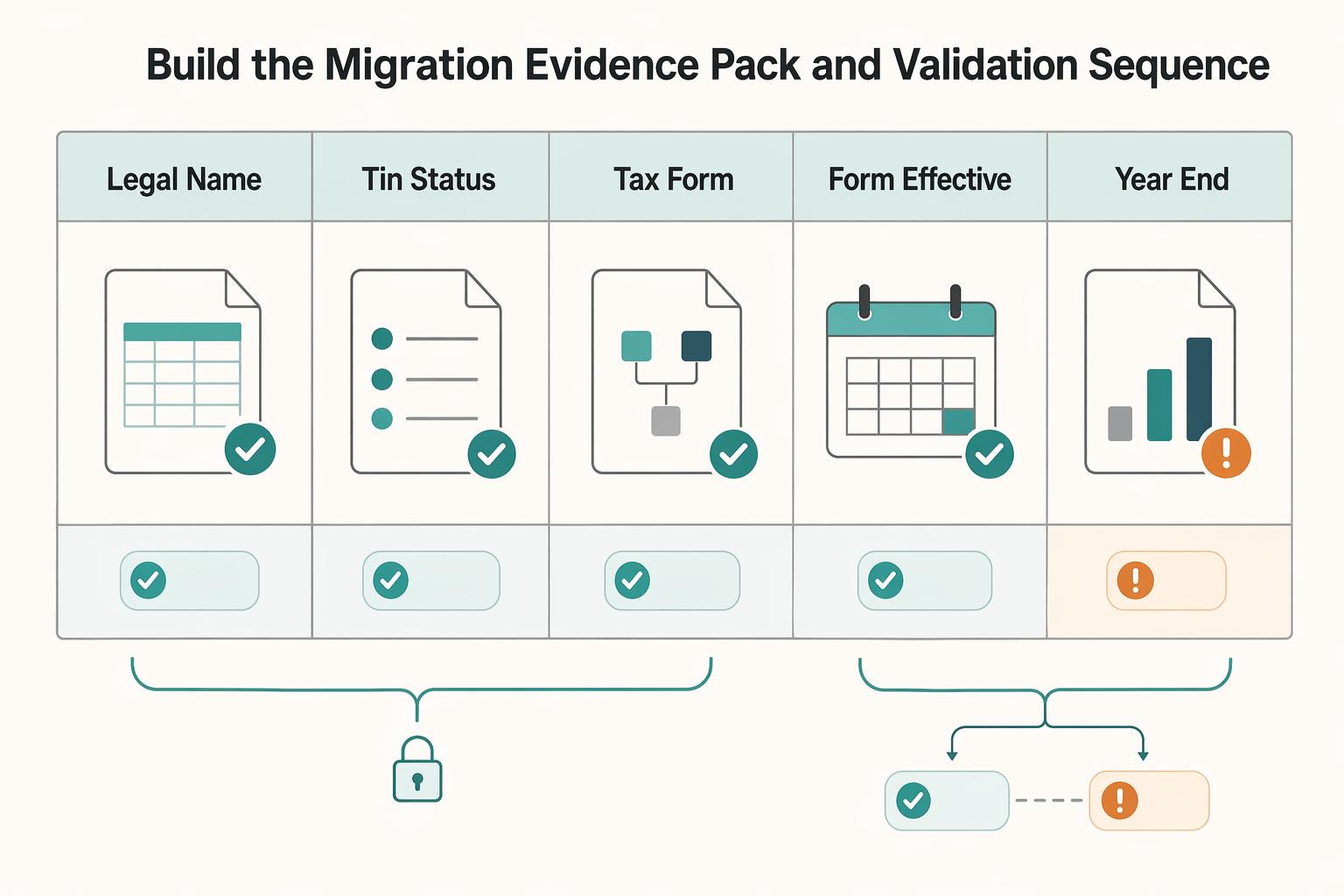
Before cutover, your approvers need evidence that each migrated tax profile still supports the correct payout treatment and year-end reporting path. If that evidence is incomplete or conflicting, call no-go.
Step 1 Assemble a pre-cutover evidence pack that is reviewable. Include source exports for the in-scope population, a field-mapping dictionary, migration transformation rules, and expected record counts by form type for the wave. Version these artifacts by date and wave so reviewers can tie each dry run to the exact inputs. Keep updating migration metadata and wave inputs as scope changes rather than validating against stale discovery data.
Reconcile source and target totals using mutually exclusive categories: W-9, W-8BEN, W-8BEN-E, other supported forms and unresolved cases. A W-8 family total is a subtotal, not another category to add to W-8BEN. Account separately for excluded, merged, superseded and deferred records so each source record has a documented destination.
Step 2. Reconcile classification and reporting fields. For a hypothetical 100-record wave, suppose the inventory has 50 W-9, 30 W-8BEN, 10 W-8BEN-E, 5 other-form and 5 unresolved records. The foreign-form subtotal is 45; adding it again would falsely produce 145 records. If 95 records load to the target and 5 stay in a controlled exception queue, reconcile 95 + 5 = 100 and verify every source ID has exactly one disposition. Then inspect the fields below; equal totals alone do not prove correct identity or tax treatment.
| Field | What to verify | Why it matters |
|---|---|---|
| Legal name | Exact match or documented normalization | For Form W-9, name and TIN alignment is required to avoid backup withholding errors |
| TIN status | Same status in source and target (for example present, missing, unverifiable) | Form W-9 is used to provide a correct TIN |
| Tax form type | Form W-9 vs Form W-8/W-8BEN stays consistent unless approved exception exists | This determines U.S. vs non-U.S. tax handling path |
| Form-effective status | Active/inactive/superseded/expired state carries over correctly | Prevents inactive or superseded forms from driving decisions |
| Reporting decision | Payer, tax year, payment type/source/channel and documented exemptions | Form family alone does not determine the information return |
| Signed form and validity interval | Original document, signature authority/timestamp, receipt, expiry and changes in circumstances | Migration must preserve evidence and cannot renew a form or rewrite historical payment treatment |
If address is part of your tax identity controls, reconcile it too.
Step 3 Run dry-run comparisons and define stop conditions in advance. Compare source and target record-by-record, not only totals. Treat cosmetic changes, such as casing or whitespace normalization, as acceptable only when they do not change tax treatment. Treat changes to identity fields, tax form type, form-effective status, or reporting tags as blocking until resolved.
Keep a mismatch log that labels each difference as acceptable, remediated, or blocking. If reviewers cannot reconstruct why a mismatch was accepted, treat it as unresolved.
Step 4 Include security and audit evidence, then issue a go/no-go packet. Include the evidence your reviewers need to reconstruct what happened across systems: access logs, audit log samples, and the controls applied to tax-data review surfaces for that wave. The packet should name signers, open risks, and rollback criteria tied to specific failure modes.
Stop migration for unexplained count variance, defective routing, missing signed evidence or access-control failures. Restore defective mappings or profile versions through the approved recovery path, preserving new submissions and historical evidence. Data rollback must not undo or replay payouts, erase withholding records or overwrite a later valid tax status.
Keep the recovery point, change log and owner approvals in the same evidence pack. Test recovery with nonproduction records before approving cutover.
Execute cutover with go/no-go and rollback decisions#
Cutover should stay controlled: freeze risky changes, run formal gates, migrate, validate, and only then reopen writes. If a gate fails, use the preplanned no-go or rollback path instead of patching live tax records under payout pressure.
Step 1. Freeze in-scope writes and preserve a recovery point. Freeze tax-profile edits for the cohort or capture them in a controlled change queue. Keep signed forms and subsequent submissions with original receipt/signature dates. A database migration does not renew a form: W-8BEN generally expires at the end of the third succeeding calendar year unless an exception applies, and a change in circumstances can invalidate it earlier. Record the actual validity rule and effective interval; do not reset dates at cutover.
Step 2 Run formal go/no-go gates at T-1 and T-0. Use T-1 to confirm ownership, escalation paths with response-time expectations, and rollback readiness. Use T-0 to reconcile the frozen source against the approved migration package immediately before start.
| Checkpoint | Pass only if | Action if it fails |
|---|---|---|
| T-1 go/no-go | Sign-offs are current, backup is confirmed, escalation coverage is active, open risks are accepted or remediated | No-go |
| T-0 pre-flight | Frozen counts still match expected counts, no unapproved post-freeze edits, migration package matches approved version | No-go and reconcile |
| Post-migration validation | Sample checks preserve form type, effective status, and reporting path | Roll back the wave for systemic defects; isolate affected records if defects are limited |
Step 3. Migrate and validate records across every exclusive form category. Sample W-9, W-8BEN, W-8BEN-E, other supported forms and unresolved cases, including reportable and excluded payments. Confirm source links, original dates and effective history. Apply temporary internal holds to affected cases where treatment remains unresolved, with an owner, required evidence and explicit release conditions. Sampling supplements record-by-record mapping checks; it does not excuse missing signed evidence.
Step 4 Reopen controlled writes only after traceability is complete. Reopen edits in a controlled sequence after validation passes and exception records are contained. Execution logs should support end-to-end reconstruction with owner, planned and actual timing, status, and notes. Capture exception decisions in the audit trail so reviewers can trace what was approved, when, and for which records.
A W-8 form draft can help prepare fields, but the migration must preserve the actual signed form and reviewed tax position. Generating a draft does not establish foreign status or treaty eligibility.
Stabilize the first 30 days after migration#
A clean cutover is not the finish line. For the next 30 days, run tight operating controls so tax-profile changes do not quietly break payout behavior or year-end reporting.
Watch for drift every day#
Use daily reconciliation as a control, not a legal requirement. Review every tax profile changed since the last check, including form type, effective status, payout treatment, and the reporting path for Form 1099-NEC or Form 1042-S.
Review changed profiles against the relevant payment facts and effective dates. Foreign-source services generally do not enter the 1042-S path simply because a foreign payee supplied W-8BEN. Keep completed, pending and invalid-document states distinct, with traceable reasons and the reporting decision for each covered payment.
Treat queue age as a reporting-risk signal#
Queue age should drive risk decisions, not just ops reporting. Track manual-review aging against your exception SLA targets and prioritize items that could block complete Form 1099-NEC or Form 1042-S outcomes.
Do not rely on overdue-only views. Use queue controls that flag records likely to miss SLA, then prioritize by reporting impact first, payout impact second, and age third.
Treat repeat edits and reopened cases as defect signals#
Repeat edits and reopened cases are usually a process signal, not just operator noise. If the same record is edited multiple times or reopens under the same reason code, treat it as a likely routing-rule or status-mapping defect until proven otherwise.
Run a weekly trend check across reopened cases, repeated payout holds, and duplicate manual-review reasons. If patterns repeat across operators, fix the rule, prompt, or mapping before scaling reviewer capacity.
Publish a weekly risk log#
Publish one weekly risk log with unresolved escalations, payout hold counts, queue-aging risk, and a named remediation owner for each issue. Keep it short, but specific enough for compliance, finance, and ops to act.
Do not carry open escalations without a clear owner and next action date. In this first month, unclear ownership is itself a control failure.
Handle common failure modes without overbuilding process#
Do not default to full rollback after every post-cutover issue. Use phased remediation for isolated defects, and switch to rollback when routing logic, reporting tags, or other shared controls are affected across a cohort.
| Failure mode | Immediate response | Follow-up |
|---|---|---|
| Wrong form | Suspend automatic release for affected case | Resolve documentation and supported payment/withholding/reporting treatment |
| TIN or identity conflict | Tax review with exact trigger | Distinguish missing/obvious TIN error, IRS notice and internal mismatch |
| Systemic routing or audit-link defect | Recover affected mapping/profile cohort | Preserve valid later forms and historical payments; replay data transformations only |
| Isolated intake defect | Correct affected records | Validate shared paths before expanding remediation |
Step 1. Isolate wrong-form records and determine the payment treatment. Suspend automatic release for affected cases under the internal migration policy. Request appropriate documentation, resolve the payer role and service/payment facts, then determine whether payment can proceed, requires withholding or must remain held. Record the applicable reporting outcome, including cases with no U.S. information-return requirement.
For U.S.-source independent personal-service compensation to a nonresident alien, 30% chapter 3 withholding generally applies unless an applicable exemption or arrangement is established. An individual claiming a personal-service treaty withholding exemption generally uses Form 8233, rather than treating a W-8BEN treaty checkbox as sufficient. Preserve review, acceptance and required submission evidence. Foreign-source service compensation is a different case.
Step 2. Investigate TIN or identity conflicts. Separate a missing or obviously incorrect U.S. payee TIN, an IRS mismatch notice and an internal name-normalization discrepancy. The tax owner determines withholding and notice action; the migration owner resolves mapping defects. Maintain an internal hold when the supported payment treatment remains unresolved, with a named owner and next action.
Your evidence pack should include the submitted form, onboarding identity data, conflicting fields, and clear case notes. Do not release funds based on a promise of later cleanup.
Step 3. Recover the affected cohort when the defect is systemic. Restore mappings or profile versions using the approved recovery plan, while retaining signed submissions, valid subsequent changes and the payment-date status history. A profile rollback does not reverse executed payments or tax deposits; those need their own authorized correction process.
Replay only validated data transformations, not payment instructions. Rerun counts, signed-document links, effective intervals and reporting-decision checks. Keep each executed payment and withholding entry tied to the tax profile version used at the time; correct reporting through the applicable amendment process where needed.
Step 4. Apply one decision rule to limit remediation risk. Use phased remediation when the defect is isolated and contained to a narrow intake path. Use rollback when the same error appears across shared routing, status mapping, or reporting tags. Planned rollback is disruptive, but emergency rollback is usually worse.
Final checklist to reduce regulatory surprises#
Migration is only complete when you can prove routing is correct, unresolved records are controlled, and year-end reporting outputs are ready.
- Freeze routing rules with record-level evidence.
Document W-9 and appropriate foreign-documentation routes with evidence and effective dates. Separate form selection, payment eligibility, withholding and reporting decisions. Keep unresolved cases in review under the internal hold policy, and retain valid later submissions rather than overwriting them with a restored legacy profile.
- Lock go/no-go, rollback, and payout-hold triggers as an internal control.
IRS guidance does not prescribe your meeting format, so treat this as your governance checkpoint before release. Confirm owners agree on the same failure triggers, including missing or incorrect TIN, wrong form type, reconciliation mismatch, or unclear reporting path.
- Close the evidence pack before declaring success.
Preserve mapping, mutually exclusive count reconciliations, exceptions and signed-document/audit links. IRS independent-contractor guidance recommends keeping W-9 for four years; apply the actual retention duties and longer holds where needed. Keep evidence for historical payment and reporting decisions accessible after profile changes.
- Verify reporting readiness, not just profile quality.
Verify the applicable reporting output and payer for each payment type and year. The general electronic-filing threshold is 10 combined information returns, subject to the applicable aggregation rules, exemptions and waivers; confirm the current instructions for the forms actually filed. Do not treat a W-8/W-9 form count as a return count.
- Publish unresolved risk before closeout.
Keep a visible log of open exceptions with owner, payout status, next escalation step, and target decision time. If you cannot quickly identify cases that still threaten TIN correctness, 1099-NEC completeness, or 1042-S coverage, the migration is not ready to close.
Frequently Asked Questions
What is the first step in a W-8/W-9 migration for a freelancer marketplace?
Inventory the payer entities, payee types, signed forms and payment facts before moving records. Establish U.S.-person, foreign-individual, foreign-entity and specialist-review paths, then validate legacy classifications rather than bulk-copying labels.
When should a platform collect Form W-9 instead of Form W-8BEN during contractor onboarding?
Use W-9 for U.S. persons, including resident aliens and U.S. citizens abroad. W-8BEN generally documents foreign individual beneficial owners, while foreign entities and other income or intermediary cases may require different documentation. Investigate conflicting signals; an address alone does not decide status.
Which controls are mandatory before tax-data cutover in production?
Approve security, document preservation, routing, withholding and recovery controls for the actual payer/payment model. Preserve signature and receipt dates, effective intervals and change history. Give missing TINs, IRS mismatch notices and foreign-status conflicts distinct tax-review paths. Internal go/no-go controls do not replace statutory withholding or filing duties.
What events should trigger a payout hold during migration?
Hold automated release where the migration leaves tax treatment unsupported or the internal risk policy requires review. Determine whether the payment legally may proceed with withholding instead of assuming every missing TIN requires a complete payout freeze. Record the actual trigger, required documentation, owner and release condition; dual approval cannot waive tax duties.
How should teams validate migrated records before year-end tax reporting starts?
Reconcile mutually exclusive form categories, then inspect signed evidence, validity dates, status versions and the payment facts that determine reporting. Check both reportable and excluded cases, including foreign-source services and covered card/network payments, rather than forcing every payee into 1099-NEC or 1042-S.
When should compliance escalate to external tax counsel instead of resolving internally?
Escalate material or ambiguous status, beneficial-owner, service-source, treaty or withholding questions. Use outside tax advice where the responsible team cannot support the documentation and payment treatment. Business urgency does not establish a tax position.
Try a related tool
Researched and edited by the Gruv editorial team. Gruv builds cross-border billing, payouts, and finance-operations software for global businesses.
Sources
- irs.gov/instructions/iw9trusted
- irs.gov/instructions/iw8bentrusted
Educational content only. Not legal, tax, or financial advice.
Related Posts

The Freelance Payment Penalty: A Modeled Audit of Platform Fees, FX Spreads, and Payout Delays
The money rarely disappears through a single, easy-to-spot fee. The real loss is stacked. A marketplace takes its commission, a processor adds a charge for international cards, a bank or payment company converts the currency at a spread, a platform holds the funds before release, and a wire sheds a little to intermediaries on the way in. Each layer looks defensible on its own, but the worker feels the combined result as a smaller deposit and a later payday.

How to Respond to a Subpoena for Business Records
Move fast, but do not produce records on instinct. If you need to **respond to a subpoena for business records**, your immediate job is to control deadlines, preserve records, and make any later production defensible.

A US Expat's Guide to Investing in UCITS ETFs to Avoid PFIC Issues
The real problem is a two-system conflict. U.S. tax treatment can punish the wrong fund choice, while local product-access constraints can block the funds you want to buy in the first place. For **us expat ucits etfs**, the practical question is not "Which product is best?" It is "What can I access, report, and keep doing every year without guessing?" Use this four-part filter before any trade: