
Quick Answer
Build a chargeback risk playbook for platforms around four decisions: prevent, fight, accept, or escalate. Start by mapping liability and loss concentration across card checkout, invoice links, bank transfer, and VBA flows, then run every case through a triage matrix tied to reason-relevant evidence, costs and actual case deadlines. Assign explicit stage owners, keep a reason- and flow-specific evidence checklist, and connect dispute actions to recovery accounting so finance and ops can reconcile from the same record. Keep missing-data cases visible and retrieve gaps urgently; an incomplete internal record does not suspend the response clock.
What Daily Chargeback Decision Rules Should Cover#
If you run a marketplace platform or an embedded payments product, generic merchant advice leaves gaps. This playbook is for the team making decisions across product, ops, finance, and engineering, not a single merchant storefront.
A chargeback is a formal card-network dispute initiated through the issuer. Merchant dispute guides explain the network process, while platform teams also need to identify who owns the loss, who holds the evidence and which controls reduce risk without disrupting legitimate volume.
That ownership question matters early. In some marketplace charge types, the platform is liable for chargebacks and related costs, including destination charges and separate charges and transfers. If finance assumes the seller absorbs the loss but your payments setup says the platform does, the process breaks exactly when speed matters. Before you tune any controls, confirm which payment flows leave liability on the platform versus the connected party in your current setup.
This guide is built around four decisions you actually have to make. When should you prevent a bad payment before it lands? When should you defend it through representment? When should you accept the loss and move on? When should you tighten controls only for the risky segment instead of everyone? That last call is where many teams get into trouble. One failure mode is adding blanket checkout friction after a loss spike instead of targeting the segment driving disputes.
Scope matters because dispute behavior is not uniform. The flow can differ by card scheme and payment method, and whether a payment can be disputed depends on the method used. Card payments can be disputed. Bank transfers are not disputed in the same way. For invoice links and VBA flows, look at the underlying payment rail and the program rules rather than treating the label of the flow as the operational answer.
The lens here is practical. We will map risk by flow, set owner boundaries, define evidence standards, and give you clear rules for fight, accept, or escalate decisions. There is no universal setting for this. There is, however, a workable way to cut losses while keeping checkout and payout usable.
What to prepare before you touch chargeback controls#
Before you tighten checkout rules or add payout holds, lock down ownership, baseline visibility, evidence operations, and policy blockers. If those are unclear, control changes usually create confusion instead of reducing losses.
| Area | What to confirm | Checkpoint |
|---|---|---|
| Ownership and handoffs | Assign one accountable owner for dispute management end to end; split technical webhook handling from dispute review | For a new dispute, name who receives the webhook, who reviews the case, and who records the finance impact |
| Baseline visibility | Pull latest dispute reasons, current SLA targets, and existing KPI dashboard view | Review trends across pending, open, and defended disputes, not only total volume |
| Evidence retrieval | Decide required fields, log location, and webhook storage and query rules in advance | Reviewer can retrieve the provider event, internal transaction record, and customer communication without an engineering escalation |
| Policy and verification constraints | Check the actual provider/account requirements and permitted payout controls | For Stripe Accounts v1, use current_deadline and enabled flags; distinguish a live platform pause from a manual payout schedule |
-
Assign one accountable owner and explicit handoffs. Keep payments ops, finance, product, and engineering involved, but make one person accountable for dispute management end to end. Split responsibilities clearly: technical webhook handling and dispute review are different jobs. Checkpoint: for a new dispute, can you name who receives the webhook, who reviews the case, and who records the finance impact?
-
Set a baseline from current dispute operations. Pull your latest dispute reasons, current service-level agreement targets, and existing KPI dashboard view before you change controls. Keep reason-code analysis payment-method specific, and review trends across pending, open, and defended disputes rather than only total volume.
-
Define an evidence checklist around event retrieval. Decide required fields, log location, and webhook storage/query rules in advance. Stripe webhook events arrive as JSON, automatic retries run for up to three days in live mode, and Stripe Events listing covers up to 30 days. Retain needed dispute evidence internally beyond those retrieval windows. Checkpoint: a reviewer can retrieve the provider event, internal transaction record, and customer communication without an engineering escalation.
-
Check applicable verification and policy constraints. For Stripe Accounts v1, inspect
requirements.currently_due,current_deadline,past_dueanddisabled_reason, alongsidecharges_enabledandpayouts_enabled. Deadlines depend on the account’s capabilities and requirements; do not assume a universal 14-day grace period. For Accounts v1 where the platform is liable for negative balances, a live platform payout pause blocks automatic and manual payouts, while a manual payout schedule alone does not prevent an authorized manual release.
Map risk by flow before you optimize anything#
Start with flow-level concentration: if one payment path drives most losses, fix that path before rolling out platform-wide controls.
Split exposure by lane (card checkout, invoice links, bank transfer, VBA), then identify the balance that absorbs the amount and fees. For Stripe Connect destination charges and separate charges and transfers, disputed amounts and associated fees debit the platform balance and the platform is ultimately liable. Direct charges use a different balance and responsibility model; map the actual charge type and negative-balance liability rather than extending the indirect-charge rule to all Connect payments.
Use a simple checkpoint: for any dispute, can your team identify the payment path and the balance that absorbs amount plus fees from a single report? If not, your map is still too abstract to drive control decisions.
Keep scheme/payment-method reason codes separate from your internal cause buckets, then link each cause to one lever:
| Cause bucket | What to verify | Primary lever |
|---|---|---|
| True fraud | Whether the payment was unauthorized or clearly abusive, using method-specific reason data plus your transaction record | Checkout friction |
| Friendly fraud | Whether a legitimate purchase was later disputed by the cardholder | Documentation quality |
| Fulfillment mismatch | Whether delivery/access/description records support what was promised | Documentation quality or payout delay |
| Technical failure | Whether retried events or idempotency gaps created duplicate or conflicting states | Instrumentation and routing |
Do not force card-style dispute handling onto bank transfer or VBA by default. Map those rails separately, classify whether you are dealing with a formal chargeback, another dispute type, or an internal loss event, and assign controls from there.
If one flow is producing most losses, prioritize that flow first. It is usually faster to validate and less disruptive than broad changes across all checkout and payout paths.
You might also find this useful: Vendor Risk Assessment for Platforms: How to Score and Monitor Third-Party Payment Risk.
Set owner boundaries so disputes do not stall in handoffs#
Assign ownership by stage, not by department, so each dispute has a clear path from notice to ledger entry. If ownership is unclear, cases stall and deadline risk rises.
Name one owner for each stage#
Set one accountable owner for each stage of chargeback management: prevention logic, investigation, representment, and recovery accounting. Keep one accountable person per stage, even when multiple teams are consulted.
This is critical when platform liability sits with the marketplace. On Stripe Connect, your platform is liable for chargebacks and related costs for destination charges and separate charges and transfers.
Checkpoint: for any new dispute, can you name one owner and one due date within minutes of the notice?
Write the RACI around systems, not the org chart#
Build a compact RACI around the systems your team uses in day-to-day dispute handling:
- Who monitors dispute webhooks and confirms they are firing
- Who works the exception queue and assembles evidence for investigation or representment
- Who approves finance adjustments and posts recovery accounting entries
Handoffs often break at webhook ownership. Dispute notifications mark the start of the defense period, so an alert with no clear responder is already lost time.
Add escalation triggers before cases sit too long#
Add escalation triggers to your operational runbook so high-risk cases bypass normal queue order. At minimum, escalate when evidence deadlines are near, platform-funded exposure is high, or seller documents needed for defense are missing.
Treat deadline protection as non-negotiable: missing evidence submission deadlines can result in automatic loss. Keep triggers specific to processor and rail instead of assuming one RACI model fits every path.
Build a fight accept escalate decision matrix your team can run daily#
Your team should be able to route every new dispute to one of three internal actions: fight, accept, or escalate. Keep the matrix simple enough to run under deadline pressure: miss the response deadline and you automatically lose the dispute, and Stripe describes usual 7-to-21-day windows, while the actual provider case deadline controls.
Build rows reviewers can score fast#
Use one row per dispute, with columns your reviewers can score quickly:
- signal quality
- dispute type
- evidence strength
- customer value
- operational cost
- time to deadline
- current exception queue depth
Treat provider scores as prioritization signals when available, not the final decision or a guaranteed win probability. Review the actual claim, reason-specific evidence, deadline and cost before choosing an action.
Before submission, assemble the evidence relevant to the actual dispute reason and verify the case can still be challenged. Missing internal records should trigger urgent retrieval, not automatically end the defense. Stripe’s Dashboard allows one submitted response with no later additions, so review the selected evidence before sending it.
Write explicit if-then rules#
Make rules explicit so outcomes do not depend on who opens the case.
| Internal action | Choose it when | Operator note |
|---|---|---|
| Fight | Reason-relevant evidence supports defense and likely recovery justifies cost within the actual deadline | Retrieve gaps before submission; do not require every internal reporting field |
| Accept | Claim is valid, defense is uneconomic or relevant evidence cannot be obtained in time | Record the basis for acceptance and repair recurring gaps |
| Escalate | High exposure, unclear liability or evidence needing urgent retrieval | Keep the live owner/deadline; decide fight or accept before the provider cutoff |
For a formal chargeback, the response is to challenge with evidence or accept the dispute; internal escalation must resolve before the provider cutoff. Pre-dispute inquiries have a different state: on Stripe, accepting an inquiry does not resolve it, so follow the inquiry response process.
Make timing and capacity visible#
Use the actual deadline on each provider case. Stripe describes response windows usually between 7 and 21 days, depending on the network. Adyen PULSE requires defense documents within 30 days after the Notification of Chargeback. Those examples do not establish a universal Mastercard or platform-wide window.
| Flow or guidance | Window | Ops note |
|---|---|---|
| Stripe card disputes | Usually 7–21 days; actual case deadline controls | Use the provider case record, not a generic network estimate |
| Adyen PULSE | 30 days from Notification of Chargeback | Documents cannot be updated later in this process |
| Other methods/networks | Provider- and case-specific | Record the actual deadline and evidence requirements at intake |
Use remaining time and live queue depth to prioritize defensible cases. Escalate missing evidence early enough to retrieve it before the actual deadline. A case can merit defense without every internal reporting field being complete; judge the reason-relevant evidence and expected recovery against costs.
Your one-page output should run in daily ops and finance review. Quick check: give the same disputes to two reviewers. If they land on different actions most of the time, your matrix is still too vague.
We covered this in detail in Device Fingerprinting Fraud Detection Platforms for Payment Risk Teams.
Instrument evidence so every case is defendable and auditable#
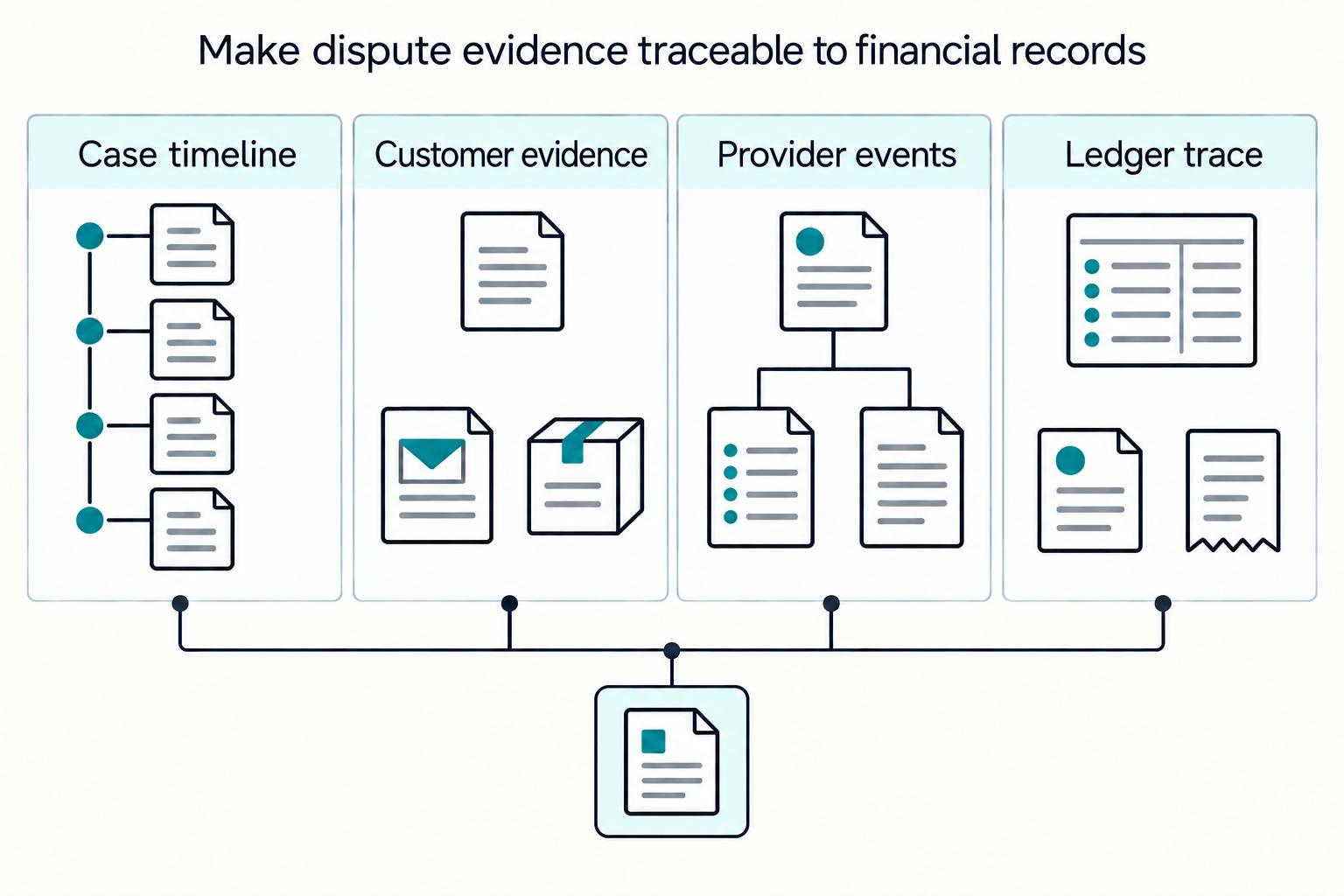
Aim to make each case traceable from dispute notice to provider reference and ledger posting. Repair missing joins as internal work while keeping the live case, owner and response deadline visible.
Step 1. Set a minimum checklist per flow and reason code. Use a flow-specific, reason-aware checklist instead of one generic narrative. Keep evidence grouped by type so reviewers can scan fast and submit what directly supports the dispute reason.
- transaction state and timeline (internal ID, provider reference, timestamps, status changes)
- customer communications
- fulfillment proof for the specific flow
- policy or terms acceptance records, where relevant
- system logs and provider dispute events captured from webhooks
Step 2. Treat webhooks as the evidence intake layer. Dispute events should be captured asynchronously through provider webhooks and linked to the case record in a queryable way. If those records are fragmented across tools with weak joins, reviewers end up rebuilding chronology by hand.
Step 3. Make retry handling idempotent. Deduplicate incoming events and serialize case-state transitions so concurrent deliveries cannot repeat an action. Use provider-supported idempotency for unchanged outbound request replays and retain a durable internal action record. Stripe can prune idempotency keys after at least 24 hours, so provider retention is not a permanent replay guard; resolve an unknown submission outcome before creating another action.
Step 4. Tie case evidence to reconciliation artifacts. Link each case to the underlying balance transaction and payout reconciliation artifacts so finance can match dispute outcomes to settled batches, especially at month-end. Run a simple checkpoint: can a second reviewer reconstruct request, provider reference, balance transaction, and ledger posting from one trail? If not, fix the joins before scaling. For a related angle, see Accounts Payable Software Comparison for Platforms That Need Operational Proof.
Run dispute operations in a fixed order and recover fast on failures#
Run disputes through intake, classification, triage, a fight/accept/escalate decision and the permitted response. In parallel, record debits, fees and later recoveries when provider financial events occur; accounting must not wait for the defense decision.
Step 1. Intake and clock start Put every notified case in an owner queue and record the provider’s actual response deadline immediately. Separate pre-dispute inquiries from formal disputes. If critical data is missing, keep the live case and its clock visible while opening an urgent retrieval task; an exception queue must not suspend the deadline.
Step 2. Classify and triage before drafting evidence Review the claim and reason code, then choose fight, accept or escalate. Gather relevant evidence while time remains. Accept a valid claim or a case whose likely recovery does not justify the costs; do not automatically accept because an internal checklist or ledger link is incomplete. Escalate unresolved evidence gaps with enough time for a final decision before the provider deadline.
Step 3. Review the evidence before submission Confirm the case state permits a challenge and that the response addresses the dispute reason. Keep one case owner and a reason-specific checklist, distinguishing evidence the issuer needs from internal reconciliation links. Stripe’s Dashboard response cannot be supplemented after submission. For an unknown API result, check the provider state before retrying; idempotent handling and state checks must prevent duplicate submissions.
Step 4. Route backlog by deadline pressure Use each case’s remaining response time, evidence strength and exposure. Stripe describes usual 7-to-21-day windows, but the actual case deadline controls. During spikes, apply overflow rules and prioritize defensible cases close to deadline without dropping unresolved cases from view.
Step 5. Record financial events and case decisions separately Book dispute debits, fees, reversals and recoveries when the relevant provider financial events occur, using the case and transaction references. Do not wait for the fight-or-accept decision to record a balance impact that has already occurred. Review exception aging, win/loss reasons and broken joins regularly, then turn repeated gaps into workflow fixes.
Tighten prevention controls without crushing conversion#
Tighten prevention by flow, not everywhere at once, and connect those controls to payout release so you reduce disputes without cutting off good volume.
| Area | Control focus | Key note |
|---|---|---|
| Card checkout and card-funded invoice links | Use stronger pre-authorization controls where they fit, including 3D Secure and dynamic 3DS for higher-risk transactions | Watch checkout friction; redirect-based 3DS can reduce conversion through drop-off or redirect errors |
| Stripe Radar | Use the actual available risk setting or custom control | Plan and account controls matter; backtest fraud and acceptance impact instead of assuming universal numeric defaults |
| VBA and bank transfer | Use rail-specific controls your provider supports | Focus on method-level risk thresholds, review actions, and payout-side controls instead of forcing card-style authentication onto non-card flows |
| Multi-merchant orchestration | Add a policy gate between payment acceptance and payout release | Use permitted timing controls or a supported live pause; a manual schedule alone does not block release |
| Cohort tuning | Relax friction for low-risk cohorts when false positives rise faster than dispute reduction | Avoid global tightening after one spike; keep stricter controls on high-risk segments |
- Separate prevention by payment flow.
For card checkout and card-funded invoice links, apply stronger authentication where appropriate and monitor drop-off or errors. If you use Stripe Radar, check the controls and plan available to your account. Current guidance recommends risk settings that adjust protection thresholds; legacy risk scores range from 0 to 99, but 65 and 75 are not universal current settings. Backtest the actual setting or custom threshold against fraud and legitimate-payment acceptance before applying it.
For VBA and bank transfer, use rail-specific controls your provider supports instead of forcing card-style authentication onto non-card flows. In practice, focus on method-level risk thresholds, review actions, and payout-side controls.
- Insert a policy gate before payout release.
In multi-merchant orchestration, do not treat payment success as automatic payout eligibility. Add a policy gate between payment acceptance and payout release so you can evaluate transaction risk outcomes and connected-account risk state before funds move out.
When risk is unresolved, use the payout controls your provider and account model permit, and verify who can release a manual payout. For Stripe Accounts v1 where the platform is liable for negative balances, a platform payout pause blocks automatic and manual payouts in live mode. This workflow is unavailable for Accounts v2, and sandbox pauses do not enforce payout blocking. A manual schedule or longer delay is a timing control, not the same hard block.
- Tune by cohort when false positives rise.
Use a simple rule: if false positives are rising faster than dispute reduction, relax friction for low-risk cohorts and keep stricter controls on high-risk segments. Avoid global tightening after one spike; keep controls targeted by flow and risk concentration.
- Validate on losses and experience together.
Measure each prevention change on both outcomes: loss metrics and customer-experience metrics. For example, pair dispute rate or fraud loss with checkout completion, invoice paid rate, manual-review volume, payout-delay volume, or seller complaints.
Conclusion#
What separates a useful playbook from generic advice is not volume. It is whether your team can make the same good decision every day under time pressure, with clear owners, a usable triage matrix, and evidence that stands up to both dispute review and finance reconciliation.
If your current process is still loose, start with three concrete moves: publish the decision matrix, instrument the evidence path, and put SLA-backed queue governance around dispute handling. That sequence works because ownership and timing are not abstract problems for platforms. In Stripe Connect marketplace setups, the platform is liable for chargebacks and related costs for destination charges and separate charges and transfers, and chargebacks can debit the platform balance immediately.
Define owners across prevention, disputes, and recovery#
Define owners for prevention, disputes, and recovery accounting. You need one accountable person over the full chain, even if product, ops, engineering, and finance each own parts of execution. A quick verification check: when a chargeback lands today, can your team name who classifies it, who submits evidence, and who books the finance impact without a Slack search?
The red flag is split ownership with no transfer rule. That is how reversals get delayed after a chargeback, which increases platform loss risk, and how cases miss evidence deadlines that can turn into automatic losses.
Publish the matrix and use it in daily review#
Publish a fight, accept, escalate matrix with SLA rules and use it in daily review. Do not chase win rate alone. Include evidence strength, dispute type, customer context, queue depth, and deadline risk so operators know when to fight, when to accept, and when to patch the underlying data gap instead.
Two analysts should reach the same action from the same case facts, deadline and costs. Keep a reason-specific evidence checklist attached. Store provider references, financial events and ledger links in the internal case record for recovery accounting, while submitting only the evidence relevant to the issuer’s claim. Broken reporting joins should be repaired without hiding a live case or blocking an otherwise supportable response.
Audit webhooks and idempotent requests#
Audit signatures, duplicate-event handling, concurrent workers and out-of-order delivery. Stripe retries undelivered events for up to three days in live mode; acknowledge already processed events without repeating work. On outbound calls, use supported keys for unchanged replays and keep durable internal action records beyond provider retention. Check unknown outcomes before another submission and reconcile actual financial events with the case.
Use this checklist:
- Define owners for prevention, disputes, and recovery accounting.
- Publish a fight, accept, escalate matrix with SLA rules.
- Use a reason- and payment-flow-specific evidence checklist, with shared internal reconciliation fields.
- Audit signature verification, deduplication and durable action records; Stripe Events listing covers up to 30 days, not permanent dispute evidence storage.
- Review loss drivers and monthly network monitoring under the current entity, region and volume criteria; do not apply acquirer VAMP thresholds to every merchant.
- Tune policy gate controls based on what the loss review actually shows, not what feels strict.
Related: Revenue Recovery Playbook for Platforms: From Failed Payment to Recovered Subscriber in 7 Steps.
Frequently Asked Questions
What is a chargeback risk playbook for platforms?
A chargeback risk playbook for platforms is a written operating guide for how your team prevents, triages, fights, accepts, and records dispute losses. The useful version is case-level, not generic: who decides, what evidence is required, when to escalate, and how payout decisions change when risk rises. If your document cannot tell an operator what to do with a dispute today, it is too abstract.
Who should own chargeback risk on a marketplace platform?
Set one accountable owner over the process, with product and engineering owning supporting controls and data as needed. That matters even more when your provider structure makes the platform financially liable for chargebacks and related costs. Split ownership can break the workflow when ops handles disputes, engineering holds the logs, and finance only sees the loss at reconciliation.
When should we fight a chargeback versus accept the loss?
Fight when reason-relevant evidence supports challenging the claim and expected recovery justifies the cost before the actual deadline. Retrieve missing evidence or escalate while time remains; an incomplete internal checklist alone does not require acceptance. Accept a valid claim or a case that is uneconomic or cannot be supported in time, record why, and repair recurring instrumentation gaps.
What should be included in a chargeback evidence checklist?
Use a reason-specific checklist for receipts, communications, fulfillment or access proof, terms acceptance and relevant logs. Submit concise evidence that answers the issuer’s claim, in the formats your provider permits. Keep transaction, dispute and ledger references linked internally for reconciliation; those internal joins need not all be completed before a defensible response can be submitted on time.
Which metrics should we track weekly versus monthly?
Use weekly reviews for actionable signals such as new disputes, aging, evidence gaps and decisions. Review network monitoring monthly under the applicable entity, region and volume rules. Visa’s VAMP ratio combines reported fraud and disputes over settled card-not-present transactions, with specified exclusions. Its 50-basis-point Above Standard and 70-basis-point Excessive levels apply to acquirer portfolios, not every merchant. Merchant thresholds and minimum counts differ by region; the published fact sheet reduces the merchant ratio to 150 basis points in AP, Canada, EU and U.S. from April 1, 2026. Confirm which current limits your acquirer applies to your business.
How do prevention controls and payout controls work together?
Prevention acts before or at payment acceptance; payout controls limit exposure before funds leave. Use reserves, delays or pauses only where your provider and account model support them. A manual payout schedule is not a hard block. For Stripe Accounts v1 where the platform bears negative-balance liability, a live platform pause blocks automatic and manual payouts; this workflow is unavailable for Accounts v2 and is not enforced in a sandbox.
How do webhooks and idempotent workflows reduce dispute operational risk?
Webhooks provide structured payment and dispute events, but delivery can be duplicated or out of order. Verify signatures, durably accept the event, deduplicate processing and reconcile case state. Stripe retries undelivered events for up to three days in live mode; already processed events should receive success without repeating actions. Provider-supported keys protect unchanged outbound request replays within their scope and retention window; keep durable internal action records and resolve unknown results before sending another action.
Try a related tool
Researched and edited by the Gruv editorial team. Gruv builds cross-border billing, payouts, and finance-operations software for global businesses.
Sources
Includes 4 external sources outside the trusted-domain allowlist.
- consumerfinance.gov/ask-cfpb/how-do-i-dispute-a-charge-on-my-cre...trusted
- consumerfinance.gov/consumer-tools/credit-cards/how-to-fix-mista...trusted
- docs.stripe.com/connect/marketplace/tasks/refunds-disputestrusted
- docs.stripe.com/api/idempotent_requeststrusted
- corporate.visa.com/content/dam/VCOM/corporate/visa-perspectives...external
- docs.adyen.com/risk-management/understanding-disputes/dispu...external
- docs.adyen.com/risk-management/disputes-api/dispute-notific...external
- mastercard.us/content/dam/public/mastercardcom/na/global-s...external
Educational content only. Not legal, tax, or financial advice.
Related Posts
AI-Driven Churn Prediction for Platforms Before Subscribers Cancel
A churn score matters only if it changes what you do before a subscriber leaves. If the output lives in a dashboard and never affects pricing, outreach, feature access, or support treatment, you do not have a retention motion. You have a reporting artifact.

Revenue Recovery Playbook: Recover Failed Subscriber Payments in 7 Steps
A subscriber whose renewal fails may still want the service. Product owns the customer path and access policy, engineering owns payment state and event processing, and finance owns collection reconciliation. Give support a view of the invoice, failure reason and next action so a customer receives one consistent answer.
Vendor Risk Assessment for Platforms: How to Score and Monitor Third-Party Payment Risk
Use this guide to build a practical, defensible approach to scoring and monitoring payment-adjacent vendor risk, with clear escalation points and named ownership. It is for compliance, legal, finance, and risk teams that need decisions and evidence that will hold up under scrutiny.