
Quick Answer
Start by treating a freelancer cease and desist as a structured risk event: read the notice closely, preserve records, and avoid admissions. In your first pass, isolate the exact conduct they want stopped, what harm they claim, and what proof is missing. Then compare allegations against your MSA, SOW, invoices, and dated communications before taking a merits position. If pressure is high, send only a narrow receipt note and set an internal deadline earlier than theirs so your next response is factual and defensible.
Start Here if You Got a Cease-and-Desist Letter#
Treat a cease-and-desist letter as a serious legal demand, not an automatic court order. Receiving one does not automatically mean a lawsuit will follow. Your first job is controlled triage: identify the demand, protect your options, and avoid mistakes that weaken your position. If you are a freelancer or consultant, the near-term goal is not to win a legal argument on day one. The goal is to choose a defensible next step and keep your written record clean.
Your first move should be quiet and methodical. Read the letter, organize your records, and verify your contract terms before you debate. If your records are scattered, use a freelance client onboarding checklist to rebuild the file in one place before you respond. That sequence keeps you from adopting the sender's framing too early and helps you avoid statements you cannot later support.
Before You Start#
Read the letter line by line before you respond. Some letters cite large demand amounts, including $20,000, without showing how harm was calculated. Treat any number as a claim to test, not proof that you already lost. If you feel urgency, turn that urgency into structure: capture what is clear, label what is unclear, and hold conclusions until your documents are in front of you.
- Step 1: Classify the letter.
Mark two core points: what they want stopped and what harm they say must be addressed. Write both in plain language on one page. If either point is vague, flag it now so your first response can request specifics rather than argue against a moving target.
- Step 2: Stabilize your posture.
Take the notice seriously without panicking. Do not send quick admissions, broad apologies, or aggressive counterclaims in your first reaction. If you cannot summarize the claim in one neutral sentence, you are not ready for a substantive reply.
- Step 3: Define your decision target.
Pick one immediate outcome you can defend in writing: request evidence, discuss a narrow remedy, or escalate to counsel. Add one line that states what fact would change your position. This prevents emotional drift and keeps your next message tied to evidence.
- Step 4: Set scope limits early.
Use this process to reduce risk, not to replace legal advice on your exact facts. In contract and copyright disputes, drafting details can affect outcomes and legal costs. List what you know, what is missing, and what needs legal review before you argue the merits. That way, your first-response position is documented rather than reactive.
Gather Your Documents Before You Reply#
Once your posture is stable, move to the record. Build your response from documents, not memory, so pressure language in the letter does not set your facts for you. This is where most response quality is won or lost.
Before You Start#
Treat this as documentation, not debate. A cease-and-desist is not a court order by itself, but it can be an early written move before potential litigation, so collect and organize first, then decide what to say. Build a simple incident report with timestamps, file hashes, and any claimed amount (for example, $5,000 or €2,000) before you draft. If you skip this step, you risk answering with partial facts and then spending time correcting the record.
- Step 1: Gather the core record set.
Pull the records and communications directly tied to the allegations. Include any details mentioned in the letter that affect what the sender says happened. Keep originals unchanged and do your analysis on copies so you can always return to a clean source file.
- Step 2: Build a dated timeline.
Create a simple log of who sent what, when, and what they demanded. If the letter includes timing requests, note them and set an internal review deadline that comes earlier. If a date is uncertain, mark it as uncertain instead of guessing.
- Step 3: Isolate the two core claims.
For each allegation, write the exact conduct they say must stop and the harm they say must be fixed. If a money demand is listed, note whether the letter explains how that amount was calculated. When calculation support is missing, flag it as an evidence gap.
- Step 4: Separate bundled allegations.
If the notice combines multiple issues, split them into separate tracks. One track might be alleged trade secret misuse, another an NDA-breach claim, and another a takedown demand. Clear separation now produces a clearer, narrower response later, and gives you a document base that can support each sentence you send.
Triage the First 24 Hours Without Making It Worse#
Day one is for containment, not argument. Start by testing claims against your agreement record before taking a firm position. The first 24 hours can set the tone and risk for what follows.
Before You Start#
Use the first 24 hours to stop unforced errors. Use the broader first 72 hours to compare the allegations against contract terms and available evidence.
- Step 1: Pause reactive moves.
Hold angry replies, public back-and-forth, and rushed edits or deletions while you review. Keep the pause temporary and internal so you can respond from verified obligations.
- Step 2: Acknowledge receipt only if needed.
If acknowledgment helps reduce pressure, keep it narrow: confirm receipt, say you are reviewing, and give a date for a substantive reply. Avoid admissions in this initial note. A short process update is enough at this stage.
- Step 3: Set an internal deadline before theirs, then verify obligations.
Give yourself an earlier internal deadline so review happens before pressure peaks. Check the MSA, SOW, and any written, verbal, or implied agreement evidence you have. Confirm whether work started without a signed SOW and whether scope, authorization, or work quality is disputed before you take a full merits position.
- Step 4: Escalate based on risk and timing.
If the letter threatens suit, injunction, or account action, consider prompt counsel review based on the stated timeline and your risk level. Send a tight packet: the letter, timeline, key contract excerpts, and open questions. Keep your escalation note short so a reviewer can spot risk quickly and help you respond from verified obligations.
Confirm Who Sent It and What They Are Actually Demanding#
Before you debate substance, confirm who sent the letter and ask for clarity. You need to know exactly what conduct they want stopped and what consequence they claim may follow. Without that, any substantive reply is guesswork.
Treat sender details as information to document, not assumptions to trust. Record name, organization, role, and any stated representation language exactly as written in the letter. If that information is incomplete, do not fill in the gaps.
- Record who is writing and what they claim.
Log sender details exactly as written, including who they say they represent. Mark representation status as stated, unverified, or disputed so you do not treat an unverified representation as settled fact.
- Split the letter into separate demand blocks.
Treat each allegation as a separate item. For each item, track the alleged act, the stop action demanded, and the consequence they claim may follow. If one block is clear and another is vague, reply accordingly instead of treating all issues as equally supported.
- Make unknowns explicit in writing.
Label missing information as unknown instead of filling gaps with assumptions. Common gaps are unclear conduct, unclear stop action, unclear consequences, or missing support. Writing unknown is a risk-control choice, not a weakness.
- Use an incompleteness checkpoint before your substantive response.
If they do not identify the exact behavior to stop, treat the demand as incomplete and request specifics. Ask for the precise act, the requested stop action, and claimed consequences if conduct continues. Keep your reply factual and narrow, because ignoring a notice can strengthen the other side's record that you were informed.
Build an Evidence Pack You Could Hand to a Lawyer in 10 Minutes#
A fast, useful evidence pack is structured and factual. Start with clear issue framing, and avoid overstating what you can prove from the records you have. If a detail is uncertain, label it clearly.
Use a repeatable template so your notes stay consistent as facts evolve.
-
Build one record map. For each item, note the core fact it supports and any open question. If an item does not map cleanly, mark it
unknownorunmatched. -
Split each disputed point into two lines. Write one line for what happened and one line for what is being alleged. This keeps facts separate from legal conclusions.
-
Create an objective sequence before replying. List events in neutral order and note where records conflict. If support is missing, say that plainly instead of choosing a version without evidence.
-
Mark jurisdiction status. Mark jurisdiction as
known,unclear, ordisputed. If it is unclear, hold strong legal conclusions until that point is resolved, because laws can differ across countries. -
Prepare a clean handoff set. Share the organized record map and unresolved questions in a short note so counsel can evaluate next steps.
Review the Contract Clauses That Usually Decide the Outcome#
Map each allegation to exact contract text or record evidence before you draft arguments. That keeps your response disciplined and helps you avoid overbroad concessions. If the available text does not support a demand, say so in clear, narrow terms.
| Issue area | Compare against | Key note |
|---|---|---|
| Ownership and usage | "work for hire" and "assignment of rights" wording | Pull the exact sentence supporting each point and mark unclear language as unresolved. |
| Exit terms | Termination language, unpaid invoices, and any post-termination usage dispute | Keep sequence explicit: what was delivered, approved, invoiced, and used after notice. |
| Risk-transfer clauses | Limitation of liability and indemnification wording against the exact claim type | Tie each conclusion to actual clause text and a supporting record reference. |
| Forum and procedure | Governing law, jurisdiction, venue, and dispute resolution language | If forum terms are unclear, keep your response factual and reserve legal conclusions for counsel. |
Use one comparison sheet with allegation, cited conduct, clause text, evidence reference, and open question. If the letter does not identify the specific conduct, does not include dates and times with supporting evidence, or does not cite a legal or contractual basis, treat those omissions as gaps and request specifics.
- Ownership and usage first.
For takedown or usage demands, compare work for hire and assignment of rights wording line by line. Pull the exact sentence supporting each point and mark unclear language as unresolved. According to the U.S. Copyright Office FAQ, ownership and permission disputes depend on the exact rights granted in writing. For trademark allegations, according to USPTO trademark basics, confusion and use details also matter, so keep screenshots and dates. If helpful, cross-check your framing with Work for Hire vs. Assignment of Rights: A Freelancer's Guide to Owning Your IP.
- Reconcile exit terms with money records.
Read termination language alongside unpaid invoices and any post-termination usage dispute. Keep the sequence explicit: what was delivered, approved, invoiced, and used after notice. If timing is unclear, state that clearly before discussing remedy.
- Map risk-transfer clauses to the specific allegation.
Review limitation of liability and indemnification wording against the exact claim type, not a worst-case narrative. Keep each conclusion tied to actual clause text and a supporting record reference.
- Check forum and procedure before choosing posture.
Review governing law, jurisdiction, venue, and dispute resolution language before deciding how far your written response should go. If forum terms are unclear, keep your response factual and reserve legal conclusions for counsel.
A useful checkpoint is simple: every claim in your draft response should point to one clause or one evidence item, and ideally both.
Choose Your Path With Clear If-Then Rules#
Choose one response path before you draft your message. Base it on evidence clarity, cross-border complexity, and immediate business risk, then document why. A written decision rule helps you stay consistent under pressure.
| Situation | Path | Next step |
|---|---|---|
| Claim is fact-light and deadline-heavy | Request evidence before concessions | Ask for the exact act, the specific remedy, and the legal basis they are asserting. |
| Allegation is specific and supported | Negotiate remedy scope early | Define what you will stop or change, by when, and what closes the issue, without broad admissions. |
| Cross-border terms are weak or unclear | Prioritize counsel before settlement talk | Keep communications procedural until forum terms and core obligations are clear. |
| Business impact is immediate | Do not ignore the letter and run parallel tracks | Get legal help quickly while you manage operational continuity, preserve records, control internal messaging, and keep deadlines visible. |
Use a one-page decision sheet with claim, what is proven, what is missing, risk if wrong, and next action. Keep this sheet current as new records arrive, because your path can change when facts change.
- If the claim is fact-light and deadline-heavy, request evidence before concessions.
Ask for the exact act, the specific remedy, and the legal basis they are asserting. Confirm who sent the letter and request support for ownership and infringement claims. This path is strongest when demand language is broad but proof is thin.
- If the allegation is specific and supported, negotiate remedy scope early.
When the other side provides clear support, move to scope control. Define what you will stop or change, by when, and what closes the issue, without broad admissions. Narrow remedy language can reduce downstream risk.
- If cross-border terms are weak or unclear, prioritize counsel before settlement talk.
Treat enforceability as uncertain and escalate early for legal review in complex situations. Keep communications procedural until forum terms and core obligations are clear.
- If business impact is immediate, do not ignore the letter and run parallel tracks.
Get legal help quickly while you manage operational continuity. Preserve records, control internal messaging, and keep deadlines visible.
If more than one path applies, start with the higher-risk path and record the reason in writing.
Draft a Professional Reply That Protects You#
After you choose a path, send a neutral reply that preserves your options and creates a clear written record. Keep it procedural, factual, and limited to what you can support. Your first substantive message should reduce ambiguity, not add to it.
Draft once for clarity, then edit for risk. Remove emotional phrasing, broad legal conclusions, and any sentence you cannot tie to a document. For high-risk or complex situations, have an attorney review the draft before you send it.
- Confirm receipt and define scope.
Acknowledge receipt and state that you are reviewing the claims and relevant contract terms. Avoid apologies, legal conclusions, or language that reads as an admission. Keep the opening concise.
- Request specific, verifiable details.
Ask for the exact conduct they want stopped, the rights they say are affected, and the remedy they want. Request supporting material and the contract basis they rely on. If a demand is vague, ask for clarification before discussing resolution.
- Reserve rights without overcommitting.
You can include a short reservation-of-rights sentence so your response stays a discussion step, not an admission. Keep this line plain and concise.
- Propose one next step tied to the contract process.
If your contract includes dispute resolution language, use it to suggest one clear next step and document what information is still needed. If fees or partner claims are part of the dispute, map them to how to structure a success fee in a consulting agreement and how to structure a referral fee agreement with a partner before you commit in writing. If a call occurs, send a prompt written recap that confirms what was discussed and what is still unresolved.
A simple check before sending: your response should make sense to someone who has not read prior emails. It should also stand on its own without verbal context.
Handle Cross-Border Disputes Without Guessing#
Once your draft is ready, the main risk is making forum assumptions you cannot prove. Treat this stage as intake: document what is confirmed, mark what is unknown, and escalate quickly when key terms stay unclear. Cross-border pressure can push you to write too much too soon. Keep it narrow.
Before you start: collect the signed contract and amendments, payment records, and platform messages in one dated folder. If no signed contract exists, keep proposal versions, acceptance messages, and invoice approvals that show how the deal operated.
Step 1 Map forum terms from documents, not memory#
Create a one-page map of forum-related terms (for example, governing law, jurisdiction, and venue). For each line, attach exact contract text or dated message support. If support is missing, mark it unknown.
This keeps early emails factual and avoids unsupported legal conclusions. It also prevents internal confusion when different people are reading different drafts.
Step 2 Screen cross-border escalation for practical burden#
When the parties are in different countries, obligations can span multiple jurisdictions. Use that as a risk screen before you escalate. Unresolved forum language can mean more coordination and more review.
If your map still has gaps, avoid strong legal claims in writing and send a neutral holding response while counsel reviews. A short process-focused note is often safer than a detailed legal narrative at this point.
Step 3 Preserve platform evidence early#
If the dispute involves a platform complaint, capture the case or listing identifier, the reporting party, and the complaint category before you respond. Then export timestamped records for scope, deliverable submissions, approvals, dispute messages, and payment proof. Keep originals and working copies separate.
This is especially useful when formal agreement terms are thin. Platform records can help clarify sequence and performance even when contract language leaves room for dispute.
Step 4 Escalate fast when core forum terms stay unclear#
If those forum lines are still unresolved after document review, route the draft to counsel before sending a substantive legal position. Keep outbound communication narrow: acknowledge the notice, request missing specifics, confirm preservation, and set one procedural next step.
Final check: no admissions, no unsupported legal conclusions, and one concrete next action.
Avoid the Mistakes That Create Liability#
A cease-and-desist letter is a formal demand to stop alleged conduct. It is not legally binding by itself, but it may later be used as evidence. Keep records intact, keep your language controlled, and state only what you can support with dated evidence.
Before you send anything: keep one evidence folder with dated messages, files, screenshots, and a timeline so each statement ties back to dates, times, and supporting evidence.
- Freeze the record before deleting or editing anything.
Pause changes, preserve originals, and log what changed and when. Keep a written record of your position and any corrective steps so your account stays clear.
- Argue from records, not memory.
Build every substantive point from supporting evidence with dates and times. If a fact is unclear, mark it as disputed and request clarification in writing.
- Avoid emotional language that can escalate risk.
Use neutral wording: acknowledge receipt, confirm review, and avoid legal conclusions you cannot support. Keep your message calm and structured.
- Manage deadlines in writing.
Do not go silent. If you need more time, request a short extension and propose a concrete response date you can meet. Extensions are not guaranteed. Keep extension requests brief and tied to document review, then route the matter for attorney review when risk or complexity is high and local law could change the analysis. As a process benchmark, ask for 3 business days and confirm receipt by 5:00pm UTC.
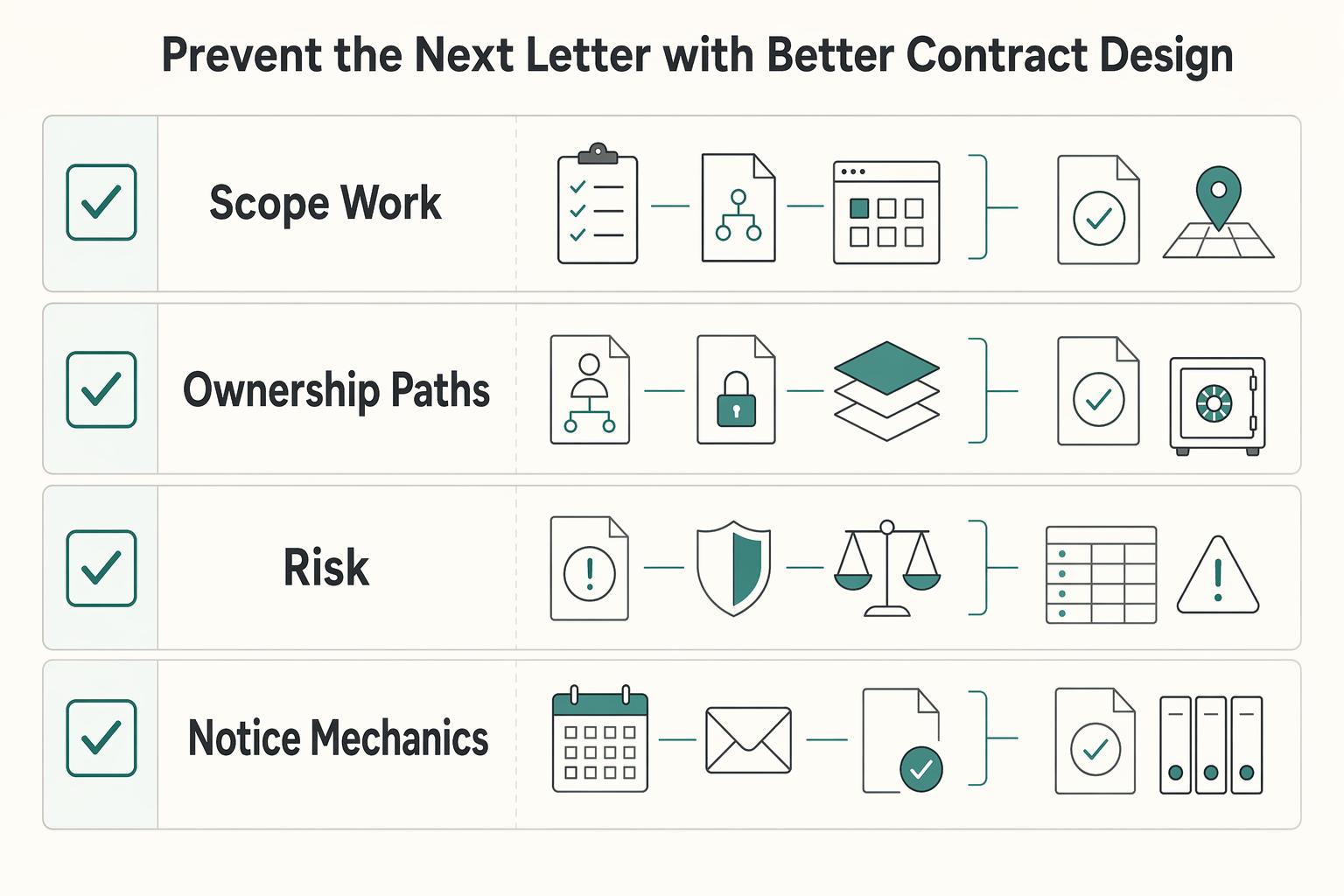
Prevent the Next Letter With Better Contract Design#
Prevent repeat disputes by removing ambiguity before kickoff. Make scope, ownership, risk terms, and dispute path readable from the contract itself. Use a freelance client onboarding checklist, then lock scope in writing with a SOW generator and ownership terms with a freelance contract generator. Good drafting does not stop every conflict, but it reduces avoidable conflict.
| Contract area | What to define | Why it matters |
|---|---|---|
| Scope of work clause | Set deliverables in measurable terms, tie acceptance to clear sign-off triggers, add revision limits, and add a written path for delayed feedback. | Helps keep approval disputes from drifting. |
| Ownership paths | Do not let ownership and assignment language overlap without a clear order of control, and state if transfer depends on a signed document. | Ownership can stay disputed while usage continues. |
| Key risk terms | Use standalone sections for indemnification and limitation language. | Later review is faster and misreads during disputes are reduced. |
| Notice mechanics | Define who receives notices, where they are sent, and how receipt is confirmed. | If unresolved at signature, treat that as open risk and close the gap before work starts. |
Before work starts, use a short clause checklist. If a core term is still
to be finalized, pause kickoff until both sides sign final language.
- Define objective acceptance in the scope of work clause.
Set deliverables in measurable terms and tie acceptance to clear sign-off triggers: what was delivered, where approval is given, and when it is recorded. Add revision limits and a written path for delayed feedback so approval disputes do not drift.
- Separate ownership paths so they cannot conflict.
Do not let ownership and assignment language overlap without a clear order of control. If transfer depends on a signed document, state that explicitly. One failure mode is unsigned transfer language that leaves ownership disputed while usage continues. For deeper drafting examples, see Work for Hire vs. Assignment of Rights: A Freelancer's Guide to Owning Your IP.
- Use standalone sections for key risk terms.
Keep indemnification and limitation language easy to find and negotiate. Dedicated sections make later review faster and reduce misreads during disputes. They also make internal handoff easier when someone else needs to assess risk quickly.
- Set notice mechanics before kickoff.
Define who receives notices, where they are sent, and how receipt is confirmed. If those terms are unresolved at signature, treat that as open risk and close the gap before work starts.
A practical standard is simple: if a future dispute reviewer cannot find the key clause in under a minute, rewrite for clarity before signing.
Your Next Step This Week#
This week, build a clean case file before you send a substantive reply. Move quickly, but prioritize documented facts over fast opinions. If you complete the checklist below in order, your next message will be clearer and narrower.
- Step 1: Collect the available record. Save the materials you already have (for example, the letter, contract documents, invoices, relevant messages, and disputed content). Log the exact receipt time, for example
4:30pm.
Expected outcome: each allegation maps to at least one document.
- Step 2: Build a dated timeline before drafting your argument. List events by date and time, sender, and what was said or delivered. Capture each allegation in neutral terms, and confirm who sent the notice: the client directly or a lawyer or law firm.
Expected outcome: another reviewer can follow the dispute sequence without extra explanation.
- Step 3: Review contract terms with a checklist, not memory. Recheck the clauses against what was agreed with the client, then confirm payment terms and service limits are clearly stated.
Expected outcome: every planned response point has a clause reference, an evidence reference, or both.
- Step 4: Pick one response path and set an internal deadline. Choose a path based on current facts and risk, document why you chose it, and revisit it if new documents change the core picture.
Expected outcome: your next action is explicit, time-bound, and tied to current evidence.
- Step 5: Send a neutral written response with one concrete next action. Acknowledge receipt, state what you understand is disputed, request missing specifics, and keep the exchange focused on verifiable details. Propose one practical next step, such as evidence exchange or a short call limited to contract points.
Expected outcome: your message reduces ambiguity and keeps the process moving.
If key documents are still missing after Step 3, pause and close that gap first. Once this week's review is complete, keep the same file structure for future matters so the next notice does not force a restart.
For your next client cycle, set up cleaner documentation and payment workflows from day one with Gruv for freelancers, and include pre-signed terms from a freelance contract generator before kickoff.
Frequently Asked Questions
Is a cease-and-desist letter legally binding for a freelancer?
A cease-and-desist letter is a formal notice, not a court order by itself. It still matters because it can be used later as evidence that you were put on notice. Treat it seriously, but do not treat it as an automatic judgment. A calm, well-documented response can matter more than a first emotional reaction.
Should I respond to a cease-and-desist letter from a client or stay silent?
There is no universal rule that you must respond immediately or stay silent. A practical first move is to confirm who sent it, including whether it came from the client or a lawyer or law firm. If the claim is unclear, ask in writing for the specific conduct they want you to stop. If you respond, keep it short and factual while you verify the claim.
What should I do in the first 24 hours after receiving a legal notice?
Preserve records before you send a detailed response. Keep the letter and related materials, then build a dated timeline with exact times and supporting evidence. Ignoring the notice entirely can create a record that you were notified and continued the conduct. Use the first day as a triage window, not as a universal legal deadline.
Can a client send a cease-and-desist over a one-star Google review?
Yes. A cease-and-desist can be tied to a one-star Google review. The letter itself does not automatically prove the underlying claim. Preserve the exact review text, timeline, and related records before deciding your next move. Avoid editing the record first and reasoning later.
What changes when the client is in the United States and I am in Greece?
Cross-border disputes are fact-specific, and country names alone may not be enough to predict outcomes. Without contract text and forum terms, reliable conclusions on jurisdiction or enforcement are difficult. Keep your response narrow and avoid overcommitting to legal conclusions. If forum terms stay unclear after document review, consider legal counsel before making substantive legal arguments.
When should I hire a lawyer instead of handling the response myself?
No single cutoff fits every freelancer cease and desist scenario. Consider counsel when allegations are unclear, stakes are high, or cross-border posture is uncertain. If you send an initial response yourself, keep it factual and tied to a clean evidence record. If potential consequences are unclear or significant, get legal advice early.
Try a related tool
Researched and edited by the Gruv editorial team. Gruv builds cross-border billing, payouts, and finance-operations software for global businesses.
Sources
- calbar.ca.gov/Portals/0/documents/rules/2015_SelectedStatu...trusted
- copyright.gov/help/faq/faq-general.htmltrusted
- ftc.gov/legal-library/browse/statutes/consumer-revie...trusted
- ftc.gov/system/files/documents/cases/602529_d09395_-...trusted
- govinfo.gov/bulkdata/ECFR/title-34/ECFR-title34.xmltrusted
- law.cornell.edu/rules/frcp/rule_26trusted
- sec.gov/Archives/edgar/data/1529864/0001193125253382...trusted
- uspto.gov/trademarks/basicstrusted
Educational content only. Not legal, tax, or financial advice.
Related Posts

Work for Hire vs Assignment of Rights for Freelancers
A freelance agreement is not just about price and scope. It decides who controls the rights in the work. If the ownership language is loose, rights can move earlier than you expect, cutting down your control once the work is delivered or used.
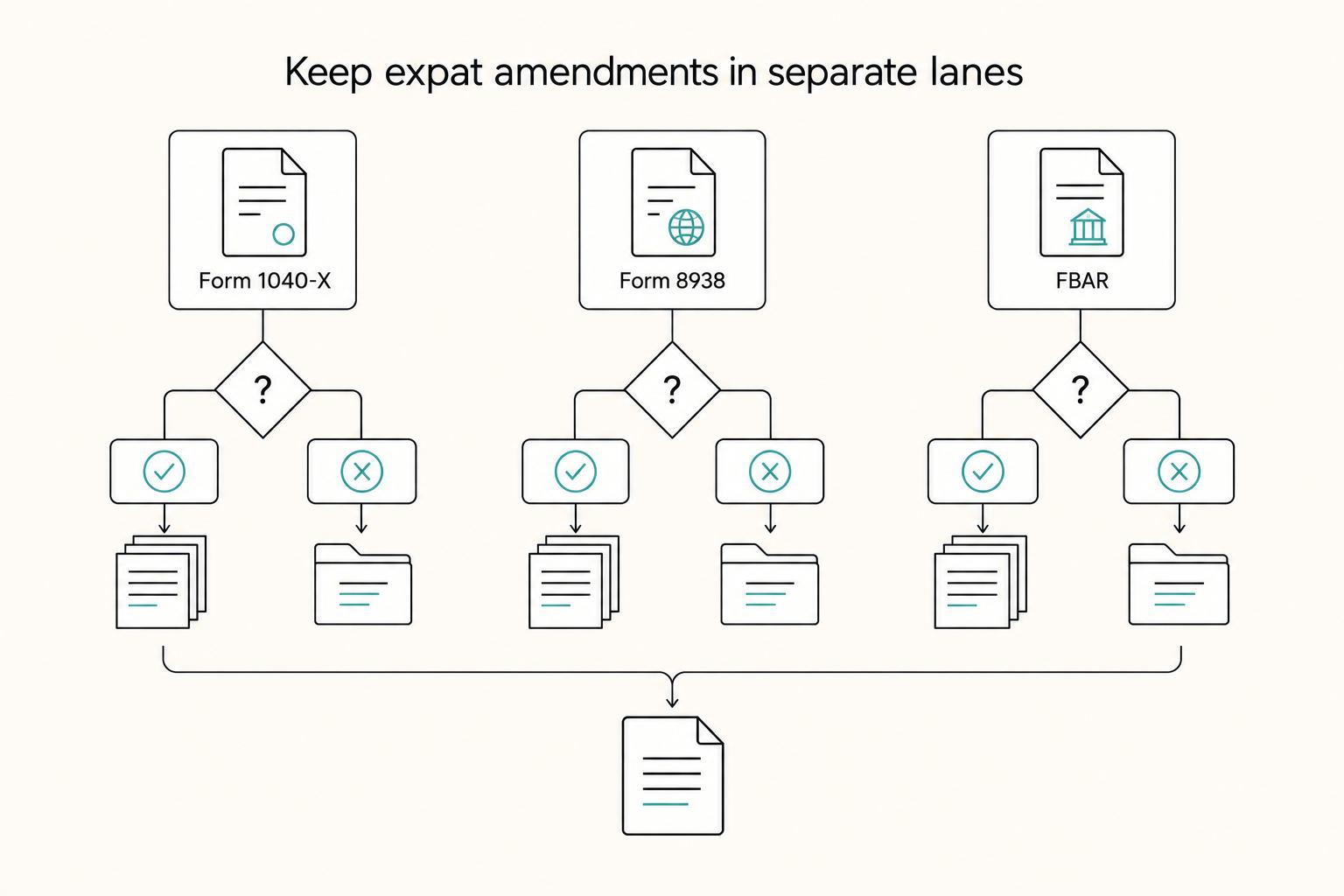
How to Amend a Tax Return as a US Expat (Form 1040-X)
If you need to amend an expat tax return, work in one controlled sequence: confirm scope, prepare the amendment once, and keep proof for every changed number.

The Freelance Payment Penalty: A Modeled Audit of Platform Fees, FX Spreads, and Payout Delays
The money rarely disappears through a single, easy-to-spot fee. The real loss is stacked. A marketplace takes its commission, a processor adds a charge for international cards, a bank or payment company converts the currency at a spread, a platform holds the funds before release, and a wire sheds a little to intermediaries on the way in. Each layer looks defensible on its own, but the worker feels the combined result as a smaller deposit and a later payday.