
Quick Answer
Use ACH for suitable scheduled vendor credits, Same Day ACH within current limits/cutoffs and approved wires for time-critical cases. Verify bank instructions and enrollment, inventory outstanding checks and prevent duplicate obligations across rails. Treat unknown status as pending investigation; issue a replacement only when the original cannot still pay. Pilot credit-payout metrics and reconcile provider results to ledger and bank evidence.
Why Finance Teams Move Vendor Payouts Off Checks#
Move vendors from checks to ACH or wire by coordinating rail choice, verified bank instructions, outstanding checks and exception recovery. Keep vendor payments on schedule while preventing duplicate settlement during the transition.
The rails are not fully interchangeable in practice. ACH is a nationwide U.S. network where depository institutions exchange batched electronic credit and debit transfers, and FedACH is described as efficient, low-cost, batched processing. A wire transfer is a bank-to-bank electronic transfer method. In the Fedwire context, it is generally used for large-value, time-critical payments that are immediate, final, and irrevocable once processed.
This article is for platform finance, payments operations, and engineering teams paying contractors, creators, sellers, or marketplace participants at scale. It is an execution guide with checkpoints, not a generic payment-rails explainer. You will get decision rules, implementation sequencing, and ownership boundaries for onboarding, routing, exceptions, and reconciliation.
Confirm the provider’s bank cutoffs, corridor coverage, funding, release checks and wire approvals before rollout. FedNow and RTP availability depends on institution and account support; a network launch does not enable every provider or destination.
For a broader view of ACH, wire, SEPA, and real-time options, see What Are Payment Rails? ACH Wire SEPA and Real-Time Networks Compared.
Start with the rail definitions your team must align on#
Standardize the four terms before you touch onboarding copy or API fields#
If your team uses these labels loosely, you create avoidable support debt. Give support, finance, and engineering one shared glossary, then use those exact terms in vendor communications, ticket macros, and payout specs.
| Term | Operational meaning for your team | What to remember |
|---|---|---|
| Electronic check (eCheck) | A label often used for bank payments moving on the ACH Network | Clarify whether the provider means an ACH debit or credit; vendor payouts here are ACH credits. |
| Automated Clearing House (ACH) | A nationwide network where depository institutions exchange batched electronic credit and debit transfers | U.S. banking network with broad reach across U.S. bank and credit union accounts |
| Electronic funds transfer (EFT) | Broad category of electronically initiated transfers; Regulation E uses a consumer-account definition. | Useful as a category term, not precise enough for routing decisions |
| Wire transfer | Electronic bank-account-to-bank-account transfer | In Fedwire terms, immediate, final, and irrevocable once processed |
Checkpoint: your payout method dropdown, ledger labels, and support scripts should clearly distinguish ACH from wire. If "EFT" is standing in for a specific rail, tighten it now.
Encode the behavior differences into product requirements#
Set the routing logic to match how the rails actually behave. Use ACH as your default migration rail for batched processing and lower-cost positioning. Use wire for a different job: large-value, time-critical payments where finality matters once processed.
Be explicit about payment patterns. ACH supports both recurring and one-time behavior, including one-time debit use cases. Teams may describe eCheck as a one-off experience, but do not hard-code that assumption into product rules. The ACH Network processes payments 23¼ hours every business day and settles four times daily. Make that timing explicit in internal expectations.
Separate what is known from what your policy must decide#
Lock down the facts first, then write the policy choices down.
Known
- ACH runs on the U.S. banking network and is batch-based.
- Wire, in the Fedwire context, is immediate, final, and irrevocable once processed.
- ACH is often positioned as a low-cost batched rail, while Fedwire is generally used for large-value, time-critical payments.
Unknown until you confirm internally
- Who can approve a wire transfer.
- Your provider's cutoff behavior and coverage.
- Which payout failures justify rerouting from ACH to wire.
If these wire criteria are not written down before rollout, exceptions turn into manual judgment calls.
Set explicit rules for when to use ACH, Same-Day ACH, or wire#
Routing policy belongs in product and operating rules, not in ad hoc operator judgment. Default to ACH for planned, repeatable payout volume. Use Same Day ACH when same-business-day processing is needed and the payment fits network limits. Use wire for time-critical cases where delay has material business impact.
Publish one routing table your product and ops team can both follow#
Use one shared table across finance, ops, support, and engineering. Then map those conditions into payout fields and approval paths.
| Rail | Urgency | Amount sensitivity | Reconciliation burden | Failure tolerance | Vendor preference |
|---|---|---|---|---|---|
| ACH | Scheduled, predictable payouts | Broad fit for routine U.S. payouts | Works well for batched reconciliation on known due dates | Appropriate when a miss is inconvenient, not business critical | Use when vendor wants bank payout and can follow normal ACH windows |
| Same Day ACH | Same-business-day processing target | Up to $1 million per payment | ACH-style reconciliation with tighter submission timing | Appropriate when faster timing matters but wire finality is not required | Middle option when vendor wants faster bank payout without a wire exception |
| Wire transfer | Time-critical payouts | Exception path, especially for large-value or high-consequence payouts | Higher review burden with tighter approvals and exception handling | Use when finality once processed is required | Treat as exception, not default convenience |
As of 4 October 2026, Same Day ACH has a $1 million per-payment limit and three daily settlement windows. Nacha approved a $10 million limit effective 17 September 2027; keep routing rules effective-dated and do not split entries to evade the current cap. Fedwire finality concerns interbank settlement; confirm the receiving bank’s beneficiary posting and cutoff behavior before promising arrival.
Checkpoint: your payout request should capture rail, urgency class, amount, due date, and approval status before money movement starts.
Write the hard judgment rules in plain language#
Write rules that remove ambiguity at execution time:
- If urgency is high and delay has material business impact, route to wire.
- If volume is high, counterparties are known, and predictability matters more than immediacy, default to ACH.
- If same-business-day processing is needed and the payment is within the $1 million Same Day ACH cap, use Same Day ACH before escalating to wire.
- If a vendor requests wire as a speed preference, require a reason code and approval.
Do not treat Same Day ACH as an instant, always-on rail. ACH processes payments 23 1/4 hours every banking day and settles four times every banking day, and ACH payments are not currently settled on weekends and federal holidays. Keep SLA and support language aligned to that behavior.
When escalating to wire, finality is both the benefit and the risk. Before you promise delivery timing, re-check payout instructions and confirm provider or bank cutoff behavior.
Add edge-rail logic now so you do not hard-code a dead end#
Once the core routing rules are set, decide how edge cases will be handled before they show up in production.
For U.S. routing, keep RTP and FedNow as eligibility-based alternatives, not default promises. FedNow is positioned for near real-time payments at any time, any day of the year, and RTP is positioned as always-available real-time infrastructure, including weekends and holidays. Availability still depends on participating institutions.
For euro corridors, confirm that the sending and receiving institutions participate in the selected SEPA scheme. Geographic scope covers 41 countries and territories; SEPA Credit Transfer and SEPA Instant have distinct eligibility and timing.
Example internal policy: repeated ACH delays for a payout class prompt a scheduling/rail review for future obligations. For an existing delayed payment, first confirm its status and whether it can still settle. Authorize a wire replacement only after confirming the original cannot still pay, then log original reference, evidence, approver and replacement reference.
For more on using same-day ACH to speed payments without defaulting to wire fees, see Same-Day ACH for Platforms: How to Speed Up Contractor Payments Without Wire Transfer Fees.
Before you lock your ACH vs wire routing policy, validate how batch status, exception handling, and retry-safe payout flows will work in practice with Gruv Payouts.
Prepare the minimum data and controls before migration starts#
Do not start vendor outreach until your intake pack and payout-activation gates are fixed. If vendors go live before data quality, compliance checks, and retry controls are explicit, rollout effort shifts to preventable cleanup.
| Control area | What is required | Article note |
|---|---|---|
| Payee identity | payee name and contact/address details; tax documentation where required | Confirm each record has complete payee identity before activation |
| ACH destination | nine-digit routing transit number, account title, and account number | For U.S. ACH setup, require the ACH routing number, not the wire routing number |
| Ownership evidence | approved account-validation method and independently confirmed instructions | A voided check or statement alone does not authenticate a changed bank instruction. |
| Authorization proof | evidence showing the vendor authorized the payout method | Store proof you can provide to your ODFI on request |
| Compliance checks | KYC, KYB, and AML checks where your program and institution require them | Payouts should stay blocked until they pass |
| Duplicate-safe execution | Idempotency key support on payout creation | Retries should not create a second money movement |
Lock the onboarding data pack before the first migration email. At minimum, collect:
- payee name and contact/address details; tax documentation through a restricted channel where required
- payout destination details: nine-digit routing transit number, account title, and account number
- approved account-validation evidence and independent confirmation of changed instructions
Vendor authorizationevidence showing the vendor authorized the payout method
Collect the ACH-capable nine-digit routing number and correct account details. Verify changed instructions through a previously trusted contact/channel; do not use only the phone number in the change request. Confirm eligibility and required approval before activation, with validation evidence and payout agreement retained.
Treat required KYC, KYB, and AML checks as hard activation blockers. These gates do not apply identically in every platform or jurisdiction, but where your program and institution require them, payouts should stay blocked until they pass.
Bank CIP and beneficial-owner rules apply to covered institution account opening, with applicable exemptions and current relief. A platform paying a vendor does not automatically assume every bank onboarding obligation. Record the requirements your program and provider actually impose, and route personal tax/identity data through restricted collection.
Require duplicate-safe payment execution before the first live ACH payout. The minimum control is Idempotency key support on payout creation so retries do not create a second money movement.
Use the provider’s supported key format and retention behavior. Stripe allows keys up to 255 characters and can prune them after at least 24 hours; internal duplicate prevention must outlive that window. Its live webhook retries can run up to three days. Test one business operation across retries and resource retrieval, not just duplicate event IDs.
Document the Exception handling workflow before rollout and assign ownership clearly. A practical split: finance owns approval policy, ops owns onboarding quality, engineering owns API and event reliability, and a named compliance lead coordinates KYB, KYC, and AML decisions.
Separate ACH credits paying vendors from any debits used to collect or recover funds. Authorization formats, proof requests and return rules differ by entry type and account. Agree record retrieval and response deadlines with the ODFI/provider; a debit-proof-request workflow is not a universal vendor-credit release rule.
Related: ACH Payment Processing for Platforms: How to Move Money via the US Banking Network.
Segment vendors into migration waves that reduce risk early#
Your wave plan should reduce uncertainty first, not just spread effort across dates. A practical low-risk starting point is vendors that add meaningful volume on straightforward Automated Clearing House (ACH) flows; defer edge cases until controls are stable.
Rank vendors by operational risk first#
Rank vendors by the things most likely to break operations: payout criticality, payment volume, exception history, and handling complexity. Those fields usually separate clean migration candidates from vendors that will expose gaps in onboarding quality, approvals, or exception handling.
A practical first wave is often high-volume, low-complexity vendors. Move vendors with stable payout details and low exception history first, and hold vendors with frequent payout changes, prior returns, or manual handling for later waves. If a vendor regularly requires Wire transfer, treat that as a separate, higher-control migration case and sequence accordingly.
Validate real settlement behavior with a Vendor payout batch#
Judge early wave health at the batch level, not only by individual vendor. ACH is batch-based, so a Vendor payout batch is the right control unit.
In early live waves, keep batch behavior easy to inspect: confirm when a batch closes, how status updates arrive, and how partial failures are handled. After closure, reconcile batch totals to credits, debits, and transaction counts, then trace failed payouts into the exception queue.
Set wave success metrics before outreach#
Define success before contacting vendors, and keep the same definitions across waves so the comparisons stay usable. At minimum, track:
- adoption rate for the target cohort
- payout success rate for payouts attempted in the wave
- exception resolution speed in the
Reconciliation workflow(MTTR)
Also review failed payouts separately from successful payout batches each cycle so settlement totals do not hide operational issues.
Expand only when the pattern stays stable#
Scale only after the first wave is predictable. That means batch closure is consistent, webhook-driven status changes map cleanly to internal records, and exception resolution time stays controlled as volume grows.
Validate in sandbox before production, then run a limited live cohort before broad rollout. If a new wave causes a jump in manual intervention, failed payouts, or unresolved reconciliation items, pause and fix the cause before adding harder cohorts such as wires or other operationally complex vendors.
For a step-by-step walkthrough, see How to Find Vendors for Your Platform and Vet Third-Party Providers at Scale.
Build onboarding that converts vendors without creating support debt#
Once your wave order is set, onboarding becomes the main control point. Make Automated Clearing House (ACH) the default, make Wire transfer a defined exception path, and capture payout permission through a formal Vendor onboarding mandate rather than ad hoc email approvals.
Set the choice architecture before requesting banking details#
Lead with a clear rule: ACH is the standard payout rail, wire is exception-only, and checks end on a stated date for that cohort. Vendors often keep checks out of habit, so vague language can prolong check usage.
Publish your own approved migration date and available alternatives. A federal disbursement transition is not a mandate for private vendors. Explain who confirms enrollment, what happens if details are incomplete and how due payments remain payable.
Before broad outreach, test comprehension with a small vendor sample. They should be able to state their default rail, the wire exception path, and the check cutoff date.
Capture authorization inside the Vendor onboarding mandate#
Do not treat "bank details by email" as authorization. For ACH, the authorization record underpins entry origination and defines the agreement terms, so the Vendor onboarding mandate should hold identity, selected payout method, account details, approver evidence, and payout terms in one place.
Regulation E section 1005.10(b) requires signed or similarly authenticated authorization and a copy for preauthorized transfers from a consumer account. That debit rule is distinct from vendor ACH credits. Use the correct entry type and bank agreement; consumer-credit notice requirements are addressed separately in section 1005.10(a).
Set a hard activation rule: payout status does not move to active until mandate record, approval evidence, and account details are complete.
Define the stall path before vendors stall#
Define the fallback order in advance so ops does not improvise exceptions:
- send reminders tied to the published check deprecation date
- escalate to support for commercially important or time-sensitive payouts
- allow temporary rail overrides only through an approved exception path
- stop creating new checks for enrolled vendors after the approved cutoff, while tracking already-issued checks and lawful payment alternatives
Treat overrides as controlled exceptions, not convenience. Every override should have an owner, reason, and expiry tied to the next payout cycle.
A wire exception still requires independently verified bank instructions and release approval. Incomplete enrollment does not erase a due obligation: arrange an approved lawful alternative or resolve enrollment promptly. Before electronic replacement, account for every outstanding check and confirm the original cannot still be paid.
Worked migration example: an enrolled vendor has a $2,000 invoice and an outstanding check. Mark that obligation as excluded from ACH while the check can still clear. If replacement is requested, verify check status with the bank and complete the approved stop-payment/cancellation process before releasing one linked ACH replacement. Preserve the original check number, confirmation, approval and ACH trace. If the check already cleared, reconcile the invoice as paid rather than issuing another payment.
Before rollout, How to Build a Payment Sandbox for Testing Before Going Live covers how to test payout flows and edge cases safely.
Implement payout integration so retries never duplicate money movement#
The integration pattern is straightforward: create one internal payout record first, submit with one persistent Idempotency key, treat Webhook event data as trigger data, and finalize only when provider state and Ledger journal state match.
Create one payout record before any provider call#
Start in your system, not in the provider API. Create one payout record with vendor ID, amount, rail, batch ID if used, and a unique Idempotency key tied to that exact business action.
Reuse that same key for retries of the same action. Do not mint a new key on retry. Persist the payout ID-to-key mapping so replay behavior is explainable later. If you use Stripe, keys can be up to 255 characters, and Stripe notes keys can be removed after they are at least 24 hours old, so your internal record should remain authoritative for replay analysis.
Persist submission state before showing completion#
Persist the submission state and provider reference, then apply the approved accounting policy. A request or callback is not by itself proof of cash settlement. Keep operational pending states separate from ledger recognition and bank reconciliation.
Keep three internal states separate:
Requested: payout record created.Submitted: provider request sent and operational state persisted; accounting entries follow approved policy.Outcome confirmed: provider outcome recorded; settled cash reconciled independently, with later returns or reversals applied as linked adjustments.
Keep the transaction record, provider state, ledger and bank evidence linked. A provider status supports operations; accounting recognition follows the obligation and applicable policy, while settlement must reconcile to independent cash evidence.
Process each Webhook event as a signal, not final truth#
A Webhook event is an HTTPS callback, not a guaranteed once-only, in-order source of truth. Handle it in this order:
- Verify authenticity with the provider's method.
- Store the raw event plus event ID immediately, return 2xx, then process.
- Check whether the event ID is already processed. If yes, stop.
- If payload freshness is uncertain, fetch current provider resource state.
- Update the payout record; create or adjust ledger entries only when required by accounting policy and reconcile settlement independently.
This protects you from duplicate deliveries and stale or out-of-order payloads.
Route failure paths through the Exception handling workflow#
Define these paths before production:
- Delayed webhook: keep payout in submitted-pending, fetch or poll provider state, and escalate only after your documented provider-specific threshold.
- Duplicate callback: suppress by event ID and verify no second ledger posting occurred.
- Partial batch failure: keep batch status separate from payout status, surface payout IDs needing action, and avoid blind whole-batch retries.
Prove reliability with pre-production checkpoints#
Require evidence for three checks before go-live:
- Replay test: resend the same submission with the same
Idempotency key; confirm no new payout record is created. - Duplicate suppression test: deliver the same
Webhook eventtwice; confirm the second receipt is logged and skipped with noLedger journalchange. - End-to-end audit trail test: from one payout ID, reconstruct request creation, key assignment, submission, callback handling, journal updates, and any human override.
If any checkpoint fails, fix the integration before launch.
If you are moving from manual files to automated payouts, ACH API Integration to Programmatically Initiate and Track Transfers in Your Platform covers initiation and transfer tracking.
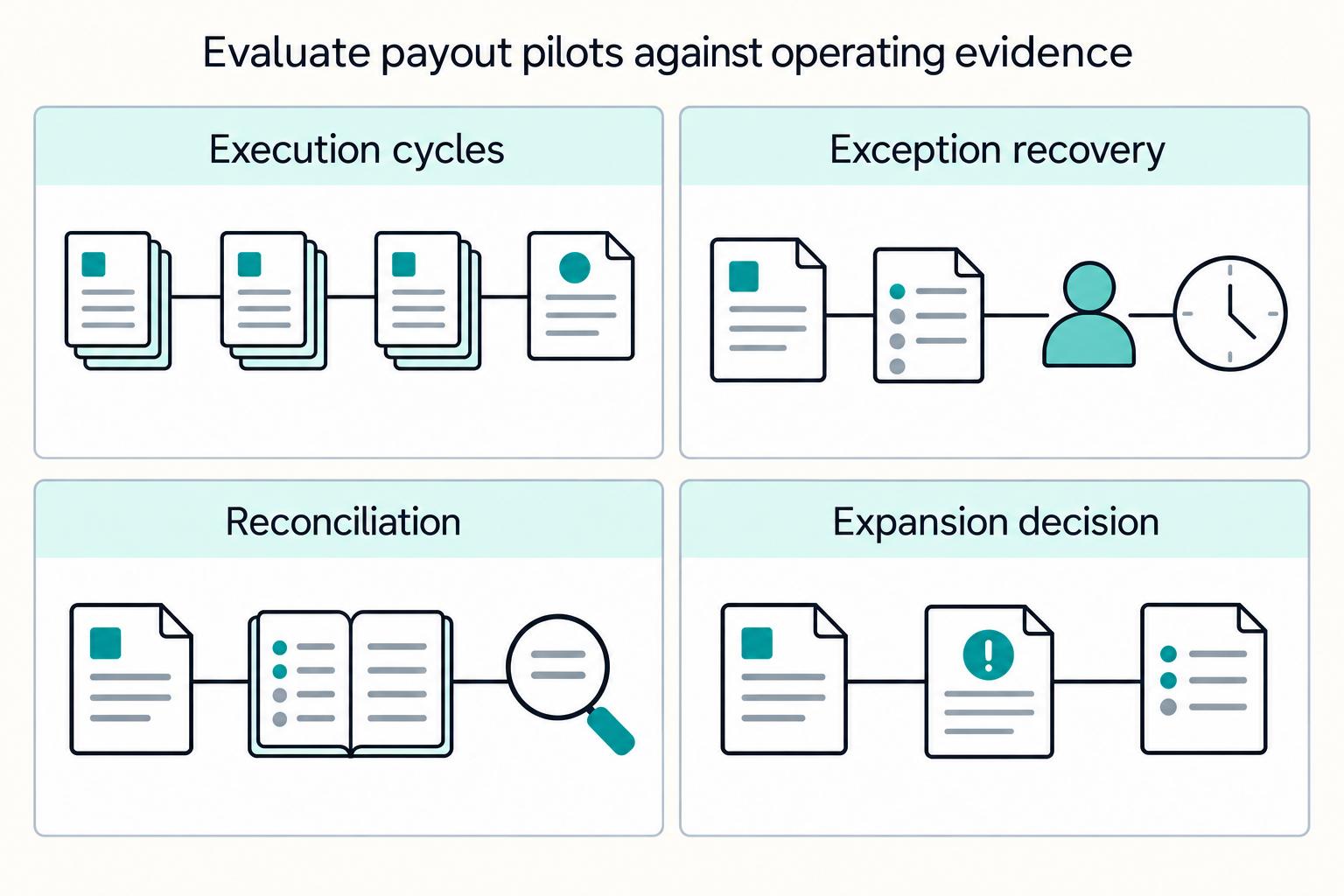
Run a pilot with hard pass and fail gates before full rollout#
Treat the pilot as a certification step, not a soft launch. Run a controlled vendor cohort and evaluate payout behavior by batch or cycle so pass/fail decisions stay attributable.
| Gate | Condition | Threshold or note |
|---|---|---|
| Pass | Payout execution is stable across cycles | Use explicit pass gates before you expand volume |
| Pass | Exceptions are resolved within your defined recovery window | Use explicit pass gates before you expand volume |
| Pass | Reconciliation closes cleanly | Records match across systems |
| Fail | Credit-payout returns or rejects exceed the pilot’s internal tolerance | Track codes/counts/value by vendor credit cohort; do not use debit-return thresholds as credit-payout limits. |
| Fail | Blocked-party hits create unresolved holds | Funds must remain blocked when required |
| Fail | Manual overrides repeat | Indicate process-control failure in your workflow |
| Fail | Event-to-ledger mapping breaks | You cannot reliably tie payout events to ledger outcomes |
Use explicit pass gates before you expand volume:
- Payout execution is stable across cycles.
- Exceptions are resolved within your defined recovery window.
- Reconciliation closes cleanly, with records matching across systems.
Use explicit fail gates and rollback triggers:
- Credit-payout rejects/returns or recovery age exceed internal pilot limits. If the program also originates debits, separately monitor applicable debit-return rules with the ODFI.
- Blocked-party hits create unresolved holds, where funds must remain blocked when required.
- Manual overrides repeat and indicate process-control failure in your workflow.
- Event-to-ledger mapping breaks and you cannot reliably tie payout events to ledger outcomes.
If any fail gate is hit, pause expansion, fix controls, and re-run production validation before full rollout.
Scale in phases and keep auditability intact#
After the pilot passes, scale in controlled waves so each expansion can be explained, approved, and paused without breaking your audit trail.
Expand in fixed change windows#
Move from pilot to production with named waves, not continuous rollout. For each wave, define the vendor cohort, change window, approvers, and rollback checkpoint before the next cohort starts.
Do not overlap waves until the prior wave is understood. Before expanding, confirm the last payout batch has a clear status by rail, exceptions are understood, and ledger journal records are complete enough for reconciliation.
Enforce activation gates for identity and business review#
Keep activation gated on completed KYC/KYB checks when your program, bank, or provider requires them. The cited regulatory requirements are bank-specific: CIP is risk-based, and beneficial-owner procedures for legal entities must be written and maintained. If you are not the regulated bank, align your activation logic and records with the controls your bank or provider requires.
Treat overrides as controlled exceptions. As an internal control, record who requested the override, what was missing, why it was approved or denied, and required follow-up.
Instrument operator-facing audit views#
At scale, your operations views should answer basic questions quickly. Track batch status by rail, exception queues, and reconciliation state against ledger journal close, with ACH and wire activity clearly separated.
Monitor credit returns and rejects by cause, cohort, age and value. Nacha’s 0.5% unauthorized debit threshold and 3% administrative/15% overall debit inquiry levels concern debit origination, not this credit-payout success metric; exceeding the latter inquiry levels is not automatically a Rules violation.
Constrain wire use to explicit urgency classes#
Keep wire as an exception rail, not a default fallback. Fedwire is generally used for large-value, time-critical payments and is immediate, final, and irrevocable once processed, so require explicit urgency classes, reason codes, and approvers for each wire.
Review wire reasons after each wave. If recurring reasons point to onboarding gaps, pause expansion and fix onboarding before scaling further.
Fix the failure modes competitors skip#
Treat exceptions, duplicate events, and reconciliation mismatches as first-class payout states, not edge cases. If each state does not have a named owner and defined action, small ACH issues can turn into reporting errors and support backlog.
Assign an owner and SLA for ACH exceptions#
Assign each ACH return or reject path to one named ops owner, with a backup owner. ACH exceptions are broad by definition, so set SLAs by case type instead of one blanket deadline.
Use a short communication template: what happened, whether funds moved, what you need from the vendor, and when you will send the next update. If an ODFI Request for Return is initiated, log that in the case notes. Each exception ticket should include owner, opened time, bank or provider reference, and next action.
Enforce idempotency and replay-safe webhooks#
Use one stable business-operation key for the original creation and uncertain retries, backed by an internal uniqueness constraint. Retrieve existing provider state before retrying outside its key-retention window. A confirmed replacement is a separate linked operation approved only when the original cannot still settle.
Assume webhook delivery can retry, duplicate, and arrive out of order. Track processed event IDs, ignore already processed events, and only advance payout state when the event is valid for the current state. Before production, replay the same event twice, then send an older event after a newer one. The expected result is no second money movement and no second Ledger journal posting.
Pause settlement reporting when records disagree#
Treat this as internal policy: if payout status and the Ledger journal disagree, consider pausing settlement reporting for that batch until the variance is resolved. Reconciliation is a control, not just reporting hygiene, so independent settlement evidence should take priority when records conflict.
Investigate paid-status/journal mismatches and cash entries without settlement evidence. Do not assume every unpaid payable or pending clearing entry is an error; distinguish valid accruals from incorrect disbursement records.
Publish one recovery matrix ops can run without escalation#
Document one recovery matrix inside your Exception handling workflow so ops can act without escalation bottlenecks. Keep it compact: failure mode, owner, immediate action, required evidence, and escalation trigger.
| Failure mode | Immediate action | Key evidence or rule |
|---|---|---|
| ACH return or reject | Assign the case to one named ops owner with a backup owner | Each exception ticket should include owner, opened time, bank or provider reference, and next action |
| Duplicate webhook event | Track processed event IDs and ignore already processed events | Expected result is no second money movement and no second Ledger journal posting |
| Out-of-order event | Only advance payout state when the event is valid for the current state | Before production, send an older event after a newer one |
| Payout-status versus ledger mismatch | Consider pausing settlement reporting for that batch until the variance is resolved | Classify valid accrual/pending records separately from incorrect cash or missing settlement evidence. |
Include at least: ACH return or reject, duplicate webhook event, out-of-order event, and payout-status versus ledger mismatch. If a case still needs ad hoc escalation with the available evidence, tighten the matrix before scaling further.
Conclusion#
This migration works when you design three parts together: rail choice, vendor onboarding controls, and event-to-ledger reliability. Use ACH for the payouts it fits, reserve wire transfer for explicit exception classes, and treat pilot evidence as the release gate.
Align language before you change behavior. Finance, ops, engineering, and support should use the same definitions for Electronic check (eCheck), Automated Clearing House (ACH), Wire transfer, and EFT, so specs, tickets, and approvals do not drift.
The rails are complementary choices by use case, not interchangeable defaults. ACH is the U.S. electronic network for Direct Deposit and Direct Payments. Wire transfer is electronic bank-to-bank movement and, in the Fedwire context, is generally used for large-value, time-critical payments that are final once processed. If teams treat wire as "faster ACH," approval and reconciliation risk increases.
Publish routing rules people can execute. Default to ACH for scheduled or otherwise predictable payouts between known counterparties on known due dates. Escalate to Same Day ACH when timing matters and the payment still fits ACH requirements. Use wire for defined urgency or value-sensitive exceptions.
Ownership is a control point. Each wire exception class needs an approval owner and clear evidence requirements, or "temporary" overrides become permanent.
Finalize the onboarding mandate before first live money movement. Capture payout authorization, destination account details, and required compliance evidence. If you use labels like KYC, program-specific KYB, and AML, tie them to explicit gates.
In regulated bank onboarding, identity verification is risk-based through CIP procedures, and legal-entity onboarding can require beneficial ownership details for natural persons who own or control the entity. No vendor should enter a live payout batch until onboarding is complete and approved.
Ship integration controls that reduce duplicate movement risk and preserve auditability. Use an Idempotency key on payout creation, durable handling for each Webhook event, and policy-based ledger entries matched to independent bank evidence.
Verify this with failure-mode testing, not happy-path demos. Replays should not create a second payout, duplicate callbacks should not post twice, and payout status must map cleanly to the ledger before settlement reporting.
Run a pilot with hard pass and fail gates before scaling. Use a controlled cohort and attributable batches, including successful settlement, invalid instructions, uncertain status and check-replacement cases. Multiple observed cycles can demonstrate readiness for that cohort; one batch does not prove every future rail or vendor scenario.
Treat repeated failures as design signals, not pilot noise. Repeated manual overrides, unresolved holds, or broken event-to-ledger mapping mean rollout controls are incomplete.
Track outcomes weekly and tighten policy where failures repeat. Review reconciliation lag, exception aging, duplicate suppression, and wire usage outside policy. When a payout class repeatedly misses expectations on ACH, document whether the fix is Same Day ACH, wire, or upstream scheduling changes.
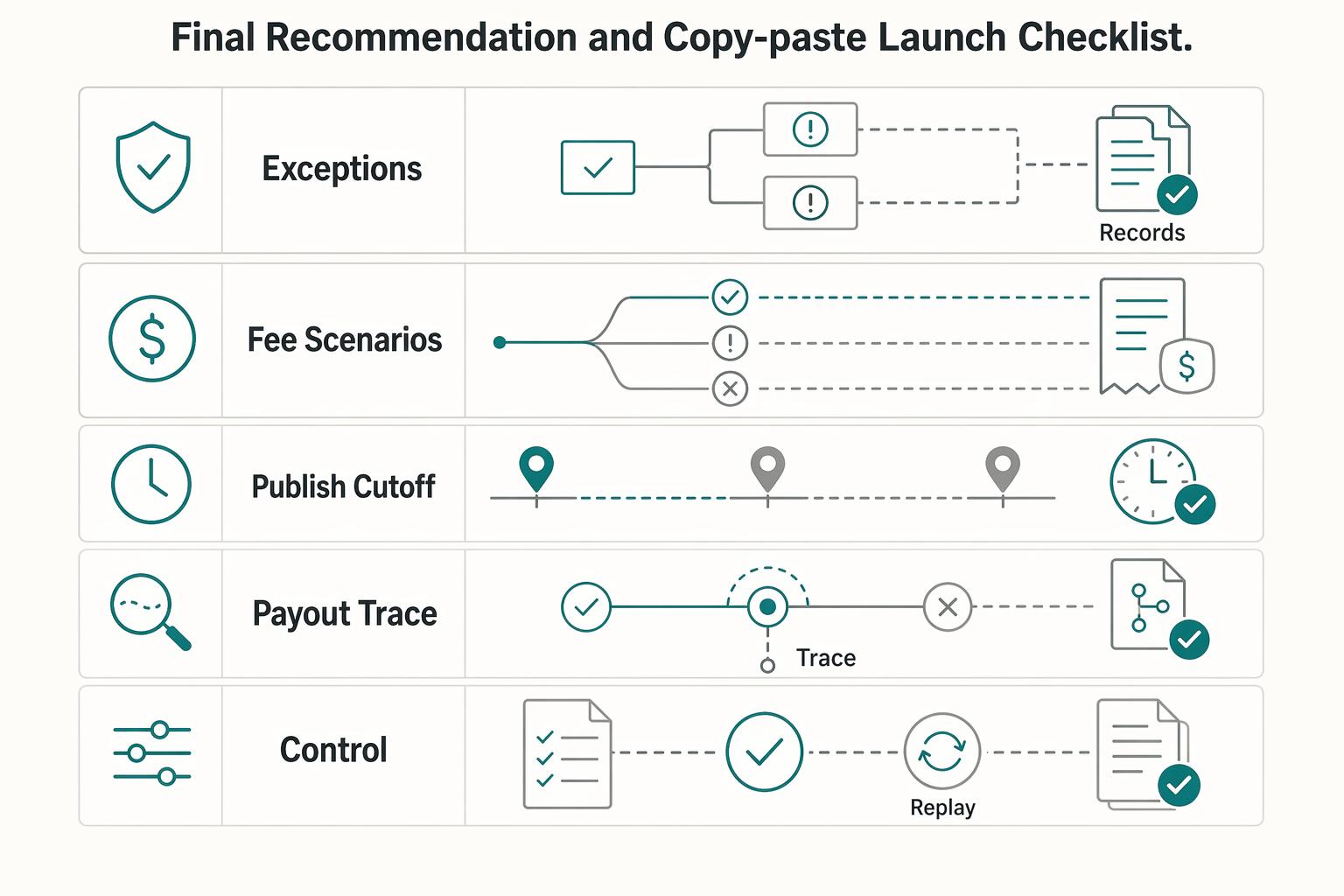
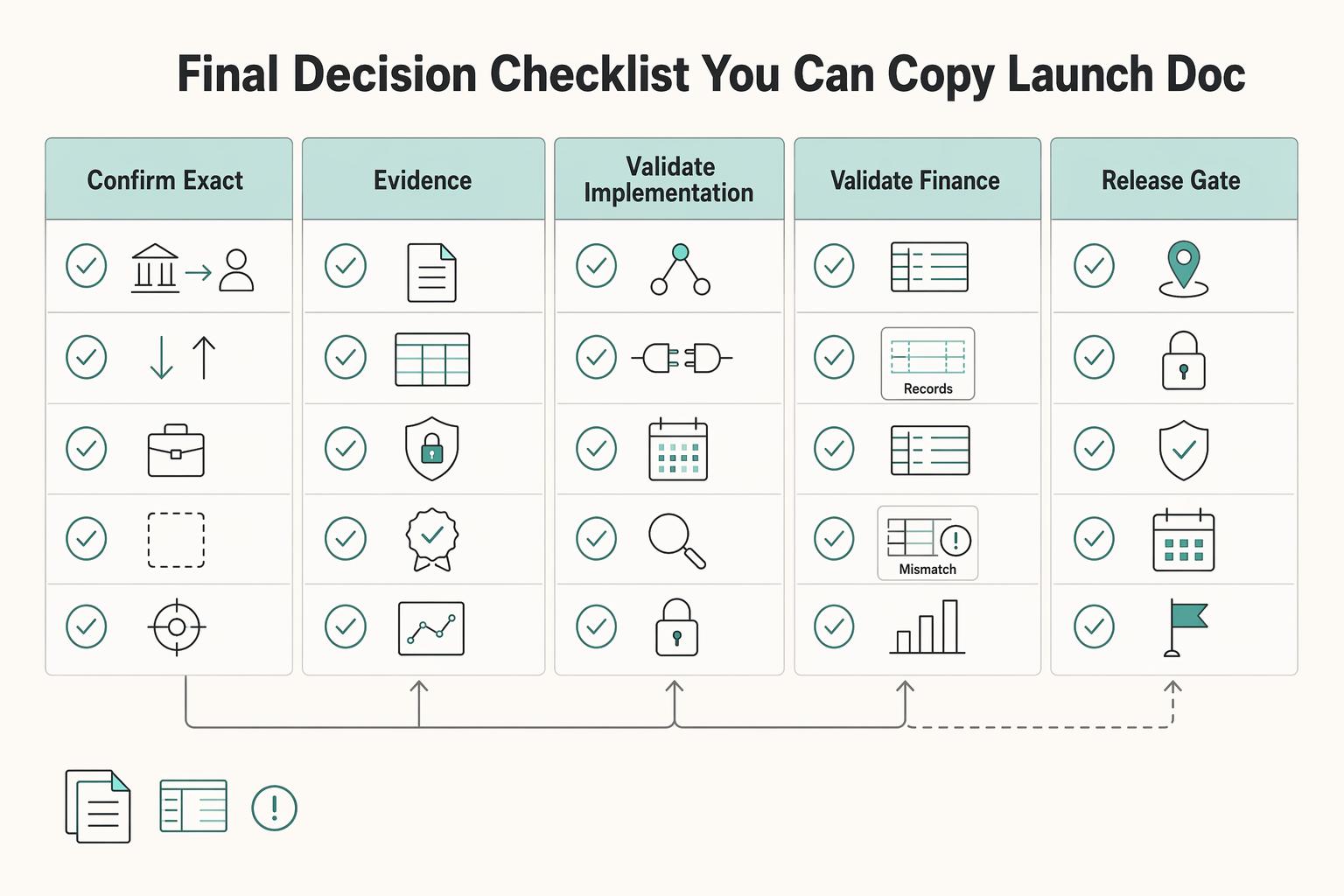
Closeout checklist:
- Align rail definitions (
eCheck, ACH, wire, EFT) across finance, ops, and engineering. - Publish ACH vs wire decision rules with named approval owners.
- Finalize
Vendor onboarding mandateand compliance gates (KYC, program-specificKYB,AML). - Ship idempotent payout integration (
Idempotency key,Webhook event,Ledger journal). - Run pilot with explicit pass/fail gates before full
Vendor payout batchscale-up. - Track reconciliation and exception metrics weekly, then tighten policy where failures repeat.
When you are ready to turn this checklist into an implementation plan, review your markets, controls, and rollout constraints with Gruv.
Frequently Asked Questions
What is the practical difference between check, `Electronic check (eCheck)`, `Automated Clearing House (ACH)`, and `Wire transfer` for vendor payouts?
A traditional check moves through the banking system as a check item or check image. An Electronic check (eCheck) can refer to converting check account information into a one-time ACH debit, rather than routing a paper check through traditional check processing. Automated Clearing House (ACH) is the U.S. batch network for electronic credits and debits, while a wire transfer moves money electronically from one bank account to another.
How long does ACH usually take, and how should teams think about ACH cost vs wire cost in platform operations?
ACH is not an always-next-day rail. The ACH Network processes payments 23 1/4 hours every banking day and settles four times every banking day, but some transfers can still take several days, and ACH does not currently settle on weekends or federal holidays. In operating terms, treat ACH as a lower-cost alternative to wire and reserve wire for higher-urgency cases.
When should a platform choose `Same-Day ACH` instead of standard ACH or wire?
Use Same Day ACH for eligible time-sensitive payments that meet bank submission cutoffs. The current limit is $1 million; the approved $10 million limit takes effect 17 September 2027. It is a banking-day service, not an always-on instant rail. Verify original status before any wire replacement.
What are the first steps to migrate vendors from checks to electronic rails without disrupting payout cycles?
Confirm enrollment and independently verify bank instructions, then validate the destination with your approved method. Inventory outstanding checks, prevent the same obligation entering both rails and confirm any original check cannot still pay before electronic replacement. Pilot a controlled cohort and keep lawful payment alternatives for incomplete enrollment.
Can ACH support both recurring and one-time payouts in the same vendor base?
Yes. ACH is explicitly used for large volumes of scheduled and recurring payments between known counterparties on known due dates, and it can also be used for one-time transfers. You can run both patterns on the same core rail if your payout-state controls are reliable.
How should teams evaluate `Real-Time Payments (RTP)`, `FedNow`, or `SEPA` alongside ACH and wire for future routing?
Evaluate supported accounts, currencies, institution reach, limits and finality. RTP and FedNow provide always-on US alternatives where institutions participate. For euro payments, SEPA Credit Transfer and SEPA Instant have distinct timing/eligibility; geographic scheme scope covers 41 countries and territories, but not every bank supports every scheme.
Try a related tool
Where Gruv fits
Plan and approve payout batches
See how payee status, approval rules, route review, and exception handling sit in one payout workflow.
See reconciliation and mismatch review
Compare ledger entries, provider payment records, and statement rows to see what matches and what finance needs to review.
Researched and edited by the Gruv editorial team. Gruv builds cross-border billing, payouts, and finance-operations software for global businesses.
Sources
Includes 2 external sources outside the trusted-domain allowlist.
- consumerfinance.gov/rules-policy/regulations/1005/10trusted
- docs.stripe.com/api/idempotent_requeststrusted
- docs.stripe.com/webhookstrusted
- federalreserve.gov/paymentsystems/fedach_about.htmtrusted
- federalreserve.gov/paymentsystems/fedfunds_about.htmtrusted
- sao.wa.gov/sites/default/files/2023-04/Best-practices-f...trusted
- europeanpaymentscouncil.eu/about-sepaexternal
- nacha.org/content/abcs-achexternal
Educational content only. Not legal, tax, or financial advice.
Related Posts
Same-Day ACH for Platforms: How to Speed Up Contractor Payments Without Wire Transfer Fees
The goal is simple: cut avoidable wire use without making contractor payouts less reliable. That is where Same-Day ACH earns its place. Nacha describes it as the faster payment method on the ACH Network. It also notes that it can support same-day pay for many gig and contract workers, with settlement that can occur within a few hours.
ACH Payment Processing Platforms for U.S. Collections and Payouts
Start with the outcome, not the feature label. You may need a setup that collects money in and sends money out over the U.S. banking network, not just a generic bank-transfer option. In practice, that often means ACH debits for collections and ACH credits for payouts, with controls your product, engineering, and finance teams can run in production.
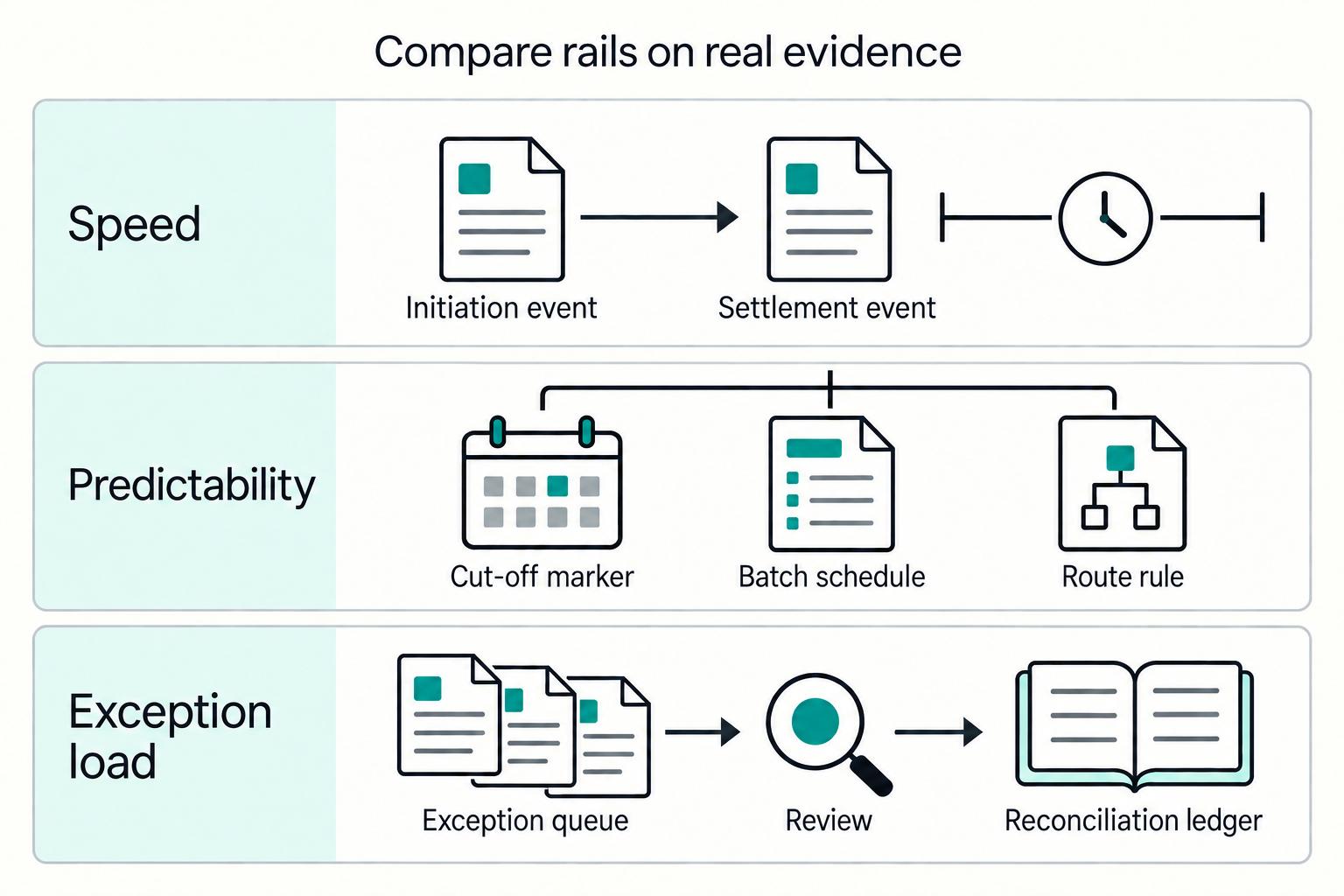
What Are Payment Rails? ACH Wire SEPA and Real-Time Networks Compared
For platform operators, rail choice is an operating decision, not just a glossary term. It affects payout speed, exception handling, and how much cleanup your support and finance teams inherit.