
Quick Answer
Set renewal reminders as control checkpoints, not just date alerts. Start with a complete contract record, named owner, and escalation path, then tie reminders to the signed notice window and auto-renewal terms. Use staged checkpoints for discovery, review, approval, and execution, and require a current evidence pack so scope drift, clause changes, and control gaps are caught before approval.
Why renewal reminders fail and how this guide fixes it#
The main failure is often not a missed date. It is treating renewal like calendar admin rather than a control point for legal, compliance, finance, and operations. If you treat renewal like a simple date alert, you miss obligation drift.
Treat renewal as a life-cycle control review#
Treat renewal as a life-cycle control review, not a one-time admin task. US interagency third-party guidance finalized on June 6, 2023 frames risk management across the full relationship life cycle, including contract negotiation, ongoing monitoring, and termination. Renewal sits inside that cycle, where undocumented changes can quietly become accepted practice.
That is also where teams misread scope creep. PMI notes that scope creep is commonly driven by stakeholder misalignment, inconsistent understanding, and weak analysis. The risk is not just pricing pressure. Business terms, legal terms, and day-to-day operations can drift out of sync.
Set accountability before you set reminders#
Set accountability before you set reminders. A reminder without a named owner and reporting path is just a future inbox event. We recommend naming the owner before your first reminder fires. GAO's 2025 Green Book, effective in fiscal year 2026, emphasizes communicating internal control responsibilities through established reporting lines.
Use a documented ownership and escalation structure so review responsibility is explicit. If the contract record does not show a current owner and approval path, it is not renewal-ready.
Require decision evidence at each checkpoint#
Require decision evidence at each checkpoint. Renewal reviews break down when people are asked to decide without the current contract record and scope history in front of them. At minimum, keep scope boundaries and change history documented so reviewers can test whether live operations still match approved terms.
That discipline aligns with control expectations. The FCA ties review of critical or important outsourcing arrangements to the first appropriate contract renewal. That reinforces renewal as a control execution moment, not a paperwork step.
Build a defensible renewal trail#
Build a renewal trail you can defend later. EU DORA implementing standards treat contractual-register information as essential for internal ICT risk management and oversight. Even outside DORA, the practical point is similar: if renewal evidence is fragmented, the control is weak.
This guide follows a practical sequence: set prerequisites, design reminder stages, define required evidence, apply legal checkpoints, route escalations early, and finish with a copy and use checklist. Keep the process proportionate to risk and complexity, then tighten controls first where third-party dependency and disruption risk are highest.
What to prepare before you set the first reminder#
Get the inputs right before you automate anything. If the register, document set, or ownership map is incomplete, reminders will only speed up confusion and increase scope-drift risk.
Build a minimum register that supports a real renewal decision#
Use one row per vendor relationship, with fields that show who owns the decision, what renews, and when notice rights expire. A practical minimum set can include:
- contract owner
- auto-renewal clause
- notice window
- Statement of Work (SOW)
- change-control clause or log reference
- renewal decision date
Keep expiration date and notice trigger separate. Notice schedules are typically based on expiration plus a notice-period offset, and automatic renewal can continue unless notice is given within contract-defined timeframes.
Verification checkpoint: do not mark a contract reminder-ready until auto-renewal status, notice window, and current owner are populated and dated.
Collect the documents that define the current relationship#
Build one review packet per vendor: the master contract or MSA, current SOW, any engagement letter used for that relationship, and the latest written change log.
This matters because the operative agreement may be the base agreement plus the SOW, and the SOW defines the services and deliverables. Pair the change-control clause with the written change trail so reviewers can assess the current scope, not an outdated file set. Verification checkpoint: confirm there is one clear current SOW version before reminders start.
Separate reminder ownership from approval authority#
Set a RACI matrix before launch so reminder execution and approval authority stay separate. Keep one accountable owner per contract, and define who is responsible, consulted, and informed. If you skip this split, your reminder owner can end up approving the same change.
The reminder owner can be different from the renewal approver. If that split is unclear, teams start treating a calendar event as the decision. Verification checkpoint: each contract has one accountable owner and one escalation path before the notice window closes.
Gather only applicable compliance evidence and limit phase one#
Collect only the KYC, KYB, and AML evidence that applies to the specific relationship and jurisdiction, not a generic compliance folder.
In the U.S. banking context, CIP sits inside AML, and beneficial-owner identification for legal entity customers is a legal-checkpoint area that should be validated against current guidance at renewal time. The eCFR text for 31 CFR 1010.230 still states identification at each new account opening as of 3/30/2026. A February 13, 2026 industry report describes FinCEN relief affecting repeat checks. Treat this as a verification point in legal review, not an assumption.
For cross-border relationships, do not assume AML requirements are identical across markets. FATF sets an international standard that countries implement through local measures.
Keep phase one narrow enough to prove control. Possible exclusions can include:
- low-risk contracts with no auto-renewal clause
- dormant vendors with no active SOW
- relationships missing baseline documents that need cleanup before entry into the reminder process
Related: How to Write an Engagement Letter for a Bookkeeping Client.
What scope creep at renewal actually looks like in cross-border payments#
Once the basics are in place, look for where scope actually drifts. At renewal, scope creep often shows up as new obligations rather than obvious price or ticket-volume changes.
Compare the live footprint to the written scope#
If a provider says service is unchanged but adds countries, verification steps, or tax-document handling, treat renewal as a control checkpoint, not an admin task. If you see those additions, you should pause and recheck the live control set.
Scope creep is scope expansion without explicit approval or matching time, cost, or resource changes. In cross-border payments, start with one question: what are you newly agreeing to do? Compare the current SOW, live payout corridors, and change log against the renewal language. Phrases like "support for further markets" can introduce new payout countries, new customer types, or additional customer and beneficial-owner verification work.
Verification checkpoint: before approval, confirm whether renewal allows any country, entity type, or onboarding activity not documented in the current SOW. If yes, record it as a scope change even if commercial terms are unchanged.
Check the obligations that drift fastest#
Common drift points are AML/CFT, tax, and VAT controls. Adding payout coverage, especially where high-risk jurisdictions are involved, can raise diligence expectations. FATF's 13 February 2026 Call for Action urges enhanced due diligence for high-risk jurisdictions, and FATF standards were amended as of October 2025. Obligations can shift while contract language still looks familiar.
If renewal changes who collects or refreshes onboarding data, review the added verification steps your team must perform, especially customer and beneficial-owner checks. On tax handling, confirm whether the relationship now requires Form W-9 (TIN collection), Form W-8BEN-E (foreign entity status), or Form 1099-NEC reporting. For EU activity, confirm whether VAT-number validation through VIES is now part of delivery.
Require a short drift memo before approval#
Before approval, require a one-page delta memo covering changes in payout countries, due-diligence steps, tax forms, and VAT checks. This keeps "same service" language from hiding control expansion. If 1099-NEC is in scope, verify the current IRS threshold at review time because IRS instruction and FAQ wording are not fully aligned.
For a step-by-step walkthrough, see How Freelancers Prevent Scope Creep Without Slowing Client Deals.
Build one renewal inventory your teams can actually operate#
Use one renewal inventory across legal, compliance, tax, and ops. When the same contract is tracked in separate systems, scope changes are easier to miss.
Build one row per contract and make each row decision-ready#
Create one table where each row is one live contract, amendment set, or vendor relationship that can renew. Treat it as a standing control record across the relationship lifecycle, especially where regulated third-party oversight applies, not a quarter-end cleanup sheet. We recommend keeping it where your legal, compliance, and finance owners can all review the same record.
| Contract ID | Contract renewal reminder | Notice window | Renewal type | Current SOW | LoL | Indemn. | Termination | Governing law | Jurisdiction | Dispute resolution | KYC/AML gate | VAT validation | Tax form deps | Evidence links | Renew-ready |
|---|---|---|---|---|---|---|---|---|---|---|---|---|---|---|---|
| CTR-001 | |||||||||||||||
| CTR-002 | |||||||||||||||
| CTR-003 |
In Contract renewal reminder, store the actual trigger date. In Notice window, store the exact contract language. In Renewal type, mark manual or auto. If California consumer auto-renewal rules are relevant, tag that explicitly instead of assuming your standard B2B notice field covers it.
For Current SOW, store the current version or link plus effective date. The record should make clear the work, location, period of performance, and deliverable schedule.
Add legal columns that force review#
Track Limitation of Liability, Indemnification, Termination, Governing Law, Jurisdiction, and Dispute Resolution as separate fields. These are common places for legal drift to hide inside a "same commercial terms" renewal.
Do not mark fields only as present. Record the clause reference, last review date, and status (unchanged, changed, or pending legal review). Governing Law identifies which law applies in dispute. Jurisdiction identifies court authority over the parties. Dispute Resolution should show litigation or ADR, since ADR is an alternative to litigation.
Treat blanks as not reviewed, not no issue. Controlled values such as Reviewed no change, Change detected, Pending review, and Not applicable keep reporting usable under deadline pressure.
Tie compliance, tax, and evidence fields to the live payment flow#
The compliance and tax fields should map to what actually happens in the payment flow, not to generic policy labels.
For KYC/AML, capture who performs due diligence, whether onboarding checks changed, and whether beneficial-owner identification for legal entities is implicated at account opening. If a renewal changes essential customer facts, make it a review item.
For VAT validation, capture whether validation is required, who owns it, and where evidence sits. If EU VAT validation is in scope, note whether VIES is used, but do not treat VIES alone as complete VAT compliance.
For tax dependencies, capture the exact form and owner. Track W-9 dependency where TIN collection supports information return workflows. Track W-8BEN dependency for individuals where foreign-status withholding or reporting certificates are needed. Track downstream 1099-NEC dependency where nonemployee compensation reporting may apply. Flag FBAR only where foreign account facts could trigger filing relevance ($10,000 aggregate at any time in the year; annual due date April 15 with automatic extension to October 15). Keep FEIE as a potential-impact flag tied to Form 2555, since applicability depends on taxpayer facts.
Add evidence links for exception logs, unresolved incidents, and audit artifacts tied to payment and payout flows, including Merchant of Record programs where used.
Gate renew-ready on completeness and dates#
Do not mark a contract renew-ready until every mandatory field is populated, dated, and linked where required. Include document version, review date, and owner for each open item.
If volume is high, prioritize by risk and complexity first. Start with contracts tied to cross-border payouts, onboarding controls, tax document collection, or disputed service performance.
Set a reminder cadence tied to decisions not just dates#
Set reminders to decision checkpoints, not just to the contract end date. A single expiry alert is often where scope drift slips through, because teams discover changes after much of their negotiation negotiating room is gone.
Anchor the cadence to the actual notice language#
Start with the contract's Notice window and Auto-renewal clause, then count backward. Use the contractual action date, not an invoice or signature anniversary. If you count from the wrong date, your team can lose the notice window.
If the contract auto-renews, trigger the first checkpoint early enough to preserve a real legal and commercial decision. FAR 52.217-9 illustrates the principle. The clause uses a pre-expiry notice window (default bracket 60 days unless changed), and preliminary notice is not the extension decision itself. Use the same operating logic here. Early notice preserves options, while late notice can end up documenting a foregone outcome.
As a control check, sample at least one contract per renewal type and confirm Contract renewal reminder is tied to the agreement's notice obligation.
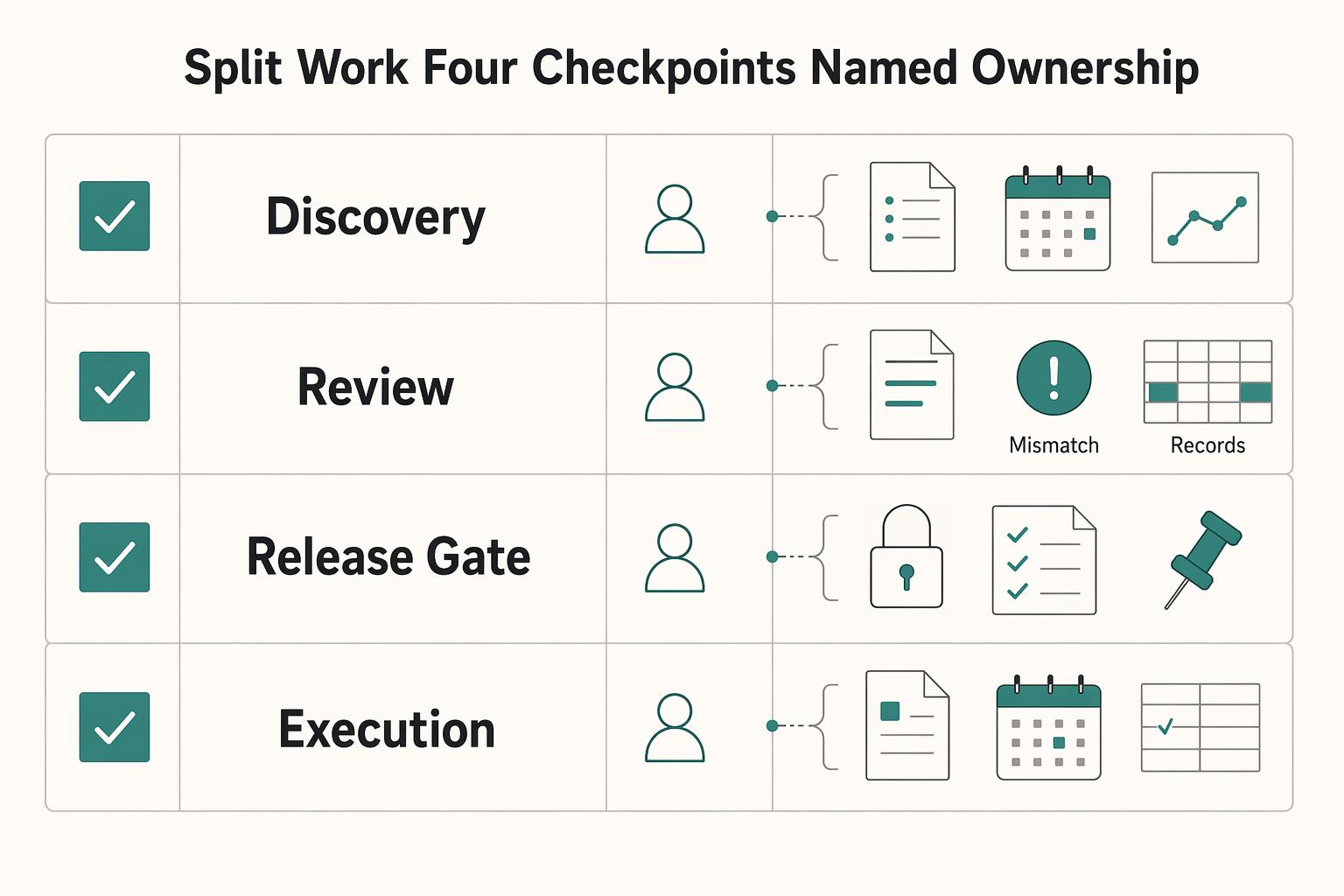
Split the work into four checkpoints with named ownership#
A workable cadence separates issue-finding, decision-making, and recordkeeping. Use four checkpoints: discovery, review, approval, and execution. They are not legally required in every renewal, but they make it harder for changes to slip through. Assign a named owner from your RACI matrix at each step.
| Checkpoint | What must happen | Minimum owner signal | Required artifact |
|---|---|---|---|
| Discovery | Compare current SOW, amendments, incidents, and control changes against last signed terms | Responsible owner assigned | Updated risk summary |
| Review | Legal, compliance, tax, and ops assess deltas and open issues | Reviewers confirmed in RACI matrix | Legal markups or no-change memo |
| Approval | Decision-makers choose renew, amend, extend, or terminate path | Accountable approver named | Approval memo with rationale |
| Execution | Notice sent, amendment signed, or termination steps started | Execution owner named | Sent notice, signed document, or termination record |
A reminder without an artifact is calendar noise. If a checkpoint fires, the required output should exist and be review-ready.
Set early triggers where negotiating room can disappear#
Do not wait until the notice deadline to begin review on auto-renewal contracts. Waiting may preserve process, but it can reduce negotiating negotiating room.
Where jurisdiction-specific notice rules apply, tag them explicitly instead of treating them as universal timing. California consumer automatic-renewal rules can use a 15 to 45 day pre-renewal window in specific contexts. New York GOL § 5-903 uses 15 to 30 days for certain service, maintenance, or repair contracts tied to enforceability. These are context-specific, not default timing for every cross-border B2B payment contract.
Start tight only where the risk justifies it#
Use the tightest cadence where risk is highest, then scale. Start with contracts that carry higher legal, financial, or operational risk.
If volume is high, apply a simple rule: high-risk contracts get all four checkpoints. Lower-risk contracts start with discovery and approval, then expand if misses persist. After two cycles, check for slippage. If reminders fire but artifacts are missing, the issue is usually ownership, not timing.
Define the evidence pack each reviewer must see before approval#
Before approval, require a dated evidence pack from legal, compliance, operations, and finance. If any packet is missing or stale, pause the renewal.
That fits third-party oversight expectations. Regulators describe a full relationship life cycle, and examiner guidance expects records across the relationship. The cited guidance does not prescribe a required renewal-packet form, but a renewal packet is a practical way to show what was reviewed before extending the relationship.
| Packet | What it must answer before approval | One blocking check |
|---|---|---|
| Legal | Did the paper change, and do risk clauses still work for us? | Redlines compare to the current executed baseline, not an old draft |
| Compliance | Did control obligations, due diligence, or tax handling change by market or flow? | Status for KYC, KYB, AML, VAT, and tax forms is current and dated |
| Operations | Is unresolved performance or incident risk being carried into renewal? | Open exceptions are separated from closed items and have owners |
| Finance | Did term or footprint changes alter cost or exposure? | Deltas tie to specific contract or operating changes |
Build the legal packet from the signed baseline#
Start with the signed baseline, not the latest draft. Include the current signed agreement, active amendments, current SOW, and a redline against the live contract baseline. Add change history that explains how scope moved over time, including change requests, amendment logs, and Change-control clause history.
Make the decision point explicit: did Limitation of Liability, Indemnification, or Termination change in a way the business accepts? We recommend using a short delta memo, even when the answer is "no change."
Map compliance and tax obligations to the actual relationship#
Show current and proposed obligations for KYC, KYB, and AML, with market-specific notes where they differ. If beneficial-owner data is part of your controls, make status explicit. Covered institutions need procedures to identify and verify beneficial owners of legal-entity customers under 31 CFR § 1010.230.
Keep tax handling in this same packet: whether VAT validation is required, whether a U.S. payee needs Form W-9, and whether a foreign payee has Form W-8BEN when requested by the payer or withholding agent. For EU counterparties, record whether VAT status was checked in VIES and when it was checked.
For 1099 logic, keep tax-year context. IRS materials reference $600, and IRS FAQs reference $2,000 for payments made after December 31, 2025, so do not hard-code one threshold without date context.
Show operational risk that approvals can miss#
Operational evidence should show what renewal would carry forward, not just what the contract says. Summarize service performance, unresolved exceptions, payout or collection incidents, and known failure modes.
If scope changed in practice, for example through new corridors, segments, or verification steps, include it even when the contract text still looks similar. Keep this packet time-bound and concrete: what is open, what is closed, what risk is accepted, who owns each unresolved item, and which market or process is affected. Ongoing due diligence is expected across the relationship lifecycle, and incomplete incident detail can weaken approval records.
Tie finance approval to term and footprint changes#
Finance review should connect economics to what changed in the contract and in operations. Show pricing, credits, exposure shifts, and processing-footprint changes such as cross-border routing changes.
For each delta, state the driver: new market coverage, added verification steps, revised termination charges, changed liability allocation, or routing assumptions. This prevents approvals that look cheaper while hiding higher control or loss exposure.
Set one hard gate: no complete, current, internally consistent packets, no approval. That is what keeps reminder workflows from turning into calendar admin.
Apply clear decision rules for renew amend or terminate#
Treat renewal as a new commitment, not administrative carryover. Renew as-is only when the evidence is complete and the relationship in practice still matches the signed contract set. If practice changed without matching contract updates, use an amendment before renewal or move to termination.
Confirm whether this is a true renewal or a modification#
Start with one question: does the current signed agreement still describe what is actually happening? If yes, and there are no unresolved approval blockers, renew as-is. If no, move to a modification path and require updated contract paper before renewal.
Where the contract requires signed writing for changes, do not rely on informal approvals to carry scope changes.
Escalate material protection regressions before signature#
Do not let improved commercial terms hide weaker legal protection. If Limitation of Liability, Indemnification, or Dispute Resolution moved against your position, escalate before signature and require explicit risk-owner approval of that tradeoff. Your approval note should identify each regressed clause and the accepted downside, not just say "commercially approved."
Use extensions narrowly and block silent renewals with control gaps#
Use a time-bounded extension only when the remaining gap is specific, documented, and accepted by the right risk owners. If compliance exceptions or required control documentation are still unresolved near deadline, we recommend an explicit decision rather than defaulting into automatic renewal.
This aligns with lifecycle oversight expectations. Third-party governance includes termination, and outsourcing does not remove your compliance responsibility.
Match reminder timing to clause mechanics and record the decision#
Set reminders to match the contract's renewal mechanics. Some contracts renew automatically, while others require notice, so timing has to leave enough room for a real decision.
Record the final path as one of four outcomes: renew, amend, extend, or terminate. Include the reason, approvers, unresolved items, if any, and the exact document or action needed to close the gap.
When renewal requires an amendment, lock scope before legal sign-off by drafting a structured work delta with the SOW Generator.
Review legal clauses that quietly create downstream risk#
Do not roll these clauses forward as admin carryover. If Governing Law, Jurisdiction, Dispute Resolution, or Termination no longer match how the relationship operates, reopen terms before the notice period closes.
Re-check governing law and jurisdiction against where you now operate#
Treat these clauses as risk controls, not boilerplate. The governing law clause selects the legal system that interprets the contract. The choice-of-court clause is intended to set where covered disputes are decided. Both should still fit your operating footprint and enforcement reality.
Compare the signed law and forum with where the relationship now operates and where enforcement would likely occur. Your review note should explain why the chosen court is still practical for your team, not just familiar. If scope expanded through a Statement of Work (SOW) update or informal Change request but forum practicality weakened, escalate before renewal.
Re-test dispute resolution against real recovery options#
Use a practical enforceability test, not a paper-strength test. If the contract uses court litigation, confirm the chosen court still works in practice. If it uses arbitration, confirm the clause mechanics still fit your escalation path.
The ICC model clause routes disputes to final resolution under ICC Arbitration Rules. The New York Convention framework supports recognition and enforcement of arbitral awards, with enforcement handled under local procedure. Your Contract renewal reminder should require one clear legal answer: if a serious dispute lands next quarter, who escalates internally and what remedy is realistically pursued.
Validate that termination still produces an executable exit#
Termination is only protective if exit is executable. EBA outsourcing guidance states the contract should include a termination and exit management clause. EBA Q&A text reflects paragraph 99(c): the arrangement should facilitate transfer to another provider or re-incorporation in-house.
Check notice mechanics, transition support, data handoff, and accountable owners in your RACI matrix. In practice, termination and exit arrangements are friction points because they sit at the intersection of regulatory compliance and operational reality. If an Auto-renewal clause is near and these mechanics are still vague, escalate before signature.
Set escalation paths before the notice window closes#
When a real legal or compliance issue appears, escalation should follow a defined path, response target, and deadline tied to your notice window. That is how you avoid renewal by silence.
Assign owners and response times for each stage#
Document escalation responsibilities and timing for the stages in your process, such as review, decision, and final approval before renewal or non-renewal notice. Treat the Escalation SLA as an operating commitment on responsibility and timing, not a label in a policy.
Name accountable owners for the functions involved, and clearly separate who can advise from who can block. Escalation can fail when everyone is copied but no one is accountable. Your renewal record should make four fields easy to find: contract owner, issue owner, deadline, and next decision point. Before marking a contract renew-ready, verify that escalation contacts are current and response targets are documented for that stage.
Use trigger-based escalation, not gut feel#
Escalate on defined conditions, then classify by impact severity. Criteria-based escalation is stronger than opinion-based escalation because it sets when to escalate and who must be informed.
In renewal work, triggers can come from documented breaches, missing documentation, unresolved review findings, or unresolved clause changes identified in legal review. If activity expanded through the current Statement of Work (SOW) or latest Change request but contract terms did not keep pace, treat it as a potential scope-drift trigger.
Keep the escalation packet complete: current agreement, latest redlines, current SOW, relevant change history, notice-window date, and the specific blocking question. If the issue includes suspicious-activity review in a bank context, make sure supporting documentation is collected and maintained as the process runs.
Split advisory issues from blocking issues#
Use two lanes: advisory and blocking. Advisory escalation needs visibility or a recommendation while work continues. Blocking escalation means renewal cannot proceed until the issue is resolved or formally accepted by the appropriate owner.
This helps prevent two common failures: minor issues freezing the entire renewal, and material risk being waved through as "for awareness only." Define these labels before deadlines, not during deadline pressure.
Decide the fallback path before the final checkpoint#
Set the fallback path before the final notice-window checkpoint. The specific option depends on contract terms and jurisdiction, but the key control is deciding early and documenting approval.
Where law or contract sets a fixed action deadline, treat it as a hard stop. One cited Vermont consumer auto-renew rule uses a 30 to 60 day pre-renewal notice window, while other contracts may differ. By the deadline, you should be able to show which path was chosen, who approved it, and what notice or amendment was sent.
Connect reminders to systems so controls survive turnover#
Controls are more likely to survive turnover when the renewal process is traceable. Record key reminder, approval, and execution actions in a system of record with secure, time-stamped history and named user attribution. That way, you can show who did what, when, and what changed.
Map each reminder and approval to a record with owner attribution#
Map the key renewal events first: reminder sent, evidence pack completed, legal approval, compliance approval, final decision, and notice or amendment executed. For each event, use a controlled record tied to an individual user, not a shared inbox or generic account.
Preserve history when dates, owners, or statuses change. Prior values should remain visible alongside who made the change and when, so the record is explainable without reconstruction. Use your internal role assignments as a control check: the approver on record should match the role assigned for that stage.
Keep a retrievable audit trail for each contract and renewal cycle#
Keep a retrievable path for each contract ID and renewal cycle, even if records live across multiple systems. You should be able to pull reminder history, evidence, approvals, and execution artifacts together quickly during review.
Link records instead of duplicating them. Keep contract ID, renewal cycle, notice-window date, status, and evidence links in the renewal record, and point to signed notices, amendments, or decision memos in a controlled document store.
Protect audit logs and logging tools from unauthorized access, modification, or deletion, and limit log-management rights to a privileged subset.
Minimize sensitive fields while still proving completion#
Store only what is necessary to prove control completion, and restrict access to the minimum needed for assigned tasks. That keeps renewal tracking useful without turning it into a duplicate tax or onboarding database.
For tax or compliance checks, use status markers in the renewal record, for example received, validation date, reviewer, and storage location, instead of copying full forms into workflow records. For Form W-9, keep routing in mind: it is given to the requester, not sent to the IRS by the payee.
Apply the same pattern to other compliance checks: track completion status, review date, and owner in the renewal flow, while keeping underlying documents in restricted repositories.
Run periodic sample tests and fix what breaks#
Run regular sample tests as an operating checkpoint to confirm controls still work in practice. Periodic effectiveness testing helps catch drift that day-to-day activity can miss.
For each sample, verify:
- reminder fired as scheduled and reached the assigned owner
- approval path matched your assigned roles
- recorded outcome was executed (for example, notice sent, amendment signed, or renewal blocked)
Also confirm that time-stamped history still shows prior versions after changes. If a reminder was missed and later backfilled, record it as a control failure and corrective action, not just administrative cleanup.
Common failures and the fastest recovery path#
When a renewal control breaks, fix the decision path before you tune reminder wording. The fastest recovery is to hardwire ownership, timing, evidence, and escalation into the record.
Enforce named ownership#
A reminder without a named owner is operational noise. For each renewal task, require one Responsible person and one Accountable approver in the RACI matrix, and reject tasks that are unowned or routed to shared inboxes.
Use a simple control check before each review cycle: filter open renewals for blank owner fields. If accountability is unclear in the record, do not move the item to review-ready.
Pull legal review forward from the renewal deadline#
A common timing failure is starting legal review inside the effective Notice window. With an Auto-renewal clause, the practical deadline is often the last date to serve notice, commonly 30, 60, or 90 days before renewal.
Set the first legal reminder before that date, with enough lead time for review, approvals, and execution. If work starts after the notice deadline, record a control miss and corrective action. In some New York contract contexts, there may also be a separate 15 to 30 day statutory reminder-notice window, but that is jurisdiction- and contract-type-specific.
Block approval when evidence is incomplete#
Approvals degrade when decisions rely on memory or scattered inbox threads. Define a minimum evidence pack for your process and block approval when required fields are blank or links are missing.
At minimum, the renewal record should point to the current agreement and required review artifacts, including clause-change history where applicable. If a reviewer cannot reconstruct the decision from the record alone, the approval is not complete.
Codify escalation by trigger type#
Informal escalation is where scope drift becomes silent acceptance. Define an Escalation SLA by stage and trigger escalation from conditions, not opinion: missing evidence, unresolved clause changes, or elapsed time past the review threshold.
Route advisory issues differently from blocking issues, and document both. If a blocking trigger remains open as the Notice window closes, follow the pre-decided fallback path, for example amendment hold, extension request, or termination prep.
Copy and use this weekly renewal control checklist#
Use this checklist weekly to force a clear renewal decision and a defensible record. If review ends with "looks fine" but no dated evidence, you still have a control gap.
Update the renewal queue and confirm ownership#
Start with the executed contract, not an old tracker. Confirm the Notice window is current, including the last notice date for any auto-renewal clause.
Then confirm owner and reviewer in the RACI matrix (Responsible, Accountable, Consulted, Informed). If no one is explicitly accountable, treat the item as blocked until ownership is assigned.
Verification point: every queued item has a contract ID, current notice deadline, and one accountable owner.
Compare legal clauses against the last approved position#
Compare the renewal draft to the last signed contract and amendment history. Check drift in Limitation of Liability, Indemnification, Termination, Governing Law, Jurisdiction, and Dispute Resolution.
Keep key distinctions explicit: a governing law clause selects which law applies, while jurisdiction or forum selection sets where litigation may be brought. An indemnity clause can shift loss exposure even when commercial pricing is unchanged.
If material legal regression appears near the notice deadline, escalate before signature.
Re-test compliance and tax dependencies#
Re-check whether the current operating footprint still matches compliance and tax assumptions. For AML, apply a risk-based approach and confirm CDD controls still cover customer and beneficial-owner identification, verification, and record-keeping expectations where applicable.
For tax, stay precise. Form W-9 is used to collect a correct TIN from a U.S. person for IRS information-return reporting; missing or incorrect TIN data can trigger backup withholding. For foreign individuals in U.S. withholding or reporting contexts, Form W-8BEN is used to establish foreign status. For EU cross-border VAT checks, use VIES to validate VAT numbers, but do not treat VIES alone as proof of full VAT compliance.
If U.S. nonemployee reporting applies, confirm timing dependencies early, since Form 1099-NEC is due by January 31.
Confirm the evidence pack before any approval#
Do not approve until the evidence pack is complete. Include the current agreement, latest SOW or engagement letter, change history, legal redlines, unresolved incidents or exceptions, and current compliance or tax documents relevant to the relationship.
This is where scope creep becomes visible. The file should show whether obligations expanded without matching approvals or contract updates.
Verification point: nothing moves to renew-ready with missing, undated, or inconsistent mandatory documents.
Record the decision and preserve the audit trail#
Record one explicit outcome per item: renew, amend, extend, or terminate. Document the rationale in plain language, especially for conditional approvals or time-bounded extensions.
Log completion and escalation outcomes as a real audit trail: a chronological record of what happened, when, and by whom. At minimum, retain decision date, approver, blockers, escalation path, and final disposition.
Related reading: Background Checks for Employees and Contractors Without Scope Creep.
If you want this checklist mapped to your payout and compliance workflow with market-specific constraints, contact Gruv.
Frequently Asked Questions
What is contract renewal scope creep in regulated payment operations?
Contract renewal scope creep is unapproved expansion of work or obligations at renewal without matching resources or approved contract updates. In regulated payment operations, that can include broader monitoring, added CDD or AML workload, or extra tax-document handling. The risk is operational drift while the institution still retains compliance responsibility.
When should a contract renewal reminder fire if there is an auto-renewal clause?
The first reminder should be based on the timing in the signed renewal provision. Use the executed contract's notice or renewal terms, not a generic template. Before marking the item review-ready, confirm that timing in the record.
Who should approve contract renewals across legal, compliance, finance, and ops?
There is no universal approver lineup for every organization. Approval roles should follow the relationship's risk and context, with clear final decision ownership and required reviewers when their domain is affected. The main control failure to avoid is broad review activity with no single final decision owner.
What documents should be mandatory before renewing a cross-border payments contract?
There is no single mandatory document list for every cross-border renewal. A practical baseline includes the current agreement, latest SOW or engagement letter, change history, legal redlines, and relevant ops exceptions or incident records. Add risk-specific items when applicable, such as beneficial-owner identification and verification procedures, current CDD evidence, Form W-9, Form W-8BEN, or VIES verification evidence. If U.S. nonemployee compensation of $600 or more is in scope, confirm 1099-NEC dependencies and that needed tax data was collected in time.
What escalation triggers should block renewal before the notice window closes?
Renewal should be blocked when required evidence is incomplete, material clause issues are unresolved, or ongoing monitoring has open suspicious-activity concerns that are not yet dispositioned. For regulated relationships, ongoing CDD should inform the escalation decision. If blockers remain open near the notice deadline, follow a predefined escalation path instead of allowing passive renewal.
When should a team choose amendment or termination instead of renewing as-is?
Use an amendment when scope, controls, or the operating footprint changed but the contract language did not. Consider termination, or a strictly time-bounded extension while preparing termination, when the relationship no longer fits control requirements or required evidence cannot be assembled with confidence. A common warning sign is saying nothing material changed while the SOW or change log shows otherwise.
How do Governing Law, Jurisdiction, and Dispute Resolution terms affect operational risk?
These terms affect different risk points and should be reviewed separately at renewal. Governing Law determines which law applies, Jurisdiction addresses a court's power, and Dispute Resolution can route disputes to arbitration or other ADR processes. In cross-border contracts, that mix affects certainty and enforceability. Confirm the clause set still fits your operating footprint and recovery strategy.
Researched and edited by the Gruv editorial team. Gruv builds cross-border billing, payouts, and finance-operations software for global businesses.
Sources
- ecfr.gov/current/title-31/subtitle-B/chapter-X/part-1...trusted
- federalregister.gov/documents/2023/06/09/2023-12340/interagency-...trusted
- federalreserve.gov/newsevents/pressreleases/bcreg20230606a.htmtrusted
- guides.gaoinnovations.gov/greenbook/2025/principle-14-communicate-inte...trusted
- irs.gov/forms-pubs/about-form-w-9trusted
- irs.gov/individuals/international-taxpayers/forms-fo...trusted
- oag.ca.gov/news/press-releases/attorney-general-bonta-i...trusted
- sec.gov/Archives/edgar/data/1591587/0001193125191802...trusted
Educational content only. Not legal, tax, or financial advice.
Related Posts

The Freelance Payment Penalty: A Modeled Audit of Platform Fees, FX Spreads, and Payout Delays
The money rarely disappears through a single, easy-to-spot fee. The real loss is stacked. A marketplace takes its commission, a processor adds a charge for international cards, a bank or payment company converts the currency at a spread, a platform holds the funds before release, and a wire sheds a little to intermediaries on the way in. Each layer looks defensible on its own, but the worker feels the combined result as a smaller deposit and a later payday.

How to Respond to a Subpoena for Business Records
Move fast, but do not produce records on instinct. If you need to **respond to a subpoena for business records**, your immediate job is to control deadlines, preserve records, and make any later production defensible.
A US Expat's Guide to Investing in UCITS ETFs to Avoid PFIC Issues
The real problem is a two-system conflict. U.S. tax treatment can punish the wrong fund choice, while local product-access constraints can block the funds you want to buy in the first place. For **us expat ucits etfs**, the practical question is not "Which product is best?" It is "What can I access, report, and keep doing every year without guessing?" Use this four-part filter before any trade: