
Quick Answer
Define the bookkeeping services, exclusions, required records and ledger access, deliverables, approver, deadlines and payment terms. Specify how both parties approve genuine scope changes and how overdue-payment notice and cure lead to any permitted pause. Add termination, handover, liability and dispute terms appropriate to the engagement. Use a SOW if project detail needs a separate attachment, and obtain mutual acceptance of changed terms before work begins under them.
Your engagement letter is not a formality. Treating it as the last administrative step before the real work starts is a mistake. A generic template does more than leave gaps. It weakens your authority, blurs expectations, and exposes your business to avoidable risk.
Used well, this document does three jobs at once. It screens clients, sets the rules for delivery, and protects your cash flow when work or payment goes sideways. The three pillars here are Pre-emption, Precision, and Protection. Together, they turn a simple agreement into the document that governs the relationship from first call through final handoff.
Pillar 1: Pre-emption - Filtering Clients and Setting the Stage#
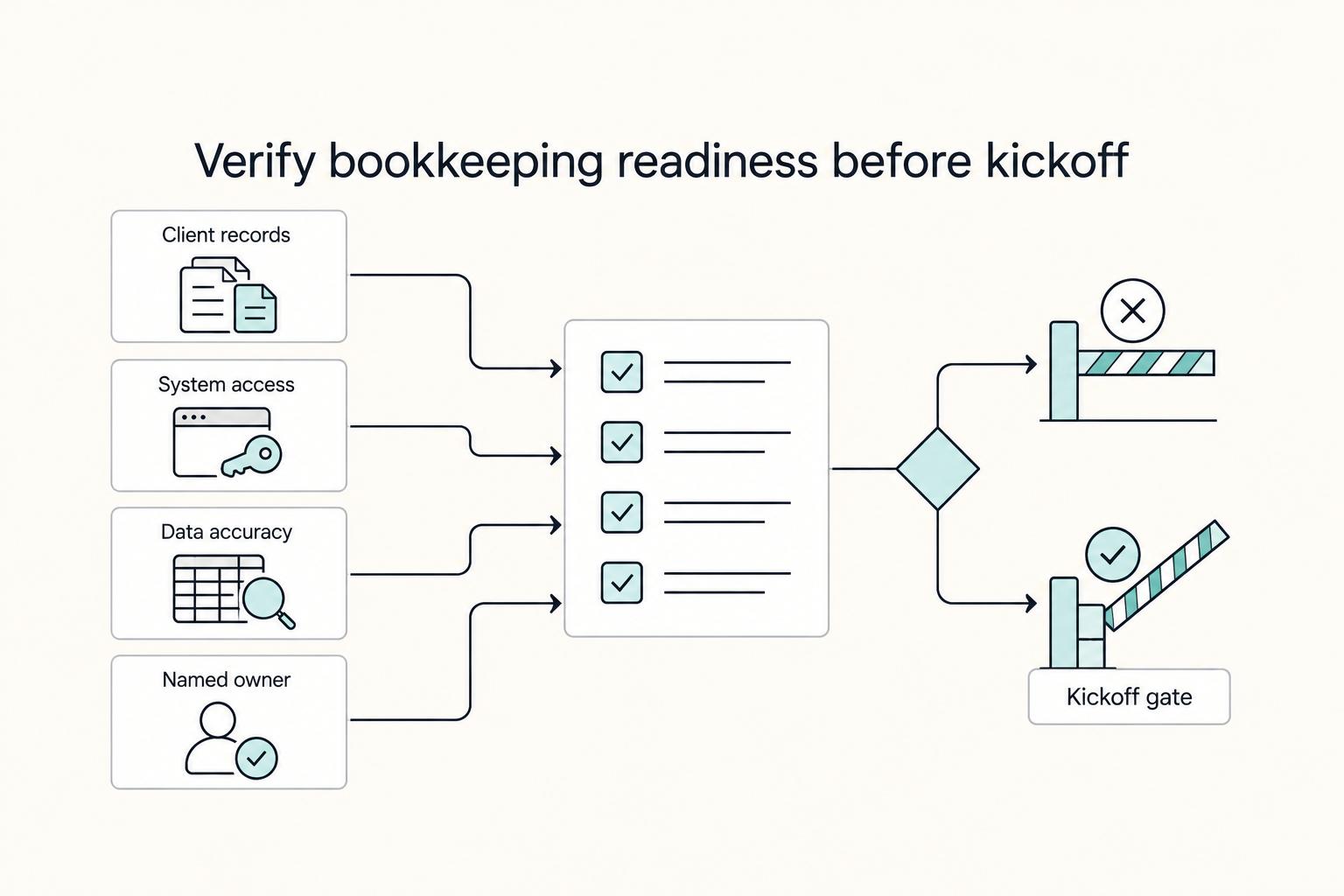
The first decision is client fit, not kickoff speed. Before you start bookkeeping work, use the engagement letter and pre-sign checks to confirm that the client can meet deadlines, provide accurate records, and stay within clear role boundaries.
Before you discuss a start date, confirm four basics:
- a short discovery summary of goals, deadlines, and current pain points
- required intake materials for the agreed work, delivered on time and in usable form
- ledger access readiness with role-based permissions
- a clearly designated client contact for approvals, corrections, and scope changes
Step 1. Use the discovery call to qualify, not just close#
The discovery call should test whether the working model will hold up in practice. That means confirming what bookkeeping covers, what the client must provide, and who owns decisions.
Ask direct questions before you send terms. Who sends records? Who approves coding decisions and follow-ups? Are there unreconciled periods, missing records, or access gaps? If the answers are vague, or the client resists basic role boundaries, treat that as a risk signal.
A practical rule: if they cannot clearly assign document responsibilities and approval authority before signing, pause production work and keep them in pre-onboarding.
| Good-fit behavior | High-risk behavior |
|---|---|
| Shares requested records promptly and in an organized way | Delays intake or sends partial records without context |
| Accepts that timely, accurate information is their duty | Treats missing documents as your problem to solve alone |
| Defines a clear approval contact and path | Keeps approval ownership unclear or conflicting |
| Cooperates with ledger access and role-based permissions | Pushes back on proper access or asks you to work without appropriate system access |
| Understands extra work needs updated terms | Assumes cleanup, catch-up, and ad hoc asks are included |
Verification point: After the call, you should be able to document scope, client duties, deliverables, dates, and a clear approval path. If you cannot, the engagement is not ready.
Step 2. Verify readiness before kickoff#
Bookkeeping delivery can slip for basic reasons: late records, bad access, or unclear ownership. Your letter should make timely records and accurate information the client's responsibility, and your intake should verify that before work starts.
For system access, require formal accountant access in the ledger system rather than ad hoc credential sharing. In QuickBooks Online, confirm who the Primary admin is because that role controls key company-level settings. In Xero, confirm the invite was accepted, since invitations expire after 14 days.
Use a simple kickoff evidence pack:
- finalized engagement letter
- completed intake for the agreed period
- accountant access confirmed in-system
- client responsibilities and approval path confirmed in writing
At kickoff, you should be able to access the ledger with the correct permissions and know exactly who can approve decisions.
Step 3. Set communication and request boundaries in writing#
Scope creep is easier to prevent with process than with arguments after the fact. State the approved channels for instructions, document sharing, and approvals, such as a designated email, portal, or single project workspace.
Set turnaround expectations in plain language you can actually maintain. Separate routine requests from urgent issues. Then define the routing rule. If a request comes through the wrong channel, acknowledge it and move it into the approved channel before scheduling work.
This protects the record trail and cuts down on unpaid extras. If a client sends "quick" work by text or chat, restate it in the formal channel and confirm whether it is in scope. Your draft should name approved channels, the authorized approver, and the routing rule for out-of-channel requests.
Step 4. Match fee structure to the work and isolate extras#
Fee structure should match the type of work you are actually doing. Retainers often fit recurring bookkeeping with stable scope. Fixed-scope pricing often fits clearly defined deliverables and dates. Cleanup, catch-up, and one-off advisory work should sit outside the recurring service unless you explicitly include them.
| Situation | Pricing fit | Scope rule |
|---|---|---|
| Recurring bookkeeping with stable scope | Retainers often fit | Recurring bookkeeping stays on the agreed plan |
| Clearly defined deliverables and dates | Fixed-scope pricing often fits | Work outside the agreed scope moves to a new scope addendum or updated engagement letter before work begins |
| Cleanup, catch-up, and one-off advisory work | Outside the recurring service unless explicitly included | Special projects, historical cleanup, and new requests require separate written approval |
The core rule is scope control. Work outside the agreed scope moves to a new scope addendum or updated engagement letter before work begins. Additional work is common, but if the engagement changes, your terms need to change with it.
Recurring bookkeeping stays on the agreed plan. Special projects, historical cleanup and other work outside that plan require separate written approval; correcting your own error in an included deliverable does not automatically become an extra service.
Pillar 2: Precision - Eliminating Ambiguity and Preventing Scope Creep#
Once client fit and readiness are clear, ambiguity becomes the main risk. Precision is what keeps routine bookkeeping from turning into unpaid extra work. In the engagement letter, define scope, deliverables, payment flow, and change handling so requests are routed by process, not negotiation.
Step 1. Separate recurring work, one-off cleanup, and excluded work#
Your scope should read like instructions: what is included, what is excluded, and what needs separate approval. When those categories blur together, scope creep follows.
| Work type | Include as in-scope | Deliverable examples | Boundary rule |
|---|---|---|---|
| Recurring bookkeeping | agreed recurring monthly tasks | monthly report pack, reconciliation status, ledger updates | applies only to the agreed period and only when required records and access are provided |
| One-off cleanup/catch-up | historical fixes and backlog cleanup | cleanup summary, unresolved-items list, corrected-period notes | Agree a separate fee and timeline only where cleanup is outside the existing plan; preserve cleanup expressly included and corrections to your own included work. |
| Advisory/compliance requests (if outside agreed scope) | higher-judgment advisory or compliance requests | separate memo or package, or separate engagement | treat as out-of-scope unless explicitly added in writing |
Compare the request with the agreed periods, tasks, complexity assumptions and decision responsibilities. A genuine expansion needs a written scope change and agreed fee before work starts. A 15-hour estimate becoming 40 hours may instead reflect an inaccurate estimate or an error to correct within the existing service; time spent alone does not authorize an extra charge.
Step 2. Write deliverables as acceptance-ready outputs#
Deliverables should be described in a way that supports handoff and review. State what the client receives, in what format, who reviews it, and what must happen before delivery. Activity language alone is not enough.
| Field | What to state |
|---|---|
| You receive | named reports or outputs for this service |
| Format | ledger export, PDF, spreadsheet, or portal upload |
| Client owner | named approver for questions or exceptions |
| Handoff trigger | delivery starts after required records, access, or responses are complete |
| Review checkpoint | feedback due within the agreed number of business days in the approved channel |
For each service line, confirm one output, one format, one owner, and one trigger. That gives you a clear handoff point instead of a vague promise to "keep the books updated."
Step 3. Make payment terms a workflow, not a sentence#
Payment terms should explain how invoicing and collection actually work, not just say that payment is due. The more practical the workflow is, the fewer arguments you will have when an invoice sits unpaid or a start date slips.
| Payment item | What to define |
|---|---|
| Invoice workflow | when invoices are issued, where they are sent, and who owns approval and payment |
| Payment methods | if you require specific methods, state them in the agreement |
| Late-payment handling | define what counts as late and what action follows |
| Collection setup | if used, require payment method setup at signing |
| Missing prerequisites | Identify the actual dependency and delivery impact; agree revised dates or rescheduling through the stated process. Any formal suspension must follow the applicable notice/cure terms and legal or professional duties. |
This makes disputes less likely because expectations are explicit before delivery starts.
Step 4. Add a compact change-control flow#
Scope expansion should be procedural. If a request is not documented and approved, it should not quietly become part of the job.
- Request intake: capture every new request in writing through the approved channel.
- Scope review: confirm the impact on deliverables, timeline, fees, and client responsibilities.
- Written approval artifact: issue one consistent approval record, such as an addendum, revised scope, or written approval message with fee and timeline.
- Execution gate: treat added work as pending until approval is documented.
In your process, if the request, revised scope, and approval are not documented, treat the change as not yet approved.
For a step-by-step walkthrough, see How to Use a Letter of Intent (LOI) in a Freelance Engagement.
Before you send your draft, convert your in-scope and out-of-scope notes into client-ready language with the SOW Generator.
Pillar 3: Protection - Your Ironclad Clauses for When Things Go Wrong#
Once scope and payment are clear, the next job is protecting the relationship under stress. These clauses define what happens when invoices go overdue, work pauses, the relationship ends, or a dispute starts.
Before you draft the clauses#
Run one consistency check across the whole letter first. Protection language can break down when it conflicts with your payment terms, notice mechanics, governing law and dispute terms, or your scope and change-order process.
Confirm these points:
- the same notice method and notice channel are used everywhere
- the overdue trigger in payment terms matches the suspension trigger
- governing law and forum or ADR path are explicitly named
- if using AAA administration, confirm the applicable rule set, current fee schedule and agreed clause rather than copying dated references
| Clause | What risk it controls | What must be explicitly defined |
|---|---|---|
| Termination | Unpaid work in progress, unclear end date, disputes over unfinished close work | Who may terminate, notice method, effective date, payment for completed and in-progress work, treatment of in-progress reconciliations, reporting cutoff date, access revocation responsibility, handover conditions |
| Limitation of liability | Claims that exceed the commercial value of the engagement | Cap formula or amount, excluded damage categories, required carve-outs |
| Suspension of work | Unpaid balances growing while services continue | Overdue-payment trigger, required notice and cure period, services that pause, legally permitted handover or withholding conditions, restart requirements and revised timeline |
| Dispute resolution | Expensive conflict over process, venue, and applicable law | Governing law, court forum or arbitration path, whether mediation comes first, chosen rules if used, arbitrator count if arbitration applies, notice mechanics |
Step 1. Write termination as an exit procedure#
Termination should work like an operating procedure, not a vague right. State who can end the engagement, how notice is sent, and when termination becomes effective. Then spell out what happens to the books at that point.
For bookkeeping, be specific about in-progress reconciliations, draft reports, and partial-period work. If termination lands mid-close, say whether you finish that close, stop at the last completed checkpoint, or deliver a status summary of unresolved items.
Define handover clearly: what is delivered, in what format, and under what release conditions. Also keep jurisdiction limits in mind, because rules can differ on withholding records for unpaid fees and on the distinction between client records and firm work product. Use a practical handover package, such as ledger exports, reconciliation status, open-items list, and completed reports through the cutoff date, tied to applicable law. Preserve client-owned access and release records as required by applicable law and professional obligations; do not make payment a condition where those rules prohibit it.
When termination is triggered, send a disengagement letter using a traceable delivery method. Avoid informal "one last favor" work after termination unless scope and fees are documented in writing.
Step 2. Use a liability cap you can defend#
A liability clause is a risk boundary, not immunity. Because enforceability can vary, draft it conservatively and make sure it fits the governing law.
Define one cap formula in one place, and verify any required carve-outs before signing. If other sections include indemnity, confidentiality, or data-security obligations, confirm they do not accidentally override the cap.
Agree the liability cap and any lookback period before signing. Check that the formula is clear, its exclusions fit the engagement, and it complies with the governing law.
Step 3. Make suspension rules bookkeeping-specific#
A stop-work clause should use the same overdue-payment trigger as the payment section. Follow the agreed notice, grace period and opportunity to cure before suspending, subject to applicable law and professional obligations.
State what pauses: posting, reconciliations, report preparation, and review of client-submitted records. Also state that draft balances or partial reconciliations are not final deliverables and should not be relied on until work resumes and final review is complete.
Set restart conditions in plain terms: cleared payment, required access, complete records, and updated deadlines. When suspension happens, send written notice with a status snapshot that shows the completed period, open items, withheld deliverables, and current access state. That snapshot can help reduce later disputes about what was done and what was still pending.
Step 4. Set dispute path and governing law now#
If this section is vague, you can end up fighting over process before you ever reach the underlying dispute. Name the governing law and choose the path: court forum selection or ADR.
If you use ADR, define whether mediation comes first and whether arbitration covers all disputes or only specified categories, such as fee disputes. Identify the administering body, applicable rules, number and selection of arbitrators, and any exceptions for urgent relief. Confirm that this process fits the governing law and the client relationship before signature.
Finish with one cross-check. The notice clause, payment default language, termination mechanics, and dispute terms should all point to the same channels, defined parties, and governing law. That alignment improves the odds these protections hold up in practice. Related: How to Manage Bookkeeping for Your Freelance Business.
The Global Professional's Addendum: Cross-Border Essentials#
Cross-border bookkeeping work can break down when the letter stays vague. Before work starts, document key terms in writing and confirm jurisdiction-specific legal language through counsel.
Step 1. Match law, venue, and delivery model#
Treat governing law and dispute venue as one drafting checkpoint. The goal is not to pick a "best" jurisdiction. It is to align terms with how the work is delivered and who is signing.
State plainly:
- which law is intended to govern (pending legal review)
- where disputes are intended to be handled
- which entity is providing services and which entity is receiving them
Then run a consistency check. Keep these terms aligned across the main engagement letter, notice clause, and any scope addendum.
Step 2. Fix currency, settlement, and FX exposure#
Naming a currency may not be enough for operational clarity. If applicable, also define the payment rail and who carries conversion and transfer-cost risk between invoice issuance and receipt.
| Item | Lock it down in writing | Why it matters |
|---|---|---|
| Invoice currency | USD, EUR, GBP, or other named currency (as agreed) | Prevents billed-amount disputes |
| Payment rail | Bank transfer, card, platform payout, or other named method (as agreed) | Sets settlement and fee expectations |
| FX-risk owner | Client, service provider, or split as agreed | Makes conversion exposure explicit |
Step 3. Set privacy and data-handling terms#
Identify the privacy laws that apply to the engagement and determine each party’s role from what it actually does with personal data. A bookkeeper may act as a processor for some services and an independent controller for others. Where a data-processing agreement is required, attach it before processing begins. Define authorized access, security, retention and deletion, permitted transfers and incident reporting. Agree reporting responsibilities and applicable deadlines before exchanging personal data.
Step 4. Run a cross-border pre-sign checklist#
Before signing, confirm these fields are consistent across the engagement letter and any scope addendum:
- full legal entity names and signer capacity
- tax identity fields you plan to collect, as applicable
- banking details, beneficiary name, and remittance reference, as applicable
- governing law, dispute venue, and notice mechanics
- titles of privacy, security, and data-processing attachments
This consistency check can reduce avoidable drafting mismatches before they become payment or dispute problems.
Conclusion: From Document to Strategic Asset#
Your bookkeeping engagement letter should govern the relationship, not just start it. Use it to set boundaries before work begins, keep scope from sliding into "one more thing," and anchor compensation to clear written terms.
Start with Pre-emption. Before kickoff, make sure the letter states the scope, compensation structure, required records and system access, and who is responsible for each milestone. If those basics are unclear at the start, they usually get harder to fix once work is underway.
Then use Precision to manage delivery. Define services in plain, specific terms, include a timeline, and assign responsibility for each milestone. Keep boundaries explicit, and make deadlines contingent on receiving client records and system access. Anything outside that scope should be documented before work expands.
Finally, use Protection to limit avoidable risk. State the compensation model clearly, whether that is milestone, retainer, or hourly, and make sure fee handling is clear before work begins.
Then execute. Finalize the terms, apply the same scope, timeline, and compensation discipline throughout delivery, and document changes when scope or timing shifts. You might also find this useful: How to structure an 'SOW' for a retainer-based consulting engagement. For your next client onboarding cycle, you can also use the Freelance Contract Generator and tailor it to your bookkeeping terms.
Frequently Asked Questions
How is a bookkeeping engagement letter different from a SOW?
Use the engagement letter to set core terms such as scope, responsibilities, deliverables, timelines, and billing terms. Use the SOW to define the specific bookkeeping services or work package to be delivered. If you use both, state clearly how they work together so scope and payment terms are not ambiguous.
What should you do first if a client stops paying?
Send a written notice that cites the billing terms and late-payment consequences in your engagement letter. List the overdue invoices and amounts due, and take next steps only as the agreement allows.
Can you rely on email acceptance only?
Confirm that electronic acceptance is permitted under the applicable law and that the parties agree on the method. Keep the final terms, evidence linking acceptance to the signer, timestamps and any e-sign audit trail. For example, Virginia law assesses attribution from the person’s act and surrounding circumstances; a message without clear agreement to the final terms leaves an avoidable evidence gap.
Should you include a kill fee?
Do not treat a kill fee as automatically required. If you include one, define it clearly in writing and confirm it fits your jurisdiction and engagement. For recurring monthly services, a clear termination clause plus payment terms for work performed is often the safer baseline.
How often should you update the letter?
Review the letter regularly, for example annually, and when services, entities or pricing change. An evergreen letter can continue until termination, but changed terms need agreement rather than a unilateral rewrite. Have both parties accept the updated letter or addendum before work starts under those changes.
Where should you draw the line between bookkeeping and tax advice?
State the boundary directly in scope and exclusions. If you provide bookkeeping only, say tax advice and IRS representation are outside scope unless covered by a separate engagement. Check this clause against your credentials, because representation rights differ, and unlimited IRS representation rights apply to enrolled agents, CPAs, and attorneys.
Can you keep using one old letter for a long-term client?
Review whether it still matches the services, parties and agreed terms. If those have changed, obtain both parties’ acceptance of an updated engagement letter or addendum before delivering under the new terms.
Try a related tool
Researched and edited by the Gruv editorial team. Gruv builds cross-border billing, payouts, and finance-operations software for global businesses.
Sources
Includes 4 external sources outside the trusted-domain allowlist.
- irs.gov/tax-professionals/understanding-tax-return-p...trusted
- irs.gov/businesses/small-businesses-self-employed/re...trusted
- law.lis.virginia.gov/vacode/title59.1/chapter42.1/section59.1-487trusted
- oregon.gov/das/Procurement/Guiddoc/SOWWritingGuide.pdftrusted
- adr.org/clause-draftingexternal
- central.xero.com/0/guide/a5B3m000000rnPSEAY/get-ready-to-use-...external
- micpa.org/community/stay-informed/news/2024/12/16/enga...external
- mncpa.org/resources/firm-management/client-record-rete...external
Educational content only. Not legal, tax, or financial advice.
Related Posts

Freelance Bookkeeping: Invoices, Receipts, and Month-End Close
Freelance bookkeeping connects what you earned, what a client owes, what a provider received, and what reached your bank. It also records expenses and the evidence behind them. Clear records help you identify missing payments and resolve mismatches; they cannot guarantee faster payment or prevent every dispute.

The Freelance Payment Penalty: A Modeled Audit of Platform Fees, FX Spreads, and Payout Delays
The money rarely disappears through a single, easy-to-spot fee. The real loss is stacked. A marketplace takes its commission, a processor adds a charge for international cards, a bank or payment company converts the currency at a spread, a platform holds the funds before release, and a wire sheds a little to intermediaries on the way in. Each layer looks defensible on its own, but the worker feels the combined result as a smaller deposit and a later payday.

How to Respond to a Subpoena for Business Records
Move fast, but do not produce records on instinct. If you need to **respond to a subpoena for business records**, your immediate job is to control deadlines, preserve records, and make any later production defensible.