
Quick Answer
A legal marketplace modernizes trust accounting compliance by making fund movement traceable from receipt to release, separating hold and payout decisions, and tying every release to documented evidence in ledger journals. The article recommends baselining the current flow, defining owners for approvals and overrides, rolling out in phases, and measuring both compliance outcomes and operating friction before calling the redesign a success.
Why trust accounting needed a better system#
Trust accounting is often treated as a compliance topic, but for a legal marketplace it is also an economic decision. When money movement and control are unclear, operating friction rises and pricing pressure gets harder to manage.
Name the business pressure#
The pressure shows up in market structure. The California State Bar's Legal Market Report from October 2024 updates the 2018 report. It describes a split between PeopleLaw and organizational-client work, cites earlier findings that three-quarters of law-firm receipts came from organizational clients, and notes that a growing share of consumers forgo legal services rather than pay higher prices. For consumer-facing marketplace models, avoidable operating cost becomes a commercial risk, not just a compliance concern.
That is why trust accounting should not sit in a legal-only lane. At core, trust is a fiduciary relationship with respect to property. How funds are handled shapes both control design and business design.
Follow the money design, not just the policy deck#
The most useful review starts with what changed in fund movement and control, then tests whether those changes are easier to prove and easier to operate. That is more useful than relying on a policy deck or a one-time legal sign-off.
Keep the review concrete:
- Where do funds sit before release?
- Who can approve or override a hold?
- What evidence supports each release decision?
- Which handoffs create delay or unclear ownership?
Decide what proof will count#
Treat "modernized" as a claim that needs evidence. A practical control lens comes from the OCC's Compliance Management System guidance. In the banking context, it emphasizes board and management oversight, plus a compliance program with documented procedures, monitoring and testing, and audit.
Apply that lens pragmatically. Look for clear owners, written procedures, traceable approvals, and a repeatable way to test exceptions. By the end of this guide, you should be able to verify three things clearly: what changed in money design, which controls mattered, and what evidence supports improved readiness.
What this case study solves for a legal marketplace#
The problem is not trust controls in the abstract. It is control drift during payout decisions. That drift raises compliance and review burden and adds avoidable operating friction.
Define the loss mechanism#
Treat trust design as both a quality lever and a revenue risk. In marketplace settings, stronger trust can improve match quality, but when trust gets very high it can also increase disintermediation as participants bypass the intermediary. The practical failure mode runs both ways. Weak controls create exception and review burden, and weak payout design can increase off-platform behavior.
Narrow the scope to settlement funds and payout control#
This case study is about marketplace-managed funds and disbursement orchestration, not general bookkeeping. Keep the scope to four checks:
| Scope check | Question to answer |
|---|---|
| Fund location | Where funds are held before release |
| Payout authority | Who can trigger or approve payout |
| Required record | What record must exist before funds move |
| Exception handling | How exceptions are routed and contained |
Aim for disbursement that is fast, clean, and defensible#
The target is faster release with traceable controls that can withstand fiduciary scrutiny. Use one verification rule early. An independent reviewer should be able to reconstruct each release from source to destination, including the approver, the release condition, and the transfer record.
If you want a deeper dive, read Legal Marketplace Payouts: Attorney Referral Fees Trust Accounting and Compliance.
What to prepare before you touch the money flow#
Before you redesign disbursement, build one review pack that lets a reviewer trace how money moves today, who approved it, and what evidence exists when something goes wrong. If that trace breaks between policy documents, control records, and exception handling, your prep is not done.
Assemble the minimum evidence pack#
Start with artifacts that show documented behavior, not just intended process: current policies and procedures, internal control records, risk assessment materials, and relevant examination checkpoints, for example an Internal Control Questionnaire and any applicable 12 CFR 7.1026 compliance worksheet materials. Then test the linkage across those records. A reviewer should be able to follow the same case across operations, controls, and exception handling without relying on tribal knowledge.
Use three prep buckets to keep the pack clean and defensible: policies and procedures, internal controls, and risk assessment.
Gather compliance artifacts by lane#
Gather compliance artifacts by lane, and keep lanes separate when decision paths differ, for example onboarding review versus payout release. That makes it easier to show which policy and control set applied at each decision point.
For tax handling, limit the pack to forms that are actually in scope. If Form 1099-B is in scope for your program, include the filing mechanics so no one has to rely on memory, including how many forms to file for each transaction and how many transactions to report on each form.
Document role ownership for approvals and overrides#
If you maintain an internal approval matrix, write ownership at the action level so approvals and overrides stay unambiguous.
| Action | Primary owner | Backup owner | Required evidence |
|---|---|---|---|
| Standard payout approval | Named role | Named role | Approval trail + payout record |
| Policy exception / override | Named role | Named role | Exception rationale + approval trail |
| Hold release decision | Named role | Named role | Release condition + linked transaction record |
If approvals are happening in chat or through verbal escalation, record that now as an explicit gap in the current flow.
Set review boundaries with counsel before launch#
Set boundaries early. Define what your team can confirm internally and what still needs legal review before launch. Do not copy another program's control language and assume it fits.
Risk profiles differ, so finish prep with a short open-issues list: internally confirmed items, legal-review items, and launch blockers. Include risk checkpoints that cover operational, fraud, credit, liquidity, and compliance exposure, plus any material third-party risk management dependencies.
Baseline the current state and expose commingling risk#
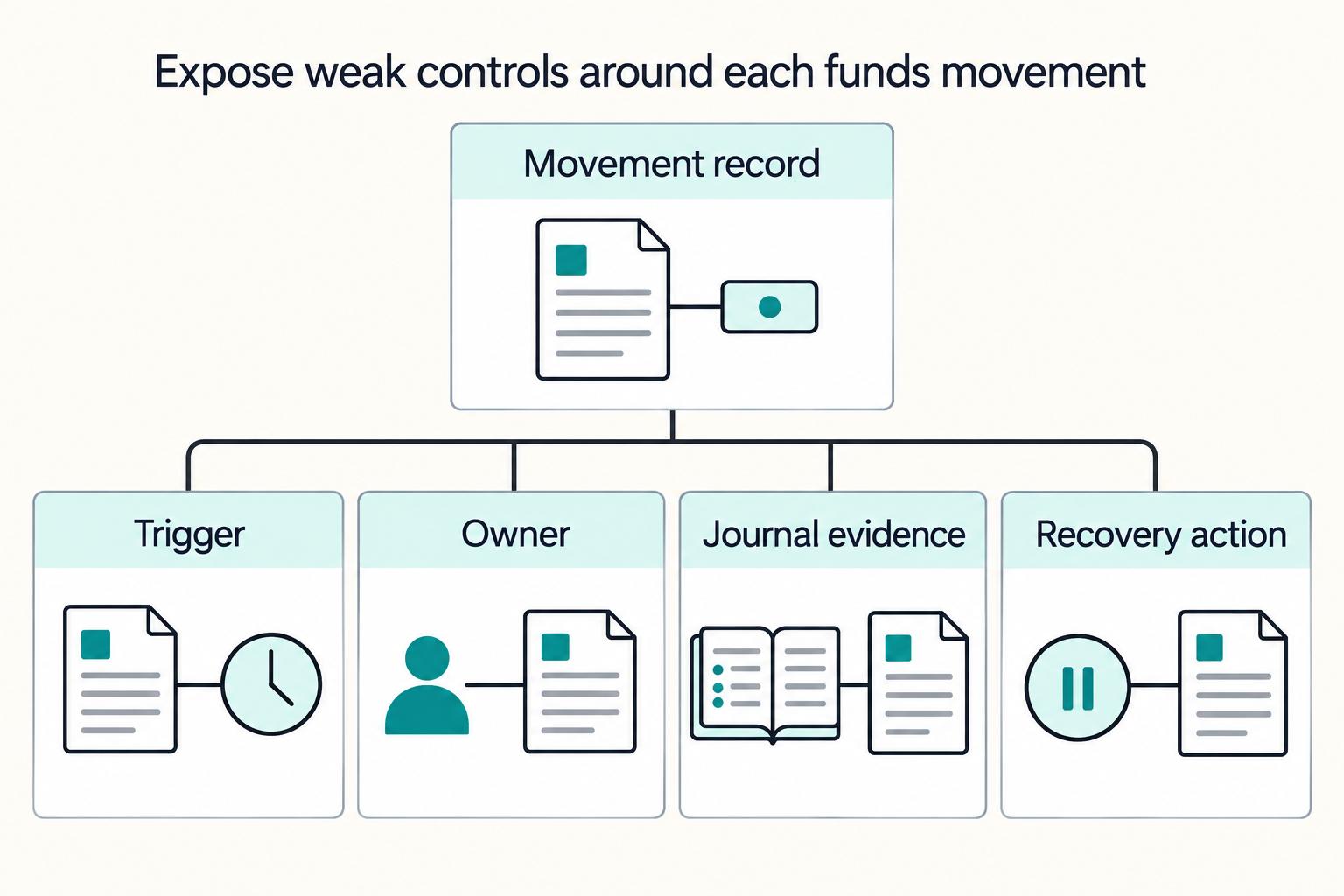
Do not redesign from anecdotes. First make money movement auditable end to end. Then baseline the current state in one shared artifact that finance, product, ops, and legal can all use to trace how funds move and how each movement is controlled in ledger journals.
A simple risk discipline helps: identify, measure, monitor, and control. It keeps the team focused on both the movement and the control around the movement.
Map the money path as a shared artifact#
Create one current-state map from initiation through release, including key handoffs and decision points in your flow. Keep it as the single source so teams are not working from conflicting versions.
For each transition, capture the trigger event, owner or role, record created, what changed, status, ledger position, or both, and the linked reference or evidence. Journey mapping is useful because it gives stakeholders a common view of how the flow actually works and anchors improvement decisions in one artifact.
Build a decision table from ledger journals#
Turn the map into a control table, with ledger journals as the source of truth.
| Trigger | Risk | Control owner | Required evidence | Rollback action |
|---|---|---|---|---|
| Funds event recorded | Misposting to the wrong balance lane | Named finance/accounting owner | ledger journals + transaction reference | Reverse or reclassify with approval trail |
| Internal movement request | Unclear transfer rationale | Named approver | Request record + approval trail | Cancel move or post correcting journal |
| Release request | Release before evidence is complete | Release approver | Release approval + linked record | Hold or stop release with documentation |
| Manual exception | Path around standard controls | Exception owner + reviewer | Exception ticket + rationale + journal links | Return to prior state and log remediation |
Then pressure-test each row against policies, processes, personnel, and control systems. If a row depends on memory instead of documented controls, treat it as a gap.
Flag blur points between trust-designated and operating money#
Once the table exists, mark every place where funds can blur between trust-designated and operating lanes. The goal is to expose ambiguity early, not assign blame.
Prioritize manual paths first, then check for:
- one event label used for different money states
- the same role both requesting and approving a movement
- balance adjustments without linked transaction or release records
- operating entries supported only by free text
Any path that allows movement between lanes without separate approval and journal evidence is a redesign priority.
Quantify operational friction before modernization#
Measure friction directly from the map and table so your baseline stays operational, not theoretical. Focus on handoff delays, unresolved reconciliation items, and manual exception load.
Track metrics that tie to specific transitions and control rows, such as:
- open items by aging bucket
- unresolved items by transition type
- manual interventions by release or transfer batch
- close-period items that required cross-team follow-up
Finally, separate true bottlenecks from constraints. Legal, policy, technology, and internal organizational constraints can all limit what you can change, so label them explicitly before redesign.
Related: The Best Software for Trust and Estate Administration.
Redesign fund segregation and posting logic for speed and control#
Redesign the posting boundary first, but keep the factual scope clear. This guidance supports control discipline and reliability checkpoints; it does not establish legal trust-accounting architecture requirements. If your team separates receipt, hold, and release records, present that as an internal control choice, not a source-defined rule.
Adopt a hard posting boundary#
Use explicit records for key events rather than implied intent, and keep journal evidence linked to each step your policy requires.
A transferable control from the excerpts is recurring checkpoint management: update records with actuals, revise for changes, and review estimated-versus-actual differences.
Keep collection, holding, and release decisions separate#
Keep decision points explicit in your workflow, even if one platform component handles multiple functions.
Required trust-designated ledger lanes are not defined here, and architecture choices such as Virtual Accounts, Payouts, or Merchant of Record (MoR) are not prescribed for this use case.
Make posting retries safe#
Treat reliability as an operating objective and run repeatable checks on receipt, release, and reversal paths based on your internal control design.
An idempotency requirement or implementation pattern is not specified here, but recurring checkpoints and estimated-versus-actual review help catch drift early. Weak reliability is also associated with cost overruns, missed deadlines, and performance shortfalls.
Define explicit release states for settlement funds#
If you use internal release states, document them as organization-specific operating policy.
There is no canonical release-state model for settlement funds established here, so state names, evidence rules, and transitions should not be presented as established facts.
Keep friction at the release boundary, not everywhere#
Concentrate review controls where risk is highest, and avoid spreading extra approvals across low-risk internal moves unless your policy requires it.
For a step-by-step walkthrough, see Legal Marketplace Payouts: Trust Accounts and ABA Compliance.
Place policy gates where they reduce risk without blocking revenue#
Policy gates work best at real risk boundaries. Once receipt, hold, and release are separated, the goal is simple: make decisions traceable where risk changes while keeping low-risk internal transitions light.
Gate risk boundaries, not every ledger update#
Use policy gates where counterparties or money movement create a new risk decision, and avoid duplicating full reviews on routine internal status updates. If your program uses identity or compliance checks, treat timing as a documented policy choice reviewed by counsel, not a universal sequence you assume applies everywhere.
A quick test helps. If repeated reviews are happening for the same reason without any new risk signal, your controls are probably creating queue debt more than control value. Defined checkpoints, such as formal reporting periods, can help keep that review cadence explicit.
Tie deeper review to explicit triggers#
Do not rely on reviewer instinct alone. Define the triggers that require escalation, then map each trigger to an action, owner, and evidence requirement.
Treat trigger design as a policy decision that must be documented and consistently applied. Each hold needs a clear close-out standard so exceptions do not become a hidden path around your control model.
Treat legal references as design pressure, not a shortcut#
Use applicable legal and regulatory references to pressure-test traceability and ownership. Do not treat them as a substitute for jurisdiction-specific legal review or as a complete product requirements document.
Design as if records may be examined later and failures may carry penalties. In practice, that means each payout decision should be reconstructable from system evidence, not memory or side-channel messages.
Define override authority before exceptions scale#
Overrides are sometimes necessary. Invisible overrides are the real risk. Define in writing who can override, what evidence is required, and where that approval is stored.
At minimum, keep the trigger, reviewer identity, rationale, and linked decision or journal references together in the same decision record. If overrides are visible in the decision evidence pack, exception handling stays controlled instead of eroding control discipline.
Roll out in phases across product finance and operations#
Roll out in phases, with explicit decision evidence before each expansion. Core finance implementations are never risk free, so risk comes down when requirements stay traceable from origin to implementation and each phase is evaluated with quantitative checkpoints.
Depending on your program, one practical pattern is:
| Phase | Scope | What to prove before expanding |
|---|---|---|
| Phase 1 | Mirror-mode posting in Gruv while legacy disbursement stays live | ledger journals represent real production events accurately without moving money |
| Phase 2 | Narrow cohort routed through Payouts | Reconciliation, exception handling, and payout behavior remain stable in a limited live lane |
| Phase 3 | Full production volume, then retire legacy transfer paths | The new path works at full volume without hidden dependence on legacy flows |
Run mirror mode first#
Start with mirror mode. Post production-like ledger journals in Gruv, but keep live disbursement on the legacy path. Use real event shapes, IDs, retries, reversals, and timestamps so the test reflects production behavior.
The checkpoint is traceability. For sampled releases, holds, reversals, and failed payouts, you should be able to connect the source event, journal entries, and payout outcome without relying on memory or side spreadsheets.
Cut over a narrow cohort through Payouts#
Move a limited cohort only after mirror results are consistently explainable. Keep the cohort small enough that you can inspect exceptions end to end, and define rollback authority before cutover.
Monitor reconciliation deltas on a fixed cadence and review exception aging against your SLA. If payout completion looks stable but reconciliation drift grows, pause expansion and investigate.
Expand only when legacy paths can be retired cleanly#
Expand because the evidence is stable, not because one short period looked calm. Before full-volume cutover, document each legacy transfer path's owner, dependency, and retirement condition.
If exceptions still require old paths, call that out before expansion. Hidden dual operations usually recreate the ambiguity this rollout is supposed to remove.
Set explicit checkpoints before each phase change#
Define checkpoints in advance and review them on a fixed cadence. Teams can get close to deployment without enough quantitative measures, then struggle to separate tolerable noise from stop conditions.
| Checkpoint metric | What it covers |
|---|---|
| Reconciliation pass rate | journal, provider, and settlement evidence |
| Exception SLA | aging, ownership, and close-out proof |
| Payout completion stability | success, failure, retry, and return behavior |
At minimum, review quantitative measures that show requirements, testing, data conversion, interfaces, and risk controls are holding under live conditions. In a Gruv rollout, that can include the three checkpoint metrics above.
Keep the evidence-pack format consistent each time: metric result, sample size, open exceptions, rollback owner, and linked journal or payout references.
Set hard decision rules for holds releases and escalations#
Once live money movement starts, release decisions should be rule-based. If required compliance checks, sanctions status, or deposit provenance are unresolved, keep funds in a documented hold state with a named owner.
| Decision area | Required status or evidence |
|---|---|
| Unresolved identity and sanctions issues | Treat unresolved compliance reviews as hold conditions until they are formally resolved in the case record; the record should show the screening result, disposition, reviewer, decision time, and the exact party tied to the transaction |
| Unclear deposit provenance | Keep the balance visibly marked as unresolved until the underlying records are tied out; confirm the originating event, amount, timestamp, and provider or bank reference before moving it forward |
| Record conflicts | Treat that as an open reconciliation exception; assemble one review packet with the event ID, journal entries, provider reference, settlement evidence, and approver notes |
| Escalation lane | Document the primary owner, backup owner, response target, and minimum evidence to escalate; at minimum, include hold reason, amount, affected party, jurisdiction, linked journals, provider references, and the exact decision question |
Hold on unresolved identity and sanctions issues#
Treat unresolved compliance reviews as hold conditions until they are formally resolved in the case record. This is especially important for OFAC sanctions, where some programs require blocking property of specific persons or entities and prohibit dealing in blocked property.
Before lifting a hold, rely on the case file, not informal approvals. The record should show the screening result, disposition, reviewer, decision time, and the exact party tied to the transaction.
Keep unclear deposit provenance unresolved#
If you cannot clearly tie a deposit to its source, owner, and intended obligation, do not treat it as releasable. Keep the balance visibly marked as unresolved until the underlying records are tied out.
Use ledger journals and external references to validate provenance. For each exception, confirm the originating event, amount, timestamp, and provider or bank reference before moving it forward.
Resolve record conflicts before closing exceptions#
When ledger journals and bank or provider records do not align, treat that as an open reconciliation exception, not a judgment call. Exception closure should follow evidence, not ad hoc fixes.
For sampled cases, assemble one review packet with the event ID, journal entries, provider reference, settlement evidence, and approver notes. If records still conflict, keep the hold in place until the discrepancy is resolved.
Define escalation lanes with ownership and evidence standards#
Write escalation rules so decisions are repeatable under pressure. Trust law is state-based, and some institutions may also operate under federal fiduciary frameworks such as 12 CFR 9, so keep fact gathering, compliance review, and legal interpretation clearly separated.
Document four items for each escalation lane: primary owner, backup owner, response target, and minimum evidence to escalate. At minimum, include hold reason, amount, affected party, jurisdiction, linked journals, provider references, and the exact decision question.
For a closer look at hold and release logic across real payout states, review Gruv's Payouts workflows.
Measure whether modernization improved both compliance and unit economics#
Do not call modernization a success until matched before-and-after cohorts show better control quality and better operating economics. Keep outcomes and assumptions separate so the readout stays auditable, and do not confuse seasonality, volume mix, or case-mix shifts with real improvement. Without matched before-and-after cohorts, treat unit-economics outcomes as unknown.
Freeze the baseline and separate facts from assumptions#
Lock metric definitions before reviewing results. Put observed outcomes, financial analysis detail, in one sheet and assumptions in another, then keep the same reporting-window length on both sides of cutover.
Compare like-for-like slices only. If jurisdiction mix, payout-method mix, or case mix changes, treat whole-period averages as directional, not conclusive.
Measure compliance outcomes from evidence, not sentiment#
Track four compliance outcomes:
- reconciliation timeliness
- exception aging
- audit-ready evidence completeness
- policy-gate breach counts
For each payout or hold decision, verify that the audit-ready evidence packet is complete and retrievable. If exceptions close faster but evidence completeness drops or policy-gate breaches rise, compliance did not improve.
Measure monetization outcomes with defensible timing boundaries#
Track four economics outcomes:
- payout cycle time
- manual ops hours per payout batch
- failed disbursement rework
- margin leakage
Define start and stop times in advance and keep them stable. If manual hours cannot be tied back to actual payout batches, do not use them to claim savings.
Add tax-readiness signals, then compare matched cohorts#
Include downstream readiness checks in the scorecard.
For Form 1099 lanes in scope, use concrete 2026 Form 1099-B checkpoints: transactions per form, forms per transaction, whether a tax information statement is furnished to TIH, and backup withholding handling. Then compare matched cohorts. If mix changes materially, report results as directional rather than proof.
Common mistakes and how to recover#
A common failure mode is designing controls around anecdotes instead of documented transaction flow, ledger requirements, and clear accountability.
Rebuild from transaction states and owner accountability#
If your process design starts from cautionary stories, reset the baseline. Recover by mapping each transaction state end to end and assigning a named owner, required control activity, and allowed next action at each state.
Use a practical test: pick a recent exception or correction and confirm the owner, triggering event, and ledger history are all clear from records, not memory.
Replace periodic cleanup with recurring ledger checkpoints#
Delayed cleanup can hide issues until they are harder to unwind. Recover by aligning reviews with the general-ledger posting process, documented accounting control activities, and recurring reporting checkpoints.
At each checkpoint, review unresolved items and stale exceptions before they roll forward. Delays increase risk because unchecked issues can scale and become harder to stop later.
Move from training-only fixes to structural detection and control#
Training helps, but it is not a recovery plan when the process structure stays the same. Recover by adding structural controls and early monitoring so issues are detected earlier, before escalation risk grows.
Run sample checks on recent exceptions and verify that records are complete enough to reconstruct what happened from ledger and reporting artifacts alone. If that still requires cross-team reconstruction, the control design needs tightening.
Use law-firm lessons without copying law-firm architecture#
Use law-firm materials to set your accountability standard, not to copy a law-firm operating model into marketplace payouts. Translate what you borrow into product event controls, ledger evidence, and release rules that fit your system.
Separate the standard from the workflow#
Law-practice accounting contexts come from a different operating environment than platform payouts. Treat them as principle inputs, not process templates. Keep the accountability bar, then define your own trigger event, allowed state change, owner, and required evidence.
If a source cannot be mapped to a real payout or ledger event, it is guidance, not a control.
Use legal references as guardrails, not specs#
Case references can set legal accountability expectations, but they do not define your retry logic, disbursement handling, stale holds, or correction paths. Your controls still need to run on actual product events.
Apply the same filter to practice guidance. The BASF Solo and Small Firm Toolkit describes itself as an overview and a "jumping off point for further inquiry." Treat it as a starting point, then finish design decisions with product, finance ops, and counsel.
Reject jurisdiction-specific assumptions by default#
Do not assume a single-firm legal structure transfers to a platform. The 2025 BASF toolkit says attorneys in California cannot operate a law firm as an LLC and cites California Corporations Code Section 17375.
Use one rule: borrow accountability standards, not local office architecture. Validate assumptions with legal counsel and tax advisors, then implement platform controls with explicit states, named authority, and ledger-backed evidence.
Related reading: Trust Accounting for Freelancers Who Use Retainers.
Copy and paste checklist for your next implementation step#
Use this as an execution checklist, not legal authority. The goal is to force decisions into a predefined plan, reduce omissions, and keep controls reviewable before you scale volume.
- Confirm scope first.
Document the workflow lanes in scope, the transaction types in each lane, and who owns each decision point. If ownership is unclear on paper, execution can drift in production.
- Map the baseline flow from intake to release.
Lay out each state change in order, for example intake, hold, review, release, return, and exception handling. For each step, define the evidence you expect to retain, such as transaction records, approvals, provider references, bank records, or reconciliation notes.
- Lock separation rules before optimizing speed.
If your program uses separate balance categories, define that logic clearly and keep those categories distinct in records, approvals, and reporting views. A reviewer should be able to trace held balances without netting them into unrelated activity.
- Place compliance gates at named decision points (
KYC,KYB,AML, where required).
Decide where each check runs, what outcomes trigger hold or escalation, who can override, and what evidence must be retained. A gate is only real when pass, fail, and manual-review outcomes are logged and reviewable.
- Define hold, release, and escalation rules with clear ownership.
Give each hold a reason code, primary owner, backup owner, and an internal response expectation. Also define blocked actions while a hold is open, especially manual payouts or ad hoc balance adjustments.
- Use phased cutover with reconciliation checkpoints.
Start with limited traffic or a mirror flow, prove balances and evidence match, then expand. Do not widen scope while exceptions remain unexplained.
- Review outcomes on a recurring cadence and fix repeated patterns at the control level.
Track reconciliation completion, exception aging, unresolved owner cases, stale items, and adjustments that need after-the-fact explanation. If the same issue repeats, update the rule, evidence requirement, or approval point instead of treating it as one-off operator error.
- If coverage varies by jurisdiction or program, validate final controls with counsel before full launch.
Keep a review-ready evidence pack: scope document, flow map, separation rules, gate definitions, escalation ownership, and recent reconciliation samples. This checklist is an operating aid. It does not replace independent legal judgment.
When you are ready to validate this design against your jurisdiction and rollout constraints, start with the Gruv docs.
Frequently Asked Questions
What is trust accounting in a legal marketplace, in one practical definition?
In practical terms, trust accounting in a legal marketplace means keeping funds held for someone else clearly identified, separately tracked, and fully documented until proper release. It is an operating standard, not a universal legal definition across jurisdictions. The key test is whether you can show who owns the funds, why they are held, and what records support the balance.
How is marketplace trust accounting different from a traditional law-firm client trust account?
A marketplace should not treat its model as identical to a traditional law-firm client trust account. Trust law is primarily state-law based, and the California State Bar's October 2024 legal market report distinguishes law firms from other legal service providers. A marketplace should define its own responsibilities and release authority, then validate that design with jurisdiction-specific counsel.
Which controls are non-negotiable if we want to prevent commingling?
As a practical baseline, keep ownership records current, keep held-funds records distinct from operating records, and run documented reconciliations. Use a strict process for unidentified funds: if the owner is unclear, treat it as an active exception and document resolution steps. In Washington, WSBA guidance says you must take reasonable steps to locate the person for whom funds are held.
How often should reconciliation happen once the new design is live?
Use monthly reconciliation as the baseline checkpoint. Add an outstanding-check review every six months as a supplement, not a replacement. At each close, unresolved exceptions should be named, tracked, and aging visibly.
What events usually trigger audit or compliance incidents in payout operations?
Common triggers include unresolved unidentified funds, stale outstanding checks, and missed filing or reporting duties in the jurisdictions that apply to you. WSBA guidance points unresolved owner cases to Washington unclaimed-property handling after reasonable search steps fail. In Canada, client-specific trust accounts may have annual return obligations starting with the 2023 taxation year, while a lawyer's general trust account is described as exempt.
What should we document when one of those incidents occurs?
Keep an evidence pack, not just a ticket note. Include ownership records, steps taken to identify or locate the owner, reconciliation evidence, and any adjustment rationale. Where your reporting framework uses adjustments, they should be explainable and traceable to formal reporting records.
Which metrics best prove the modernization improved both compliance and margin?
These sources support compliance checkpoints more directly than margin benchmarks. Track monthly reconciliation completion, aging of unidentified-funds exceptions, outstanding-check backlog, and explainable adjustments tied to reporting, then pair that with your own cost-to-serve and margin measures. Faster operations alone are not enough if exception evidence gets weaker.
Researched and edited by the Gruv editorial team. Gruv builds cross-border billing, payouts, and finance-operations software for global businesses.
Sources
- acquisition.gov/afars/chapter-5-definitionstrusted
- acus.gov/sites/default/files/documents/Identifying-an...trusted
- calbar.ca.gov/Portals/0/documents/accessJustice/2024-Legal...trusted
- doi.gov/sites/doi.gov/files/pfm-accounting-handbook.pdftrusted
- fdic.gov/bank-examinations/section-8-compliance-confl...trusted
- fdic.gov/resources/supervision-and-examinations/exami...trusted
- gao.gov/assets/a244270.htmltrusted
- gao.gov/assets/a77186.htmltrusted
Educational content only. Not legal, tax, or financial advice.
Related Posts

The Freelance Payment Penalty: A Modeled Audit of Platform Fees, FX Spreads, and Payout Delays
The money rarely disappears through a single, easy-to-spot fee. The real loss is stacked. A marketplace takes its commission, a processor adds a charge for international cards, a bank or payment company converts the currency at a spread, a platform holds the funds before release, and a wire sheds a little to intermediaries on the way in. Each layer looks defensible on its own, but the worker feels the combined result as a smaller deposit and a later payday.

How to Respond to a Subpoena for Business Records
Move fast, but do not produce records on instinct. If you need to **respond to a subpoena for business records**, your immediate job is to control deadlines, preserve records, and make any later production defensible.
A US Expat's Guide to Investing in UCITS ETFs to Avoid PFIC Issues
The real problem is a two-system conflict. U.S. tax treatment can punish the wrong fund choice, while local product-access constraints can block the funds you want to buy in the first place. For **us expat ucits etfs**, the practical question is not "Which product is best?" It is "What can I access, report, and keep doing every year without guessing?" Use this four-part filter before any trade: