
Quick Answer
Use ARR vs MRR by decision horizon, not preference: MRR is the monthly operating signal, while ARR frames annual recurring scale for planning and external updates. Keep Annualized Run Rate explicitly labeled, and do not blend it silently with stricter recurring-revenue reporting. Before sharing numbers, confirm exclusions for one-time fees and non-recurring fees, then reconcile monthly subscription changes to the published annual view so finance, product, and ops are reading the same system.
How platform teams should use ARR and MRR#
ARR vs MRR is not a branding debate. It is a decision problem. If you run a subscription business, you usually need both views. Monthly Recurring Revenue gives you close-up operating visibility. Annual Recurring Revenue helps with planning and leadership communication. Used together, they connect short-term movement to longer-term impact.
Put the operator dashboard, the finance model, and the board or investor update side by side. In each place, check whether ARR or MRR means the same thing. If no one can explain the variance without opening three tabs and two spreadsheets, treat that as the red flag.
This guide stays narrow on purpose. It is about recurring subscription revenue, the predictable income tied to monthly or yearly subscriptions. It is not about broad growth storytelling, and it is not about every revenue line your company might book. That boundary matters because a metric can look clean in a dashboard and still be useless if teams are mixing subscription revenue with other categories or using the same label to mean different things.
At the simplest level, the difference is cadence. Monthly Recurring Revenue is the total predictable subscription revenue generated each month. Annual Recurring Revenue measures that recurring revenue on an annual basis. Related, yes. Interchangeable, no. MRR gives you the close-up monthly view, while ARR gives you the broader annual perspective that tends to show up in planning and investor conversations.
This is where teams usually get into trouble. Operators move fast on MRR because it reflects monthly changes in recurring subscriptions. Then leadership gets an ARR number built from a different definition, or from a looser annualized view, and suddenly product, finance, and ops are arguing about whose number is right. Usually the issue is not arithmetic. It is language.
That side-by-side check matters more than the variance itself. A small variance is not the red flag by itself. The red flag is when no one can explain it without opening three tabs and two spreadsheets.
So the goal here is straightforward. You should leave with a clear way to choose which metric leads each conversation, where each one helps or hides risk, and how to keep one company-wide definition so recurring revenue reporting stays useful under pressure instead of turning into a reconciliation exercise. Related reading: Italy Regime Forfettario for Freelancers: Eligibility, Red Flags, and Monthly Checks.
ARR vs MRR at a glance for operators#
Use MRR to run the month and ARR to frame annual scale, but lock your definitions first. ARR is used in more than one way.
| Operator check | MRR | ARR |
|---|---|---|
| Time horizon | Monthly view of recurring revenue | Annual view of recurring revenue |
| Core audience | Product, growth, and ops teams managing near-term execution | Leadership/finance planning and external communication |
| Update cadence | Changes as monthly subscription activity changes | Changes with the recurring base and how you annualize it |
| Volatility | More sensitive to short-term movement | Smoother presentation, but still definition-dependent |
| Common misuse | Treating one month as the whole story | Mixing "annualized run rate" with stricter recurring-revenue definitions |
| Use this when | Monthly execution, package tuning, pricing/churn response | Annual planning, hiring, budgeting, investor communication |
| New monthly subscriptions | Increases MRR | Increases annual view when annualized from the same base |
| Upgrades | Increase MRR | Increase annual view when annualized from the same base |
| Downgrades | Decrease MRR | Decrease annual view when annualized from the same base |
| Churn rate / churned subscriptions | Reduces MRR from lost recurring revenue | Reduces annual view from the same lost recurring base |
| Annualized Run Rate tie-in | Current monthly recurring base | One interpretation is ARR = 12 x MRR (next-12-month projection) |
| One-time/non-recurring fees | Not defined by these sources; set a clear internal rule and apply it consistently | Not defined by these sources; set a clear internal rule and apply it consistently |
Practical checkpoint: when ARR moves, you should be able to trace it to the same subscription movements that changed MRR, then confirm whether your reported annual figure is an annualized run rate or a stricter recurring-revenue measure.
Define ARR and MRR with one company-wide language#
Set the vocabulary first. Monthly Recurring Revenue (MRR) is the total predictable subscription revenue your business generates each month. Annual Recurring Revenue (ARR) is the annual recurring-revenue view used for longer-horizon planning and investor conversations. Use them as a paired KPI set, not interchangeable labels.
Keep Annualized Run Rate as a separate term from ARR, and name it explicitly wherever it appears. If two reports both say ARR but do not say whether the definition is the same, you do not have one metric system yet.
Use one short metric dictionary across your dashboard spec, finance pack, and board deck appendix so each label means the same thing everywhere.
| Term | Use this label to mean | Rule |
|---|---|---|
| MRR | Total predictable subscription revenue generated each month | Use for close-up monthly performance tracking |
| ARR | Annual recurring-revenue view used for planning and investor conversations | Use for annual perspective, not as a synonym for monthly movement |
| ACV | Confirm with the relevant authority | Do not treat as ARR or MRR; document separately before use |
| CARR | Confirm with the relevant authority | Do not fold into ARR without a written internal definition |
Be explicit about what is still unsettled: the roles of MRR and ARR are supported here, but one universal formula standard for every edge case is not established. Your internal glossary has to close that gap.
Related: SaaS Revenue Metrics Glossary: MRR ARR Churn NRR LTV CAC Explained for Platform Operators.
Pick your primary metric by stage, contract shape, and audience#
Pick one primary KPI per room, not one universal winner across the company. For day-to-day execution and short-term forecasting, lead with MRR. For annual planning, investor reporting, fundraising, and valuation conversations, lead with ARR.
MRR is the normalized monthly revenue from active subscriptions, so it is usually the clearer operating signal. ARR is the annualized recurring-revenue view, so it is the clearer strategic and investor headline.
| Decision context | Primary metric | Why it fits | Keep beside it |
|---|---|---|---|
| Weekly execution reviews | MRR | Best for short-term movement and operational tracking | Churn and recent MRR trend |
| Operator dashboard | MRR | Better for near-term monitoring and decisions | ARR for annual scale context |
| Board deck | ARR | Better for annual planning and strategic communication | Recent MRR trend |
| Fundraising or transaction materials | ARR | Common headline in investor and valuation discussions | MRR momentum and churn |
There is a real tradeoff. ARR smooths monthly movement, which helps for annual plans and external narrative, but it can mask rapid deterioration. MRR surfaces momentum and risk earlier, but it can overreact to short-term swings.
If signals conflict, keep both metrics visible and assign one primary KPI by meeting type and decision type. Put the primary metric in the agenda or deck header, then show the secondary metric on the same page so context is never lost.
We covered this in detail in Choosing Between Subscription and Transaction Fees for Your Revenue Model.
Standardize formulas before you ship dashboards#
Lock your metric definitions before you publish, or ARR and MRR comparisons will break down fast. Most disputes are not about the label itself. They come from teams using different definitions under the same label.
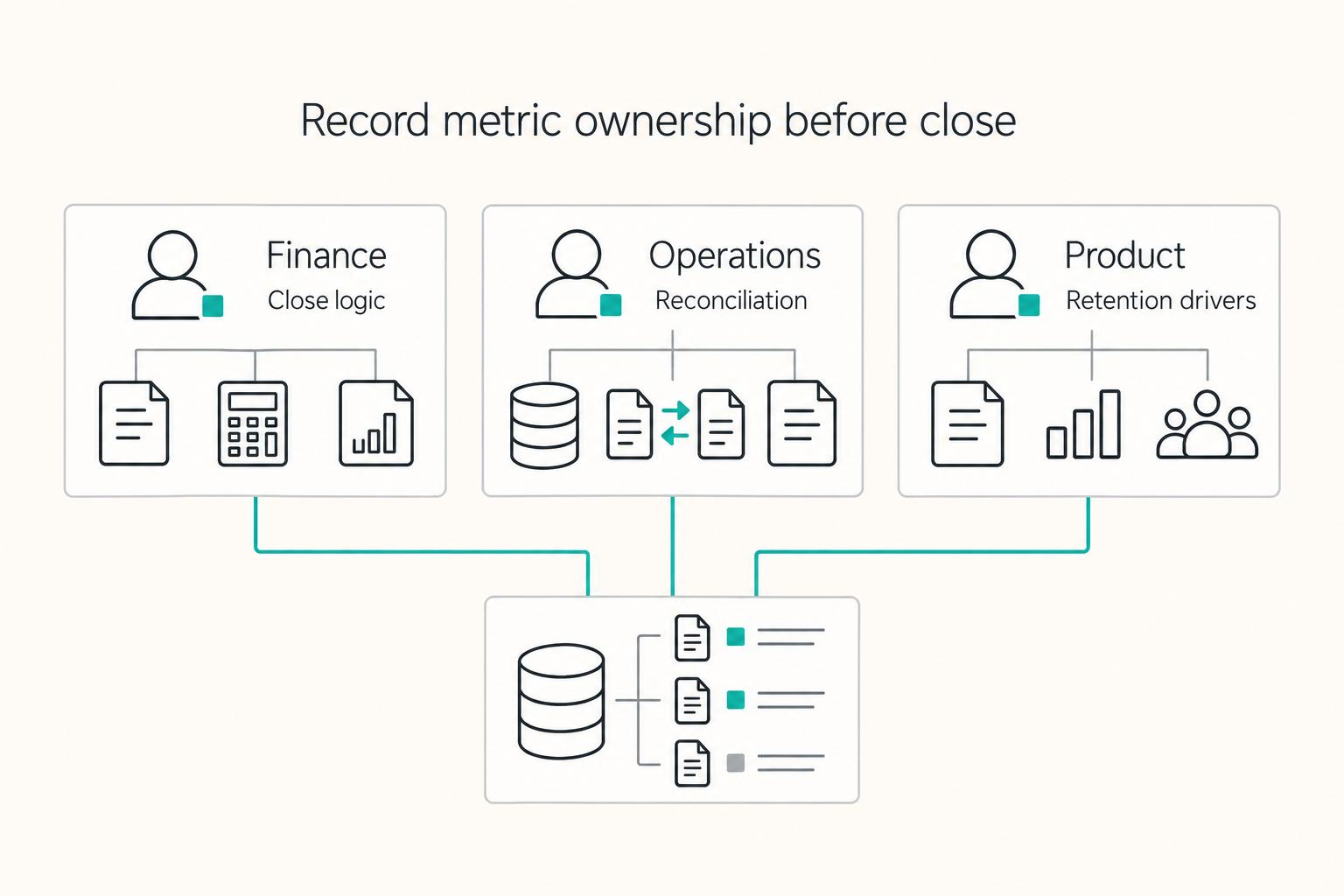
Recurring revenue is valuable because it is predictable enough to support planning, budgeting, and resource allocation. That value drops when your dashboard and board deck are built from different recurring-revenue logic. Use a short, versioned metric dictionary with named owners and required sign-off before any number goes out.
Agree the dictionary before you debate the trend#
Get cross-functional agreement on ARR, MRR, Net Revenue Retention, and Customer Lifetime Value definitions first. You are not creating a universal standard for every edge case. You are creating one company standard everyone can apply the same way.
ARR is recurring subscription revenue normalized to a one-year period. MRR is monthly recurring revenue. Because they differ by timeframe and calculation, shared written definitions are a prerequisite for meaningful comparison.
| Metric | Agree in writing | Core owners | Pre-publish check |
|---|---|---|---|
| ARR | What recurring subscription revenue is included in the annualized view | Finance + data | Does the annual figure use the same recurring base as monthly reporting? |
| MRR | Which active subscriptions and monthly movements are included | Finance + ops + data | Can month-over-month movement be traced to booking activity? |
| Net Revenue Retention | Which movements are included in the retained base and comparison period | Finance + data | Is the comparison period consistent across teams? |
| Customer Lifetime Value | Which inputs are included and over what horizon | Finance + product | Are inputs consistent with current billing and margin assumptions? |
If discounts, pauses, credits, and non-recurring fees are not documented, you are not ready to publish. The exact treatment can vary by business, but it must be explicit, versioned, and applied consistently over time.
Publish in a fixed order#
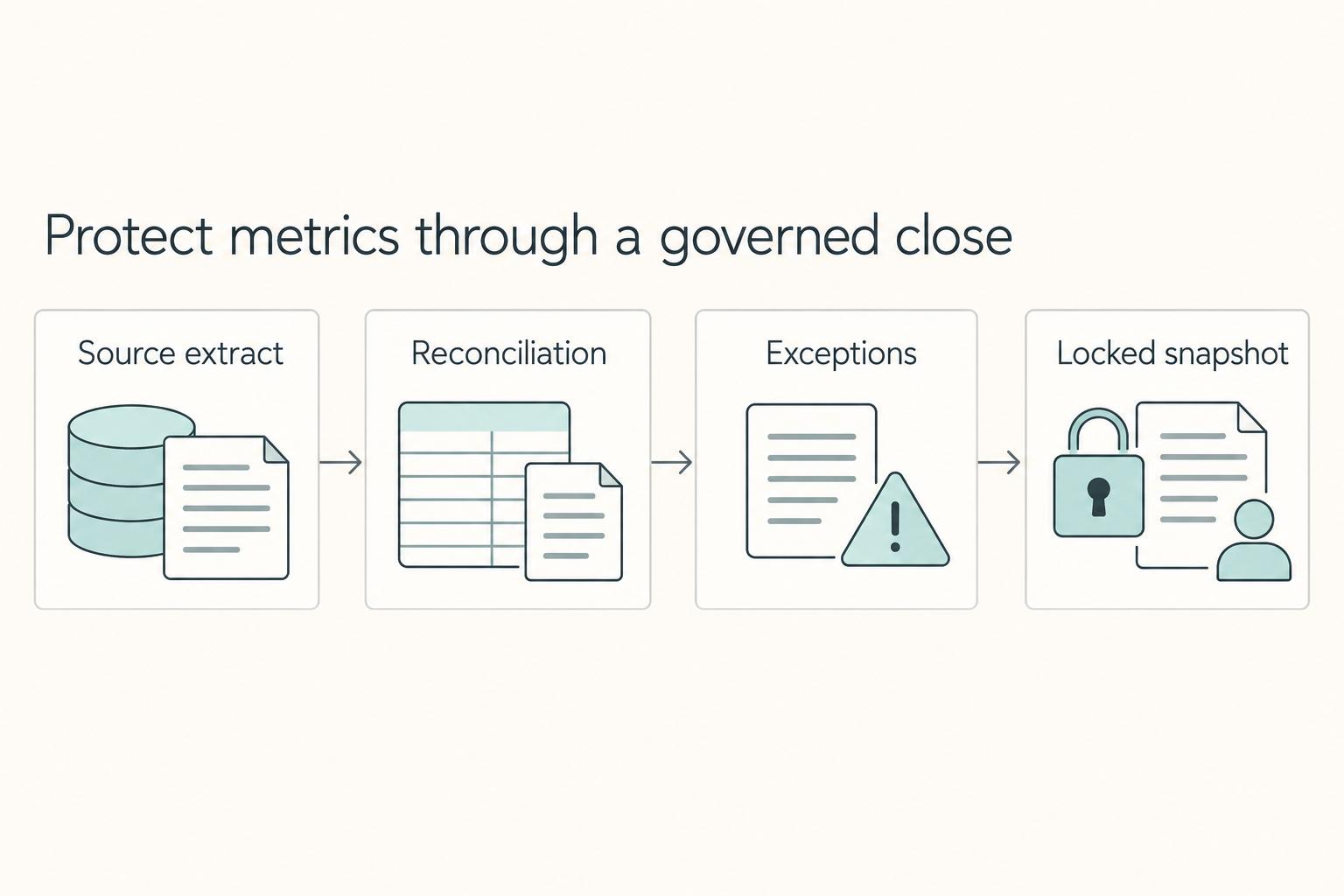
Use the same release sequence every cycle: source events, transform logic, owner sign-off, then publication to dashboards and board materials. This prevents publishing numbers before anyone validates how they were produced.
| Step | What it covers | Key rule |
|---|---|---|
| Source events | Subscription and billing activity that changes recurring revenue | Source events should reflect the activity that changes recurring revenue |
| Transform logic | Application of your agreed definitions | Apply your agreed definitions, not tool defaults |
| Owner sign-off | Review by the owners in the dictionary | Sign-off should come from the owners in the dictionary |
| Publication | Dashboards and board materials | Do not publish numbers before anyone validates how they were produced |
Source events should reflect the subscription and billing activity that changes recurring revenue. Transform logic should apply your agreed definitions, not tool defaults. Sign-off should come from the owners in the dictionary.
Add two checks before every release#
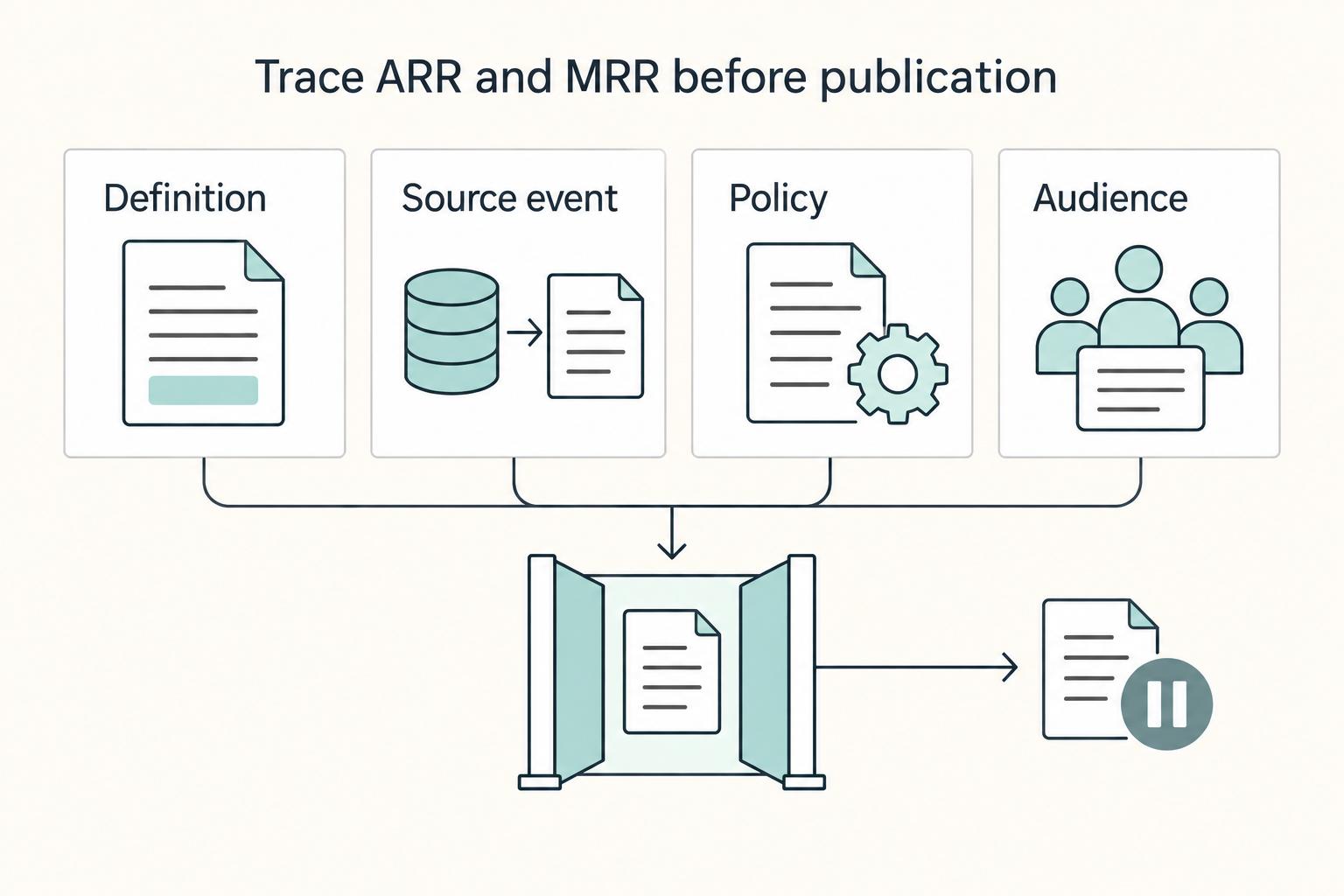
Run two checks before distribution. First, reconcile monthly recurring movement to booking activity. If movement cannot be explained, hold the release. Second, compare implied annual change against monthly movement. If direction or scale conflict, review definitions and transformation logic before publishing.
Treat the metric dictionary as a release gate, not optional documentation. It is better to delay a deck than circulate numbers your team cannot reconcile. For a step-by-step walkthrough, see Retainer Subscription Billing for Talent Platforms That Protects ARR Margin.
Handle edge cases that break naive ARR equals MRR times twelve#
The shortcut breaks as soon as your monthly base is not clean. Keep the annual view tied to MRR that is normalized to monthly equivalents and adjusted for upgrades, downgrades, churn, and prorations in the month those changes happen.
| Edge case | What the recurring base should reflect | What the naive shortcut gets wrong |
|---|---|---|
| Multi-year deal | Convert the recurring portion into monthly equivalents | Treats total contract value as if it were current recurring revenue |
| Mid-cycle upgrade or downgrade | Apply the change in the month it happens, including proration | Assumes the new price applied for the full month or year |
| Reactivation or cancellation | Move the recurring base when the status change occurs | Misses in-month movement in the recurring base |
| One-time fee on a subscription | Exclude it unless it is converted into a recurring charge | Inflates recurring revenue with non-recurring items |
Keep labels strict in your metric dictionary. Deal-size metrics and live recurring metrics are not interchangeable, and combining them makes trend lines harder to trust.
Use a simple month-close check before publishing: confirm event date, confirm the change is recurring, and confirm proration treatment. If billing and subscription-change records do not reconcile to the movement, hold the number instead of annualizing transitional data into planning assumptions.
You might also find this useful: Subscription Metrics That Matter: MRR ARR LTV and Churn Rate Explained.
Tie metrics to operating decisions, not just reporting slides#
Use MRR for decisions you can change this month, and use ARR for decisions that commit annual budget, capacity, or external reporting. The metric should match the decision horizon, not just look clean on a slide.
A normalized monthly base can still mislead you if you use it for annual planning, and an annualized view can hide live retention problems if you use it to run weekly operations.
| Decision | Lead metric | Companion checks | Verify before acting |
|---|---|---|---|
| Pricing or package experiment | MRR | CAC, churn, NRR | Did active subscriptions change this month, and were prorations handled correctly? |
| Churn intervention or save motion | MRR | NRR, Customer Lifetime Value | Are downgrades, cancellations, and reactivations recorded on the right event date? |
| Annual budget, hiring, and capacity planning | ARR | NRR, LTV:CAC | Is ARR built from normalized recurring revenue, with one-time fees excluded? |
| Board or investor update | ARR as headline, MRR as health check | NRR, churn, LTV:CAC | Can you reconcile ARR back to the monthly bridge and subscription events? |
For execution work, MRR is usually the sharper tool because it is used for short-term forecasting and operational tracking. Estimation quality matters: overstating the monthly base can push premature hiring, while understating it can delay needed capacity.
For planning and investor reporting, ARR is useful because it compresses recurring revenue into an annual view ([MRR x 12](https://stripe.com/resources/more/how-to-use-monthly-recurring-revenue-mrr-and-annual-recurring-revenue-arr-to-guide-growth)). But optimizing only for ARR can delay detection of weaker monthly cohort behavior, rising contraction, or softer expansion.
Treat companion KPIs as required context, not optional extras. Read churn, NRR, and LTV:CAC alongside both ARR and MRR. One fundraising-oriented benchmark treats NRR above 110% as strong and LTV:CAC of at least 3:1 as a useful pressure check, not a universal pass-fail rule.
For platform teams, make the metric definition traceable across systems so audit questions are answerable. Take one material subscription change and confirm you can follow it from source event to transformed recurring value to dashboard output; if you cannot, hold the published number.
Use this decision checklist before publishing ARR or MRR externally#
Treat ARR vs MRR as a publication control, not a slide choice. If the number cannot be traced to your documented metric rules and source events, pause publication.
| Check before publish | What to verify | Red flag that means stop |
|---|---|---|
| Definition clarity | The deck uses the same metric names and wording as your internal dictionary and dashboards | The same number is labeled differently across teams or reports |
| ARR grounding | If ARR is shown, it is presented as annual recurring subscription revenue and calculated consistently from your subscription base | ARR is used without a clear, documented calculation path |
| Policy consistency | Any internal treatment rules for upgrades, downgrades, churn, or multi-term contracts are applied the same way across periods | Manual one-off adjustments were made only for external reporting |
| Audience context | The metric view matches the audience, and limits or caveats are stated plainly | The chart is presented without context on what it does and does not represent |
Practical checkpoint: pick one material account change and reconcile it from source event to transformed recurring value to the final published figure.
Most failures here come from label drift, not arithmetic. If naming or treatment changed midstream, rename the metric or add a clear caveat before publishing.
If you want a deeper dive, read ARR vs. MRR: Which Subscription Metric Matters More for Your Platform's Fundraising Story.
Conclusion#
The clean answer is to assign metric ownership by decision type, goals, and stage, not by personal preference. Put MRR in front of the team managing monthly execution. Put ARR in front of the people making annual planning, investor reporting, or valuation decisions.
| Policy element | What to include | Related check |
|---|---|---|
| MRR | List the exact definition for MRR | Use the same definitions in dashboards, board materials, and operating reviews |
| ARR | List the exact definition for ARR | Use the same definitions in dashboards, board materials, and operating reviews |
| Annual figure link | Note that the annual figure is derived from the monthly base | Sense-check the implied annual delta |
| Exclusions | Name any exclusions | A common failure mode is scope drift |
| Monthly movement | Reconcile monthly movement back to the subscription events that caused it | If MRR moved but nobody can point to the underlying new business, expansion, or churn, stop there and fix the source |
That is the practical resolution. These are not rival numbers fighting for the same job. MRR is the normalized monthly revenue from active subscriptions, so it is the right lead metric for near-term movement like upsells, churn, and new customers. ARR gives the annualized view of that recurring base, which is why it is often the headline for strategic planning and external reporting.
If you only remember one operating rule, use the monthly figure to steer and the annual figure to frame scale. A healthy annual headline can still hide weakening momentum underneath, so do not let a board slide replace your monthly trend review. The reverse is also true: a noisy month should not automatically rewrite your annual plan if the recurring base is intact and definitions have not changed.
What prevents avoidable reporting drama is not the formula by itself. It is the shared policy behind it. You need one page that defines what counts as recurring revenue, what gets excluded, and which label belongs in which meeting. If finance says one thing in a dashboard, data publishes another version in the operating review, and leadership presents a third number in the board deck, the problem is no longer math. It is governance.
Make that one-pager concrete enough to check. At minimum, list the exact definitions for MRR and ARR, note that the annual figure is derived from the monthly base, and name any exclusions. Before anything is published, reconcile monthly movement back to the subscription events that caused it and sense-check the implied annual delta. If MRR moved but nobody can point to the underlying new business, expansion, or churn, stop there and fix the source.
A common failure mode is scope drift. Someone changes what is included, or swaps labels between internal and external materials, and the numbers still look polished enough to travel. That is how teams end up debating the metric in the meeting instead of debating the business.
So the next step is simple and worth doing this week. Publish a one-page metric dictionary, get finance, data, product, and ops to sign off on it, and enforce it everywhere. Use the same definitions in dashboards, board materials, and operating reviews. Once that policy is stable, both metrics become more useful because they are finally answering the questions they were meant to answer.
Frequently Asked Questions
Is ARR just MRR multiplied by 12?
Not by definition. ARR is the total value of contracts set to automatically renew over a 12-month period, while MRR is estimated monthly recurring revenue excluding one-time and non-recurring charges. Multiplying MRR by 12 can be a rough sense check only when your definitions and scope are consistent.
What should be excluded from ARR and MRR calculations?
Exclude one-time charges and other non-recurring charges from both metrics. That is a common recurring-revenue calculation pitfall. If a metric jumps because non-recurring revenue slipped in, stop and fix the scope before the number reaches a dashboard or board update.
Which metric matters more for early-stage platform teams?
If you are trying to manage month-to-month execution, MRR usually deserves the front seat because it shows trend changes earlier and can lead future ARR growth. Keep the annual view for planning and investor context, but do not let the annual headline hide a weakening monthly base. In practice, teams usually need both, with MRR showing short-term movement and ARR showing longer-term impact.
When should we report ACV or CARR instead of ARR?
Use ACV when the question is customer size, not current recurring scale. Use CARR when you need visibility into contracted revenue that has not fully gone live yet. Keep both labels separate from ARR because ACV, ARR, MRR, and CARR are connected metrics, but they are not synonyms.
Can a company have strong ARR while MRR is weakening?
Yes, that can happen, and that is exactly why you should look at both. The annual number can still look healthy while the monthly trend starts to soften, since MRR gives earlier visibility into short-term movement. If you see that split, bring the monthly bridge into the review and do not rely on the annual total alone.
How often should finance and data teams review metric definitions?
The grounded rule is consistency, not a fixed calendar. Define each metric once, write it down, and apply the same formula across dashboards, updates, and board materials. Recheck definitions any time those surfaces stop matching, because if teams use different definitions in different contexts, reporting stops reflecting reality.
Try a related tool
Researched and edited by the Gruv editorial team. Gruv builds cross-border billing, payouts, and finance-operations software for global businesses.
Sources
Includes 2 external sources outside the trusted-domain allowlist.
- academia.edu/64999604/Dictionary_of_Acronyms_and_Technica...trusted
- archive.ics.uci.edu/ml/machine-learning-databases/bag-of-words/v...trusted
- dpw.lacounty.gov/epd/swims/TrashCollection/docs/contractdocum...trusted
- faa.gov/documentLibrary/media/Order/7340.2P_Bsc_w_Ch...trusted
- lf-public.deq.utah.gov/WebLink/DocView.aspxtrusted
- stripe.com/resources/more/how-to-use-monthly-recurring-...trusted
- billingplatform.com/blog/comparing-arr-and-mrr-saasexternal
- capchase.com/blog/arr-vs-mrr-navigating-saas-revenue-trac...external
Educational content only. Not legal, tax, or financial advice.
Related Posts
ARR vs MRR for Your Platform's Fundraising Story
For platform finance teams, the ARR versus MRR question in fundraising is less about which formula sounds cleaner and more about whether your numbers hold up when someone starts pulling at the thread. In many cases, you should lead with **Annual Recurring Revenue (ARR)**, then support it with clean **Monthly Recurring Revenue (MRR)** movement that ties back to the books.
SaaS Revenue Metrics Glossary for Platform Operators
This glossary is for platform operators, not a generic SaaS KPI refresher. If your team owns the ledger, reconciliation, settlements, or payout execution, the real question is not what MRR or NRR means in theory. It is whether the number can be tied back to source records, period cutoffs, and settlement evidence before it reaches board reporting.
Subscription Metrics MRR ARR and Churn for Better Pricing Decisions
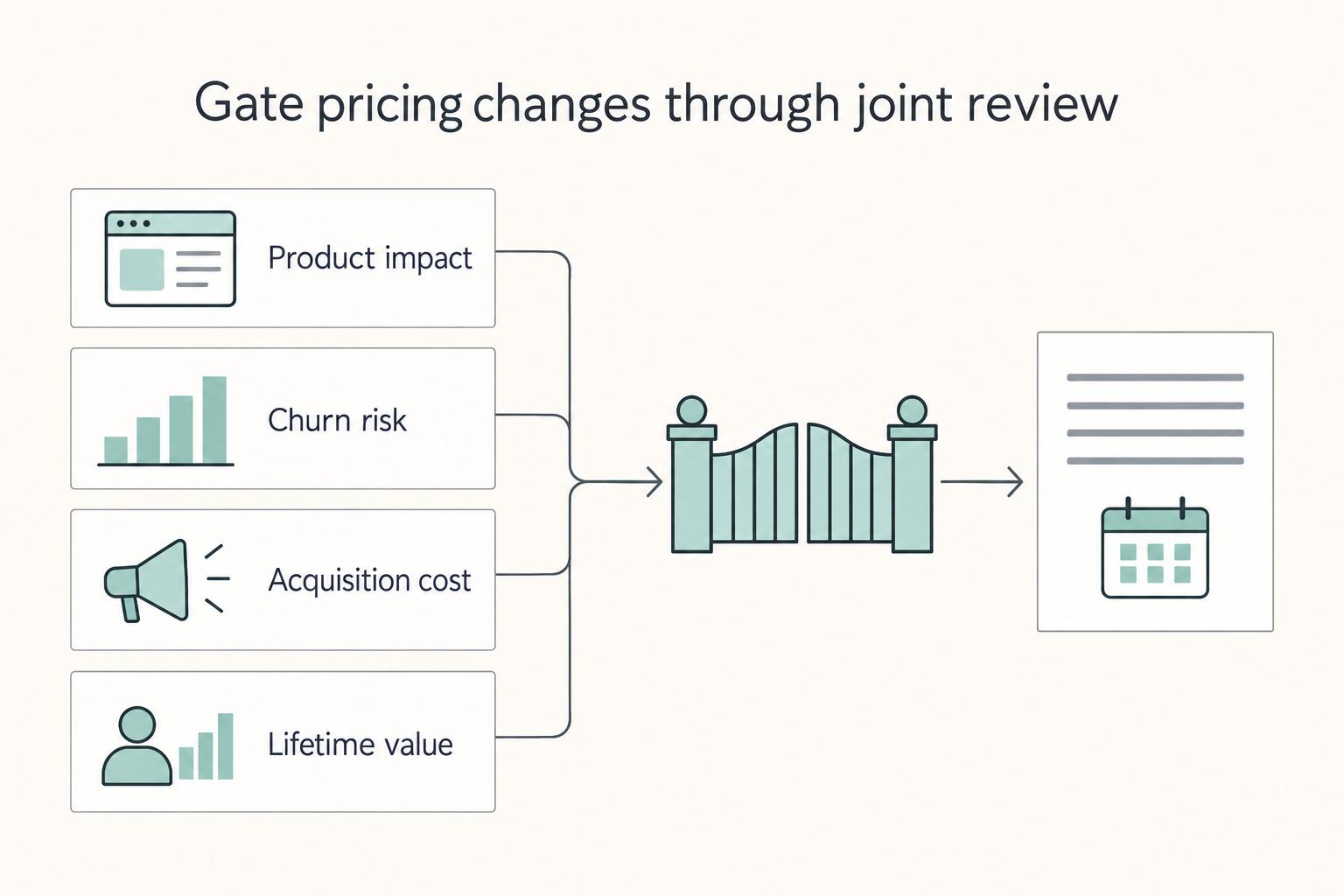
Recurring revenue is simple in principle: money your company receives on a regular basis. The trouble starts when clean definitions turn into messy decisions. Teams often track Monthly Recurring Revenue and Annual Recurring Revenue, but still make pricing, packaging, or customer-save calls without enough context.