
Quick Answer
SOC 2 Type II examines the system description, control design and operating effectiveness over a specified period. For a payment platform, prepare complete control populations and dated evidence of access reviews, change approvals, reconciliation and exception resolution where those controls are in scope. Agree the categories, system boundary and period with the independent CPA firm.
What Auditors Review in a SOC 2 Type II#
If buyers are asking for SOC 2 Type II, the real question is simple: can you show that controls operated over time, with clear scope and clear evidence ownership?
- Why this keeps showing up in payment platform deals
A SOC 2 report can support buyer diligence on controls relevant to security and any additional selected trust services categories. It is a restricted-use attestation report, rather than a certification or a general-use guarantee.
- Who should use this guide
This guide is for teams coordinating audit readiness before fieldwork: auditor fit, scope decisions, evidence ownership, and escalation paths. If you handle procurement responses, control mapping, or cross-functional audit prep, this applies even if you are not the named project lead. It assumes buyer pressure is current and practical, not theoretical.
Type II tests operating effectiveness over the specified period. Agree that period and the evidence needed with the firm before committing a report date.
A simple checkpoint helps: can each control be tied to a named owner, a real artifact, and a clear criteria mapping? If not, the problem is evidence readiness, not auditor branding.
Getting this wrong creates operational and commercial friction. Weak controls can erode trust after incidents and trigger regulatory consequences, and weak evidence practices can make procurement reviews harder. The goal is not the broadest scope. It is the narrowest defensible scope with evidence that holds up under review.
Choose an auditor for the in-scope payment system#
Use this list if you are selecting a SOC 2 auditor now, not learning the basics. Start with a hard filter: only evaluate licensed CPA firms. Then narrow the list to firms that can clearly test the Trust Services Criteria in your scope.
- Use this if you own readiness, not just awareness
This section is for compliance, legal, finance, risk, and technical owners coordinating evidence across teams for an actual report. You need an auditor who can test controls against the criteria in your scope.
- Skip this if you need a primer first
If your team is still at a high-level Type I vs Type II education stage, this is too far downstream. This is an auditor-selection lens. A consultant can support readiness, but only a CPA can issue the final SOC 2 report.
- Run qualification checks before sales-fit discussions
Verify objective items early:
- The firm is an independent CPA firm operating under AICPA AT-C 205 attestation standards.
- The team has experience with all Trust Services Criteria in your scope.
- They can provide references from similar-sized companies in your industry.
- CPA peer-review results are available for review.
- Prioritize credibility over speed promises
Ask each firm to show how it will test controls against the Trust Services Criteria in your scope. A fast, generic report process can become a credibility problem in enterprise diligence.
A practical red flag is a firm that promises a quick, clean report without showing how it will test your selected criteria. Treat that as a credibility risk in enterprise diligence.
Choose Type I or Type II based on buyer risk not internal comfort#
Type I covers the system and control design at a specified date. Type II also examines operating effectiveness over a specified period. Choose the report according to user needs and the assurance sought; a Type I need not be described as an inferior or temporary product in every engagement.
- Default to Type II when buyers need operating evidence
Type I addresses control design and implementation at a date; Type II also tests operating effectiveness over a period. Confirm which assurance the intended user needs.
- Use Type I when point-in-time assurance meets the requirement
Confirm what the buyer will accept before promising a report. If a later Type II is needed, assign an owner to evidence collection and agree its scope and period with the firm.
- Check evidence maturity before committing
Run a readiness assessment before fieldwork and confirm artifacts are being collected while controls are running, not recreated later. First attempts commonly fail on timing and evidence quality, not just missing controls. This check can reveal gaps that policy reviews alone may miss.
- Record the decision and revisit date in one page
Document buyer requirements, selected report type, applicable criteria, evidence gaps and a revisit date. If a later Type II is required, record its readiness conditions separately.
That report decision shapes everything that follows, especially what auditors test and how much operating evidence you will need.
What auditors actually test in payment platforms#
Auditors examine the described system, the suitability of control design and operating effectiveness over the agreed period. The period and sampling approach depend on the engagement; neither a six-month nor a twelve-month window should be presented as a universal requirement.
Start with the five trust services categories and translate them into payment reality#
Distinguish the five trust services categories from the individual criteria within them. Agree which categories and criteria apply to the described service before mapping evidence.
| Trust services category | What it means in a payment platform | What auditors will want to see in practice |
|---|---|---|
| Security | Who can access production, payment operations tools, and sensitive admin functions | Evidence of logical access controls, monitoring, vulnerability management, and incident evaluation running in production |
| Availability | Whether the platform stays usable and whether incidents are handled in a controlled way | Records showing availability controls operated over time |
| Processing Integrity | Whether transactions are processed completely and accurately | Records showing transaction-processing controls operated effectively over the period |
| Confidentiality | How sensitive business and payment data is restricted | Evidence that access to confidential data is limited to approved roles and reviewed over time |
| Privacy | How personal data is handled, where applicable | Controls and records tied to personal-data handling where your platform processes personal data |
In practice, the strongest evidence is operational proof that controls worked over time, not just control design or policy text.
Policies matter, but production evidence decides the audit#
A clear control narrative helps, but it does not carry a Type II on its own. The report package includes the auditor opinion, management assertion, system description, and a testing-results summary. Each part depends on evidence that controls operated effectively throughout the period.
Before fieldwork, run a quick readiness check: choose one access control, one availability control, and one transaction-accuracy control, then pull the exact artifacts you would provide for testing. If the proof is mostly recreated documents or undated screenshots, the evidence set is weak even if the control design is sound.
Processing Integrity needs explicit, testable operational evidence#
For an illustrative daily reconciliation control, retain the complete population of scheduled runs, source totals, unmatched transactions, reviewer timestamps and linked resolution records. If a review was missed, preserve the exception and remediation date. An auditor can select samples from that population and test whether the described control operated; a successful payout screenshot alone does not show that review occurred.
The goal is not perfect uniformity across every flow. It is a documented method, clear ownership, and production records that show review and resolution over time.
Your system description and scope boundary need to match reality#
Auditors also test whether the scoped system description is accurate. When boundaries between internal controls and provider-operated controls are unclear, scope descriptions can drift from reality.
Before fieldwork, keep a simple internal scope-and-boundary view: what is in scope, what is provider-handled, and who owns evidence at each boundary. Using provider-operated controls does not remove the need to describe the boundary accurately and show what your team still monitors or reviews.
If a control cannot be tied to a named owner, a production artifact, and an in-scope system component, treat it as unready.
Set scope boundaries for multi-entity operations early#
For multi-entity payment operations, define scope before evidence collection starts. Waiting makes your service description, control ownership, and samples harder to align during fieldwork.
- List every legal entity and mark each one in scope or out of scope with a reason.
Build one table that shows each entity, what it does, whether it is in scope, and why. Include any entity that touches the in-scope service. Keep the rationale explicit: if an entity or deployment is necessary to deliver the service or service commitments, include and describe it. If it is not necessary, it can sit outside the boundary.
- Make control ownership explicit when operating models differ.
Use your structure to clarify who performs each control, who approves exceptions, and where evidence is retained. Keep the boundary accurate instead of forcing labels into unsupported SOC 2 rules. Type II is about how controls operate over time, so ownership should reflect who actually operated the control during the period.
- Pressure-test exclusions against service commitments and buyer scrutiny.
Do not exclude an entity that is necessary to deliver the in-scope service or commitments. If an entity is outside scope, document why. A practical test: if a buyer asks which entity operated a control during the Type II period, your answer should match the scoped boundary without caveats.
- Document intercompany handoffs so responsibility stays traceable over time.
Where control steps cross entities, record who initiates, who reviews, what record is retained, and how exceptions are returned. A compact evidence set is enough if it is consistent: handoff matrix, named owners, sample approval or ticket records, and the repository location for retained evidence.
Once scope is fixed at the entity level, the next pressure point is functional ownership. That is often where evidence gaps surface.
Build the evidence pack each function must own#
Treat evidence ownership as an operating responsibility, not just a compliance collection exercise. In a SOC 2 attestation engagement, Type II testing focuses on whether controls were suitably designed and operated effectively over time. Each function should own proof for the controls it runs.
Start with one evidence matrix before anyone starts pulling files. It forces clear ownership, criteria mapping, and retention location before fieldwork. Use it as a tailored working document, not a universal checklist. If a control has no clear retention source, treat that as an ownership gap, not a formatting gap.
The matrix below is an example template, not a mandated format; adapt control objectives, criteria mappings, owners, and retention sources to your services, infrastructure, and risk profile.
| Control objective | Illustrative category links; map individual criteria separately | System owner | Backup owner | Retention source |
|---|---|---|---|---|
| User access is reviewed and inappropriate access is removed | Security, Confidentiality | Identity or engineering access owner | Security manager | Access review repository, ticket export, admin logs |
| Transactions are reconciled and exceptions are investigated | Processing Integrity, Availability | Finance operations owner | Controller or finance backup | Reconciliation folder, exception log, case management tool |
| Policies and control statements align to audit narrative | Security, Availability, Processing Integrity, Confidentiality | Compliance or policy repository owner | Legal/compliance backup | Policy register, control mapping file, approval record |
| Incidents and production changes are authorized and traceable | Security, Availability, Confidentiality | Engineering or security operations owner | SRE or engineering manager | Incident tracker, change tickets, deployment records |
- For transaction-accuracy and availability controls, have finance provide sample-ready reconciliation and exception evidence.
Ask for artifacts that show source population, exception details, reviewer, action taken, and recorded resolution. Summary-only files without drill-down, time context, or linked case records can create sampling friction.
- Have legal/compliance maintain policy-to-control traceability in auditor-facing terms.
Keep policy language, control wording, and criteria mapping aligned so testing requests and retained evidence describe the same control. This prevents narrative drift, where one control appears under different labels across teams.
- For access and confidentiality controls, have engineering/security show operating evidence.
Build a proof trail from retained artifacts such as access reviews, incident records, change tickets, logs, screenshots, approvals, and related outputs. The key test is traceability over time: what happened, who reviewed or approved it, and where remediation was recorded when needed.
- Run a pre-fieldwork verification checkpoint and escalate misses.
Before sampling starts, every in-scope control should have a named owner, a sample-ready artifact, and an escalation path. Escalate missing ownership or incomplete evidence immediately, because weak readiness can delay attestation or contribute to a qualified opinion.
Turn your evidence matrix into a repeatable operating workflow with policy gates, audit trails, and reconciliation exports in the Gruv docs.
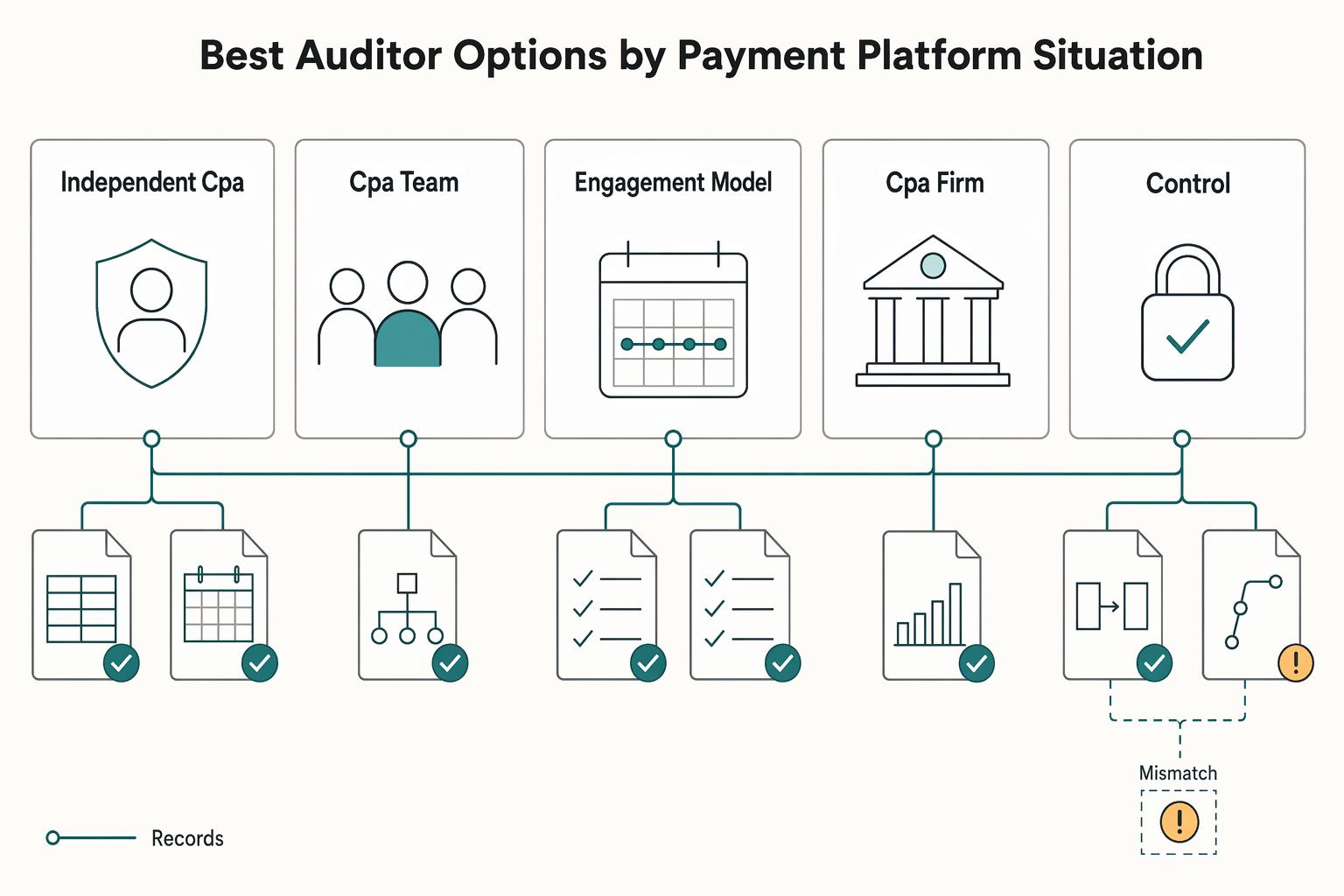
Best auditor options by payment platform situation#
Choose for control fit and evidence quality first, brand second. For a Type II engagement, you need an independent CPA team that can test how controls operated over time, not just review policy language.
- Independent CPA team with fintech systems expertise
Useful when you are moving from SOC 2 Type I to SOC 2 Type II and need testing that reflects real payment operations. This works when the auditor can follow control paths in practice and map approvals to the Trust Services Criteria. Ask for a sample request list before signing. It should ask for timestamps, reviewer or approver identity, before-and-after evidence, and control mapping, not just policies and screenshots.
- CPA team with multi-framework capability
Useful when your scope spans multiple SOC frameworks and you need one coordinated request model. The core value is keeping evidence requests consistent against the same control wording. Confirm who owns the master request list, how scope conflicts are escalated, and how cross-team handoffs are tested.
- Engagement model aligned to procurement pressure
Useful when enterprise procurement pressure is part of the deal cycle. Prospective clients may request SOC reports before contracts, so make sure the audit plan matches your actual pipeline. The key check is whether the team can clearly explain how it will test transaction-accuracy controls in your transaction lifecycle.
- CPA firm paired with a compliance automation stack
Useful when recurring evidence collection is straining a small compliance and engineering team. Automation can reduce manual collection work, but it does not replace auditor independence or judgment. Verify evidence portability: you should be able to export audit-ready proof with timestamps, approver identity, before-and-after evidence, and control mapping. If exports are weak, gaps can surface late and create rushed remediation. For a broader standards view, see Global Payment Compliance Certifications: PCI DSS SOC 2 ISO 27001 for Payment Platforms.
- Technical testing depth for payment controls
Useful when your hardest risks are transaction logic, exception handling, and strict transaction-accuracy expectations. Ask the team to show how it will test through operational artifacts, for example logs, tickets, and finance records, not only policy text. Run a scoped walkthrough before signing using one real exception scenario. Look for a testing approach that covers source populations, exception logs, reviewer signoff, remediation records, and time-bounded proof, and confirm who will staff the engagement.
Use these as selection patterns, not fixed rankings. The strongest choice is usually the auditor that can explain independence clearly, request sample-ready evidence early, and test payment controls beyond a generic controls narrative.
Spot weak auditor fit before you sign#
Weak auditor fit usually shows up before kickoff: vague communication, overly broad scope, and an evidence approach that is unclear about operating proof.
- Look for clear boundaries and clear communication
Ask the firm to explain, in plain language, what support it gives before fieldwork versus what remains your team's responsibility during attestation. If answers are vague or inconsistent, treat that as a risk signal. Poor communication and checkbox-style behavior are warning patterns.
- Check whether scope reflects real operations
Align the system boundary and selected trust services categories with the service commitments and system requirements. A narrower scope must still describe the service accurately and meet the assurance need.
- Validate the testing mindset, not just policy review
A stronger team will discuss how controls are tested over time and what operating evidence is expected, instead of stopping at policies and screenshots. The key checkpoint is timing: evidence should be collected while controls are operating, not reconstructed later. Many first-audit issues come from timing and evidence gaps, not missing controls.
- Confirm readiness work before fieldwork
Ask whether they use a practical SOC 2 compliance checklist and readiness assessment to identify gaps before fieldwork begins. This helps set practical expectations up front.
Plan budget and timeline with explicit unknowns#
Treat cost, timeline, and test depth as variable inputs, not promises. Public sources are clear that SOC 2 Type II tests control operation over time. They do not provide reliable payment-platform pricing benchmarks, and auditor brand alone does not determine outcome.
A useful way to plan is to define scope first. Then build budget and timing around what that scope will require.
- Minimal scope
For a narrower first scope, agree the service boundary, categories, examination period and evidence collection with the firm. Ensure the coverage still meets the assurance need.
- Realistic scope
Use this as the default planning case. Include core production systems, name evidence owners, and confirm operating records exist for what auditors will test, not just policy files. Before you socialize the plan, verify each in-scope control has an owner, backup owner, sample-ready artifact, and a clear control start date. Key differentiator: practical assurance depth with manageable execution risk for a first Type II.
- High-scrutiny scope
Use this when enterprise diligence is likely to probe claims deeply, including categories such as Availability, Confidentiality, or Processing Integrity. Expect deeper testing, more exception handling, and more work to distinguish inherited controls from controls you own. Key differentiator: stronger diligence posture, with more failure points if evidence quality is uneven.
If sales commitments depend on one quarter, lock scope and evidence ownership before selecting auditor brand tier. One failure pattern to avoid is choosing the firm first, then discovering controls have not operated long enough or evidence cannot support the review period.
Keep an assumptions log separate from the budget. At minimum, track: unknown, working assumption, owner, decision date, and downside if wrong. This prevents draft SOC 2 Type II plans from quietly turning into fixed commitments. It matters even more when benchmark visibility is limited because reports are restricted-use and often shared only under NDA. Related reading: Choosing Per-Transaction or Subscription Pricing for Payment Platforms.
Execute a 90-day readiness sequence#
Use this 90-day sequence as a practical readiness plan before fieldwork, not as a substitute for the Type II observation period. The goal is to lock scope and ownership early so control gaps are found internally, not by the auditor.
- Days 1 to 30. Lock scope and map criteria
Finalize the system boundary first, because scope drives what the auditor evaluates. Map controls to the Trust Services Criteria, with Security first and Availability, Processing Integrity, Confidentiality, and Privacy selected based on customer expectations. Use one working document with a single compliance lead, clear owners, and deadlines for each control task.
- Days 31 to 60. Test operating evidence before the auditor does
Run internal sample testing for in-scope controls and verify that controls produce reviewable operating evidence, not just policy text. Track failures in a log with issue, remediation owner, due date, and whether the gap is control design, operating effectiveness, or both. This helps avoid the common failure mode where issues are discovered only during audit testing.
- Days 61 to 90. Run a dry evidence pull for the draft report package
A dry-run pull is not a formal SOC 2 requirement, but it is a useful readiness check. Pull expected artifacts and confirm they are complete, dated, and traceable to each control. For access controls, evidence should show who accessed what, when access occurred, and whether access reviews happened on schedule.
- Add a cross-functional risk review cadence
Run a short cross-functional review to clear blockers tied to scope, ownership, or evidence quality. Keep the same working document as the source of truth so unresolved issues do not sit unowned as fieldwork approaches.
Conclusion#
Keep decisions anchored in scope discipline, evidence ownership, and early escalation. Choose report type based on buyer expectations, not internal preference.
Type I provides point-in-time assurance, while Type II includes operating-effectiveness testing over a period. State what the buyer requires and what each report actually covers.
Keep scope anchored to the Trust Services Criteria you selected. If a control cannot be mapped to those criteria, or no owner can produce evidence from the observed period, that is a readiness gap to fix before fieldwork.
Prioritize evidence readiness. A credible report includes the auditor report, management assertion, system description, and tests of controls. Reviewers often read the auditor's report first, but the full report still shows whether controls were actually tested and supported over the period observed. Use three practical checks before kickoff:
- Pick Type I vs Type II by buyer expectations
If users need period-based assurance, plan a Type II examination with the firm. A Type I can meet a point-in-time need; document any later Type II requirement separately.
- Confirm owner-level evidence coverage early
Assign an owner and retain period evidence for each in-scope control. The auditor evaluates the available evidence and reports the conclusion, including relevant limitations or exceptions.
- Interpret report outcomes carefully
An unqualified opinion does not mean every control was perfect, and failed controls can still be visible to report readers. If no relevant incidents occurred during the period, some controls may not be tested, so avoid over-claiming what the report proves.
Next, shortlist auditors by fit and run a documented Type I vs Type II decision check. Start readiness work early enough to collect usable period evidence before buyer or procurement deadlines tighten. If you want a practical review of scope boundaries, control ownership, and payout-flow traceability before fieldwork, talk to Gruv.
Frequently Asked Questions
What do SOC 2 Type II auditors look for in payment platforms beyond policy documents?
They look for evidence that controls were designed appropriately and operated effectively over a defined period, not just documented. Auditors evaluate controls against the Trust Services Criteria and look for evidence from the review period. If evidence from that period is missing, policy text alone may not be enough.
When is SOC 2 Type I acceptable and when should a platform move directly to SOC 2 Type II?
Type I provides point-in-time assurance on the described system and control design. Type II adds operating-effectiveness testing over a specified period. Use the report the buyer or other intended user needs, and agree the period with the CPA firm rather than treating a fixed duration as universal.
What must be in scope for a multi-entity payment operation across the United Kingdom and United States?
Scope the described service, its supporting components and relevant entity handoffs. Record provider responsibilities and exclusions with the firm. UK or US location alone does not determine whether a component belongs in the system boundary; legal obligations remain a separate review.
How should we evaluate CPA firm independence and payment-platform experience before selection?
Confirm the issuing CPA firm, applicable licensing and professional requirements, independence safeguards, engagement staffing and relevant experience. Ask how it will obtain complete populations and test a payment-control exception. Document any readiness services and how the firm addresses independence before signing.
Which Trust Services Criteria usually fail first in payment-platform audits and why?
Do not assume a ranking of failure rates. Review evidence for the applicable criteria in the selected categories and identify your own gaps before fieldwork.
How do SOC 2, PCI DSS, and ISO 27001 relate without duplicating controls?
SOC 2 is an AICPA-designed attestation framework, while ISO 27001 is a globally recognized ISMS standard, and many organizations pursue both. A validated PCI DSS crosswalk is not provided here, and automatic control de-duplication across frameworks is not established. For deeper comparison, see Global Payment Compliance Certifications: PCI DSS SOC 2 ISO 27001 for Payment Platforms.
What is unknown about auditor pricing and timeline from currently available public sources?
Obtain a scope-specific proposal that separates readiness, the examination period, fieldwork and reporting. Identify assumptions about systems, entities, categories, evidence quality and retesting. Public timing ranges do not guarantee a delivery date or fee.
Researched and edited by the Gruv editorial team. Gruv builds cross-border billing, payouts, and finance-operations software for global businesses.
Sources
Includes 3 external sources outside the trusted-domain allowlist.
Educational content only. Not legal, tax, or financial advice.
Related Posts
How to Evaluate PCI DSS, SOC 2, and ISO 27001 for Payment Platforms
Certifications and regulatory authorisation answer different risk questions, so treat them as separate checks in payment-platform due diligence. For onboarding or renewal, focus on three things: what boundary is attested, who assessed it, and whether the activity also needs separate legal permission. This guide is for compliance, legal, finance, and risk owners evaluating `PCI DSS`, `SOC 2`, and `ISO/IEC 27001` without confusing them with UK regulatory status.
SOC 2 for Payment Platforms: What Your Enterprise Clients Will Ask For
If you are evaluating platforms that enterprise clients can approve, start with this assumption: SOC 2 is a baseline, not the finish line. A SOC 2 examination gives buyers control assurance, but enterprise review usually moves past a badge claim quickly.
EU Payment License Types Explained: EMI vs PI vs Agent Model for Platforms
An electronic money institution (EMI) can issue electronic money and provide authorised payment services. A payment institution (PI) provides payment services but cannot issue electronic money under its PI authorisation. A registered payment-services agent acts for a regulated principal within an agreed scope. Choose the route by examining the claim the customer holds, who receives and controls funds, and what payment activities each entity performs.