
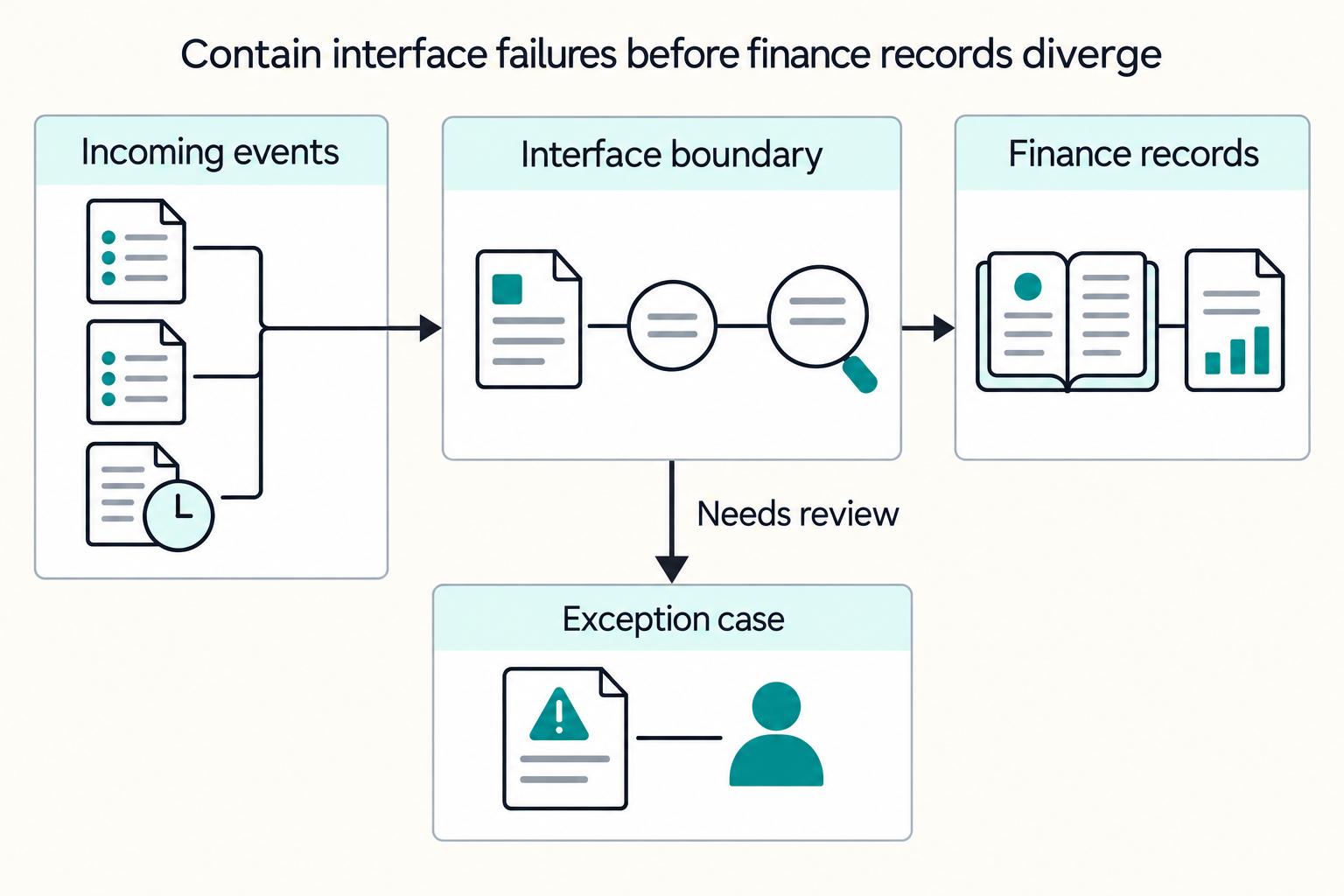
Quick Answer
Choose the target edition and release, then scope General Ledger, AP, AR, Asset Accounting, Management Accounting and any treasury or consolidation functions against the business processes you need. A system conversion, new implementation and Central Finance rollout are different paths. Reconcile balances and open items and rehearse finance operations before cutover.
An SAP finance project should begin with the questions finance needs to answer: what do we owe suppliers, what do customers owe us, which costs belong to each product or business unit, and how much cash can we use? “Implement finance” is too broad to tell an application team what to configure.
Write the target deployment, release and migration path at the top of the scope document. SAP S/4HANA Cloud Public Edition, Private Edition and on-premise SAP S/4HANA have different scope and operating characteristics. Do not apply a Private Edition conversion procedure as a universal implementation checklist.
Distinguish the finance areas before choosing scope#
The map below uses established finance process names. SAP’s release-specific feature scope describes the actual functions; the presence of an area in the product family is not a statement that every edition, license or tenant includes every capability.
| Finance area | What it does | Business question |
|---|---|---|
| General Ledger / Financial Accounting | Maintains legal accounting and financial statements | Can we explain company-code balances and close? |
| Accounts Payable | Records supplier obligations and payment/clearing activity | Which invoices are due, paid or disputed? |
| Accounts Receivable | Records customer receivables and incoming-payment clearing | Which customers owe us money? |
| Asset Accounting | Tracks asset values and depreciation | Do asset records reconcile to the books? |
| Management Accounting / Controlling | Analyzes internal costs, allocations and margins | Where do costs and contribution arise? |
| Cash and Liquidity Management | Supports bank-account management, cash position and liquidity visibility | Where is cash and what is expected next? |
| Treasury and Risk Management | Manages treasury financial transactions and related exposures | How are financing, investments and risk positions controlled? |
| Group Reporting | Supports consolidation of group financial information | Can entities produce an explained consolidated result? |
The Universal Journal integrates financial and management accounting line-item information. It helps provide a common accounting basis; it does not prove that every bank statement, open item, external payment and reporting transformation reconciles. Those interfaces and policies still need validation.
Financial planning can involve SAP planning and analytics capabilities beyond transactional posting. Confirm the planning product, model, licensing and data integration you actually intend to use. A chart of accounts alone is not a budget or forecast design.
Choose a migration path that matches the starting landscape#
| Path | What changes | Finance planning consequence |
|---|---|---|
| System conversion | An existing supported SAP ERP landscape is converted | Resolve relevant simplification and data issues while preserving a reconciled baseline |
| New implementation | A new target is configured and selected data is migrated | Design processes and map balances/open items rather than assuming an in-place conversion |
| Central Finance | Financial information from source systems is replicated into a central SAP S/4HANA environment | Govern mappings, replication errors and source/central ownership |
| Selective transition | An agreed subset of processes/data moves under a specific approach | Prove the chosen tooling, historical scope and boundaries |
Central Finance is not another name for cash management or Group Reporting. It supports a central finance landscape and replication from supported sources. The actual integration path matters: SAP’s third-party FI interface documentation is not permission to connect every SAP source through that interface. Use the supported connector for the source and release.
SAP Business ByDesign is a separate product. Its closing task names or technical checks can inspire a control question, but they do not establish mandatory S/4HANA closing steps. Use your target system’s documentation and enabled scope.
Turn the module map into a first-wave decision#
Start with the finance processes causing material errors or manual work. Name the source systems, master data, accounting policy, required reports and responsible owners for each. Core finance can be the first wave, but no universal rule makes it the correct first wave for every landscape.
| Problem | Scope candidate | Dependency and acceptance example |
|---|---|---|
| Supplier balances unreliable | AP, GL and payment integration | Reconcile supplier open items and payment clearing to GL |
| Receipts matched manually | AR and bank-statement processing | Explain matched receipts and unmatched items without duplicating invoices |
| No trusted cash forecast | Bank accounts and cash/liquidity management | Map balances and expected flows, with freshness and exception ownership |
| Product margin disputed | Management Accounting and margin analysis | Approve cost centers, allocations and source-to-margin mapping |
| Multi-entity close inconsistent | Group Reporting with entity reporting interfaces | Reconcile local submissions, eliminations and consolidated results |
Before you add another module, complete one representative reporting cycle with expected upstream timing, understandable exceptions, usable outputs, and clear end-to-end ownership for integration issues. If any of that is still unclear, adding scope usually hides problems instead of fixing them.
Define decision rights before build starts. Ownership gaps between Finance and IT can slow delivery. If your team cannot say who approves exceptions, who signs off on supported SAP interfaces, and who is accountable for decision logging, ownership is still too loose.
| Decision area | Primary owner to name | What to document before build |
|---|---|---|
| Outcome targets, policy, and approval rules | Named business owner with IT counterpart | Outcome target, approval path, no-go conditions |
| Integration path into SAP processes | Named technical owner with finance approver | Supported SAP interface path, contract ownership, exception handling |
| Automated decision controls and evidence | Named process/control owner | What gets logged, required evidence, escalation path |
Before configuration begins, require a decision register for each major area: owner, boundary, sign-off evidence, and escalation path. For automated or semi-automated flows, confirm two points explicitly: the flow uses supported SAP interfaces, and every automated decision is logged. If either point is unclear, pause and assign ownership before adding scope.
Use actual maintenance and contractual dates for the installed products and support agreement. Do not base a migration deadline on a mixed list of ECC, S/4HANA and compatibility-pack dates. Ask the owner of the existing landscape to document the applicable support exposure.
Use conversion documentation for its stated context#
The cited SAP guide is for SAP S/4HANA Cloud Private Edition2025, version2.0 dated25 February2026. It covers a supported conversion from SAP Business Suite. Its stages include planning, preparation, realization using SUM and follow-on activities. They are not a universal Public Edition new-implementation procedure.
For that conversion path, use the required assets and supported start-release checks, applicable Simplification Item-Check, custom-code analysis and Data Transition Validation as described by SAP. SAP Readiness Check is highly recommended in the guide, rather than mandatory. Distinguish recommendations from required technical checks.
Set project entry and exit criteria around that path: resolved critical data issues, an approved scope, finance-reconciled rehearsal outputs and agreed downtime. The organization chooses its cutover and rollback thresholds; a successful technical tool run is not enough to approve the financial result.
Work through a cutover reconciliation#
Suppose a hypothetical company’s cut-off pack shows EUR200,000 of supplier open items, EUR150,000 of customer open items and EUR80,000 in its bank GL account. Compare those populations and balances by company code and currency after migration. Do not net AP and AR together to hide a difference.
If supplier items total EUR198,000 in the target while AP control remains EUR200,000, the EUR2,000 mismatch needs a documented explanation and correction. A trial balance balancing overall does not prove the supplier subledger is complete.
If the bank statement is EUR75,000 while bank GL is EUR80,000 because an evidenced EUR5,000 receipt is booked but not yet on the statement, show that reconciling item. It is different from an unexplained EUR5,000 migration error. Timing items need ownership and follow-up, not automatic deletion.
| Reconciliation | What to compare |
|---|---|
| GL balances | Source and target by company code, currency, ledger and accounting cut-off |
| Supplier/customer open items | Items, due dates, currencies and totals to control accounts |
| Assets | Acquisition values, accumulated depreciation and remaining records to GL |
| Bank/cash | Book balances to statements with identified timing items |
| Management reporting | Source-to-cost center/profit center/margin mappings and policy effects |
Record any conversion adjustments separately with approval and a source reference. Keep historical data accessible under the retention plan. Reconcile the delta between the rehearsal snapshot and live cutover so late postings do not disappear.
Validate cash, access and finance integrations#
Cash and Liquidity Management can centralize bank-account data and show cash positions and cash flows. Its setup depends on the edition, release and enabled scope. Verify bank-account master data, relevant feeds, roles and apps for the exact target instead of requiring a legacy business-function switch in every environment.
Do not rely on technical job status alone. Validate sampled records, ownership fields, and source-to-target account coverage so configuration is not built on incomplete bank data.
Require one proof point from security and one from the application lead: intended-role assignments for target user groups, and one non-production end-to-end execution using those roles. If testing still depends on broad admin access, this gate is not passed.
Keep retry and duplicate handling explicit in the integration contract, not buried in implementation details. Define the business key, duplicate behavior, partial-failure retry path, and accountability for reconciliation.
Traceability should answer a simple close-period question: where did this number come from? Keep enough lineage to follow the source record, the transformation step, and the reporting output without guesswork.
- source-to-target mapping with business meaning
- persistent transaction or correlation identifier
- replay and exception test results
- reconciliation sign-off from integration and finance owners
For outbound payments or remote postings, persist the business instruction and exact request identity before dispatch. A local database transaction cannot commit a remote SAP or provider action atomically. Track unknown responses and retrieve the remote result before issuing another identity or a fallback payment.
For inbound events, distinguish receipt from completed processing. Commit local posting/state effects and the processed marker together, with durable outbound intent where needed. Authenticate and durably store messages before acknowledgment, then process them through recoverable jobs.
Use supported APIs or integration mechanisms and document which business object and process they affect. A balanced journal does not necessarily clear a supplier open item, and importing a bank statement is different from posting the payment it records. Finance should approve those mappings.
Rehearse period close and recovery#
A period-close rehearsal should exercise the enabled processes: completed posting interfaces, open-item review, asset depreciation, accruals, allocations, intercompany work and reporting as applicable. The exact tasks and sequence depend on the target and policy. Assign owners to unresolved items and document which are blocking.
For ledger-to-report consistency, require a tie-out demo before launch. A reviewer should be able to start from a reported figure, identify the contributing ledger records, and see the mapping that explains the transformation.
If your operating policy includes additional approval gates, document them in the same pack used by engineering and compliance. Include the trigger condition, blocked action, approver role, override evidence, and expected audit record, with SoD built in from the start.
Test finance users with their intended roles rather than broad administrator access. Confirm preparation and approval remain separated where required by policy. Prove an exception can be investigated and resolved without losing its source or accounting history.
Before cutover, agree the recovery point, restore procedure, decision authority and how external actions will be handled. A database restore does not reverse payments already sent to a bank. Keep external references and reconcile actions after the restore before replaying jobs.
Pause scope expansion if a critical report cannot be traced to postings, a subledger mismatch remains unexplained or a required user action fails. Resolve the current wave before adding another interface or optional finance function.
Frequently Asked Questions
Which finance areas should we evaluate first?
Start with GL, AP, AR, assets and Management Accounting against your core books and reporting needs. Add cash, treasury, planning or consolidation scope for identified problems. Confirm availability and licensing for the target edition and release.
Are Central Finance, Treasury and Risk Management and Group Reporting interchangeable?
No. Central Finance concerns a central finance and replication landscape; Treasury and Risk Management concerns treasury transactions and exposures; Group Reporting concerns consolidation. They may coexist but have distinct data and operating needs.
Does every S/4HANA project need SUM conversion?
No. SUM is part of supported technical conversion scenarios. A new implementation or another transition path has different steps. Apply the guide written for your target and starting system.
Does the Universal Journal remove reconciliation work?
No. It integrates accounting information but does not establish correct source mappings, complete open items, bank agreement or external-payment outcomes. Reconcile those explicitly.
What should finance approve before cutover?
Approve explained opening balances and open items, accounting transformations, working roles/interfaces, representative close outputs and the recovery plan. Define concrete blocking differences for the actual program.
Researched and edited by the Gruv editorial team. Gruv builds cross-border billing, payouts, and finance-operations software for global businesses.
Sources
Includes 3 external sources outside the trusted-domain allowlist.
Educational content only. Not legal, tax, or financial advice.
Related Posts

The Freelance Payment Penalty: A Modeled Audit of Platform Fees, FX Spreads, and Payout Delays
The money rarely disappears through a single, easy-to-spot fee. The real loss is stacked. A marketplace takes its commission, a processor adds a charge for international cards, a bank or payment company converts the currency at a spread, a platform holds the funds before release, and a wire sheds a little to intermediaries on the way in. Each layer looks defensible on its own, but the worker feels the combined result as a smaller deposit and a later payday.

How to Respond to a Subpoena for Business Records
Move fast, but do not produce records on instinct. If you need to **respond to a subpoena for business records**, your immediate job is to control deadlines, preserve records, and make any later production defensible.
A US Expat's Guide to Investing in UCITS ETFs to Avoid PFIC Issues
The real problem is a two-system conflict. U.S. tax treatment can punish the wrong fund choice, while local product-access constraints can block the funds you want to buy in the first place. For **us expat ucits etfs**, the practical question is not "Which product is best?" It is "What can I access, report, and keep doing every year without guessing?" Use this four-part filter before any trade: