
Quick Answer
Start with route sorting and one clean submission: for caf housing allowance france, check APL first, then ALF, then ALS, and use the simulator only as an initial estimate. Confirm key gates before upload, including residence basis, principal-home use, landlord relationship, and accommodation fit. Then file a complete request on Caf.fr, track progress in Mon Compte, and avoid budgeting rent around aid until CAF confirms your result.
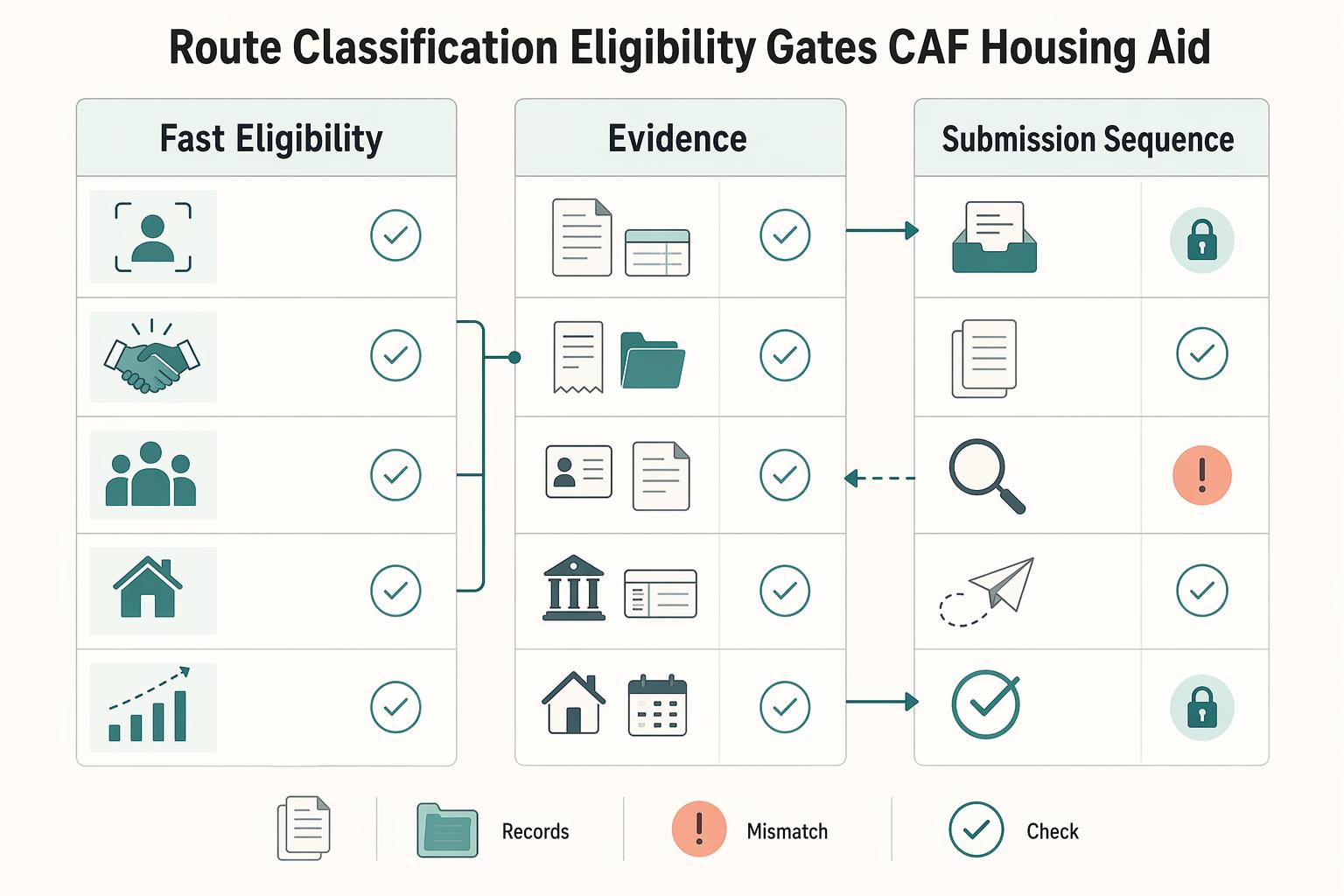
Start here: route classification and eligibility gates for CAF housing aid#
For freelancers, creators, and very small teams, the first question when looking at caf housing allowance france is simple: do you have a real, verifiable path to apply, or are you planning around support that is still unconfirmed?
CAF has dedicated student housing-aid pages, so this guide follows the same official process and applies it to less standardized profiles, including independent workers and mixed-income households.
Use the official CAF site as your source of truth, and treat the simulator as triage, not approval. CAF says the simulator result is an estimate, takes about 5 minutes, and that only a formal request can confirm the exact amount.
You should leave this guide with three things:
- a fast eligibility triage to catch obvious blockers early
- a document pack checklist so key proofs are ready before you start
- a submission sequence that helps reduce avoidable processing delays
The sequence is straightforward. Simulate first, apply online, then track the file in Caf - Mon Compte. CAF also warns that multiple housing-aid requests are unnecessary and can slow treatment of your file.
Delay risk rises when avoidable errors stack together. Examples to watch for are budgeting from an estimate as if it were final, starting before core documents are ready, submitting multiple requests, or relying on broad 2026 claims that are not clearly confirmed for your profile. CAF states that housing aid supports main residence costs for modest resources, and that there are 3 non-cumulative routes: APL, ALF, and ALS.
This guide stays narrow and risk-first. Confirmed points are stated as confirmed, and areas that stay unclear for non-student, international, or edge-case profiles are labeled as uncertainty. Treat housing aid as possible support until your request is filed and moving through the official channel.
For a step-by-step walkthrough, see Opening a Livret A in France for Freelance Cashflow Protection.
How CAF housing allowance actually works#
Start by classifying the route. The first decision is not "how much will I get?" but "which route does this file belong to?" CAF, the Caisse d'allocations familiales, handles personal housing-aid requests, but you need to identify which of the 3 non-cumulative routes fits your case before filing.
APL, ALF, and ALS are separate routes with different award criteria, not different calculation methods:
| Route | High-level assignment logic |
|---|---|
| APL | Based on your housing context |
| ALF | Based on your family situation |
| ALS | Used when you are not eligible for APL or ALF |
CAF also presents these aids as non-cumulative and granted in an order of priority. That matters because treating them as interchangeable labels creates confusion early and rework later.
Your result still turns on the same core inputs CAF repeats:
- your accommodation context
- your household composition
- your household resources
That is the practical model here. Classify the route first, then run the process. Use the simulator for orientation only, and rely on the formal application to confirm the final amount.
Compare APL, ALF, and ALS before you apply#
The main mistake here is thinking you get to choose among the 3 aids. You do not. CAF treats these aids as non-cumulative and applies them in priority order, APL, ALF, ALS, based on eligibility.
| Route | Who it is for in plain terms | Housing context to check first | Excluded when |
|---|---|---|---|
| APL (Personalized Housing Assistance) | Tenants in housing covered by an owner-State agreement | Check this first if your rental is conventioned | If the housing is not conventioned |
| ALF (Family Housing Allowance) | People outside APL scope who meet family-linked conditions | Check only after APL is ruled out | If APL applies, or if ALF family conditions are not met (for example children, expected child, certain dependants, or married household for less than 5 years) |
| ALS (Social Housing Allowance) | Tenants who cannot receive APL or ALF | Check after APL and ALF | If APL or ALF can be granted |
| Key point | These aids differ by award criteria, not by calculation method | Keep the APL → ALF → ALS order when sorting your case | The final route can still be ALF or ALS |
Use this rule before you open the form. If the housing is conventioned, start with APL. If not, test ALF. If ALF does not fit, move to ALS. The important point is not the label you prefer, but the route your facts support.
Take one minute to sort the case before you run the simulator. Use the CAF online simulator as triage, then continue with the application.
- Is the housing conventioned? If yes, start with APL.
- If not, do any ALF family conditions apply?
- If neither APL nor ALF fits, treat ALS as the remaining route.
- Can you answer consistently on housing context and household facts before running the estimate?
Run a fast eligibility triage before collecting documents#
Do the pass-fail check first. If the basics do not hold, more paperwork usually will not change the result. Check status, main residence, landlord relationship, and accommodation fit before you upload anything.
| Check | Pass signal | Pause or fail signal | Why it matters |
|---|---|---|---|
| Status in France | You are a French national, or a foreign national with a valid residence permit. For European Union (EU), European Economic Area (EEA), and Switzerland profiles, verify handling in your local CAF flow. | Your status is unclear, or it is not clearly accepted in the simulator/local flow. | CAF's simulator is scoped to French nationals or foreign nationals with a residence permit. The available guidance does not support one universal rule for every EU/EEA/Swiss non-student case. |
| Main residence | The home is your résidence principale and occupied at least 8 mois par an (except stated exceptions). | Short-stay use, temporary use, or not your true main home. | Service-Public ties APL to main-residence occupancy. |
| Landlord relationship | You are a tenant with no direct family link of the kind flagged by CAF's simulator. | The owner is a parent, grandparent, child, or grandchild, or the relationship is unclear. | CAF flags specific direct family links; Service-Public also indicates outcomes can depend on the exact relationship. |
| Accommodation fit | You rent housing or live in an eligible setting such as a foyer, hotel, meublé, or résidence universitaire. Verify exact fit in your local CAF flow. | Housing type is unusual, informal, or not clearly mapped in CAF categories. | Official CAF pages show multiple eligible contexts, but not every setup is confirmed. Verify your specific arrangement on Caf.fr. |
| Decency and surface | The place appears to meet minimum decency, including 9m² with 2m20 height. Verify in your local CAF flow. | The room appears below that threshold, or decency is doubtful. | CAF provides this minimum reference and says to contact CAF if there is doubt. |
Use one hard stop rule. If any core gate fails or stays unclear, pause and confirm with CAF before uploading anything. Start with the simulator, answer consistently, and treat any unresolved result as "confirm first," especially for decency or relationship edge cases.
Sort your case by risk before you build the file.
- Likely eligible
Status is clearly accepted in the simulator/local flow, this is your main residence, there is no flagged family link with the owner, and the housing setup maps clearly.
- Unclear but possible
EU/EEA/Switzerland profile not fully covered for your non-student case, non-standard housing setup such as hotel, foyer, or meublé, or a landlord relationship that is not clearly resolved by the listed examples.
- High risk of refusal
Status cannot be clearly confirmed in the simulator/local flow, it is not a principal residence, there is an apparent decency or surface issue, or the owner is a parent, grandparent, child, or grandchild.
Some edge cases remain unresolved. That includes all EU/EEA/Swiss non-student paths, every family-landlord relationship pattern, and every non-standard housing scenario. For those profiles, do not guess. Treat the case as "confirm before filing," then build your document pack from that answer.
Build the document pack that prevents back-and-forth#
A clean file can help more than rushing into the form. Build the pack before you start the online flow. Prepare the core file first, then add only the documents that match your profile.
Start with the core file. Use CAF's recurring document categories as your base: identity, housing, bank details, and resources.
| Pack layer | What to prepare | Why it matters |
|---|---|---|
| Identity and status | ID card, passport, or titre de séjour | CAF lists identity proof in the housing-aid file |
| Housing proof | Lease (bail) and relevant rent proof | Your declared housing situation should match your documents |
| Payment details | RIB | CAF requests bank account details |
| Resources | Household resources for M-2 à M-13 | Resources are part of the online filing steps |
Before you upload anything, check consistency across names and core details. CAF tenant guidance notes that the lease and rent receipt should be in the occupants' names, including the person applying.
Add profile documents only where they fit. Do not borrow another applicant's checklist and assume it applies to you. CAF states that the final page of the online form shows the supporting documents required for your file.
Useful branches to prepare early:
- EU student profile in CAF's tutorial: school certificate and EHIC copy.
- Non-EU student profile in CAF's tutorial: copy of a valid French residence permit.
Treat these as profile-specific examples, not universal requirements for every applicant.
Pull landlord items forward. Request the attestation de loyer early. CAF landlord guidance says it should be completed and signed when the lease is signed and given to the tenant.
That document is not automatically required in every case, but getting it early can help avoid delays if your file is later asked for it.
Clean the evidence before upload. Before submitting in Mon Compte, do one final organization pass. CAF's flow runs through 5 étapes: Accès, Situation, Logement, Ressources, and Coordonnées bancaires. Organize your files to match those steps so checks are easier to follow.
Use clear filenames, and make sure identity, housing, and household details align across all uploads and the online form.
Submit on Caf.fr in the right order#
Sequence matters here. Submit once, and only when your simulator inputs, form answers, and documents all tell the same story.
| Step | Action | Key check |
|---|---|---|
| 1 | Run the simulation on the official site | Use Mes services en ligne then Faire une simulation |
| 2 | Start the online request | APL, ALF, and ALS use one online application flow |
| 3 | Enter profile details | Check identity, housing, resources, and residence status for consistency |
| 4 | Upload supporting documents | Upload documents that match the answers in the form |
| 5 | Submit one complete application | Have a signed rental agreement and bank details in France or the SEPA area ready |
Follow the sequence without improvising. Start with the CAF online simulator before opening the request. A concrete path shown in the sources is Mes services en ligne then Faire une simulation. Because APL, ALF, and ALS use one online application flow, this first step helps you validate the profile before filing.
Use this order:
- Run the simulation on the official site.
- Start the online request.
- Enter profile details.
- Upload matching supporting documents.
- Submit one complete application.
This order reduces rework because the outcome depends on factors already flagged in the sources: resources, family situation, rent, and accommodation type.
Do not skip the post-simulator checkpoint. Before you submit, stop and check that the profile data and documents align. At minimum, confirm consistency across identity details, housing details, resource declarations, and residence status.
Also confirm baseline readiness before filing: a signed rental agreement and bank account details in France or the SEPA area. If either is missing, pause and complete the file first.
Be careful with eligibility assumptions. Some residence permit types do not qualify for CAF housing allowance, even though other public guidance may sound broader on nationality. Where immigration status matters, use a conservative reading and verify before filing.
Policy timing can also change: a measure is announced for 1 July 2026, but implementation details are still pending decree. Treat eligibility checks as time-sensitive and confirm the current rule set before you submit.
Avoid the mistakes that trigger delays or refusals#
Delays and refusals often come from contradictions in a file, not one dramatic mistake. The main checks here are residence status, landlord relationship, and landlord paperwork.
| Risk area | What to verify | Why it matters |
|---|---|---|
| Residence status | For foreign applicants, check whether a valid titre de séjour is required and whether the form matches the identity or residence documents | A passport alone may not be enough, and inconsistent status evidence can create refusal risk |
| Family-landlord relationship | Check whether the property owner is a close relative and whether the lien de parenté affects eligibility | A file can look complete and still be ineligible on this point |
| Landlord paperwork | Treat the attestation de loyer (Cerfa 10842*07) as part of file readiness and review Accès, Situation, Logement, Ressources, and Coordonnées bancaires before the final recap | Missing residence evidence or landlord paperwork can delay or block the file |
Do not rely on nationality shortcuts#
Do not assume "any nationality can apply" is enough. For foreign applicants, eligibility can depend on having a titre de séjour en cours de validité. Where that proof is required, a passport alone may not be enough, and your residence evidence should match what you submit in Mon compte.
CAF's checklist includes identity proof: ID card, passport, or residence permit. Before submitting, make sure your name, date of birth, and status are consistent across the form and all identity or residence documents.
Treat family-landlord cases as an eligibility gate#
A signed lease does not automatically settle a family-landlord issue. Service-Public states that eligibility depends on the lien de parenté with the property owner, and it includes explicit ineligible outcomes for some APL, ALF, and ALS scenarios.
If your landlord is a close relative, treat that as a stop-check before final submission. A file can look complete and still be ineligible on this point.
Do the final recap like an auditor#
Finish the pack before submission, not after. The attestation de loyer (Cerfa 10842*07) is a landlord- or manager-completed document sent with the request, so treat it as part of file readiness.
CAF also describes 5 étapes before the final recap: Accès, Situation, Logement, Ressources, Coordonnées bancaires. Use that structure for one last completeness pass:
- Accès / Situation: identity details and status match your form, and your residence permit is current where required.
- Logement: address, move-in date, landlord details, and lease information are aligned; the rent attestation is ready if requested.
- Ressources / Coordonnées bancaires: resources are fully declared and banking details are correct.
Then read the application's final page and match every requested document against your checklist. If anything is missing, especially residence evidence or landlord paperwork, pause and complete the pack first.
Related reading: The Best Ways to Transfer Money Out of Thailand.
Plan your cashflow while the CAF decision is pending#
Until CAF confirms your file, treat housing aid as uncertain. Do not budget rent using assumed APL or ALS before you have clear confirmation.
For freelancers, this is usually a timing problem. Rent is fixed, but income can move around. Plan on rent clearing from cash you already control, even if the CAF outcome is delayed or requires follow-up.
Build a bridge plan from cash you already control. Keep it simple:
- Fixed essentials: rent and other non-negotiable costs due soon.
- Expected inflows: cash already received and payments you can reasonably verify.
- Fallback moves: expenses you can pause and collections you should prioritize first.
Separate invoiced money from received money. If funds are not confirmed and available, do not treat them as rent-ready cash.
Use a conservative rule while you wait. Do not rely on housing aid in your core rent plan until it is confirmed. If approval comes later, treat it as upside that strengthens your buffer.
Keep the file organized so you can respond quickly if asked for clarification. Store your submission date and copies of what you uploaded in one place.
Let official updates trigger action, not panic. When new information arrives, use it to guide one practical decision:
- File action: review what you sent and answer any request clearly.
- Landlord communication: communicate early if payment timing looks tight.
- Cash protection: cut optional spend and accelerate open invoice follow-up.
If updates are unclear and your buffer is shrinking, default to caution: protect housing first and adjust only when information is confirmed.
Separate confirmed rules from unconfirmed 2026 claims#
The safest way to use this information is to separate what is confirmed in the official excerpts from what still needs direct verification. That matters most with broader 2026 claims and generic "typical payout" language.
| Rule or claim | Status in current source set | What to do now |
|---|---|---|
| Apply online through Caf.fr | confirmed in CAF excerpt | Use this as the application route. |
| Housing aid includes APL, ALF, and ALS (non-cumulative, priority order) | confirmed in CAF/Service-Public excerpts | Classify your case by aid type before making assumptions. |
| Eligibility depends on your situation and resources | confirmed in Service-Public/Réfugiés.info excerpts | Review your profile details before relying on aid in your budget. |
| Simulator result is your final entitlement | needs direct verification with CAF (and contradicted by CAF excerpt) | Treat simulator output as an estimate only. |
| One standard payout range applies to everyone | needs direct verification with CAF | Do not budget from generic ranges. |
| The 2026 Finance Act fully changes access for all non-student applicants | needs direct verification with CAF | Do not treat this as confirmed for freelancers or other non-student profiles. |
For the 1er juillet 2026 point, the confirmed wording is scoped to foreign students and references a scholarship-on-social-criteria condition. That is not the same thing as a confirmed universal rule for all applicant groups.
Keep your notes labeled either "confirmed in official excerpts" or "needs direct verification with CAF." Before making any rent-level commitment, re-check the unconfirmed items with CAF. The result still depends on your specific situation in France.
Related: Can Digital Nomads Claim the Home Office Deduction?.
Handle special scenarios without guessing#
If your case is not a standard solo tenancy, classify the scenario first and verify the document path before you submit to the Caisse des Allocations Familiales.
| Scenario | What to verify first | Common failure mode | Triage outcome |
|---|---|---|---|
| CROUS student housing | CROUS certificate path and/or proof-of-address form completed by the landlord | Submitting only the standard student documents and missing the CROUS-specific proof path | Gather missing proof unless the CROUS document path is complete |
| Non-EU applicant | Valid residence permit and required identity documents for your route (student vs non-student) | Using an incomplete document set for your route | Proceed now only when required documents are complete and valid; otherwise gather missing proof |
| Shared or non-standard housing | Whether your setup maps to APL, ALF, or ALS, and whether each occupant files correctly | Treating all shared setups as APL or filing one request for the entire flat | Confirm with CAF first if classification is unclear |
CROUS housing needs a specific proof path#
For CROUS-run accommodation, do not assume the regular student checklist is enough. CAF guidance points to a CROUS certificate workflow and also references a landlord-completed proof-of-address form in student housing guidance.
Before you submit, confirm that this CROUS-specific proof is in your file. If it is missing, the right outcome is gather missing proof.
Non-EU files depend on route-specific documents#
For non-EU applicants, confirm the required document set for your route before filing. Service-Public states that foreign ALS applicants must hold a valid residence permit.
For non-EU students, CAF student guidance is more specific and includes permit, passport, and a birth certificate with French translation. Keep that requirement scoped to the student path shown in the guidance, and use proceed now only when the file is complete.
Shared or non-standard housing must be classified before filing#
Do not guess the aid type in shared or non-standard arrangements. APL, ALF, and ALS are separate non-cumulative routes, and ALS is the fallback when APL or ALF does not apply.
In colocation, each roommate must file their own request and declare their own rent share, and CAF guidance says to declare the total dwelling area, not just bedroom area. If your setup is a sublet or otherwise unclear, confirm the route with CAF first. The simulator can help you orient the file, but it remains an estimate.
Use this 15-minute pre-submit checklist#
A good final check is not complicated. Confirm the eligibility gates, confirm the document pack, confirm portal access, and keep a clear line between what is verified and what still needs CAF confirmation.
| Check area | Items to confirm | If unclear |
|---|---|---|
| Gates | Status and residence basis fit your path, you are filing as a tenant with a lease, and the route is correctly classified | Pause and confirm with CAF first |
| Pack | Identity proof, lease, landlord attestation, resource information, and any profile-specific documents are complete | Do not upload until identity details match across documents and site entries |
| Portal readiness | You can sign in to Mon Compte, use CAF credentials or FranceConnect, access caf.fr, and each upload is readable | Fix access or document-quality issues before starting |
| Risk note | Keep a short split between Confirmed and Needs CAF confirmation | Keep unresolved classification or eligibility points out of your core assumptions |
Check the gates#
Confirm each gate before you submit:
- Your status and residence basis fit your path.
- You are filing as a tenant and hold a lease (if you are a minor, the lease can be in a parent's name).
- For ALS, the home is your principal residence in France and meets decency conditions.
- Your landlord relationship does not fall into the close-family block: parents, grandparents, children, grandchildren.
- Your route is correctly classified: APL (conventionné), ALF (family situation), or ALS (other cases).
- If you are a foreign applicant on the ALS path, your residence permit is valid.
If one gate is unclear, pause and confirm with CAF first.
Check the pack#
Submit only when the core file is complete:
- Identity proof (front and back).
- Lease.
- Landlord attestation covering housing use, surface, and decency.
- Resource information, for ALS the last 12 months.
- Any profile-specific documents required for your case.
Before uploading, verify that identity details match across your documents and your site entries.
Check portal readiness#
Make sure access works before you start:
- You can sign in to Mon Compte.
- You can log in with CAF credentials or FranceConnect.
- You are using caf.fr, the official CAF site.
- Each upload is readable and complete.
Write the risk note#
Keep a short two-column note:
- Confirmed: items you have already verified.
- Needs CAF confirmation: unresolved classification or eligibility points.
Keep that split explicit because the simulator gives an estimate, and the exact amount is known only after the formal housing-aid request.
If CAF timing is uncertain, keep incoming cash predictable with a simple client billing fallback using this free invoice generator.
Conclusion#
The fastest reliable path is still the simplest one: identify the likely aid route, verify the eligibility gates, build a complete file, and then submit online through the CAF website.
The real decision is classification before form-filling. The material above supports three routes, APL, ALF, and ALS, and shows that they feed one online application with similar core inputs. If you still cannot place your case clearly, pause and confirm with CAF before you file on assumptions.
From there, file quality matters more than speed. For non-EU applicants, right of residence is a key gate, so unclear or inconsistent residence status is a real refusal risk.
Use one operating rule throughout. Do not submit first and sort it out later. Check that residence basis, lease details, and bank details are consistent across documents before submission, then track the same references after filing. Small contradictions can create avoidable delays.
Keep a strict line between confirmed and unconfirmed points. This guide supports online filing and confirms that household resources matter, but it does not support guaranteed payouts, guaranteed timelines, or a complete 2026 rule map for every international profile. Treat student-facing references to €100 to €280 per month and July 1, 2026 as verification prompts, not universal planning rules.
If you can answer four questions cleanly, the file is stronger: which route you are testing, whether your residence basis is solid, whether the core documents are complete, and whether every application statement is backed by the file. If any answer is weak, verify first, then submit.
If you want tighter control over cross-border payout operations and status visibility after this CAF process, review Gruv Payouts.
Frequently Asked Questions
What is the difference between APL, ALF, and ALS?
Confirm the distinctions between APL, ALF, and ALS with the relevant CAF authority or on Caf.fr.
Who can apply for CAF housing allowance in France?
Confirm your eligibility details with CAF directly or via the simulator on Caf.fr.
Can non-EU applicants qualify with a valid residence permit?
Confirm non-EU eligibility rules with CAF directly or via the simulator on Caf.fr.
What documents should I prepare before using Caf.fr?
Confirm the required document list for your application via Caf.fr or a CAF adviser.
How does the CAF online simulator change the application process?
Confirm how the CAF online simulator affects your application outcomes on Caf.fr.
What should I do if my file is pending in Mon compte?
Confirm pending-file handling steps and timelines via Mon compte on Caf.fr.
Are 2026 eligibility changes fully confirmed for all international freelancer profiles?
No. This guide does not confirm 2026 CAF eligibility changes for international freelancer profiles.
Try a related tool
Researched and edited by the Gruv editorial team. Gruv builds cross-border billing, payouts, and finance-operations software for global businesses.
Sources
- congress.gov/bill/118th-congress/house-bill/2670/texttrusted
- docs.fcc.gov/public/attachments/FCC-10-58A1_Rcd.pdftrusted
- irs.gov/pub/irs-access/p2104_accessible.pdftrusted
- oecd.org/content/dam/oecd/en/publications/reports/200...trusted
- read.dukeupress.edu/demography/article/60/5/1493/382373/Fertilit...trusted
- sme-vat-rules.ec.europa.eu/sme-scheme/cross-border-sme-scheme_entrusted
- taxation-customs.ec.europa.eu/archives/taxable-persons/vat-cross-border-ru...trusted
- uscourts.gov/sites/default/files/fr_import/ST2007-01.pdftrusted
Educational content only. Not legal, tax, or financial advice.
Related Posts
Should Your Freelance Business Accept Credit Cards?
Offer card payments, but stay in control of how money reaches you. The goal is not a smoother checkout screen. It is predictable cash you can use to run the business.

Can Digital Nomads Claim the Home Office Deduction?
Claim the deduction only when your facts and records can carry it. With the home office deduction for digital nomads, the real decision is usually a three-way call: claim it, do not claim it, or pause and get help because your file is not ready.

How Freelancers Can Decide on France’s Micro-Entrepreneur Regime
Low-stress compliance starts with one question: does the Micro-entrepreneur regime match your real setup right now? It is often presented as a simplified option for lower-revenue activity, so use it as a fit test, not a shortcut.