
Quick Answer
Choose a GBC when the business can maintain genuine Mauritius management/control and its local governance, banking, records and activity duties. An AC is for principally overseas business with central management/control outside Mauritius and a Mauritius Management Company as registered agent. Resident treaty benefits do not follow from AC incorporation. For either route, check each client country, foreign tax exposure and full recurring cost before paying a provider.
Decide whether Mauritius fits your operating model#
If you work solo across African markets, you usually need one thing first: a credible operating base you can run compliantly across borders. In practice, that pressure shows up in ordinary places like client contracts, payment operations, and keeping your legal and tax position consistent as you work in multiple countries.
That is where Mauritius can fit, but not as a shortcut. If you are weighing Mauritius as an offshore jurisdiction for Africa, use a practical lens. Mauritius is a regulated cross-border jurisdiction. The Financial Services Commission regulates the non-bank financial sector, and Global Business is structured for resident corporations conducting activities outside Mauritius. For an active service business, that is the part that matters.
A Global Business Licence application is made through a Management Company. For GBL holders, online Tax Residence Certificate applications go to the FSC before MRA processing. Match the requested certificate year and treaty to the actual income claim.
A Mauritius-incorporated company centrally managed and controlled outside Mauritius is treated as non-resident under section 73A of the Income Tax Act. The MRA’s non-resident-company communiqué says this generally applies to Authorised Companies and explains the separate CRS information requirements. Non-resident status is not exemption from every foreign tax or reporting duty.
So the case for a Mauritius company can be strong, but only in the right fact pattern. If you need a resident company for active business outside Mauritius, it may be a good fit. If you need a non-resident structure, or you cannot sustain the compliance load, another path may be better.
Build a revenue map before choosing an entity: client country, service, place of performance, expected withholding, treaty status and annual compliance cost. A company can centralize contracts and records while leaving tax duties in the countries where you manage it or perform the work.
When cross-border work warrants a separate company#
A separate company can give clients a consistent contracting party, bank account and ownership record. Incorporation also adds filings, accounting and provider costs. Start with the commercial problem you need to solve rather than assuming every solo consultant needs a foreign company.
That does not make a sole proprietorship automatically wrong. It means that once contracts, payments, and counterparties span multiple countries, you should validate your setup locally before you scale.
Where this usually affects you#
- How disputes, invoicing, and personal exposure are treated in each jurisdiction where you work.
- Whether counterparties onboard individuals and entities differently in procurement workflows.
- How clearly you can maintain an audit trail across countries, banks, and advisers.
- What continuity looks like if you need to transfer work, add partners, or step back.
| Decision area | Sole proprietorship | Incorporated entity |
|---|---|---|
| Liability separation | Confirm how personal exposure is handled under local rules | Confirm what protection exists and where legal limits apply |
| Procurement readiness | Confirm whether buyers accept individual vendors or require extra documentation | Confirm whether buyers prefer a company vendor profile |
| Compliance centralization | Confirm how you will separate personal and business records across jurisdictions | Confirm whether one entity simplifies records without removing local obligations |
| Business continuity | Confirm how work continues if you pause or transfer engagements | Confirm what transfer and ownership mechanisms are available locally |
The decision lens#
Compare the additional annual cost with the commercial benefit. If your clients already accept you as an individual and the new entity adds no useful operating capability, the formation fee alone does not justify it.
For the wider entity decision, compare sole proprietorship and LLC structures, including local tax and liability limits.
Is Mauritius the Right Home Base for Your Solo Business?#
Mauritius can be a strong fit when your revenue is genuinely cross-border across African markets, your clients expect a company profile they recognize, and you are ready to maintain real compliance records over time. It is a weaker fit when most of your work is domestic, you want minimal administration, or your only rationale is tax.
Jurisdiction choice should be a multi-factor decision, not a tax-only shortcut. In practice, assess tax rules, operating ease, and political reliability. Then pressure-test one practical question: will this setup make onboarding, invoicing, and explaining your structure easier or harder in your actual client markets?
Where Mauritius can fit#
A Mauritius company can hold contracts with clients in several markets, but “Africa-focused” is not a tax category. Client acceptance, source-country tax and the location of your work must be checked for each market. A bank still evaluates ownership, activity and source of funds independently.
Treaty value matters only if it matches your actual revenue map. Focus on whether a Mauritius entity could change tax outcomes or make your tax position clearer in the countries where you get paid. Then verify current treaty coverage against those specific countries.
For a simple illustration, MUR 1,000,000 of chargeable ordinary consulting profit at the standard 15% corporate rate produces MUR 150,000 income tax before any eligible credit or separately applicable charge. This is not a quote for total owner take-home tax. The MRA partial-exemption rules list specific income/activity classes and substance conditions; overseas consulting clients alone do not establish a 3% effective rate.
How treaty access helps operations#
For a business-of-one, treaty access matters when it improves pricing and cash-flow predictability across borders. If taxes can be applied in more than one place on the same income stream, a treaty-capable setup may reduce surprises.
For example, the MRA treaty list lists South Africa among agreements in force, while Kenya and Nigeria await ratification. A signed agreement awaiting entry into force cannot support current relief. For each contract, check the operative treaty, service-income article, permanent-establishment rules, applicable anti-abuse provisions and any source-country claim procedure. A Mauritius residence certificate is evidence of residence, not approval of every claimed benefit.
Practical comparison#
| Decision area | Mauritius | Generic alternative jurisdiction |
|---|---|---|
| Treaty usefulness for Africa-focused revenue | Can be useful if current agreements cover your client countries and your entity qualifies | May be weaker, irrelevant, or better only if its agreement network matches your revenue map |
| Banking and procurement acceptance | Can be familiar in some international finance contexts, but still depends on each counterparty and your documentation quality | May look simpler at formation, but unfamiliar setups can trigger more explanation requests |
| Compliance operating burden | Works best when you maintain a clear, ongoing compliance file tied to real operations | Setup may appear lighter, but the burden can reappear during onboarding, banking, and tax review |
| Governance stability | Should be assessed in current due diligence; political reliability is one of the selection factors | Varies widely; low setup cost alone is not a reliability signal |
What to verify before you commit#
Before you spend money or start a setup, test the structure the way a skeptical bank, client, or tax reviewer would.
| Check | What to confirm | Why |
|---|---|---|
| Country fit | Map where you actually earn revenue and verify whether Mauritius helps in those specific countries | Tests fit against the countries where you get paid |
| Entity usability | Confirm what your banks and key clients will request, and prepare a clear business rationale plus supporting records | Shows whether onboarding, invoicing, and explaining the structure will be easier or harder |
| Risk profile | Test how the structure would look in the source country where the income is generated | Surfaces reputational and onboarding costs if the structure appears mainly tax-driven |
Document the business purpose alongside the tax analysis: clients served, where services are performed, who takes decisions, and why Mauritius supports those operations. Do not assume invoicing through Mauritius changes where the work creates tax exposure. Retain any required source-country withholding certificates and relief applications.
Once the revenue map supports Mauritius, choose between a company managed there and an Authorised Company managed outside it. The management location must reflect actual decisions.
Choosing Your Structure: GBC vs. Authorised Company#
Start with what the company will actually do and where it will be managed. This is a tradeoff, and each structure has distinct advantages and limitations.
Under sections 71 and 71A of the Financial Services Act, the global-business framework addresses principally overseas business with majority non-Mauritian ownership or control. A GBC is managed and controlled from Mauritius and administered by a Management Company. An AC has central management and control outside Mauritius and a Mauritius registered agent that is a Management Company. Financial or other regulated activities require the appropriate separate permissions; ordinary incorporation does not license them.
| Decision criterion | GBC | Authorised Company (AC) |
|---|---|---|
| Operating profile | Resident corporation conducting business principally outside Mauritius | Company conducting business principally outside Mauritius with central management/control outside |
| Management | Managed and controlled from Mauritius; licensed Management Company administration | Central management/control outside Mauritius; Mauritius Management Company as registered agent |
| Mauritius tax position | Generally resident; standard corporate tax 15%, with eligible relief assessed by income type | Non-resident where central management/control is outside; foreign tax and Mauritius-source exposure need separate analysis |
| Treaty position | Potential treaty relief subject to residence, actual treaty and claim conditions | Non-resident AC does not obtain Mauritius-resident treaty benefits merely through incorporation |
| Evidence and reporting | Resident directors, local principal bank account and accounting records; audited statements and substance records | Outside-management records, registered-agent file and annual FSC financial summary; tax return duties remain |
Common misclassification to avoid#
An AC is not a low-cost way to obtain the resident treaty position of a GBC. A GBC is not compatible with a director who makes all material decisions abroad and asks local directors only to sign them. Decide where competent directors will actually exercise control before choosing the route.
Before incorporation, verify three points in writing with your provider or adviser:
- Whether your planned activity aligns with the structure's stated use profile.
- Whether your management pattern aligns with the structure you choose.
- Whether your planned DTAA reliance is valid for your facts.
For an illustrative case, a consultant controlling all contracts from Nairobi while a Mauritius agent handles filings should not present that arrangement as Mauritius management for a GBC. Moving genuine decision-making to a Mauritius board is a change in operations, not a change in the wording of minutes. Kenyan residence, source tax and other duties still need separate analysis.
If using nominee directors, define their actual authority and duties. Nominee arrangements do not remove beneficial-owner disclosure or permit directors to ignore independent judgment.
The Compliance Checklist: Meeting Substance Requirements as a Digital Nomad#
A GBC must maintain management and control in Mauritius and carry out core income-generating activities in or from Mauritius as required under the Income Tax Act. The FSC considers local directors, banking, records, audited statements and board participation when assessing management/control. Keep evidence of how the business actually operates.
Your personal residence and the company’s residence are separate. A mobile shareholder can own a GBC, but personal travel flexibility does not replace the company’s Mauritius management and activity obligations. A provider’s office address alone does not establish substance.
What you need to keep defensible#
| Requirement | Why it matters | Who owns it (you vs. management company) | What proof to retain |
|---|---|---|---|
| Management and control | GBC residence/licence conditions | Board and Management Company, with owner cooperation | At least two suitably capable resident directors; board meetings including at least two Mauritius directors; genuine decision papers/minutes |
| Local banking and accounting | FSC management/control assessment | Company and Management Company | Principal bank account in Mauritius; accounting records at registered office; statutory statements audited in Mauritius |
| Core activity and resources | Licence conditions and any claimed partial exemption | Company, provider and tax adviser | Activity records; adequate suitably qualified staff employed directly/indirectly and proportionate expenditure where partial-exemption conditions apply |
| Beneficial ownership | Disclosure applies despite nominees | Owner supplies information; provider maintains file | Identity, address, ownership/control chart and change records |
| Treaty reliance | Residence alone does not determine relief | Company and relevant advisers | TRC, actual treaty/claim documents, source-country tax and business-purpose evidence |
A practical failure mode is operational drift: real decisions happen outside the Mauritius governance record, while local files capture only signatures. Keep your file aligned with how the business is actually run.
How the management company workflow should run#
A reliable way to stay out of trouble is to treat the management company as part of your operating process, not just a formation vendor.
| Step | Action | Evidence or trigger |
|---|---|---|
| Onboarding | Provide beneficial ownership information and requested supporting identity records to your licensed service provider | Beneficial ownership information and supporting identity records |
| Governance rhythm | Keep your provider updated on material contracts, banking changes, and major commercial decisions | Updates so the Mauritius record reflects real control |
| Records handling | Keep books and supporting records complete so substance evidence is available when needed | Books and supporting records |
| Escalation and approvals | Actively approve or sign governance events, including ownership changes, new business lines, treaty-dependent deals, and control or administration changes | Governance events and approval trail |
Your working checklist#
Use one current evidence pack rather than rebuilding the file every time someone asks for it:
- Keep identity and address documents, beneficial ownership records, corporate records, service agreements, and core commercial records together.
- Maintain a dated governance file for approvals, resolutions, and significant decisions.
- Review whether local office, staff, and expense support still matches actual operations.
- Notify your provider early when ownership, banking, contracts, or your operating model changes.
- Do not rely on treaty outcomes without a file that supports proper structuring and genuine substance.
- For any requirement that may change, verify the current rule before acting.
A Mauritius digital-nomad visa concerns permission to stay and work under its terms. It does not establish where the company is managed or authorize every local business activity.
Before you finalize your setup, map your travel and tax footprint in one place with the Tax Residency Tracker.
Beyond Tax: The Three Pillars of a Resilient Global Enterprise#
A proper structure is not only about tax. A resilient cross-border setup rests on three things: clean entity separation, a defensible commercial profile, and decision records that match how you actually run the business.
| Pillar | What it solves for you | Operational proof | Common failure mode |
|---|---|---|---|
| Asset protection | Helps keep business risk within the company instead of your personal affairs | Client contracts in the company name, company-issued invoices, dedicated company banking, dated approvals for major commitments | You sign personally, mix personal and company spending, or treat governance as an afterthought |
| Credibility and bankability | Makes client diligence and bank onboarding easier to support | Current KYC and UBO file, business-activity summary, sample contracts and invoices, consistent company details across records | Your compliance file, banking profile, and real activity conflict |
| Control and autonomy | Lets you operate across markets without losing governance discipline | Dated resolutions, decision logs, banking mandates, contract archive, provider communication trail | Decisions happen off-record and are documented later only for signatures |
Asset protection#
Use the company as the contracting and paying party: contracts, invoices and accounts should identify the same entity. Limited liability has legal limits, including personal guarantees and personal wrongdoing; separation does not eliminate source-country tax or protect against every claim.
Credibility and bankability#
For bank and client onboarding, keep current ownership/KYC documents, an activity summary, sample contracts and invoices. Give accurate tax-residence and controlling-person information requested for reporting. Incorporation does not guarantee bank approval, and information exchange does not mean company affairs are anonymous.
Control and autonomy#
Give the board and provider timely information to make and record real decisions. For an AC, retain evidence of actual outside management. For a GBC, overseas owner instructions followed by local signatures can contradict the claimed Mauritius control. Review major contracts, financing and changes of management when they happen.
A company account is not a personal asset-protection trust. If succession or asset holding is a separate objective, assess it separately from the consulting entity’s licensing and tax duties.
Match the Structure, Set It Up, Then Keep It Compliant#
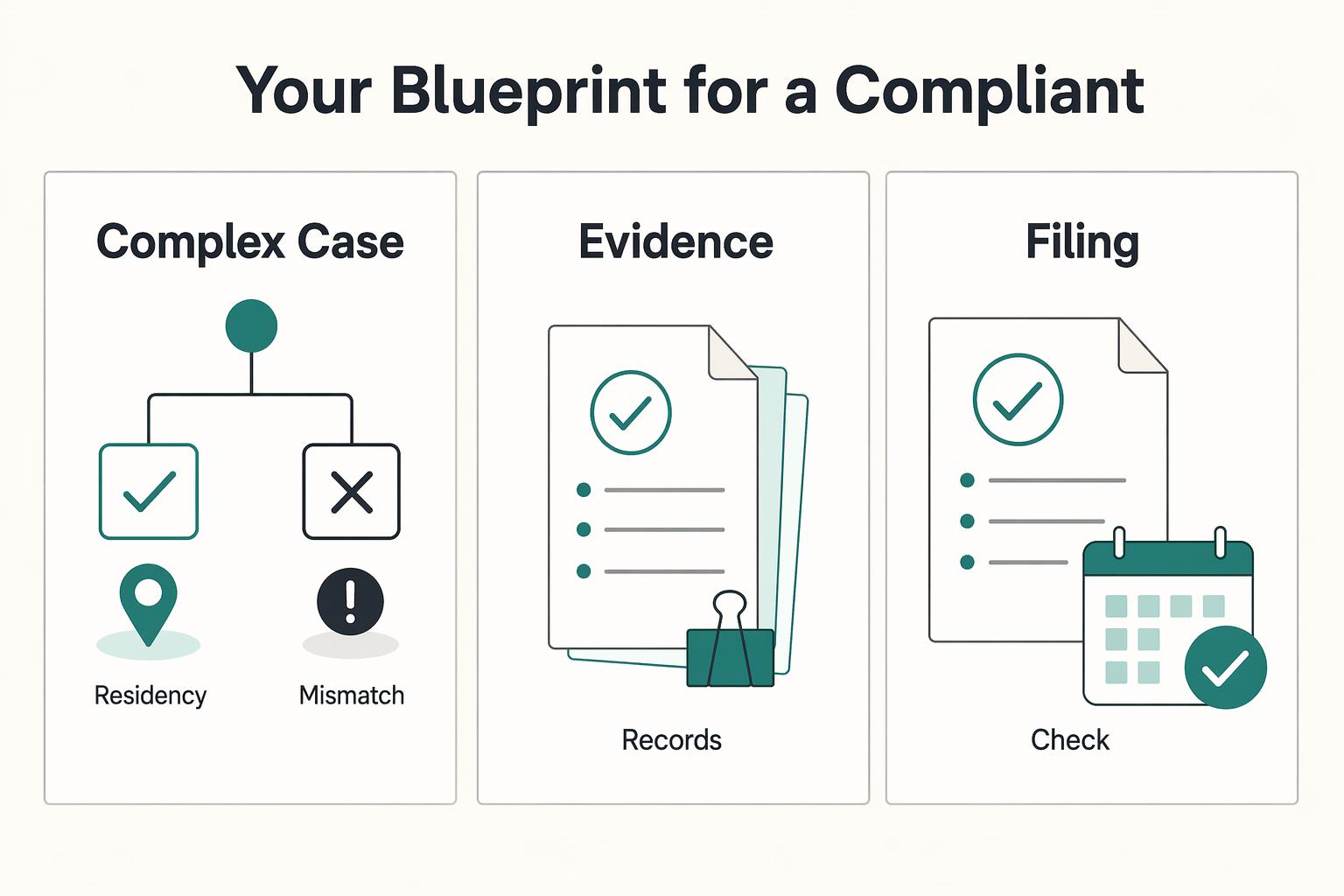
The sequence matters. First, match the structure to how you actually operate. Next, set it up through the required licensed channel. Then keep the compliance record current. Risk reduction and continuity depend on governance and filing records staying up to date.
| Blueprint stage | Primary objective | Key documents/workflows | Main risk if skipped |
|---|---|---|---|
| Decide structure | Match legal form to how you actually operate | Structure decision memo, written provider confirmation of GBC or AC, place-of-effective-management/control analysis | Entity mismatch and tax-residency/control problems |
| Set up with licensed management company | Complete setup through the required regulated intermediary and document scope | Engagement letter, application pack, resident director details (for GBC), registered office/registered agent confirmation | Weak setup trail, unclear responsibilities, governance gaps |
| Run ongoing compliance | Keep the company compliant in practice, not only at incorporation | Board approvals, CIGA records, annual return workflow, APS workflow where applicable, filing/payment evidence | Missed filings, substance failures, or management/control drift |
Decide structure#
Choose the entity on function, not convenience.
- Decide
GBCif you need a Mauritius tax-resident company managed and controlled from Mauritius, with potential treaty access. - Decide
AConly if the business is mainly outside Mauritius and central management and control are outside Mauritius. - Get the entity choice and rationale in writing, including how place of effective management will be maintained.
Set up with licensed management company#
Specify the recurring services in the engagement letter: administration, directors or registered agent, bookkeeping, audit where applicable, returns, regulatory filings and renewal payments. Assign each deliverable an owner and due date.
- For a
GBC, route the Global Business Licence application through an FSC-licensed Management Company. - For an
AC, make sure the company has a Mauritius registered agent that is a management company. - Confirm what the engagement covers after incorporation, not just at setup.
- Require a clear deliverables list for governance support, filings, and compliance evidence handling.
Run ongoing compliance#
This is where many otherwise sound structures start to drift. Treat compliance as a standing operating task, not a year-end cleanup.
| Item | Applies to | Timing or standard |
|---|---|---|
| Management/control and core-activity conditions | GBC | Maintain continuously; retain genuine board, activity, bank and record evidence |
| FSC audited financial statements | GBC | Within six months after financial year close |
| FSC financial summary or specified accounts/return | AC | Annually, not later than six months after financial year close |
| MRA income return and balance of tax | Companies including non-resident AC | Normally six months from end of accounting-period month; June/December year ends are due two days (excluding Saturdays/public holidays) before December/June end |
| APS statements and payments | Companies whose preceding-year gross income exceeded MUR 10 million and had chargeable income | Normally within three months from quarter-end month; March/September quarters are due two days (excluding Saturdays/public holidays) before June/December end |
| Licence renewal and Registrar filings | Relevant GBC/AC | Use applicable current renewal notice and separate company-law calendar |
Then take these next actions:
- Confirm in writing whether your operating model requires a
GBCorAC. - Request the Management Company engagement letter with post-incorporation scope.
- Create one evidence folder for approvals, director records, filings, and receipts.
- Verify the current filing requirements before you rely on them.
- Check the operative treaty for each client country and income type; signed but unratified agreements are not current relief.
For a USD 10,000 service invoice, assume solely for illustration that source-country withholding is 10% and no relief is applied: the bank receipt is USD 9,000. Record USD 10,000 gross revenue and USD 1,000 withholding separately; it is not a customer discount. Preserve the certificate and assess relief or foreign-tax credit under the applicable rules. For ordinary consulting profit, do not assume the 80% partial exemption applies merely because clients are abroad: the MRA lists specific eligible income/activity classes, and ordinary overseas consulting is not a general listed class.
Frequently Asked Questions
How can you use Mauritius as a solo consultant or independent operator?
Use the entity that matches where the company is really managed and what it does. Put contracts, invoices, banking and records in the company name. A GBC requires real Mauritius management and compliance; an AC requires outside management and a local registered agent. Neither route automatically changes your personal residence or foreign reporting duties.
What are the real costs to set up a company in Mauritius?
Under the FSC fee schedule effective 1 July 2026, processing is USD 600 for either route; full annual licence fees are USD 2,600 for a GBC and USD 1,400 for an AC. First-year annual fees depend on the quarter of grant. Add Registrar charges, Management Company/agent fees, directors where applicable, accounting/audit, banking and any activity-specific fees. These regulatory amounts are not an all-in provider quote. See the current regulatory fee rules.
Can you meet substance requirements if you are not living in Mauritius full time?
A mobile shareholder need not personally replace the company’s local arrangements. A GBC still needs genuine Mauritius management/control, competent resident directors, local banking/records and applicable core-activity evidence. Partial exemptions separately require eligible income, local core activity, adequate qualified staff and proportionate expenditure. An AC instead needs actual outside management and its Mauritius registered agent.
How do you choose between a GBC and an Authorised Company?
Choose a GBC where you can maintain Mauritius management/control and need a resident company, potentially for a specific treaty claim. Choose an AC where the company is actually managed outside Mauritius and principally conducts overseas business. Test the relevant income and treaty, not a total treaty count or the old GBC1/GBC2 labels.
Is Mauritius a better choice than the UAE for an Africa-focused business?
Compare the client countries and specific income treatment, where you will manage/work, bank onboarding, permit needs and full annual compliance cost. Mauritius’s resident GBC and non-resident AC are different options. A cheaper incorporation quote in either Mauritius or the UAE does not establish a lower combined tax burden.
What should you verify before you pay any provider?
Verify three items in writing: the proposed entity type, the step-by-step setup scope, and the full fee schedule. Cross-check How to set up against Fees so you can spot exclusions and later charges. If the provider is vague on scope or fees, pause and get clarification first.
Try a related tool
Researched and edited by the Gruv editorial team. Gruv builds cross-border billing, payouts, and finance-operations software for global businesses.
Sources
Includes 4 external sources outside the trusted-domain allowlist.
Educational content only. Not legal, tax, or financial advice.
Related Posts

Sole Proprietorship vs LLC for Global Freelancers in 2026
For most freelancers in 2026, the practical default is still simple: use the simplest structure you can run cleanly, then formalize when risk actually rises. If your work is still in validation mode and the downside is contained, a sole proprietorship is often the practical starting point. When contract exposure, delivery stakes, or dispute risk starts climbing, forming an LLC deserves earlier attention.

How to Write a Professional Bio That Attracts Clients
If you want to know **how to write a freelance bio** that is client-focused, write for scan speed, not autobiography. Clients often read your headline before they open your portfolio, and first impressions can form in less than seven seconds. Your opening should show fit, proof, and a clear next step fast.

What Is FinCEN for Freelancers and FinTech Users
If you are asking **what is fincen**, focus first on the decision in front of you. FinCEN, the Financial Crimes Enforcement Network, is tied to FBAR filing through FinCEN Form 114 when foreign financial accounts create reporting duties. By the end, you should know whether to act now, gather records, or escalate.