
Plan a successful SAP migration by locking scope, ownership, migration path, object mapping, integration design, ETL validation, compliance checks, cutover rehearsal, and post-go-live stabilization into one finance-and-engineering checklist. The key is evidence-based gates: define pass or fail acceptance, validate reconciliation on migrated data, and do not progress when critical outputs, interfaces, or controls cannot be explained or trusted.
A useful SAP migration checklist for finance teams has to do more than list tasks. It has to show what to decide early, what to validate with evidence, and what to sequence so reconciliation problems are less likely after data moves and interface cutovers.
Migration risk is not just technical. Common failure modes include broken integrations, compliance issues, user disruption, and unplanned downtime. Your migration path affects data strategy, timeline, and resourcing from the start.
This guide is for CTOs, engineering leads, solution architects, and finance ops owners working across SAP ERP, payment rails, and payout operations. The core approach is simple: plan finance controls and technical delivery as one decision stream, not two parallel tracks.
Preparation is an early signal of migration quality. Successful S/4HANA programs usually do the hard work up front. They clarify the current system market, identify data dependencies, and bring IT, finance, and operations in before design assumptions harden.
That evidence-first bias runs through the whole checklist. SAP financial-accounting migration guidance includes concrete early checkpoints teams can use. One source file per company serves as the migration unit. G/L totals in the template should net to zero, and bank-account template balances should match bank balances.
Structure matters early too. A company can maintain multiple sets of books, including different currencies, and each template entry is one row per set of books. If that is misaligned, it can create rework later in mapping, reconciliation, and downstream reporting.
By the end of this guide, you should have four things:
The goal is not a frictionless SAP move. It is a finance-and-engineering checklist that makes the risky parts visible early enough to act on them.
We covered this in detail in ERP Integration for Payment Platforms: How to Connect NetSuite, SAP, and Microsoft Dynamics 365 to Your Payout System.
Do not start design until scope, baseline, and evidence are clear enough to test. If you cannot state the source system, the target scope, and which finance processes are out of scope, stop and close that gap first.
| Evidence item | What it covers |
|---|---|
| Current process maps | In-scope finance flows |
| Known reconciliation issues | Where they appear and who owns the current workaround |
| Custom object inventory | Reports, extracts, and integrations with finance data dependencies |
| Integration dependency list | Upstream inputs, downstream consumers, and third-party dependencies that could block cutover |
Set the baseline in plain language: which company-level datasets move, what finance capabilities are required at go-live, and what is deferred. Define rough project scope, budget, timeline, and a small set of measurable checkpoints so finance and engineering are judging the same plan. Then build a minimum evidence pack before planning continues:
Use one hard readiness check here: confirm financial accounting data is complete and consistent at the company level. Financial migration guidance treats the company as the migration unit. It expects general ledger and subledger data to move together at the same point in time, and source files to be fully prepared because they are loaded together rather than one by one.
Document constraints and unknowns early so they are tracked instead of assumed away. If your program includes compliance, tax-document handling, or audit-trail requirements, record how they could affect flows, interfaces, retention, and evidence outputs. Keep an explicit unknowns log with owner, due date, and required decision, and block design sign-off if unresolved items could affect reconciliation evidence or critical dependencies.
You might also find this useful: Month-End Close for Payment Platforms: A Step-by-Step Checklist for Finance Teams.
Once Step 1 evidence exists, turn responsibility and readiness into clear decisions before you commit to dates or re-estimate costs. Name owners, lock day-one scope, and define pass or fail acceptance.
Use an ownership matrix tied to your interface catalogue, and keep owner and business criticality visible together so unresolved issues do not bounce across teams during testing. If a critical lane has no clear owner, treat it as an open risk and resolve it before finalizing plans.
| Critical lane | Accountable owner | Decision or sign-off | Evidence artifact |
|---|---|---|---|
| Market readiness | One named systems owner | Current view of ECC and connected systems is approved | Market diagram |
| Interface reliability | One named integration owner | Interface list is complete and triaged by criticality | Interface catalogue, test outcomes |
| Scope governance | One named business/program owner | Day-one scope is locked; deferred items are tracked separately | Scope list, deferred backlog |
| Progress tracking | One named program owner | Key performance measurements are selected and reviewed | KPI checklist, status log |
Write acceptance criteria so finance and engineering can answer yes or no, not "mostly." For this section's scope, keep the checks explicit, and name the owner, required evidence, and pass or fail outcome for each one:
Lock must-have day-one scope first, then track non-blocking improvements in a deferred list to control scope creep. Use one filter for every proposed addition: does go-live fail without it?
Keep critical interfaces and core operating requirements in day one. Defer enhancements that do not block operational readiness. Early buy-in across finance, engineering, and business owners helps keep that line stable when the schedule tightens.
This pairs well with our guide on Spend Analysis for Platform Finance Teams to Categorize and Benchmark Vendor Payments.
Choose the migration path with a written, evidence-based comparison rather than defaulting to what seems fastest. Greenfield, Brownfield, and Hybrid are the primary strategy options, and each should be tested against execution risk, resource capacity, and delivery constraints identified during assessment.
Run an early assessment and planning pass before you commit to a path. The point is to validate readiness and produce a migration roadmap so the decision reflects current constraints rather than assumptions.
Use the artifacts from Steps 1 and 2 as decision inputs:
If those inputs are incomplete, treat the path decision as provisional.
Keep the comparison focused on tradeoffs you can defend in review and later approvals:
| Tradeoff area | What to test in the decision |
|---|---|
| Risk exposure | Technical, operational, and financial risk accepted with this path |
| Custom code and standardization | Whether the path aligns with clean-core direction by reducing custom code, standardizing processes, and using extensions deliberately |
| Timeline pressure | Whether waiting increases cost, complexity, and risk for your program |
| Capacity constraints | Whether partner talent, SI capacity, and tooling availability support realistic execution timing |
Do not let timeline pressure become an excuse to skip the comparison. A path that looks faster on paper can still fail if the risk and capacity assumptions are weak.
Document timing constraints directly in the evaluation:
Do not frame 2027 as the end of all ECC options. Do treat it as a planning and negotiating constraint.
Capture the decision in a one-page architecture memo and include it in approvals. At minimum, record:
| Memo element | What to record |
|---|---|
| Selected option | Greenfield, Brownfield, or Hybrid |
| Alternatives considered | Why they were not selected |
| Key risks | Risks accepted |
| Assumptions | Timing and capacity assumptions |
| Validation checkpoints | Checkpoints that would trigger re-review |
If the memo cannot explain why this path fits your current constraints and timing reality, the decision is not ready to commit.
Treat this as behavior mapping, not a table copy. The real test is whether ECC finance object behavior still produces reliable outcomes in S/4HANA reporting, not whether data merely loads.
Start by documenting how key ECC finance objects are used in current close and extract workflows, then define how that behavior should appear in target reporting. Do not start with field-level guesses.
Use a simple mapping sheet to keep decisions auditable, and do not call the mapping ready unless you can name the report, extract, or reconciliation dependency behind it:
| Legacy object | Current report/process dependency | Target reporting expectation | Owner sign-off |
|---|
Lock org-structure assumptions early so ETL, reporting logic, and interfaces are built against the same target design. If those assumptions move late, teams can end up rebuilding transformation logic and retesting downstream outputs.
Keep those assumptions in the same evidence set as your market diagram and interface catalogue. The interface catalogue should show owner, criticality, technology, and frequency so org-sensitive dependencies are visible before dry runs begin.
Define "equivalent reporting" in finance language first, then translate it for engineering. "Loads successfully" is not enough. Set clear, named outputs for finance reports, reconciliations, and exception handling.
For each output, record ECC source logic, target S/4HANA logic, and the validation method. Use this step to decide whether each extract can be retested as-is or needs redesign.
Do not wait until full rehearsal pressure to find reporting gaps. Add a pre-cutover checkpoint where close-critical outputs are already testable on migrated data.
The pass condition is usable evidence, not perfection. Finance should be able to review, compare, and explain outputs from the target design. If a close-critical output cannot be produced or explained, pause and fix the mapping assumptions before moving on.
If you want a deeper dive, read SAP S/4HANA for Finance Teams: Complete Guide to Modules and Migration Planning.
Design integration reliability before the first data-load wave. A phased migration roadmap helps reduce risk, but vague planning often shows up later as integration failures during migration.
Put interface decisions on the same roadmap as your data waves. For each finance-critical integration, document key assumptions, ownership, and expected outcomes before dry runs start.
If your migration depends on external systems, document those dependencies early so wave outcomes can be tested against stable assumptions. If key interface details are still unresolved, treat wave readiness as at risk.
Make traceability explicit from the start. For each critical flow, document how the integration path connects to downstream SAP and finance reporting outputs.
Keep this practical. Finance and engineering should be able to walk one normal case and one failure case end to end. If the path cannot be explained clearly, migration test readiness is limited.
Dry-run results only help when interface assumptions stay stable enough to isolate defects. If contracts are still moving, consider a narrow change-control window during dry runs and clear ownership for each change.
The source material does not define a mandatory freeze model, so use a rule your team can enforce consistently. The goal is attributable defects, not extra process for its own sake.
Agree early on how finance should read reports when data may still be in transit between integration and final posting. Without that agreement, teams may mistake timing differences for migration defects, or miss real defects because they assume timing explains everything.
The sources here do not provide timing thresholds or settlement windows, so avoid hard-coded rules you cannot support. Use explicit report labeling and a shared interpretation before cutover rehearsal.
For a step-by-step walkthrough, see Measure AP Automation ROI for Payment Platform Finance Teams.
Once interface assumptions are stable, run ETL in controlled waves with clear stop/go gates. Treat each gate as a finance evidence decision, not just a technical "job finished" status.
Use wave design as an operating choice your team can apply consistently. The provided sources do not prescribe a single ETL wave pattern, so treat the split below as an internal example rather than an SAP-defined requirement.
| Wave (internal example) | What you are trying to prove | Minimum team-defined stop/go check |
|---|---|---|
| Master data | Core finance objects and reference values land correctly | Critical entities are present and usable for downstream posting and reporting |
| Open items | Current operational activity can move without breaking reconciliation | Agreed critical-entity counts and values tie back to source extracts |
| Historical data | Prior-period reporting remains usable in target | Agreed history slices can be reproduced without unexplained gaps |
Set wave depth based on your migration path. The SAP S/4HANA implementation road map covers system conversion, new implementation, and selective data transition, and those paths are not equivalent. In SAP terms, system conversion typically means converting an existing ECC system, commonly ECC 6.0, to SAP S/4HANA, including a HANA database migration and software upgrade. Migration and system conversion are related, but not identical.
The provided excerpts do not define a standard ACDOCA validation checklist, so document this checkpoint as a team rule with explicit review evidence.
For each wave, capture:
For reporting verification, prefer stable query outputs over ad hoc screenshots. SAP Help states that released CDS query views can be used by tools that support CDS views. General Ledger Accounting provides released CDS views that can serve as a repeatable validation surface.
Use an internal no-go rule: if critical-entity reconciliation fails, do not progress to the next wave. Apply your documented recovery or reload method, fix the transformation logic, and rerun before moving on. Classify failures before retrying as a mapping issue, source issue, configuration issue, or accepted business exception. Anything unclassified stays no-go.
If this fits your governance model, use paired sign-off at each gate so both technical correctness and finance meaning are confirmed. Engineering verifies scope, transform version, and rerun state. Finance ops verifies reconciliation outcomes and exception ownership.
Use short gate questions:
If any answer is unclear, keep the gate at no-go. If you want a practical reference for webhook handling, idempotent retries, and traceable status flows, review the Gruv integration docs.
After ETL sign-off, treat compliance and tax checks as migration gates, not post-UAT cleanup. Put each control on the execution calendar with explicit stop or go ownership and evidence.
Map each existing internal compliance gate to the exact activation or payout path it allows or blocks, then test that path in the wave that enables it. Do not leave those controls in a separate workstream with only verbal dependencies.
Keep this at the level you can prove. This section does not define universal compliance thresholds. Use your approved internal policy definitions and show, for each enabled path, the gate name, owner, expected result, and test evidence.
Run tax continuity as a hard migration check: can your team still produce the record, file, or decision the process depends on, not just confirm that the fields exist. For FBAR-focused controls, verify the concrete filing path and data requirements below before UAT closes.
| FBAR checkpoint | What to verify in migration execution |
|---|---|
| Filing trigger | Decision logic identifies U.S. persons with qualifying foreign account financial interest or signature authority and still applies the $10,000 maximum/aggregate threshold test |
| Filing channel | Output supports electronic filing through the BSA E-Filing System |
| Timing | Workflow still supports April 15 filing with automatic extension to October 15 |
| Value support | Data supports maximum account value determination and currency conversion with a verifiable rate source |
| Item 15a handling | For fewer than 25 accounts, process can support "amount unknown" handling when applicable |
| Submission quality | Sample output includes required elements to reduce rejection risk |
If rules differ by market, product, or program, use a coverage matrix before UAT. Include scope, gate name, trigger event, expected allow or block result, owner, and evidence artifact. This helps prevent a common false signal: one program passes UAT and gets mistaken for global readiness.
Set PII handling rules before defect triage starts, and do not place sensitive FBAR content in support tickets. Apply the same discipline to extracts, validation files, logs, screenshots, and exception tickets. Use masked samples or controlled reference IDs when evidence is needed, rather than raw personal or account data.
Related: How to Audit Your Payout Platform: An Internal Audit Checklist for Finance Teams.
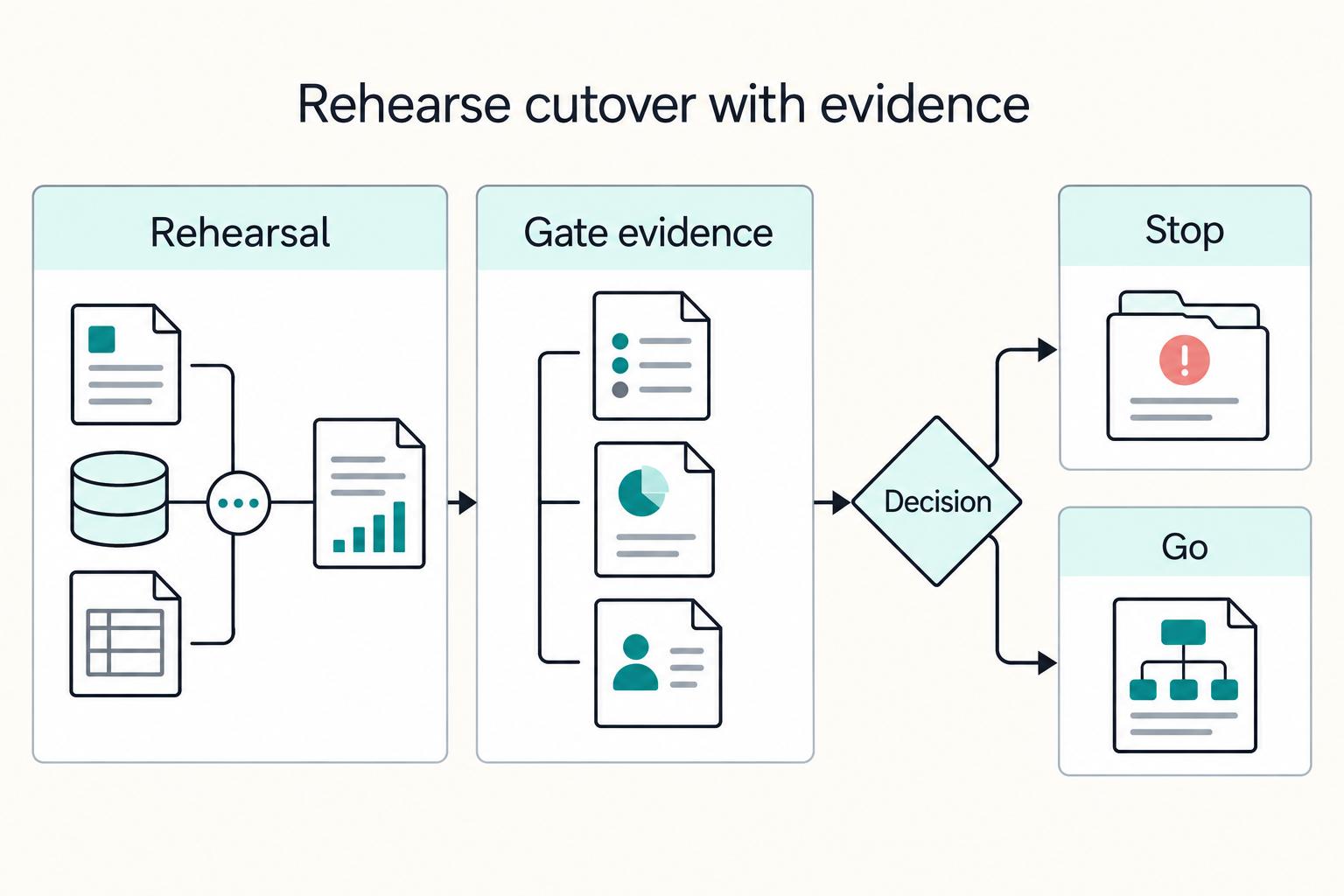
A cutover rehearsal should prove that your team can make a stop or go decision from evidence, not confidence. Treat it as an execution test where finance and IT validate data integrity, dependency readiness, and decision ownership. That is how you surface migration problems before go-live, while there is still time to act.
Run the rehearsal with realistic sequencing, handoffs, interfaces, and reporting outputs instead of validating results in isolation. The key check is whether results can be explained end to end, not just whether jobs complete.
Use a concise evidence pack for the run: what entered, what changed, what moved across dependencies, and what finance reviewed in reports. If outputs shift because of messy master data, unstructured invoices, or inconsistent naming, treat that as a cutover risk and fix it before go-live.
Write stop or go gates before the rehearsal starts so the decision does not depend on verbal confidence. The rehearsal should show that agreed checks pass, key dependencies hold, and open issues are understood before go-live.
Document the gate list, required evidence, escalation path, and next action if a gate fails. Include dependency identification directly in the gate sheet so the team can isolate breaks quickly instead of debating symptoms.
Set a clear decision point for the rehearsal and confirm decision ownership before that point. The goal is to prove that the team can make a clean call with the evidence available at decision time.
Watch for ownership drift. Migration is often IT-led, but finance owns the data. If that line is unclear during rehearsal, treat it as a launch risk and fix it before cutover.
Track each defect against a likely source such as data, mapping, configuration, interface dependency, or cutover execution. That simple view helps the team separate data integrity issues from dependency and execution issues.
This structure gives teams a practical recovery path: fix the source of the break and recheck reporting outputs. The point is to turn launch-week decisions into repeatable, pre-agreed actions.
Need the full breakdown? Read Treasury Management for Platform Finance Teams: Cash Pooling Forecasting and Investment.
Go-live is not the finish line. Success here means finance is actually using SAP S/4HANA as the primary system, not slipping back to spreadsheets or side processes when pressure rises.
Set a named stabilization window with regular triage for reconciliation breaks, failed postings, and other issues that affect finance visibility. The goal is to separate technical defects from adoption gaps, not just close tickets.
Use a short evidence pack in each triage: what failed, what was reprocessed, and what finance had to do manually to finish the day. Integrations can look green while teams are still working around the new process.
Keep ECC available in a limited read-only mode during stabilization while finance builds trust in SAP S/4HANA outputs for close work and audit evidence. Treat this as a risk-control decision, not a race to shut legacy down.
One useful checkpoint is whether finance can complete close and answer audit-style questions from S/4HANA outputs alone. If teams are still rebuilding core tasks in Excel three months later, that is an adoption gap, not a completed migration.
If the same incident pattern keeps returning, convert it into a standing control instead of handling it as launch-week noise. This aligns with a post-migration optimization approach and reduces repeat manual recovery.
Define legacy-retirement criteria that match your risk profile and require written confirmation that:
If any one of these is weak, retire later. That is usually safer than finding out after shutdown that key evidence still depended on legacy workflows. Related reading: Upskilling Platform Finance Teams for Payments Compliance and Automation.
Late failures usually follow one pattern: the migration looks technically complete, but finance still cannot trust the outputs. A practical recovery step is to tighten evidence and decision gates now. Fixing migration errors after implementation is typically far more expensive than investing in governance and testing before go-live.
| Mistake | Recovery |
|---|---|
| Treating technical completion as business success | Hold progression until finance-use evidence is clear, including whether teams can run core accounting work in S/4HANA |
| Treating data migration as an afterthought | Move data governance and testing earlier in the plan, and treat them as core delivery work, not cleanup |
| Assuming late fixes will be manageable | Use explicit go/no-go checks tied to finance outcomes, not schedule confidence alone, and resolve data-quality issues before cutover pressure peaks |
| Carrying forward legacy assumptions without revalidation | Revalidate migration decisions against current implementation evidence and SAP migration artifacts, including the Simplification List for SAP S/4HANA 2023 initial shipment, before finalizing cutover commitments |
Mistake 1. Treating technical completion as business success. A completed load is not the same as a usable finance system. If finance still cannot close the books from SAP S/4HANA outputs, the migration is not done.
Recovery: hold progression until finance-use evidence is clear, including whether teams can run core accounting work in S/4HANA.
Mistake 2. Treating data migration as an afterthought. When migration discipline is deferred, risk surfaces late and expensively. The pattern is straightforward: prevention before go-live costs less than repairing errors after implementation.
Recovery: move data governance and testing earlier in the plan, and treat them as core delivery work, not cleanup.
Mistake 3. Assuming late fixes will be manageable. Late-stage fixes can overwhelm launch readiness, even after a program has already consumed significant time and budget. That can hide cutover risk until go-live.
Recovery: use explicit go/no-go checks tied to finance outcomes, not schedule confidence alone, and resolve data-quality issues before cutover pressure peaks.
Mistake 4. Carrying forward legacy assumptions without revalidation. Teams can miss S/4HANA-specific changes when legacy behavior is kept by default without rechecking current requirements.
Recovery: revalidate migration decisions against current implementation evidence and SAP migration artifacts, including the Simplification List for SAP S/4HANA 2023 initial shipment, before finalizing cutover commitments.
Ship only when architecture choice, ETL validation, and reconciliation controls line up for both finance and engineering. If either side is still relying on workarounds, treat that as not ready.
Use this as a live gate review. Keep items unchecked until you have named evidence, an owner, and a recorded decision. Unchecked items are not failure. Marking an item complete without evidence is.
Copy and use this checklist in your gate review.
Evidence: status unknown in this grounding pack; verify in program records.
Evidence: status unknown in this grounding pack for this SAP program; verify in program records.
For FBAR (FinCEN Report 114), filing requirement is identified when a foreign account maximum value, or aggregate maximum value, exceeds $10,000.
For FBAR, maximum account values are recorded in U.S. dollars and rounded up to the next whole dollar (for example, $15,265.25 -> $15,266).
For FBAR, if a Treasury exchange rate is unavailable, another verifiable exchange rate is used and its source is recorded.
For FBAR, filing uses the BSA E-Filing System and institutional filers have registered credentials.
For FBAR XML submission, required elements are present (missing required elements can cause rejection).
For FBAR, filing dates are tracked against April 15 with the automatic extension to October 15 documented.
For filers with fewer than 25 accounts who cannot determine aggregate maximum values, item 15a handling is reviewed as a checkpoint.
Cutover rehearsal passed with explicit stop/go gates and rollback path tested.
Evidence: status unknown in this grounding pack; verify in program records.
When your cutover checklist is final and you need to confirm market or program coverage, talk to Gruv.
Start with defined goals, budget, timeline, scope, and performance measurements. Add a market diagram for ECC and connected systems, an interface catalogue with owner, business criticality, technology, and frequency, plus explicit data-accuracy checks.
Keep ownership explicit because migration execution is often IT-led while finance owns data accountability. Confirm IT and finance alignment at major approval points before advancing, even if you do not use a fixed RACI model.
Validate that migrated data is accurate and usable in the reports and extracts finance will rely on after go-live. The article does not define ACDOCA-specific pass or fail thresholds, so use explicit review evidence and reconciliation outputs.
Choose Greenfield, Brownfield, or Hybrid from documented tradeoffs, not habit. Compare cleanup burden, reporting dependencies, interface complexity, architecture choices, timeline, cost, scalability, and any unvalidated legacy reporting assumptions.
Late failures usually come from scope creep, broken integrations in testing, messy data, and cutover planning done too late. When that happens, stop adding scope and resolve data and integration issues first.
Public checklists cannot reflect your exact system market, interface criticality, report dependencies, or internal ownership gaps. If you use SAP's SEA ERP migration page, verify critical wording against the original because its machine translation may not be correct or complete.
A former product manager at a major fintech company, Samuel has deep expertise in the global payments landscape. He analyzes financial tools and strategies to help freelancers maximize their earnings and minimize fees.
Includes 2 external sources outside the trusted-domain allowlist.
Educational content only. Not legal, tax, or financial advice.

The real problem is a two-system conflict. U.S. tax treatment can punish the wrong fund choice, while local product-access constraints can block the funds you want to buy in the first place. For **us expat ucits etfs**, the practical question is not "Which product is best?" It is "What can I access, report, and keep doing every year without guessing?" Use this four-part filter before any trade:

Stop collecting more PDFs. The lower-risk move is to lock your route, keep one control sheet, validate each evidence lane in order, and finish with a strict consistency check. If you cannot explain your file on one page, the pack is still too loose.

If you treat payout speed like a front-end widget, you can overpromise. The real job is narrower and more useful: set realistic timing expectations, then turn them into product rules, contractor messaging, and internal controls that support, finance, and engineering can actually use.


