
Quick Answer
PropTech contractor payments scale best when you define payee scope, map the money path, and verify approvals, funding, and settlement before adding markets or faster rails. Expansion usually breaks payouts when teams add payee types, countries, or rails without clear release ownership and end-to-end traceability. Start with a narrow launch, test rails with evidence, and keep new markets on hold until compliance, onboarding, and exception handling are documented.
Why PropTech contractor payments break during expansion#
Contractor payouts in PropTech often break during expansion when teams push speed ahead of control. In a sector often described as conservative, weak control points show up quickly once you add markets, payee types, and payout rails.
PropTech spans buying, selling, renting, managing, designing, and construction. Here, the payments problem is narrower: paying service providers inside property workflows while keeping approval, funding, and settlement records clear enough to scale.
This is not a vendor pitch. The real decision is not which provider promises the fastest payout, but whether your operating model can absorb another market, another payee type, and another rail without losing traceability.
Speed only helps when control points are stable#
Faster payouts only help when the control points are already stable. Before you scale, you should be able to answer the same questions for every payment from start to finish:
- Who funded it
- Who approved release
- Which entity is paying
- Where final settlement status is recorded
If those basics are inconsistent, the problem usually shows up before rail choice becomes the main issue.
Why expansion makes the cracks visible#
Expansion increases pressure; it does not reduce it. As you add markets, payee types, and rails, approvals multiply, exception paths widen, and weak controls get exposed faster.
That is not a payments metric, but it is still an operating signal. When scrutiny rises, execution detail matters more. In a conservative industry, adding markets can bring more approvals, more exceptions, and more local variation. Weak controls become visible sooner.
The checkpoints that actually matter#
Use this article as a decision path for market order, rail choice, payee mix, and rollout controls, not as a provider pitch. The practical checkpoint is simple: confirm ownership and traceability before you add complexity.
If your team cannot trace payment state clearly and assign end-to-end ownership for exceptions, expansion risk rises with volume, market count, and recipient diversity. The rest of this guide focuses on how to sequence those choices.
Define the payment scope before you compare providers#
Define scope before you take demos. Use PropTech contractor payments as a working scope for outbound disbursements to service providers in property workflows, not every money movement on your platform. If your draft still treats all "contractors" as one segment, split them into payee archetypes before you compare products or pricing.
Start with the role split already common in platform terms: property-manager customers on one side and service-provider trades on the other. That forces clearer answers on who gets paid, how often, and through which approval path. Use early payee buckets that reflect your real workflow, for example:
- service-provider trades
- property-manager customers, where relevant to your payout flow
- any other payout role explicitly defined in your platform terms
Keep outbound payout flows separate from other money movements on your platform. If those flows are merged into one KPI, operational metrics get harder to read.
Before you select a provider, create a one-page scope sheet for each archetype with the release trigger, approver, expected frequency, and flow type, whether outbound-only or mixed. Then evaluate total cost of ownership against projected usage, especially for pay-per-request pricing.
As a practical checkpoint, test expected volume against the pricing tiers, batch limits, concurrency caps, and support model that would apply to your forecast so you do not choose on sticker price and absorb overruns later.
Map the real money path from funding to final payout#
Your payout flow can only move as fast as its slowest release gate. Before you compare rails, map the full path from funding source to recipient settlement and mark every approval, condition, and status that can block release.
Start with the origin, not the payout method#
Begin with the funding source. That is your first hard constraint. Then map, for each payee type, the sequence from incoming funds to approval, payout initiation, recipient settlement, and reconciliation.
If your workflow uses staged approvals, hold conditions, or similar controls, show those as explicit blocked states. That keeps your team from treating every delay as a late payout when the real issue sits upstream in release logic.
Mark the breaks in timing and control#
Document exactly where timing breaks happen: waiting for funds, waiting for approval, waiting for a condition to clear, or waiting for settlement. If the break point is unclear, rail decisions and delay explanations will be unclear too.
Traditional rails still have different timing and operational characteristics. In the United States, Same Day ACH can settle within the same business day and currently supports payments up to $1 million per payment, while the FedNow Service is built for near real-time interbank clearing and settlement at any time of day. Those options can shorten time to funds after approval, but they do not unblock money held earlier in the path.
Trust is part of the tradeoff. Slower processes are still widely trusted in high-stakes property transactions, especially where large sums or multiple parties are involved, so speed alone should not drive the design.
Treat special release models as separate paths#
When a region, customer segment, or contract model uses different approval or control steps, map it as a separate path instead of forcing it into a standard flow. Keep a short evidence pack for each path: approval record, any relevant sign-off, job or invoice reference, hold status, selected rail, and send timestamp.
If your team cannot explain a delayed payout quickly from that pack, the map is too abstract. That usually means you are optimizing payout speed while the real bottleneck sits upstream in approvals or controls. For a step-by-step walkthrough, see Virtual Credit Cards for Platforms: How to Issue Single-Use Cards for Contractor and Vendor Payments.
Compare rails by payout speed, reversibility, and reconciliation load#
Treat rail choice as an operations decision, not a speed claim. Build a matrix from provider-confirmed behavior and your own test evidence. The current material does not support benchmark comparisons for settlement time, reversibility, failure rates, or reconciliation effort by rail.
The practical filter is straightforward: if you cannot verify eligibility rules, status states, exception handling, and reference data for a rail, do not treat it as production-ready for your workflow.
| Rail | What to verify before launch | Reversibility and exception visibility to confirm | Reconciliation load to test | Ops mode: Bulk Payout vs per-payment |
|---|---|---|---|---|
| Visa Direct / Push-to-card payments | Recipient eligibility, market coverage, and setup requirements for your payee mix | Full status lifecycle and how declines or returns are surfaced | Stable IDs across API, webhook, export, and ledger mapping | Treat mode selection as a test decision; no excerpt-backed evidence ranks bulk vs per-payment risk |
| ACH / EFT | Account and data requirements, plus market-specific eligibility constraints | Pending, reject, and return states and where they appear operationally | Ability to tie exceptions back to original payout records without manual work | Treat mode selection as a test decision; no excerpt-backed evidence ranks bulk vs per-payment risk |
| SEPA transfer API | Beneficiary coverage and required recipient or account data | Accepted, rejected, and returned states and transfer-reference continuity | Whether finance exports preserve your internal references end to end | Treat mode selection as a test decision; no excerpt-backed evidence ranks bulk vs per-payment risk |
| Account-to-Account (A2A) payments via Open Banking | Bank coverage depth and recipient availability in each target market | Meaning of "completed" in the provider status model and post-initiation failure handling | Provider IDs plus bank-side references, when available, for support traceability | Treat mode selection as a test decision; no excerpt-backed evidence ranks bulk vs per-payment risk |
| Known unknowns | Uptime, true coverage depth, and implementation effort | Incident handling quality and escalation path under failure | Export and webhook quality under failure events | Treat as pilot validation items, not sales-sheet assumptions |
Decision rule to use as a starting hypothesis#
Use prioritization as a test plan, not a benchmark truth. The current material does not support a claim that push rails or bank-directed rails are inherently better for urgency, control, or reconciliation outcomes.
Where Bulk Payout helps most#
Bulk Payout and per-payment controls are implementation options to validate in your environment. From the current material alone, you cannot claim one is safer or riskier than the other.
Red flags before committing#
Do not accept generic "completed/failed" reporting as enough. You should be able to trace each payout from request to provider reference to ledger outcome, including any rejection or return path.
Also verify that reference data survives across API responses, exports, and exception messages. If your workflow includes account-to-account options built on open banking, make sure internal payout IDs, bank-side references, and ledger mappings still line up after retries and returns. If key references drop out, reconciliation risk shows up after launch.
Before locking your rail matrix, sanity-check cost and settlement assumptions with your own validated data.
Pick launch markets with a compliance-first country filter#
Use a compliance-first filter before speed or demand. Do not rank markets by provider marketing alone. Rank them by whether you can document who handles funds, which onboarding or compliance steps apply, and how blocked payouts are resolved.
For 2026 rollout planning, launch only when the compliance path and operational burden are both clear. A fast rail is not a launch reason if you cannot show who may handle funds, what checks are triggered, and how exceptions will be managed in operations.
Define the written launch gate before you open a market#
For each candidate market, capture the flow in plain language: who pays, where funds sit before release, which entity contracts with the payee, which onboarding checks apply, and which team owns blocked payouts.
Treat written confirmation from counsel, providers, and ops owners as the checkpoint, not "we think this flow should work." Launch decisions should rest on decision-grade evidence, not a mix of demos, summaries, and assumptions.
If your operating model depends on custom exceptions, long hold periods, or ambiguous release authority, write those risks down before you spend build time on coverage expansion.
Keep legal fund-handling questions as hard gates#
If you cannot explain custody, safeguarding or segregation expectations, payout onboarding, tax handoff, or support escalation in writing, keep that market on hold. Unknowns are planning inputs, not launch approvals.
Go/hold table based on current proof#
| Market lane | Current evidence confidence | Go or hold now | Proof required before launch |
|---|---|---|---|
| Home market | High when the flow already runs in production with visible approvals and settlement states. | Go when controls are already proven. | Named owner for approvals; payout-state visibility; reconciliation export; failure playbook. |
| First cross-border market | Medium until counsel, provider coverage, and support ownership are all documented. | Conditional go | Written provider coverage confirmation; counsel review of fund flow; onboarding checklist; blocked-payout escalation. |
| Second cross-border market | Medium to low until the first cross-border lane is operationally boring. | Hold until the first lane is stable. | Exception rate trending down; repeatable support workflow; audit pack that survives retries and returns. |
| Long-tail markets | Low when coverage exists only in summaries, demos, or partial documentation. | Hold | Country-specific legal review; exact recipient-type coverage; payout-method confirmation; funding and reconciliation ownership. |
Decision rule: do not turn unknowns into launch assumptions. Add a market only when coverage, release ownership, and compliance interpretation are concrete enough that your team can explain the flow end to end.
Choose payout timing logic by use case, not by marketing term#
Choose payout timing based on the release event and your team's exception capacity, not the payout label.
| Timing mode | Best fit | Release rule to define up front | Common failure mode |
|---|---|---|---|
| Instant | Urgent maintenance with clear completion evidence | A documented job-close signal and confirmed recipient details | Paying before the right approval is in place, then handling reversals or disputes |
| Scheduled batch | Recurring contractor pools with approved amounts | A fixed approval window and a clear exception queue | Urgent exceptions getting trapped in cycle timing or pushed into manual workarounds |
| Release-on-condition | Work that depends on explicit release conditions | Explicit condition or conditions required before funds are releasable | Work marked complete operationally while release conditions are still incomplete |
Use fast payout only where completion proof is clean#
For urgent jobs, teams often compare card-based push payouts, Same Day ACH, and instant-bank options such as the FedNow Service. The practical question is not just the rail label. It is whether your completion signal is reliable enough to release funds without creating avoidable support overhead.
Reserve Bulk Payout for stable, approved pools#
Scheduled Bulk Payout can be a fit when contractor groups and approved amounts are predictable. You trade immediacy for cleaner operations and reconciliation, especially when finance and ops need one approval cycle and one exception process.
Keep prefunding separate from release authority#
Set a clear policy for workflows with retainage or inspection sign-off: prefunding does not automatically mean funds are releasable. Prefunding can solve liquidity timing, but release authority should remain explicit.
That separation also helps reduce financial middleman risk in collect-then-pay-later patterns. Where feasible, keep contractor funds flowing directly from payer to contractor instead of normalizing long-held balances under platform control.
Avoid payment designs that ask customers to pay separately, since added payment steps create friction and increase the risk that installers arrive unpaid. A single checkout that splits funds between recipients is one practical alternative.
If scope volatility is high, plan for more exception handling before release. If completion evidence is consistently clean, faster rails are easier to evaluate without rushing into avoidable operational complexity.
For platform evaluation criteria, see Choosing a Tail-End Spend Management Platform for Long-Tail Contractor Payments.
Design the compliance and fund-control layer upfront#
Design the control layer before payout UX so each transfer is defensible after the fact. Fast release logic only holds up when eligibility, approvals, and traceability are clear in the payout record.
Every payout record should let your team answer four questions quickly: who was paid, why they were eligible, what approval released funds, and how the transfer maps across provider and ledger records.
Minimum controls per transfer#
Use a small baseline of controls, apply it consistently, and store it with each transfer.
| Control | What to verify | What to store with the transfer | Common failure mode |
|---|---|---|---|
| Identity check | The recipient is the intended contractor or business payee | Identity result, timestamp, method used, payee profile version | Paying with stale or incomplete payee data |
| Policy gate | The payout matches your release rules | Linked work order, invoice or job ID, approval event, approver, amount basis | Ops marks work complete before payout release is actually approved |
| Compliance check (if required by your policy) | Required check steps were run and recorded | Check timestamp, result status, case ID if escalated | Assuming checks were covered without a usable record |
| Audit trail reference | The transfer is traceable end to end | Internal payout ID, provider reference, ledger posting ID, funding reference | Support cannot reconcile payout, funding, and approval |
Strong identity and payout controls should live in the operating flow, not in a side spreadsheet or inbox. If a release decision relies on manual memory, the control is too weak for scale.
A practical checkpoint is to sample recent payouts and test whether finance or audit can reconstruct the full transfer story from system records alone. If they still need inbox threads or chat history, tighten the audit trail.
Fund control is a product decision, not just a legal one#
Map the money-holding model before launch. Document what each account is for, who controls it, how inflows match outbound transfers, and what records prove allocation in your system.
Do not assume anything from labels alone. Confirm in writing how funds are received and moved in each target market, and whether your planned model depends on permissions you do not hold directly.
Lock in fee transparency early. When charges are disclosed late or poorly itemized, they can become brand-damaging surprises.
Local property rules can change the whole structure#
Assume market-specific legal requirements may change custody, segregation, and reporting expectations, and get legal review before rollout.
Also check the legal-source confidence of your evidence pack. Some legal-information pages are explicitly informational and may not provide legal notice, so verify key points against official legal editions before relying on them. If you cannot diagram the money path and link approvals to each payout state, the flow is not ready to scale across markets.
Build day-2 operations for retries, failures, and auditability#
Once approvals and fund controls are set, day-2 reliability becomes the next risk. Retries, missing events, and partial failures need to be handled so one payout intent still leads to one payout outcome.
Make retries safe before you optimize speed#
Use one idempotency key per intended payout, not per API attempt. Keep that key stable across client retries, worker restarts, and timeout recovery so repeated submissions resolve to the same record.
Treat webhooks and event streams as replay-tolerant inputs. Store raw events, map them to the internal payout ID, and apply a clear conflict-resolution rule before changing status. If event evidence is ambiguous, hold for review instead of guessing.
As integrations grow, the failure surface grows with them. More integrations mean more failure modes, and point-to-point designs can expand toward roughly N² connection paths as systems increase.
Name failures so ops can act on them#
A single "failed" bucket is not operationally useful. Classify failures by what broke, what to check, and what action is allowed next.
| Failure class | What it signals | Ops check | Next move |
|---|---|---|---|
| Duplicate-intent risk | Retry or replay may create a second payout record | Idempotency key history and existing payout record | Merge to the original intent; block new release |
| Timeout or rate-limit disruption | High-volume flow became unstable during API processing | Request logs, retry history, provider lookup, event log | Throttle, retry safely, and resume from last confirmed state |
| Event-state conflict | Events conflict, repeat, or arrive late enough to create status ambiguity | Raw event timeline and conflict-resolution outcome | Advance only when status evidence is clear; otherwise manual review |
| Partial batch processing | Bulk sync or backfill accepted only in part | Submitted vs accepted counts and per-item states | Requeue only unresolved items |
| Cross-system state mismatch | Product, provider, and ledger records disagree | Record IDs and timestamps across systems | Reconcile before any further release |
Make status and audit chain exportable#
Keep payout state visible from initiation through final outcome, with explicit "under review" handling when evidence conflicts. Escalate on observable gaps, such as status not moving with no confirming event, or mismatched accepted versus submitted counts in bulk runs.
The verification checkpoint stays the same: each payout should be traceable from API request to provider reference to ledger posting to export pack. Include actor, action, and time audit entries for manual changes, and centralize logs so incident response and audit prep do not depend on inbox threads.
For advance payout options without taking credit risk, see Contractor Advance Payments for Platforms Without Taking Credit Risk.
Reduce disputes with explicit release rules and evidence packs#
One way to reduce payout disputes is to make release conditions explicit and keep the supporting evidence in one place before funds move. Condition-based execution is useful here: release happens when the coded condition is met, not when someone assumes it is met.
Set one decisive release trigger per payment decision#
Use one primary release trigger for each payment decision, and record who satisfied it and when. Avoid mixing ad hoc approvals across chat, email, and call notes if you want a clean dispute trail.
Reflect contract states clearly in the payout record#
If your workflow includes staged approvals or held amounts, represent those states directly in the payout record instead of burying them in free text. Keep the record explicit about what is approved now, what is held, and what condition unlocks the next release.
Require a compact evidence pack for each release decision#
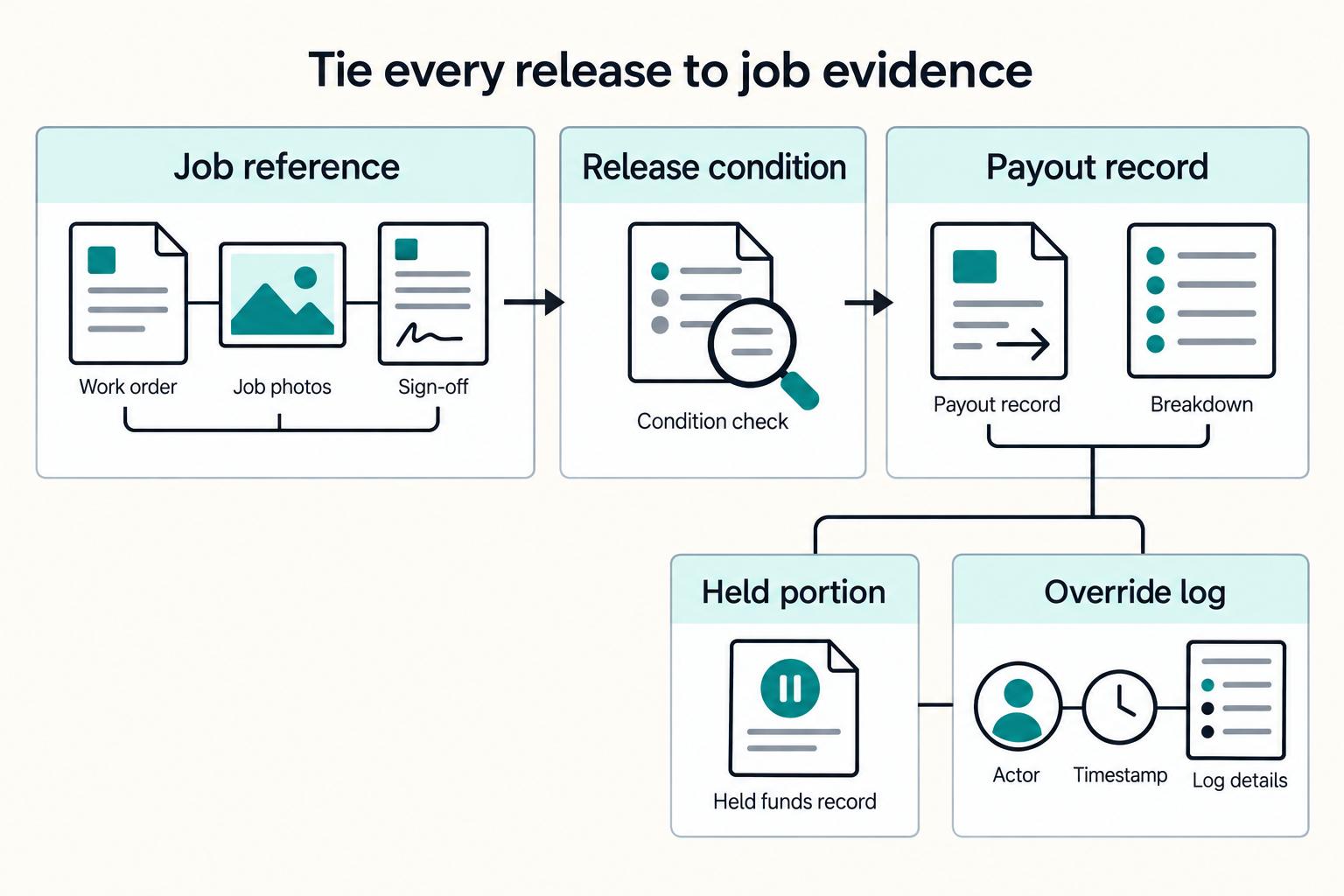
Use a short, consistent evidence pack for each release decision:
| Evidence pack item | Included detail |
|---|---|
| job or transaction reference | Include in each release decision evidence pack |
| the condition checked for release | Include in each release decision evidence pack |
| acceptance or sign-off record (if used) | Include in each release decision evidence pack |
| amount breakdown, including any held portion | Include in each release decision evidence pack |
| actor and timestamp log for overrides | Include in each release decision evidence pack |
Attach this pack to the payout record itself. A single, current record shortens dispute handling, audit prep, and provider escalations because every approval, hold, and override sits in one place.
Set classification and reporting boundaries before cross-border scale#
Set the boundary early: payout operations and tax reporting are connected, but they are not the same function.
Flag cross-border edge cases early#
Route cases for tax or compliance review as soon as you know the payer entity, payee jurisdiction, payee type, and payment reason. Do not treat all contractors as one reporting class when entity type, country, or payment purpose changes the follow-up work.
If you need a separate Form 1042-S walkthrough, use this companion read: IRS Form 1042-S for Platform Operators: How to Report and Withhold on Foreign Contractor Payments.
Use one operational checkpoint: each cross-border payout should map to one payer entity, one payee record, and one evidence pack. If that mapping is missing, do not assume tax can rebuild it reliably from ledger exports and chat history.
Keep data collection proportional#
Do not treat every international payout as a reason to collect every possible tax form or extra PII. Collect only what your flow, jurisdiction mix, and provider setup actually require, and record why each field is needed.
| Decision input | Why it matters | Who should own it |
|---|---|---|
| Payer entity | Changes which legal party sends funds and which reporting path applies. | Finance and compliance |
| Payee country and entity type | Affects onboarding, tax review, and provider coverage checks. | Ops and compliance |
| Payment purpose | Distinguishes contractor payout from rent, refund, or other money movement. | Product and finance |
| Evidence pack status | Shows whether release approval, amount basis, and audit trail are complete. | Payments ops |
Confirm classification before collection. The right question is who needs the data, for what filing or control step, and at which point in the flow.
Treat tax forms and regulatory filings as downstream decisions that depend on clean payout records, not as substitutes for payout ops discipline.
Run a 90-day rollout plan with hard checkpoints#
Treat the 90-day plan as an internal operating plan, and move forward only when each checkpoint has evidence.
| Phase | Main focus | Exit check |
|---|---|---|
| Days 1 to 30 | Define payee scope, money path, and first rail tests. | Scope sheet approved; release states mapped; launch-gate owners named. |
| Days 31 to 60 | Run a constrained cohort and classify every exception. | Retry, return, and manual-review paths are documented and traceable. |
| Days 61 to 90 | Expand only where reconciliation and support handling stay stable. | Audit pack exports cleanly; failure classes are usable; blocked payouts have owners. |
Days 1 to 30#
Decide your first payee types, market, and rail tests, then lock the scope sheet and money-path map before you onboard volume.
Before onboarding your first cohort, make sure your team can correctly route these cases:
- missing or stale payee onboarding data
- approval held or completion evidence incomplete
- payout rejected, returned, or left in an ambiguous status
Days 31 to 60#
Run a constrained cohort and log whether exceptions come from rail behavior, payee readiness, or internal release logic.
For support handling, require clear playbooks for recipient corrections, retries, returns, and manual approval escalation.
Days 61 to 90#
Expand payee types or markets only where exception handling is stable. Do not widen scope if reconciliation still depends on ad hoc investigation.
Use hard exit checks before full rollout:
- exceptions are understandable case by case
- each payout is traceable from request to final status
- audit packs and ledger exports stay usable without inbox archaeology
Related reading: Same-Day ACH for Platforms: How to Speed Up Contractor Payments Without Wire Transfer Fees.
Make the first expansion decision on controllability, not speed#
Make the first expansion decision based on what your team can explain and operate, not on the fastest-looking payout path. For contractor payouts in property workflows, a narrower launch with explicit release rules and visible failure handling can be safer than broad coverage that leaves operations guessing.
PropTech can absolutely improve payment speed and visibility, but vendor claims are not a substitute for your own controls. Use 2026 launch planning to narrow scope until your team can prove approvals, settlement states, and exception ownership with real records.
Pick the market and payout setup you can explain end to end#
When you compare bank transfer, card-based, or bulk payout setups, start with traceability, not speed. For any live payout, your team should be able to answer:
- where the money sat before release
- who approved release
- which document or event triggered release
- what status confirms settlement or failure
- who owns the next action if it stalls
If those answers are not clear in one country, do not add a second. Speed only helps when the path stays legible from request to settlement.
Narrow scope is a control, not a lack of ambition#
A conservative first move can be one country, one or two payee types, and explicit release logic. For example, you can launch scheduled payouts for one payee group first and keep another on manual review until completion evidence is stable. That gives you a measurable base: intervention rate, unclear release conditions, and whether ops can reconstruct exceptions.
The avoidable failure mode is committing product and GTM resources before coverage and compliance details are settled. This often shows up as theoretical coverage with edge-case gaps, or country plans built on general research that is not decision-grade.
Treat unclear compliance signals as a stop sign#
If compliance expectations are unclear, pause expansion until they are clarified. Use a short evidence pack before greenlighting a market:
| Proof item | What to confirm | Why it matters |
|---|---|---|
| Provider coverage confirmation | Written confirmation of the exact country, recipient type, and payout method in scope | Avoids roadmap decisions based on partial or outdated availability |
| Legal verification | Counsel review of fund flow and release model, with open questions listed clearly | Prevents hidden compliance debt in product assumptions |
| Release logic record | One-page map of trigger events, approvers, and exception handling | Gives ops a shared reference when payouts are delayed or disputed |
| Source check | Official legal text or official PDF where relevant, not only summaries or web renderings | Reduces reliance on unofficial or incomplete materials |
That source check matters. Prefer official legal text, official provider documentation, and tested workflow evidence over summaries or sales copy before treating a point as settled.
If coverage, release ownership, or compliance interpretation is still fuzzy, pause. A delayed launch is usually cheaper than one your team cannot explain, audit, or defend.
For controls around off-contract contractor payments, see Maverick Spend in Platforms: How to Stop Off-Contract Contractor Payments Before They Drain Margin.
If you're moving from planning to implementation, review Gruv's payouts to map compliance gates, status tracking, and reconciliation into your rollout.
Frequently Asked Questions
What are PropTech contractor payments, and who counts as a contractor in this context?
PropTech contractor payments means outbound disbursements to service providers inside property workflows, not every money movement on the platform. The material does not give a formal market-wide definition for tradespeople, inspectors, and property managers. Define each payee group explicitly in your policy, contracts, and reporting, and avoid one generic contractor bucket when release conditions differ.
Which payout rails should we compare first for tradespeople, inspectors, and property managers?
The material does not support a fixed rail order by payee type. Start by confirming where funds sit, who controls release, and how each payout is traced from request to settlement. Then compare rails only after you verify eligibility rules, status states, exception handling, and reference data.
Is instant payout always better than scheduled batch payouts?
No. Do not assume faster is always better. Use instant payout only where completion proof and recipient details are reliable, and use scheduled or slower flows when traceability, approvals, or exception handling are still unstable.
What compliance controls are mandatory before we pay contractors in a new country?
The article does not establish a country-by-country mandatory control set, so a generic checklist is not complete legal guidance. It does support a minimum discipline: identity checks, release-rule verification, any policy-required compliance check, and an audit trail that links the internal payout ID, provider reference, ledger posting ID, and funding reference. Before a new-country launch, keep legal fund-handling questions as hard gates.
How should we prioritize which countries to launch first?
Prioritize markets where you can prove coverage, fund-flow ownership, onboarding requirements, and exception handling in writing. Launch where your team can explain approvals, funding, settlement, and blocked states end to end, and keep unclear markets on hold.
How do we reduce failed payouts and contractor disputes at scale?
Reduce failures and disputes by making release rules explicit and attaching a compact evidence pack to each payout record before funds move. Use one stable idempotency key per intended payout, keep webhook and event handling replay-tolerant, and classify failures so ops knows what action is allowed next. Keep staged approvals, held amounts, overrides, and final status visible in an exportable audit trail.
Which metrics best show whether our contractor payment model is working?
The material does not provide universal payout KPI thresholds, so avoid fixed benchmark claims. Track intervention rate, reject or return rate, ambiguous-status rate, time to resolution, and whether finance can reconcile payouts end to end without inbox threads or chat history.
Researched and edited by the Gruv editorial team. Gruv builds cross-border billing, payouts, and finance-operations software for global businesses.
Sources
Includes 3 external sources outside the trusted-domain allowlist.
Educational content only. Not legal, tax, or financial advice.
Related Posts

The Freelance Payment Penalty: A Modeled Audit of Platform Fees, FX Spreads, and Payout Delays
The money rarely disappears through a single, easy-to-spot fee. The real loss is stacked. A marketplace takes its commission, a processor adds a charge for international cards, a bank or payment company converts the currency at a spread, a platform holds the funds before release, and a wire sheds a little to intermediaries on the way in. Each layer looks defensible on its own, but the worker feels the combined result as a smaller deposit and a later payday.

How to Respond to a Subpoena for Business Records
Move fast, but do not produce records on instinct. If you need to **respond to a subpoena for business records**, your immediate job is to control deadlines, preserve records, and make any later production defensible.
A US Expat's Guide to Investing in UCITS ETFs to Avoid PFIC Issues
The real problem is a two-system conflict. U.S. tax treatment can punish the wrong fund choice, while local product-access constraints can block the funds you want to buy in the first place. For **us expat ucits etfs**, the practical question is not "Which product is best?" It is "What can I access, report, and keep doing every year without guessing?" Use this four-part filter before any trade: