
Quick Answer
A marketplace operator's monthly revenue review should combine the core financial statements with an operating layer that ties revenue, cash, settlements, payouts, and exceptions back to source evidence. The pack should lock metric definitions, separate actuals from assumptions, run reconciliation and settlement checkpoints in a fixed order, and end each section with a variance reason, owner, due date, and documented action.
What This Revenue Review Template Covers#
If your monthly review cannot explain why cash, revenue, settlements, and payouts moved together or drifted apart, it is not doing enough. We built this platform-operator template for finance, payments ops, and product teams that need tighter reconciliation, clearer settlement visibility, and payout reliability in the core review.
The standard financial outputs still matter: the Income Statement, Balance Sheet, and Cash Flow Statement. For marketplace operations, this template adds an operating layer so those statements can be reviewed alongside the controls and exception views that actually affect them.
The goal is a repeatable review that ties reporting to operating evidence. Start from source-backed numbers, test them against settlement and payout activity, and end with dated decisions and clear owners.
What good looks like#
A good monthly review should produce three visible outputs in the review itself:
- A decision log showing what changed, why it matters, and what action follows.
- Clear owners for open issues across Finance and Payments Ops.
- A traceable path from source records to final reported numbers.
Financial projections are assumption-sensitive because they rely on historical data, market trends, and future assumptions. That is why the monthly pack should not only present results. It should preserve the artifacts behind them.
Why this template is artifact-first#
This article uses an artifact-backed approach on purpose. The Treasury Guide to the Financial Management Marketplace (November 2025) presents reporting in terms of standards, common capabilities, and concrete artifacts, including pre-built business reports. Its update history also shows that retired references are removed from scope, which is a practical warning against stale logic and outdated mappings.
Use one working rule throughout the review: if a headline figure cannot be tied to a source artifact, extraction point, and reporting logic, treat it as provisional until that trail is clear. If you cannot show that trail, you should pause the narrative and fix the evidence first.
Who this is for#
Use this if you own platform finance, payments operations, or product surfaces that affect reconciliation, settlement handling, and exception queues at scale. The sections that follow are built to help you verify reported numbers against source artifacts, catch failure modes early, and assign actions across Finance, Payments Ops, and Product.
Set scope and ownership before month-end starts#
Set scope and named ownership before close starts. If a section is shared but unnamed, flag it as at risk until one owner is assigned.
Start with the artifacts in your monthly review pack. For each section, document one primary owner, one reviewer, and the system of record.
Use an artifact-first ownership map. In this excerpt, anchor scope to what is actually visible: period tokens (2024-01-01 to 2024-12-31), unit tokens (iso4217:USD and xbrli:shares), marketplace revenue members (including Reverb and Depop), and fee-related minimum/maximum member tags. Ownership rules, approval routing, and ledger sign-off requirements are not readable from this tag stream alone and should be treated as unknown here.
Before variance review, verify period coverage and units in the evidence pack so reviewers are comparing like-for-like data. If ownership or approval logic is ambiguous, mark the section at risk and resolve it in internal policy before the pack moves forward.
Define your revenue logic before you open a spreadsheet#
Lock your revenue logic before analysis starts. If you define GMV, revenue, orders, returns, and Take Rate differently across teams, the review can look clean and still send you toward the wrong decision.
Set one definition sheet and freeze it for the month#
Use a single definition sheet inside the Monthly Revenue Report or Monthly Financial Review Template. Keep it decision-oriented, not dashboard-oriented, and use a consistent Raw Data Input Sheet style for monthly inputs such as revenue, orders, returns, and cancellations.
| Definition item | What to document |
|---|---|
| Business purpose | Activity, finance, or diagnostic |
| Source and owner | System of record, extraction timestamp, and accountable owner |
| Inclusions and exclusions | What is counted and what is not |
| Sign treatment | How returns, cancellations, refunds, and disputes are represented |
| Change log | What changed from last month, why, and who approved it |
Definition drift can hide warning signs until late in the review cycle.
Keep operating volume separate from finance outputs#
Keep operating context separate from finance outputs unless your definition sheet explicitly says otherwise. GMV, order count, returns, and cancellations are useful context, but keep them clearly labeled so readers can see whether each line is platform activity, a finance output, or both.
Use one checkpoint for each headline metric. Ask, Is this platform activity or a finance output? If the answer is both, split it into clearly labeled lines. If your team uses Take Rate, define the numerator and denominator in plain language and state which internal line it is meant to explain.
Write reversal rules before you discuss margin#
Document reversal treatment before you discuss Gross Margin or Net Margin. Refunds, disputes, failed settlements, returns, cancellations, and related leakage should be handled in one agreed note that states where each item is recorded in your internal bridge and who approves exceptions.
Then test actual reversal-path transactions against that logic. If the transactions do not land where the definition sheet says they should, fix the logic before you make performance claims. Clear definitions, consistent inputs, and a short change log keep the review decision-useful.
Build the monthly data pack with inputs, owners, and evidence#
Once your metric definitions are fixed, treat the monthly pack as a controlled record. We recommend one platform record for the month: if Finance and Ops review different source versions, decisions can drift before anyone even discusses revenue, cash, or margin.
A strong pack makes the evidence chain obvious: what fed the number, when it was extracted, who owns it, and whether it is closed-month actuals or assumptions.
Name the source set before review starts#
Create a monthly source register before analysis begins. Keep it tied to the input classes your process actually uses, and name those classes before review starts so the review does not turn into ad hoc tabs.
| Input class (example) | Useful metadata (example) | Why it helps |
|---|---|---|
Business Report extract | version, section updated, summary note | keeps monthly inputs aligned to a documented update trail |
Business Information Exchange (BiE) extract | interface name, pull date, mapping note | makes data movement assumptions visible during review |
| Additional FM solution or legacy-system feed | system name, integration note | records where non-FMCF legacy integration may affect interpretation |
Projection view (Income Statement, Balance Sheet, Cash Flow) | as-of date, key assumptions, scenario label | keeps estimates distinct from closed-month actuals |
If multiple upstream tools are involved, log revisions when files are re-pulled or mappings change.
Keep a formal update log for the pack#
Use a simple version log for pack changes. A practical structure is version, section updated, and summary of update. That keeps the pack from turning into a moving target during close.
Before variance review, confirm the register is internally consistent. If same-month inputs came from different extraction dates or different systems, reconcile that difference explicitly before continuing.
Make the evidence trail visible#
For key headline figures, material adjustments, or manual bridges, keep the source extract, any transformation or mapping note, and the final destination line in the report together. The point is reproducibility without guesswork. Operational logs can explain timing, but they should not replace accounting records.
Separate actuals from assumptions#
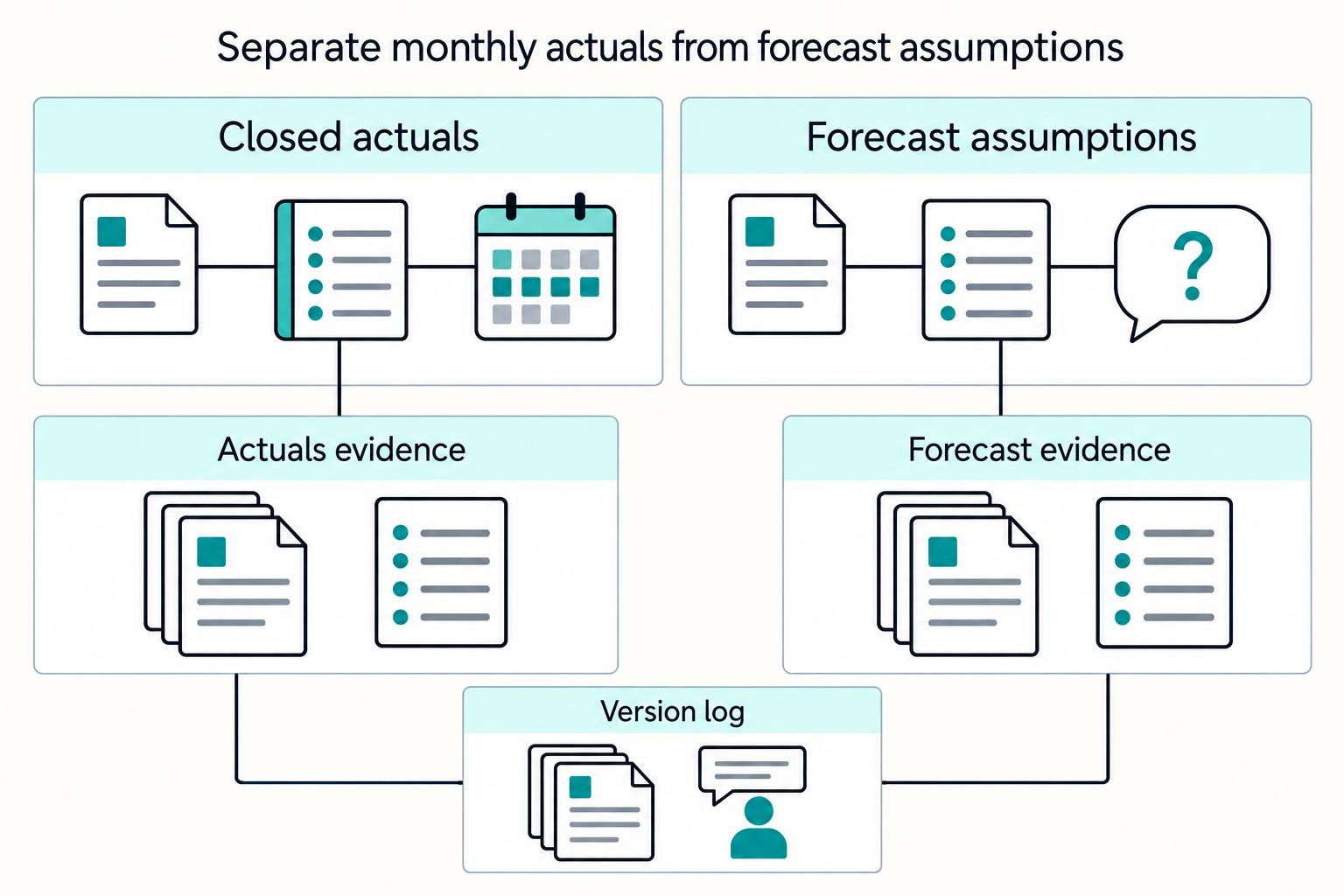
Do not let actuals and assumptions share the same evidence trail. Closed-month actuals should stay separate from projections, which are assumption-driven estimates and may include forecast views of the income statement, balance sheet, and cash flows.
If one line mixes both, split it with clear labels. Use one rule throughout the pack: if a number will drive a decision, keep its assumption/actual label and revision trail visible.
Build the template sections that turn reporting into execution#
A useful monthly review does more than display totals. Each section should show what changed, why it changed, who owns the response, and when it is due. If you cannot name the owner or next action, you should not treat the section as complete.
Keep the review concise and plain. The goal is not a prettier deck. It is a set of actions you can verify next month.
Keep the financial core, and make every block end with action#
Use a consistent inputs -> steps -> outputs structure across your core sections, and use the same completion test everywhere.
| Section | Inputs and steps to define | Output required before sign-off |
|---|---|---|
Income Statement | Ledger export, revenue mappings, close-period adjustments, and grouping method for report lines | MoM and YoY variance reason, owner, and due date for unexplained movement |
Balance Sheet | Ledger balance extract, supporting schedules, and open-item review for key accounts | tie-out status, unresolved account list, owner, and due date per break |
Cash Flow Statement | accounting cash activity and settlement-related timing support | cash movement explanation, timing-item list, and mismatch follow-up owner |
Variance Analysis | prior-month and prior-year comparatives with delta method note | variance reason field, evidence reference, and action |
Working Capital | A/R Aging Report, Accounts Payable snapshot, and settlement timing support | aging or timing issue list, recovery action, owner, and due date |
For every section, require all three parts before sign-off: source extract, mapping or calculation note, and action output.
Add the marketplace blocks most reviews skip#
Some monthly packs stop too early. Add a second layer that explains activity, recognized revenue, and money movement together, such as a GMV bridge to recognized revenue, Take Rate movement, payout success rate, settlement lag, and exception aging.
For the GMV bridge, do not force a universal formula. Require a traceable bridge from activity to recognized revenue lines, with major adjustments shown where they occur.
Keep classification labels stable. The SEC excerpted labels MarketplaceRevenueMember, EtsyPaymentsProcessingFeesMember, and OffsiteAdvertisingMember are a useful reminder that distinct classes should not be blended into one bucket. Your internal template does not need XBRL tags, but it does need consistent line labeling so take-rate commentary remains comparable month to month. For each ops-facing block, apply the same rule: metric, method, action.
Make variance explanation mandatory#
Make variance explanation a required field, not a nice-to-have. Every material MoM and YoY delta should carry a reason. This is an operating control for review quality, not a regulatory claim.
Keep each explanation short but specific. Require:
- variance reason
- evidence reference or input file name
- classification of change such as
timing,mix,pricing,classification, orerror correction - owner
- due date
Gate completion hard#
Do not mark a section complete when the action is blank, the owner is missing, or the due date is TBD.
Use practical checks before you write narrative conclusions. If Take Rate moves while GMV is flat, review revenue mapping and fee routing before writing a growth explanation. If payout success weakens while the Cash Flow Statement looks stable, open a finance-and-ops follow-up and validate timing assumptions before finalizing the narrative. If a variance reason cannot be tied to the evidence pack, remove the narrative until it can.
That is what turns a monthly review template into an operating document: what changed, how the number was built, and what happens next.
If your review includes EU VAT on platform fees, see How to Handle VAT on Platform Fees Across the EU: A Marketplace Operator's Guide.
Run reconciliation and settlement checkpoints in a fixed order#
Sequence can matter for internal controls, but the SEC-style excerpts provided do not prescribe a required reconciliation workflow.
| Order | Checkpoint | What to confirm |
|---|---|---|
| 1 | Reconcile the Ledger first | Confirm the base record ties and document any breaks before interpreting downstream movements |
| 2 | Review settlement support | Use it as supporting context, not as a substitute for unresolved base-record issues |
| 3 | Check the Cash Flow Statement next | Confirm cash movement is consistent with the reconciled accounting base and documented evidence |
| 4 | Finish with Working Capital and balance-sheet tie-outs | Name the accounts and evidence used for each tie-out, including tagged items such as us-gaap:AccountsPayableCurrent or us-gaap:OtherCurrentAssetsMember when applicable |
If you use a fixed order internally, treat it as policy rather than filing-derived guidance. Instead, anchor each checkpoint to a traceable artifact, the correct reporting period, and a verifiable line item before you write performance narrative.
Meanwhile, keep evidence explicit in the monthly pack: the reporting-period boundary, the source extract, and the checked line items. When relevant, that may include period ranges such as 2024-01-01 to 2024-12-31. Tagged fragments like us-gaap:AccountsPayableCurrent388364iso4217:USDxbrli:shares are a reminder to verify units and scale in full context before drawing conclusions.
If you are tightening the settlement side of this process, Building a Payout Ledger with Double-Entry Bookkeeping for Platform Financial Records gives useful implementation context.
Track payout reliability as a monthly financial control#
Payout reliability belongs in the monthly financial review, not in a side queue. If you run a platform with recurring payout batches, align this checkpoint to the same period boundary used across close so payout activity can be reviewed alongside cash, liabilities, and exception aging.
Build one tight checkpoint into the pack. Report payout batch statuses for the period using consistent internal labels, and keep unresolved items visible at period end. Define attempted, completed, and recovery states in your own operating model so everyone reads the same signal.
Keep payout execution exceptions separate from revenue variance commentary. That separation matters because revenue reconciling items can include inter- and intra-segment eliminations and foreign-exchange impacts, which are distinct from payout execution outcomes. Keep the payout block beside cash and liability review, with named evidence and dates. Use date-specific checkpoints consistently across the review, including the same style used for dated disclosures such as March 31, 2024 and March 31, 2023 with stated amounts.
If you need the ledger design behind this review, see Building a Payout Ledger with Double-Entry Bookkeeping for Platform Financial Records.
Add compliance and tax checks that affect financial truth#
Add compliance and tax checks only where they change payout eligibility or reporting completeness. Used that way, they sharpen the monthly review. Used loosely, they add noise.
| FBAR item | Detail |
|---|---|
| Filing trigger | Single-account maximum or aggregate maximum exceeds $10,000 during the calendar year |
| Amounts | Record amounts in U.S. dollars, rounded up to the next whole dollar |
| Foreign currency | Use the Treasury year-end rate, or another verifiable rate with the source documented |
| Due date | April 15th |
| Automatic extension | October 15th |
| Correction method | Submit a new FBAR and check the amend indicator (Item 1) |
| E-filing risk | Missing required XML elements can cause e-filing rejection |
- Track open compliance holds as operational blockers.
If your internal model treats compliance cases as payout blockers, list them in the monthly pack as open exceptions with clear ownership and traceable IDs. Keep this operational: show what is open, what is affected, and what is still unresolved at period end. Keep the detailed KYC/KYB/AML rules in internal policy, not in the monthly review.
- Track tax-document readiness only where your workflow uses it.
If your process captures tax-document statuses such as Form W-8, Form W-9, or Form 1099, report readiness from system evidence such as status export, timestamp, and counts rather than assumptions. Use this as a completeness checkpoint, not a legal memo.
- For cross-border work, separate dependency labels from proven filing readiness.
Note jurisdictional dependencies when they change payout eligibility or reporting completeness, but keep the monthly template focused on operational readiness rather than country-by-country tax analysis.
For FBAR (FinCEN Form 114), one concrete control is available: when a filer's single-account maximum or aggregate maximum exceeds $10,000 during the calendar year, an FBAR must be filed. Keep the account list, ownership, and value method current during monthly review so annual filing is not reconstructed at the deadline.
For FBAR evidence quality, retain the FBAR Line Item Filing Instructions and the FinCEN XML User Guide in your control notes so reviewers can confirm field handling, rounding, and amendment mechanics.
- Record amounts in U.S. dollars, rounded up to the next whole dollar.
- For foreign currency, use the Treasury year-end rate, or another verifiable rate with the source documented.
- Annual due date is April 15th, with an automatic extension to October 15th.
- To correct a filing, submit a new FBAR and check the amend indicator (
Item 1). - Missing required XML elements can cause e-filing rejection.
- Keep review artifacts privacy-safe and audit-traceable.
Check your internal privacy controls so reviewers can verify blocked payouts and reporting-ready populations from approved artifacts and internal IDs, without relying on sensitive raw fields.
Related reading: How to Account for Platform Float in Your Financial Statements: GAAP Treatment. For a tax workflow example tied to fee treatment, see How to Handle VAT on Platform Fees Across the EU: A Marketplace Operator's Guide.
Use clear escalation rules for monthly decisions#
A good monthly review separates what you will monitor, what you will fix this month, and what you need to escalate now. If the template does not force that choice, it turns into commentary.
A simple three-class model can work, but the trigger criteria should come from your internal policy:
| Action class | Use it when | Owner | Deadline | Required evidence |
|---|---|---|---|---|
| Monitor | Internal policy indicates watch-only handling | Named function owner | Next monthly review | Current status note, source report version, watch metric |
| Remediate this month | Internal policy indicates corrective work before the next cycle | Team lead with executor named | This month-end action date | Fix step, test result, updated report extract |
| Escalate now | Internal policy indicates immediate leadership review | Functional leader | Immediate review slot | Impact summary, source artifact, decision request |
Make cross-functional patterns visible#
Cross-functional issues should be handled as one issue, not several disconnected comments. When multiple functions see deterioration in the same monthly cut, route that through a shared review path if your escalation policy calls for joint handling. Attach one evidence pack so teams work from the same period view.
Before escalation, confirm the report timestamp, reporting population, and period cut for each signal. Confirm escalation rules for specific marketplace metrics with the relevant authority.
Hold unexplained revenue movement in place until traced#
Do not let unexplained revenue movement slip into a review-ready narrative. If variance analysis shows a movement you cannot explain, treat it as unresolved and route it through your governance checkpoints.
Keep an exceptions register for each high-risk item with status, next step, closure criteria, owner, and the artifact that supports closure.
Related: HMRC Reporting Rules for Platforms: What UK Marketplace Operators Must Do. If the issue touches payment operations as well as revenue movement, it can also help to compare your process against the patterns in State of Platform Payments: Benchmark Report for B2B Marketplace Operators.
Run sanity checks before final sign-off#
Final sign-off should test evidence, not presentation. If key numbers or exceptions cannot be traced and dispositioned, treat the status as incomplete.
- Trace every headline figure to source records and keep lineage logs.
For each top-line number in the Platform Operator Revenue Report Template, keep a clear path to the underlying extract, supporting file, and review field. Store the month's files and lineage logs together in a secure workspace so reviewers can verify source, timestamp, and transformation steps quickly.
- Check related narratives side by side before publishing conclusions.
Review connected commentary together and resolve conflicts before sign-off. If explanations of performance, cash movement, and balance impacts conflict, mark the commentary for follow-up before finalizing conclusions.
- Anchor commentary in prepared transaction data.
Percentage movement is easier to interpret when paired with underlying evidence. Tie commentary back to the transaction-level ERP and sub-ledger extracts used in the analysis, and keep working evidence when changes involve mapping, formula updates, or manual adjustments.
- Define and enforce a completion gate for open risk items.
Use your internal policy to decide when unresolved issues keep work from "complete" status. For recurring control-related issues, cross-reference control libraries against prior audit findings and SOX deficiencies, and record owner plus evidence for each disposition.
Applied consistently, these checks turn the month-end pack into an auditable baseline rather than a meeting deck.
Conclusion#
A strong Monthly Financial Review Template is useful only if it drives decisions, not just presentation. If you cannot show the inputs behind the numbers, the checkpoint used, who owns each issue, and how corrections are handled, it is a reporting file, not a platform operating control.
The core standard is simple: treat the platform review as a decision system. Keep two things separate and explicit each month: what happened, and how each reported item is defined.
Run one full cycle now with minimum but consistent discipline:
- Define revenue logic before review starts.
Document treatment for revenue, orders, returns, and cancellations in one place, such as the Raw Data Input Sheet, so definitions do not shift during close.
- Assemble the data pack before analysis.
Keep raw inputs, calculations, and the final review artifact together so time goes to decisions, not version disputes.
- Use the same checkpoints every month.
If base records do not support a headline figure, resolve that break before adding commentary.
- Close with documented actions.
Every material variance or unresolved exception should end with an owner, next step, and correction status.
The common failure mode is usually not a dramatic error. It is seeing warning signs too late. That is why recurring checkpoints and action notes matter as much as calculated outputs. The MIS example stays practical with three essential sheets, including a Raw Data Input Sheet and a monthly analysis component that calculates KPIs. Keep your version lean, but make sure it still produces decisions.
For related workflow context, review Payouts.
Frequently Asked Questions
What should a marketplace operator include in a monthly revenue review?
Include the Income Statement, Balance Sheet, and Cash Flow Statement, then add an operating layer that explains revenue, cash, settlements, payouts, and exceptions together. The pack should also show a decision log, named owners, a definition sheet, source-backed evidence, and variance actions.
How is a platform operator revenue report different from a standard monthly financial report?
A platform operator revenue report adds controls and operating evidence that a standard monthly financial report often misses. It reviews the core statements alongside settlement visibility, payout reliability, exception aging, and a traceable path from source records to reported numbers.
Which checks catch reconciliation and settlement risk early?
Start by verifying period coverage, units, ownership, and extraction dates so reviewers are comparing like-for-like data. Then reconcile the Ledger first, review settlement support, check cash flow consistency, and finish with Working Capital and Balance Sheet tie-outs.
How do `GMV` and `Take Rate` fit into an `Income Statement`-led review?
GMV and Take Rate should be treated as operating context unless your definition sheet explicitly maps them into finance outputs. Use a traceable GMV bridge to recognized revenue, define the Take Rate numerator and denominator in plain language, and split lines if a metric mixes platform activity with finance output.
What action items should be mandatory before month-end sign-off?
Before sign-off, every section should include the source extract, the mapping or calculation note, and the required action output. Every material variance should have a reason, evidence reference, classification, owner, and due date. Do not mark a section complete if the action is blank, the owner is missing, or the due date is TBD.
How should teams track payout failures tied to `KYC`/`AML` versus technical issues?
Track payout execution exceptions separately from revenue variance commentary. Report payout batch statuses with consistent internal labels and keep unresolved items visible at period end. If compliance cases are treated as payout blockers, list them as open exceptions with clear ownership and traceable IDs, while keeping detailed KYC, KYB, and AML rules in internal policy.
What documents should be retained as an audit-ready evidence pack each month?
Retain the source extracts, supporting files, transformation or mapping notes, and the final report lines for key figures and adjustments. Keep the monthly source register, version log, assumption versus actual labels, and lineage logs together in a secure workspace so reviewers can verify source, timestamp, and transformation steps.
Researched and edited by the Gruv editorial team. Gruv builds cross-border billing, payouts, and finance-operations software for global businesses.
Sources
- bsaefiling.fincen.gov/docs/XMLUserGuide_FinCENFBAR.pdftrusted
- cftc.gov/media/13096/2025AFR/downloadtrusted
- comptroller.war.gov/Portals/45/Documents/afr/fy2025/DoD_FY25_Age...trusted
- fincen.gov/reporting-maximum-account-valuetrusted
- fincen.gov/system/files/shared/FBAR%20Line%20Item%20Fil...trusted
- home.treasury.gov/system/files/266/Treasury-FY-2025-AFR.pdftrusted
- irs.gov/pub/irs-pdf/p5316.pdftrusted
- lis.virginia.gov/bill-details/20261/HB642/text/HB642S1trusted
Educational content only. Not legal, tax, or financial advice.
Related Posts

State of Platform Payments Benchmark Report for B2B Marketplace Expansion
This article translates broad payments narratives into expansion decisions: where a B2B marketplace operator should launch first, what to delay, and what to validate before committing product and GTM budget in 2026.
Building a Payout Ledger with Double-Entry Bookkeeping for Platform Financial Records
A usable payout ledger should be treated as an accounting system, not just a record of money moving out. This guide focuses on the mechanics your finance and ops teams need every day: record transactions in a journal, post them to the general ledger, and confirm that debits and credits stay in balance.
How to Account for Platform Float in Your Financial Statements: GAAP Treatment
If you are working through **account platform float financial statements gaap treatment**, treat exported statements as the starting point, not the accounting answer. This guide is for teams that own close quality and need a defensible path from `Float Account Statement` data to posting and review decisions a controller can sign off on.