
Quick Answer
Start by treating personal branding freelancers use as a pricing system: pick one position, standardize proof across your LinkedIn profile and digital portfolio, and measure inquiry quality, close rate, and rate acceptance each week. If lead volume rises but discount pressure does not improve, fix offer clarity and scope before redesigning visuals or adding more content. Use small outsourced tests on Upwork or Fiverr only after your core message is stable.
Personal branding for freelancers is a pricing decision not a design exercise#
Step 1. Treat your brand like a revenue choice, not a style project. If your branding cannot be tied to what a buyer will pay for, question, or compare, it is not doing much commercial work. This guide shows you how to treat your brand like any other monetization input: something you can inspect, test, and improve with evidence instead of taste.
That matters because rate decisions are not random. Upwork states that freelancer rates are based on demand for a skill and the freelancer's expertise. Your brand can help the market read your expertise faster, with less confusion. If your message is fuzzy, buyers may fall back to price comparison. If it is sharp, you may be judged on fit and specialization earlier in the conversation.
Step 2. Define the outcome before you touch copy or visuals. The goal is not "more visibility." It is to improve the conditions around pricing: clearer positioning and, where your own results support it, stronger rate acceptance or less pressure to justify every line item. Treat those as outcomes you can test, not assumptions.
Use a simple check before making changes. Write down your current starting rate, how often prospects ask for discounts, and the words leads use when they explain why they contacted you. If you change your brand and only get more replies, but the same low-fit leads still push on price, you have more activity without better fit. That is your first red flag.
Step 3. Separate identity advice from hiring access. A lot of personal branding advice for freelancers stops at identity: look polished, stand out, present yourself well. ReelCrafter explicitly frames the topic around standing out and improving your creative identity. That can help, but it does not tell you whether a buyer will understand your offer well enough to accept your rate.
Marketplace guidance solves a different problem. Upwork's client path centers on posting a job, then proposal flow, and says most clients hire within three days of posting a job. Fiverr describes itself as an online marketplace and emphasizes search and finding the most fitting freelancer or service. Those mechanics help buyers discover and hire. Those sources establish access and discovery workflows, not downstream decision quality once a buyer is already considering you.
Step 4. Judge success with three concrete criteria. Success here means three things:
- Clear positioning
A buyer should be able to tell what you do, for whom, and why you are a fit in one quick read.
- Standardized proof
Your evidence should not change wildly from one surface to another. Case snippets, credibility lines, and offer language need to match.
- Repeatable conversion checkpoints
You need fixed moments to inspect performance: profile visit to inquiry, inquiry to call, and call to rate discussion.
If one of those is missing, polished branding can still fail commercially. The usual failure mode is looking more professional while staying just as easy to compare on price.
If you want a deeper dive, read A Freelancer's Guide to LinkedIn Marketing.
Define your brand as a commercial position#
Your brand should communicate one clear market position across buyer-facing surfaces, or you make the pricing conversation harder from the start.
Step 1. Set one position across LinkedIn and your portfolio. Use your LinkedIn profile and digital portfolio to present the same specialist solving the same problem for the same type of client. Treat LinkedIn as your storefront, not a resume archive. If your headline, portfolio intro, and client bio describe different identities, buyers have to resolve that confusion before they can evaluate fit.
Step 2. Check consistency before you add more content. Run a quick review across visuals, message, and proof so your public profile feels coherent. Keep the look and tone aligned, keep your positioning and target client language aligned, and keep your credibility examples aligned across surfaces. In a quick scan, a buyer should be able to answer: what you do, who you do it for, and why they should trust you.
Step 3. Fix positioning before redesign if lead quality is low. If low-fit inquiries keep showing up, narrow your niche first and then update visuals. Broad targeting can feel safer, but freelancer testimony points to it as an early mistake that weakened client fit. Tighten the positioning, then polish presentation so clarity drives the redesign order.
This pairs well with our guide on US-India DTAA Independent Personal Services for Freelancers.
Prepare the inputs before you rewrite anything#
Start with evidence, not memory. If you rewrite first, you can improve the wording while leaving the same conversion friction in place.
Step 1. Build a minimum evidence pack from real buyer interactions. Collect recent proposals, win/loss notes, objection patterns, and screenshots from LinkedIn inquiries. Keep the raw language around price, scope, proof, timing, and internal approval. Objections belong here because they show the barriers that block buying.
Before moving on, check one thing: can you clearly state what buyers think you do, where they hesitate, and what proof they ask for?
Step 2. Inventory every public surface where buyers verify you. Put all active brand surfaces in one audit list: LinkedIn profile, digital portfolio, YouTube channel, guest posting bylines, and client bios. For YouTube, include profile picture, channel banner, and video watermark. For guest posts, include author bio, headshot, and destination link.
Keep the sheet simple: live URL, surface type, owner/login access, main service claim, and last update note.
Step 3. Mark inconsistencies that weaken trust first. Prioritize conflicts in service claims, tone, sample recency, and proof. If two surfaces conflict, treat the one closest to closed work as the temporary source of truth and flag the other for rewrite. If a sample is outdated and you would not defend it in a sales call, archive it.
Step 4. Define one baseline metric set before touching copy. Lock definitions first so before/after comparisons stay valid, including if you review weekly.
- Inquiry quality: tag inbound leads by fit and whether they appear to have budget or buying authority.
- Close rate: (Conversions / Total Leads) x 100.
- Rate acceptance: track whether your quoted rate was accepted, negotiated down, or declined.
Related: How to Leverage Guest Posting for Freelance Brand Building.
Choose your rate hypothesis before your content plan#
Set your rate hypothesis before you plan content, because positioning and pricing determine whether buyers treat your offer as comparable or distinct.
Build a three-option positioning table#
Use your evidence pack to choose one of three hypotheses, then test it. This table is a decision tool, not a market forecast.
| Position option | Expected volume signal | Expected close friction | Expected pricing power |
|---|---|---|---|
| Broad generalist | Broadest potential match range | Higher, because clients can compare many similar proposals and package-style offers | Lower to moderate unless proof is very strong |
| Focused specialist | Narrower pool, but still practical for common problems | Moderate, with clearer fit and more tailored proposals | Moderate to strong when scope and proof are specific |
| Premium niche specialist | Smallest pool, strongest self-selection | Mixed: lower for exact-fit buyers, higher for everyone else | Strongest when scope and business outcome are clear and defendable |
These are working assumptions based on platform mechanics: Upwork clients often review many proposals and expect tailored cover letters, while Fiverr's standardized package structure (including Basic, Standard, and Premium tiers) makes side-by-side comparison easier. If you cannot place your current profile, proposal language, and service page into one row, you do not have a clear rate hypothesis yet.
Match each option to pricing model and scope boundary#
Pick pricing structure with the position, not after it. Upwork's common models are hourly, project-based (fixed), and value-based, and fixed pricing is the cleanest test when deliverables are clearly defined.
For each row, write one line for scope boundary, pricing model, and required proof. Keep one explicit rule in view: if rate negotiations repeatedly stall, tighten offer scope before changing logo, colors, or posting frequency. When added work appears, define original terms and renegotiate scope and pricing instead of absorbing extras.
Lock a test window and decision checkpoint#
Choose one fixed test window and hold the position steady until it ends. Make the keep-or-change decision only after consistent evidence across inquiry quality, close rate, and rate acceptance.
At the checkpoint, check whether the chosen position matches your headline, main portfolio page, and Upwork or Fiverr profile copy. Starting May 28, 2026, Upwork Specialized Profiles will no longer be available, so main-profile positioning carries more weight. Before rejecting a position, fix profile fundamentals first: Upwork reports complete profiles are 4.5 times more likely to be hired, and freelancers with published portfolios are hired 9x more often.
Once the hypothesis is locked, focus on proof quality, not content volume. For a step-by-step walkthrough, see The Best Personal Finance Apps for Freelancers.
Standardize proof assets across channels#
Standardize your proof assets so buyers see one clear value story everywhere, not conflicting versions of your work. When your profile, bio page, and portfolio drift, trust drops and your positioning weakens.
Build one proof stack and reuse it everywhere#
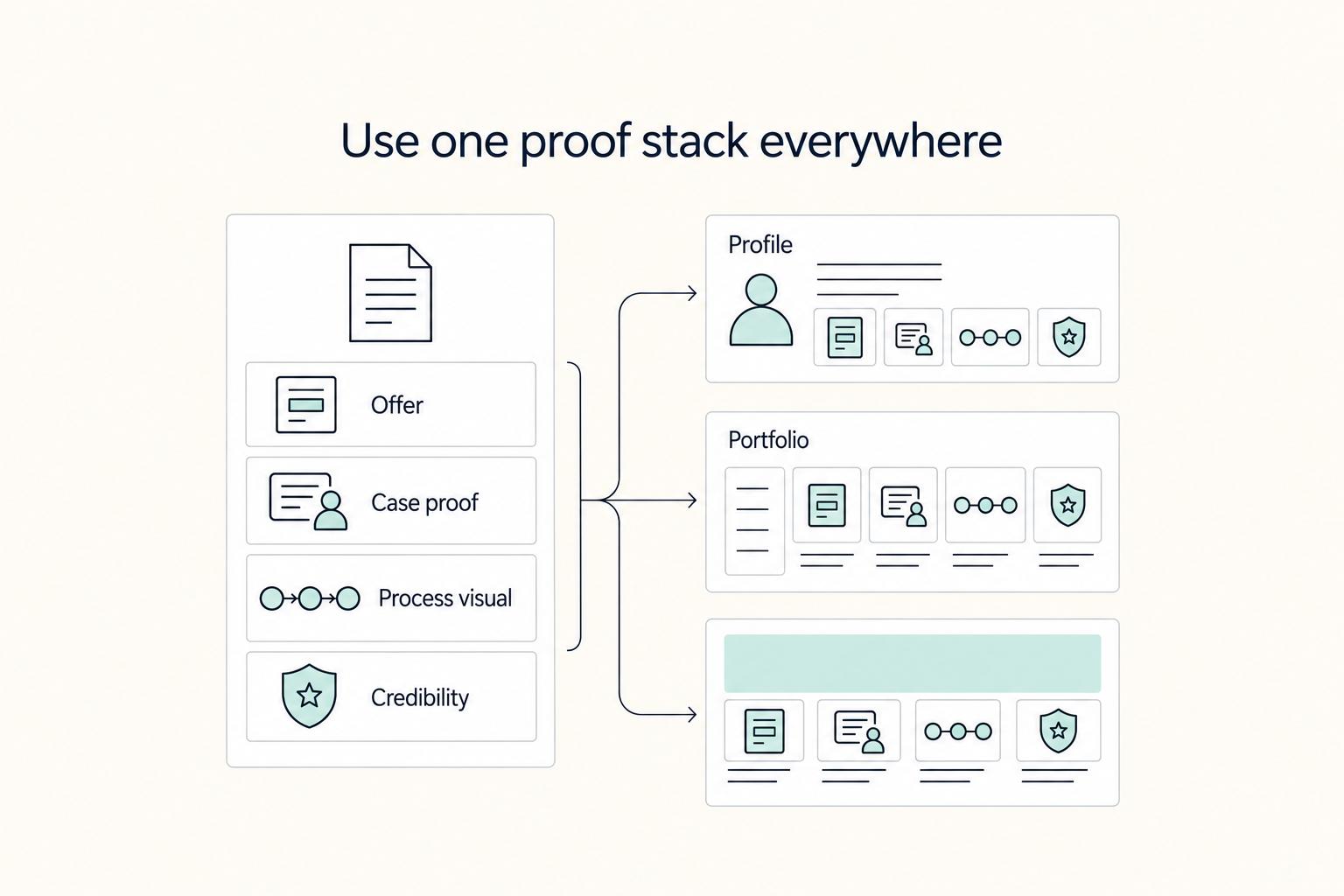
Create one source document and reuse it across channels:
- Core offer statement
- Two short case snippets
- One process visual
- One credibility line
This is a practical packaging choice, not a formal standard. It helps you repeat the same commercial story without rewriting from scratch each time.
Keep each part tight and comparable across channels. Then do a side-by-side check of your profile, bio page, and portfolio. If the service promise, proof examples, or tone shift, fix those first. Inconsistency in brand elements weakens trust.
Match identity across LinkedIn, your bio page, and your portfolio#
Use consistent positioning language across your LinkedIn profile, client bio page, and portfolio intro. The wording can vary, but the buyer should quickly recognize the same person and the same value proposition.
If each channel presents a different version of your work, buyers have to interpret instead of deciding. Keep identity aligned so fit is easier to evaluate.
Distribute proof deliberately and check platform trust surfaces#
Use YouTube and guest posting as proof distribution channels only when they reinforce the same core offer and proof stack. If a piece cannot connect back to that stack, treat it as optional, not core sales support.
Before publishing or repurposing on LinkedIn, verify the current trust-policy surfaces: User Agreement, Privacy Policy, Cookie Policy, and Professional Community Policies. LinkedIn's March 2025 California Terms of Service Report (covering July 1 to December 31, 2024) notes terms updates and points to current terms links, so do not rely on old saved copies.
For channel execution ideas, see How to Create a YouTube Channel to Showcase Your Freelance Skills.
Decide what to do yourself and what to outsource#
Keep positioning, offer logic, and message hierarchy in-house unless you can confidently evaluate strategic quality. Once your proof stack is stable, outsource execution assets first. The common failure mode is cleaner visuals paired with a weaker commercial story.
Separate strategy from production before you hire#
Decide with one filter: can you define what good looks like, and can you verify it on delivery?
| Work area | Keep DIY when | Outsource when | Good first scoped task |
|---|---|---|---|
| Messaging | You are still deciding niche, buyer, or offer statement | Your position is set, but you want editing or packaging help | Rewrite one headline, one summary, and one case snippet without changing the core claim |
| Visual identity | You need consistency, not a full redesign | Your message is stable and visuals are reducing trust | Refresh banner, headshot treatment, and simple portfolio style rules |
| Profile optimization | You know what you want to be hired for but need polish | You can brief exact sections and success criteria | Improve headline, About section, and featured proof order |
| Portfolio production | Your case evidence is thin or outdated | You already have case snippets, process visual, and CTA copy | Build or redesign one portfolio page around existing proof assets |
Check every delivery against your source proof stack. If the buyer, promise, or evidence changes, the output may look better but be commercially off-target.
Match the platform to risk and scope#
Use Upwork for clearly defined work you can split into stages. Upwork frames fixed-price contracts for clearly defined projects, and milestones divide work into smaller chunks with set payment, which makes small test phases practical.
| Platform | Best fit | Key note |
|---|---|---|
| Upwork | Clearly defined work you can split into stages | Fixed-price contracts and milestones divide work into smaller chunks with set payment; do not start milestone work before funding is in place |
| Fiverr | Tightly bounded execution you can review quickly | Formal revision path after delivery review; buyers have three days before auto-completion, so review promptly |
| Fiverr Pro | Higher brand-risk tasks where a curated pool helps | Positioned as vetted and offers money-back protection on eligible orders; treat this as risk reduction, not a substitute for a strong brief |
The table gives the default. In practice, use Fiverr for tightly bounded execution you can review quickly, like a banner, profile visual set, or one portfolio page layout. Use Fiverr Pro when the brand risk is higher and a curated pool helps. On Upwork, keep one non-negotiable: do not start milestone work before funding is in place.
Write acceptance criteria before you send the brief#
Make deliverables inspectable, not subjective. Keep your brief tied to scope and project goals, and include:
- Clear brief: target buyer, core offer statement, two case snippets, one process visual, and current profile/portfolio URLs.
- Conversion checkpoints: for example, headline states buyer, problem, and result; portfolio page ends with one clear CTA.
- Revision limits: set them in the agreement, since revision terms vary by seller and package.
- Proof of similar work: request relevant before/after examples or live profile/page links, not just polished mockups.
If strategy quality is hard for you to judge, keep positioning decisions with you for now and outsource execution pieces you can score with a checklist. Expand scope only after a small test shows clear improvement in the checkpoint you care about.
Need the full breakdown? Read Building a Personal Website That Converts for Freelancers.
Execute a 30-day rollout with weekly checkpoints#
Run this as a 30-day test focused on pricing power and close quality, not output volume. Keep what improves rate acceptance, objection quality, and sales win rate (the share of final-stage opportunities that close), and cut what only increases activity.
Rewrite your core surfaces in week 1#
Lock your positioning first, then update your LinkedIn profile and digital portfolio so they tell the same commercial story. Align your headline, summary, offer statement, case snippets, and CTA across both.
Before publishing, compare both pages line by line for buyer, problem, result, and proof. If those elements differ, fix that first.
Publish authority assets in week 2#
Publish authority content tied directly to the buying problem you want to be hired to solve. In this plan, that can be two total assets across guest posting and/or YouTube, based on where your audience is most engaged.
Choose topics from real sales friction: repeated objections, proposal questions, and pricing pushback. If you use YouTube, commit to a schedule you can sustain instead of a short burst you cannot maintain.
Test outreach and inbound scripts in week 3#
Treat objections as iteration data, not failure signals. Test scripts and log each interaction with date, channel, script version, quoted rate, objection, outcome, and win/loss reason.
Use exact language from replies where possible so your pattern analysis is reliable. This keeps you from overweighting one loud conversation.
Review week 4 with business outcomes first#
Keep the changes that improved rate acceptance, reduced discount pressure, or increased sales win rate. Cut the changes that only raised impressions, profile views, or low-fit inquiry volume.
If activity rose but negotiation pressure stayed the same, pricing power likely did not improve. Standardize the scripts, proof assets, and messages that consistently support cleaner closes at your target rate.
Related reading: How to Evaluate Multi-Currency Personal Finance Software for Tax Residency, FBAR, and Invoicing.
Fix the common mistakes that keep rates flat#
After the 30-day review, remove changes that add activity but not pricing power. If rates are still flat, fix offer clarity, channel consistency, and execution controls before spending more on design or contractors.
Step 1. Rewrite the offer before you redesign anything. If buyers still ask what you do after a visual refresh, the issue is positioning. Lock one offer statement, one target-buyer line, and two proof snippets, then make sure those same lines appear in your profile, portfolio, and proposals. Redesigning around a vague offer usually preserves the same sales friction.
Step 2. Create one source of truth for LinkedIn and your client bio page. Inconsistent messaging across surfaces creates doubt fast. Keep one message doc with five fixed fields: buyer, problem, offer, proof, and CTA. Verify by comparing your LinkedIn profile and client bio page side by side, line by line, before you publish.
Step 3. Test advice before you adopt it. Generic summaries are prompts, not proof for your market. Run small tests with one variable at a time, then keep only changes that improve results in your own pipeline, such as cleaner inquiries, better close outcomes, or stronger rate acceptance. If you cannot show a clear before-and-after, do not standardize the change.
Step 4. Scope outsourcing tightly on Fiverr or Upwork. Early outsourcing fails most often when the brief and checkpoints are unclear. Define scope, goals, deliverables, budget, timeline, milestones, and revision expectations before work starts. Replace vague asks with measurable outputs, for example: rewritten headline, one client bio page draft, two revision rounds, and a checkpoint to approve message accuracy before design begins.
We covered this in detail in US-Australia Tax Treaty Independent Personal Services for Freelancers.
Turn this into a weekly operating checklist#
Use this as a standing weekly operating review so you can see whether your brand work is improving pricing conversations, not just increasing activity.
Step 1: Confirm one positioning statement everywhere. Compare your profile, client bio page, and digital portfolio side by side. Your buyer, problem, and offer should match across all three touchpoints. If the headline, intro, and service summary read like different businesses, fix that first.
Step 2: Update one proof stack and reuse it. Refresh one proof set, then reuse it across YouTube, guest posting, and outreach. Keep the same case snippet, process explanation, and credibility line so trust can compound across channels.
Step 3: Review decision metrics, not just activity. Track inquiry quality, close rate, and rate acceptance against predefined goals. Close rate is your closed-won vs closed-lost share, so it is a stronger decision signal than posting volume alone. Keep activity measures in view across daily, weekly, and monthly cadence, but treat them as support metrics.
Step 4: Keep, cut, or revise based on evidence. Keep tactics that improve inquiry quality or pricing response. Cut tactics that only create noise. Revise tactics that bring the right leads but still stall on scope or price.
Step 5: Expand outsourcing only after a scoped test works. If you outsource on Upwork or Fiverr, align scope, budget, milestones, deadlines, and communication upfront. Review bids, cover letters, and work samples before awarding work. Expand only after the first scoped engagement improves outcomes.
Copy/paste checklist#
- Confirm one positioning statement across your profile, client bio page, and digital portfolio.
- Update one proof stack and reuse it across YouTube, guest posting, and outreach.
- Review weekly metrics for inquiry quality, close rate, and rate acceptance.
- Keep, cut, or revise tactics based on evidence, not activity volume.
- If outsourcing, expand scope only after clear outcome improvement from the first scoped engagement.
Want help applying this to your business? Talk to Gruv.
Frequently Asked Questions
What is personal branding for freelancers in practical terms?
It is the deliberate practice of defining your value and expressing it clearly wherever a buyer checks you. In practice, that means one target buyer, one core problem, one offer statement, and a small proof stack shown consistently on your profile, your client bio page, proposals, and portfolio. If those surfaces tell different stories, your brand message is unclear.
Why does personal branding affect rates instead of just visibility?
Rates can move when trust and fit improve, not just when more people see your profile. If a prospect quickly understands what you do, who it is for, and why you are credible, you may face less pressure to discount. Visibility without that trust can create more low-fit conversations instead of better pricing.
Should freelancers build their brand themselves or hire on Upwork or Fiverr?
Keep strategy in house unless you can judge strategy quality with confidence. If you cannot tell whether a positioning change is actually better, do not outsource that decision first. Use Upwork or Fiverr for narrower execution tasks, and start with a smaller paid scope to test fit before expanding. If you hire on Fiverr, Fiverr Pro can be a vetted-talent signal, but not a quality guarantee.
What are the core components of a freelancer personal brand?
Start with your professional identity: expertise, values, and the qualities that matter to a specific audience. Then translate that into visible parts: a clear buyer, a defined problem, a scoped offer, and proof that you have solved it before. Message consistency matters more than flashy visuals if you want buyers to trust what they see.
How long should I test a new positioning before changing direction?
There is no universal test window, so do not copy someone else’s timeline. Keep the positioning stable long enough to collect comparable signals such as inquiry quality, close rate, and rate acceptance across similar conversations. Change only when the evidence says the message is attracting the wrong work, or failing to improve pricing conversations.
What should I fix first if my branding looks polished but rates are still low?
Fix the offer and proof before you touch design again. Check whether your headline, service description, and case snippets make the same claim across your profile and your client-facing pages, and remove vague language first. If negotiations still stall, test rate adjustments based on budget, scope, and complexity instead of dropping your price blindly.
Try a related tool
Researched and edited by the Gruv editorial team. Gruv builds cross-border billing, payouts, and finance-operations software for global businesses.
Sources
Includes 6 external sources outside the trusted-domain allowlist.
- oag.ca.gov/sites/default/files/LinkedIn%20California%20...trusted
- online.hbs.edu/blog/post/personal-branding-at-worktrusted
- blog.hootsuite.com/social-media-auditexternal
- blog.hubspot.com/sales/win-rateexternal
- fluum.ai/journal/build-a-personal-brand-as-a-freelanc...external
- forbes.com/councils/forbesbusinesscouncil/2025/05/06/19...external
- hbr.org/2025/01/want-your-company-to-get-better-at-e...external
- help.fiverr.com/hc/en-us/articles/29453184449169-Fiverr-Pro-...external
Educational content only. Not legal, tax, or financial advice.
Related Posts

LinkedIn for Freelancers Who Want a Predictable Client Pipeline
Treat LinkedIn as two jobs you run at the same time: a credibility check and a conversation engine. If you only chase attention, you can get noise. If you only send messages, prospects may click through to a thin profile and hesitate.

How to Use Guest Posting for Freelance Brand Building
**Treat guest posting like a system you run regularly, not a lottery ticket you hope pays off.** As a business-of-one, you do not need "more exposure." You need a repeatable way to use guest posts to build trust, authority, and clear business signals without burning time.
How to Create a YouTube Channel to Showcase Your Freelance Skills
Treat this like a business decision, not a creator identity project. Your goal is to publish videos that attract qualified inquiries instead of random attention.