
Quick Answer
A pre-Series A payment infrastructure audit is a scoped, evidence-based review of how money moves, which controls operate, and what proves they worked. A strong checklist maps transactions from intake to payout, links every checkpoint to inspectable artifacts, tests control design and operation separately, and flags gaps where records, approvals, reconciliations, or ownership cannot be reproduced quickly.
Start the audit with money movement evidence#
A practical payment infrastructure audit checklist should answer one question first: can you show, with evidence, how money is handled, where controls run, and what proves those controls worked? If you cannot produce that proof quickly, you likely have a reliability risk, not just a documentation issue.
Treat audit readiness as an evidence exercise, not a slide-deck exercise. In practice, that means confirming a control exists, confirming it operated as intended, and confirming you can reproduce proof without rebuilding it from memory. In payment security audit prep, that is the baseline. Gap analysis, documentation, and validation all matter, but readiness comes from day-to-day operating discipline.
What this article will make easier. This article uses a 50-point review, but the number is not the goal. Each checkpoint should leave inspectable evidence behind: a document, export, policy, calculation, or approval record. You want a reusable audit set you can update, not reinvent.
Payment reviews usually fail in predictable ways. Controls are described but not evidenced. Records exist but are hard to trace. Fee changes appear without a clear explanation of cost impact. In fee audits, effective rate is total processing costs divided by total processed volume. If you cannot calculate that cleanly, treat it as a visibility gap.
What good evidence looks like. Good evidence is specific, current, and easy for another operator to inspect. That usually means dated records, clear approvals, and artifacts that show operating practice, not policy text alone.
Use a simple test: pick one checkpoint and ask whether another operator could follow the evidence trail without verbal context. If not, that checkpoint is not ready. That is the difference between documentation that exists and evidence that is usable.
What you should leave with. The output should be practical enough to reuse for routine reviews and audit preparation. At minimum, you want four things:
- a checklist with named checkpoints
- a scoring sheet showing status and risk
- an evidence-pack structure with stable links
- remediation rules for what to fix now versus later
If you only gather files and do not assign decisions, the review can stall. If you only assign owners and do not collect evidence, the next review may start from zero.
One early red flag to watch. An early red flag is any important payment or accounting claim that depends on one person's memory. That includes unexplained support, undocumented fee changes, or a control said to run every time without retained proof. When you find one, mark it as a gap, capture the missing evidence, and decide whether the control needs redesign or tighter documentation and monitoring.
That is the lens for the rest of this article. Find the gap, test the proof, and keep only the controls you can defend.
This pairs well with our guide on Accounting for a Payment Infrastructure Business: How to Structure Finance Ops.
Define the audit boundary before you start#
Set the boundary in writing before you collect files. That keeps the review focused on how money moves and how payment controls were run.
| Decision | What to document |
|---|---|
| State what is in scope | Name the lifecycle stages and the exact artifacts you will inspect, such as ledger exports, reconciliation support, approval records, and policy or procedure documentation. |
| State what is out of scope for this pass | Tag Pre-IPO or SEC-facing reporting items separately unless they directly affect the control question in this review. |
| Keep parallel audits separate | Keep PCI DSS work separate unless card-data handling directly affects the control question being tested. |
| Assign clear ownership for the audit artifact | Use an owner or small owner group to maintain the scope note, file index, and owner list so reviewers work from the same version set. |
For a Series A diligence pass, start with the payment lifecycle and the finance records that explain it. Treat this as a working scope for this review, not a universal regulatory template.
Use a short scope note with four decisions:
-
State what is in scope. Name the lifecycle stages and the exact artifacts you will inspect, such as ledger exports, reconciliation support, approval records, and policy or procedure documentation.
-
State what is out of scope for this pass. Tag Pre-IPO or SEC-facing reporting items separately unless they directly affect the control question in this review. If an item looks like registration-statement prep work, for example Form S-4 work, keep it on a separate track from payment-control evidence.
-
Keep parallel audits separate. If you process, store, or transmit payment card information, remember PCI DSS work is a formal standards-based assessment. Pull it into this review only when card-data handling directly affects the control question being tested.
-
Assign clear ownership for the audit artifact. Use an owner or small owner group to maintain the scope note, file index, and owner list so reviewers work from the same version set.
Quick check: if your team cannot quickly produce the current scope note, file index, and owner list, tighten the boundary before you proceed.
You might also find this useful: How to Respond to a Regulatory Audit as a Payment Platform.
Build the 50-point checklist architecture and scoring logic#
Make the score defensible from day one. Every checkpoint should map to inspectable evidence, and predefined fail conditions should override a strong average.
Set phase weights before scoring#
Inspectable controls and verifiable evidence artifacts are supported here, but an exact 50-point model or a required six-phase split is not prescribed here. If you use this structure internally, assign points intentionally so control operation and traceability carry real weight:
| Phase | Points | Focus |
|---|---|---|
| Mapping | 6 | Show the payment path from intake to ledger posting, settlement, and payout, with named owners and system touchpoints. |
| Evidence | 8 | Link each claim to an artifact with version date, source system, and retrieval path. |
| Controls | 12 | Show key approvals and accounting controls as documented and operated. |
| Handoffs | 8 | Make re-entry, exports, and out-of-system approvals visible and controlled. |
| Reconciliation | 10 | Tie payment activity across systems without unexplained breaks. |
| Remediation | 6 | Track exceptions to closure with owner, date, and proof. |
For every checkpoint, require at least one anchor: a document, a system view, or a control test. If it cannot be inspected, do not score it as complete. A good test is an independent rerun, for example an Examiner Query Pack-style check. The goal is reproducibility by a reviewer without trust-based reliance.
Grade evidence quality, not file presence#
If useful, use clear internal labels such as:
- Exists: Artifact is present.
- Verified: Reviewer traced the artifact to the underlying event or outcome.
- Repeatable: Another reviewer can reproduce the same result from source.
Apply the stricter bar to your highest-risk controls and reconciliations.
Keep one shared scoring sheet#
Use one sheet for finance and ops so scoring and ownership stay together:
| Checkpoint | Owner | Evidence link | Risk level | Investor relevance | Rule anchor (if applicable) |
|---|---|---|---|---|---|
| Control or reconciliation checkpoint | Named person | Exact file/view | High/Med/Low | Plain-language impact | 15c3-3/Custody Rule linkage |
A few rules keep this usable: one named owner per row, direct links to exact evidence, and investor relevance written in plain language. A standardized evidence manifest, for example a JSON Evidence Pack Framework, with source system, export date, period, preparer, and reviewer also helps reviewers move faster.
Define fail conditions before entering scores#
Set non-negotiable fail conditions at the top of the sheet and apply them consistently. Define your stop-condition list explicitly and include high-risk unresolved recovery scenarios, such as insolvency or key-compromise playbooks that are not executable, as stop conditions until remediated.
This keeps the checklist honest. The score should reflect verifiable proof, not confidence alone.
Related reading: How to Build a Gross Margin Model for a Marketplace: Payment Costs FX and Infrastructure.
Map money movement from intake to payout with failure points#
Build a literal transaction map that lets a reviewer trace one payment end to end without extra explanation. If any payable or payout stage combines manual re-entry with no named owner, treat it as an early-stage fix candidate. That is usually where traceability and accountability start to weaken.
Start with the AP lifecycle your team actually runs: invoice capture, validation, matching, approvals, payment scheduling, and ERP reconciliation. Then carry that same flow through settlement and payout status so you can see where operational events become ledger entries, where those entries clear, and what evidence proves each step.
Build the map around touchpoints, not teams#
Map every system that touches the transaction, including side tools used for approvals or status updates. Possible touchpoints include the intake source, ERP or finance system, purchase ledger, payment file generator, payment processor or bank portal, and approval surfaces such as DocuSign if used. Hidden tools are often where fragmented systems and labor-intensive reconciliation create visibility and compliance risk.
Keep the purchase ledger visible in the flow. It is the detailed supplier transaction record that supports reconciliation and auditability. If your map jumps from "approved" to "paid" without that detailed record, or an equivalent, the audit trail is too thin.
Require one inputs-to-outputs table per stage#
Use one structure for every stage: incoming event, control gate, ledger posting or status effect, reconciliation artifact, and final status.
| Stage | Incoming event | Control gate | Ledger posting or status effect | Reconciliation artifact | Final status |
|---|---|---|---|---|---|
| Capture | Supplier invoice or bill enters by email, portal, or EDI | Intake completeness check and duplicate check | Initial record created, pending review | Intake log or source export | Received |
| Validation and matching | Invoice linked to vendor, PO, or receipt where applicable | Validation and matching review | Invoice recording increases AP | Purchase ledger entry and ERP record | Validated |
| Approval | Validated payable routed for signoff | Approval evidence in ERP, approval log, or DocuSign if used | Approved for payment scheduling | Approval timestamp and approver identity | Approved |
| Payment scheduling and release | Approved item added to payment batch or processor file | Release authorization and batch review | Payment initiation recorded; payment decreases AP when paid | Processor portal batch, bank file, or payment register | Scheduled or sent |
| Reconciliation and settlement | Settlement outcome or bank confirmation received | Reconciliation review and exception handling | Cleared or flagged unresolved in ERP | Purchase ledger cleared status, bank match, ERP reconciliation support | Settled, failed, or exception |
Use specific verbs. "Reviewed" is weak unless you can show who reviewed it, when, and against what. Verify the map with one completed sample trace from source invoice to approval evidence, payment reference, ERP entry, and cleared purchase-ledger status.
Mark every manual handoff explicitly#
Manual handoffs can create breaks, so mark each re-entry point directly on the map:
- Portal export pasted into a spreadsheet before ERP upload
- Approval captured in DocuSign or email but not linked to the payable record
- Payment or settlement status copied manually from the processor portal to an internal tracker
These points can create voucher mismatches, duplicate records, delayed exception handling, and stale status between tools.
Add failure modes where they begin#
Attach failure modes to the exact step where they start, not only in a separate incident list. A delayed webhook belongs at the processor-to-ledger status step. An unmatched deposit belongs at the settlement-to-reconciliation step. A failed payout belongs at release or settlement, depending on where it is detected. A reconciliation break belongs where the operational event no longer aligns with the financial record.
Keep the rule practical: manual re-entry plus no owner is an escalation candidate during diligence. You are not assuming every gap is material. You are prioritizing weak-control conditions where errors, delays, fraud exposure, and weak accountability are more likely.
A finished map should answer five questions for each stage: what entered, who controlled it, what posted, what proved reconciliation, and where it can fail.
Related: How to Scale Global Payout Infrastructure: Lessons from Growing 100 to 10000 Payments Per Month.
Assemble the evidence pack investors and auditors expect#
Build an evidence pack that is quick to review and easy to test. Every control claim should point to a specific file, export, or policy. If the transaction map from the prior section cannot link each stage to evidence, you still have a folder dump, not a diligence-ready record.
Management is responsible for preparing and fairly presenting the financial statements, so do not expect auditors or investors to infer how records connect.
Build the index before you chase files#
Start with one evidence index that names the artifact, reporting period, owner, file location, and checkpoint supported. For this checklist, start with statement-level artifacts, then add scope-specific items where relevant:
| Artifact | What it should answer | Verification detail |
|---|---|---|
| Income statement | Whether revenue, costs, and period results tie to your reporting story | Confirm period end matches the close pack and version date is visible |
| Balance sheet | Whether assets, liabilities, and equity agree with the close | Confirm balances tie to period support in your close documentation |
| Cash flow statement | Whether cash movement aligns with operating activity | Check major cash movements against period summaries |
| Cap table (if equity changes are in scope) | Whether equity ownership and recent changes are documented | Confirm the version date aligns with the period under review |
| General ledger export (if requested) | Whether statement line items can be traced to entries | Verify export period, source system, and saved filter settings |
| Trial balance support (if requested) | Whether account totals roll into the statements cleanly | Spot-check totals against the ledger export and statements |
| Key contracts (if material to reported balances) | Whether material accounting obligations are supported | Include signed versions and effective dates |
If an item exists only as a template or screenshot, treat it as a risk until you confirm the underlying support can be reproduced. Template quality alone is not enough.
Organize the PBC list so checkpoints are clear#
You can organize the PBC list by checkpoint, not only by team, so each request ties to one control claim and one risk in your risk matrix. That makes gaps easier to spot because each missing file maps to a specific assurance gap.
A simple format can use five fields per checkpoint: checkpoint name, control claim, evidence link, owner, and risk if missing.
Scope-specific audit manuals can be useful prompts, but not universal startup requirement lists. Use them to stay explicit at the statement level, then tailor the checklist to your own environment.
Include policy artifacts that can survive questioning#
Keep dated policy artifacts for financial-reporting controls and related exception paths where those controls affect the statements under review. Revision dates matter because undated policies do not show which rule applied in the period under review.
If a material process changed during the period, a short "what changed this quarter" note can reduce follow-up requests. Include what changed, effective date, affected checkpoints, and where the supporting evidence now lives.
Auditors use professional judgment on supplementary information and testing scope. Unexplained process changes can trigger more requests, so documenting changes up front is usually cheaper than defending surprises later.
For a step-by-step walkthrough, see How to Audit Your Payout Platform: An Internal Audit Checklist for Finance Teams.
Test control design and control operation separately#
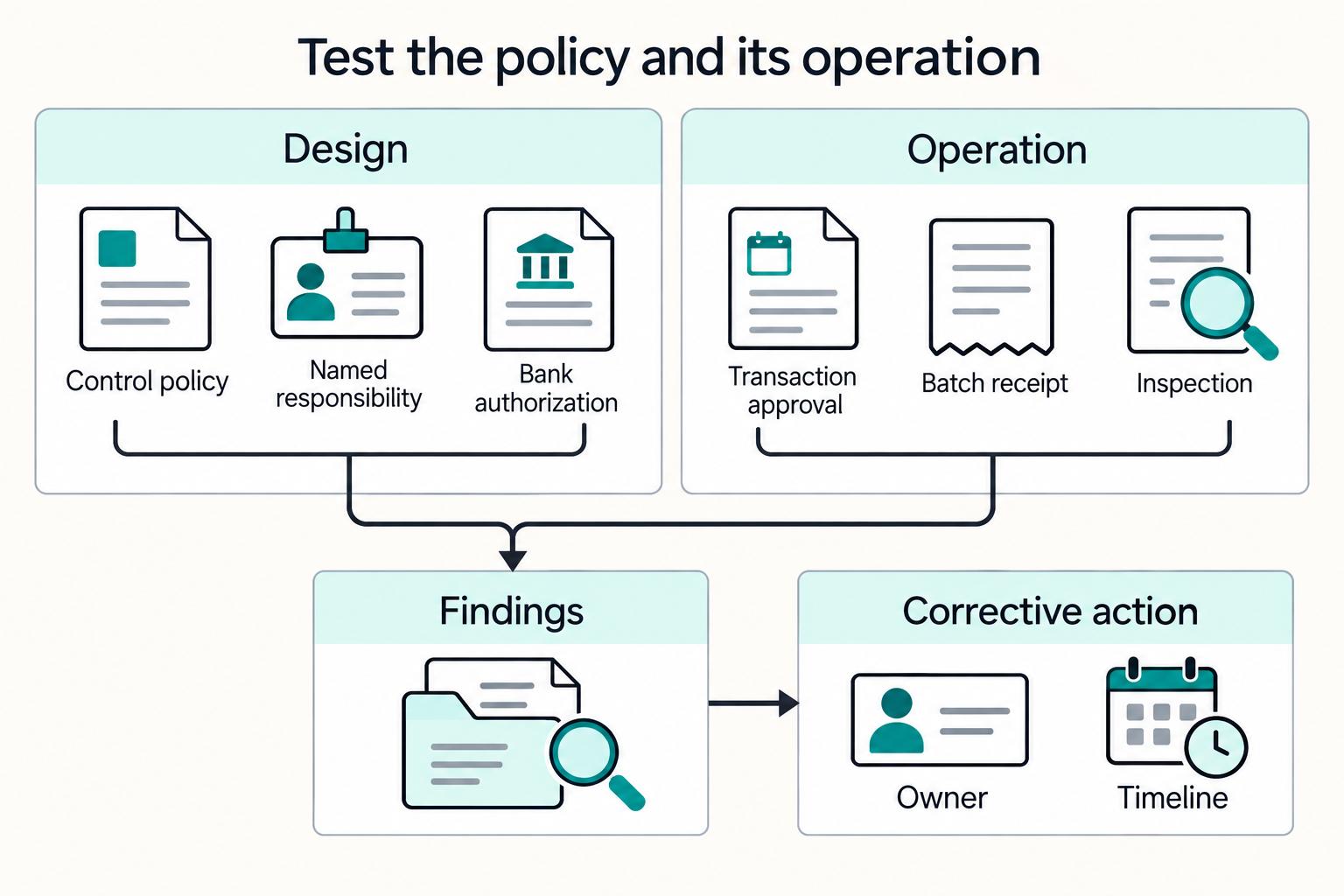
Treat each control as valid only when two things are true: it is clearly designed, and you can show it operated during the review period. A written policy shows intent, but it does not show that internal controls were followed in real payment activity.
Checklists help, but they do not guarantee against fraud, missing assets, or control bypass. Your evidence should show who is responsible, what the control requires, and proof that it happened.
Run separate tests for each control#
| Test | What to confirm | Evidence or follow-up |
|---|---|---|
| Design test | Confirm the control is documented and assigned to specific personnel. | For disbursements, verify authorization responsibility is clearly defined; where relevant, keep authorized bank account and signer documentation with the same checkpoint records. |
| Operation test | Collect period evidence that the control actually ran. | For manual steps, keep dated approval records and supporting documentation tied to real transactions or batches. |
| Ownership and remediation test | When a test fails, assign an owner and remediation timeline. | Control testing should explicitly evaluate deficiencies, then report findings and recommended actions. |
- Design test
Confirm the control is documented and assigned to specific personnel. For disbursements, verify authorization responsibility is clearly defined. Where relevant, keep authorized bank account and signer documentation with the same checkpoint records.
- Operation test
Collect period evidence that the control actually ran. For manual steps, keep dated approval records and supporting documentation tied to real transactions or batches.
- Ownership and remediation test
When a test fails, assign an owner and remediation timeline. Control testing should explicitly evaluate deficiencies, then report findings and recommended actions.
Compare manual and automated controls by auditability#
Whether a control is manual or automated, apply the same standard: clear evidence that it operated as designed. If a control cannot be audited with that evidence, redesign it before relying on it.
Include timing checks without over-claiming#
For transaction-related controls, verify that the documented timing trigger matches the event timing used in practice. If policy and execution do not match, flag it for remediation before reporting.
Audit tool sprawl and handoffs before they become scale debt#
Treat tool sprawl as an audit risk when the same workflow is documented in multiple places with different status records. The answer is not simply fewer tools. You need one clear, searchable record of what changed, where, and when.
Build a real inventory, not a logo list#
Inventory every system and side tool that can change or report workflow status. Keep the inventory in a structured table and capture fields that make records auditable and comparable.
| Field | What to record |
|---|---|
| System or record name | The listed product, system, or report name |
| Status field | Current status label, such as Provisional, Level 1, or Level 2 |
| Category | System type or workflow category |
| Path | Listed certification path or workflow path label |
| Expiration date | Date tied to certification validity, including provisional expiration where applicable |
| Record number | Unique item number used to track a recommendation or decision |
| Record language | The decision or recommendation text tied to that number |
Map handoffs in one searchable location#
For each handoff, log the source record, destination record, and the exact status text carried forward. Keep those logs in a single searchable location so your team can reconcile from one place instead of from disconnected message trails.
Set a conflict rule before drift grows#
When two tools hold the same status but disagree, set an explicit internal rule for which record controls decisions. If one path is retained temporarily, mark it as reference-only so it is not treated as a live source of truth.
For a deeper dive, read How to Scale a Gig Platform From 100 to 10000 Contractors: The Payments Infrastructure Checklist.
Verify reconciliation close from operations to financial statements#
Treat this part of close as a documented workflow with named owners and review evidence, not analyst memory. If someone else cannot reproduce the result from your notes and retained support, you likely have a control gap.
Month-end close is cross-functional and depends on clean, on-time data from multiple systems and teams. One late accrual, missing invoice, or unapproved journal entry can disrupt the sequence, so reconciliation should not stop at a single match check.
Define the close workflow in order#
Write the handoff sequence between operations and finance, then run it the same way each month. Keep checkpoints explicit and retain review documentation at each step.
| Close stage | What to verify | What to retain |
|---|---|---|
| Data intake across teams/systems | Period scope and inputs are complete and on time | Source reports/exports plus cutoff note |
| Reconciliations | Key accounts and balances are reconciled | Reconciliation file plus dated review evidence |
| Journal entries and accruals | Entries are reviewed, approved, and posted for the period | Posting support plus reviewer notes |
| Financial reporting | Reports are produced from reconciled, reviewed data | Final close package and retained support |
Track exceptions with clear ownership#
Use visible exception handling with clear owners and follow-up. When items stay open across closes, carry them into the next review cycle so they do not disappear.
Check cutoff and completeness before escalating mismatches#
Before you label a break as a true mismatch, confirm both teams used the same period cutoff and that expected inputs were complete. Keep a short reviewer note on what was checked and what remains open.
Use one repeatable checklist and reviewer trail#
Use one repeatable checklist and retain the reviewer trail:
- Confirm operations and finance used the same period cutoff.
- Reconcile key accounts using clean source data.
- Review and approve journal entries, including accruals.
- Produce financial reports from reconciled results.
- Document open exceptions, assign owners, and retain review evidence.
We covered this in detail in Month-End Close Checklist for Payment Platform Finance Teams.
Prepare exception handling and incident evidence before diligence starts#
Prepare your exception process before diligence, not during it. When material exceptions occur, document how they move from review to decision to closure in durable records tied to internal controls and approvals.
Treat exceptions as controlled events, not support tickets#
If an exception can affect reported balances or control quality, handle it as a control event. Your record should show who reviewed it, what was decided, and where approval evidence is retained in formal documentation.
A practical diligence check is simple: sample a few exceptions and confirm the documentation is reviewable without live explanation.
Define the incident packet you will retain every time#
Set one incident packet format and use it consistently so your PBC materials are organized before requests arrive on day one. The exact format is your internal choice. Consistency is what makes the file reviewable.
A compact packet can include:
- The issue summary and key dates
- The control decision and approval record
- The remediation action taken and current status
Then test traceability. Sample an incident and verify it links to the supporting records you would provide in diligence.
Set correction documentation rules before finance needs them#
Write correction-documentation rules before cleanup pressure starts. The goal is simple: allow corrections without breaking traceability back to the underlying source records.
Keep the rule explicit on when correction is allowed, who approves it, and how the correction links back to the source documentation. If that link is missing, documentation quality drops even if balances look cleaner.
Escalate recurring failures into remediation work#
When the same failure pattern repeats, move it from case handling into documented corrective action with ownership and follow-through. Manual due-diligence workflows are time-consuming and can slow onboarding and ongoing risk monitoring.
This is also a credibility issue. Unprepared teams can face longer audit timelines, control-quality findings, higher fees, and credibility damage. Keep a short escalation rule in policy, and maintain version history by clearly marking substantive revisions and archiving prior versions.
For a fuller walkthrough, read Digital Nomad Payment Infrastructure for Platform Teams: How to Build Traceable Cross-Border Payouts.
Apply fix now or defer rules for pre-Series A teams#
Fix now any gap that weakens confidence in your reporting controls. Defer only when risk appears lower, a compensating control is already working, and the decision is documented.
Keep decisions consistent by rating each gap on two axes: risk severity and remediation effort, with risk weighted first. Use the matrix below as an internal triage guide, then adapt it to your context.
| Risk severity | Remediation effort | Action |
|---|---|---|
| High | Any | Fix now |
| Medium | Low or medium | Usually fix now in the current cycle |
| Medium | High | Defer only with documented compensating control and clear owner |
| Low | High | Defer with a documented owner and review date |
What belongs in the fix now bucket#
A gap belongs in Fix now when the evidence would not hold up under review. Use a concrete check: can you produce account reconcilements, general ledger account review support, documented control procedures, and a named control owner? If not, the item is unresolved.
What can be deferred#
You can defer hardening work when the current control is imperfect but still auditable, with consistent dated evidence and ownership. Delegating operational work is fine, but accountability for effective controls still stays with the board or equivalent leadership.
If helpful, use an Internal Control Questionnaire-style review to document defer decisions. Adapt it to your context rather than lifting bank-supervision materials as-is. When your fix-now list is finalized, use Gruv Docs to map controls to events, ledger postings, and reconciliation checkpoints.
Run sanity checks before board and investor review#
Before you circulate the packet, make sure it reads as complete, reviewable, and controlled, not just well formatted. Investor diligence will test legal, financial, and operational records together, and small oversights can turn into major friction quickly.
Close every high-risk item to a reviewable state#
Every high-risk checkpoint should show a named owner, evidence link, and current status. Do not leave in progress in final materials. If an item is not done, mark it unresolved or explicitly deferred with its compensating control, owner, and next review date.
Use a quick readiness test: open a sample of high-risk rows and follow the evidence links. If a link is broken, points to drafts, or only makes sense with a live walkthrough, treat that item as not ready.
Reconcile naming and version drift across the packet#
Your PBC list, Risk matrix, and control narratives should reference the same system names and document versions. If labels or versions differ across files, you create avoidable diligence work and raise preventable questions.
Resolve drift before review. Gap resolution is expected before final approval, whether through a fix, adjusted terms, or added protections.
Check financial artifacts for internal consistency#
Run a final internal tie-out across key financial artifacts so the packet behaves like one coherent set. Confirm totals are internally consistent and that all files use the same report date, entity scope, and export version.
If numbers do not align, surface the issue immediately. Determine whether the break is a version mismatch or an unresolved variance.
Add the non-operator summary#
End with a short plain-language summary for board members and investors: what changed, what still needs work, and why risk is controlled today. Keep it concrete by naming the process change, remaining gap, owner, and supporting evidence.
Conclusion#
A credible pre-Series A payment audit should show that controls, records, and day-to-day operations agree. A clean finance folder alone is not enough. A cleaned-up tool stack alone is not enough if a reviewer still cannot trace a real payment event through approval, reconciliation, and reporting support.
That bar matters at Series A because diligence is more rigorous than seed. Investors will scrutinize financials, legal docs, product, team, and market, and they expect diligence materials to be prepared in advance. Your payment process should map directly to that review: each claim about how money moves should tie to an owner, an artifact, and a testable record.
Completing a checklist with named owners and evidence links can reduce avoidable diligence friction. Timeline improvements vary, so treat speed gains as directional, not a promise. The real benefit is simpler: you answer diligence questions with proof instead of meetings, memory, or cleanup projects.
Use one final verification pass: trace one ordinary transaction and one messy exception end to end across your stack. If either breaks because status is split across tools, approval evidence is missing, or review-pack support is stale, you have identified the highest-priority fix.
A common failure mode is assuming a provider or partner covers more than they actually do, especially when support varies by market or program. If card data is in scope, remember that a PCI DSS audit is a formal assessment of payment security controls, including policies, procedures, and technical safeguards. Formal evaluations may involve a Qualified Security Assessor. Your prep can align to that scope, but it does not replace it.
Your next move.
- Replace generic checklist rows with your actual stack: name the source of truth for each step, link exact evidence, and assign one owner.
- Mark every coverage assumption that depends on market, processor, or card program, and state what artifact proves your side is complete.
- Before sharing with board or investors, re-run the two sample traces and remove placeholders, stale links, and unsupported claims from your diligence pack.
Do that, and you are not just tidying operations. You are building evidence that can hold up in Series A diligence and support safer, faster payment-scale decisions. If you want to pressure-test your payout and audit trail design against this checklist, contact Gruv.
Frequently Asked Questions
What is a payment infrastructure audit for a pre-Series A startup?
It is a scoped review of how money moves through your operations and whether each step is supported by reviewable evidence. It is broader than a security-only check because readiness can include financials, documentation, internal controls, and people. If payment card data is in scope, PCI DSS work can be part of the review for that slice, but it does not replace end-to-end operational and financial auditability.
What must be included in a Series A ready payment audit checklist?
Include current financials, internal controls documentation, organized PBC materials, and a gap assessment showing where records, controls, or policies still fall short. Add a project plan with the required steps and associated evidence. The checklist should let a reviewer test claims directly from artifacts.
How is a payment operations audit different from general financial audit prep?
General audit prep is broader and focuses on readiness across financials, documentation, controls, and people. A payment operations audit goes deeper on transaction flow, handoffs, and related records across tools. The key test is traceability: can you follow an operational payment event through supporting records and back?
How do we audit handoffs and duplicate data entry across payment tools?
Start by mapping the systems and handoff points that touch payments and collections, then answer planning questions on setup, payment types, compliance, timeline, and prioritization. Use a project plan checklist to verify each handoff has consistent records and clear supporting documentation. Log any mismatch as a gap to remediate.
Which internal controls are mandatory before scaling payouts?
There is no universal mandatory control list that fits every startup and payout model. Before scaling, prioritize controls that are formally documented and evidenced in real activity. If a control is documented but not evidenced in records, treat it as not ready.
How should we decide what to fix now versus defer until pre-IPO?
Fix items now when they create clear readiness gaps in records, controls, or policies. Defer only lower-risk items that are clearly documented in your plan for later review. If you cannot show evidence today, the item is not ready to defer.
How many systems are too many in Payments and Collections?
There is no fixed number. You likely have too many when handoff problems or inconsistent records across tools keep appearing in the checklist and gap assessment. If reviewers cannot trace transactions cleanly with the available artifacts, the stack is too fragmented for clean review.
Researched and edited by the Gruv editorial team. Gruv builds cross-border billing, payouts, and finance-operations software for global businesses.
Sources
Educational content only. Not legal, tax, or financial advice.
Related Posts

The Freelance Payment Penalty: A Modeled Audit of Platform Fees, FX Spreads, and Payout Delays
The money rarely disappears through a single, easy-to-spot fee. The real loss is stacked. A marketplace takes its commission, a processor adds a charge for international cards, a bank or payment company converts the currency at a spread, a platform holds the funds before release, and a wire sheds a little to intermediaries on the way in. Each layer looks defensible on its own, but the worker feels the combined result as a smaller deposit and a later payday.

How to Respond to a Subpoena for Business Records
Move fast, but do not produce records on instinct. If you need to **respond to a subpoena for business records**, your immediate job is to control deadlines, preserve records, and make any later production defensible.

A US Expat's Guide to Investing in UCITS ETFs to Avoid PFIC Issues
The real problem is a two-system conflict. U.S. tax treatment can punish the wrong fund choice, while local product-access constraints can block the funds you want to buy in the first place. For **us expat ucits etfs**, the practical question is not "Which product is best?" It is "What can I access, report, and keep doing every year without guessing?" Use this four-part filter before any trade: