
Quick Answer
Choose a model before you launch: use Multi-Currency Pricing (MCP) when you want control of displayed local amounts, and treat DCC as a separate checkout conversion path with different disclosure and markup implications. For tight-margin corridors, prefer explicit local prices on a Rate Plan Charge instead of raw per-session auto-conversion. Then enforce FX quote freshness, set fallback behavior for rate failures, and verify each completed order ties buyer currency, settled currency, and ledger outcome in one trace.
Treat Local-Currency Display as a Pricing Decision, Not Checkout Decoration#
Treat local-currency display as a pricing decision, not a checkout decoration. A sound multi-currency pricing strategy local display setup makes prices feel native to the buyer. It also changes who controls the FX quote, how margin moves, how settlement is configured, and what finance has to reconcile later.
What are you actually choosing?#
Start with the decision in front of you. Multi-currency pricing, or MCP, means the shopper pays in local currency while your settlement currency is configured separately. That is different from Dynamic Currency Conversion, where a provider applies an exchange rate and markup at checkout and card-scheme disclosure rules come into play. If you want tighter control over how prices are set and presented, MCP can be the cleaner starting point. If you leave conversion to provider logic at checkout, you usually have less control over markup, disclosure, and presentation.
That distinction matters because local pricing affects behavior, but not uniformly or automatically. One cited report says 93% of consumers claim that seeing prices in their local currency affects their decision to purchase. Treat that as directional evidence, not a promise of uplift. The real operator question is whether the gain in clarity and trust is worth the extra pricing, ledger, and policy work on your side.
Should you price by conversion or by intent?#
Next, decide whether you are pricing by conversion or by intent. In practice, that means choosing between a live exchange-rate approach and explicit local prices in a price book. If margins are tight or you do not want daily drift, do not rely on raw auto-conversion from a base currency on every session. Use explicit per-currency prices instead. Zuora's model shows the pattern clearly: activate multiple currencies on the specific Rate Plan Charge.
That one choice shapes almost everything downstream. Finance cares about quote policy and spread. Product cares about display consistency. Engineering cares about stale-rate handling and traceability. Operations cares about whether a charge, settlement record, and ledger entry all tie back to the same currency decision without manual cleanup.
What must be true before launch?#
Before launch, define the control points. At minimum, you should know who owns the FX quote policy, where exchange rates come from, whether prices are fixed or refreshed, and what evidence proves the right amount was shown and settled. A simple checkpoint is this: for any test transaction, can you retrieve the selected currency, the applied price or FX quote reference, and the settlement outcome in one place?
A common failure mode is mismatch. A shopper sees one local price, checkout recalculates another, or settlement lands in a way finance did not expect. This guide is about avoiding that outcome: better local pricing without silent margin leakage, reconciliation pain, or compliance surprises.
For a step-by-step walkthrough, see How to Evaluate Multi-Currency Personal Finance Software for Tax Residency, FBAR, and Invoicing.
Gather the inputs before you touch pricing#
Do the prep first: if corridor, FX, and ownership inputs are unclear, you risk mismatch between displayed price, settlement currency, and ledger outcome.
Map your corridors and rails first#
Map corridors and payment rails before you set local prices. For each cross-border path, document buyer currency, settlement currency, and payment rail. Then answer one decision question per corridor: where should checkout currency differ from settlement currency, and where should it not?
Use this readiness check for every launch corridor:
- Display currency is defined.
- Home-currency settlement outcome is defined.
- Approval owner is explicit.
Build one evidence pack#
Create one shared evidence pack before configuration starts. Include:
- Exchange-rate source.
- 90-day realized volatility view.
- Current cart abandonment by market.
- Current ledger reconciliation error rate.
Use volatility as context, not a standalone stress signal. Timely and accurate rate updates help protect margin, but the bigger operational risk is stale or untraceable FX inputs that you cannot tie back to pricing decisions.
Confirm prerequisites and assign owners#
Assign ownership before you change tools: finance owns FX quote policy, product owns the price experience, and engineering owns stale-quote rejection and ledger integrity. Then confirm implementation prerequisites across catalog ownership, pricing model location, including rate plan/Rate Plan Charge structure where relevant, webhook reliability, and idempotency handling.
| Area | Owner |
|---|---|
| FX quote policy | Finance |
| Price experience | Product |
| Stale-quote rejection and ledger integrity | Engineering |
If ownership or evidence is still fuzzy, pause rollout until those gaps are closed.
If you want a deeper dive, read A Guide to Pricing and Packaging for International Markets.
Choose your model before you configure tools#
Choose the pricing model before checkout configuration: if finance cannot absorb daily margin drift, do not auto-convert every session from a base currency. Set explicit local prices and update them on a schedule you can defend.
How is MCP different from DCC?#
MCP and DCC are not the same decision, even though both can show a local-currency amount. MCP is a pricing approach where you present prices in multiple currencies based on customer location or preference, and that can reduce manual conversion friction for buyers.
The operating difference is ownership of the shown amount. With MCP, your team governs a predefined local price book. With DCC-style flows, the displayed local amount may come from a conversion flow, so review that setup separately rather than treating it as equivalent to a catalog price.
When should you use a price book versus live conversion?#
Use market-based local prices where demand is stable and localized. Use controlled FX-linked conversion where frequent movement is genuinely required. This keeps the model tied to margin control, not gut feel.
A practical pattern is one rate plan charge with explicit local prices, for example:
| Same product, same rate plan charge | Local price |
|---|---|
| USD list price | $100.00 |
| GBP list price | £90.00 |
| JPY list price | ¥12,000 |
For each corridor, define whether checkout uses a price-book value or an FX-derived value, who approved it, and when it will be reviewed next.
Why keep one catalog and many currency prices?#
Keep one product catalog with currency-specific prices; do not clone products by currency. Global pricing works best when product definition stays separate from the list of prices by currency.
Cloning "Product A USD," "Product A GBP," and "Product A JPY" multiplies records and creates avoidable data-integrity risk. The safer pattern is one product definition, one rate plan, and explicit price entries per currency.
Related: How to Handle Multi-Currency Pricing for Your SaaS Product.
Set margin guardrails that survive volatility#
Set your guardrails before launch, not after incidents. Once a corridor is live, even a 5% FX move can materially change margin, so policy-by-Slack-thread is not enough.
What belongs in the FX policy?#
Make the FX policy finance-owned and engineering-readable. For each corridor, define the rate-source hierarchy, how quote usability is determined, spread policy, and rounding approach by currency. If those points are unclear, the corridor is not launch-ready.
| FX policy element | What to define |
|---|---|
| Rate-source hierarchy | For each corridor |
| Quote usability | How quote usability is determined |
| Spread policy | For each corridor |
| Rounding approach | By currency |
| Primary rate source unavailable | Precedence |
| Exchange-rate update strategy | Sources, storage, and refresh behavior |
| Acceptable margin band | Per corridor and what action is required when live pricing moves outside it |
Also define precedence when the primary rate source is unavailable. Your exchange-rate update strategy should clearly cover sources, storage, and refresh behavior so checkout behavior matches your actual risk tolerance.
Model adverse scenarios, not just the happy path. Currency risk is a multi-year operating issue, so finance should sign off on an acceptable margin band per corridor and document what action is required when live pricing moves outside it.
How should checkout enforce the policy?#
Enforce policy in checkout logic, not only in reporting. Validate quote freshness using your policy rules, recompute totals server-side before authorization, and provide a clear next step when a displayed quote is no longer valid.
The goal is consistency: avoid situations where storefront totals and settled totals diverge and become support disputes later.
What is your fallback when rates fail?#
Choose fallback behavior before production failures. Typical options are using a previously approved rate for a tightly controlled period or routing to home-currency settlement with clear disclosure that local pricing is unavailable.
Verify it operationally. Finance approves the worst-case margin band, and engineering can trace each transaction from pricing decision through settlement outcome in logs.
You might also find this useful: Multi-Currency Payment Links: How to Let Clients Pay in Their Local Currency.
Build the transaction path end to end#
Once your quote policy exists, make the path from displayed price to settlement explicit and shared across teams. Define one transaction path per corridor and payment rail so product, finance, and engineering are working from the same flow.
Map the buyer journey from display to posting#
Start by mapping the buyer journey from first displayed amount to final posting. A practical sequence is: local price display, checkout confirmation, conversion decision, settlement posting, then ledger journal creation. This is your operating model, not an industry requirement, but you need one agreed sequence.
| Stage | What it covers |
|---|---|
| Local price display | First amount shown |
| Checkout confirmation | Checkout-approved amount |
| Conversion decision | Conversion path used |
| Settlement posting | Settled amount |
| Ledger journal creation | Ledger outcome |
Keep MCP and DCC clearly separated in that map. MCP presents a local-currency price from the beginning of the purchase process, while DCC converts the final amount later at checkout; blending those behaviors creates transparency risk. Also account for the fact that DCC availability can depend on card-network support.
Your checkpoint is simple: trace one completed order from the first amount shown, to the checkout-approved amount, to the conversion path used, to the settled amount.
Preserve the artifacts finance will need#
Capture enough transaction data for finance to reconstruct what happened without piecing together scattered systems. The exact schema is your choice, but it should let you connect what the buyer saw, what was approved, and what settled to the ledger outcome.
The common failure is split records across checkout, processor, and ledger. If teams cannot reconcile those views quickly, disputes and margin questions become slow and expensive to resolve.
Decide who owns checkout presentation#
Set ownership for checkout presentation before you add marketplace or platform payout complexity. If a Merchant of Record (MoR) is involved, define who controls customer-facing currency and tax presentation and make sure it matches settlement and booking responsibilities.
The tradeoff is operational clarity versus control. Whichever model you choose, keep one accountable owner for presentation decisions and one clear handoff into settlement.
Document non-card flows separately#
Treat non-card rails as their own flow and document them separately. Bank-transfer and similar rails often have different timing and state transitions than card checkout, so mapping them independently reduces reconciliation surprises.
For the full breakdown, read Managing a multi-currency project budget in Airtable for a global creative campaign.
Engineer for reconciliation not just conversion#
Local display is not enough on its own. Your setup is only reliable when the same transaction can be explained across settlement, reconciliation, and accounting. Weak implementation creates accounting headaches, failed payments, and customer confusion.
Reconcile conversion with accounting outcomes#
Reconcile from the full transaction story, not conversion screens alone. In practice, the local amount shown before purchase completion, the conversion outcome, the settlement record, and the accounting record should describe the same payment without contradiction.
This matters because processors may convert a foreign-currency transaction into the merchant's base currency even when the customer saw a local-currency total at checkout. If those records are not connected, finance and operations can reach different conclusions about the same order.
Treat reconciliation as a core implementation track#
Treat settlement, reconciliation, and accounting as a defined implementation track, not cleanup work after launch. Multi-currency decisions affect billing, tax compliance, financial reporting, and user experience, so ownership and handoffs should be explicit across product, engineering, payments, and finance.
A practical checkpoint is whether your team can trace a completed order from customer-facing amount to settlement and posted accounting record from preserved transaction data.
We covered this in detail in How to Get Local Currency Abroad Without a Recordkeeping Mess.
Apply compliance and tax gates by market#
Use compliance evidence as a launch gate, not a post-launch cleanup task. If required policy artifacts for a corridor are undefined, pause that corridor even when local pricing is technically ready.
Set the launch gate before local pricing goes live#
Define each market's gate before you turn on local display. Treat settlement readiness separately from compliance, tax display, and invoicing decisions, and do not launch while those requirements are still unresolved.
Document foreign-account reporting exposure#
Document FBAR exposure anywhere your design involves foreign financial accounts. Under the Bank Secrecy Act, U.S. persons include U.S. citizens, U.S. residents, and domestic legal entities, and FBAR applies when there is financial interest in, signature authority over, or other authority over foreign accounts and aggregate value exceeds $10,000 at any point in the calendar year.
Your operating check is straightforward: identify who holds the obligation, which accounts are in scope, and the maximum account value recorded in U.S. dollars rounded up to the next whole dollar (for example, $15,265.25 becomes $15,266).
Tie tax-form ownership to payout timing#
Before contractor or creator payouts scale, assign clear ownership for document collection, payout blocking rules, and recordkeeping timing across tax and reporting workflows. For FBAR timing, keep the due-date split explicit: April 15, 2026 remains the due date for most individuals with an FBAR obligation, while certain individuals with signature authority but no financial interest are covered by a further extension to April 15, 2027.
Launch in phases and prepare for failure modes#
Launch local pricing in phases, not all at once. Start with a small corridor cohort, confirm the flow is working end to end, and expand only when the signal is clear.
Start with a narrow pilot#
Pilot a limited set of currencies and customer paths first so finance, product, and engineering can review issues quickly. Keep MCP and DCC on separate tracks: MCP is upfront local-currency display, while DCC converts at checkout and may vary by card network support and availability.
Before expanding a corridor, confirm you can trace transactions consistently from displayed price through checkout and into your records. If exceptions are still unclear, hold expansion.
Track a minimum dashboard from day one#
Use a minimum dashboard from day one, even if it starts simple:
| Metric | What to watch for |
|---|---|
| Conversion rate | Whether local display appears to help completion |
| Cart abandonment | Whether buyers are dropping before payment |
| FX leakage | Whether realized economics are drifting from pricing intent |
| Stale quote rejection rate | Whether quote timing is breaking checkout reliability |
| Reconciliation exception count | Whether operations can close cleanly |
If one metric improves while others degrade, pause rollout. Cross-border payments can be slow, expensive, and risky, so expansion decisions should follow evidence, not momentum.
Predefine first-week recovery actions#
Define recovery ownership before launch for predictable first-week failures, including quote outages, rounding disputes, webhook delays, and disclosure complaints in checkout flows. Keep the rule simple: decide in advance who can pause, roll back, and approve restart for each corridor.
If support tickets, stale-quote rejects, or reconciliation exceptions rise faster than your team can explain, stop adding corridors until the cause is clear.
This pairs well with our guide on Using an HSBC Expat Multi-Currency Account Without Single-Point Payment Risk.
What to do next and the checklist to copy#
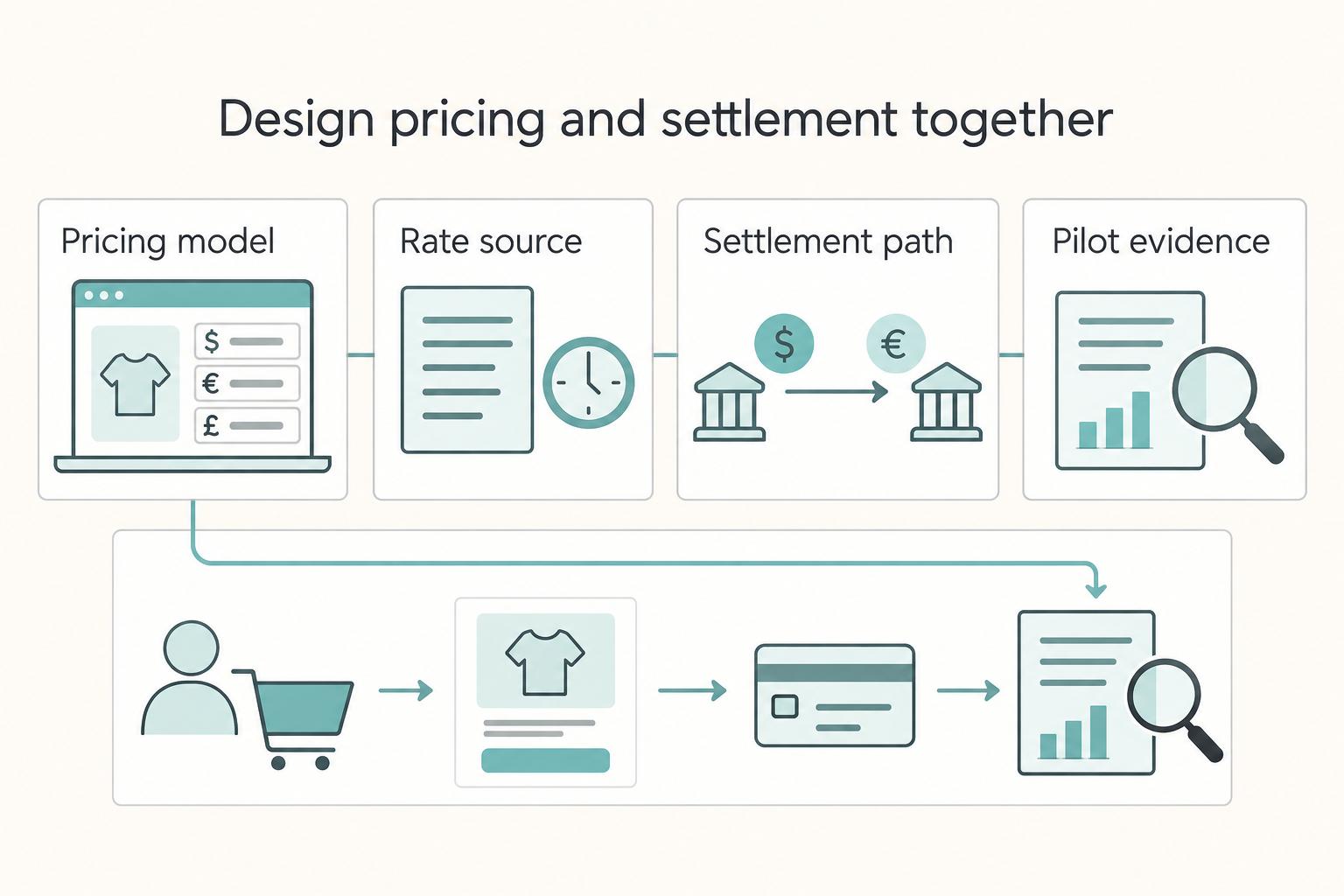
Start by writing one policy that covers both pricing and settlement before you turn local display on. It works best when those decisions are designed together, not added after checkout.
- Set pricing and settlement rules together.
Decide whether you will run MCP or provider-side conversion, then choose market-based pricing or live FX quotes by corridor. Keep one written rule for price display, rate source, and settlement currency across finance, product, and payments ops.
- Test one live corridor and verify the records.
Run a low-value real transaction and capture the full path: displayed currency, displayed amount, settlement currency, whether the rate was locked at initiation, and any conversion or fee detail. If your team cannot clearly explain shopper view versus settled outcome, pause rollout.
- Use settlement design to control avoidable FX cost.
Where supported, holding or settling in local currency can reduce unnecessary conversions and transfer fees. Expand corridor coverage only when that benefit is clearer than the added reconciliation workload.
- Pilot, review, then expand.
Local display can improve conversion, but it changes margin and reconciliation operations. Review pilot results for conversion impact, margin outcome, and whether one transaction can be explained end to end without manual guesswork.
Use this checklist in your launch doc:
- Confirm your pricing model and settlement model, and document why.
- Choose market-based pricing or live FX quotes by corridor.
- Define your rate source and when rates are considered locked for a transaction.
- Confirm how provider markup and fee behavior is handled in your policy.
- Verify transaction records capture displayed amount/currency and settled outcome clearly.
- Run one pilot corridor, review conversion, margin, and reconciliation outcomes, then expand.
Related reading: The Best Accounting Software That Handles Multi-Currency Invoicing. If you want a quick next step, try the free invoice generator.
Frequently Asked Questions
What is Multi-Currency Pricing (MCP) in one sentence?
Multi-Currency Pricing (MCP) is a pricing approach where customers pay in their local currency while you settle funds in a configured currency. In practice, it means showing a local price up front rather than forcing the buyer to mentally convert at checkout.
What is the practical difference between MCP and DCC for margin and conversion?
MCP lets you set prices up front using your own FX quote or localized price book, which can give you more control over pricing and presentation. Dynamic Currency Conversion (DCC) applies a provider exchange rate and markup at checkout and comes with card-scheme disclosure rules. Local display can reduce friction because buyers see a familiar amount. One cited report says 93% of consumers say local-currency pricing affects their purchase decision, but results still depend on corridor, payment method, and checkout quality.
Should we use market-based pricing or live exchange rate conversion?
This guide does not prescribe one universal choice between market-based pricing and live conversion. It does support using local-currency presentation to improve customer experience and distinguishing MCP (merchant-set pricing) from DCC (provider-applied checkout conversion). Choose based on your margin goals, risk tolerance, and operating model.
Can customers pay in local currency while we settle in home-currency settlement?
Yes. That is the core MCP model described here: the shopper pays in local currency and you settle in a configured currency. Some providers also describe like-for-like settlement in 14+ currencies, but that is provider-specific, so verify settlement options by corridor before launch.
Who should own FX policy decisions across product, finance, and payments ops?
A required ownership model across product, finance, and payments ops is not established. Treat ownership as an internal governance decision, but make sure responsibilities are explicit and documented so pricing and checkout behavior stay consistent.
What are the minimum controls to launch without margin surprises?
At minimum, ensure local-currency presentation is clear, required checkout disclosures are in place (especially for DCC), and your acquiring/settlement setup is validated by corridor. The cross-border acquiring source also flags potential card-brand fine risk when transactions are acquired outside domicile, so confirm that setup before scaling.
What breaks first in production and how do we prevent it?
Early issues are often customer friction from unclear currency presentation and compliance risk from how conversion and acquiring are implemented. Reduce that risk with transparent local pricing, correct DCC disclosures, and upfront validation of acquiring and settlement design.
Try a related tool
Researched and edited by the Gruv editorial team. Gruv builds cross-border billing, payouts, and finance-operations software for global businesses.
Sources
- federalregister.gov/documents/2023/10/23/2023-23449/proposal-of-...trusted
- financialresearch.gov/financial-markets-monitor/files/OFR-FMM-2017...trusted
- fincen.gov/system/files/2025-12/FBAR-FBAR-Filing-Requir...trusted
- fincen.gov/report-foreign-bank-and-financial-accountstrusted
- irs.gov/newsroom/how-to-report-foreign-bank-and-fina...trusted
Educational content only. Not legal, tax, or financial advice.
Related Posts

SaaS International Pricing That Protects Cashflow First
If you are a freelancer or a small team selling software across borders, protect cashflow first. The first job is not maximizing conversion in every market. It is building an international pricing approach that works from quote to invoice to collection.

How to Handle Multi-Currency Pricing for Your SaaS Product
**Treat SaaS multi-currency pricing as a get-paid system, not a checkout feature.** If you only localize the price label, you miss the points where margin and cash timing break. As the CEO of a business-of-one, your job is to make "getting paid" boring and predictable, even when you sell globally. Start by linking presentment, settlement, and payout so your setup can absorb delays and FX movement as you expand.
Let Clients Pay in Local Currency with Multi-Currency Payment Links
Multi-currency payment links can speed up international collection, but the harder decision is operational: will your FX, settlement, and reconciliation setup produce the outcome finance and ops expect after payment?