

Quick Answer
Use separate plans for reserve access, payment execution and records. HSBC Expat is a personal-banking candidate, and Global Money cannot be used for business purposes. Keep business money in suitable business accounts, test backup access and compare complete payment quotes. Review foreign-account reporting separately.
Split Storage, Movement, and Compliance Across the Right Tools#
Separate three functions in an international banking setup: holding reserves, executing payments, and keeping reporting records. First separate personal money from business money. Each account must permit its intended use and belong to the correct person or entity.
| Function | What it does | Decision to make |
|---|---|---|
| Storage | Hold reserves | Permitted use, ownership, protection and independent access |
| Movement | Collect and send money | Eligible personal or business account and tested route |
| Records | Track balances and reporting | One register across relevant accounts |
HSBC Expat can be a candidate for eligible personal funds. Its base current accounts use GBP, EUR or USD, and Global Money adds a multi-currency wallet. Compare the account’s permitted use, access, protection and payment routes with the jobs you need it to perform.
Protection depends on the contracted entity, account and depositor eligibility. HSBC Expat deposits follow Jersey’s scheme rather than UK FSCS; eligible deposits may be protected up to £50,000 under scheme terms. A payment or e-money product may instead use safeguarding, while a banking product may have deposit protection. Check the exact product rather than ranking providers by brand.
Before you choose tools, score each one on four checks:
- Stability: protection model, jurisdiction, and continuity if you relocate
- Transfer speed: your actual payout route, not the headline promise
- FX transparency: rate clarity before you confirm
- Compliance visibility: whether you can maintain complete records across foreign accounts
Do not skip the last check. If you are a U.S. person, FBAR uses the aggregate value across foreign accounts once it exceeds $10,000 at any point in the year. It is not a per-account test.
With that screen in place, the next step is to evaluate each tier by job, tradeoffs, and the point where it stops being the right tool. For the bank-account side of the setup, see A Guide to Opening a Bank Account in Hong Kong as a Foreigner.
Tier 1: The Institutional Anchor#
Consider HSBC Expat for permitted personal reserves if its eligibility, currency and access terms fit. A separate account can support continuity, but a bank account can also be restricted. Keep business reserves and business payment operations in accounts that expressly permit that use.
The storage function holds funds you do not need for immediate spending. The movement function handles permitted incoming and outgoing payments. Those functions may share a provider, but that can leave them dependent on the same access controls. Compare the conversion quote and charges before moving funds between currencies.
Global Money is linked to an HSBC Expat account and is currently available through the mobile app. Its terms prohibit business use. They describe direct receipts from friends, family or employers; confirm the permitted sender and route for your account before relying on incoming payments.
What the product looks like in practice#
Check current country eligibility, account-opening criteria and required evidence on HSBC’s official application pages. Confirm which funding or salary route applies to you and whether you can maintain its conditions. Arrange critical payments through an already usable account while the application is reviewed.
| HSBC Expat feature | Possible personal use | Limit to check |
|---|---|---|
| Base account in GBP, EUR or USD | Hold funds in a major currency | Current eligibility and account terms |
| Linked Global Money wallet | Permitted personal currency payments | Business use prohibited; access linked to the base account |
| Jersey deposit protection | Protection for eligible deposits | Scheme scope, depositor eligibility and cap |
| Mobile access | Manage wallet activity | Device access and statement export |
Where Tier 1 stops#
A reserve account still needs usable access and withdrawal routes. HSBC’s terms say Global Money access becomes unavailable when the linked Expat current account is frozen or suspended. Two accounts under that dependency do not provide independent access during a restriction.
For the workflow side of this, read Automating Your Freelance Finances: A Zapier Workflow for Connecting Stripe.
Tier 2: The Agile Fintech Fleet#
Choose payment accounts by the actual flow: personal spending, client collections, supplier payments or contractor payouts. Business flows need a suitable business account and correct account ownership. HSBC Global Money’s personal-use terms exclude it from a business payment workflow.
| Comparison | Verify before choosing |
|---|---|
| Account purpose | Personal or business use, legal owner and permitted activity |
| Payment route | Sender, recipient, currency and expected arrival |
| Cost | Conversion quote, fees and net receipt |
| Protection | Contracted entity and applicable scheme or safeguarding |
Local account details and multi-currency balances can help with collection and conversion, but availability depends on the account, legal entity, country and currency. Check whose name receives the payment and whether the intended business activity is permitted before comparing providers.
What Tier 2 does best#
For a frequent or time-sensitive business payment, compare eligible business providers using the recipient route, expected arrival, total quote and available status records. Test the route before assigning it a critical payment; a local account number alone does not guarantee instant execution.
Compare the total cost on your actual route: conversion rate, separate fee, intermediary deductions and the net amount the recipient receives. A mid-market reference rate helps reveal the conversion spread, but it does not include every possible charge.
| Decision factor | Payment account | Reserve and backup planning |
|---|---|---|
| Transaction purpose | Use an account that permits the payment | Keep personal and business ownership separate |
| Urgency | Test the needed route before relying on it | Maintain access to funds needed for essential payments |
| Cost | Compare the full quote and recipient amount | Account for fees as well as conversion spread |
| Interruption | Maintain an independently accessible permitted route | Do not bypass a legal or compliance restriction |
The real risk is interruption#
Any provider may restrict access while reviewing an account or payment. Keep the contracts, invoices, expected activity and source-of-funds evidence relevant to your account available. Response times vary by case; do not build a critical payment plan around a promised maximum review time.
Check the legal entity and protection terms for each balance. An independently accessible backup can help with an operational outage, but it does not authorize rerouting a legally blocked payment or bypassing a compliance restriction.
Keep a restriction-ready checklist#
If you rely on Tier 2 for live operations, prepare for a review before one happens. Keep these basics ready:
| Checklist item | Primary rule | Direct note |
|---|---|---|
| Documentation | Retain account-purpose and payment evidence | Keep it accessible during a review |
| Backup access | Test a permitted route without the same access dependency | Use it for operational continuity |
| Cash buffer | Plan access to essential funds | Keep business funds in eligible business accounts |
Before you pick your day-to-day transfer rail, run your common payment routes through this payment fee comparison. That way, your Tier 2 choice is based on total cost, not headline claims.
Tier 3: The Compliance Brain#
Use Tier 3 as your oversight layer. Here, you track exposure across accounts and turn compliance into a repeatable process. Your accounts hold funds. This layer holds the evidence, rule checks, and filing steps that keep surprises out of filing season.
Providers can support your accounts, but disclosure obligations still sit with you. If you use HSBC Expat alongside fintech and local foreign accounts, your reporting exposure can span all of them.
Job one is cross-account reporting readiness#
The goal here is simple: keep a live register that lets you confirm filing obligations quickly and defensibly. For many readers, that includes FBAR (FinCEN Form 114) and a separate Form 8938 review, because one does not replace the other.
Inputs you maintain for each foreign account:
- institution, jurisdiction, account number, legal owner
- open/close dates
- currency and balance snapshots
- highest-balance method plus supporting statement
- Form 8938 review flag
- linked evidence folder (monthly statements, year-end exports)
From that register, you produce:
- FBAR candidate list
- Form 8938 review list
- filing calendar
- institution folders with consistently named records
Use this review cadence:
- monthly reconciliation: every active foreign account appears in the register, and every line has supporting records
- pre-filing checkpoint: confirm due dates and extension workflow, then finalize the pack
Keep a visible field in your register for the reporting trigger, and leave its value pending until you confirm the live requirement from the official source.
Job two is residency tracking#
Residency should be treated as a live risk check, not a year-end guess. You need a country-by-country status view with risk flags, because different rule families use different tests and exclusions.
Inputs you maintain:
- entry/exit dates
- passport/itinerary evidence (including transit context where relevant)
- accommodation dates
- work-location notes
- local registration or payroll start dates
From that, you produce:
- country-by-country residency status view
- risk flags tied to specific rule families
- action log for travel or filing decisions
Review it:
- monthly if you travel frequently
- immediately before or after any long stay that could change status
Keep a visible field in your dashboard for residency-rule limits, and leave its value pending until you confirm the live rules for the relevant jurisdiction.
| Rule family | What you must track | Where mistakes usually happen | Action when a risk flag appears |
|---|---|---|---|
| U.S. foreign account reporting | Full foreign-account inventory, legal owner, highest-balance evidence, filing calendar for FinCEN Form 114 and Form 8938 review | Looking at one account in isolation, assuming Form 8938 replaces FBAR, missing account records | Freeze the year's account list, backfill missing records, verify current reporting trigger, and prepare filing materials early |
| U.S. tax residency | Current-year presence, prior-year travel context, excluded-day categories | Counting days with one rule, ignoring exclusions, relying on memory | Rebuild the log from source records, verify current residency limits, and get advice before extending stays |
| UK tax residency | UK tax-year travel log, workdays, home/family ties, automatic-test outcomes and ties analysis | Treating residency as only a day-count issue, tracking the wrong tax-year frame, missing tie factors | Map facts to the SRT structure, review sufficient-ties exposure, and pause discretionary travel until status is clear |
| CRS and cross-border data matching | Declared tax residencies and account-holder details across institutions, plus year-over-year changes | Stale profile data, inconsistent residency declarations across providers | Update records across institutions, reconcile declared residencies, and align filing positions to current account data |
Handled properly, Tier 3 is what makes the rest of the setup reliable. Reconcile accounts monthly, update residency logs as you travel, and enter filing season with an evidence pack that is already organized. For the tooling side, see The Best Accounting Software That Handles Multi-Currency Invoicing.
From Anxious to in Command#
You move from anxiety to control when each tier has a distinct job, a fallback role, and a clear escalation trigger. Stop asking one provider to do everything. Give each part of your setup a narrow, deliberate role.
For the storage function, choose an account that permits the funds and ownership involved. HSBC Expat can be considered for eligible personal money. Global Money is linked to the base account and cannot be used for business purposes, so keep business reserves and client collections in appropriate business accounts.
For the movement function, confirm the receiving and payout routes, fees and statement access of the specific account. Choose personal or business products according to the actual activity. Reassess the backup route whenever a provider or account term changes.
Tier 3, the Compliance Brain, is your evidence and filing layer, not an account. It can reduce reporting errors by keeping one register across all foreign accounts. FBAR can be triggered when aggregate foreign account value exceeds $10,000 at any point in the year, and Form 8938 review is separate.
| Tier | Primary use | Best for | Watchouts | When to escalate |
|---|---|---|---|---|
| Storage | Permitted reserves | Personal or business funds in appropriate accounts | Restrictions, eligibility and protection terms | Access dependency or ownership/use changes |
| Agile Fintech Fleet | Transfers and spend | Invoicing flows, FX conversion, routine payouts | Some providers are not banks; feature constraints can interrupt routes | Incoming payment blockage or repeated transfer friction |
| Compliance Brain | Reporting readiness | FBAR workflow, Form 8938 review, residency tracking records | Easy to neglect until filing season | Aggregate balances increase, travel pattern changes, or account footprint changes |
- Weekly: review funds needed for upcoming payments, account access and failed or delayed transfers; move reserves only between accounts that permit the ownership and activity.
- Monthly: reconcile every foreign account in your register, save statements, and keep balance records organized.
- Pre-filing: review FBAR timing (April 15, with automatic extension to October 15 if needed), then review Form 8938 separately.
- Trigger-based: update Tier 3 immediately when you change country, open or close accounts, or start carrying larger balances.
Audit your current setup against the three tiers, identify the missing layer, and take the next implementation step that closes that gap. For a step-by-step walkthrough, see Opening a UK Bank Account as a Foreigner Without Guesswork.
As you put the three-tier setup into practice, keep your travel and residency evidence in one place with the tax residency tracker.
Frequently Asked Questions
How does HSBC Expat compare with Wise or Revolut?
HSBC Expat is a personal-banking option, while business offerings from Wise or Revolut are separate products with their own eligibility and legal entities. Compare accounts that permit the same intended use. Then check the actual route, protection terms and total conversion quote.
What are the real fees when you exchange currency?
FX cost can appear in the exchange rate, as a separate fee, or as intermediary deductions. HSBC Global Money’s terms direct customers to the tariff for some payment charges. Compare the full transaction quote with a reference rate and the recipient’s expected net amount.
Is HSBC Expat enough on its own if you are a U.S. person abroad?
No. Use it as a banking layer, not a compliance layer. It can hold funds, but it does not determine your FBAR position, FEIE eligibility, or state tax residency status. If you are a U.S. citizen or resident alien abroad, you are still taxed on worldwide income, and claiming FEIE does not remove U.S. return reporting.
Does the account help with FBAR or Form 8938?
No. The account itself is not a compliance tool. You should verify current filing requirements on IRS pages, file FBAR on FinCEN Form 114 when required, and review Form 8938 separately because one does not replace the other. Keep one combined record across all foreign accounts so you do not miss your full reporting footprint.
What should you verify before applying?
Confirm your country eligibility, the applicable salary or funding route, and the documents currently requested by HSBC. Application timing depends on review and complete evidence; keep critical payments on an already available route.
What documents should you prepare for account opening?
Prepare the identity and address documents HSBC requests for your application. Follow the current accepted-document and recency rules, and check names and addresses before upload.
Can bank statements prove your tax residency?
No. Bank statements are supporting evidence, not a standalone residency determination. You should verify current rules with the relevant tax authority because country rules differ, and U.S. state tests differ by jurisdiction. Build an evidence file with travel logs, housing records, registrations, and tax documents, then use statements as one supporting piece.
Try a related tool
Researched and edited by the Gruv editorial team. Gruv builds cross-border billing, payouts, and finance-operations software for global businesses.
Sources
Includes 2 external sources outside the trusted-domain allowlist.
- ftb.ca.gov/file/personal/residency-status/index.htmltrusted
- irs.gov/businesses/small-businesses-self-employed/re...trusted
- irs.gov/individuals/international-taxpayers/substant...trusted
- oecd.org/en/publications/consolidated-text-of-the-com...trusted
- tax.ny.gov/pubs_and_bulls/tg_bulletins/pit/permanent_pl...trusted
- tax.virginia.gov/residency-statustrusted
- expat.hsbc.com/international-banking/multi-currency-accountsexternal
- expat.hsbc.com/international-banking/products/global-moneyexternal
Educational content only. Not legal, tax, or financial advice.
Related Posts
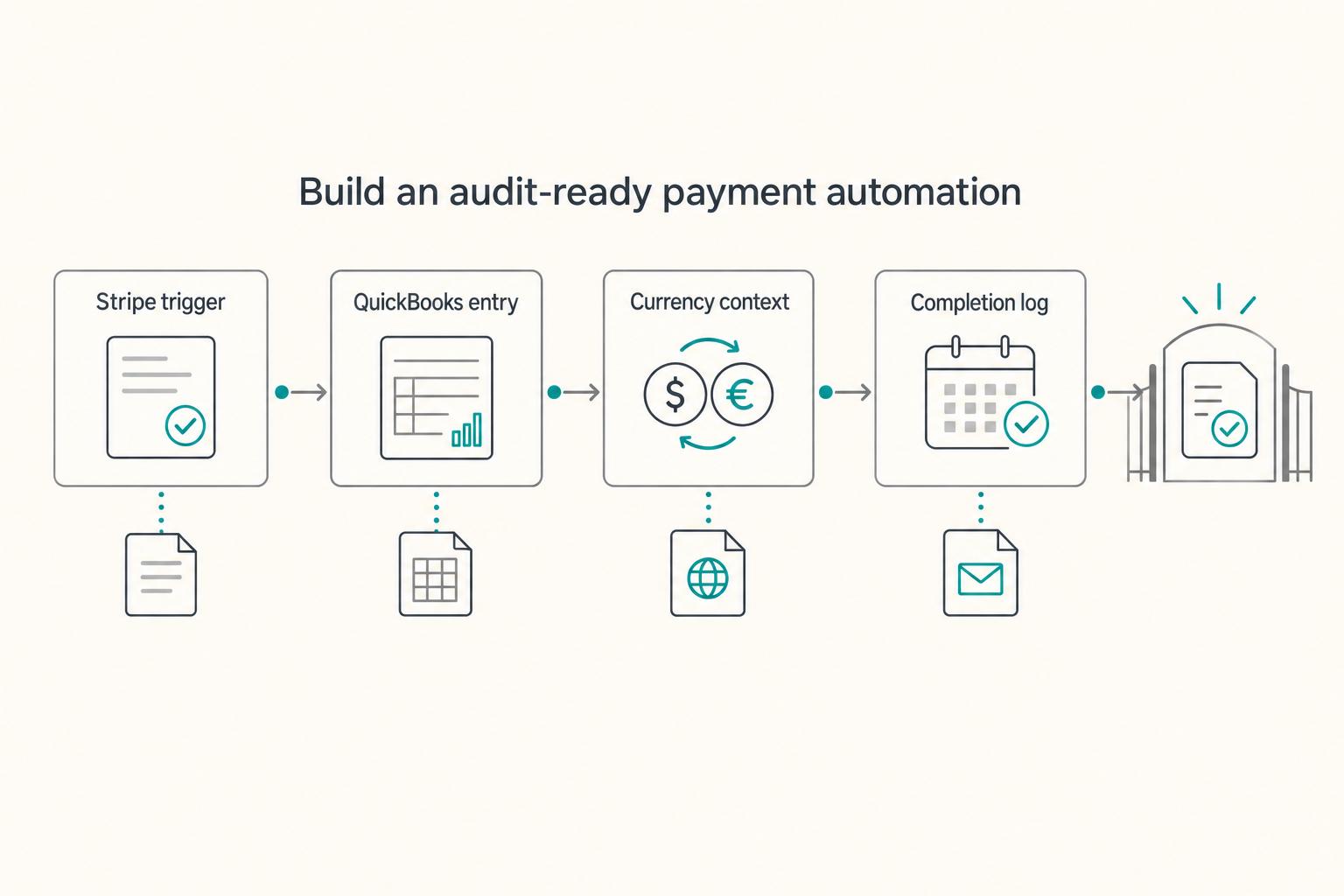
Automating Your Freelance Finances: A Zapier Workflow for Connecting Stripe, QuickBooks, and Wise
Start with one payment flow you understand, then automate its accounting record without losing the source reference. Stripe captures payments, QuickBooks holds the books, Zapier connects the selected steps, and Wise records any separate cross-border balance or conversion activity.
Opening a Hong Kong Bank Account as a Foreigner With Fewer Delays
Opening a Hong Kong account as a foreigner is possible in some cases, but success usually comes down to eligibility and routing, not form filling. Access, document checks, and whether you can start remotely all depend on the provider you choose.

The Freelance Payment Penalty: A Modeled Audit of Platform Fees, FX Spreads, and Payout Delays
The money rarely disappears through a single, easy-to-spot fee. The real loss is stacked. A marketplace takes its commission, a processor adds a charge for international cards, a bank or payment company converts the currency at a spread, a platform holds the funds before release, and a wire sheds a little to intermediaries on the way in. Each layer looks defensible on its own, but the worker feels the combined result as a smaller deposit and a later payday.