

Quick Answer
Start with control, not complexity: for saas international pricing, define your localization type, choose a global or regional architecture, and make FX ownership explicit in customer documents. If your base is still concentrated in the United States and North America, a simpler structure is usually easier to operate. Move to market-level price books only after repeat signals show conversion or margin problems by region. Then review settled cash outcomes monthly and adjust one variable at a time.
Why cashflow protection should lead your international pricing decisions#
If you are a freelancer or a small team selling software across borders, protect cashflow first. The first job is not maximizing conversion in every market. It is building an international pricing approach that works from quote to invoice to collection.
This guide takes that tension seriously. A lot of growth advice focuses on local willingness to pay, positioning, or value-based pricing. Those matter. But cross-border pricing gets harder because expectations and purchasing power vary by region, and operating conditions are not uniform. A price that looks strong on paper can still underperform once those differences show up in execution.
Measurement is the other trap. Once you sell into multiple countries, top-line revenue stops being enough. You need market-specific performance metrics to decide where to localize, where to keep a global price, and where to change packaging. If you cannot see how each market is actually performing, you are not really evaluating pricing. You are looking at list price and hoping the rest works out.
So the recommendation running through this article is simple: make growth changes in an order that preserves control. If your operations are still uneven, do not rush into aggressive regional pricing or complicated usage plans just because a benchmark says localized pricing can lift contract value. Those claims can be directionally useful, but they are not universal. And with usage-based models in particular, revenue can become less predictable if the fit is poor.
The path is practical. First, define the pricing terms people often mix up, especially the difference between cosmetic localization, currency localization, and true market-based localization. Then choose how deep your localization should go and whether one global price book or regional pricing fits your stage.
After that, map packaging choices to buyer risk and execution risk. Finish with a recurring review checklist so you can adjust based on operating data rather than guesswork.
Keep that sequence, and you are less likely to confuse more local with better outcomes. You are also more likely to end up with pricing that supports both growth and dependable collections.
Define the pricing terms before you change prices#
Start by naming the change correctly. Before you touch price points, separate presentation decisions, currency decisions, and market-level price decisions so you do not change the wrong lever.
Keep model, strategy, and regional pricing distinct#
A pricing model is the structure you use to balance value and revenue. A pricing strategy is broader and depends on your product or service, company maturity, operating scale, and target customer type. Regional pricing is a strategy choice where you adjust prices by customer location, and it is often labeled geo, geographical, or international pricing.
Separate currency choices from market-based price changes#
If you only change how currency is shown or charged, that alone is not regional pricing. Regional pricing starts when you set different approved price levels by market based on local context and willingness to pay.
Why this boundary matters in operations#
These terms are easy to blur, but the fixes are different. If a team treats a currency change as a pricing strategy change, it can miss the real issue. If it changes market price levels before packaging, billing, and collections rules are clear, charge questions and dispute handling get harder.
Related: How to Handle Multi-Currency Pricing for Your SaaS Product.
Choose your global or regional price architecture#
Start with the simplest structure you can operate well, then move to regional pricing only when repeated evidence shows the global list is no longer holding up. This choice affects acquisition, revenue outcomes, and market position, so treat it as an operating decision, not just a pricing-page decision.
| Option | Operational complexity | Margin stability | Buyer clarity | Update overhead |
|---|---|---|---|---|
| Single global list | Lower. One approved price architecture is easier to run across quoting, billing, and renewals. | Less stable when region-by-region FX effects, payment costs, or discount pressure differ. | Clearer for internal teams; some buyers may still see converted prices as "imported." | Lower. Fewer price books, approvals, and renewal exceptions. |
| Regional pricing by market | Higher. You need governed price points by geography and tighter catalog controls. | Can be more stable when local purchasing patterns differ in meaningful ways. | Can improve local fit if region rules are easy to explain. | Higher. Changes must be reviewed across regions, currencies, and customer messaging. |
If your customer base is still mostly in the United States and North America, keep the architecture simple first. If conversion gaps or margin variance by region keep recurring, move to regional tiers.
If you are already selling into Western Europe and Japan, you may need localized price books sooner because currency handling and purchasing differences can surface faster in those markets.
Document one explicit trigger for switching from cosmetic localization to market-based price changes, and keep it in your pricing decision log:
- Conversion weakness persists in a region after currency localization is already live.
- Margin compression keeps recurring after fees, FX handling, or repeated exceptions.
- Sales or success repeatedly asks for the same country-specific pricing exceptions.
Keep a final operational checkpoint: if your billing system cannot reliably assign the right price book at quote, invoice, and renewal, stay with the simpler architecture until it can.
Map packaging models to market and buyer risk#
For most small teams, start with packaging that keeps invoices clear and operations simple, then add usage complexity only when your metering and invoicing controls are reliable.
Pricing model choice influences acquisition, perceived value, upgrades, retention, and lifetime value, but no single model is universally best. The fit depends on your product, market, and growth strategy, including how buyers in each region evaluate value.
| Packaging model | Predictability | Dispute risk | Billing complexity |
|---|---|---|---|
| Flat-rate pricing | More predictable when scope and inclusions are explicit, since the charge is fixed regardless of users or usage. | Usually lower when "included vs not included" is unambiguous in contract and invoice language. | Lower. Easier to quote, invoice, and renew. |
| Usage-based pricing | Less predictable unless customers can forecast consumption and verify billed usage. | Can increase when usage logic or invoice detail is hard to validate. | Higher. Requires dependable usage capture and billing controls. |
| Tiered pricing | Can be predictable when tiers clearly map to customer needs and outcomes. | Can increase when tier boundaries or upgrade triggers are unclear. | Medium. Tier rules must stay consistent across sales, billing, and support. |
| Per-user pricing | Can be predictable when seat-count rules and timing are clear. | Can increase when seat changes or seat status are hard to reconcile. | Medium. Needs clean seat assignment and renewal handling. |
| Per-feature pricing | Depends on how clearly package boundaries are defined in your offer and billing setup. | Can increase when package boundaries are hard to explain or audit. | Medium to high. Access and billing rules must stay aligned. |
| Freemium pricing | Lower near-term cashflow predictability for paid revenue. | Can increase around upgrade events, limits, and account-state changes. | Medium to high. Transition states add operational edge cases. |
If invoice disputes are rising, reduce package ambiguity before adjusting regional price points. Tighten one of these first: seat-count rules, tier boundaries, or usage measurement logic.
A simple practical check: your invoice should match what your systems can prove. For per-user models, keep an exportable seat history. For usage-based models, keep logs or usage reports that reconcile to billed quantities. For tiered models, keep order form terms, entitlement rules, and invoice labels aligned.
Packaging also affects willingness to pay by region. Clear tier-to-need mapping can improve acceptance of higher tiers, but the strongest package fit can vary by market. If regional pricing pressure is increasing, test whether the issue is package fit before changing price levels and packaging at the same time.
Control FX exposure and protect revenue predictability#
FX exposure should be assigned upfront, or it will show up later as margin drift and noisy reporting. In practice, risk can enter at every step: quote, invoice, collection, conversion, payout, and reporting.
| Money lifecycle point | Where FX risk appears | What to lock down |
|---|---|---|
| Quote | Price is accepted now, but settlement may happen at a different rate later | Set quote validity and state what happens if rates move before invoicing |
| Invoice | Billing currency differs from your operating or reporting currency | Keep invoice currency explicit and consistent with the order form |
| Collection | Payment rails or processors may convert funds before they reach you | Confirm whether the payer, processor, or you absorb conversion movement |
| Conversion | Foreign funds are exchanged into your operating currency | Define when conversion happens and whether balances are held first |
| Payout | Settlement timing can add rate movement before funds arrive | Align payout timing with cash needs and planned margin |
| Reporting | Revenue is reported in a base currency while transactions happened in others | Separate operating performance from FX impact |
Use this order of operations each cycle: set quote validity, decide who carries FX movement between quote and settlement, then align conversion and payout timing to that policy.
Decide the owner of FX movement before localizing currency#
For early-stage teams, a single-currency model can reduce administrative overhead. One guide suggests evaluating multi-currency pricing when international revenue is consistently around 10-15% of ARR, but that is a practical trigger, not a universal rule.
If you bill in local currency, make FX ownership explicit in customer-facing documents. Silent ambiguity is the usual failure mode: sales, finance, and support each assume a different rule.
Reconcile realized FX impact against margin and revenue recognition#
Run a simple planned-vs-realized checkpoint each cycle across invoiced amount, net collected amount, and base-currency reported amount. This helps you identify whether variance came from price, fees, timing, or FX, and it keeps revenue recognition assumptions aligned with what actually settled.
Constant currency analysis is useful here because it strips out exchange-rate effects and makes underlying operating performance easier to read. Be cautious with broad external benchmark claims about localization uplift unless the segment and payment setup clearly match your own operation. Related reading: A Guide to GDPR Compliance for SaaS Businesses.
Set invoice and payout rules that reduce delays and holds#
Once you decide who absorbs exchange rate movement, make the billing promise unambiguous. In SaaS, payment friction is often caused less by the price and more by unclear terms, inconsistent routing, or billing setups that leave room for dispute after invoicing.
Your minimum contract and billing packet should be explicit: price currency, invoice due date, any late-fee terms you plan to apply, refund boundaries, and the path for billing disputes. If regional pricing or currency localization changes the customer-facing amount, keep the billing currency aligned across the order form, invoice, and collection setup. A common failure mode is selling one promise in the quote and collecting on another in the processor.
Build for reconciliation, not just invoice delivery#
The key control is traceability from pricing rule to invoice to settlement to payout. Before each billing cycle goes live, confirm every plan can be followed end to end with a usable evidence pack: accepted quote or order form, invoice, payment confirmation or settlement report, payout notice, and any linked refund or dispute record.
Billing operations do not end at invoice generation. They also include receiving payments, reconciling them, handling collections, and accounting for what actually arrived. In cross-border collections, funds can pass through multiple institutions, conversions, and regulatory checks, which creates more failure points for amount, timing, or reference data.
Choose routing with cashflow in mind#
Routing decisions directly shape cashflow speed and failure risk. If you offer local methods, cards, or bank-based rails, decide in advance which route fits each customer type and what payout timing pattern to plan around. Keep the route set tight early on, because every added path creates another reconciliation branch and another way for funds to arrive late or without a clean match.
Watch these failure modes closely:
- Unmatched deposits: funds arrive without a clean invoice or customer reference.
- Payout reversals: a payout appears complete, then gets adjusted after a refund, dispute, or processing issue.
- Policy-triggered holds: settlement is delayed while the provider reviews the payment flow.
If these issues recur, do not default to more manual exceptions. Check whether packaging complexity is driving confusion first. Subscriptions, usage charges, and plan changes can create billing edge cases, so simplifying plan boundaries often reduces dispute and collection friction faster than another pricing experiment.
Build the compliance and tax evidence pack before you scale#
Before you scale international pricing, make your documentation pack complete enough to trace what you billed, what you collected, where funds settled, and why your team chose that structure. Treat it as an operating control, not cleanup work.
Keep the core records together#
Keep these artifacts audit-ready in one place:
| Record group | Keep audit-ready |
|---|---|
| Invoice records | Final invoice; any credit note; accepted order form or quote; and the billing currency shown to the customer. |
| Payout confirmations | Settlement report; payout notice; bank credit confirmation; and any reversal or reserve adjustment notice. |
| Policy decisions | The written decision on pricing method; payout routing; refund rules; and who absorbs FX movement. |
| Reconciliation exports | Export tying invoice amount, fees, conversion, net settlement, payout date, and general-ledger mapping. |
A quick test: pick one recent cross-border transaction and confirm you can trace it end to end without rebuilding context from inboxes or screenshots.
Know the U.S. reporting terms before they surprise you#
If you have U.S. tax exposure, recognize these terms early:
| Term | What to know |
|---|---|
| FATCA | Foreign Account Tax Compliance Act. |
| Form 8938 | Used to report specified foreign financial assets when value is above the applicable threshold; attached to the tax return. |
| FBAR | Report Foreign Bank and Financial Accounts. |
| FinCEN | Publishes the FBAR filing page and due-date guidance. |
| Schedule SE | A form name you may encounter in cross-border tax discussions. |
Do not treat Form 8938 as one universal threshold. Thresholds vary by filer context, including higher thresholds for some joint filers and taxpayers residing abroad, and instructions also reference certain specified domestic entity thresholds such as $50,000 at year-end or $75,000 at any time during the tax year.
Confirm before you change structure#
Before you change pricing structure, open foreign accounts, or reroute payouts, confirm reporting impact with a qualified advisor. Requirements vary by country and program, and operational changes that improve collections can still create new filing work.
Bring the evidence pack to that discussion first. Advisors can assess obligations faster from invoices, payout records, account statements, and written policy decisions than from a retrospective verbal summary.
Run a monthly pricing and cashflow review checklist#
Run this review every month, and base decisions on settled cash rather than billed revenue.
| Review step | What to check |
|---|---|
| Net receipts by region | Compare planned vs. actual net receipts by region to spot fee leakage, FX drift, or payout-path issues. |
| Conversion, disputes, and late payments | Review patterns by packaging model and region so you are judging repeatable settlement behavior, not just top-line movement. |
| Sample customer trace | Trace at least one sample customer from contract to cash in each focus region: agreement, invoice, payment, conversion, payout, and ledger mapping. |
| Cycle decision | Make one decision per cycle: keep, test, or rollback. |
Use a simple decision rule each month:
- Keep when cash collection behavior is stable.
- Test when the issue is isolated to one region, package, or currency path.
- Rollback when a change improved surface metrics but weakened collections or made reconciliations harder to support.
Log the rationale in plain language: what changed, where it changed, what evidence you reviewed, and why you chose keep, test, or rollback. That decision trail makes future pricing changes easier to explain and repeat.
For a step-by-step walkthrough, see SaaS Usage-Based Pricing for Predictable Cashflow and Fewer Disputes.
If you want a quick next step on international SaaS pricing, try the free invoice generator.
Conclusion#
Strong international pricing is less about picking one clever number and more about keeping four decisions aligned: localization, price architecture, packaging, and predictability. If those pieces do not agree, you can look competitive on the pricing page and still create avoidable margin pressure.
The sequence matters because each step constrains the next one. Start by defining your terms so you do not confuse cosmetic localization with market-based price changes. Then choose your architecture: a single global list or regional pricing by market. That choice gets more complex as you expand internationally, and it can affect customer acquisition, revenue optimization, and positioning, so it should be explicit, not accidental.
Next, set packaging rules that your billing and support teams can actually defend. Pricing models determine how customers are charged, and each one has different benefits for different customers. If you use usage-based pricing, plan overages deliberately: overage design affects revenue and customer satisfaction, and cost predictability is a major enterprise concern.
From there, keep execution disciplined and isolate variables. If you change price levels, packaging, and overage policy all at once, it becomes harder to tell what actually improved outcomes.
The most useful next step is small and disciplined. Start with a limited set of regions or segments and verify:
- global vs regional architecture choice
- package model fit for your target customers
- usage and overage logic, including predictability impact
- acquisition, revenue optimization, and positioning signals
Then make one decision per cycle: keep, test, or rollback. Expand changes only where your own operating data supports them. That is the practical version of an international pricing strategy: define the terms, choose the architecture, set package rules, and review results on a consistent cadence so growth does not outrun predictability.
Frequently Asked Questions
What is SaaS international pricing in practical terms for a small team?
In practice, it is deciding what customers see and what they are charged across countries. That usually means choosing whether to keep one global list or use regional pricing, whether to localize only currency and language, and whether your packaging stays flat-rate, tiered, per-user, or usage-based.
When is cosmetic localization enough, and when should you move to market-based localization?
Cosmetic localization can be enough when you are mainly adapting presentation, such as currency or language, without changing local price levels. Move to true market-based localization when evidence shows willingness to pay differs by market. The key distinction is that currency localization is presentation, while market-based localization is a pricing decision.
Can you keep one global price and still stay competitive internationally?
Yes, sometimes. A single global price can work when your customer segments behave similarly. But segment fit is a core pricing question, so if one-size-fits-all is not working for all customer types, test regional or segment-specific models.
How often should international SaaS prices be reviewed?
There is no fixed review cadence. Use a consistent review rhythm your team can sustain, and change prices only when your segment and regional evidence supports a change.
How do exchange rates change what you actually collect from clients?
At a practical level, treat exchange rates as a potential gap between displayed price and realized receipts, and validate that impact with your own billing and settlement data.
Do you need different packaging models in different regions?
Not always, but you should not assume one model fits every segment or market. Flat-rate, per-user, tiered, and usage-based models are all valid options, and some SaaS companies use hybrid subscription-plus-usage approaches.
What is unknown if you rely only on high-level market stats without your own operating data?
You still do not know whether those patterns will hold for your product and customer segments. External benchmarks can show that regional variation exists, but they do not prove the same pricing response in every market. Use your own operating results to validate pricing and packaging changes.
Try a related tool
Researched and edited by the Gruv editorial team. Gruv builds cross-border billing, payouts, and finance-operations software for global businesses.
Sources
Includes 2 external sources outside the trusted-domain allowlist.
- dawsoncountyga.gov/DocumentCenter/View/1444trusted
- fincen.gov/report-foreign-bank-and-financial-accountstrusted
- irs.gov/businesses/corporations/do-i-need-to-file-fo...trusted
- irs.gov/forms-pubs/about-form-8938trusted
- sec.gov/Archives/edgar/data/1666134/0001628280260119...trusted
- sec.gov/Archives/edgar/data/1997403/0001376474260002...trusted
- dnagrowth.com/the-saas-audit-checklist-is-your-financial-m...external
- gatilab.com/understanding-saas-pricing-models-per-seat-u...external
Educational content only. Not legal, tax, or financial advice.
Related Posts
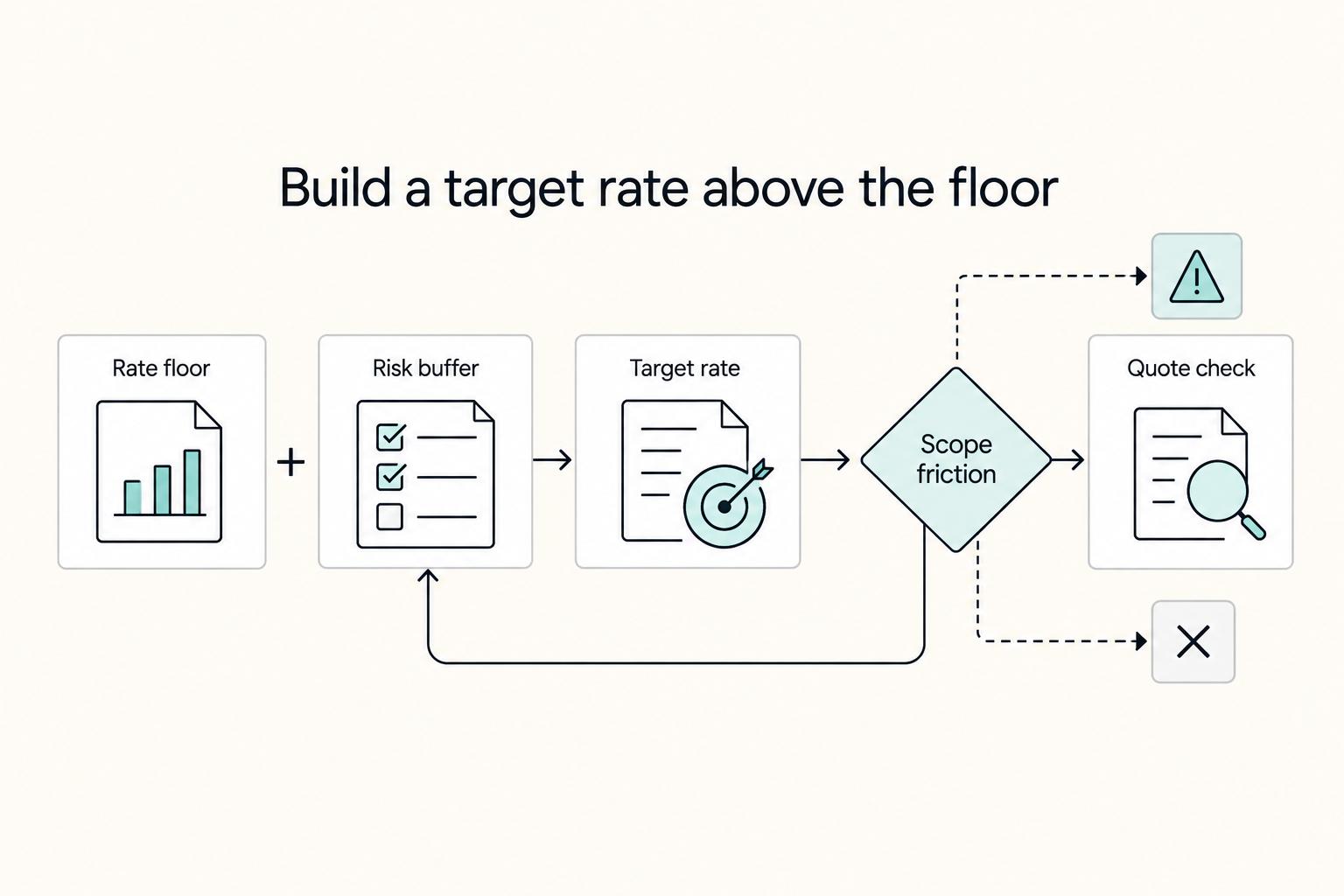
How to Calculate a Freelance Rate You Can Actually Get Paid On
A workable rate is not the neat number a calculator produces. It is the number that still works after you account for real billable capacity, non-client time, scope drift, and the gap between sending an invoice and receiving cleared cash. Start with hourly math even if you do not plan to bill hourly, then turn that number into a quote with clear `payment terms`.

How to Handle Multi-Currency Pricing for Your SaaS Product
**Treat SaaS multi-currency pricing as a get-paid system, not a checkout feature.** If you only localize the price label, you miss the points where margin and cash timing break. As the CEO of a business-of-one, your job is to make "getting paid" boring and predictable, even when you sell globally. Start by linking presentment, settlement, and payout so your setup can absorb delays and FX movement as you expand.

International Expansion for SaaS With a Three-Stage Operating Framework
Before you spend on localization or outreach, lock down four unglamorous basics: your entity setup, your day-count tracker, your contract language, and your invoice controls. The exact legal and tax treatment of these items is jurisdiction-specific, so verify the details before you rely on them.