
Quick Answer
Choose compatible software or a digitally linked bridge, then add custom automation when your period records and approvals work reliably. Confirm MTD scope and exemptions, reconcile the VAT account, approve the return and retain HMRC acceptance. Resolve uncertain submissions before retrying; filing acceptance and VAT payment remain separate checks.
Why MTD for UK VAT Needs Both Speed and Control#
If you operate a platform and need to automate UK VAT reporting, the practical path is usually staged. Get MTD-compliant filing working first with compatible software. Then add deeper automation once you can show your digital records tie to submitted VAT return totals.
MTD for VAT requires digital VAT records and software filing for VAT-registered businesses, subject to exemptions. Mandation extended below the registration threshold from April 2022. Monthly and quarterly returns ceased using the old VAT online account from November 2022; confirm the route applicable to your registration.
- Start from the legal minimum
You do not need to begin with a custom HMRC API build to be compliant. HMRC allows either compatible software or bridging software that connects non-compatible tools, including spreadsheets, to HMRC systems.
- Plan for multi-owner accountability
This guide is for compliance, legal, finance, risk, and engineering owners who must ship automation and explain it to internal reviewers. A practical failure mode is not "the return would not send," but "the return sent and the team cannot show how totals were derived, who approved them, or what changed after an exception."
- Move from manual returns to checkpointed automation
This is an operating recommendation, not an HMRC rule. Start with a testable checkpoint: can you trace source transactions to return-ready totals and retain filing confirmation from your software? Then define exception handling. When totals do not reconcile or a submission is rejected, is there a named owner, a documented fix, and a record of what changed before resubmission?
Use current VAT Notice 700/22 and HMRC exemption guidance for scope. Historic below-threshold wording in an API catalogue is not an alternative to the April 2022 extension.
Record whether your business is in scope or exempt, then document the compatible software chain and filing owner.
The upside is practical. HMRC's policy note says users of compatible software have reported faster VAT return preparation and greater confidence in getting their tax right. The tradeoff is equally practical. Filing software can speed submission without fixing weak record-keeping, missing approvals, or poor exception handling. The sections that follow focus on the lightest path to compliance without creating hidden control risk.
How to choose an MTD acceleration path#
Choose the path that closes your immediate compliance risk first, then expand. In practice, that often means getting UK VAT filing working through MTD-compatible software, then deepening automation once the records and approvals are defensible.
- Set scope before choosing tooling
Separate two jobs: filing VAT returns under Making Tax Digital for VAT (MTDfV), and improving upstream VAT record-keeping. HMRC frames MTDfV as both digital record-keeping and return filing, so a clean submission layer does not fix weak records. If your immediate requirement is UK MTD filing, keep phase one narrow: compliant software filing, digital records for the UK VAT scope in question, and retained filing evidence.
- Choose by constraints, not preference
The available routes are compatible software, bridging software, and software that interacts directly with HMRC via the MTD APIs. HMRC allows hybrid setups across multiple products if they are digitally linked. Direct API integration is valid when your team can build and test against HMRC's developer flow, but it increases operational ownership. Also assign ownership for software access renewals, since authority can lapse after 18 months.
- If lineage is weak, start software-led
If you cannot clearly trace submitted totals back to source transactions, a direct API build is usually better as a later phase. A software-led route can limit initial build complexity while you fix traceability, approvals, and exception handling. This is also practical because, since 1 November 2022, regular VAT returns cannot be filed through the old VAT online account and must follow a supported software route.
- Be explicit about who this is not for
This path is not for teams seeking a one-off filing fix with no ongoing owner. Automation only holds if someone owns recurring review, exceptions, and evidence retention. Confirm scope before building: MTDfV includes defined exemptions in some cases, including insolvency procedures.
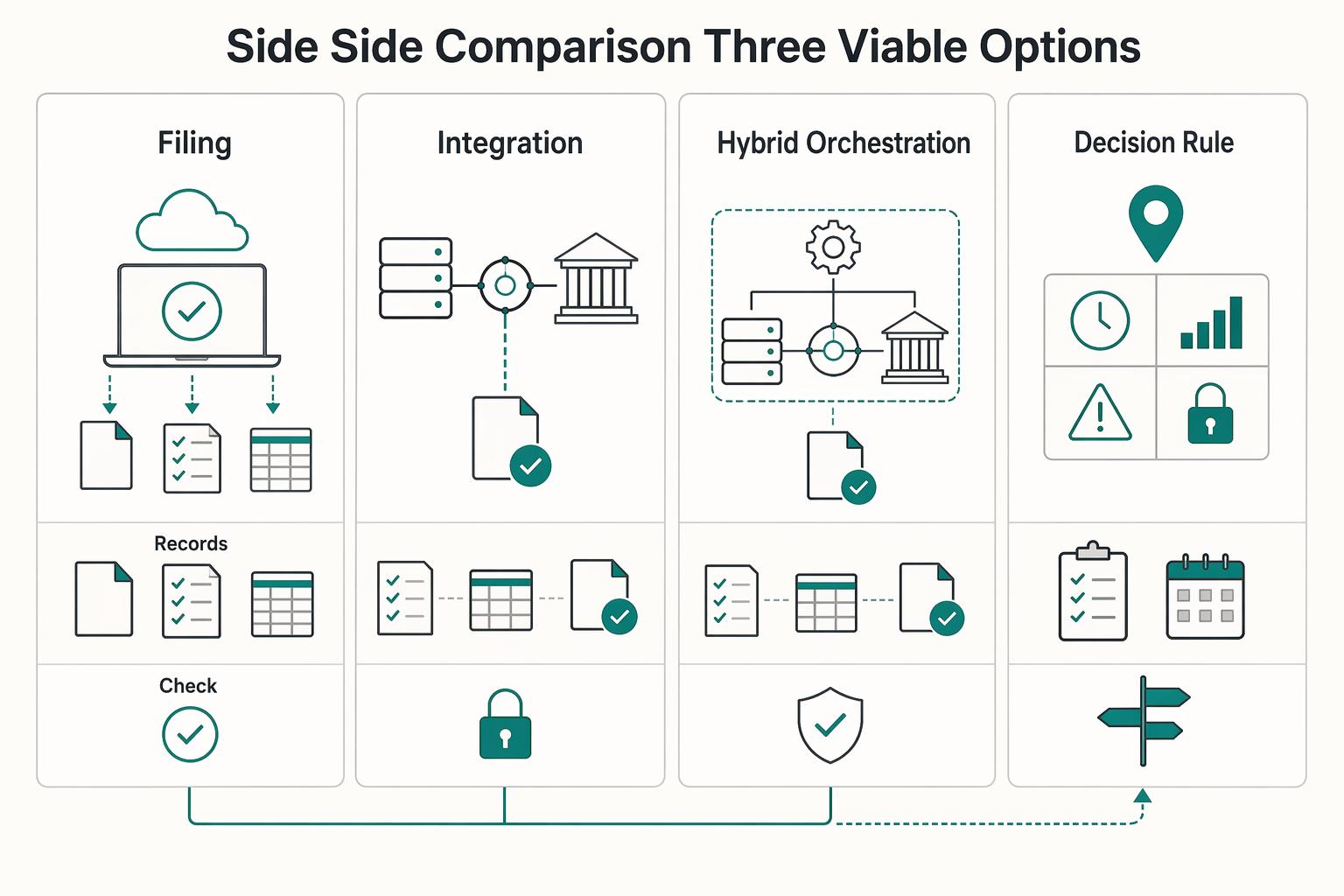
Side by side comparison of the three viable options#
For UK VAT filing under Making Tax Digital for VAT (MTDfV), choose the route based on ownership as much as tooling. A software-led or bridging route can be practical when filing continuity is urgent and controls are still maturing. Direct API or hybrid can fit teams that want more internal ownership and can operate it reliably.
HMRC's baseline stays the same across routes. Businesses in scope must keep digital VAT records and file VAT Returns using software, including software that communicates with HMRC through its API platform. What changes is who owns validation, exception handling, and audit evidence assembly.
| Option | Best for | Control depth | Implementation effort | Failure visibility | Dependency risk | Audit evidence quality for MTDfV |
|---|---|---|---|---|---|---|
| Off-the-shelf filing software | Teams that need a compliant filing path within vendor workflows | Vendor-defined controls, plus your internal review steps | Product setup, process design, and evidence export procedures | Usually clear submission status in-product; external lineage depends on exports | Vendor dependency | Strong when you retain submission confirmations, return outputs, and approval records |
| Direct HMRC API integration | Engineering-led teams that want custom validation, routing, and telemetry | Defined by what you design, monitor, and enforce | Build, test, operate, and evidence-capture responsibilities stay in-house | Strong only if requests, responses, errors, and reconciliations are fully instrumented | Internal ownership dependency | Strong only if payload lineage, approvals, and HMRC outcomes are archived together |
| Hybrid orchestration | Teams that need compliance now with phased internal control expansion | Split across vendor and internal components | Ongoing alignment across two operating layers | Split unless tool events and internal checks are joined per filing period | Dual dependency (vendor + internal) | Strong only when cross-system evidence is tied to the same period record |
| Decision rule | If filing continuity is urgent and controls are still maturing, a software-led route is often practical; API or hybrid can fit teams that want more internal ownership. | Match route to current control maturity | Do not build past your ability to support period close | Visibility matters only if exceptions are reviewed each period | Accept dependency only with explicit ownership | Evidence quality depends on process discipline, not product label |
1. Off-the-shelf filing software#
Use this route when finance needs a predictable filing path this period and engineering capacity is limited. HMRC's software guidance (last updated 1 May 2025) describes compliant routes as a compatible software package or bridging software, so this is often a practical path to MTDfV filing operations.
For a software-led shortlist, confirm the product on HMRC’s compatible-software finder and test your actual record-to-return flow. Ask for submission outcomes, correction handling and usable exports; a vendor’s advertised validation count does not prove your return is correct.
Checkpoint: confirm you can retrieve period figures, submission confirmation, and approver trail without manual reconstruction. A common gap is treating a vendor "submitted" status as complete evidence when reviewers still need traceability back to digital records.
2. Direct HMRC API integration#
Use direct API when you need to own validations, exception routing, and observability instead of relying on a vendor-defined submission flow. HMRC's API page states software can "interact directly with our systems via the MTD APIs," so this is a valid path when you can support the operational controls around it.
The key tradeoff is ownership, not automatic quality. You control how returns are assembled, what checks run, how failures are escalated, and what evidence is retained. richpeck/vat-mtd on GitHub is a representative code-level pattern because it is described as a "Ruby implementation of HMRC's VAT (MTD) API," but it is not official product guidance.
Checkpoint: prove a clean chain from source totals to submission artifacts and HMRC outcomes. The common failure mode is building the submission call but underbuilding the review and evidence layer.
3. Hybrid orchestration across software and API#
Use hybrid when you need near-term filing stability and a staged move to more internal controls. HMRC explicitly includes a bridge-style path via "bridging software to connect non-compatible software (like spreadsheets) to HMRC systems," which supports split operating models.
The practical advantage is phased ownership. Keep vendor-led filing for current cycles while moving higher-risk checks, reconciliations, or approval logic into internal systems over time.
Checkpoint: stitch evidence across systems for each VAT period so tool output, internal validation results, and HMRC acceptance clearly map to the same filing record. The common failure mode is split visibility, where teams see different statuses and cannot prove which approved figures were filed.
Option 1 Use MTD software first#
Use this option when your immediate goal is a compliant MTDfV filing process through an existing software workflow, rather than building and operating your own HMRC API integration.
- Best fit
VAT-registered businesses in scope must keep the specified digital records and file using compatible software. Confirm any exemption before choosing the operating route.
- What this route includes
HMRC's compatible software guidance (last updated 1 May 2025) sets out two paths: a compatible software package or bridging software for non-compatible tools such as spreadsheets. That means you may be able to run MTDfV without rebuilding your full tax data stack first, provided you keep a clear chain from digital records to the filed return.
- Representative patterns
A filing product and a broader tax-compliance tool can support different review workflows. Compare them using the same period data and require evidence of actual record, approval and submission behavior.
- Control checks before you commit
A prebuilt software route can reduce implementation work for filing to HMRC. You still need to verify that review, exception handling, and evidence capture fit the product's operating model. Before you commit, verify in the live product that you can:
- Retain or export the period figures that were filed.
- Preserve HMRC acceptance or rejection outcomes.
- Show approver actions without reconstructing from side channels.
- Manage HMRC software authorisation renewal, which HMRC says lasts 18 months.
One risk is treating a vendor "submitted" status as complete evidence. Keep a single period file that ties reviewed figures, approvals, filed values, and HMRC outcome to the same VAT period.
Option 2 Build direct HMRC API integration#
Choose direct HMRC API integration when you need more control over how VAT filings are prepared and submitted in your own systems. Under Making Tax Digital for VAT (MTDfV), VAT-registered businesses must keep records digitally and file VAT Returns using software, and that software communicates with HMRC through its API platform.
- Best fit
This route can suit teams that want clearer internal evidence of how filed figures were produced, checked, approved, and submitted. Since 1 November 2022, HMRC says routine quarterly or monthly VAT Returns can no longer be sent through the old VAT online account, so software-based filing is the operating path.
- Reference implementation only
Use richpeck/vat-mtd on GitHub as a reference point for request flow and client structure. Treat it as an example implementation, not evidence of HMRC approval or production readiness for your environment.
- What production design should include
HMRC provides a sandbox endpoint (https://test-api.service.hmrc.gov.uk) and a production endpoint (https://api.service.hmrc.gov.uk), with guidance to integrate and test in sandbox before live use. In practice, teams often include:
- Environment separation: isolate sandbox and production credentials, endpoints, and logs.
- Submission evidence: retain filed figures, approver record, and HMRC acceptance or rejection outcome for each VAT period.
- Fraud-header handling: capture and transmit all available fraud header information with related tax information, as required by HMRC's direction.
- Failure traceability: record validation failures, API errors, and resubmissions so finance and engineering can trace each return period.
- Main tradeoff
The advantage is greater control in your own process design. The tradeoff is ongoing ownership: API maintenance, compliance review, and period-close evidence retention need clear accountable owners before go-live.
Option 3 Run a hybrid model#
A hybrid model can be a practical path when you need MTDfV filing live soon but want stronger in-house controls over time. Start with software-led submission, then move high-risk controls, such as validation, exception routing, and evidence capture, into your own HMRC API layer as operations stabilize.
HMRC's baseline does not change in this model. VAT-registered businesses must keep records digitally and file VAT Returns using software, and that software communicates digitally with HMRC through the API platform. Hybrid changes where controls sit first, not the requirement itself.
- Use compatible or bridging software as the submission shell
Use a compatible software package, or bridging software if finance still prepares figures in spreadsheets. HMRC allows both routes, provided the electronic account and digital-link requirements are met. This lets finance retain suitable spreadsheets while improving upstream data and process controls.
Track software authority as an operational control: HMRC states the authority lasts 18 months. If that authority lapses, submissions may be interrupted even when figures are correct.
- Migrate high-risk logic before final filing
Once submission is stable, move the controls most likely to create filing risk into your own application layer first, such as validation rules, reconciliations, exception categorization, and approval evidence. Use HMRC Developer Hub materials and reference implementations like the Ruby-based richpeck/vat-mtd repository to understand API flow, while software continues to submit live returns.
Avoid split-truth operations. For each VAT period, define one source of truth and keep one evidence pack: source totals, adjustments, approver record, software output, and HMRC acceptance or rejection outcome.
- Treat governance as the main hybrid cost
Hybrid can reduce cutover risk, but it adds governance overhead across compliance, finance, and engineering. If ownership is unclear, you can end up with two partial processes and weak auditability.
Resolve scope using current HMRC VAT guidance: below-threshold VAT-registered businesses entered MTD from April 2022, subject to exemptions. Do not build a voluntary-use branch from obsolete catalogue wording.
Control checkpoints before you automate filing#
Do not enable automated filing until accountability, data lineage and release checks pass. Businesses in scope of Making Tax Digital for VAT must keep the specified records digitally and submit through functional compatible software. HMRC exemptions and alternative arrangements can apply; confirm the business’s actual obligation before choosing its submission path.
| Checkpoint | What to confirm | Key detail |
|---|---|---|
| Accountability | Show who prepares figures, who approves the return, who can stop submission, and who retains period evidence | Assign responsibility for VAT record-keeping quality, draft return quality, and submission operations. |
| Data lineage | Run an end-to-end walkthrough from source transactions to return totals and back again | Trace required electronic-account transfers through digital links; document initial source entry and permitted adjustments separately |
| Go/no-go gates | Do not auto-submit when reconciliation does not tie, material exceptions remain unresolved, or period records cannot be produced digitally | Confirm the filing method returns HMRC receipt confirmation and store it with period evidence. |
- Set a minimum accountability layer before the first live return
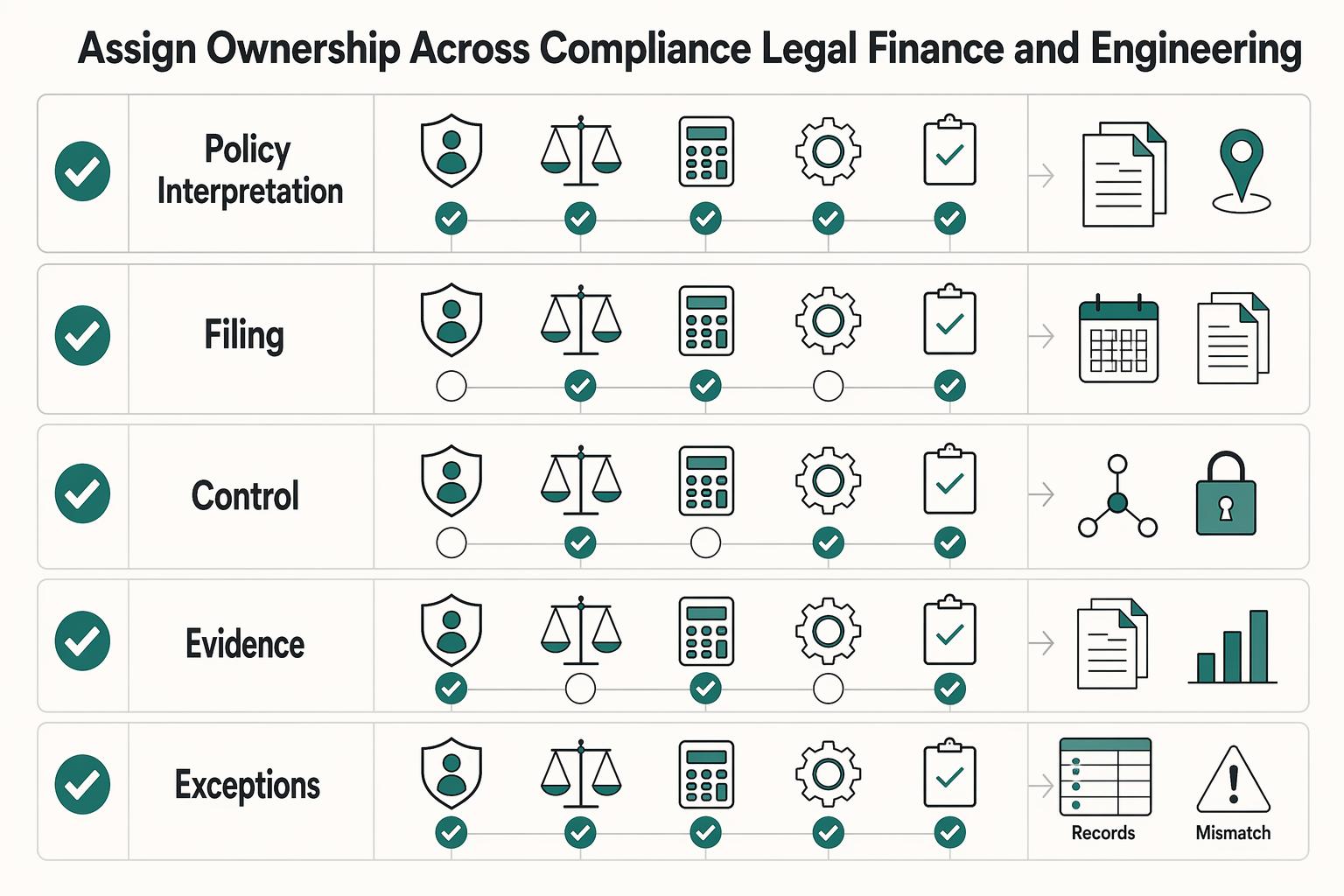
The cited HMRC guidance does not prescribe a specific internal org chart, but you still need clear ownership, approval, and evidence retention before automation starts. If you cannot show who prepares figures, who approves the return, who can stop submission, and who retains period evidence, you are not ready.
Keep the model practical: assign responsibility for VAT record-keeping quality, draft return quality, and submission operations, including engineering or external tooling where relevant. One person can hold multiple roles in smaller teams, but approval should still be explicit and documented.
Retention should cover both records and decisions. Records in the electronic account must be kept digitally in functional compatible software, and they should be complete, up to date, and sufficient to calculate VAT correctly. For each period, you should be able to retrieve return-ready totals, reconciliation output, approver records, and software receipt confirmation.
- Prove data lineage from source transaction to VAT return totals
Before automating, run an end-to-end walkthrough from source transactions to return totals and back again. This is the control that separates "we can submit" from "we can explain the submission."
Use a representative sample and trace where data enters the chain, how VAT treatment is applied, how adjustments are made, and how values flow into return totals. Test both directions: transaction-to-box total and reported total-to-source records.
Digital links are required between software components where the data remain part of the electronic account. Copying those totals manually is not a digital link. Initial entry from source invoices and permitted adjustment calculations have specific treatment under VAT Notice 700/22; document that boundary rather than banning every manual entry.
- Define go/no-go gates before live submission starts
Write submission gates before deadlines create pressure. HMRC does not publish a universal numeric threshold for unresolved exceptions or reconciliation breaks, so set internal tolerances and apply them consistently.
At minimum, do not auto-submit when reconciliation does not tie, material exceptions remain unresolved, or period records cannot be produced digitally. Define "material" in advance and document it.
If a gate fails, use controlled manual review: named reviewer, correction within the compatible software chain, rerun reconciliation, and record the reason for change. Avoid workaround filing through final manual copy steps.
Confirm the filing software returns HMRC receipt evidence and store it against the return period. If tax was underpaid, follow the applicable correction and payment process; do not infer a universal 30-day payment deadline from general compliance-check guidance.
Tighter gates may slow early automated periods, but loose gates create higher risk: faster filing with weak evidence. If reconciliation breaks or exceptions accumulate, pause automation for that period and revert to controlled manual review.
Before you lock in software, API, or hybrid, map your approval gates and evidence flow first, then pressure-test implementation paths in the Gruv docs.
Operating sequence for each VAT period close#
Use a repeatable close sequence: fix the period scope, reconcile first, run explicit approvals, submit, then confirm receipt before the usual deadline of one calendar month and 7 days after period end.
| Step | Action | Record or note |
|---|---|---|
| Lock the period | Record the cutoff time, included ledgers or exports, and any items held for review | If you are VAT-registered, you still submit a VAT Return even when there is no VAT to pay or reclaim. |
| Reconcile first | Tie source transactions to the VAT account, review adjustments, and only then generate the draft in functional compatible software | If you cannot explain return totals back to source records, stop and resolve that gap first. |
| Role gates | Define an internal role model and apply it consistently before submission to HMRC | A practical split is finance for numbers and reconciliation, compliance for VAT treatment or policy alignment, and a tooling owner for submission-path integrity. |
| Verify acceptance and archive | Confirm the software receipt that HMRC received the return, then archive the period evidence | Archive the return, approved figures, reconciliation, receipt and correction records. VAT records are generally retained for at least 6 years; longer periods can apply. |
- Lock the period before anyone builds the return
Start with a real cutoff for which transactions are in scope for that VAT period. HMRC does not require a step named "freeze period inputs," but your records still need to be complete, up to date, and sufficient to calculate VAT correctly under Making Tax Digital for VAT (MTDfV). Record the cutoff time, included ledgers or exports, and any items held for review.
Include nil periods in the same control path: if you are VAT-registered, you still submit a VAT Return even when there is no VAT to pay or reclaim.
- Reconcile tax-relevant transactions before generating draft VAT returns
Reconcile before you optimize filing mechanics. Tie source transactions to the VAT account, review adjustments, and only then generate the draft in functional compatible software. If you cannot explain return totals back to source records, stop and resolve that gap first.
Keep records and filing in compatible software through to final submission.
- Use role gates before the HMRC submission step
The submission step requires an explicit declaration that the return is correct and confirmation to submit to HMRC. HMRC does not prescribe your internal role model, so define one and apply it consistently.
A practical split is finance for numbers and reconciliation, compliance for VAT treatment or policy alignment, and a tooling owner for submission-path integrity via your filing software connected to HMRC's MTD APIs.
- Verify acceptance, then archive enough to defend the period
After submitting, confirm the software receipt that HMRC received the return, then archive the period evidence. Do not treat "sent" as complete until receipt is confirmed.
Consider setting named owners and internal SLAs for rejected submissions, mismatched totals found before filing, and errors found after filing. For post-filing errors, move to the formal correction process. Leaving errors uncorrected can create penalty and interest exposure.
Archive the submitted return, approved draft, reconciliation, approval and receipt evidence, plus later corrections. VAT records are generally retained for at least 6 years, rather than only up to 6 years; keep longer records where required.
Red flags that mean you should slow down#
If any of these are true, pause acceleration. These are UK VAT control risks, not just tooling gaps.
- You cannot trace return totals back to source records
Stop if you cannot explain a VAT return number from source transactions through to the submitted return. MTDfV requires digital VAT records and digital links from sales or purchase ledger data to VAT Return submission, so broken lineage can mean reconciliation is not ready for more automation.
Quick test: take one box total and rebuild it from the period data and adjustments used for that return. If the trail breaks, fix lineage before increasing HMRC API submission volume.
- Your team treats software output as final
Slow down when draft output is accepted without challenge before submission. Functionally compatible software can prepare and submit, but the submitter still has to declare the information is correct and confirm submission to HMRC.
Responsibility also stays with the business even if an agent files on your behalf.
- Exceptions are piling up and nobody can size the exposure
A growing exception queue is a filing-risk signal when no owner can quantify which periods or returns may be affected. Pause, assign ownership, and quantify impact before scaling automation.
For VAT periods starting on or after 1 January 2023, each late return normally adds one penalty point. The thresholds are 2 points for annual returns, 4 for quarterly and 5 for monthly returns. Reaching the threshold triggers a £200 penalty; each subsequent late return while at the threshold triggers another £200 penalty.
- You are expanding markets and reusing UK logic by default
Treat this as a stop signal: this MTDfV guidance is UK HMRC-specific. If you expand into other jurisdictions, do not assume the same record rules, submission path, or evidence expectations apply unchanged.
Reuse architecture where it helps, but validate legal and reporting controls market by market.
Evidence pack to keep for audits and internal risk review#
Keep a VAT-specific period pack linking digital records, return values and submission outcome. Update it for corrections and preserve records under the applicable retention schedule.
- Period file tied to each filing
Record VAT registration number, obligation period/key, source ledgers, VAT account reconciliation, adjustments, approved nine-box values and HMRC outcome. Retain invoices and supporting evidence required for the entries, as well as the data-transfer trail.
- Route and access decisions log
Document filing software, authorisation status, renewal owner and any access failure. After an uncertain submission response, establish whether HMRC accepted that period before attempting another filing.
- Deadline and penalty risk notes
Record the actual obligation due date and payment date, and the owner of any rejected return or post-filing correction. Keep VAT deadlines separate from Self Assessment tax-year dates; distinguish filing acceptance from payment completion.
If you can only improve one thing this quarter, make the period file complete and repeatable first. For related context, see HMRC Reporting Rules for Platforms for UK Marketplace Operators.
Conclusion#
Choose the route that matches your current control maturity, not the one that looks most advanced. For MTDfV, HMRC's baseline is digital VAT records and VAT Returns filed through compatible software, including software that connects through HMRC APIs.
- Start with compliance you can evidence
If you still rely on manual reconciliation, copy and paste between tools, or person-specific handoffs, a software-led route can be a practical first step. The key test is not technical ambition. It is whether you can show a clean, reproducible path from source records to submitted VAT figures.
- Deepen automation after filing is repeatable
A staged sequence is often practical: stabilize filing, prove controls, then expand automation where volume and risk justify it. HMRC's final evaluation (published 27 February 2025) reported that around 60% found their first MTD submission easy, rising to over 70% for ongoing submissions. That supports a measured ramp, not a forced big-bang rebuild.
- Use period evidence as the go/no-go check
Before adding complexity, make sure each period leaves a defensible record: reconciliation, approval, submission event, and software confirmation of receipt. HMRC states that after submission, confirmation is provided through the software. If you cannot reliably reproduce how totals were prepared and accepted, keep strengthening controls before moving to deeper integration.
HMRC phased mandation from April 2019 for VAT-registered businesses at or above the £85,000 taxable turnover threshold, then from April 2022 for VAT businesses below that threshold. The operating question now is how much of the digital filing chain you should own directly, and when.
If you want to turn this staged VAT control model into an executable rollout plan with clear ownership, start with a focused implementation discussion.
Frequently Asked Questions
What does Making Tax Digital for VAT (MTDfV) require from platform operators in practice?
VAT-registered businesses in scope must keep specified VAT records digitally and file through compatible software, subject to exemptions. Transfers within the electronic-account software chain require digital links. Initial entry from source documents and permitted adjustment handling are distinct from copying totals between linked systems.
What is usually the fastest compliant route for UK VAT reporting: software, HMRC API, or hybrid?
There is no public HMRC benchmark proving one route is fastest for every platform. If your immediate gap is compliant filing, a common route is compatible software, including bridging software where appropriate, and the old VAT online account route for quarterly or monthly returns ended on 1 November 2022. Direct API or hybrid routes are planning choices, not publicly benchmarked speed winners.
Which controls are mandatory before automating VAT returns?
The legal baseline is digital records, software-based filing, and digital links where multiple tools are used. You should also be able to trace return totals back to source records and reproduce that path, because HMRC may check records to confirm the right tax was paid. If reconciliation cannot be reproduced, your control position may be weak even if a return was submitted.
Who should own each step of submission, approval, and exception handling?
HMRC does not prescribe a fixed internal ownership model, so you need to define one and keep it stable. At minimum, assign clear owners for preparation, filing approval, and exceptions such as rejected submissions, broken digital links, or software authority issues. Track software authority status as an operational control, since HMRC says that authority typically lasts 18 months.
What should trigger escalation to specialist VAT counsel instead of internal handling?
Escalate uncertain VAT treatment or exemption eligibility to the responsible tax adviser. An outdated catalogue’s threshold wording does not change current MTD scope. Continue your usual filing route while awaiting HMRC’s exemption decision.
What evidence should we retain to defend our HMRC filing process?
Keep the digital records used for the return, the reconciliation to VAT figures, approval records, submission confirmations, and software sign-up or authority records. Retention should align with VAT record-keeping expectations, which are generally at least 6 years. Your strongest pack shows the full digital path from source data to submitted return, especially when multiple systems are involved.
Which claims about implementation speed, integration depth, and effort are still unknown from current public sources?
Public sources do not provide definitive delivery-time benchmarks across compatible software, direct HMRC API builds, and hybrid models. They also do not provide reliable fixed estimates for engineering effort or failure rates by route. Open-source examples such as richpeck/vat-mtd should be treated as exploratory references, not production benchmarks.
Try a related tool
Researched and edited by the Gruv editorial team. Gruv builds cross-border billing, payouts, and finance-operations software for global businesses.
Sources
Includes 4 external sources outside the trusted-domain allowlist.
Educational content only. Not legal, tax, or financial advice.
Related Posts
Making Tax Digital for Income Tax for UK Freelancers: Who Needs It and When
Making Tax Digital for Income Tax is moving into mandatory rollout, not just sitting on the list of future admin changes. Some sole traders and landlords must use it from **6 April 2026**. Your immediate job is to confirm whether you are in scope, get your digital records into shape, and avoid a rushed software switch.
Making Tax Digital for Income Tax and UK Platform Operators: Confirmed Rules and Open Scope Questions
For platform operators, the first useful move is to separate confirmed HMRC and GOV.UK statements from scope assumptions. Most public guidance on Making Tax Digital for Income Tax is written for sole traders, landlords, and their agents, not for platform operators as a distinct audience.

VAT for UK Freelancers Without Filing Surprises
For a UK-established freelancer, VAT begins with the value and location of supplies, not profit or a marketplace tax setting. Check whether registration is compulsory, establish the effective date, then connect invoices, digital records and VAT returns.