
Quick Answer
Choose a wellness subscription model by repeat useful service, paid survival and contribution margin. Track renewals due, failed and recovered as unique events. Compare equal cohort exposure; ninety days can show monthly renewals and engagement, but cannot prove new annual subscribers will renew.
Test retention before scaling the wellness model#
Retention in wellness is not just a growth metric. It is a model-selection filter. If a membership only holds during initial excitement, the model is fragile even when acquisition looks strong.
A January promotion can attract people whose expectations differ from your regular members. Measure that acquisition cohort separately, then ask whether the first useful experience, recurring value and billing cadence still fit after the offer ends. Subscription retention is not proof of improved health; participation and outcomes need their own definitions.
This article compares retention mechanics across subscription models and operating choices so operators can make decisions from observable behavior, not story-led positioning. The goal is practical: identify what can sustain repeat engagement and what breaks after the first renewal cycles.
Use three views together: paid subscription survival, engagement with the service and recurring revenue from the existing base. They have different units. An annual member can retain access for ninety days without having faced a renewal, while a monthly member may already have faced several. Compare equal exposure instead of treating both as evidence of renewal success.
- Set clear expectations up front, since transparency reduces confusion and dissatisfaction risk.
- Review cancellation-related support tags weekly, not monthly.
- If the same issue appears twice, escalate to cross-team triage.
When teams run that loop consistently, they learn faster where the experience is breaking and what to change.
Define the retention terms before you compare models#
Choose the unit and endpoint before calculating. In this operating scorecard, a cohort starts with first paid subscriptions, not downloads or free trials. Use stable subscription IDs, acquisition dates and plan terms; track multiple subscriptions held by one person separately unless you deliberately build a customer-level metric.
| Metric | Definition for this scorecard | Boundary |
|---|---|---|
| Paid cohort survival | Opening paid subscriptions still in a paid service period at the stated endpoint / opening paid subscriptions | State elapsed time; scheduled cancellation is intention until access expires |
| Renewal completion | Unique subscriptions with a paid renewal invoice / unique subscriptions due to renew in the window | Count each due renewal once, not each retry; close or disclose pending cases |
| Involuntary churn | Subscriptions whose paid service ends after failed collection / opening paid subscriptions in the window | First failure or past_due is a recovery state, not automatically churn |
| Save rate | Eligible cancellation-intent subscriptions still paid/entitled at a defined later endpoint / eligible intents assigned to that tactic | Acceptance of an offer is an intermediate event |
| Returning subscriber mix | Reactivated paid subscriptions / all paid subscription starts in the window | Separate original-cohort survival from later reactivation |
| Net revenue retention | Closing normalized recurring revenue from the opening base / opening normalized recurring revenue | Include expansion/contraction/churn of that base; exclude new customers and one-time shipping |
Keep intent, entitlement, invoice payment and cash receipt as distinct events. A scheduled cancellation can leave paid access active until expiry. A failed renewal can remain in recovery. Use separate voluntary, payment-failure and unknown end reasons; do not force missing reason data into voluntary churn.
For engagement, define a useful activity for the model: completing a workout, attending a booked session or using the delivered supply. Report engaged members / members eligible for that activity in the same window. Do not use an app open, a paid invoice and a health outcome interchangeably.
An illustrative renewal cohort has 1,000 subscriptions due: 900 invoices pay first time and 100 initially fail. Within a preselected fourteen-day recovery window, 60 of those 100 pay and 40 end unpaid. First-attempt completion is 90%; completed renewal is 960/1,000 = 96%; recovery among initially failed invoices is 60/100 = 60%. This is invented arithmetic, not a wellness benchmark. If some cases remain pending, disclose them instead of counting them as recovered or terminal churn.
Before you compare subscription models, keep a one-page metric dictionary with each metric's event source, time window, owner, and inclusion rules.
Separate useful benchmarks from weak evidence#
The RevenueCat 2026 report describes apps using its platform, with a minimum activity threshold, primarily 2025 observations and some older cohorts for long renewal horizons. It is an app-subscription population, not a representative survey of every gym, replenishment box or coaching practice.
| Evidence | What it can answer | What it cannot establish |
|---|---|---|
| App-subscription report with category/term/cohort scope | Where your comparable app segment sits in an observed distribution | A universal wellness churn target or box-versus-app winner |
| Your replenishment usage/delivery records | Whether stock accumulates before the next delivery | Whether an app benchmark predicts repeat physical orders |
| Your January cohort and comparable regular cohort | Paid survival, engagement and renewal exposure by acquisition route | That the promotion caused a difference without controlling selection and offer changes |
Write the population, paid-versus-free unit, observation horizon and plan duration next to any external number. The RevenueCat retention chart documentation distinguishes cumulative subscription retention from individual renewal rates. Compare your metric to a matching definition, not merely a matching percentage.
Compare app memberships, replenishment subscriptions, and hybrid offers#
Choose by the service you can deliver repeatedly. The table gives concrete operating hypotheses to test, not empirical rankings of which model retains best. Use a comparable cohort and margin calculation for your own offer.
An app earns repeat value through activities members return to; replenishment earns it by replacing something consumed; a hybrid must coordinate digital/service value with fulfilment. None of those mechanisms guarantees retention. A mismatch can show up as unused access, accumulating stock or an unused part of a bundle.
| Model | First useful experience to measure | Retention hypothesis to test | Operating cost/risk |
|---|---|---|---|
| Workout or meditation app | Complete a selected first session | Members who find a routine repeat useful sessions before renewal | Content/support cost; app-store billing and access lifecycle |
| Replenishment subscription | Receive and use the first delivery | Delivery cadence matches consumption without stock buildup | Inventory, shipping, returns and contribution margin |
| Coaching plus physical/digital bundle | Complete intake and first booked service | Each component contributes value rather than concealing an unused component | Appointment capacity plus fulfilment and separate component costs |
For replenishment, offer a cadence change or skip when supplies remain unused. Track the next paid delivery and contribution margin, not only the number who accept a skip. For coaching, track completed appointments and available capacity; booked-but-missed sessions are a different engagement problem from a failed card charge.
You might also find this useful: Health and Wellness Platform Billing: How to Manage Memberships Trials and Insurance Integrations.
Choose pricing cadence that matches behavior and risk#
Monthly billing offers earlier observed renewal cycles and a lower initial commitment; annual billing collects a longer term upfront. Select the term with explicit service, renewal, cancellation and refund terms. Annual access survival during the initial paid year is not proof of an annual renewal.
Observe early renewals in a monthly cohort#
A monthly January cohort lets you observe early renewals, subject to the actual start dates and recovery windows. Compare members who have reached the same renewal number, with the same offer and eligibility rules. A February endpoint alone is insufficient when one member started January 1 and another January 31.
Test annual only when the offer is durable#
An annual test can show initial purchase, engagement, early cancellation intent and refund exposure. Keep those results separate from first annual renewal, which requires the relevant year-long exposure. Cash collected upfront is also not the same as normalized monthly recurring revenue or earned accounting revenue.
Avoid making monthly-first a universal rule. If the service is naturally a year-long programme, an annual commitment may fit the offer; if usage is uncertain, a shorter term may fit better. Test the commercial hypothesis without claiming ninety days proves annual renewal retention.
Tie cadence to recovery and measurement capacity#
Match cadence to what your team can actually recover and measure. Do not assume monthly and annual recovery will behave the same way.
Before rollout, make sure billing outcomes are easy to read in reporting without manual reconstruction:
- retention and churn trends by cadence
- post-promotion behavior shifts
- renewal, recovery, pause, and refund event visibility
- side-by-side cohort readability across billing terms
Build churn prevention into the product before scaling acquisition#
If retention breaks inside the product, more acquisition can just scale costly first-month cancellations. Make churn prevention measurable before you increase spend.
A practical way to structure the work is to test retention controls in sequence and keep only what improves cohort outcomes over time. Treat the sequence as an operating hypothesis, not as a universal rule.
Start with habit formation and early-warning visibility#
Product behavior can be your first retention control. For many subscriptions, that means helping customers build a repeatable usage pattern early. In replenishment subscriptions, the challenge is maintaining real consumption habits between renewals.
Choose an operational early-warning signal you can act on, such as a member missing their own selected session cadence. Avoid labelling a low-usage member medically at risk from subscription telemetry. Record what action was offered and whether useful participation resumed.
Review engagement alongside paid survival and contribution margin. A tactic that preserves payment while the member never uses the service deserves scrutiny; a tactic that preserves participation with unsustainable discounts may also fail the business test.
Route cancellation reasons into testable save paths#
Treat cancellation flows as measurement tools, not just save screens. Keep them simple enough to audit: one selected reason, one primary path, one recorded outcome. The goal is not to maximize same-day saves. It is to improve retention quality across later billing cycles.
| Cancellation reason | Optional path to test | Later endpoint |
|---|---|---|
| Temporary interruption | Defined pause or skipped delivery | Eligible members resume and pay at the agreed date |
| Unused supplies | Longer delivery interval | Next paid delivery arrives when needed, with acceptable margin |
| Bundle too broad | Smaller appropriate offer | Useful participation and paid renewal persist without the unused component |
| Low perceived value | Relevant onboarding/help, or straightforward cancellation | Measure participation and later paid retention; do not obstruct cancellation |
For a pause, tell the member when billing and access stop and resume, what happens to unused sessions or stock, and how to cancel. Pause billing, pause entitlement and skip delivery are different actions. Only offer the operation your actual billing and fulfilment system supports.
Treat save tactics as revenue-quality experiments#
Assign the tactic at the eligible intent event and preserve that population. Measure paid survival at the agreed endpoint, refunds, customer complaints and margin. An accepted discount that disappears before the next renewal is not a durable save. Use comparable or randomized groups where feasible before attributing an improvement to the tactic.
Keep the tactics that hold up over time. If one raises short-term saves but does not improve later cohort outcomes, revise it or remove it.
Fix payment failure leakage before adding new perks#
Separate payment recovery from product-value work. A declined renewal can be recoverable, while an explicit cancellation must remain respected. Route the next action from the actual invoice/payment state rather than sending everyone a discount or another charge.
In Stripe Billing, subscription and invoice status are distinct: active need not mean every invoice is paid. Use the relevant paid invoice and access policy to count renewal completion. A past-due state is not by itself a final churn event.
Document your current recovery path end to end#
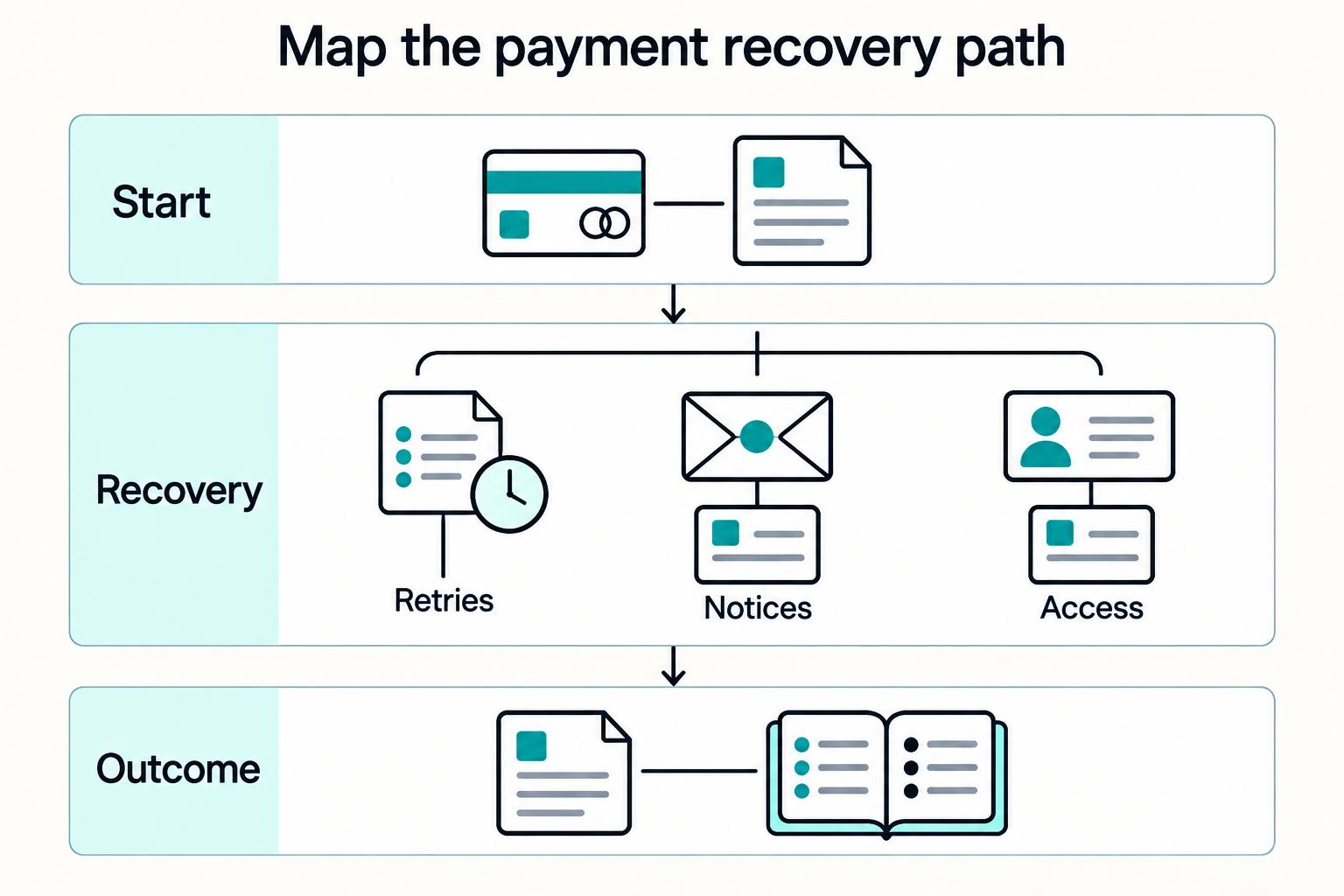
For a Stripe example, Smart Retries does not execute automatic retries for specified hard declines or without an available payment method. Update the payment-method field that actually governs the subscription’s charge, and follow required customer action. Let the configured recovery outcome determine the subscription endpoint; do not build a second independent charge loop.
| State | Next action | Metric treatment |
|---|---|---|
| Confirmed retryable failure | Use the supported configured retry/recovery flow | One unpaid renewal in recovery, not multiple lost subscriptions |
| Hard decline or action needed | Request the permitted update/authentication through a secure customer flow | Unresolved until actual payment or terminal endpoint |
| Unknown submitted result | Look up the existing payment before any replacement | Pending; do not count paid or send duplicate charge |
| Recovery paid | Record the existing invoice/payment and entitlement result | Recovered once for that invoice |
| Recovery ended unpaid | Apply configured access/cancellation policy and record end reason | Count terminal payment-failure loss at its actual endpoint |
Persist authenticated billing events before acknowledging them, then make the local invoice/access updates recoverable and resistant to duplicate delivery. Preserve actual payment and refund movements even when a local control fails. Reconcile against the provider’s records rather than relying on arrival order alone.
Weekly, review initially failed invoices, recovered invoices, pending cases and terminal ends by billing channel. Keep app-store billing recovery in its own supported store flow; a web processor’s retry settings are not a universal implementation for store-managed subscriptions.
Add compliance and tax gates early for cross-border resilience#
Treat market launch obligations as a separate workstream: exact service and billing channel, customer location, permitted offer and cancellation terms, tax treatment, supported recurring payment method and fulfilment. Those facts affect the offer, but an OSS registration is not a failed-payment recovery action.
Instrument retention so teams can make weekly decisions#
Use a scorecard whose numbers can be reproduced from the event population. Segment January promotions from regular acquisition, monthly from annual, and app-store from direct-web billing. Keep engagement, recurring revenue and renewal recovery in different columns.
For an independent invented revenue example, the opening base has normalized monthly recurring revenue of EUR20,000. It loses EUR2,000 to churn and EUR500 to contraction, while upgrades add EUR1,000. Closing recurring revenue from that base is EUR18,500, so NRR is 92.5%. EUR3,000 from new customers is excluded. This is not the earlier 1,000-renewal cohort or an accounting revenue-recognition calculation.
| Measure | Unit and window | Action it supports |
|---|---|---|
| Paid survival | Percent of original paid cohort at equal elapsed/renewal exposure | Assess whether the offer still holds after promotion |
| Renewal recovery | Initially failed unique invoices paid within the selected window / initially failed invoices | Assess payment recovery without mixing new sales |
| NRR | Percent of opening normalized recurring revenue remaining, including base expansion | Assess revenue change separately from member count |
| Useful participation | Percent of eligible members completing a defined service activity in the window | Find onboarding, scheduling or consumption friction |
| Pending data | Count and amount of unresolved invoice/access cases at cutoff | Qualify the result and assign investigation |
A recovered invoice can improve cash collection without changing a member’s useful participation; a discount can keep a member while reducing NRR and margin. Read these changes together without turning them into one undefined “retained value” score.
Keep the metric definitions and source populations consistent across teams. An adjustment needs an identified event and reason so it can be reproduced; a spreadsheet is useful only if it preserves that traceability.
- Product can explain what changed and which underlying events are included.
- Finance and operations can reproduce the same totals from shared definitions.
- Teams can clearly label where evidence is incomplete and treat decisions as provisional.
If teams are operating from conflicting base definitions, treat conclusions as provisional until the definitions are aligned.
The executive view should show cohort exposure, paid survival, NRR, participation and margin. The operator view should show pending invoice/access cases, recovery actions and fulfilment issues, with an owner for each exception.
Use weekly reviews for operational exceptions and longer observation periods for cohort conclusions. Keep the defined cutoff and pending cases visible. Related: calculating net revenue retention.
Run a 90-day implementation sequence without overbuilding#
Use ninety days to improve instrumentation and observe early monthly renewals, engagement and offer response. It cannot establish an annual renewal rate for new annual subscribers. Keep that longer observation window open after the programme ends.
| Phase | Work | Evidence at the endpoint |
|---|---|---|
| Days 1–30 | Define paid cohort, due renewals, activity and event states | Reproducible opening population and known pending cases |
| Days 31–60 | Test one optional cadence/onboarding/save change in a comparable segment | Assignment, participation and early paid-renewal results |
| Days 61–90 | Compare observed cohorts and contribution margin | A scoped next experiment; annual renewal conclusion deferred until exposed |
Set decision rules and the evidence trail first. Before you add complexity, require one auditable event trail that product, finance, and operations can all review for core lifecycle outcomes.
At day thirty, reproduce invoice and access totals from source events. Resolve duplicated or missing movements and document pending cases. Do not substitute a generic risk score for a reconciled paid cohort.
Test one retention hypothesis per segment at a time and keep the method explicit. Separate what you observed from what you inferred, and keep the supporting artifacts together so decisions are reproducible.
Keep feedback tied to the model: unused supply, missed appointment, unused app access or unexpected billing. Use it to choose a test, then retain the measured outcome separately from the customer’s explanation.
At day ninety, decide whether the observed model and margin justify a larger comparable pilot. State which renewal cycles have occurred and which remain unobserved. Continue following annual cohorts until their actual renewal windows rather than labelling them validated now.
Conclusion#
Choose the wellness model whose repeat service members use and whose paid cohorts and margin survive beyond the promotion. Keep the model-specific friction visible: app routine, delivery consumption or appointment/bundle value.
Before scaling acquisition, reproduce paid survival, renewal recovery, engagement and normalized recurring revenue from their own definitions. Explain pending cases and unobserved annual renewals. That gives the next pricing or cadence decision a clear basis.
Start with one January cohort and one comparable regular cohort. Keep the same unit and observation window, choose a relevant change, and continue following the cohort through the renewal exposure the decision actually needs.
Frequently Asked Questions
What retention tactics work best after the New Year signup spike in health and wellness subscriptions?
Start with the reason your January cohort stops using or paying for the offer. Test relevant onboarding, an appropriate delivery interval or an optional pause against comparable groups. Measure a later paid/participation endpoint rather than same-day offer acceptance.
Which benchmarks should founders trust when comparing app retention versus subscription-box retention?
Use a benchmark with the same paid subscription unit, category, plan term and elapsed or renewal horizon. RevenueCat’s app population is not a box-business retention survey. For replenishment, use your own paid delivery cohorts, usage and margin instead of copying an app percentage.
How should teams decide between monthly and annual plans for wellness memberships?
Match the commitment to the service and measure equal exposure. Monthly plans show renewals sooner; new annual plans can show engagement and refund/cancellation intent within ninety days but not first annual renewal. There is no universal cadence winner.
What is the fastest way to reduce churn from failed payments in cross-border subscriptions?
Identify the failed invoice and permitted recovery action first. Use supported retries for retryable failures, secure payment updates or authentication where needed, and status lookup before replacing an unknown submission. Respect cancellation. Tax registration does not recover a declined charge.
When do pause subscriptions outperform discounts as a save tactic?
Test them among comparable eligible cancellation intents and measure later paid survival, participation and margin. A pause can address a temporary interruption; a discount addresses price only. State billing/access/resume behaviour clearly and preserve straightforward cancellation.
How do payment constraints and compliance gates change rollout decisions across APAC, Europe, and North America?
Check the actual provider, billing channel and recurring-payment support for each market, along with local offer, cancellation, tax and fulfilment requirements. Store-managed subscriptions and direct-web subscriptions have different recovery mechanisms. Assess those separately from the retention experiment.
Try a related tool
Researched and edited by the Gruv editorial team. Gruv builds cross-border billing, payouts, and finance-operations software for global businesses.
Sources
Includes 2 external sources outside the trusted-domain allowlist.
Educational content only. Not legal, tax, or financial advice.
Related Posts

The Freelance Payment Penalty: A Modeled Audit of Platform Fees, FX Spreads, and Payout Delays
The money rarely disappears through a single, easy-to-spot fee. The real loss is stacked. A marketplace takes its commission, a processor adds a charge for international cards, a bank or payment company converts the currency at a spread, a platform holds the funds before release, and a wire sheds a little to intermediaries on the way in. Each layer looks defensible on its own, but the worker feels the combined result as a smaller deposit and a later payday.

How to Respond to a Subpoena for Business Records
Move fast, but do not produce records on instinct. If you need to **respond to a subpoena for business records**, your immediate job is to control deadlines, preserve records, and make any later production defensible.

A US Expat's Guide to Investing in UCITS ETFs to Avoid PFIC Issues
The real problem is a two-system conflict. U.S. tax treatment can punish the wrong fund choice, while local product-access constraints can block the funds you want to buy in the first place. For **us expat ucits etfs**, the practical question is not "Which product is best?" It is "What can I access, report, and keep doing every year without guessing?" Use this four-part filter before any trade: