
Quick Answer
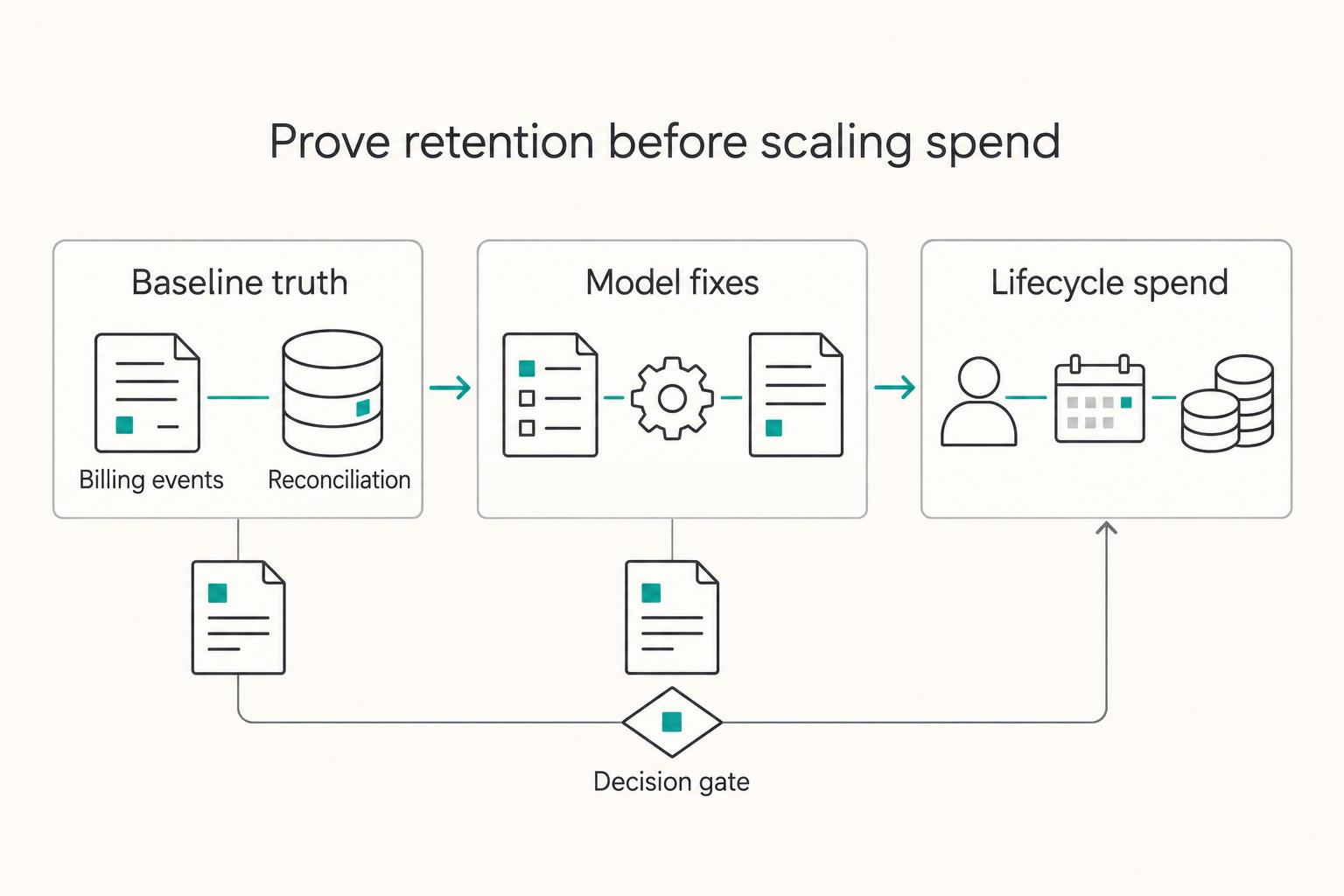
Start with model fit, then repair billing, then scale lifecycle channels. An ecommerce subscription retention playbook works when curation, replenishment, or access aligns with customer value and your CAC recovery assumptions, and when failed-charge recovery is visible in subscription billing events. Use pause or downgrade for timing and plan-fit issues, use dunning and payment-method recovery for involuntary churn, and judge progress with cohort NRR rather than campaign activity alone.
Validate subscription economics before lifecycle spend#
Start by choosing the subscription model and checking whether your billing setup can actually support it. If you jump straight to lifecycle campaigns, you can create more repeat orders on paper while still losing customers to weak economics, payment friction, or a promise the plan cannot keep.
That is the core idea behind this playbook. Curation, replenishment, and access subscriptions are not interchangeable. They fit different businesses, and they break for different reasons. Retention is a real growth lever in subscription commerce, but teams often give too much credit to loyalty, email, or SMS when the real problem sits earlier in the chain.
A practical way to think about the sequence is:
- Pick the model that matches how customers get value. Recharge frames ecommerce subscriptions around curation, replenishment, and access. The point is to choose the right model, not force a one-size-fits-all template.
- Set the billing mechanics around that model. In subscription commerce, the customer pays on a recurring schedule such as monthly or quarterly to receive goods. That cadence, plus plan structure and payment handling, shapes retention more than most campaign teams want to admit.
- Layer messaging and loyalty after the foundation is visible. Yotpo positions SMS, email, and loyalty as a connected retention layer. That only helps if the offer and recurring billing logic are already sound.
For founders, revenue leaders, product teams, and finance operators, the question is not whether retention matters. It is where retention work belongs first. In many cases, you will get a clearer picture by fixing model fit and billing before expanding channel activity. If your payment setup is costing you customers, more messaging will not solve the root issue.
Before you build campaigns, confirm that you can see renewals, failed charges, plan changes, and model-level contribution clearly enough to tell why a customer stayed or left. If you cannot separate a billing failure from a weak value proposition, you risk solving the wrong problem. A common failure mode is a healthy-looking email click rate alongside preventable churn from recurring payment issues or a plan design that does not match how customers actually buy.
The sections that follow are meant to help you make that call in order. First choose the model and the economics you can defend. Then decide where loyalty, email, and SMS genuinely improve retention quality instead of just adding activity.
Billing structure comes first; Subscription Billing Platforms compares the plan, add-on, coupon, and dunning controls behind retention work.
Pick the subscription model that fits your unit economics#
The right model is the one your margins can support at the pace customers expect to buy, not the one that sounds most marketable. Before you launch, pressure-test each option against contribution margin, expected reorder cadence, and customer acquisition cost (CAC) payback. Retention often breaks where those three stop lining up.
Recharge's core distinction is useful here. Subscription types work best when they match what you sell and how customers buy. If your value is discovery and surprise, start with a Curation subscription model. If the value is convenience and predictable recurring shipments, start with a Replenishment subscription model. If the value is continuing perks or benefits, start with an Access subscription model.
| Model | Best fit value promise | Contribution margin profile to check | Expected reorder cadence | CAC recovery window check | Churn exposure to watch | Red flag before launch |
|---|---|---|---|---|---|---|
| Curation subscription model | Discovery, novelty, surprise | Check whether margin still works after model-specific variable costs such as assortment, packaging, and fulfillment | Cadence should feel intentional rather than arbitrary | If CAC recovery needs many renewal cycles, test whether the novelty promise can support that | Voluntary churn if the offer feels repetitive or misaligned with customer taste | You promise surprise but ship on a rhythm customers do not actually want |
| Replenishment subscription model | Convenience, predictable supply | Check whether margin stays healthy after recurring fulfillment costs | Regular cadence is the point, so timing has to match real consumption | Under 12 months is a useful CAC payback checkpoint | Churn risk rises when delivery frequency does not match actual usage | You sell predictability but the product is not consumed on a stable enough schedule |
| Access subscription model | Ongoing perks, member pricing, exclusive benefits | Check whether contribution still works after benefit, discount, or service costs | Cadence depends on ongoing value, not product depletion | If payback is slow, confirm the benefits are clear enough to justify multiple billing cycles | Churn risk rises when members do not see or use the benefits | You charge recurring fees for benefits customers cannot clearly see |
Use the three-input check, not instinct#
Start with contribution margin at the renewal level, not just on the first order. For a physical goods offer, include discounting, packaging, fulfillment, and any model-specific variable cost that only appears once the plan is live. A curation offer, for example, can look different once assortment complexity is counted. An access offer can look different once member discounts or service costs are included.
Next, map expected reorder cadence to actual customer behavior. Replenishment needs the hardest evidence because regular shipments are the product promise. If customers naturally rebuy on a longer or shorter cycle than your default cadence, you may have built churn into the design. For curation and access, cadence still matters, but the test is different: can customers clearly explain why a monthly or quarterly charge makes sense?
Then stress-test CAC recovery. CAC payback period is the time it takes to recoup acquisition investment, and under 12 months is generally considered a strong target. If your model only works when customers stay far longer than your current retention base suggests, that is not a messaging problem. It is model risk.
What to verify before you commit#
You do not need a massive forecasting deck, but you do need a clean evidence pack before launch:
- A model sheet showing contribution margin per renewal cycle, with variable costs broken out clearly
- A cadence assumption backed by transaction history, usage data, or a believable consumption proxy
- A simple scenario plan for churn, LTV, and CAC payback so you can see what happens if renewal behavior is worse than expected
One practical checkpoint is to have finance and product sign off on the same renewal economics. If growth is working from gross revenue and finance is working from post-fulfillment contribution margin, you can approve a model that never had room to retain profitably.
The biggest red flag here is a promise-rhythm mismatch. When the customer value story says discovery, convenience, or perks, but the actual billing and delivery rhythm says something else, email, SMS, and loyalty mostly hide the problem for a while. Fix the model first. No retention layer will make an unnatural subscription feel natural for long.
When you are still choosing the revenue model, Choosing Between Subscription and Transaction Fees helps separate subscription fit from payment preference.
Map voluntary and involuntary churn to the right levers#
Once you know which model you are running, split churn into customer-choice churn and payment-friction churn before you touch another campaign. If failed payments are one of your largest churn buckets, fix subscription billing, Dunning campaigns, and Alternative payment methods first. That is not an engagement problem.
That split matters more than most teams admit. Chargebee's guidance is blunt: the first step is to segregate voluntary churn from involuntary churn. Recharge frames Involuntary churn as customers losing access because payments fail even though they still value the service, and Stripe says failed subscription payments cost businesses about 9% of annual revenue. If you lump that together with true cancels, you will send win-back messages to people who really just need a working way to pay.
Start with a two-bucket diagnosis#
Use a simple decision rule in your churn taxonomy:
| Case | Definition | Handling note |
|---|---|---|
| Voluntary churn | The customer chose to cancel because of cadence, value, relevance, or budget. | Keep it separate from payment-friction churn. |
| Involuntary churn | The subscription ended or lapsed after a failed charge, expired payment method, or unrecovered billing issue. | Fix billing recovery before adding more retention messaging. |
| Mixed cases | A customer hits a failed payment and then cancels a week later. | Keep these separate until reviewed. |
The checkpoint that matters is event-level verification inside your billing data. For each lost subscriber, you want to see the sequence of payment_failed, retry attempts, payment-method update, pause or cancel action, and final subscription status. If your lifecycle team reports churn saved but finance cannot reconcile that to recovered subscriptions in billing records, you are grading campaigns on the wrong evidence.
Match the lever to the model#
The right lever depends on both the churn type and the promise of the subscription. Use the table below as a starting point, not a universal rule.
| Subscription model | When churn is voluntary | When churn is involuntary | Where a Loyalty program helps | Failure mode to watch |
|---|---|---|---|---|
| Curation subscription model | Test pause or skip first if timing or box relevance appears to be the issue. | Prioritize dunning and payment-method recovery when the customer still appears engaged but lost access after a failed payment. | Can help when it adds preference data or clearer reasons to stay engaged between boxes. | Do not assume a loyalty layer will fix weak assortment relevance on its own. |
| Replenishment subscription model | Check frequency, quantity, or timing before offering discounts. | Test dunning and alternative payment methods when a failed charge interrupts the convenience promise. | Can help when it reinforces routine or repeat usage. | Teams can mistake stock-up behavior for disengagement and send promos instead of correcting cadence. |
| Access subscription model | Look at downgrade, pause, or benefit clarity if members do not feel enough ongoing value. | Protect continuity of access with strong payment recovery and flexible payment options. | Test carefully, because the core subscription may already include the main perks. | Stacking rewards without checking margin and renewal quality can add cost without improving retention. |
Use if-then rules before you expand campaigns#
A few working rules keep this grounded:
- If failed payments show up repeatedly before churn, improve billing recovery before adding more retention messaging. Recurly defines dunning management as the communications and strategies used after an initial payment failure, so make sure those messages exist and are tied to recovery events.
- If customers actively cancel while payments are healthy, do not treat that as a billing issue. Use pause, skip, cadence changes, or plan redesign instead.
- If pause usage is high but reactivation is low, pause may be delaying churn rather than preventing it. That may be a model-fit warning, not a lifecycle win.
A single evidence pack is enough to keep teams honest: churn reason taxonomy, failed-payment counts, recovery rate from dunning, share of subscribers using alternative payment methods, and reactivation rate after pause. That gives you a cleaner read on whether you are fixing real friction or just masking it.
For recurring-billing gaps, Building Subscription Revenue on a Marketplace covers the marketplace-specific control work.
Set plan architecture before you scale messaging#
After you split voluntary churn from payment friction, set the plan menu before you add more lifecycle volume. Messaging can help customers choose among good options, but it will not fix a subscription structure that asks for the wrong commitment, the wrong cadence, or the wrong bundle.
Recurly's language on Diversified plan management is useful because it frames plan flexibility as good for both customer experience and the bottom line. That is the right standard. A plan change should reduce avoidable churn without quietly training customers into lower-value behavior that weakens future expansion.
Align the menu to the model#
Use the subscription model to decide what kind of flexibility belongs in the product, not just in the cancel flow.
| Model | Plan architecture to prioritize | Best use of flexibility | Red flag |
|---|---|---|---|
| Curation subscription model | Moderate commitment with clear skip or pause paths | Timing relief when interest is intact but the next box feels mistimed | Too many saves come from discounting boxes customers no longer want |
| Replenishment subscription model | Delivery frequency and quantity controls | Cadence changes, date shifts, and bundle-size changes when usage changes | Teams interpret stock-up behavior as churn instead of a plan-fit issue |
| Access subscription model | Upgrade and downgrade paths tied to benefit usage | Right-size membership when the value is real but the tier is wrong | A pause option can hide weak perceived value if members rarely use benefits |
Treat that table as a starting point, not a universal rule. The real checkpoint is whether the event trail supports it. Look at customers who almost left and verify whether a plan edit, pause, downgrade, or bundle change happened before the account stabilized, and whether that stabilization lasted beyond the next renewal.
Write explicit save rules#
Do not let the cancel team improvise offers. Define what each save path is for.
- Offer pause when the issue is temporary timing or short-term budget pressure. Recurly explicitly supports the logic that allowing subscribers to pause instead of cancel can deter voluntary churn. If pause adoption is high but return-to-active rates stay weak, you are delaying churn, not preventing it.
- Offer downgrade or bundle changes when the customer still wants the core product but not the current quantity, cadence, or tier. This is especially important in replenishment and access offers where the relationship may still be healthy.
- Use blanket discounts last. They can preserve logos while lowering retained revenue from the same customer base, which is exactly why you need to judge them through Net Revenue Retention (NRR) and not just save rate.
Track whether flexibility preserves revenue quality#
If churn clusters around billing dates, renewal moments, or failed-charge recovery, plan flexibility can be worth testing before assuming the offer itself is broken. If churn shows up after the customer experiences the product or benefits, review the offer design as another hypothesis, because a pause or downgrade may only postpone the real problem.
Stripe defines Net Revenue Retention (NRR) as retained revenue from existing customers over a defined period, influenced by upsells, expansions, churn, and downgrades. That makes it the right scorecard for plan changes. Your evidence pack should include cohort-level before-and-after revenue, share of customers saved via pause versus downgrade, and whether those saved accounts later expand or simply sit at reduced value. The failure mode is common: teams celebrate cancels saved while NRR falls because most of those saves became permanent downshifts.
For talent-platform economics, Retainer Subscription Billing for Talent Platforms shows how ARR margin depends on billing and payout design.
Fix payment friction before adding more campaigns#
If involuntary churn is showing up in your data, hold off on adding more lifecycle volume until you fix recovery first. Many failed payments are recoverable, which means your retention problem may sit inside billing operations, not email cadence.
Audit the recovery chain end to end#
Start with the actual sequence, not the campaign calendar. You want one visible path from failed charge to final outcome: the failure event, retry logic, Dunning campaigns, payment-method update prompt, and any accepted Alternative payment methods.
| Step | What to review | Grounded detail |
|---|---|---|
| Failure trigger | Confirm the failure trigger exists and fires reliably. | On Shopify, the exact Flow trigger is subscription billing attempt failure. |
| Retry logic | Review retry logic before you review copy. | Stripe says Smart Retries default is 8 tries within 2 weeks; Recurly Commerce says AI-determined retry counts are typically between 3 and 7. |
| Dunning window | Inspect the dunning window and message handoff. | Recurly states that longer dunning windows have shown higher recovery rates. |
| Payment mix | Check whether customers have a way out of card failure. | Alternative payment methods include PayPal, Amazon Pay, and Apple Pay. |
Use this checklist:
- Confirm the failure trigger exists and fires reliably. On Shopify, the exact Flow trigger is subscription billing attempt failure. If that event is missing, delayed, or disconnected from your messaging tool, you are blind at the moment recovery should begin.
- Review retry logic before you review copy. Stripe says many payment failures are recoverable, and its recommended Smart Retries default is 8 tries within 2 weeks. Recurly Commerce describes AI-determined retry counts as typically between 3 and 7. Do not treat either pattern as universal. The real check is whether retries line up with how your customers fund purchases, because repeated attempts at the same off-hours window can simply repeat the same decline.
- Inspect the dunning window and message handoff. Recurly states that longer dunning windows have shown higher recovery rates. If your recovery sequence stops after a short burst of reminders, you may be forcing churn where a longer window would have collected.
- Check whether your payment mix gives customers a way out of card failure. Alternative payment methods include options such as PayPal, Amazon Pay, and Apple Pay. They are worth testing when card declines are persistent, but do not assume they lower churn for every merchant without looking at your own payment mix.
Put finance and product checkpoints in the same view#
This is where teams break the chain. Product logs an event, growth sends messages, and finance closes the month with a different truth in subscription billing data.
Your minimum evidence pack should include the exact event name that starts recovery, the owner for exception handling, the decline reason or error captured, the retry schedule applied, and the final status that finance recognizes as recovered, expired, or churned. On Shopify, SubscriptionBillingAttempt includes associated payment transactions and errors. That detail matters because a failed payment bucket is too broad to diagnose common issues like non-sufficient funds versus suspected fraud.
The Shopify DTC trap#
For DTC (direct-to-consumer) brands on Shopify, campaign metrics can look healthy while payment failure quietly does the damage. Opens, clicks, and even save-flow completion are weak proof if subscription billing attempts are failing upstream.
If you see healthy engagement but churn still clusters around renewal moments, verify billing-attempt failure rates before you add another win-back or reminder campaign. The failure mode is simple: the team celebrates message performance while avoidable payment friction keeps cancelling subscribers who never intended to leave.
Related: Subscription Billing for eCommerce: How DTC Brands Can Add Recurring Revenue to Physical Products.
Build a 90-day execution plan with owners and evidence#
Once you can see where billing friction sits, put the next 90 days into a clear operating plan. The practical rule is simple: do not scale lifecycle spend until the first two phases show that retention improved because operations, plan design, or payment recovery improved, not just because you sent more messages.
A 30 to 60 to 90 structure works well because each phase has a different job. The first block establishes baseline truth. The second fixes the model and plan mechanics that are actually causing churn. The third is where Email automation and SMS automation earn more budget.
| Phase | Inputs and data source | Core steps and owner | Output and verification artifact |
|---|---|---|---|
| Days 1 to 30 | Subscription billing events, renewal outcomes, cancellation logs, plan-change history, campaign sends, finance reconciliation export | Product maps the trigger, condition, and action chain for key lifecycle events. Finance defines what counts as recovered, churned, expired, or active. Growth audits current messaging against those events. | Baseline pack signed off by product and finance: churn reason taxonomy, voluntary vs involuntary split, payment-failure breakdown, current retry and dunning performance, and starting NRR trend by model cohort. |
| Days 31 to 60 | Phase 1 baseline, decline reasons, plan-change tickets, support themes, cohort retention cuts by model | Product changes model and plan mechanics first, such as pause, downgrade, frequency shifts, or proration-sensitive plan edits. Growth updates the message path to match the new mechanics. Finance checks whether plan changes create contractions, recoveries, or hidden billing noise. | Model-specific fix report: before and after renewal outcomes, plan-change impact, payment recovery movement, and documented exceptions or failure cases. |
| Days 61 to 90 | Proven fixes from phase 2, channel performance data, audience eligibility rules, holdout or incrementality design | Growth scales Email automation and SMS automation only for segments where the operational fix already improved outcomes. Finance reviews quality of retained revenue. Product confirms event integrity still holds after scale. | Channel scale decision with evidence: lift by cohort, not just campaign revenue, plus finance-approved retention quality check and product validation that the trigger chain still fires correctly. |
What must be in the evidence pack#
Keep one shared pack for every review. If it lives in three tools and no one can reconcile it, it will fail the first finance challenge.
| Item | Include | Why it matters |
|---|---|---|
| Churn reason taxonomy | Split churn into voluntary and involuntary categories. | Involuntary churn comes from non-intent causes such as payment failure. |
| Payment-failure breakdown | Include decline or error categories when available, the retry schedule used, and dunning campaign comparisons. | Do not stop at failed payments recovered. |
| Plan-change impact | Track which plan edits created billing effects. | Billing-related subscription updates can create prorations and generate invoices. |
| NRR by model cohort | Trend Net Revenue Retention by cohort during the 90-day plan. | Use it to see where value is gained or lost. |
At minimum, include these four items:
- Churn reason taxonomy
Split churn into voluntary and involuntary categories. That distinction matters because involuntary churn comes from non-intent causes such as payment failure, and it should not be judged with the same lens as a value or engagement problem.
- Payment-failure breakdown
Do not stop at failed payments recovered. Include decline or error categories when available, retry schedule used, and dunning campaign comparisons. Recurly's own guidance supports comparing dunning campaigns, not only aggregate recovery totals.
- Plan-change impact
Track which plan edits created billing effects. Stripe notes that billing-related subscription updates can create prorations and generate invoices, so a successful save can still produce avoidable friction if the mid-cycle charge surprises the customer.
- NRR trend by model cohort
Net Revenue Retention measures retained revenue after expansion, contraction, and churn. ChartMogul notes that 12 months is a common measurement horizon, but inside this 90-day plan you should still trend NRR by cohort so you can see where value is gained or lost. If you need the math refresher, use this NRR guide.
Assign ownership before work starts#
Assign ownership before work starts or the work will bounce between teams. A simple RACI is enough as long as there is one accountable owner per decision. One effective split is growth for messaging tests and channel rollout, finance for retention quality checks and reconciliation, and product for subscription model and plan mechanics. That split is not universal, but explicit ownership is.
The main checkpoint is day 60. If churn improves only in campaign-attributed revenue while voluntary versus involuntary churn, payment recovery, or cohort NRR stays flat, treat that as a red flag and hold spend. Scale should be the reward for evidence, not the substitute for it.
Related reading: Document Management for Accounting Firms: Secure Intake, Retrieval, Retention, and Automation.
Use loyalty, segmentation, and advocacy where they actually fit#
These levers work best as amplifiers of a subscription model that already delivers value cleanly. If your day 60 review still shows billing friction, unclear churn reasons, or plan mechanics causing avoidable exits, keep loyalty and advocacy secondary.
- Segment by the subscription promise, not by channel convenience.
Customer segmentation is simply grouping users by shared behavior or usage traits, and the useful traits change by model. For a Replenishment subscription model, start with consumption rhythm because these are regularly consumed essentials. Segment around expected reorder interval, skips, delivery cadence changes, and days since last successful renewal. The checkpoint is simple but important: make sure those fields come from billing and order events, not just tags in your email tool.
For a curated subscription, preference signals matter more because the offer depends on product selection that matches customer preferences. Use quiz responses, item ratings, swap behavior, category affinity, or keep and return patterns if you capture them. A common failure mode is sending the same save flow to everyone when the real issue is taste mismatch. That can lift click rate while doing nothing for renewal quality.
For access-style offers, do not force a canned segmentation scheme just because another brand uses it. Start with the behaviors that show members are actually realizing the promised value in your product, then test whether those groups retain differently before you operationalize them.
- Use a Loyalty program only when it reinforces why people subscribed in the first place.
Yotpo explicitly ties loyalty data to SMS segmentation, and that can be useful. The qualifier is fit. If your replenishment offer wins on convenience, loyalty should reinforce that promise. If your curated offer wins on discovery, the rewards should reflect that experience rather than just add generic points.
The tradeoff is margin. A loyalty layer can increase cost without changing churn behavior. Ask finance to review one simple comparison before rollout: renewal rate and net retained revenue for subscribers who earn the benefit versus a matched group that does not. If the program lifts engagement but compresses revenue, it is a cost center, not a retention fix.
- Treat Referral program and Community advocacy as amplifiers, not repairs.
AudienceTap emphasizes coordinated email and SMS, including the first 45 days and a 90 day rollout. That is useful for channel execution. Yotpo also leans hard into lifecycle retention marketing. Neither emphasis should decide your rollout order on its own.
The practical rule is straightforward: if baseline retention is not yet stable, keep referral and community tests small. Verify that cohort retention, churn reason mix, and recovered revenue are holding before you invite subscribers to bring in more people. Otherwise you may be scaling acquisition into the same leak your evidence pack already exposed.
For pause mechanics, How to Use Pause Subscriptions as a Retention Tool covers implementation choices before you broaden retention campaigns.
Sanity checks before you call retention successful#
Do not call retention fixed until the gain survives three checks: existing-customer revenue quality, benchmark fit, and operational reality. This is where teams catch the false wins that look good in campaign reporting but disappear in finance review.
- Check Net Revenue Retention, not just campaign revenue.
Net Revenue Retention (NRR) measures retained revenue from an existing cohort after expansion, contraction, and churn. That makes it a better sanity check than email or SMS-attributed revenue alone, because those channels can rise while the same cohort still shrinks elsewhere. If your win story is campaign revenue is up but NRR is flat or worse, stop and inspect contraction, plan downgrades, and failed renewals before you scale the tactic. If you need a clean calculation method, use one and keep it consistent across cohorts and periods.
- Interrogate benchmark transferability before copying the tactic.
Recurly's ecommerce benchmark work examined over 900 sites on the Recurly platform across January 2017 to December 2018. Useful context, but still platform-specific and historically bounded. Yotpo's report draws from 65 million orders across over 120,000 stores, which gives scale, not automatic fit to your model or customer mix. AudienceTap is even narrower by design: its guidance is explicitly about email and SMS together. If a benchmark does not tell you the subscription model, billing setup, and measurement window, treat it as directional only.
- Confirm the lift survives billing edge cases and reconciliation.
Retention gains should still hold after dunning management outcomes, exception queues, and finance close. The checkpoint is simple: compare reported saves against final settled renewals after reconciliation files arrive. In one documented billing example, invoices and detailed reconciliation information for a January period land February 6 to 8. A common failure mode is counting a recovered subscriber before payment actually settles, then finding involuntary churn, write-offs, or duplicate exceptions later.
For a step-by-step walkthrough, see Freelance Client Retention: Weekly Systems for Repeat Work and Long-Term Relationships.
Frequently Asked Questions
What is an ecommerce subscription retention strategy, and how is it different from a campaign calendar?
It is a stage-based plan for keeping revenue and customers through product design, billing recovery, plan mechanics, and coordinated messaging. A campaign calendar is just the send schedule. If your team is only asking what email goes out next, you are already too late on the bigger retention decisions.
How do curation, replenishment, and access subscriptions differ in churn risk and margin behavior?
Curation can carry more taste risk because the customer is judging each box or selection against discovery value. Replenishment is often more exposed to cadence mismatch and payment failure, because the promise is convenience and predictability. Access models depend heavily on whether members keep seeing value in the benefits, and the margin picture depends on what those benefits cost to deliver.
Which levers reduce Involuntary churn fastest: Dunning campaigns, retries, or Alternative payment methods?
There is no universal fastest lever. A practical starting point is retry automation, because failed-payment recovery is explicitly positioned to reduce involuntary churn, and Stripe documents Smart Retries with a recommended default of 8 tries within 2 weeks. Add Dunning campaigns so customers know a payment issue happened and can update billing details. Alternative payment methods can also reduce failed-transaction churn, but treat them as part of the recovery path, not a guaranteed first move in every business.
When should we add pause options versus discounts versus a Loyalty program?
Use pause when the problem is timing, inventory build-up, or temporary budget pressure, not a broken value proposition. Use discounts carefully when you need a short-term save and you have margin room, because blanket discounting can teach customers to wait for an offer. Add a Loyalty program only when it reinforces the subscription promise. If members are leaving because the core product is weak, points may add cost without fixing the problem.
What should be included in a practical 90-day rollout using Email automation and SMS automation?
Split the first 90 days into baseline, fixes, and scale: days 1 to 30 for instrumentation and churn taxonomy, days 31 to 60 for payment and plan fixes, days 61 to 90 for channel expansion. In the first 45 days, make sure email and SMS have distinct jobs because they complement each other rather than replacing each other. Your evidence pack should include failed-payment breakdowns, dunning outcomes, plan-change impact, and NRR by cohort before you increase message volume.
Which metrics matter most for leadership reporting beyond basic repeat purchase rate?
NRR matters most because it captures retained revenue after churn, contraction, and expansion, not just order frequency. Add involuntary churn rate, failed-payment recovery rate, downgrade or contraction rate, and final settled renewals after reconciliation. If you need a clean method, use one and keep it consistent across cohorts and periods.
Try a related tool
Researched and edited by the Gruv editorial team. Gruv builds cross-border billing, payouts, and finance-operations software for global businesses.
Sources
Includes 5 external sources outside the trusted-domain allowlist.
- docs.stripe.com/billing/revenue-recovery/smart-retriestrusted
- stripe.com/resources/more/net-revenue-retentiontrusted
- stripe.com/resources/more/dunning-what-subscription-bas...trusted
- asana.com/resources/30-60-90-day-planexternal
- audiencetap.com/guides/ecommerce-retention-playbookexternal
- blog.cleeng.com/involuntary-churn-how-to-prevent-lost-revenu...external
- chargebee.com/resources/guides/ecommerce-subscriptions-cus...external
- chartmogul.com/saas-metrics/nrrexternal
Educational content only. Not legal, tax, or financial advice.
Related Posts

Calculate NRR for a Subscription Platform Without Reconciliation Gaps
The formula is the easy part. In practice, the hard part is producing a single Net Revenue Retention number that finance, ops, and product can all trace to the same recurring revenue base and the same set of in-period movements.

How Platform Builders Implement Subscription Pause for Retention
Treat subscription pause as a policy decision in your subscription lifecycle, not a nicer-looking button in the cancellation flow. If you only surface pause when someone tries to leave, you may see short-term retention wins while creating unclear billing behavior and status handling across systems.
Subscription Billing for eCommerce DTC Brands Adding Recurring Revenue to Physical Products
Direct-to-Consumer (DTC) teams are adding recurring billing for a simple reason. It can make revenue more predictable and planning less reactive. That upside is real, especially in ecommerce, where subscriptions are often associated with steadier revenue and stronger retention than one-time purchases alone.