
Quick Answer
An Irish sole trader should register for Income Tax self-assessment, check whether a CRO business-name filing is required, and assess VAT separately. The services turnover threshold is EUR42,500 per calendar year excluding VAT, but some cross-border obligations arise below it. Budget for annual 2026 Class S PRSI at 4.2375% with the applicable EUR650 minimum, keep the pay-and-file dates on your calendar, and confirm immigration permission before undertaking work where required.
Start with the legal and tax path you are actually using#
An Irish freelance setup involves separate decisions about legal structure, Revenue registration, VAT, PRSI and immigration permission. Keeping these decisions separate helps you identify which registrations apply to the work you plan to do.
That matters because Ireland does not force every freelancer into a company. Many people start as a sole trader, but the setup still has real control points: your PPSN, your Revenue registration status, whether your invoice name matches your legal setup, whether you cross a VAT threshold, and whether your immigration permission actually allows self-employment.
Start by identifying who will sign contracts and issue invoices, which taxes apply, and whether you have permission to undertake the work. Keep any client or payment-provider onboarding requirements alongside those legal and tax checks.
- Choose the structure first: decide whether to trade personally as a sole trader or through a company; a business name is a separate naming decision.
- Register in the right order: Revenue registration and self-assessment come before broad claims that you are fully set up.
- Treat thresholds separately: VAT, PRSI, and self-assessment each have their own trigger logic.
- Do not blur immigration and tax: a tax number does not prove a non-EEA person may freelance in Ireland.
Choose the business form and trading name#
A sole trader can use their surname, with or without first names or initials, or register a different trading name. A company is a separate legal entity. Choose the contracting party before completing contracts and invoice templates so the documents identify the correct person or entity.
Trade personally as a sole trader#
A sole trader setup is the usual starting point for a freelancer who is selling services personally and is not creating a separate company. Gov.ie treats moving between sole trader and limited company as a real change of legal form, so do not describe those options as cosmetic labels.
That is why your contract and invoice identity matter early. If you are personally selling services, your commercial paperwork should match the structure you actually chose. If you need a quick comparison of how invoice identity changes when you move from an individual to a company, read Invoice Sole Proprietor vs Company.
Register a business name only when you trade under another name#
For an individual, the CRO business-name rule applies when the trading name differs from the person's true surname, with or without first names or initials. For example, John Murphy can trade as “John Murphy” without a business-name filing, but “Murphy Builders” requires one. Submit the filing within one month of adopting the name. CRO business-name guidance also explains that registration does not protect the name or authorise use that infringes someone else's rights.
| Operating setup | What you are really doing | What to verify first |
|---|---|---|
| Sole trader using surname, optionally with first names or initials | You trade personally without a separate business-name filing for that name | Revenue registration, invoice identity and tax calendar |
| Sole trader under a registered business name | You still trade personally; the name does not create a separate entity | CRO filing within one month of adopting the name, plus Revenue setup |
| Limited company | You are using a separate legal entity rather than personal trading | Company formation, company tax route, and separate invoice identity |
| Switching from sole trader to company | You are changing legal form, not just redesigning branding | Transition timing, contracts, tax accounts, and invoice cutover |
The trap here is treating the trading name as the business structure. It is not. A trading name can sit on top of sole-trader activity, which means your tax and liability analysis still starts with the underlying legal form.
- Keep one legal name field: this is the person or entity that is actually contracting.
- Keep one trading-name field: only use it when the public-facing name differs from the legal name.
- Do not let a logo answer a legal question: branding does not tell Revenue or the CRO what structure you chose.
Register with Revenue using the route for your tax status#
Revenue registration is a core setup step for Irish sole traders. Establish the taxes you need to register for and record your business commencement date. Tax registration is separate from permission to work, any regulated-activity requirements and the VAT rules that apply to your supplies.
Get your PPSN and tax reference sequence right#
Revenue says that before you register for tax as a sole trader, you must have a PPSN. Revenue also says your Tax Reference Number is the same as your PPSN, but it does not become your tax reference until you register for tax. That is why the How to register for tax as a sole trader page should sit near the top of your setup checklist.
Do not bury that sequence inside a later finance task. If your client contracts, platform onboarding, or invoice templates all assume you already have a settled Irish tax identity, your admin debt starts before your first filing period.
Separate initial registration from ROS filing and payment#
Revenue says people already registered for a business tax can add Income Tax, VAT or Employers PAYE through ROS. Individuals registered only for PAYE or LPT use myAccount for initial registration. Once registered as a sole trader, you must use ROS to file returns and pay tax, so myAccount access alone does not complete that workflow.
| Starting position | Likely online route | Why it matters |
|---|---|---|
| Already registered for a business tax | ROS | Revenue says business-tax users can add Income Tax, VAT, or Employers PAYE through ROS |
| Registered only for PAYE or LPT | myAccount first | Use myAccount for initial registration, then register for ROS for sole-trader returns and payment |
| Non-resident unable to register online | Form TR1(FT) | Revenue provides this form for non-resident individuals registering for Income Tax, VAT or Employers PAYE |
| Registered as a sole trader | ROS for returns and payment | Set up ROS access after initial tax registration |
Use the initial registration channel that fits your existing tax status, then arrange ROS access for the ongoing sole-trader filing process. Keep registration confirmation and login access as separate checklist items.
- Check your current Revenue status first: the right route depends on what you are already registered for.
- Store the confirmation date: if your setup is challenged later, you want proof of when you completed registration.
- Match the registration outcome to the work model: service freelancing, employer setup, and VAT are not the same request.
If your freelance work is part of a bigger multi-country plan, keep the Irish file distinct from your wider tax strategy. The crossover questions belong in How to Handle Taxes on Income from Multiple Countries, not inside the Irish registration step itself.
Freelance Ireland tax calendar and self-assessment deadlines#
Put the annual return, balance payment and current-year preliminary tax on your calendar as separate items. They fall due together, but concern different tax years.
Learn who must enter self-assessment#
Revenue says you should register for Income Tax self-assessment if you are self-employed. Revenue also sets hard thresholds: you must register if taxable non-PAYE income exceeds EUR5,000 or if gross non-PAYE income exceeds EUR30,000. That is the official baseline on the Who should register for Income Tax self-assessment? page.
Revenue provides a Form 12 route through myAccount for declaring non-PAYE income that does not exceed those limits. Keep taxable income and gross income separate when checking the thresholds; the EUR5,000 test is not a gross-receipts limit.
Build the pay-and-file rhythm around 31 October#
Revenue's pay-and-file guidance sets the ordinary deadline at 31 October. In 2026, the return and balance payment concern 2025, while preliminary tax concerns 2026. The extended deadline is 18 November 2026 only if you both pay and file through ROS.
| 2026 planning item | Core date or trigger | What to do now |
|---|---|---|
| Preliminary tax for 2026 | 31 October 2026 | Reserve cash before Q4 so the payment is not treated as a surprise |
| 2025 return and any 2025 balance payment | 31 October 2026 | Prepare figures early enough to avoid a rushed Form 11 filing |
| ROS extended pay-and-file date | 18 November 2026 | Use the later date only if you are actually filing and paying online through ROS |
| Self-assessment registration threshold | Taxable non-PAYE income over EUR5,000 or gross non-PAYE income over EUR30,000 | Do not wait for year-end if you already know the threshold will be crossed |
That filing rhythm is one reason to keep your Irish records clean from the start. If invoices, expenses, and permissions are scattered across email, spreadsheets, and payment tools, the October deadline becomes a data-rebuild exercise instead of a filing exercise.
- Create a tax calendar now: include both the standard 31 October date and the ROS online date you intend to use.
- Tag Irish freelance income separately: this keeps later cross-border analysis cleaner.
- Name one record owner: even a solo freelancer needs one place where the tax file actually lives.
If your work pattern is mobile, pair the Irish calendar with a residence review. The tax filing date is not the same thing as a residence answer, which is why Digital Nomad Tax Residency in Multiple Countries should stay a separate analysis.
Freelance Ireland VAT registration checks#
VAT is a separate question from Income Tax registration. A freelancer can be properly registered with Revenue for self-assessment and still need a different decision on VAT depending on turnover and what is being supplied.
Use the service and goods thresholds correctly#
Revenue's VAT thresholds use calendar-year turnover excluding VAT. The main thresholds are EUR42,500 for services and EUR85,000 for goods, or mixed supplies where at least 90% of turnover is from goods. Certain goods manufactured from zero-rated materials and sold at reduced or standard VAT rates instead fall under the EUR42,500 threshold.
For a service freelancer established in Ireland, EUR42,500 is the main domestic turnover threshold to monitor. It is not a universal exemption: receiving taxable business services from abroad can require registration and self-accounting with no received-services threshold. Non-established traders have separate registration rules, including the conditions of the VAT SME scheme. Check Revenue's received-services guidance when buying services from suppliers outside Ireland.
Treat OSS as an extra EU layer, not a domestic shortcut#
The EU OSS system is useful, but it does not replace domestic Irish analysis. The official EU One Stop Shop guidance exists for covered cross-border VAT reporting. It is not a shortcut that makes your Irish domestic obligations disappear.
| VAT scenario | Threshold or rule (calendar-year turnover excluding VAT) | Practical reading for freelancers |
|---|---|---|
| Services only | EUR42,500 | This is the main threshold most solo service freelancers should watch first |
| Goods only | EUR85,000 | Check the separate EUR42,500 rule for certain goods manufactured from zero-rated materials |
| Mixed supplies with at least 90% goods turnover | EUR85,000 | Only use this if the turnover split truly fits the Revenue wording |
| Taxable business services received from abroad | No received-services registration threshold | Check registration and Irish VAT self-accounting even if your sales are below EUR42,500 |
| EU cross-border VAT through OSS | Separate EU scheme logic | Use OSS for covered cross-border reporting, not as a substitute for Irish domestic setup |
If you invoice both Irish and non-Irish clients, keep the VAT treatment attached to each revenue stream. Record where the customer is established and whether they are a business or consumer; the turnover threshold alone does not decide the VAT treatment of every invoice.
- Classify your supplies correctly: services, goods, and mixed models do not share one threshold.
- Store turnover evidence by category: do not reconstruct the split later from payment descriptions.
- Treat OSS as additional logic: use it when it fits, but do not let it hide domestic Irish requirements.
Budget for PRSI, USC, and preliminary tax from the start#
Income Tax is only one part of a freelance tax reserve. Include PRSI and USC, then account for the timing of preliminary tax rather than waiting for the annual return.
Distinguish annual 2026 PRSI from the October rate#
The Department of Social Protection's Class S PRSI rates are 4.2% through 30 September 2026 and 4.35% from 1 October 2026. For income returned through Revenue's annual self-assessment system, the blended 2026 rate is 4.2375%, with a EUR650 minimum where Class S applies.
Keep the income year on your calculation. The blended annual rate for 2025 income is 4.125%, even though the return is filed in 2026. Use 4.2375% for annual 2026 planning rather than applying the October rate to the whole year.
Preliminary tax changes cash flow even when income is uneven#
Revenue says USC applies to full income when total income exceeds EUR13,000, subject to exempt income and the applicable calculation rules. A 3% surcharge applies to non-PAYE income above EUR100,000. Preliminary tax estimates current-year Income Tax, PRSI and USC. A first-year taxpayer may choose the previous-year liability basis, which is normally nil; that does not remove the following year's balance payment.
| Charge or planning item | Current official reference point | What you should do |
|---|---|---|
| Class S PRSI on annual 2026 self-assessed income | 4.2375%, with EUR650 minimum where applicable | Keep separate from 2025 annual 4.125% and the 4.35% rate from October 2026 |
| USC starting point | Total income over EUR13,000; exempt income and calculation rules apply | Include USC in your reserve model rather than waiting for year-end |
| Non-PAYE USC surcharge | Additional 3% on non-PAYE income above EUR100,000 | Watch the threshold if a strong year is pushing you into a higher total burden |
| Preliminary tax | Estimate of Income Tax, PRSI, and USC due for the current year | Treat reserve building as a monthly habit, not a Q4 emergency |
A simple reserve rule is usually better than a perfect but imaginary forecast. If your monthly income swings around, move money into a tax reserve as invoices are paid, not when October is already visible.
- Price using total burden, not headline rate alone: Income Tax, PRSI, and USC all matter.
- Update old internal notes: a 2024 or early-2025 PRSI note may now be stale.
- Reserve on receipt: the cash is easiest to separate when the invoice is first paid.
Non-EEA freelancers need permission that allows self-employment#
Immigration is a separate gate from tax registration. A non-EEA freelancer should not assume that getting a Revenue number or finding clients proves the person may legally be self-employed in Ireland.
Read the wording on your stamp and permission letter#
Irish Immigration is unusually explicit on this point. The official Immigration permission stamps page says that a person on Stamp 1 must not engage in any business, trade, or profession unless that is specified in a permission letter from Immigration Service Delivery.
That means you should read the permission text literally. Do not assume self-employment is allowed just because the person is in Ireland lawfully for another purpose. The right question is narrower: does the permission actually allow self-employment or business activity?
Use STEP only for qualifying innovative founder cases#
The Irish Start-up Entrepreneur Programme is not a general freelancer shortcut. Immigration Service Delivery describes it as a route for innovative entrepreneurs with the required EUR50,000 funding and an innovative business proposal, with conditions that the person establish the business, work on it full time, and not be employed in any other capacity.
| Non-EEA situation | What the official material supports | Practical rule |
|---|---|---|
| Stamp 1 without explicit business permission | No business, trade, or profession unless the permission letter says so | Do not treat freelance work as allowed by default |
| STEP applicant or holder | Innovative founder route with funding and full-time business conditions | Use only when the facts match an actual startup-founder case |
| International protection applicant with labour market access | Separate labour-market rules exist and can refer to self-employment declarations | Read the specific permission framework rather than borrowing general freelance assumptions |
| Non-EEA person with unclear permission wording | Unclear | Pause freelance activation until the permission basis is clarified |
That is why immigration review should sit next to onboarding, not in a later compliance archive. If the person is non-EEA, your invoice, payment, and tax process should not go live until the permission file is clear.
- Store the stamp type and permission letter together: the stamp label alone is often not enough.
- Do not relabel a freelancer as a founder without evidence: STEP has its own threshold and conditions.
- Escalate uncertainty early: if the permission wording is unclear, the default should be pause, not proceed.
If you move between countries often, keep immigration and tax analysis in separate folders. Residence and work-permission questions change faster than billing habits, which is why Digital Nomad Tax Residency in Multiple Countries belongs in a different workflow.
Build an invoicing and recordkeeping pack that survives review#
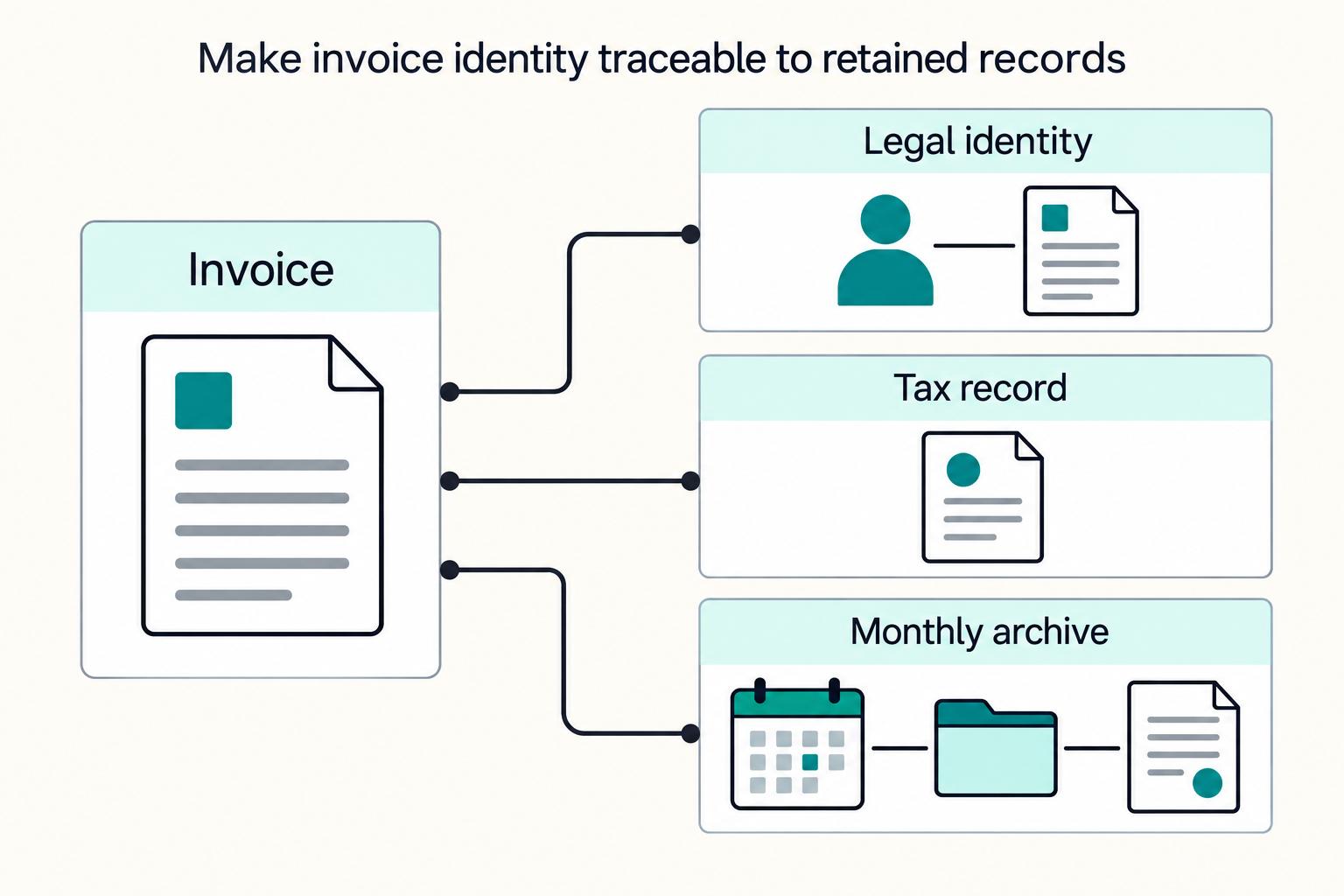
Keep the invoice name, legal identity, tax registration and records connected. For a sole trader, a trading name should lead back to the individual rather than appearing to be a separate company.
Make the invoice identity match the registered identity#
If you trade using your surname, with or without first names or initials, identify yourself consistently on contracts and invoices. If you use a registered business name, the CRO requires the proprietor's name on documents carrying that name. Include both so the client can identify the individual behind the trading name.
Keep one short identity note in the file that answers four questions: who is contracting, what name appears on the invoice, whether a business name is registered, and which Revenue status supports the work. That discipline reduces later confusion when you start dealing with foreign clients or multiple markets, including situations covered in Invoice Freelancer Spain Autonomo.
Keep tax and business records for six years#
Revenue's business recordkeeping guidance requires originals of records used to calculate your taxes to be kept for six years, including sales invoices and expense receipts. Some records need longer retention: for example, relevant VAT records must be retained until an appeal or investigation is finalised if that takes longer.
| Record pack item | Why it belongs in the Irish file | Minimum control |
|---|---|---|
| Revenue registration confirmation | Shows the tax setup is real, not assumed | Store the confirmation date and channel used |
| Business-name filing evidence if relevant | Documents the CRO filing; it does not establish exclusive rights to the name | Store CRO confirmation beside your invoice identity note |
| Invoices and expense support | Needed for self-assessment, VAT, and review | Keep a retrievable monthly archive rather than a year-end pile |
| Immigration permission evidence for non-EEA cases | Shows the person was allowed to freelance or run the business | Store the stamp and the permission wording together |
A good test is simple. Starting from one invoice, you should be able to trace the legal identity, the tax registration logic, the payment, and the retained evidence without rebuilding the story from memory.
- Keep one monthly archive: avoid splitting tax support across email, cloud drives, and accounting notes.
- Store source documents with dates: filing confidence drops when you cannot show when a step was completed.
- Check the first three invoices: trace the contracting party, proprietor name, tax details and payment records while the process is still easy to adjust.
Avoid mixing up registration, naming and online access#
Two useful checks are whether a business-name filing has been mistaken for tax registration, and whether access to an online account has been mistaken for completion of the underlying obligation.
Do not confuse business-name registration with tax registration#
The CRO and Revenue do different jobs. A business-name filing solves a public naming question. It does not replace Income Tax registration, self-assessment, VAT analysis, or PRSI planning.
For example, a sole trader who registers a studio name still needs to assess Income Tax and VAT separately. The CRO confirmation identifies the trading name; it does not confirm those tax registrations.
Do not let online access rules replace the legal rules#
A second mistake is confusing ROS, myAccount, or another online tool with the underlying legal obligation. The tool tells you where to transact with Revenue. It does not decide whether you needed self-assessment, whether VAT applies, or whether immigration permission allows self-employment.
- Do not call the setup finished after one filing: business-name, Revenue, VAT, and permission tracks can close at different times.
- Do not reuse another country's checklist: Ireland's thresholds and service channels are specific.
- Do not treat one login as proof of legal compliance: access and obligation are different questions.
Conclusion#
Choose the legal form, register for the relevant taxes, and record the trading-name decision. Then connect the tax calendar and reserve calculations to the income year, while keeping permission to work separate from tax registration.
- Confirm your structure: sole trader or company, with a separate decision about the trading name.
- Finish Revenue setup:
PPSN, tax registration, and the right online route. - Map the money obligations: self-assessment deadlines, VAT thresholds, PRSI, and USC.
- Match paperwork to reality: invoice identity, records, and permission evidence should all tell the same story.
Use the first few invoices to check that the contracting party, proprietor name, VAT treatment and retained records agree. Complete any immigration permission or regulated-activity requirements before undertaking work that depends on them, and meet the specific onboarding conditions of clients or payment providers.
Frequently Asked Questions
Do freelancers in Ireland have to register with Revenue?
Revenue says self-employed people should register for Income Tax self-assessment. Registration is mandatory if taxable non-PAYE income exceeds EUR5,000 or gross non-PAYE income exceeds EUR30,000. For non-PAYE income not exceeding either limit, Revenue provides a Form 12 declaration route through myAccount.
Can I use my own name without registering a business name?
You can use your true surname, with or without first names or initials, without registering that name. John Murphy can trade as “John Murphy”, but “Murphy Builders” requires a CRO business-name filing within one month of adopting it. The underlying sole-trader tax obligations remain separate.
When do I need ROS instead of myAccount?
For initial registration, existing business-tax users can use ROS, while PAYE/LPT-only users use myAccount. Once registered as a sole trader, you must use ROS for returns and payment; arrange that access even if you registered initially through myAccount.
What are the main VAT thresholds for a self-employed person in Ireland?
The main domestic thresholds are EUR42,500 for services and EUR85,000 for goods or mixed supplies with at least 90% goods turnover, measured by calendar-year turnover excluding VAT. Certain manufactured goods have the lower threshold. Taxable services received from abroad and non-established-trader rules can create obligations below these sales thresholds.
Can a non-EEA national freelance in Ireland on any stamp?
No. The permission wording matters. On Stamp 1, Immigration Service Delivery says a person must not engage in business, trade, or profession unless that is specified in a permission letter.
How long should I keep freelance tax and business records?
Keep business tax records for six years. Retain relevant records longer where required, such as VAT records connected with an appeal or investigation that has not been finalised.
Try a related tool
Researched and edited by the Gruv editorial team. Gruv builds cross-border billing, payouts, and finance-operations software for global businesses.
Sources
Includes 7 external sources outside the trusted-domain allowlist.
- vat-one-stop-shop.ec.europa.eu/one-stop-shop_entrusted
- citizensinformation.ie/en/employment/types-of-employment/self-emplo...external
- citizensinformation.ie/en/employment/types-of-employment/self-emplo...external
- cro.ie/registration/business-nameexternal
- cro.ie/information-leaflets/business-names-registra...external
- gov.ie/en/department-of-social-protection/publicati...external
- gov.ie/en/department-of-enterprise-tourism-and-empl...external
- irishimmigration.ie/registering-your-immigration-permission/info...external
Educational content only. Not legal, tax, or financial advice.
Related Posts

How to Register as a Sole Trader in the UK
If you want to register as a UK sole trader, the path is straightforward: confirm the structure fits, complete registration through Self Assessment, then stay on top of ongoing filing obligations.
Freelance Netherlands ZZP Registration for Operators Evaluating Launch Readiness
If you cannot verify legal work status, KVK registration readiness, and tax registration responsibilities before launch, pause. The useful lens is operator readiness: whether Dutch ZZP support works as an execution capability, not as a casual market idea.

Invoice Sole Proprietor vs Company for US, Canada, and UK Risk Reviews
When comparing **invoice sole proprietor vs company**, start with who is legally behind the obligation, not how polished the invoice looks. That is where payout acceptance risk usually splits.