
Quick Answer
Pause unless your file already proves four items: work eligibility, completed KVK registration evidence, a documented BTW process, and a pre-engagement DBA misclassification review. For Dutch ZZP rollout, market entry is an operations decision, not a demand test. If a dependency is still inferred, especially permit wording or step order, hold rollout, resolve authority-level confirmation, and only then activate onboarding or payouts.
Verify KVK, BTW, and DBA readiness first#
If you cannot verify legal work status, KVK registration readiness, and tax registration responsibilities before launch, pause. The useful lens is operator readiness: whether Dutch ZZP support works as an execution capability, not as a casual market idea.
Confirm the hard gates first. Start with what is mandatory. Business.gov.nl states that you must register at the KVK and register for Dutch taxes, and Hodak Legal describes KVK registration as the primary administrative step for freelancers.
A ZZP (zelfstandige zonder personeel) is a self-employed professional without staff. For many teams, this is the practical freelancer model in this market. The first decision is whether you can support the legal and administrative minimums, not whether demand exists.
Residency status is the first major split. Hodak states that starting freelance work requires a valid residence permit allowing living and working in the Netherlands, and other sources note that permit needs depend on residence status. If your target cohort spans mixed residency scenarios, do not run them through one onboarding funnel.
Separate mandatory from conditional. Treat KVK and Dutch tax registration as confirmed requirements, and treat residency and permit pathways as conditional and potentially blocking. Be explicit about what is verified and what still needs legal confirmation.
The practical focus here is execution quality: registration steps, BTW administration once active, and the evidence you need for invoices and later review. If launch scope depends on unverified assumptions, hold scope.
Gather proof, not intent. Require an evidence pack for each contractor path before you commit product or GTM resources. For eenmanszaak registration, the source checkpoint is clear: valid ID, proof of business address, and the registration fee.
After registration, the control work continues. Freelancers receive a KvK number that must appear on invoices and business communications, and they retain VAT and recordkeeping responsibilities. In practice, you should be able to show who verified KVK details, when tax setup was confirmed, and whether invoice templates include the required identifiers.
Make the proceed, pause, or escalate call. Use a simple launch rule:
- Proceed if legal work status is verified, KVK and tax registration are executable, and your stack supports invoice and recordkeeping responsibilities from day one.
- Pause if residency or permit status is unclear, or onboarding cannot verify the documents needed for registration and invoicing.
- Escalate if your model increases liability or classification risk, especially with Wet DBA enforcement active from January 1, 2025.
Run one final operations check before launch. Dutch freelancer setups typically require ongoing BTW administration, including 21% VAT on most goods and services with quarterly remittance, unless a later verified exception applies. If finance and product cannot support that discipline, treat ZZP support as a higher-friction expansion path.
For a step-by-step walkthrough, see How to Make a Defensible LOB Call Under the US-Netherlands Tax Treaty.
What is confirmed and what is still unknown#
The boundary is straightforward: this guide covers EU VAT administration mechanics, but not the full Dutch freelancer onboarding path. Use it to design OSS- and CBR-related VAT process decisions, not to validate KVK sequencing or other local registration requirements.
| Confirmed | Operational implication |
|---|---|
The cited pages are official EU web properties in the europa.eu domain | Suitable as EU-level VAT policy references |
| OSS guidance covers registration, VAT declaration and payment, record keeping and audits, and leaving the scheme | You can scope VAT process operations from these pages |
| The Netherlands is listed among participating CBR countries | A cross-border VAT advance-ruling route may exist when VAT registration conditions are met |
| CBR requests are filed in a participating EU country where the applicant is VAT-registered | VAT-registration status is a prerequisite checkpoint for that path |
| In some Union-scheme cases, Member State choice is binding for the calendar year plus two following years | Member State selection can create a multi-year lock-in risk |
Keep several items marked as unknown: whether KVK or Handelsregister is the central step for all freelancers, whether freelancer and ZZP are interchangeable, whether the sequence is BRP -> BSN -> DigiD -> business registration, the exact KVK fee, full non-EU pathway details, and any "register briefly then deregister" approach.
For rollout decisions, label each requirement as officially confirmed, inferred, or unknown. If a requirement is about Dutch domestic onboarding, keep it out of officially confirmed until a source directly supports it.
This pairs well with our guide on Freelance vs Contractor vs Employee Classification and How It Changes Payout Risk.
Decide if Netherlands ZZP is viable for your model#
Use a strict go or no-go matrix. The Netherlands is viable only when legal entry is clear, onboarding dependencies are evidenced rather than assumed, and your team can handle ongoing admin and classification checks.
Build the matrix before you scope product or sales. Its job is to separate verified requirements from assumptions.
| Requirement row | What you need to verify | Confidence score | Go or no-go impact |
|---|---|---|---|
| Legal entry certainty | Whether the person has a valid residence permit that allows self-employed work; if wording is unclear, check the residence document and confirm with the Immigration and Naturalisation Service (IND) | supported in pack | If unresolved, no-go for launch scoping |
| Registration dependency map | Which registration dependencies apply to your target user profile and what evidence is needed at each step | inferred | If any dependency is still assumed rather than verified, pause |
| Ongoing tax/admin burden | Whether you can support registration follow-up, tax administration, and record handling from day one | supported in pack | If you only support light-touch onboarding, this is a red flag |
| Classification risk (employee-in-practice) | Whether your review can catch cases where the worker is operating like an employee in practice | inferred | If you cannot review this before activation, pause |
Keep the labels strict: supported in pack, inferred, or unknown. That makes risk visible to leadership instead of hiding it inside launch optimism.
Hard-gate residency clarity first. Current guidance says to confirm a valid permit for self-employed work and check the document wording or contact IND if it is unclear. Make this a document check before you design any process around it. If legal entry is still unclear, pause before planning Chamber of Commerce steps, appointment prep, or payout setup.
Treat registration dependencies as a working map, not a confirmed rule set. Keep them marked as inferred until you have direct confirmation for the target profile. Use artifacts, not memory, at each dependency step. KVK also points starters to the Business.gov.nl question flow for a tailored to-do list, so use that output as part of your case evidence.
Assume the ongoing administration is material. Freelancers handle many administrative responsibilities themselves, including registration and tax administration. Also treat classification as an operating-risk check, not a contract-label check. KVK's warning is practical: someone must actually work as a zzp'er and not, in effect, as an employee.
Run one final readiness check before the first live payout. Ask whether your process can enforce the gates you chose, or whether it only records gaps after the fact. Proceed only when mandatory dependencies are confirmed or evidenced in the case file. If any critical item remains unknown, especially permit clarity or pre-registration dependencies, pause launch scoping and resolve it first.
Related: A Guide to VAT for UK Freelancers.
If your go/no-go matrix is still open, map the policy gates and payout-state checks your team needs before launch in Gruv docs.
Choose the right business structure for first entry#
For first entry, use a branching decision rather than a blanket claim that one form is always better. A solo ZZP path is one possible first operational branch for individual freelancers. Consider early BV review when liability, governance, or investor requirements are already central.
A complete legal, cost, or timeline comparison between Eenmanszaak and BV is not available here. Treat strong claims about "which is better" as unverified until you confirm the exact case with Dutch legal or tax experts.
| Decision area | What is grounded here | What remains unverified here |
|---|---|---|
| Registration baseline | Every new company must register in the KVK Business Register (Handelsregister). | Any Eenmanszaak vs BV setup-cost or setup-time comparison. |
| Tax registration flow | Separate Tax Administration registration is not required; it follows automatically after KVK registration. | Any threshold for when to switch from Eenmanszaak to BV. |
| ZZP framing | ZZP refers to self-employed people without employees. | Any claim that Eenmanszaak is always the default or best choice. |
Use this internal rule to keep rollout decisions clean:
- Start with the solo branch when onboarding an individual freelancer and no documented corporate-structure need exists.
- Consider BV review when structure choice changes signing authority, invoicing legal name, or compliance evidence requirements.
Then connect that choice directly to onboarding and invoicing data. Before you approve invoicing, verify that the legal name and registration details in your system match what is registered with KVK for the selected branch. If that match is unclear, pause go-live and resolve the structure first.
Gather prerequisites before booking registration steps#
Before you book anything, confirm eligibility and structure in writing so you do not create avoidable rework.
| Checkpoint | What to verify | Action if unresolved |
|---|---|---|
| Residence permit | Whether the person has a valid residence permit for self-employed work | Pause and check the residence documents or contact IND before moving forward |
| Legal structure record | The file explicitly shows the chosen structure, commonly eenmanszaak or BV where registration is required | Do not rely on ZZP or freelancer as the legal-structure label |
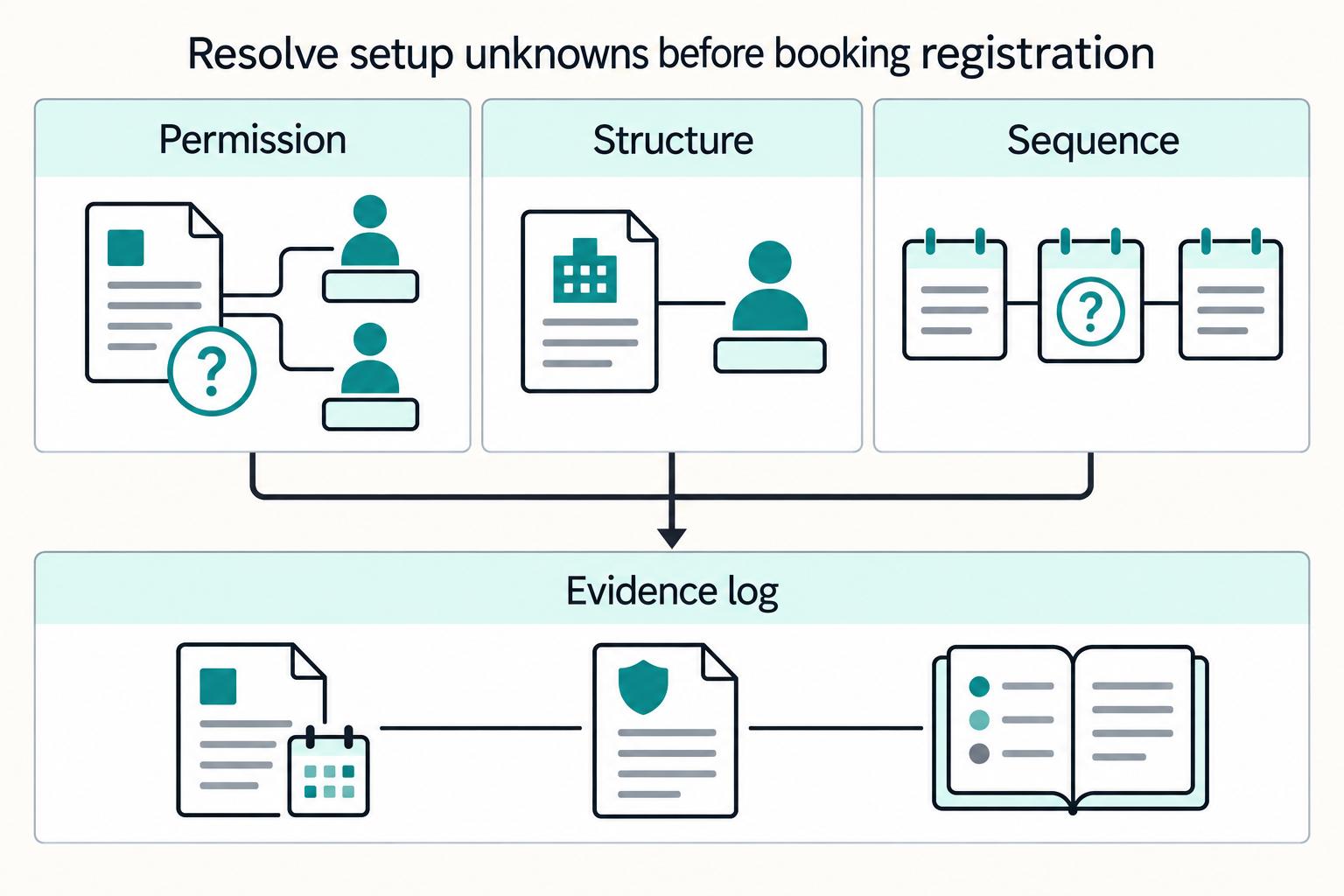
| Registration sequence | Keep the sequence marked as "to verify" with the relevant authority | Do not assume one fixed order |
| Evidence log | Step, date, authority, reference number, and status are aligned in one place | Make sure permit checks and structure choice have no open ambiguity before booking |
First, verify whether the person has a valid residence permit for self-employed work. If permit wording is unclear, pause and check the residence documents or contact IND before moving forward.
Next, lock the legal-structure record. ZZP or freelancer describes a working status, not a legal structure, so your file should explicitly show the chosen structure, commonly eenmanszaak or BV where registration is required.
Then prepare a working set of records for authority interactions and treat it as provisional, not a complete official checklist. Keep the registration sequence as "to verify" with the relevant authority rather than assuming one fixed order. A single KvK appointment is usually enough, which helps with planning but is not a guarantee.
Finally, keep a simple evidence log for handoffs: step, date, authority, reference number, and status. Before booking, make sure the chosen structure and any permit checks are aligned in one place with no open ambiguity.
Execute the EU longer-stay registration sequence without rework#
Run this as a gated sequence, not as parallel tasks. Confirm each gate is complete in your log before you move forward. No single confirmed Dutch legal order for address, BRP, BSN, DigiD, and KVK is established, so treat that path as a working hypothesis to verify with the relevant authority at each step, not as a settled rule.
Use one operating rule throughout: if completion evidence is missing, the step is still open. That prevents partial progress from being reported as readiness.
Gate discipline for the Dutch setup path#
- Keep one evidence log with: step, authority, date, reference number, owner, and status.
- Mark steps as
completeonly on confirmed completion, not on booking or submission. - If required evidence is missing or instructions conflict, pause at that gate until you have a documented resolution from the relevant authority.
- Do not skip ahead as a workaround. Resume only after the blocker is resolved and recorded.
Keep OSS compliance as a separate, explicit track#
Once establishment is actually complete, run OSS as its own process flow: registration, VAT declaration and payment, record-keeping and audits, and, when relevant, leaving the scheme.
| OSS topic | What the article confirms |
|---|---|
| Process flow | Registration, VAT declaration and payment, record-keeping and audits, and leaving the scheme |
| Member State rule | There is one Member State of identification |
| Choice lock-in | In some cases, Member State choice may be binding for the calendar year plus two following years |
| Filing cadence | Quarterly for Union and non-Union OSS; monthly for import OSS |
| Scheme status | A Member State can exclude a user from the scheme |
For planning, keep the grounded constraints in view. There is one Member State of identification. In some cases, Member State choice may be binding for the calendar year plus two following years. Filing cadence also differs by scheme: quarterly for Union and non-Union OSS, monthly for import OSS. A Member State can also exclude a user from the scheme.
Handle non-EU and short-stay cases with explicit caveats#
Do not run non-EU or short-stay cases through the EU-assumption workflow. Treat Dutch immigration and short-stay pathway details as unresolved, and keep the case paused until those points are verified through jurisdiction-specific guidance.
Separate non-EU and short-stay cases from the EU path. The BRP -> BSN -> DigiD -> Netherlands Chamber of Commerce (KVK) path above is not established here as a universal route for non-EU or short-stay cases. The current sources do not confirm Dutch setup order, permit mechanics, or whether brief register-then-deregister handling is workable.
In intake, label these cases explicitly as non-EU or short-stay, EU assumptions blocked before operational planning starts.
Gate operations on confirmed OSS eligibility facts. Use confirmed evidence, not intent, as the decision point. Record whether the taxable person is established in the EU, whether any EU fixed establishment exists, and which OSS scheme and Member State of identification apply. If those facts are ambiguous, do not onboard as active.
Keep VAT establishment decisions on a separate track. Do not assume that operating in the Netherlands automatically makes the Netherlands the OSS setup country. Under OSS, registration is in one single Member State of identification. For non-EU taxable persons with no EU establishment, the non-Union scheme allows choosing any Member State. If there is an EU fixed establishment, the Member State of identification follows that fixed establishment.
Because Member State changes can be restricted in some multi-establishment situations for the current calendar year plus the two following years, verify establishment facts before you design VAT operations.
Treat short-stay and deregistration outcomes as unresolved unless proven. OSS participants can leave voluntarily or be excluded from a scheme, but do not assume Dutch short-stay freelancer mechanics are established, or that brief registration followed by deregistration is operationally safe in non-EU cases. If required evidence is incomplete, keep the case paused and escalate rather than activating on assumptions.
Set up tax and administration controls from day one#
After KVK registration, weak admin controls create avoidable risk. Put a minimum tax and records standard in place before the first invoice is issued.
| Monthly check | What to confirm |
|---|---|
| Profile match | Profile data still matches the registered person or entity |
| Invoice identifiers | Invoices include the KVK number and, where applicable, the BTW number, and are retrievable |
| Expense evidence | Tax-relevant expenses have supporting source documents |
| Bookkeeping status | Bookkeeping is current, not reconstructed later |
| KOR or VAT decisions | Any KOR or VAT treatment decisions are documented |
Build the tax profile before issuing invoices. Treat the KVK registration record as your operating baseline. ZZP is not a legal structure on its own, so your records should reflect the actual registered form and registration details.
Your minimum profile should include:
- registered legal name
- registered business structure
- 8-digit KVK number
- assigned BTW number once received
Do not approve live invoicing until KVK and BTW details are recorded in one place and checked against onboarding records.
Standardize invoice hygiene immediately. Set invoice controls once and use them consistently. At minimum, each invoice should show the KVK number, and guidance also indicates the BTW number should appear alongside it.
From day one, lock in:
- one invoice template
- one numbering convention
- one archive location
If KOR treatment is being considered, do not apply it from memory. One guide says eligibility may apply below €20,000 annual turnover, but confirm current Belastingdienst rules before using that VAT treatment.
Run a monthly compliance check. Use a monthly checklist to keep records audit-ready, even though VAT filing frequency is not established.
Check that:
- profile data still matches the registered person or entity
- invoices include the KVK number and, where applicable, the BTW number, and are retrievable
- tax-relevant expenses have supporting source documents
- bookkeeping is current, not reconstructed later
- any KOR or VAT treatment decisions are documented
By month end, you should be able to produce invoices and expenses cleanly, without reconstructing them from chats or bank notes.
Require auditable evidence for income, expenses, and deduction claims. Internal notes alone are not enough. Keep evidence that an auditor can follow for each invoice and each tax-relevant expense.
For first-year deduction claims, add one extra control: evidence of work performed. Time tracking is not mandatory by itself, but claims must be substantiated. A commonly used benchmark is 1225 hours per calendar year, and missing records can fail under audit.
Reduce misclassification risk before the first client contract#
A practical way to reduce ZZP misclassification risk is to design the engagement so the day-to-day work shows real independence before anyone signs. Treat DBA Act risk as an operating-model decision, not a contract cleanup step.
Translate DBA risk into operating signals. Assess how the work will actually run. Escalate when several employee-like signals appear together:
- client authority over how work is done
- obligation to perform work personally
- fixed working hours
- integration into the client organization
- long-term dependence on a single client
Then confirm independence signals you can verify in practice:
- the contractor carries real financial risk
- the contractor uses their own equipment
- the contractor has multiple clients without long-term single-client dependence
A single factor is not a bright-line rule, so review the full pattern.
Match contract wording to operating reality. Contract language helps only when operating behavior matches it. If the contract says independent contractor but the setup runs like employment, the risk remains.
Set boundaries before signature, including:
- no org-chart placement
- no recurring team-meeting role as default internal staff
- no employee-like email or system setup unless strictly necessary and scoped
Add a pre-engagement review for higher-risk setups. Run a short pre-contract review when the proposed setup looks close to employment reality, especially in single-client-heavy arrangements.
Minimum review questions:
- Who sets hours and directs the work?
- Is personal service required?
- How embedded will this person be in internal teams and systems?
- What evidence supports independence, such as financial risk, own equipment, and client mix?
Use a red-flag checklist in sales and onboarding. One checklist is enough if it gets risky arrangements escalated early.
| Red flag | Why it matters | Escalation trigger |
|---|---|---|
| Client controls hours and methods | Signals authority and employment-like control | Legal or ops review before contract issue |
| Personal service is mandatory | Increases dependence on one worker | Redesign scope or staffing model |
| Contractor is treated like internal staff | Supports integration signal | Remove employee-like setup before start |
| Long-term single-client dependence pattern | Weakens independence position | Add controls and require approval |
This pre-contract discipline can reduce reclassification exposure later. Recent Dutch case outcomes show active reclassification risk, and sources also note uncertainty on current fines or retroactive recovery practice.
Build a deductible expense policy that survives review#
Once contract-level misclassification controls are in place, evidence becomes the next control. For a freelancer or ZZP'er (zelfstandige zonder personeel) in the Netherlands, keep your expense policy conservative: only keep costs you can explain, document, and retrieve quickly if reviewed.
Define narrow in-scope buckets. Start with what fits your operating model and has a clear business link, not with everything that might be deductible. Keep version one of the policy tight, then expand only with advisor input.
Treat these as internal review buckets, not automatic Dutch tax-law conclusions:
| Policy bucket | Why it belongs in scope for review | Mandatory trail | Extra checkpoint |
|---|---|---|---|
| Owned tools and equipment | Supports genuine independent business activity | supplier invoice, business purpose note, payment proof | record whether use is business-only or mixed-use |
| Professional insurance | Supports independence evidence and business risk assumption | policy or invoice, short note on business use, payment proof | confirm the policyholder matches the freelancer or business |
| Dedicated business premises, including a home office setup | Can support evidence of business premises | contract, bill, or setup invoice, business purpose note, payment proof | document whether the space is dedicated or mixed-use |
Also track whether invoicing spans multiple clients during the year, since that can support an independent business profile in reviews.
Use one checkpoint: each expense either fits a named bucket or is escalated for review.
Require one retrievable evidence trail. Set one minimum internal standard: store invoice, business purpose note, and payment proof together. This is an operating rule, not a confirmed Dutch legal formula, but it keeps explanation and evidence linked.
Keep purpose notes specific. "Laptop for work" is weak. "Laptop purchased for client delivery work and invoicing across multiple clients" is clearer. Payment proof should show who paid, when, and an amount that matches the invoice. Mismatches should be flagged. If you cannot pull the full trail quickly, the record is not ready.
Classify mixed-use spend conservatively. If business purpose is weak or mixed-use is unclear, classify conservatively and get advisor input before claiming. This lines up with broader audit risk because Belastingdienst scrutiny includes whether contractors show real independence and financial risk, not just whether the paperwork exists.
If a contractor uses company equipment, works exclusively for one company, and carries little business risk, reclassification risk can rise in an audit. The downside can be significant, including retroactive taxes and penalties.
Review before filing periods, not after. Review records before filing periods, or monthly when volume is high. Prioritize mixed-use items, higher-value purchases, and any record missing part of the evidence trail.
Use a binary outcome: ready to keep, or held back until fixed. A smaller set of well-supported claims is usually safer than a larger set you may not be able to defend later.
Connect registration choices to payment operations#
Move a contractor to payable status only after the onboarding checks you chose are recorded and reviewable.
Tie KVK and identity checks to payout eligibility. Use KVK registration as a clear onboarding gate, since the freelancer start flow includes "Register your business at KVK." For a ZZP'er, if you collect BSN details, treat them as an internal identity-consistency control and confirm any legal payout requirements separately.
Keep one verification pack per profile: KVK result or reference, invoice legal name, selected structure, for example eenmanszaak, and check-pass date. Before first payout, confirm the invoice issuer matches the approved onboarding record. If verification is incomplete, allow invoice submission but keep payout at pending review.
Build traceability from accepted invoice to settled payout. A Dutch ZZP invoicing flow should include compliance checkpoints, not just collection and disbursement. Keep VAT compliance, recordkeeping, and payment information tied to each payable item from invoice acceptance through payout attempt, payout result, and reconciliation output.
Set one finance test. Starting from a payout ID, you should be able to retrieve the accepted invoice, onboarding approval, and current payout status without manual stitching. If invoice and payout events live in separate tools without a shared ID, reconciliation and auditability can degrade quickly.
Limit product promises to documented coverage. Enable only the controls your provider documents for your Netherlands program and market, and keep a short coverage register with control, owner, verification date, and stated limits.
Match external messaging to that documented coverage. State that payout review starts only after KVK and internal verification checks are complete, and keep eligibility language conditional on documented coverage. Do not promise specific rails, automatic compliance outcomes, or universal eligibility across Dutch registration paths unless those capabilities are live and supported.
Common mistakes and how to recover quickly#
The fastest way to create rework is to treat uncertain registration and VAT assumptions as settled. If a Netherlands launch starts to wobble, recover by separating what is confirmed at EU level from local operational assumptions that are still unresolved.
Split EU and non-EU VAT paths before onboarding scales. Do not run every profile through one VAT path. For OSS, pathway rules differ based on whether the taxable person is established in the EU, and OSS setup requires registration in one Member State of identification. Before cross-border invoicing, record EU establishment status, chosen scheme if any, and the Member State used.
If your team is using residence or work-status assumptions as a proxy for VAT treatment, stop and separate those questions. Keep those items unresolved until they are verified through official local channels.
Rebuild prerequisites from verified sources, not memory. If local setup is incomplete, pause and rebuild the prerequisite pack before rebooking operational steps. Keep one retrievable file with required documents, current status, and the official source behind each requirement.
The recovery rule is simple: do not hardcode local registration dependencies from forum posts or internal memory. When a local prerequisite is unclear, mark it unresolved and block policy decisions until it is verified.
Pause invoicing until VAT filing and recordkeeping controls are live. Launching invoices before VAT controls and records are operational creates downstream finance risk. If OSS is in scope, OSS returns are additional and do not replace domestic VAT returns. Filing cadence also differs by scheme: quarterly for Union and non-Union, monthly for import.
Recover by pausing new onboarding, setting the filing calendar, and enforcing documentation standards. At minimum, each invoice should map to its VAT treatment, filing path, and stored evidence.
Separate OSS scheme exit from deregistration folklore. Do not base policy on anecdotes such as "register briefly, invoice once, then deregister." What is confirmed is narrower: OSS users can leave a scheme voluntarily or be excluded.
When cross-border VAT treatment is still uncertain, log it as unresolved and verify it through official channels before rollout decisions. For complex cross-border uncertainty, a VAT Cross-border Rulings request can be filed in a participating EU country where the taxpayer is VAT-registered.
If you want a deeper dive, read How to Register as a Sole Trader in the UK.
Conclusion#
Make this a go or pause decision, not a speed decision. Launch only when dependencies are verified and unknowns are explicit.
If you can prove all four checkpoints, you have a documented Netherlands ZZP readiness baseline. Those checkpoints are residency or work eligibility, completed KVK registration evidence, a documented BTW approach, and a pre-engagement false self-employment review. If any checkpoint is still an assumption, pause rollout and close the gap first.
- Residency and work eligibility: Confirm the person can live and work in the Netherlands for the planned freelance activity, and keep dated evidence with approver details.
- KVK completion: Where entrepreneur criteria are met, treat Business Register completion as a proof task, including the issued KvK number and its use in invoices and communications. Keep an explicit note that whether separate Belastingdienst registration is required after KVK remains a point to verify with Dutch tax authorities.
- BTW and administration setup: Define VAT handling and admin operations before first billing. Freelancers carry admin responsibility, with a 21% VAT and quarterly remittance pattern, and a possible KOR route at up to €20,000 annual turnover.
- Classification risk check: Run a final review for false self-employment before activation, since the confirmed failure mode is reclassification to employment with wage tax and social security obligations for the client.
Proceed when the file clearly shows those four controls. If it does not, stop, mark the missing evidence, and resolve it before scaling onboarding or payments.
Related reading: How Freelance Developers Use Linear to Control Scope and Billing.
When your readiness checklist is complete and you need market-specific confirmation on rollout constraints, talk to Gruv.
Frequently Asked Questions
Is KVK registration mandatory for freelancers and ZZPers in the Netherlands?
Whether KVK registration is mandatory in every freelance case is not established. Verify current Dutch official guidance for the specific setup before you encode policy.
Is there any real difference between a freelancer and a ZZP?
Whether "freelancer" and "ZZP" are legally identical under Dutch law is not established. For onboarding and compliance, use the exact business-form and registration wording shown on official documents instead of assuming the labels are interchangeable.
What are the first steps for EU professionals staying longer term: BRP, BSN, DigiD, and KVK?
The exact Dutch step order is not confirmed, so treat any fixed sequence as unverified until you check official Dutch sources.
What obligations begin right after registration, especially Value-added tax (BTW) and administration?
What is confirmed here is only the OSS cross-border VAT side. If you opt into OSS, you register in one Member State of identification and must declare all supplies covered by that scheme through OSS returns. OSS returns are additional and do not replace domestic VAT returns, and filing cadence differs by scheme: quarterly for Union and non-Union, monthly for import. OSS rules also cover records, invoices, and bad debt relief.
Can someone register briefly, invoice once, and deregister safely?
Do not treat that as a safe default. The confirmed point is narrower: an OSS user can leave a scheme voluntarily, through deregistration, or be excluded by the Member State. That does not prove a Dutch business registration can be opened, used once, and closed without broader consequences.
When should a founder choose Eenmanszaak versus BV for a first Dutch launch?
No firm rule for choosing between them is available here. For sole-trader background, see A Guide to the Netherlands' 'Eenmanszaak' for Sole Traders.
What should be verified first for non-EU applicants through IND and Residence permit checks?
The non-EU Dutch pathway is not established, so do not reuse EU assumptions for that flow. If cross-border VAT treatment is unclear, VAT Cross-border Rulings may be relevant for complex transactions between participating Member States such as the Netherlands, requested in the participating country where the applicant is VAT-registered under national conditions.
Try a related tool
Researched and edited by the Gruv editorial team. Gruv builds cross-border billing, payouts, and finance-operations software for global businesses.
Sources
Includes 1 external source outside the trusted-domain allowlist.
- assets.eurofound.europa.eu/f/279033/fb1436e542/ef1718en.pdftrusted
- business.gov.nl/starting-your-business/starting-as-a-self-em...trusted
- business.gov.nl/starting-your-business/registering-your-busi...trusted
- oecd.org/content/dam/oecd/en/publications/reports/201...trusted
- taxation-customs.ec.europa.eu/archives/taxable-persons/vat-cross-border-ru...trusted
- vat-one-stop-shop.ec.europa.eu/one-stop-shop_entrusted
- vat-one-stop-shop.ec.europa.eu/index_entrusted
- accessfinancial.com/how-to-become-a-zzper-in-the-netherlandsexternal
Educational content only. Not legal, tax, or financial advice.
Related Posts

Choosing an Eenmanszaak in the Netherlands as a Sole Trader
Treat "unlimited liability" as a legal exposure question, not a tax registration question. If you are weighing an **eenmanszaak netherlands** setup, keep the main warning simple: clean VAT or GST registration evidence does not tell you whether a Dutch business claim can reach your personal assets, or how that plays out when some of those assets sit outside the Netherlands.

How to Register as a Sole Trader in the UK
If you want to register as a UK sole trader, the path is straightforward: confirm the structure fits, complete registration through Self Assessment, then stay on top of ongoing filing obligations.

VAT for UK Freelancers Without Filing Surprises
If you want a low-stress approach to **vat for uk freelancers**, start with an HMRC-first baseline. Think of compliance as a series of decisions backed by records, not a setting inside your invoicing tool.