
Quick Answer
Use Article 26 as replaced by the 2004 Protocol. Confirm the claimant, Article 4 residence and income classification first. A private-company ownership/base-erosion route generally needs at least 50% qualifying ownership on at least half the days of the year and less than 50% of treaty-defined gross income in counted deductible payments. Derivative benefits generally needs at least 95% qualifying ownership by seven or fewer equivalent beneficiaries, with a separate base-erosion test. Check the full conditions, not just the percentages.
Make a defensible yes / no / escalate call on your LOB position#
Start with the claimant and the actual benefit requested. Then test an applicable Article 26 route and record a supported yes, a failed test, or a specific unresolved question. The worksheet below helps a preparer follow the evidence rather than infer eligibility from a Dutch address.
The U.S.–Netherlands treaty separates residence, income taxation and Limitation on Benefits. The March 8, 2004 Protocol replaced Article 26 in full. Reading only the original 1992 Convention can therefore produce the wrong thresholds.
What you should leave with#
By the end, you should have two things:
- A yes, no, or escalate decision on whether your facts are strong enough to keep testing treaty access.
- A documentation checklist you can share with a preparer or use to build your own treaty file.
The checklist is the main output. A treaty position is much easier to defend when you can point to the exact materials you relied on. Your file should include the Convention, the Protocol, and the IRS Technical Explanation, which the IRS describes as an official guide to the Convention and Protocol.
Why the gate matters#
The Convention was signed December 18, 1992, with a 1993 Protocol and a general effective date of January 1, 1994. For current LOB analysis, add the 2004 Protocol, Technical Explanation and accompanying Understanding. Historic dates identify documents; current operative provisions decide the claim.
The real question is whether your facts hold up against the full treaty package. That package spans more than one file and includes interpretive materials referenced alongside the Convention. Start with a basic control step: pull the documents from the IRS Netherlands treaty hub and confirm you can open them cleanly, because incomplete files and secondary summaries create avoidable errors.
What this article is and is not#
This is an operator-focused decision outline for freelancers and consultants who want a clean first pass before filing or briefing an advisor. It is meant to separate strong facts from weak assumptions where treaty access depends on records.
It is not individualized legal or tax advice. If your facts are messy, your ownership chain is hard to document, or the treaty materials do not clearly support your reading, escalate instead of improvising.
For a step-by-step walkthrough, see A Deep Dive into the US-Netherlands Tax Treaty for Independent Contractors.
Confirm treaty scope before you test LOB#
Before you touch Article 26, confirm scope: the right treaty, the right claimant, and the right income article. If that foundation is unclear, any LOB conclusion is guesswork. Work through this pre-screen in order:
| Check | What to confirm | Why it matters |
|---|---|---|
| Instrument and jurisdictions | Tax Convention with the Netherlands between the United States and the Kingdom of the Netherlands; Convention, Protocol, and Technical Explanation from the IRS treaty documents | Confirms the right treaty package |
| Claimant and residence | Who is claiming benefits and why that person or entity is a treaty resident under Article 4 (Resident) | LOB testing starts only after treaty residency is clear |
| Income article | Classify/source the payment: Article 7 business profits, Article 15 individual independent services, or Articles 10/12/13 dividends/interest/royalties as applicable | Avoids testing treaty benefits in the abstract |
| PE vs. LOB | Article 5 PE, Article 7 attribution and Article 15 fixed-base analysis are separate from Article 26 eligibility | They answer different questions |
- Confirm the instrument and jurisdictions.
Use the IRS Netherlands treaty document set: the underlying Convention and 1993 materials, then the 2004 Protocol and its Technical Explanation and notes. Identify the claim period and check later competent-authority arrangements relevant to your facts.
- Identify the treaty claimant under Article 4.
Establish Article 4 (Resident) status before LOB testing. Treaty residency is determined under the treaty, so you should be able to state clearly who is claiming benefits and why that person or entity is the treaty resident.
- Map the payment to the relevant income article.
Classify the actual payment. A BV’s consulting profits may require Article 7 (Business Profits); an individual’s independent services may require Article 15. Dividends, interest and royalties use Articles 10, 12 and 13 respectively. Source is a separate domestic-law question: the IRS generally sources personal-service income where the work is performed, so a U.S. customer alone does not establish U.S.-source service income.
- Keep PE analysis separate from LOB entitlement.
Article 5 defines permanent establishment; Article 7 addresses business profits and attribution. Article 26 tests access to treaty benefits. An individual’s independent-services claim may instead involve Article 15’s fixed-base rule. Passing LOB does not establish that there is no PE, fixed base or taxable income.
Two red flags should trigger a pause. First, a file that does not name the claimant, income article, and jurisdictions. Second, a file that relies on treaty tables without checking the treaty text. IRS guidance is to examine the specific treaty articles and check the relevant LOB text to see which tests are available.
Your output from this phase should be a facts-first brief with:
- claimant name and entity type
- residence position under Article 4 (Resident)
- payor country and recipient country
- income type, source and proposed article: 7/15 for relevant services or 10/12/13 for the specified investment income
- Article 5 (Permanent Establishment) facts listed separately
- documents reviewed from the official treaty set
Record unresolved scope questions explicitly—for example whether a contract pays for services or a copyright license. Resolve that classification before using a treaty withholding rate; a fully documented complex case is not automatically ineligible.
You might also find this useful: What is the 'Limitation on Benefits' (LOB) Clause in a US Tax Treaty?.
Run a one-sitting LOB pre-screen for a Dutch BV#
Use this first pass as a gate: either you have one clearly supportable basis under Article 26, or you mark the file escalate before any filing or withholding decision.
Identify missing facts rather than judging the length of the explanation. A multi-tier ownership chain can qualify, but the percentages, owner status and relevant dates must be supported.
Start with inputs you can verify now#
Use only facts you can tie to documents:
- exact claimant and legal entity type (the Dutch BV claiming treaty benefits)
- ownership map from the BV through intermediate entities to ultimate owners
- income type and the treaty article already mapped in scope
- where relevant activity tied to the income happens
Your checkpoint is simple: can a third party understand who earns the income, who owns the claimant, and where the relevant activity happens from the file alone? If not, do not move to a confident yes.
Screen major LOB tests, then confirm in treaty text#
Use IRS treaty tables as a checkpoint so you do not skip a major LOB test. Table 4 is useful for that. But the IRS also says the tables are not a complete guide, so a table-only answer is not enough.
Confirm the route against Article 26 as replaced by Article 7 of the 2004 Protocol, then read the corresponding 2004 Technical Explanation. Do not use the original Convention’s Article 26 thresholds as the current automatic test.
Build the yes/no/escalate grid#
Create a one-page grid with one row per LOB test you screened and these fields:
| LOB test screened | Result (yes / no / escalate) | One-sentence reason | Document relied on | Main open question |
|---|---|---|---|---|
| 2(f) ownership | yes — assumed facts only | 100% qualifying resident-individual ownership throughout the year | Dated register and owner residence evidence | Confirm all share classes |
| 2(f) base erosion | yes — assumed facts only | €40,000 counted payments / €100,000 treaty-defined gross income = 40% | Income calculation and classified ledger | Verify recipients and exceptions |
| 4 active business | escalate | Income connection documented; related U.S. activity comparison incomplete | Delivery records and group activity memo | Complete substantiality analysis |
Apply one strict rule: if your first pass cannot clearly support one basis under Article 26 from the treaty materials, mark escalate. A documented pause is safer than forcing a weak claim.
Compare qualifying routes and where solo operators usually fail#
Use the route you can prove now, not the one with the best-looking outcome. A defensible Article 26 path is safer than a fragile interpretation. If you cannot tie the claim back to treaty text and documents, treat it as an escalation case.
Do not confuse residency with access#
Article 4 residence is necessary, but a company also needs an applicable Article 26 route. Even a successful LOB test does not establish every benefit: the income article can impose beneficial-ownership, holding-period or other conditions. Check those conditions separately before choosing a dividend or other rate.
This is where files break. Residency is documented, but LOB eligibility is assumed instead of proven. A Dutch BV can be resident and still fail a treaty-benefit claim if no applicable Article 26 route is clearly supported.
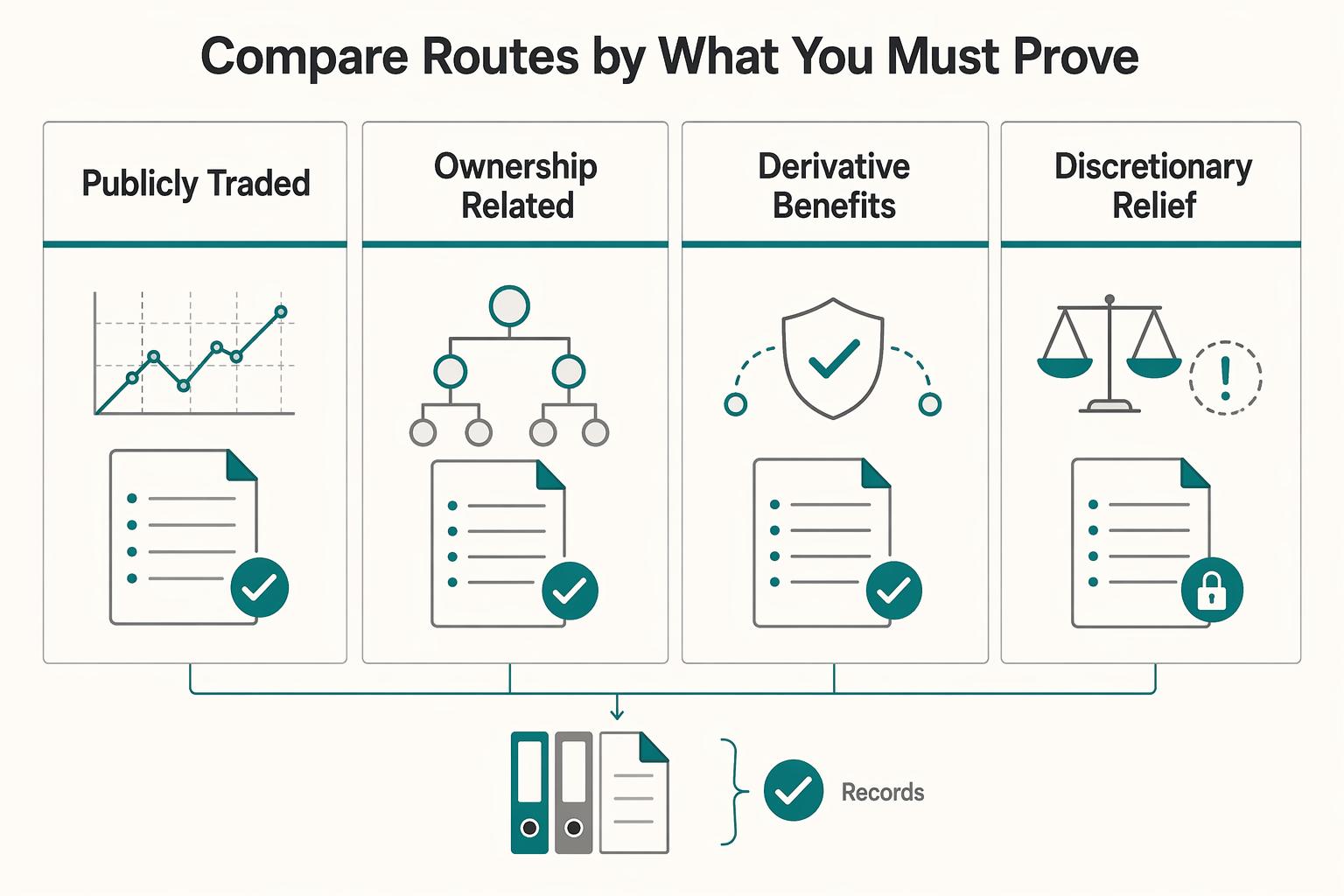
Compare routes by what you must prove#
| Route you are considering | What you need to verify now | Common failure to check |
|---|---|---|
| Resident individual: 2(a) | Treaty residence and other benefit conditions | Do not apply a BV’s company route to an individual |
| Listed company/subsidiary: 2(c) | Full trading/presence rules; subsidiary ≥50% ownership through ≤5 qualifying listed companies and permitted intermediates | A listed parent can matter; claimant-only listing is not the whole rule |
| Ownership/base erosion: 2(f) | ≥50% qualifying ownership on ≥half the year’s days; <50% gross income in counted deductible payments | Wrong owner category, year-end-only testing or all-outflow counting; unavailable to a company excluded from 2(c) solely for insufficient residence-state presence |
| Derivative benefits: 3 | Generally ≥95% vote/value through ≤7 equivalent beneficiaries; disproportionate classes and <50% base erosion separately | Assuming all foreign treaty residents are equivalent beneficiaries |
| Active business: 4 | Resident-country active business; connected/incidental income and substantiality where required | Treating no PE as proof of active-business eligibility |
| Discretionary relief: 7 | Formal source-state competent-authority determination | Self-certifying relief before a determination |
The routes below are not interchangeable. Paragraph 4 is income-specific; paragraph 7 relief requires a determination by the competent authority of the source state. The diagram highlights selected routes, not an exhaustive decision tree.
Where ownership complexity breaks the story#
A private BV need not be listed itself. Under paragraph 2(c)(ii), a subsidiary can qualify through at most five qualifying listed companies owning at least 50% of its aggregate vote and value and each disproportionate class, with U.S./Netherlands-resident intermediates for indirect ownership. Check the parent companies’ full listing requirements; a stock-exchange screenshot alone is insufficient.
A practical checkpoint is whether the claimant share register, current ownership chart, and any listing support make sense to a reviewer without oral explanation.
Use a hard stop when the route depends on exceptions#
If your route depends on exceptions you cannot evidence clearly, stop and document escalation. Record the Article 26 route considered, why it is not clearly met, what evidence is missing, and whether the next step is treaty-text review, Technical Explanation review, or advisor escalation.
IRS treaty tables are a guide, not the final authority. Before relying on any route, confirm the available tests and exact requirements in the treaty text itself. Once you know which path you are testing, the next question is whether your operating facts actually support it.
Apply the active business route without overreaching#
Use the active business route only when your file shows real operating activity tied to the income. If it does not, do not force an Article 26 (Limitation on Benefits) position.
This is a facts-first route, not a narrative rescue. A reviewer should be able to see what the claimant does, where it does it, and how that activity connects to the treaty claim without filling gaps by assumption.
Start with operating activity, not entity labels#
You are trying to show real operating activity, not just an entity that receives income. Labels like "consulting company" or "management company" are not proof on their own. Use three blunt checks as a practical screen, not as treaty thresholds:
- What recurring activity creates value?
- Who performs and controls that activity, and in which treaty jurisdiction?
- Which records support that story if challenged?
An invoicing address does not establish active conduct in the residence state. Keep staff, service-delivery, management and customer records that identify the activity actually carried on there; operations in several countries require a factual analysis, not automatic rejection.
Test the activity and income connection under Article 26(4)#
Paragraph 4 asks whether the resident actively conducts a trade or business in its residence state and whether the particular source-state income is connected with or incidental to that business. Managing investments for its own account is excluded, apart from the specified banking, insurance and securities-dealer activities.
Where the resident or an associated enterprise carries on the source-country business generating the income, the residence-country business must be substantial relative to that activity. Apply the treaty’s associated-activity rules and the Technical Explanation’s facts-and-circumstances analysis. This is not a requirement to establish a PE; keep any Article 5/7 analysis in its own section.
Know the failure mode before review#
A common overreach is claiming active business while the records show detached income flows. A formal structure can look clean while operating activity is unclear or outside the claimant's actual footprint.
Build the activity memo against Article 26(4): describe resident-country operations, the particular income connection and, if applicable, the relative source-country business. Attach delivery records, payroll or contractor records, management evidence and related-enterprise information. Preserve a separate PE/fixed-base analysis where relevant.
Handle ownership, base erosion and conduit risk in small-company structures#
For paragraph 2(f), test ownership over the year and calculate counted deductible payments against treaty-defined gross income. A current cap table and a quick cash-flow narrative do not establish the required period or the base-erosion percentage.
Small-company claims can fail when the structure sounds clean at a high level but the ownership and payment record tells a different story. That gap is where treaty-shopping risk starts to appear, especially when a Dutch BV sits between U.S.-source income and someone outside the treaty-resident story.
Build an ownership evidence map, not a cap-table summary#
Map direct and indirect owners, vote, value, disproportionate share classes and changes during the claim year. Paragraph 2(f) requires at least 50% qualifying ownership on at least half the days of that year. Identify the qualifying owner categories in paragraphs 2(a), (b), (c)(i), (d) and (e), rather than treating every treaty-country company as a qualifying owner. This route excludes a company that would qualify under paragraph 2(c) except for insufficient substantial presence in its residence state; it cannot bypass that listed-company exclusion.
Your map should align three answers at once:
- Who legally owns the shares.
- Who controls decisions.
- Who economically uses and enjoys the income after receipt.
If those answers come from different records, reconcile them before taking a treaty position.
| Check | What to verify | Red flag |
|---|---|---|
| Legal ownership | Current shareholder register, transfer records, voting rights, director appointments | Old cap table, nominee-style descriptions, or inconsistent ownership across documents |
| Payments and deductions | Classify interest, royalties, fees, tangible-property/services payments and non-deductible distributions; identify recipients | Using bank outflows as the base-erosion numerator without applying deductible-payment rules/exceptions |
| Ultimate benefit | Who actually uses and enjoys the income, based on agreements, bank flows, and decisions | Income lands in the BV, then quickly moves to a person or entity outside the treaty-resident story |
Reconcile the register, control records and payment ledger. Complexity alone is not a failed test; an unresolved owner status, percentage or payment classification is a concrete open question.
Stress-test the money trail for conduit risk#
Trace U.S.-source receipts into the BV, then trace material onward payments around those receipts. Focus on behavior, not labels.
A key anti-abuse signal in broader international tax analysis is near-total onward payment shortly after receipt to an entity that would not qualify for the same relief. Do not treat that standard as legally identical to treaty LOB rules, but use it as a conservative screening flag. If the BV looks like a short cash stop, treat the position as higher risk.
Use records that show timing and substance:
- bank statements around receipt and onward-payment dates
- intercompany agreements and invoices
- loan documents where interest is paid
- board approvals or minutes for distributions
- general ledger detail
- evidence of real local costs and expenditure
Substance should be visible in management activity, balance sheet reality, and cost structure tied to actual operations, not just formal legal steps.
Compare the two patterns before you decide#
Worked base-erosion example: assume €100,000 of treaty-defined gross income, not simply invoice turnover, and €40,000 of counted deductible payments to non-U.S./Netherlands residents under paragraph 2(f). The ratio is 40%, below 50%. €50,000 would be exactly 50% and would fail the “less than 50%” limb, unless a properly supported treaty exception changes what is counted. Ownership and the remaining conditions still need to pass.
Do not count every cash outflow as base erosion. The test concerns deductible payments to the specified recipients. Ordinary-course arm’s-length payments for services or tangible property and certain bank obligations are excepted on the treaty’s conditions. Non-deductible dividends generally are not counted deductible payments; they can still matter to the broader ownership and beneficial-ownership analysis.
The 2004 Technical Explanation specifies gross-income treatment: for Netherlands residents, principal-operation revenues are reduced by direct costs. Depreciation and amortization are not payments for this test. Keep the income calculation, payment classification, recipient residence and exception evidence together. Use the 2004 Understanding as the operative interpretive layer, not a disconnected historical passage.
For paragraph 3 derivative benefits, use a separate calculation: the relevant recipients are non-equivalent beneficiaries, not merely residents outside the United States and Netherlands. The same payment-exception wording must be checked. Do not carry a paragraph 2(f) result into paragraph 3 without reclassifying the recipients.
The 2004 Understanding retains a 30%/70% ownership pattern as objective criteria for granting paragraph 7 discretionary relief to a Dutch company: more than 30% vote/value ownership by the specified U.S./Netherlands equivalent beneficiaries and more than 70% by seven or fewer equivalent beneficiaries, with disproportionate-share and base-erosion conditions. This can be relevant to an application; it is not an automatic alternative to paragraph 3’s 95% test. A company must obtain the relevant determination before relying on that relief.
Flag edge cases you should not self-interpret#
Do not self-interpret this on a first pass when transparent entities or triangular facts are involved. When those patterns appear, treat your first read as preliminary and escalate for professional review.
For fiscally transparent entities, Article 24(4), added by the 2004 Protocol, treats income as derived by a resident to the extent the residence state treats it as that resident’s income. Determine who derives the specific item and whose LOB status must be tested. Legal entity form alone does not decide this, and flow-through documentation may differ from a BV’s own W-8BEN-E.
A triangular case can involve a treaty resident whose interest or royalty income is attributed to a third-country PE. Specific treaty limitations may restrict relief even if an ordinary LOB route is met. Record the branch, income attribution and tax treatment, then review the applicable Article 12 or 13 provisions rather than borrowing a two-country checklist.
Use this checklist before you rely on your initial reading:
- Open the full treaty package, not just the Convention text. The IRS materials describe the Technical Explanation as an official guide to the Convention and Protocol.
- Check the article discussion, not just the heading. The Technical Explanation says relevant portions of notes, the Memorandum of Understanding, and Agreed Minutes are discussed in the article discussions.
- Confirm you are using the current interpretive layer. Check the March 8, 2004 Understanding, which says it supersedes the earlier understanding tied to the 1992 Convention and 1993 Protocol notes.
- Record the unresolved rule or fact. Identify the missing derivation, owner-status or branch information for specialist review.
Use the 2004 Protocol, Technical Explanation and Understanding with the underlying Convention. The 2004 Understanding supersedes the earlier Understanding identified in its introduction. Retain historical materials where they explain the history, but do not present superseded wording as the current qualifying test.
Build the evidence pack before you claim treaty benefits#
Before you file, build the evidence pack for your treaty position so your conclusion is traceable and reviewable. If your support lives only in memory, email threads, or IRS summary tables, treat the claim as incomplete.
| File element | What to include | Key reference |
|---|---|---|
| Treaty file | Underlying Convention plus 2004 Protocol, Technical Explanation, Understanding and relevant later arrangements | Exact PDFs and access date |
| LOB support exhibits | Ownership and entity chart, business-activity summary, and support for the specific LOB test relied on | Article 26 (Limitation on Benefits) |
| Income map | Map services to 7/15 as applicable and investment income to 10/12/13; retain source analysis and underlying contract | Applicable income article |
| Double-tax memo | For each relevant income item, state who taxes it, what relief is expected, and which assumptions the filing position depends on | Article 24 and Article 25 |
Start with the treaty file, not a rate table#
Your base file should include the Tax Convention with the Netherlands, the IRS Netherlands Tax Treaty Documents hub, and the Technical Explanation. Keep the Technical Explanation with the treaty text you relied on, because it is the official guide to the Convention and Protocol.
Save the exact PDFs and the date you accessed the IRS hub. Add an “Applied reading of Article 26” memo naming the paragraph, claim year, supporting facts, calculations and open questions. A hub’s update date identifies a web page; it does not itself prove that a treaty provision changed.
Use IRS treaty tables, including Table 4, as checkpoints only. They are not a complete guide, so your file still needs the treaty text and your reasoning.
Add eligibility exhibits that match your theory#
Your exhibits should match the LOB path you are claiming under Article 26. Use Table 4 as a checkpoint, then confirm your position in the treaty text and Technical Explanation. A practical set often includes:
- Ownership and entity chart
Show direct and indirect ownership, entity types, and jurisdictions for the claim period.
- Business-activity summary
Explain the active resident-country business and its connection to each income item. Where the source-country business substantiality condition applies, document the relative activities and the associated-enterprise facts.
- Support for the specific LOB test you rely on
Tie your records to the test you are using, and note any assumptions or open uncertainties.
If another reviewer cannot follow your chart and memo quickly, the file likely needs tightening before filing.
Map each income stream to the right article#
Map each income stream to its classification and source before choosing the treaty article. Include Article 7 for a BV’s business profits and Article 15 where an individual’s independent services fall there, alongside Articles 10, 12 and 13 for dividends, interest and royalties. Keep any PE/fixed-base and income-attribution analysis separate from the LOB conclusion.
Do not rely on labels alone. Keep the underlying agreement or governing document for each mapped payment in the same file so classification can be checked.
Add a double-tax memo before filing#
Finish with a short memo anchored to Article 24 (Basis of Taxation) and Article 25 (Methods of Elimination of Double Taxation). For each relevant income item, state who taxes it, what relief you expect, and which assumptions your filing position depends on.
Show the relief method, limits and any residual tax rather than promising that the income cannot be taxed twice. Record residence-state treatment and the applicable credit or exemption rules, including any U.S. citizenship/saving-clause issues.
For an individual, the Tax Residency Tracker can organize travel dates. A BV’s residence file instead needs its tax status and relevant incorporation, management or other residence evidence; a day counter does not decide corporate treaty residence.
Align filing positions and escalation steps with your advisor#
Align on the filing position early. If you and your advisor do not agree on Article 26 (Limitation on Benefits), pause and reconcile the facts before filing or claiming a treaty rate.
Bring a review-ready pack to your preparer before filing. Include your ownership chart, income map, applied reading of the Tax Convention with the Netherlands, and the exact treaty excerpts used from the IRS Netherlands Tax Treaty Documents page. Keep the full IRS document set available, including the Technical Explanation, Protocol, and exchange of notes, so your position is tested against the full context, not just selected text.
Pre-agree the escalation triggers#
Set specialist-review triggers in advance, and escalate if any of these apply:
| Trigger | Why it escalates | Named form or article |
|---|---|---|
| No clearly satisfied LOB test | The facts do not clearly satisfy at least one LOB test, even if the entity is a Dutch BV | Article 26 (Limitation on Benefits) |
| Incomplete withholding certificate file before payment | The withholding position relies on a withholding certificate and support file that were not complete before payment | Applicable payer documentation: entity/individual, flow-through and ECI classification matter |
| Expected treaty-inconsistent taxation | The case may need Mutual Agreement Procedure assistance | Article 29 (Mutual Agreement Procedure) |
For MAP cases, treat timing and submission quality as part of the decision. The treaty labels Article 29 as MAP. IRS guidance says to read the MAP article before requesting assistance. Delays can reduce effective relief, and defective requests may be declined.
If operations and advisor narratives drift apart, do not smooth over the gap in return language. Update the facts memo, retest the treaty position, and then decide whether to file the claim, back off, or escalate.
Sanity checks before you rely on treaty benefits#
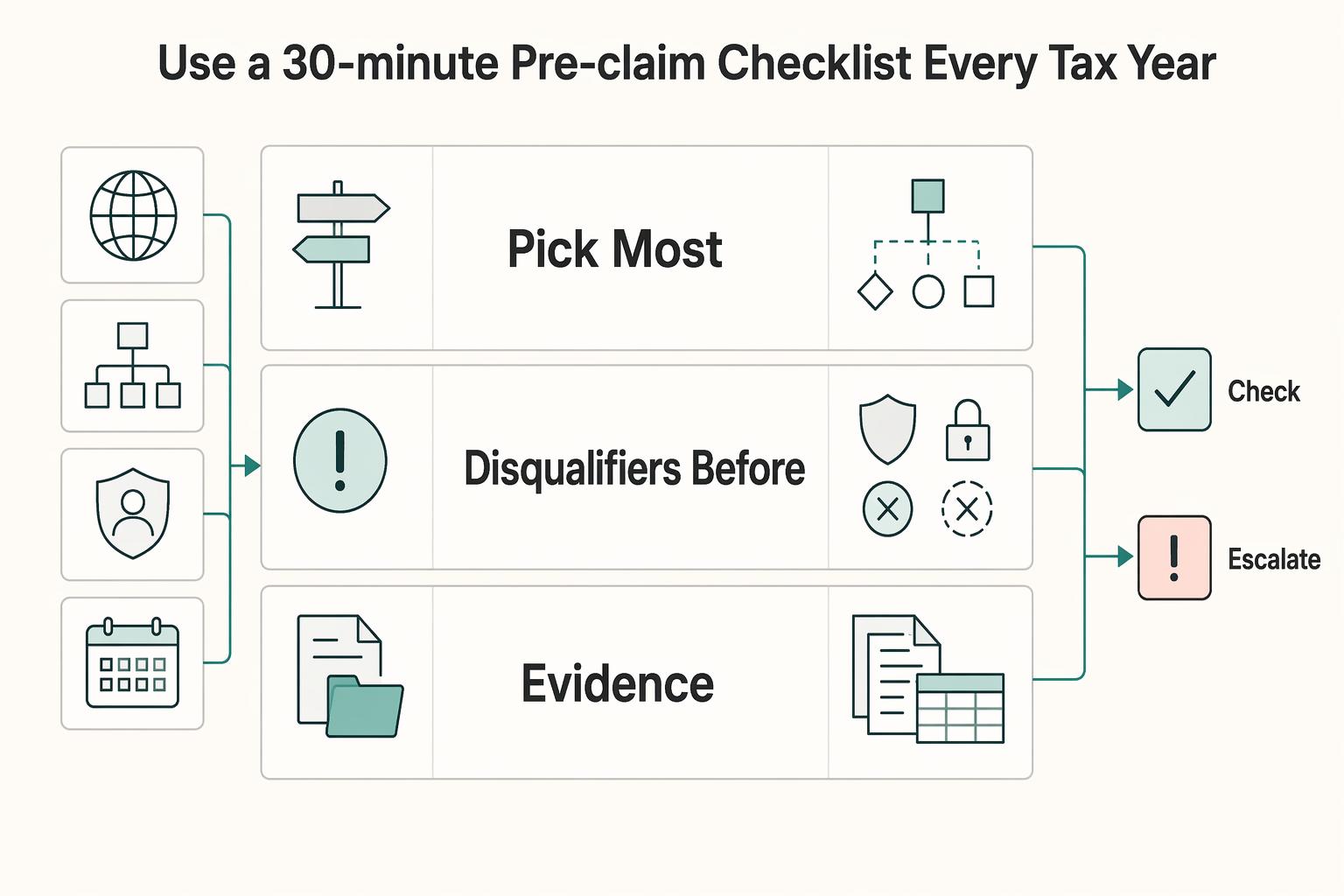
Run one final stop-or-go review before filing. If your facts changed and you have not re-tested your path under Article 26 (Limitation on Benefits), do not rely on treaty benefits yet.
- Reconfirm your claim path after any material fact change.
If key facts changed, recheck that your Article 26 position still matches the facts you can document.
- Check interpretation against current IRS treaty materials, not memory.
The Internal Revenue Service treats the Technical Explanation as an official guide to the Convention and Protocol, and its article discussions cover relevant companion materials. Your final review should use the treaty text, Technical Explanation, and current Protocol context together.
- Version-control the companion documents in your file.
Version-control the underlying Convention, 2004 replacement Article 26, Technical Explanation and accompanying Understanding. Record any later competent-authority agreement relevant to the claimed route. Retain earlier materials for context without treating them as the operative replacement text.
- Make your file reviewable by a third party.
State both your eligibility logic and its limits in plain language, with no hidden assumptions, so a reviewer can trace the treaty text, your Article 26 position, and the supporting documents from start to finish.
Final checkpoint: if any key fact is unknown, say so clearly and escalate instead of claiming certainty.
Complete the claim file#
Use a strict end state: yes, no, or escalate. For this treaty, Article 26 (Limitation on Benefits) is the gate, and if you cannot identify and document the route you meet, you are not ready to claim benefits.
Treat this as two decisions, in order. First, confirm LOB eligibility under Article 26. Then align the claim mechanics with the treaty article for your income and, where relevant, Article 24 (Basis of Taxation) and Article 25 (Methods of Elimination of Double Taxation).
Before filing, lock these three items:
- Finalize your evidence pack
Keep the treaty text, IRS treaty materials, ownership map, activity memo if you are using an active trade or business route, and income-to-article mapping together. If you rely on a route like derivative benefits or discretionary determination, say so directly in your memo.
- Verify against primary treaty materials
IRS treaty tables can support documentation, but they are not a complete guide. Confirm your position against the treaty text, then check the Protocol and Technical Explanation where they affect your route, including the 2004 materials and any later updates.
- Match filing mechanics to the position
Match the documentation to the claimant and payment. A foreign beneficial-owner entity generally uses W-8BEN-E where applicable; an individual generally uses W-8BEN, with Form 8233 potentially relevant to treaty-exempt independent services. Flow-through or effectively connected income can require different forms. Provide the applicable documentation to the requester, not the IRS, and keep the certified claim consistent with the supported route. Foreign-source services are not automatically subject to 30% withholding merely because the payer is American.
If you operate through a Dutch BV, use a conservative default: bring your yes / no / escalate worksheet and evidence pack to a qualified advisor before locking the filing position. The goal is not to maximize claims. It is to file a position you can support end to end with records.
The W-8 Form Generator can prepare a draft. Confirm the appropriate form, income classification and treaty claim first; the tool does not determine LOB eligibility or replace a competent-authority decision.
Frequently Asked Questions
Who can qualify for benefits under the U.S.-Netherlands Income Tax Treaty LOB rules?
Resident individuals are qualified persons under Article 26(2)(a); the article also lists government, company and other categories. Companies must establish an applicable route. The active-business route and competent-authority relief provide further possibilities, but passing LOB does not remove the other conditions of the benefit claimed.
If I have a Dutch BV, do I automatically get treaty benefits in the United States?
No. A Dutch BV still has to satisfy Article 26 and identify at least one LOB route it actually meets. If you cannot clearly name the route and support it with current facts, treat the position as unresolved and escalate.
What is the fastest first-pass checklist for the qualifying person test?
For a private BV, check paragraph 2(f): at least 50% qualifying vote/value and disproportionate-class ownership on at least half the year’s days, plus less than 50% counted base erosion. Paragraph 3 instead generally requires at least 95% vote/value ownership by seven or fewer equivalent beneficiaries, at least 50% of each disproportionate class, and its own less-than-50% payment test. The familiar 30%/70% pattern appears in the 2004 Understanding’s objective criteria for paragraph 7 discretionary relief; it is not the current automatic paragraph 3 threshold.
What documents should I keep to support an active trade or business test position?
Keep records of active business in the residence state and how the particular income is connected with or incidental to it. Where related source-country operations generate that income, document the substantiality comparison. Own-account investment management generally is excluded, subject to the specified banking, insurance and securities-dealer exceptions. PE evidence is a separate analysis.
When does derivative benefits test analysis become too complex for DIY?
Seek specialist review when you cannot establish an owner’s equivalent-beneficiary status, the required ownership percentages or the payment test. The equivalent-beneficiary definition includes treaty-entitlement and, for relevant income, same-or-better benefit requirements; residence in a broadly described region alone is insufficient. Check later competent-authority arrangements if an owner’s country status has changed.
How do transparent entities and triangular cases change the risk level?
For transparent entities, Article 24(4) requires identifying the resident treated as deriving the item. A third-country PE can bring separate triangular limitations for interest or royalties. These are substantive rules, not merely gaps in a flowchart; record tax classification, derivation and branch attribution before deciding eligibility.
What parts of my position must be confirmed in the Protocol to the Treaty or U.S. Treasury technical explanation?
Use the 2004 Protocol’s replacement Article 26 for the current route, then its Technical Explanation and Understanding for mechanics and interpretation. Confirm the underlying income article and any later relevant arrangement. The original Convention’s LOB text alone is insufficient.
Try a related tool
Researched and edited by the Gruv editorial team. Gruv builds cross-border billing, payouts, and finance-operations software for global businesses.
Sources
Educational content only. Not legal, tax, or financial advice.
Related Posts

Digital Nomad Taxes in 2026 With a Defensible Filing Plan
With digital nomad taxes, the first move is not optimization. It is figuring out where you may be taxable, where filings may be required, and what proof supports that position.

Tbilisi Digital Nomad Guide for 2026 Long Stays in Georgia
Start with sequence, not excitement. If your income depends on delivering work on schedule, secure your legal footing, assemble your documents, and keep month one reversible before you optimize comfort.
What Is the Limitation on Benefits (LOB) Clause in a US Tax Treaty?
A Limitation on Benefits (LOB) article restricts access to specified treaty benefits to prevent treaty shopping: routing income through a treaty-country person chiefly to obtain benefits intended for qualifying residents. Treaty residence is the starting point. Where LOB applies, the claimant must satisfy an available treaty-specific route, such as qualified-person status, an income-linked business test or competent-authority relief. Other treaty conditions still apply.