
Quick Answer
Confirm permission for the activity and the applicable tax and coverage framework. Register in the AEAT census with Modelo 036 before starting activity and arrange RETA where Spanish coverage applies. Classify invoices by the actual service and customer, track required IRPF/IVA periods and keep separate evidence of filing and payment. Reconcile gross amounts, retentions, fees and bank receipts; an internal pause does not extend a deadline.
Set up Spanish self-employment before activity starts#
An autónomo setup connects permission to work, tax registration, social-security coverage and invoice records. Use the actual activity start date, not the date a client eventually pays, to plan registration. Then give every filing, payment and unresolved question an owner and a due date.
This guide focuses on an individual freelancer using Spain’s ordinary self-employment and tax framework. Special expatriate regimes, nonresident taxation and the Basque/Navarre foral systems can change the forms and authority. Record which framework applies before using the AEAT examples below; VAT territory also differs for the Canary Islands, Ceuta and Melilla.
Keep three ledgers separate: IRPF income-tax payments and credits, IVA charged or deductible on transactions, and social-security contributions. A bank deposit alone cannot tell you all three. Set up official portal access and keep registration confirmations alongside the first invoice records.
Tax residence and permission to work answer different questions. AEAT residence guidance includes more than 183 days in the calendar year, the main base of economic interests, and a rebuttable spouse/dependent-minor presumption. Sporadic absences can count. Dual residence needs the relevant treaty analysis. A residence permit or NIE is not, by itself, a tax-residence decision or permission for every activity.
- Keep one evidence pack with registration confirmations, digital certificate access checks, filing receipts, and Social Security payment proof.
- Block quarterly prep time for IRPF and IVA, plus one annual close review for your income tax return.
- Reconcile each cycle before submission so invoices, expense records, and draft declarations match.
- Define escalation triggers now, before filing pressure starts.
Escalate permit or cross-border coverage questions before taking on affected work, and filing-access or classification problems during preparation. An internal review gate never extends a legal deadline; if activity has already started or a deadline is near, arrange timely correction and professional handling rather than simply waiting.
What the autónomo system actually is and where it starts#
Use the same declared activity and effective dates in your tax and social-security records. Update the file when your residence, activity or client mix changes. Registration is tied to starting activity, which can precede the first invoice or receipt; a first-invoice checklist is not permission to work unregistered until billing.
Think of the work as three separate jobs so nothing gets mixed, then assign each one clearly:
- Onboarding: establish the legal basis to work, register as required before activity starts, and confirm invoice and portal readiness.
- Recurring filings: complete tax and contribution obligations on schedule.
- Evidence retention: keep receipts, payment proof, and support records grouped by period.
If U.S.–Spain social-security coordination applies, use the Spain agreement, not a general assumption about U.S. citizenship. For otherwise dually covered self-employment, residence normally assigns coverage: Spain residents to Spain and U.S. residents to the United States. An exception retains the original country’s coverage when someone normally self-employed there transfers the business for five years or fewer.
A certificate proves the applicable social-security exemption; it does not replace Spanish tax registration, work authorization or invoice obligations. Request it from the authority of the covering country. For assigned U.S. coverage, SSA’s online service accepts self-employed requests. Follow the acknowledgement’s current contact instructions. Do not impose a blanket 90-business-day no-billing period on every autónomo.
Keep the coverage rule, residence/transfer facts, issuing authority, request and applicable period in the file. If work has begun and coverage is disputed, escalate to the relevant authority and adviser promptly; a pending certificate is not proof of exemption and does not authorize ignoring contributions or tax deadlines.
Decide your legal lane before you register#
Before registration, identify the activity you will perform, its location and the legal basis for performing it. Separate the immigration decision from tax residence and worker classification. Resolve missing authorization before new affected work; address existing obligations promptly even if a permit or structure question remains open.
For a non-EU applicant, check whether the actual permit authorizes the proposed self-employed activity, with any territory or sector limits. The Ministry’s cuenta propia route is a distinct authorization with activity and qualification requirements. A digital-nomad route, arraigo route or existing residence permission needs its own current conditions; a pending application is not a general approval to start.
For habitual personal self-employment, low or irregular income is not a blanket registration exemption. Use the Importass guide to establish the actual coverage and registration requirements. If the activity is genuinely occasional or falls within a special category, get a case-specific decision before relying on that distinction; do not substitute a minimum-income rule for the activity facts.
Autónomo describes individual self-employment; an SL is an incorporated company. Compare liability, administration, client contracting and the owner’s social-security position before changing structure. Incorporation does not automatically remove self-employment contribution duties. Use the actual owner/administrator role in that review rather than treating a company as a compliance shortcut.
A simple way to reduce confusion is to write a one-page lane summary before you register. Keep it plain and practical. Include your current status, any pending application, your chosen working form, and who owns each next action. This document is not legal advice. It is a control point that prevents informal assumptions from becoming filing actions.
Before you file anything, run one written verification checkpoint and keep it with your registration notes:
- Current residency or permit route, including pending status changes.
- Whether your activity is treated as continuous or repeated.
- Chosen form for this phase: autónomo or SL.
- Owner and target date for each next registration and filing action.
Record the conclusion and the evidence needed for each registration action. Unresolved authorization should block new work that requires it, while already-triggered filing and payment duties need timely handling.
Register with Hacienda and arrange the applicable social-security setup#
For the ordinary route, prepare identification, the activity description/codes, address, start date, tax obligations and receiving/payment details. Use official access or an authorized representative. Modelo 036 guidance for 2026 requires the census registration before starting the relevant activity. Modelo 037 was abolished on February 3, 2025; it is not a current alternative.
| Step | What to do | Note |
|---|---|---|
| 1 | Confirm work authorization, tax framework and any cross-border coverage decision | Keep dated decisions and source/authority; distinguish permission from pending applications |
| 2 | Submit the applicable tax census registration using Modelo 036 in the AEAT framework | Check activity, effective date and active filing obligations; save the submission |
| 3 | Arrange RETA registration if Spanish self-employment coverage applies | Importass permits notification up to 60 days before the start; complete it by the start date and align the recorded activity dates |
| 4 | Review the contribution and collection inputs before confirming | Expected net earnings, contribution base, mutua and a supported debit account; apply for any benefit only if eligible |
| 5 | Check access, confirmations and the first invoice template | Separate pending, submitted and confirmed items; keep evidence and owners rather than assuming a successful request equals approval |
The official Importass walkthrough describes identification through Cl@ve, a digital certificate or another valid method. Its form asks for the activity/IAE details, address, expected monthly net earnings, contribution base, mutua, contact details and debit account. Review the entries before confirming and download the registration receipt. Keep portal credentials private; an authorized gestor should use the appropriate representation process rather than a shared personal signing credential.
Test the access route for each required service, not just a general login. A digital certificate is useful, but it is not the sole method for every filing: the Modelo 130 instructions also allow Cl@ve and, for eligible filers, generated paper submission. Arrange a valid alternative or authorized representative before access failure puts a deadline at risk.
Confirm that the debit account is supported for the particular tax or contribution payment. Do not assume a freelancer receiving account accepts government debits. Save account verification and monitor the first charge; a submitted debit mandate is not payment proof.
Know your recurring obligations before first invoice#
Create an obligations list from the actual census and coverage decisions. Write the form, frequency, relevant period, submission deadline, payment method, earlier debit cutoff and responsible person. This is more useful than assuming every freelancer files the same quarterly forms.
For ordinary professional activity in direct estimation, Modelo 130 is a payment on account of IRPF. The professional-activity exemption applies when at least 70% of the previous year’s relevant income was subject to withholding/payment on account; in a start-up year use the corresponding quarter. The direct-estimation section uses cumulative year-to-date figures. Do not treat it as a flat tax on each bank deposit or as the final annual bill.
Modelo 100 is the annual IRPF return, often called the Declaración de la Renta. Reconcile income, allowable expenses, retentions and instalments for that return; do not deduct a credit twice. AEAT’s annual filing guidance says individuals registered as self-employed in RETA at any time in the tax year must declare regardless of income amount.
Use this minimum pre-invoice checklist to keep first-cycle decisions explicit:
- Record the applicable contribution coverage, any exemption certificate and its period; a request alone is not exemption evidence.
- Check census registration, activity details and the required first-cycle returns.
- Confirm invoice classification and payment/debit routes for the actual customer and authority.
- Assign an owner and due date to each filing, payment and open question.
- Archive invoices, receipt allocations and filing/payment confirmations from the first cycle.
A second failure mode is split ownership. One person tracks filings, another stores payment proof, and nobody confirms both match. Fix this by assigning one accountable owner for the action list even if tasks are shared.
A low-sales month does not automatically suspend registration or obligations. When you genuinely cease activity, handle the applicable tax and social-security notifications instead of quietly dropping returns or direct debits. Continue monitoring official notices and retain the confirmations.
Before new activity, resolve required authorization and registrations. For an existing operation, an open review question calls for corrective action and timely filings; it does not justify withholding a legally required invoice or indefinitely stopping compliance work.
Build a filing calendar you can actually keep#
For ordinary quarterly filers, Modelo 130 instructions and Modelo 303 deadlines set April, July and October 1–20 for the first three quarters and January 1–30 of the next year for the fourth. A weekend/nonworking-day end moves to the next working day. Confirm the actual year’s calendar and earlier direct-debit cutoffs; monthly and special cases differ.
Start with one monthly admin block that keeps each filing cycle clean:
- Organize invoices and receipts.
- Keep record categories consistent across the year.
- Confirm your certificado digital access works before filing windows.
Then use the same control points for each quarterly cycle:
- Pre-file review: check records and totals before submission.
- Submission confirmation: save proof as soon as you file.
- Post-file archive: store the filed version, supporting records, and payment or confirmation evidence together.
Keep the annual IRPF campaign and any required annual IVA summary on separate calendar entries. Modelo 390 is required only where applicable; certain filers are exempt and supply annual information in the last Modelo 303 instead. Use the 2026 Modelo 303 instructions to check your case. Carry year-end issues forward with a resolution date, not indefinitely.
Create two recurring reminders for each cycle: one for preparation and one for the actual filing window. This split keeps you from treating filing day as the first moment you look at numbers.
A quarter without sales still needs an obligations review. On Modelo 303, sin actividad means no output or input VAT accrued in the period, not merely no client payment. Expense VAT or foreign-service purchases can require entries even without sales. On Modelo 130, use the required cumulative calculation and applicable zero/negative filing treatment; do not erase previous-quarter activity.
Run invoice compliance and recordkeeping like an operator#
Create the first invoice template before work begins and review it against AEAT’s full-invoice requirements. Record a sequential number/series, issue date, supplier and customer identification/address, required NIFs, service description and taxable base, applicable rate and separately stated VAT, plus a different service/advance date where relevant. Include any required exemption or reverse-charge wording. Your service terms should add currency, due date and authenticated payment instructions.
Client country alone is insufficient to classify IVA. Under AEAT’s general service rules, business-customer services generally follow the receiving business’s establishment; consumer services generally follow the supplier, with exceptions. Ordinary cross-border B2B services can be outside Spanish IVA, and intra-EU services may require Modelo 349. Special services, such as those connected to real estate, need their own rule. Record customer status, service type and receiving establishment before copying an earlier invoice.
Set a minimum invoice standard and apply it each filing cycle so treatment stays consistent:
- Check the activity and registration basis; if historic work was unregistered, arrange correction rather than hiding it.
- Record the service classification, customer status/location and support for IVA or exemption treatment.
- Keep gross fees, IVA, applicable IRPF retention and net amount due in distinct fields.
- Link receipt allocations, provider fees, FX and any supported withholding to the invoice ID.
Build one evidence pack for each filing cycle, and complete it before you file:
- Issued invoices
- Expense proofs
- Payment records
- Filing confirmations
In a hypothetical domestic professional invoice where 21% IVA and 15% IRPF retention apply, a €1,000 service fee produces €210 IVA and €150 retention, leaving €1,060 for the client to pay. The €150 is a tax payment on account, not a discount or an unpaid fee. These are conditional rates: IVA rates and professional withholding guidance include different treatments. Confirm the payer’s withholding duty and retain its evidence; do not add a retention to every overseas or consumer invoice.
Keep the invoice and receipt views separate. If a provider receives that €1,060 and deducts an illustrative €20 fee, the bank receives €1,040. Reconcile €1,040 bank cash plus €20 provider fee against the €1,060 receipt, while separately tracking €150 retention evidence. Report according to the applicable tax timing and classification, not just net bank cash. A paid client with a pending payout needs provider follow-up, not a second collection request.
A useful quality gate is to review one sample invoice for each client type before a filing period closes. This catches repeated classification mistakes early without forcing a full invoice rewrite at the end of the period.
Match by invoice ID, period, amount and currency. A same-currency €300 part-payment against €1,060 due leaves €760; an own-funds account test is not client revenue. For converted receipts, retain the original currency, actual rate, fees and bank amount so a conversion difference does not become a fictitious unpaid invoice.
Choose DIY, gestor, or platform support without guesswork#
Choose your support model by assigning accountability first, then documenting it before deadlines get close.
A gestor is commonly presented as tax-accountant support in Spain. Platforms can help with task tracking and reminders, but filing responsibility depends on your setup and provider terms. DIY keeps control with you, and you also carry the risk if something is missed.
| Model | Main benefit | Main risk |
|---|---|---|
| DIY | Full control of records and filings | Missed steps or delays remain your responsibility |
| Gestor support | Professional tax-accountant support | Scope can be unclear if responsibilities are not documented |
| Platform plus owner review | Faster task tracking and clearer status | Tool guidance can be mistaken for final decisions |
Use professional support when a permit, tax residence, foreign-client IVA, coverage exemption or return classification requires a decision you cannot support. Repeated uncertainty is a signal to escalate; so is a first unresolved high-impact issue. Ask for the applicable rule, action and effective date in writing, then keep it with the filing records.
Set handoff boundaries in writing for every cycle so ownership is clear:
- Who prepares each filing draft
- Who submits each filing
- Who owns deadline tracking and filing confirmations
Add one more boundary: who has final sign-off authority when there is disagreement. Without a final owner, tasks can move but responsibility stays unclear.
Avoid the mistakes that trigger fines and cleanup work#
Review missed deadlines, failed debits, unsupported classifications and incomplete evidence as distinct exceptions. Assign the corrective filing or payment action to an owner. A late filing or underpayment has its own consequences; do not solve it by deleting a transaction from the records.
An autónomo registration does not, by itself, establish that every client relationship is independent work. If the arrangement changes toward employer-style control, ask for a worker-model review and keep the actual facts, conclusion and any required actions before renewing the engagement.
Quarterly filing discipline#
Treat quarter close as a preparation process with enough time for corrections and authorized submission.
- Reconcile invoices, bank receipts, fees, retentions and expense support; explain differences instead of forcing all totals to match.
- Verify the tax treatment of unclear records; preserve the source item and decision trail.
- Confirm preparation/submission owners, payment method and where acknowledgement and payment proof will be stored.
Resolve material errors during preparation. If a deadline is imminent, escalate for timely, accurate submission and the applicable correction process. An internal pause is not an extension, and uncertain expenses do not justify omitting known income.
Digital certificate readiness#
Treat each filing’s accepted access method as a dependency. Test your certificate or other valid method before preparation week; arrange authorized representation or a permitted alternative if necessary.
- Assign a primary owner and a backup path early in the quarter.
- Test login and signing on the exact setup you will use for filing.
- If a gestor files for you, keep written handoff boundaries and your own access to filing confirmations.
Residency status vs tax duties#
Keep immigration status and tax obligations on related but separate tracks, and verify obligations directly for each filing cycle.
Before annual submission, connect each figure to the appropriate period and supporting records. Investigate unexplained differences promptly and use the applicable correction route; do not miss a deadline solely because your internal checklist remains open.
If you want a deeper dive on cross-border planning, read our guide to a defensible 2026 filing plan.
Use a quarterly close checklist to stay audit-ready#
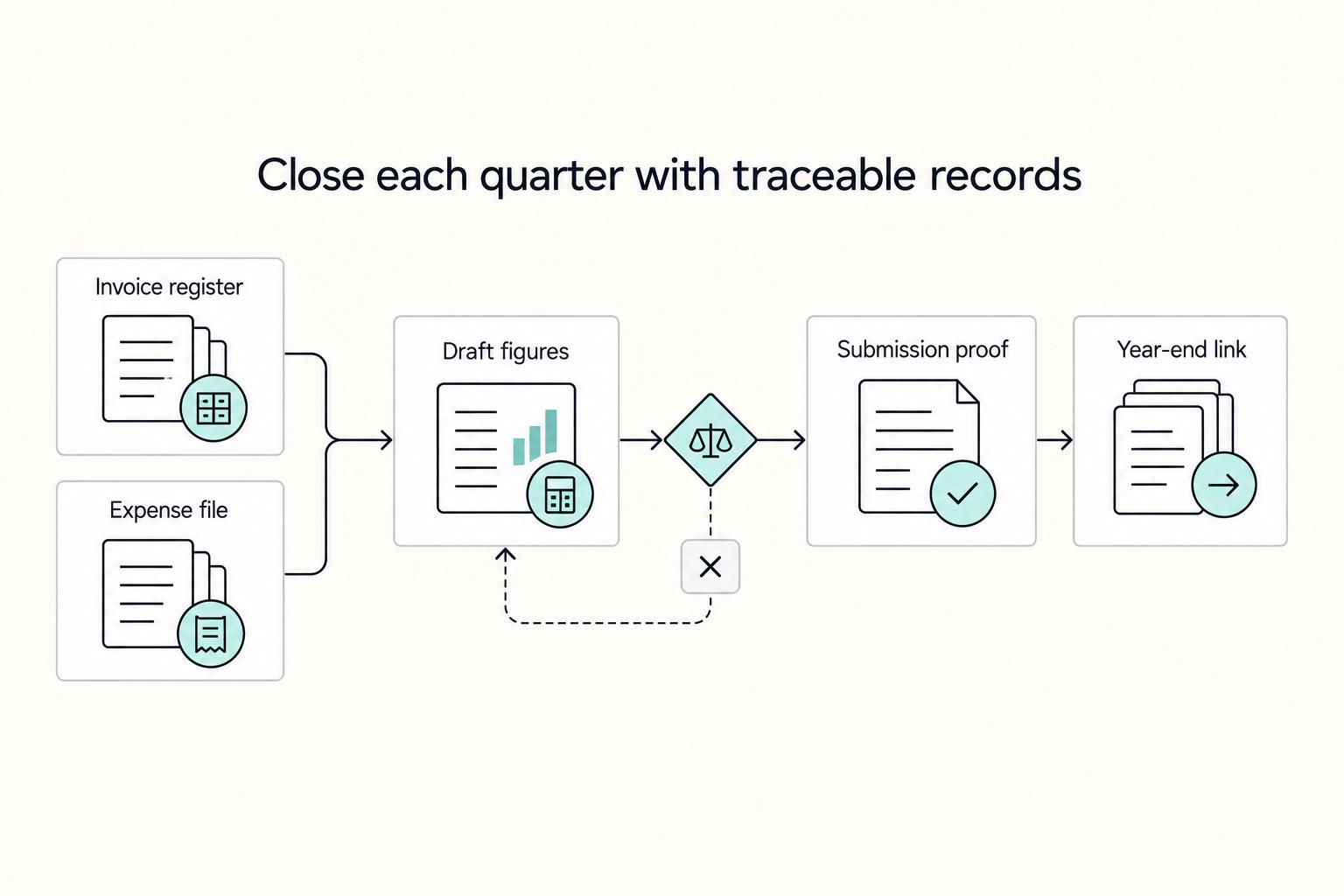
A repeatable quarterly close keeps every draft figure traceable before submission. That makes year-end tax return work easier and cuts cleanup risk.
| Step | Action | What to keep |
|---|---|---|
| 1 | Reconcile invoices, expenses, fees, retentions and bank movements, explaining timing and classification differences | A reviewed draft and a short mismatch log |
| 2 | Review required declarations using supported figures, correct duplicates and preserve a decision trail | Log corrections |
| 3 | Check monthly contribution charges and any coverage certificate or regularization notice | Proof with that quarter's tax records |
| 4 | Keep submission acknowledgements, filed forms, and related notices together | Tax authority confirmations by quarter |
| 5 | Assign unresolved issues an owner and deadline; use timely filings and the applicable correction process | A named issues list with owner, current status, and next action date |
- Step 1: Reconcile records. Match invoice IDs to receipts, fee deductions and withholding support; record timing/currency differences rather than pretending tax and bank totals must be identical.
- Step 2: Review the required declarations. Check the form and period, duplicates and tax classification. Preserve uncertain source records, resolve their treatment and escalate before a deadline; do not silently remove known income.
- Step 3: Confirm contribution status. Keep actual charge/payment evidence and any applicable coverage or regularization decision. A submitted request or debit instruction is not proof of payment or exemption.
- Step 4: Store filed forms, submission acknowledgements, payment evidence and notices by period. A saved draft is not a filed return.
- Step 5: Track open issues with owner, current status and next action date. Identify which require a current correction and which affect annual review; carrying a note forward does not suspend its deadline.
Use the close to resolve exceptions early. A failed government debit needs payment follow-up even if the form was filed; a client receipt stuck at a provider needs payout follow-up even if your tax record is complete.
Keep contractor and employment arrangements, contracts and records distinct, and review actual control when the relationship changes. Record an adviser’s conclusion and any required registrations rather than assuming separate folders solve classification.
Make the next close concrete#
Choose the next filing or payment deadline, work back to a preparation date and assign the owner. Use the verified registration, invoice and coverage decisions as inputs rather than reopening the same assumptions each quarter.
In the ordinary earnings-based contribution system, the selected base is provisional and linked to expected average monthly net earnings. Review the forecast when activity changes and keep the calculation; the later TGSS regularization uses tax-authority earnings data. A contribution base is not the monthly fee itself. Retain regularization notices and follow their payment, refund or response instructions rather than treating the provisional debit as permanently final.
Run this short checklist every cycle:
- Keep the legal basis for the activity, identity, tax census and applicable social-security registration/coverage evidence.
- Check active form obligations, valid access and supported debit/payment routes.
- Protect a preparation date before each deadline, with an earlier cutoff if direct debit applies.
- Assign unresolved permit, coverage, invoice or return issues to the appropriate authority/adviser with a due date; preserve the decision and correction evidence.
At the review, confirm what was actually filed and paid, which provider or authority exceptions remain open, and who must act next. If a contribution estimate, client type or activity has changed, update the relevant setup before carrying an old treatment into the next cycle.
Frequently Asked Questions
What taxes does an Autónomo in Spain usually handle?
For the ordinary framework, keep IRPF instalments/retentions, IVA transactions and social-security contributions separate. Applicable returns depend on activity and registration; an IVA treatment cannot be inferred from an IAE code alone. Track monthly contribution payments and the required tax periods, with separate evidence of submission and payment.
Do I still file a Quarterly tax return if I had no income?
Check each active obligation even with no sales. Modelo 303 sin actividad requires no output or input VAT in the period; expenses can change that. Modelo 130 can require a zero/negative return and cumulative figures. Do not assume a quiet quarter cancels registration or filing duties.
What should I set up first before I send my first compliant invoice?
Confirm the actual right to perform the work and the tax/coverage framework before activity starts. In the AEAT route, use Modelo 036, not abolished Modelo 037, and arrange RETA if Spanish coverage applies. Confirm valid portal access, supported payment/debit routes and invoice classification; keep the confirmations. A digital certificate is useful but not the only accepted method for every service.
How do IRPF (Impuesto sobre la Renta de las Personas Físicas) and VAT (IVA) differ in day-to-day operations?
IRPF concerns personal taxable income, instalments and retentions; IVA concerns the tax treatment of transactions and any deductible input VAT. Neither equals the cash deposited by a payment provider. Record base fees, IVA, supported retentions, expenses and fees separately, then reconcile using the applicable tax timing rules.
When is DIY enough, and when should I hire a Gestor?
DIY can work when the registration, customer treatment and required returns are straightforward and you can maintain the records. Use a gestor for an unresolved permit, tax-residence, coverage or invoice-classification question before filing. Agree who prepares, submits and monitors payment, and keep the advice and filing confirmations yourself.
How are Modelo 130, Modelo 100, and Declaración de la Renta connected?
Modelo 130 is a payment on account for applicable direct-estimation activity; professional income meeting the 70% withholding condition can be exempt from that instalment obligation. Modelo 100 is the annual IRPF return, or Declaración de la Renta. Keep the instalments and retention support for annual reconciliation so credits are counted once.
Try a related tool
Researched and edited by the Gruv editorial team. Gruv builds cross-border billing, payouts, and finance-operations software for global businesses.
Sources
Includes 1 external source outside the trusted-domain allowlist.
- inclusion.gob.es/web/migraciones/w/autorizacion-inicial-de-re...trusted
- portal.seg-social.gob.es/wps/portal/importass/importass/Colectivos/Tr...trusted
- sede.agenciatributaria.gob.es/Sede/ayuda/calendario-contribuyente/calendar...trusted
- sede.agenciatributaria.gob.es/Sede/ayuda/manuales-videos-folletos/manuales...trusted
- ssa.gov/international/Agreement_Pamphlets/spain.htmltrusted
- ssa.gov/international/CoC_link.htmltrusted
- www3.agenciatributaria.gob.es/Sede/procedimientoini/G229.shtmltrusted
- revista.seg-social.es/-/guia-para-darte-de-alta-en-la-seguridad-so...external
Educational content only. Not legal, tax, or financial advice.
Related Posts

Digital Nomad Taxes in 2026 With a Defensible Filing Plan
With digital nomad taxes, the first move is not optimization. It is figuring out where you may be taxable, where filings may be required, and what proof supports that position.

The Freelance Payment Penalty: A Modeled Audit of Platform Fees, FX Spreads, and Payout Delays
The money rarely disappears through a single, easy-to-spot fee. The real loss is stacked. A marketplace takes its commission, a processor adds a charge for international cards, a bank or payment company converts the currency at a spread, a platform holds the funds before release, and a wire sheds a little to intermediaries on the way in. Each layer looks defensible on its own, but the worker feels the combined result as a smaller deposit and a later payday.
How to Respond to a Subpoena for Business Records
Move fast, but do not produce records on instinct. If you need to **respond to a subpoena for business records**, your immediate job is to control deadlines, preserve records, and make any later production defensible.