
Quick Answer
Confirm whether the requester needs a personal TIN, Spain’s NIE/NIF or a VAT identifier, then use that national authority’s application route and document checklist. Portugal’s NIF can be requested in person by appointment or online through a legal representative; Spain’s NIE route depends on where you apply. Obtaining an identifier does not establish tax residence or permission to work. Assess full residence tests alongside day counts, keep available records and request residence certification where the relief procedure or institution requires it.
Which Tax ID You Actually Need in Europe#
Start with the identifier your client, bank or tax authority actually requests. Confirm the country, issuing authority and application requirements before treating a NIF, NIE or TIN as interchangeable. Registration, residence and permission to work remain separate questions.
If you need a European tax ID number, a common mistake is assuming there is one EU-wide process. There is not. There is no EU-level TIN, not all countries use TINs, and some do not automatically issue them to all taxpayers. So the practical question is country-specific: do you need a local tax identifier, a foreigner identifier, a VAT identifier, or no new number yet?
Step 1. Define the exact number being requested#
The first common failure mode is treating all IDs as interchangeable. They are not. A VAT number is a separate registration identifier, and each EU country issues its own VAT number nationally. EU TIN information is also scoped to natural persons, while legal entities may use other formats. Before you apply, confirm whether the requirement is for an individual tax identifier, a legal-entity identifier, or VAT registration. For example, Portugal’s tax authority lets a foreign citizen request a NIF at a Tax Office or Citizen’s Shop with an appointment, or through a legal representative using e-balcão. Prepare the identification and foreign-address documents required for your case, plus the representative’s authorization if applicable. Check document certification, translation and visa requirements on that application page. Store the issued notice; the NIF stays the same when resident status changes, but the address and tax status must be updated when appropriate.
Step 2. Separate the five terms that drive different outcomes#
You can make faster, better decisions if you keep these as separate systems:
| Term | What it refers to | Key note |
|---|---|---|
| Tax identification number (TIN/NIF-type number) | Administrative tax identifier | Does not by itself determine tax residence |
| Foreigner identifier (Spain NIE example) | Identifier for foreign nationals with dealings in Spain | Does not grant or prove Spanish residence |
| Tax residency | Status that affects whether a country taxes foreign income | UK guidance offers a clear example of the principle |
| Tax domicile | Separate connecting factor | Separate from residence or nationality |
| Local registration status | May be staged separately from ID issuance | Portugal states a NIF can be issued first with non-resident status |
If you blur these together, you can complete one admin step and still miss the status that actually controls your tax exposure.
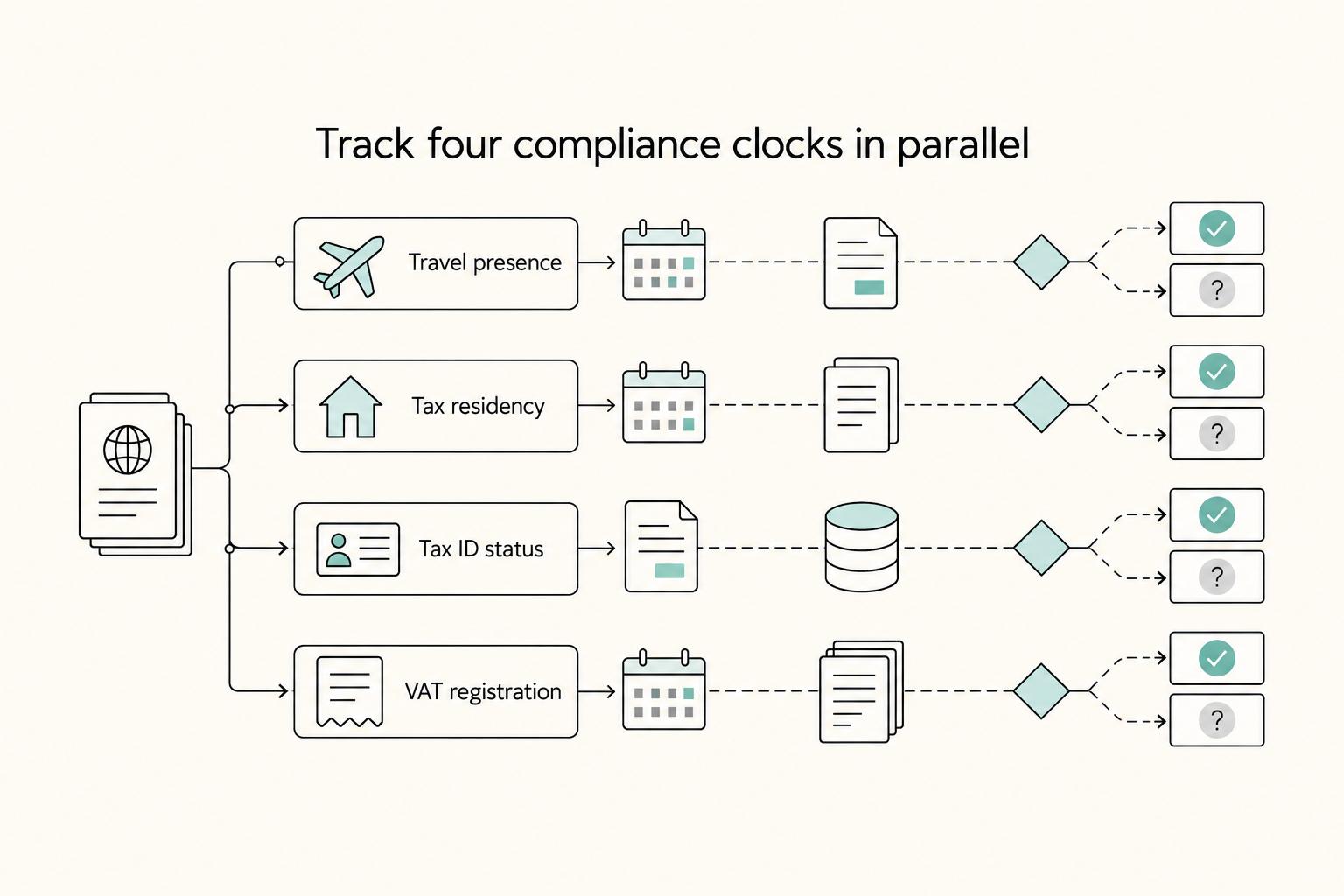
Step 3. Track the clocks in parallel#
You are not managing one rule. You are managing several clocks that answer different questions, so track them in parallel.
| Compliance clock | Grounded example | What it decides | Practical note |
|---|---|---|---|
| Travel presence | Schengen short stays: generally 90 days in any 180-day period for covered non-EU visitors | Whether the permitted short stay is met | Count entry/exit days; permit/long-stay rules differ, and this does not authorize work |
| Tax residency | UK example: 183 or more days in a UK tax year (6 April to 5 April) | An automatic UK residence test; other SRT tests can establish residence below 183 days | UK-specific, not Europe-wide |
| Tax ID status | Portugal NIF can be issued with non-resident status first | Whether an identifier exists | ID issuance and residency status are separate |
| VAT registration | Country-issued national VAT number | Whether VAT registration is required | Separate from TIN and travel rules |
This is why generic advice fails people running a business of one. It often explains one clock after the fact instead of helping you avoid conflicts across all of them before you act.
Step 4. Use this decision lens before any move#
Before any trip, contract, or filing, ask these three questions in order:
- What exact number is being requested?
- Which authority issues it?
- What status or clock changes when I obtain or use it?
If any answer is unclear, pause and verify first. Plan early for treaty evidence too. Double Tax Conventions are bilateral, tie-breaker rules are a sequence of tests, and relief is not automatic. A Certificate of Residence can be required as proof, so keep your records organized from day one. If you want the practical workflow, read Gruv's guide on how to get a tax residency certificate as a digital nomad.
Use the EU TIN checker for what it is: a structure or syntax check, not identity verification, and not proof that a TIN exists.
Run This in Three Passes: Assess, Track, Plan#
The practical way to run this is in three passes. ASSESS decides your filing exposure and ID path. TRACK keeps the records to support that path. PLAN checks the impact before you commit to trips, clients, or registrations.
Keep four terms separate so you solve the right problem. A Tax Identification Number (TIN) is a national taxpayer identifier used by most EU countries, but there is no EU-level TIN and not every country uses one. Country labels are not interchangeable. In Spain, an NIE is a foreigner identifier for economic, professional, or social dealings, while in Spain's VAT context the VAT number is the NIF with the ES prefix. Tax residency is country-specific and can affect whether worldwide income is taxed. Your filing footprint is the set of countries where you may need tax payments or declarations.
| Step | Inputs | Action | Done when |
|---|---|---|---|
| Step 1. ASSESS | Citizenship, residence history, travel pattern, client locations, contract terms, and any request for TIN/NIF/NIE/VAT number | Map where filing exposure may exist, then identify the exact ID type in scope: personal tax ID, foreigner ID, or VAT registration | You can list each country in your filing footprint and state what number is required, which authority handles it, or that no new number is needed yet |
| Step 2. TRACK | Entry and exit records, invoices, tax notices, issued IDs, and residency indicators | Monitor each country separately and maintain proof of residence and taxes already paid | You have a dated log and an evidence pack that can support a relief claim if needed |
| Step 3. PLAN | Proposed trips, new clients, start dates, and registration changes | Run pre-trip and pre-client checks before committing, including whether new filing or registration duties may arise after verification | You have checked the obligations affected by the plan, identified any mandatory prerequisites and assigned unresolved questions for timely advice |
A good default is to treat identity, residency, and reporting as separate systems until the relevant country authority confirms otherwise. One avoidable mistake is completing one admin step, such as getting an NIE, when the real issue is residency status or VAT registration. Keep in view that cross-border income tax outcomes are not set by one EU-wide rule. Country rules and bilateral Double Tax Conventions usually drive the result.
Escalate to the relevant tax authority or an advisor when two countries may treat you as tax resident at the same time, when treaty rules do not clearly resolve your case, or when you are asked to prove residence or taxes already paid. If that risk appears in Step 3, prepare proof early with Gruv's guide on how to get a tax residency certificate as a digital nomad.
Phase 1: ASSESS. Start With One Compliance Matrix#
Start with one compliance matrix. It should tell you, for each jurisdiction, where you may need a tax ID, which type applies, and what needs action now versus monitoring. There is no EU-level TIN and issuance rules differ. Use the current EU Commission country sheets to locate the relevant authority, then confirm your application route and requirements with that authority.
Step 1. Classify each jurisdiction#
Place every country into these buckets, and keep all applicable buckets if a country fits more than one:
| Bucket | How a country fits | Why it matters |
|---|---|---|
| Anchor jurisdictions | Tied to citizenship, long-term residence, home base, or company setup | Residency position, baseline filing duties, treaty position |
| Active work jurisdictions | Where you physically work, invoice, or perform tax-relevant activity | Invoicing setup, registration, withholding, local filing exposure |
| Potential trigger jurisdictions | Where travel, short contracts, or client onboarding could create future obligations | Monitor for trigger events before they become urgent filings |
Step 2. Define the matrix fields#
Your matrix should separate identity setup from residency analysis. These fields keep that distinction clear:
| Matrix field | What to record | Why it affects sequence |
|---|---|---|
| Tax residency status | Resident, nonresident, uncertain, or dual-claim risk | Determines whether you are solving filing exposure now or monitoring |
| Domicile indicator | Relevant domicile status only where the jurisdiction uses it | Prevents mixing domicile logic into residency-only decisions |
| Local tax ID requirement | Exact ID needed for natural person vs legal entity (including cases where entities use non-TIN formats) | Avoids applying personal-ID rules to entity registration, and vice versa |
| Filing obligations | Income tax, registration, withholding, treaty-relief position | Tells you whether an ID is a prerequisite or just supporting evidence |
| Document dependencies | Required proofs, for example identity, local registration evidence, tax records, or CoR and treaty forms | Defines what must be ready before you apply or claim relief |
Practical checkpoint for Spain: keep NIE and NIF separate. NIE is a personal foreigner identifier and does not grant residence rights or prove residence in Spain. For tax-relevant operations, a natural person must have a NIF, which generally coincides with DNI or NIE. Spain’s consular NIE guidance describes requesting it in Spain or through the consular office for your country of residence. For that consular route, check jurisdiction and appointment instructions, prepare EX-15 with the reason for the request, identity documents and the applicable Form 790/code 012 fee paperwork. Use that office’s current checklist for copies, representation and payment; fees and booking procedures vary. An NIE does not itself authorize residence or work.
| Signal observed | What to verify | Action now or monitor |
|---|---|---|
| Client asks for "TIN" | Is the request for personal tax ID, VAT ID, or another local registration number? | Act now if onboarding or payment depends on it |
| New country added to travel or work plan | Local residence and registration rules, including day counts, home/work or economic ties and any required work permission | Check before the activity begins; monitor relevant changes and act when an application or filing duty applies |
| Two countries may both treat you as resident | Treaty availability, tie-breaker sequence, CoR eligibility | Act now and prepare the treaty documentation path |
Do not use a TIN syntax check as proof of identity or proof that the number exists.
Step 3. Escalate material uncertainties#
Keep TRACK running while you review these issues; do not wait for a complete file to ask for help:
- Cross-border facts point in different directions.
- A required document is missing or cannot be produced.
- Residence, domicile, and ID setup are getting mixed together.
- Two jurisdictions may both treat you as tax resident.
Seek authority or advisor clarification for any material conflict, missing required document or unclear filing duty. Share the available records and labelled gaps. Pause only the application, claim or activity whose required conditions are unresolved; a second warning flag is not needed to justify advice.
Phase 2: TRACK. Run a Live Dashboard of IDs, Clocks, and Evidence#
A live dashboard works better than a notes file. Track tax ID operations, mobility clocks, and evidence quality together so you can tell whether a number is not just requested, but actually usable for filings, invoices, and portals.
Step 1. Build one row for each real counter#
Track the counters you can act on day to day: day-based clocks and ID-operation status.
| Counter name | Owner jurisdiction | Counting method | Evidence required | Trigger point | Next action |
|---|---|---|---|---|---|
| Schengen short stay | Schengen Area | Rolling 90 days in any 180-day period; count entry and exit days for covered short stays; residence-permit and long-stay rules differ | Passport scans, boarding passes, accommodation records | Approaching 90/180 limit | Recalculate before booking next trip |
| Domestic tax residence clock | Country-specific | Apply the country’s day-count method and separate home, work, family or economic-connection tests | Travel log, local address records, work calendar, payment trail | A relevant day threshold or non-day residence condition may apply | Review residency risk before extending stay |
| UK SRT presence | United Kingdom | Generally midnight presence, with exceptions and deeming rules; assess the full SRT | Travel records and supporting SRT documents | Any UK travel added | Update UK row and check if manual review is needed |
| FEIE physical presence test | United States | 330 full days in foreign countries within 12 consecutive months; test foreign tax home and other FEIE eligibility separately | Travel log with arrival and departure times | Travel changes the qualifying count/window or foreign tax-home facts | Recompute qualifying window |
| Personal tax ID operations | Country-specific, for example Italy | Status counter: application submitted, identifier issued, linked to invoicing where required, portal access verified | Application receipt, authority notice, issued identifier copy, portal screenshot | Client onboarding, filing requirement, payroll, or banking request | Confirm identifier type and mark usable only after verification |
| VAT invoice readiness | Country-specific VAT registration | Status counter: VAT number issued, VIES checked if relevant, invoice template updated | VAT notice, VIES result, invoice template, customer onboarding record | First invoice that requires VAT data | Update invoice settings before sending invoice |
Keep these as separate controls. A personal TIN, a VAT number, Schengen days, and treaty issues are different tasks.
Step 2. Record the official counting method per jurisdiction#
Do not apply one day-count rule everywhere. For each row, store the official counting rule, the authority source, and the date you verified it. Use known rule differences directly in your dashboard notes:
- Schengen: apply 90/180 to covered short stays; count entry and exit days and check permit or long-stay exceptions.
- UK SRT: generally count midnight presence, then apply exceptions, automatic tests and sufficient ties where relevant.
- FEIE physical presence: 330 full foreign-country days in 12 consecutive months is one eligibility test; check foreign tax home and qualifying income separately.
If your dashboard stores dates without the governing rule, your totals can look neat and still be wrong.
Step 3. Track ID operations until the number is usable#
"Submitted" is the start, not the finish. For each required ID, track statuses such as application submitted, identifier issued, linked to invoicing where required, and portal access verified.
Use the right validation control for the right identifier:
- EU TIN online check validates syntax or structure only. It does not confirm identity or existence.
- Some legal-entity formats are outside EU TIN portal validation.
- VIES checks VAT-number validity, not personal income-tax identifiers.
- VAT numbers are country-specific and issued by tax administrations.
Mark an ID as complete only when you have the authority notice or portal display and the number matches your legal person or entity record. Verify portal access when you need to use it, and update invoicing settings where required. For invoice-required transactions, the supplier VAT number must appear on the invoice, and invoicing is compulsory for most B2B transactions.
If Italy is in scope, check the consular route for foreign citizens against your circumstances. The Washington embassy limits that route to residents of its consular district whose Italian administrative or tax need does not require travel to Italy. Other cases may need an Italian tax-office or immigration route. Keep the officially issued identifier and any correction notices, rather than relying on a calculated code.
Step 4. Keep a minimum evidence pack and one escalation rule#
Keep a minimum evidence pack linked to each row:
- passport scans or travel document images
- boarding passes or booking confirmations
- accommodation records or address proof where relevant
- authority notices for TIN or VAT issuance
- portal screenshots showing active access or status
- invoice templates with the correct VAT number where required
Automate only after each row has a defined rule and evidence requirement. A spreadsheet is enough if you maintain it consistently. Escalate to manual review when any of these apply:
- records conflict, for example passport dates do not match bookings or logs
- a client asks for a "tax number" and it is unclear whether they need a personal TIN or VAT ID
- a cross-border residence or treaty point is unclear, since treaty relief depends on the specific bilateral agreement
Your dashboard should do two jobs: reduce routine errors and clearly show when automation is no longer enough.
Before you lock travel or client timelines, map your day-count clocks and evidence trail in the Tax Residency Tracker.
Phase 3: PLAN. Proceed, Adjust, or Pause Before You Book#
Use planning to decide before you book: proceed, adjust, or pause for advice. Phase 2 tracks what already happened. This phase tests what your next move will change.
Step 1. Define the scenario before you price the trip#
Set three terms first. A scenario is proposed dates, places and activities. A trigger is a condition that may create an obligation, including a day threshold, home or economic ties, work activity or registration rule. A decision rule records what to do when that condition changes. The table shows day-based examples, not a complete residence or permission-to-work assessment.
| Clock or trigger | Threshold | Window or note |
|---|---|---|
| Schengen short stay | 90 days | Any 180-day period for covered short stays; permits/long-stay rules differ |
| Spain day-based residence test | More than 183 days | Calendar year; economic interests and family presumptions can also matter |
| UK residence example | 183 days | UK tax year; full SRT may establish residence with fewer days |
| FEIE physical presence test | 330 full days | 12 consecutive months; foreign tax home and other FEIE conditions also required |
| FBAR exposure | Foreign accounts exceed $10,000 aggregate | For U.S. persons with a relevant interest or signature authority over applicable foreign accounts, any time during the calendar year |
Test the scenario against the rules it can affect: covered Schengen short stays, full domestic residence tests and local work or registration requirements. Eligible U.S. citizens or resident aliens considering FEIE must check foreign tax home, qualifying earned income and the applicable residence or physical-presence test. Separately, U.S. persons with a financial interest or signature authority over applicable foreign accounts may have FBAR duties when their aggregate value exceeds $10,000 during the calendar year.
Step 2. Compare the plan against the clocks it can move#
Assume one trip can move several compliance clocks at once.
| Scenario | Clocks Affected | Primary Risk | Safer Adjustment | Escalate to Pro? |
|---|---|---|---|---|
| Work sprint | Applicable short-stay/work rules; full domestic residence tests; UK SRT when relevant | You approach a residence trigger or create local filing uncertainty | Adjust dates or location only after checking home, work and registration conditions; moving outside Schengen does not resolve tax residence | Yes, if you are near a residence trigger or local filing duty is unclear |
| Personal travel | Applicable short-stay rules and full domestic residence tests | You use days needed for later client work | Reduce days, shift destination, or move dates | Seek advice if residence facts or another duty are unclear, even below a day threshold |
| Mixed-purpose travel | Applicable stay/work rules; full domestic residence tests; FEIE eligibility for affected U.S. taxpayers | Higher risk of evidence gaps and dual-residency conflict | Separate work and personal legs clearly and keep records for each leg | Yes, especially if two countries could both treat you as resident |
Check the counting method, not just the totals. Schengen uses a rolling 180-day window and counts both entry and exit days. UK SRT counts a day based on midnight presence, with exceptions.
Step 3. Apply hard if/then guardrails#
Use explicit rules for each outcome:
- Proceed when applicable stay/work permissions, residence tests and required registrations have been checked; being below a day threshold alone is insufficient.
- Adjust itinerary if you are approaching a trigger, consuming critical Schengen days, or weakening your evidence trail.
- Seek advice promptly when residence, treaty or filing duties are uncertain. Share available records and gaps; pause the activity or claim only when an unresolved mandatory condition prevents it.
Apply these checks before travel. In Spain, sporadic absences may count unless foreign tax residence is proved; economic interests and the family presumption also matter. Portugal’s habitual-home condition can establish residence with a shorter stay. In the UK, assess the full SRT even below 183 days. Recheck FEIE eligibility and applicable foreign-account reporting when those U.S. rules concern you.
If two countries may both treat you as resident, move to the tax treaty section. Tie-breaker tests are sequential, and a certificate of residence can support relief, but the foreign authority decides whether relief is granted.
Step 4. Lock the plan and set review points#
Once the scenario is acceptable, lock it down and set review points so planned and actual facts do not drift apart.
- Simulate the full trip, including entry and exit dates, workdays, and buffer days.
- Review required evidence, including travel records, accommodation or address proof, authority notices, and needed portal records.
- Document your chosen path and the decision rule used.
- Set one pre-trip review and one post-trip review to reconcile planned versus actual travel.
What Happens When You're a Resident Everywhere? Your Guide to Tax Treaties#
If two countries can both treat you as resident, that does not automatically mean you will be taxed twice on everything. The next step is the relevant Double Taxation Agreement (DTA), a bilateral treaty designed to prevent double taxation of income or capital.
A tie-breaker is the treaty's ordered set of residency tests. A treaty residency outcome is the single country the treaty treats as your residence for treaty-relief claims.
Step 1. Confirm dual residence and pull the exact treaty text#
Start with domestic rules. You only run treaty tie-breakers when both countries can claim you as resident under their own laws.
Then pull the exact treaty text for that country pair. Treaty wording varies, so do not rely on a generic summary. Before you proceed, confirm that you can name both residency claims and the treaty article you are applying.
Step 2. Run the tie-breaker tests in order#
Apply the treaty tests in sequence and stop at the first decisive result. The first test often resolves the case, but if it does not, continue in order.
| Priority | Tie-breaker test (common sequence; verify treaty text) | Decision question | Example evidence to prepare (requirements vary by jurisdiction) |
|---|---|---|---|
| 1 | Permanent home | Is a home continuously available to you in one country, both, or neither? | Lease or title, address registration, utility records, proof of availability during the period |
| 2 | Centre of vital interests | If a permanent home is available in both countries, where are your stronger personal and economic links? | Family location, contracts, client base, banking activity, community ties, local registrations |
| 3 | Habitual abode | If vital interests are unclear or neither country has a permanent home, where do you live more regularly? Confirm the treaty wording. | Travel logs, passport records, flight history, accommodation records, calendar evidence |
| 4 | Nationality | If habitual abode does not decide it, which country are you a national of? | Passport or nationality certificate |
If nationality still does not resolve the case, the competent authorities should settle it by mutual agreement.
How to run this in practice#
- Identify both countries' residency claims under domestic law.
- Apply treaty tie-breaker tests in order.
- Stop at the first conclusive test.
- Document your reasoning and supporting evidence immediately.
Step 3. Document the file and request your residence certificate#
Once you have a treaty position, document it properly. Keep a clear record of both domestic-law residency positions, the treaty article used, the decisive test, and the evidence that supports it.
A Certificate of Residence (CoR), or equivalent residency certificate, can support a treaty claim where the relevant procedure requires it. It does not guarantee relief, and a local tax number alone does not prove residence.
Request the certificate when the applicable relief procedure requires it, and verify current filing timing with the country where you will claim benefits. Confirm the certificate matches that authority's requirements, which can include:
- Your legal identity details
- The issuing tax authority
- The certified residence period
- Treaty-use residency wording, where that authority requires it
If you are using U.S. residency certification, Form 6166 is requested through Form 8802. If you are a U.S. dual-resident taking a treaty-based return position, Form 8833 may also be required.
Step 4. Escalate when the answer is not clean#
Get specialist review before proceeding if the tie-breaker result is ambiguous, both countries can challenge your facts, or treaty claims require formal filings beyond standard self-assessment.
Escalate if treaty benefits are denied or likely to be denied, and preserve the evidence trail. If a CoR is refused, ask why: eligibility, missing information, period requested and the document’s purpose need different responses. Do not assume refusal alone settles residence or removes a filing duty.
You might also find this useful: How to Get a German Tax ID as a Freelancer Without Mix-Ups.
Decide Before a Filing or Invoice Forces Your Hand#
The thread through this whole article is simple: separate the moving parts, track them consistently, and decide before a filing or invoice forces your hand. That matters early in your setup, and it matters just as much once cross-border VAT enters the picture.
| Operating habit | Reactive mode | Assess, Track, Plan mode |
|---|---|---|
| What you monitor | You wait until a bank, client, or tax portal forces a decision. | You monitor where you are VAT-registered, what belongs in OSS, and whether a cross-border scenario needs advance clarification. |
| What you decide | You rely on one document, often just a tax ID or local registration. | Choose the applicable return route, such as a domestic VAT return and, for eligible covered supplies, OSS. Separately consider an advance VAT Cross-border Ruling for qualifying unclear transactions; it is not a return or a substitute for filing. |
| What evidence you keep | You rebuild records after questions appear. | You maintain records as you go: invoices, transaction mapping, OSS records, return confirmations, and the documented fact pattern behind each cross-border treatment choice. |
Assess#
Assess the transaction, not just the identifier. A tax ID can support registration and filing, but it does not resolve complex cross-border VAT treatment on its own. If a transaction spans two or more participating Member States and treatment is unclear, evaluate whether a VAT Cross-border Ruling is the cleaner path. If multiple companies are involved, one company should file on behalf of the others.
Track#
Track the filings and records that prove control. If you opt into OSS, you must declare all supplies covered by that scheme through the OSS return. OSS returns are additional filings and do not replace your regular VAT return. Match your cadence to the scheme: quarterly for Union or non-Union OSS, monthly for the import scheme.
Plan#
Plan with explicit guardrails. Continue as planned when facts are stable, your evidence file is current, and the filing route is clear. Adjust your work structure when facts change and the VAT treatment no longer fits the current setup. Escalate to a tax professional when cross-border facts stay ambiguous, especially before filing positions conflict or scheme treatment is uncertain.
Use this execution checklist to keep the system current:
- Recheck your Assess notes whenever transaction facts change.
- Update your Track file after each invoice and filing cycle.
- Validate your next filing route before committing to new cross-border work.
- Confirm current OSS and CBR process details before acting on older notes.
- Return to the FAQ when cross-border filing questions overlap.
Need the full breakdown? Read How Remote Freelancers Can Get an NIE Number in Spain.
If your facts point to conflicting filing duties across countries, pressure-test your plan with a compliance-focused walkthrough via contacting Gruv.
Frequently Asked Questions
How do you count your days for tax residency?
Use each country’s full residence test as well as its counting method. Spain’s more-than-183-day calendar-year test includes qualifying sporadic absences, while economic interests and family circumstances can also matter. Portugal uses more than 183 days in a 12-month period beginning or ending in the tax year, or a qualifying habitual home despite a shorter stay. Ireland uses 183 days in the year or 280 across the current and prior years, with its 30-days-or-less exception. The UK generally counts midnight presence, but the full SRT can establish residence below 183 days. Reconcile counts and relevant ties to your records.
What do you do if two countries both say you are resident?
Apply treaty tie-breakers in order and stop at the first conclusive result. The sequence starts with permanent home and, if earlier tests are not conclusive, can move to centre of vital interests and habitual abode, with competent-authority negotiation if the sequence still does not resolve the case. Document why each earlier test did or did not decide the outcome, and escalate if facts point in different directions or the result changes filings in more than one country.
What proof should you get before cross-border filing or opening financial accounts?
Request a Certificate of Residence when the treaty-relief procedure or requesting institution requires it, and verify the country, period and purpose it must cover. A tax ID does not prove residence, but a CoR is not a universal prerequisite to every filing or financial-account application. Some authorities offer other residence confirmations for non-treaty purposes. For a fuller workflow, see How to Get a Tax Residency Certificate as a Digital Nomad.
Is your TIN, NIF, or NIE enough to prove tax residence?
No. Your tax ID and your residence proof are different documents. A TIN is a taxpayer identifier, and in Spain a natural person generally needs a NIF for tax-relevant operations, usually aligned with DNI or NIE, while NIE is a foreigner identity number for dealings tied to Spain. Use your ID number for identification and registration, then supply the residence proof required by the authority or institution, such as a CoR for the relevant treaty procedure.
Can you be tax resident of nowhere?
Do not rely on that as a planning strategy. Countries can still treat you as resident under domestic rules, and if two countries claim you, treaty analysis is the next step rather than proof that residence disappears. Keep at least one clearly supportable filing position with documentation, and get professional help if you have multi-country income, accounts, or reporting exposure without a clear residence-certificate path.
How is the U.S. test different from a common 183-day rule?
The U.S. Substantial Presence Test is multi-year and weighted, not a simple one-year count. It looks for at least 31 days in the current year and a weighted 183-day total across three years, using all current-year days, one-third of the first prior year, and one-sixth of the second prior year. Keep a separate weighted tracker for the U.S. test instead of folding it into a standard country day counter. For affected non-U.S. citizens, first check excluded days and applicable exceptions or treaty positions; U.S. citizenship and green-card residence have separate rules.
What if your facts conflict across countries, or your documents do not line up?
Escalate as soon as facts conflict across countries. Do not assume a treaty result automatically removes all domestic filing or reporting duties, and do not wait for a bank review or authority query before organizing your file. Preserve your evidence trail now, including travel records, home availability, contracts, registrations, and CoR request history, and get specialist support when domestic outcomes or treaty readings conflict.
Try a related tool
Researched and edited by the Gruv editorial team. Gruv builds cross-border billing, payouts, and finance-operations software for global businesses.
Sources
- europa.eu/youreurope/business/taxation/vat/check-vat-n...trusted
- europa.eu/youreurope/citizens/work/taxes/income-taxes-...trusted
- exteriores.gob.es/Consulados/chicago/en/ServiciosConsulares/Pa...trusted
- home-affairs.ec.europa.eu/policies/schengen/border-crossing/short-stay...trusted
- info.portaldasfinancas.gov.pt/en/tax-information/getting-started-in-portug...trusted
- info.portaldasfinancas.gov.pt/en/tax-information/getting-started-in-portug...trusted
- irs.gov/individuals/international-taxpayers/us-citiz...trusted
- irs.gov/individuals/international-taxpayers/foreign-...trusted
Educational content only. Not legal, tax, or financial advice.
Related Posts

The Freelance Payment Penalty: A Modeled Audit of Platform Fees, FX Spreads, and Payout Delays
The money rarely disappears through a single, easy-to-spot fee. The real loss is stacked. A marketplace takes its commission, a processor adds a charge for international cards, a bank or payment company converts the currency at a spread, a platform holds the funds before release, and a wire sheds a little to intermediaries on the way in. Each layer looks defensible on its own, but the worker feels the combined result as a smaller deposit and a later payday.

How to Respond to a Subpoena for Business Records
Move fast, but do not produce records on instinct. If you need to **respond to a subpoena for business records**, your immediate job is to control deadlines, preserve records, and make any later production defensible.
A US Expat's Guide to Investing in UCITS ETFs to Avoid PFIC Issues
The real problem is a two-system conflict. U.S. tax treatment can punish the wrong fund choice, while local product-access constraints can block the funds you want to buy in the first place. For **us expat ucits etfs**, the practical question is not "Which product is best?" It is "What can I access, report, and keep doing every year without guessing?" Use this four-part filter before any trade: