
Quick Answer
For initial context, Upwork's pages checked on 3 October 2026 show $35–$250/hour for data scientists and $50–$200/hour for machine-learning engineers. Use comparable scoped quotes to set your budget: the public ranges are broad platform references, not local 2026 medians. Keep employee salaries separate and add tools, review time and contingency.
Sort rate sources by what they actually measure#
Public pay data for data and ML freelancers is easy to misuse because the inputs do not measure the same thing. If you treat every published number as one clean market rate, you will end up trusting averages built from different role labels, scopes, and collection methods.
Marketplace contract ranges, employee salaries and individual quotes answer different questions. Compare sources with the same role, geography, currency and measurement basis before combining them.
Use direct contract evidence for freelance budgets. An employee salary divided by working hours excludes the freelancer's non-billable time, business costs and risk, so it cannot establish a contract rate.
A practical verification step is simple. Before you copy any figure into a hiring model, label it as a marketplace signal, a salary-derived proxy, or a tiered freelance benchmark. Then note the role scope attached to it. One role label should not automatically share a pricing assumption with another, even when public listings blur the titles.
The main failure mode is false precision early, followed by operational surprises later. Teams often anchor on one average, approve budget, and only then discover that rollout timing can also depend on how they will contract, pay, and reconcile, plus any tax or compliance requirements tied to the engagement. This guide is designed to prevent that sequence error. It starts with source quality and role mix, then moves into rollout comparisons and the payment, compliance, and tax checks that change the real cost of getting work live.
Some public guides are thin on method or scope. Treat them as planning inputs, then check the numbers against your own contract, payout, tax, and finance requirements before approval.
Start with a clean mental model of what a rate source actually measures#
The fastest way to misprice this work is to treat discussion content and career content as if they were compensation benchmarks. When sources conflict, check the source type and method first.
| Source | Cue | Budget use |
|---|---|---|
| Marketplace contract data | Role, currency, time period and sample stated | Directional contract context; confirm scope |
| Employee salary survey | Employment compensation rather than billings | Employee alternative only; not a freelance hourly quote |
| Individual proposal | Named deliverable and assumptions | Usable for the project after checking exclusions |
Use a simple source filter before any number enters your model:
- Benchmark-quality compensation input: data built to describe pay.
- Anecdotal discussion signal: community posts that show sentiment or individual experience, not market averages.
- Non-compensation content: guides focused on skills or career paths rather than rates.
Exclude community anecdotes, career guides and consent or error text from your numeric benchmark table. They may suggest questions to investigate, but they do not measure what buyers paid.
Use a hard checkpoint: before any number influences budget, tag it by source type, role label, geography, and whether it is benchmark-quality or anecdotal.
Related reading: Freelance Sales Qualifying That Protects Your Time and Pipeline.
Build a 2026 benchmark band before you estimate any market#
Start with a benchmark band, not a single number. To get a usable view of the market, keep source type, role label, and geography separate before you budget.
| Role | Direct marketplace reference | Measurement caveat | Next budget input |
|---|---|---|---|
| Data scientist | Upwork: $35–$250/hour | Selected historical worldwide contracts; not a 2026 local median | Comparable scoped quotes |
| Machine-learning engineer | Upwork: $50–$200/hour | Broad public platform range; project complexity and experience vary | Comparable production-scope quotes |
Keep two bands from the start: Freelance Data Scientist and Machine Learning Engineer. Even when external sources blend titles, your budgeting sheet should not. Add a normalized role field to each row so blended titles do not collapse into one misleading average.
Checked on 3 October 2026, Upwork's data-scientist cost page shows $35–$250/hour and its machine-learning engineer page shows $50–$200/hour. The data-scientist page describes its range as selected historical contracts worldwide. These broad platform figures are starting references, not geography-specific 2026 medians or quotes for your scope.
Use simple confidence labels:
- Stronger evidence: relevant scoped quotes and clearly defined contract samples.
- Directional evidence: broad platform ranges or salary surveys used within their own basis.
- Weak evidence: anecdotes, missing methods or repeated numbers without an independent source.
Before a row enters your budgeting sheet, require: extraction date, currency, geography, raw title, normalized role, and a one-line inclusion note. If any field is missing, leave the row out of the estimate.
For a step-by-step walkthrough, see When Freelancers Need a Data Processing Agreement and What to Redline First.
Translate benchmark bands into hiring scenarios you can fund#
Treat this as a scenario exercise, not a single-rate estimate. Build conservative, base, and specialist-heavy mixes before you decide where to launch. Model the full delivery shape rather than one role price.
Use the same order every time: role mix first, scope assumptions second, risk buffer third, then market rollout sequence. Reversing that order usually hides delivery risk inside an hourly estimate.
Build the model in the right order#
| Order | Focus | Why first |
|---|---|---|
| Role mix first | Choose the mix by delivery risk, not title prestige; use Data Analyst for reporting and exploratory analysis, Data Engineer for data reliability and movement, and Machine Learning Engineer when production constraints, deployment, or serving behavior are in scope | Reversing the order usually hides delivery risk inside an hourly estimate |
| Scope assumptions second | Write version one data inputs, acceptance criteria, handoff points, and review load | If it is not written, the estimate is still guesswork |
| Risk buffer third | Add explicit buffer for rework, coordination, infrastructure, and specialist review | True investment extends beyond the obvious line item |
| Market rollout sequence last | Confirm actual contracting and payment requirements after the delivery budget works | Obligations differ by payer, worker and work location |
- Role mix first
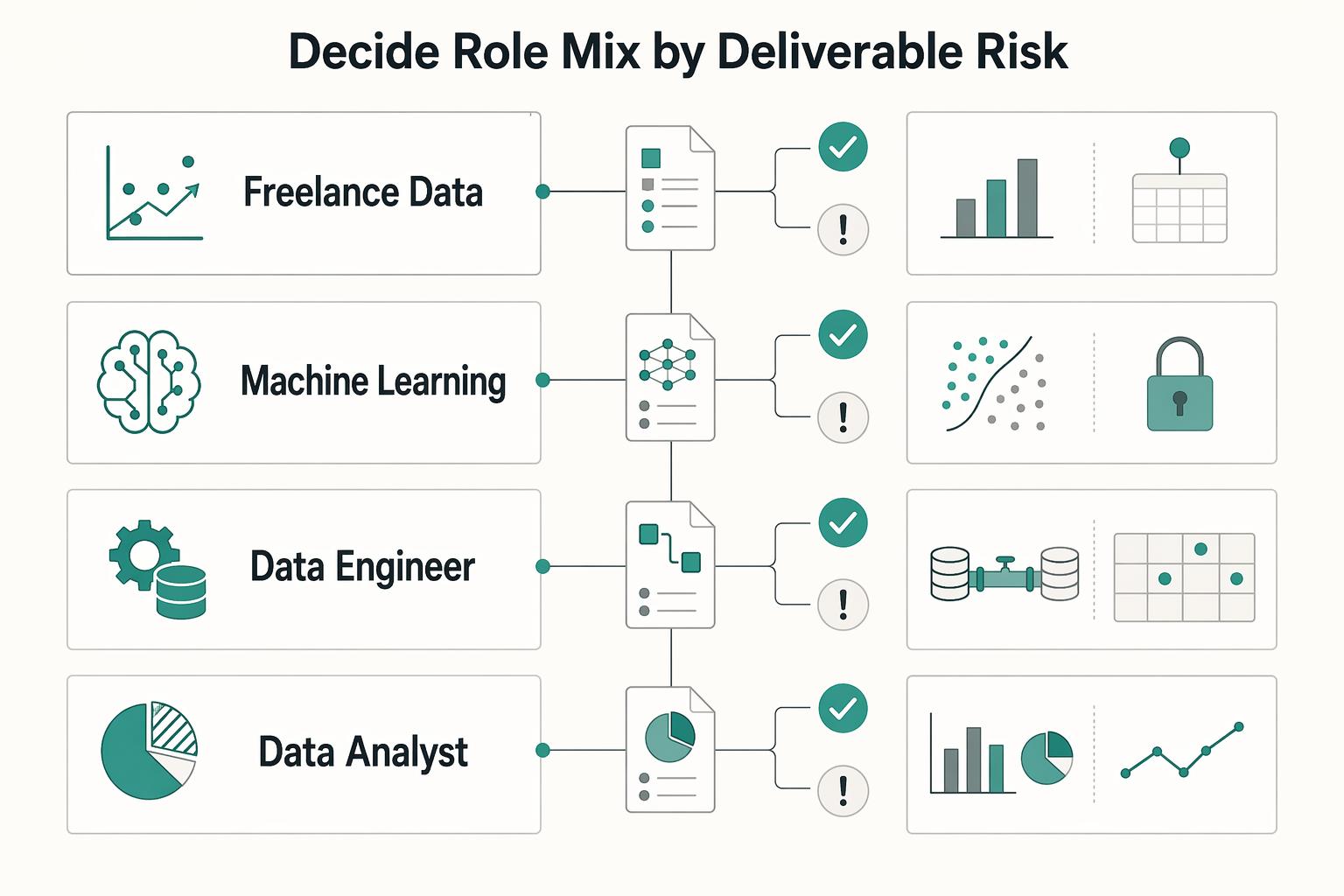
Choose the mix by delivery risk, not title prestige. Use Data Analyst for reporting and exploratory analysis, Data Engineer for data reliability and movement, and Machine Learning Engineer when production constraints, deployment, or serving behavior are truly in scope.
- Scope assumptions second
Write what version one must deliver: data inputs, acceptance criteria, handoff points, and review load. If it is not written, the estimate is still guesswork. If needed, anchor this in a Scope of Work for an AI Development Project.
- Risk buffer third
Add explicit costs for rework, coordination, infrastructure and specialist review. Keep each allowance visible rather than hiding it inside the hourly rate.
- Market rollout sequence last
Choose the contracting and payment setup for the actual countries involved. Local obligations vary; the label Europe does not define a common worker or tax regime.
Three mixes that reveal whether the work is fundable#
| Scenario | Role combination | Typical fit | Verification checkpoint before launch |
|---|---|---|---|
| Conservative mix | Data Analyst-led, narrow Data Engineer support, Machine Learning Engineer only for bounded review/tasks | Early demand is uneven; first milestones are analysis and decision support | Demand is real enough to justify the work, margin still holds if delivery runs longer, and timeline allows handoffs/iteration |
| Base mix | Data Analyst + Data Engineer core, Machine Learning Engineer only where production constraints are explicit | You need usable analysis plus reliable data movement, with limited production work | Demand is steady enough for two active workstreams, margin supports coordination load, and timeline includes engineering dependency milestones |
| Specialist-heavy mix | Machine Learning Engineer + Data Engineer core, Data Analyst for validation/reporting/interpretation | Production behavior, integration, and model operations are central from day one | Demand is strong and committed, margin absorbs higher burn without optimistic utilization, and tighter timeline truly benefits from specialist speed |
Compare the cost and delivery risk of each mix. More specialist hours can increase spend, but a cheaper mix is not useful if it lacks the skills needed for the acceptance criteria.
If the specialist-heavy case is unaffordable, narrow the deliverable or specialist involvement while preserving required competence. Do not substitute a less experienced worker for a safety-critical or production responsibility solely to meet the spreadsheet.
Illustrative budget: a scoped analysis quote is 80 hours at $100/hour, and production review is 20 hours at $150/hour. Labour totals $11,000. Add a stated $500 tooling allowance and a 15% labour contingency of $1,650: total $13,150 before taxes, platform fees or FX. If analysis grows to 100 hours, labour rises to $13,000 and the same contingency policy produces $15,450 including tools. These are planning assumptions, not market averages; agree whether contingency authorises extra work or only reserves budget.
For a hiring-path comparison, see How to Compare Freelance Hiring Paths by Trust, Evidence, and Control in 2026.
Decide role mix by deliverable risk, not by title prestige#
Choose roles by the work that must be delivered. An analysis or model-selection problem differs from production deployment, data-pipeline reliability and reporting.
Write the deliverable first, then compare quotes from people who can complete it. Different job labels and scope boundaries make salary comparisons a weak substitute for a scoped proposal.
| Role | Approve when your scope clearly requires | First measurable deliverable to write down | Failure mode to name upfront |
|---|---|---|---|
| Freelance Data Scientist | Problem framing and modeling direction in version one | A written analysis brief, baseline, or model/no-model recommendation | Exploration continues without clear decision criteria |
| Machine Learning Engineer | Production constraints are in version one scope | A deployment and integration handoff plan beyond notebook-only work | Work runs in development but stalls before reliable release |
| Data Engineer | Data reliability or movement is the blocking risk | A validated pipeline or refresh process tied to downstream use | Model debates mask broken, stale, or incomplete data |
| Data Analyst | Reporting clarity and KPI alignment are first milestones | A dashboard plan (for example in Tableau or Microsoft Power BI) with agreed metric definitions | Stakeholders keep revising definitions and reports do not stabilize |
Before you approve spend, require two lines per role in your scope doc:
- one measurable deliverable by milestone
- one named failure mode that role is intended to prevent
If you cannot state both plainly, pause and tighten scope before hiring. For payout-risk tradeoffs, compare Freelance Crypto Payments That Protect Cashflow and Reduce Disputes.
Price for cross-border reality and program constraints early#
Price cross-border operations early. AI cost estimation is already one of the least standardized parts of budgeting. If your scope and delivery risk are still moving, unvalidated onboarding, tax handling, and payout assumptions add a second layer of uncertainty to cost and launch timing.
Price the market you can actually activate#
Rate tables help, but they are not enough to choose your first launch market. Treat items like KYC, KYB, AML, and VAT as market-specific policy checks you need to verify in your own setup, not as assumptions. If that coverage is unclear, sequence that country later and start where your team can run onboarding, approvals, and reconciliation with fewer unknowns.
Choose payment rails before go-to-market#
Choose a supported way to pay the contractor and confirm fees, FX, timing and responsibilities. Merchant-of-record services for customer sales are not a prerequisite for hiring a freelancer.
Verify these gates before you commit budget#
Before you approve launch spend, confirm:
- documented onboarding and payout approval gates for the target market
- payout-state visibility your team can use operationally
- reconciliation artifacts Finance can export and review
If any of these are still unclear, move that market later in the rollout. A lower quoted rate is not a lower operating cost when execution controls are unproven.
For a specialist pricing example, see How to Price a Clinical Trial Data Analysis Project.
Lock scope and pricing mechanics before rate negotiation#
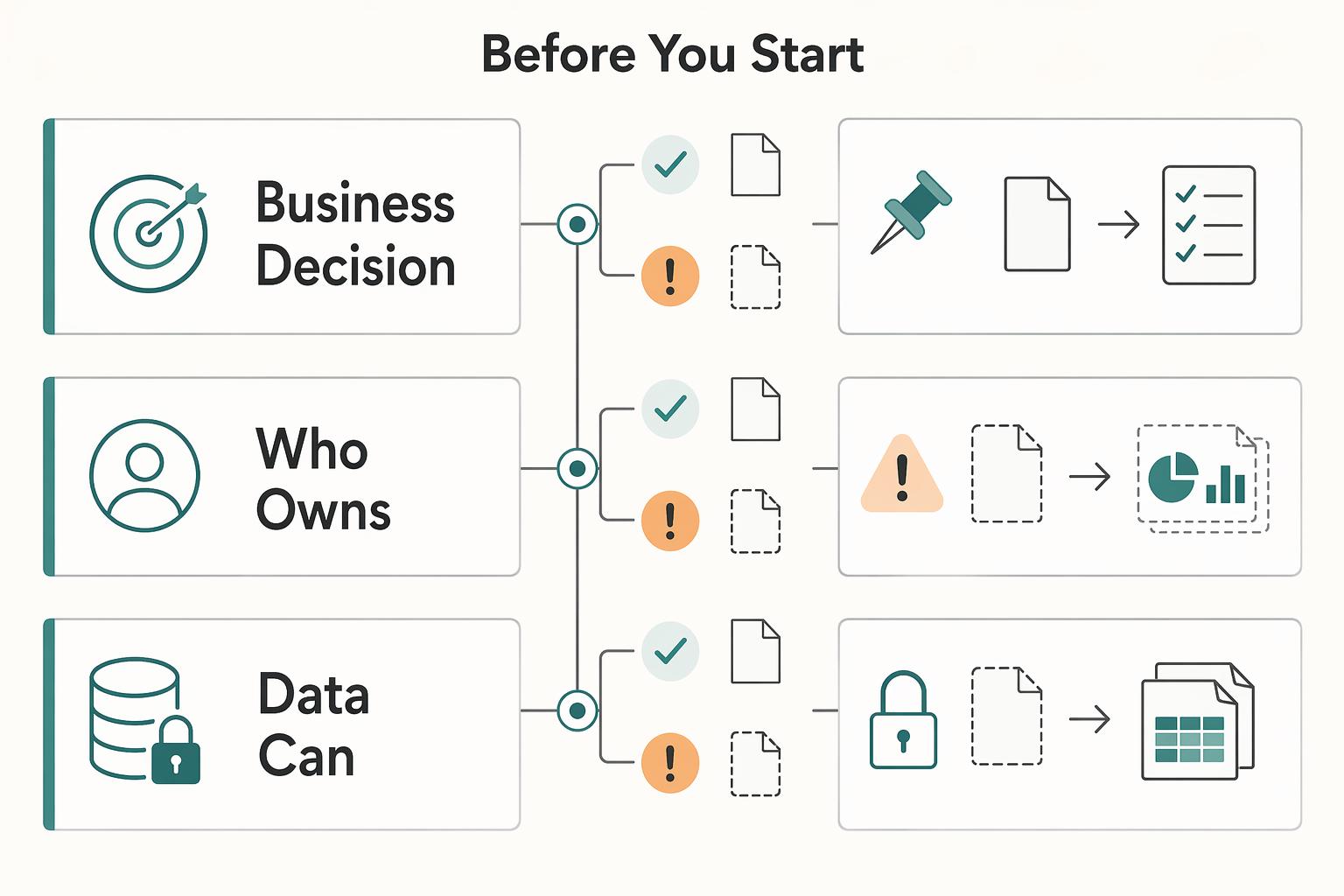
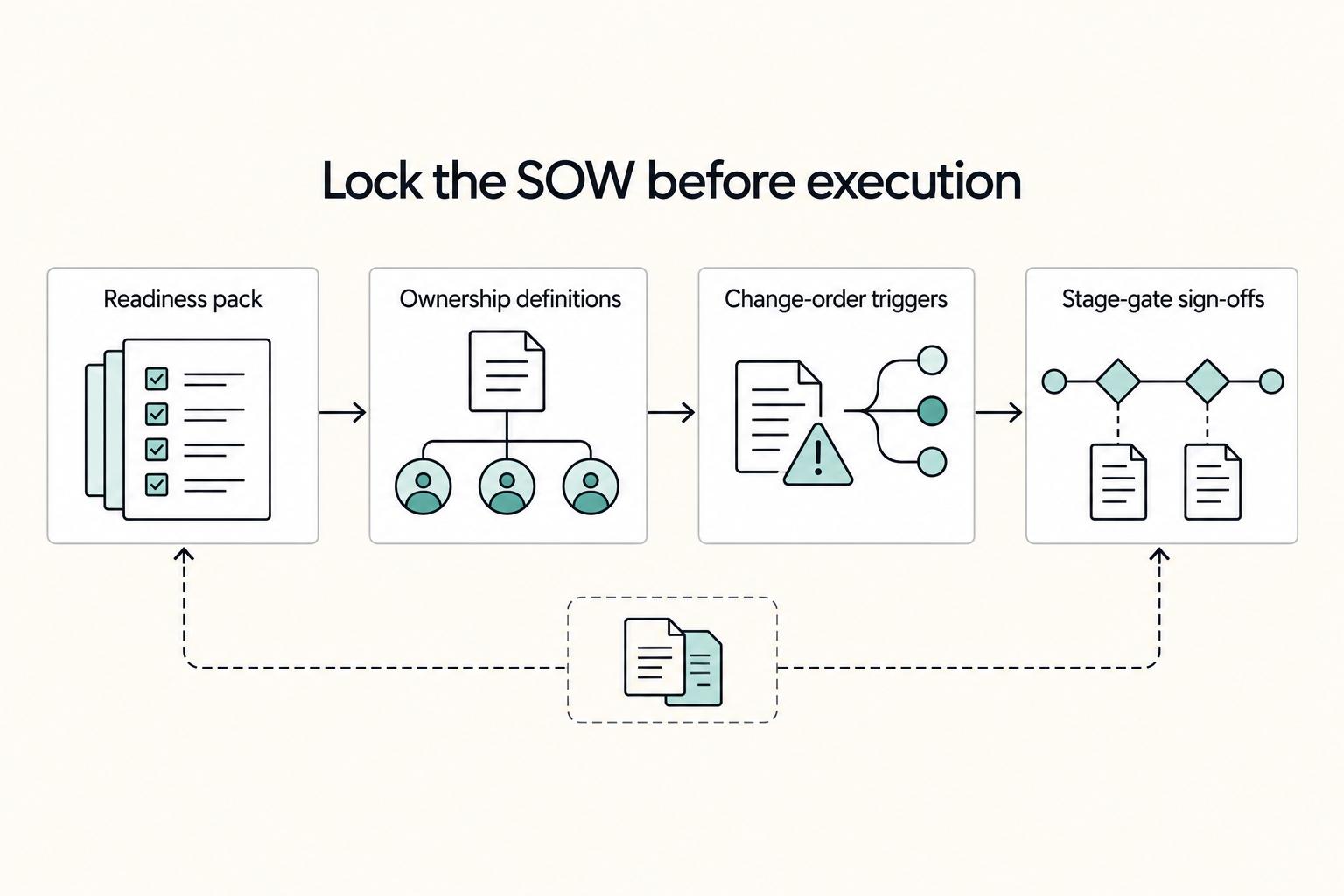
Negotiate the rate only after your scope artifact can withstand a change request. If scope is still vague, you are pricing ambiguity, not a defined outcome.
Make the scope specific enough that both sides can verify the same finish line: named deliverables, acceptance tests, revision limits, dependencies, and handoff criteria tied to each budget assumption. "Build a predictive model" is too loose. A usable scope says what is delivered, how it is evaluated, and what the handoff includes.
Use one scope artifact to anchor the price#
The direct marketplace pages above provide broad role ranges. Check whether a quote covers exploratory analysis, production delivery or ongoing model maintenance before comparing it with either range.
Before negotiation, require each deliverable to show three items: who provides inputs, how acceptance is checked, and what happens if upstream data is late or unusable. If those rules are missing, fixed-price language can still hide discovery work.
Write the change rules before work starts#
Set change logic in writing before kickoff:
| Case | Examples | Treatment |
|---|---|---|
| Core assumptions change | Dataset, target metric, deployment requirement, or review load | Reprice |
| Minor in-scope changes | Minor clarifications, agreed bug fixes, and revisions within the written limit | Keep in scope |
| Blocked dependencies | Missing data access, delayed labels, or added compliance review | Pause delivery |
- Reprice when core assumptions change, such as dataset, target metric, deployment requirement, or review load.
- Keep in scope minor clarifications, agreed bug fixes, and revisions within the written limit.
- Pause delivery when dependencies block progress, such as missing data access, delayed labels, or added compliance review.
If you use an up-front payment, settle it before work starts and define whether it is a flat retainer or a percentage of the work. Do not assume one standard percentage applies to every engagement.
Keep scenario pricing outcome-based. For model-performance pricing, define the metric, baseline, test-set ownership, and success condition before using freelance data scientist rates as an anchor. For structure, see How to Price a Data Science Project based on 'Model Performance'.
Prepare the payment and tax evidence pack before first payout#
Collect the payment and tax documentation applicable to the payer, payee and work location. Finance should determine lawful withholding or reporting where information is missing; a generic evidence-pack rule should not replace contractual payment obligations.
For a U.S. payer, identify the payee's tax status and where services are performed, then select the required documentation and reporting treatment. W-9 and the relevant W-8 forms are not interchangeable universal forms. A nonresident claiming a treaty exemption for personal services performed in the U.S. may need Form 8233 rather than W-8BEN.
FEIE, FBAR, Form 8938 and Schedule SE concern a worker's own tax or reporting circumstances. They are not routine documents for a platform to collect before paying a contractor. Keep personal filing advice separate from the payer's documentation and withholding responsibilities.
| Checkpoint | Owner | What must be stored |
|---|---|---|
| Tax intake | Finance | Applicable payer documentation, payee status and work-location evidence |
| Payout readiness | Ops | Provider reference, payout method, request-to-payout approval trail |
| Product gating | Product | Milestone approval and documented treatment of unresolved requirements |
Keep auditability explicit: request ID, contractor ID, invoice or milestone reference, payout provider reference, and an exportable ledger line for reconciliation. If evidence-pack completeness is below your threshold, delay expansion launch rather than backfilling after payouts begin. For workflow detail, see Freelance Finance Automation With Zapier and Stripe Controls.
Conclusion#
Stop looking for one market-clearing number. Treat freelance data scientist rates as a decision range shaped by what the source measures, what work you actually need done, and how much negotiation room remains once scope is clear.
The two direct marketplace ranges above overlap substantially. A rate by itself cannot show whether the quote includes data cleaning, validation, deployment, documentation or ongoing support. Compare the same deliverable and assumptions before negotiating.
The practical mistake is using a single midpoint as your budget anchor and calling the job done. If you hire a Freelance Data Scientist for ambiguous analysis, then compare that spend to a Machine Learning Engineer solving production constraints, you are not comparing like with like. A similar problem shows up when teams blend marketplace rates with anecdotal discussions into one number. You move faster when you separate benchmark types first, then decide whether the role mix still works for your delivery plan.
Your last check before you commit budget should be operational, not just financial. Confirm that your benchmark table shows which inputs are high confidence, which are directional only, and which are anecdotal. Then verify that your scope artifact is usable: deliverables, acceptance tests, revision limits, dependencies, and handoff format should already be explicit before negotiation starts. If those details are fuzzy, the price you "won" will usually become the price you revisit.
A simple next step is enough:
- Build a benchmark table with source type, role, geography, range, and confidence.
- Turn that into at least three funding scenarios: conservative, base, and specialist-heavy.
- Before rollout, stress-test assumptions for negotiation drift, revision cycles, and onboarding friction.
If the budget works only with the cheapest quote, no revisions and immediate data access, it is fragile. Recalculate with the actual specialist quote, likely review effort and a stated contingency rather than assuming a universal premium rate.
The teams that make good calls here do not find the "true" rate. They build a source-aware model, test it against real delivery risk, and only then lock budget.
Frequently Asked Questions
What do freelance data scientists charge in 2026 based on public sources?
As checked on 3 October 2026, Upwork's public references show $35–$250/hour for data scientists and $50–$200/hour for machine-learning engineers. These broad platform ranges do not establish a universal 2026 median. Obtain comparable scoped quotes for the actual work and country.
Why do Upwork and ZipRecruiter benchmarks conflict for similar roles?
Because those sources often measure different things. Platform freelance listings are compared with employee salary figures converted to hourly equivalents before overhead and benefits, so direct comparisons can mislead.
How should I budget when comparing multiple countries with different compliance programs?
Do not budget from rate alone. Your real cost should include the worker price plus tools, software, and structured onboarding, because those hidden costs can materially change total spend. Country-by-country compliance requirements are not established, so that part should be validated separately.
When should I hire a Machine Learning Engineer instead of a Freelance Data Scientist?
Hire an ML engineer when deployment, serving, integration, monitoring or production reliability is part of the deliverable. Use a data scientist for problem framing, analysis and modelling; one person can cover both only when their demonstrated skills fit the scope.
Which benchmark inputs are high-confidence versus low-confidence?
Prefer evidence with a clear role, geography, time period, sample and measurement basis. Two sources agreeing does not make them independent: they may repeat the same underlying dataset. Treat anecdotes and unlabeled figures as questions to investigate.
What is the minimum contract scope detail needed before rate negotiation?
Before you treat any quote as final, clarify scope and account for onboarding and tooling needs in the budget. If you need a template, How to Write a Scope of Work for an AI Development Project can help.
Which payment and tax checkpoints should be validated before first cross-border payout?
Confirm payee identity, payment details, agreed milestone, applicable payer tax documentation and withholding treatment, then retain the invoice and payment reference. The worker's personal FEIE or foreign-account filings are separate.
Try a related tool
Researched and edited by the Gruv editorial team. Gruv builds cross-border billing, payouts, and finance-operations software for global businesses.
Sources
Includes 2 external sources outside the trusted-domain allowlist.
Educational content only. Not legal, tax, or financial advice.
Related Posts

How to Write a Scope of Work for an AI Development Project
Treat your AI project Scope of Work (SOW) as an operating control document. It reduces free work, payment ambiguity, and "we thought you meant..." debates when the project gets messy. If you're the CEO of a business-of-one, this is how you keep scope, timelines, and cashflow from turning into negotiation.
How to Price a Data Science Project by Model Performance
A data science fee needs to cover delivery effort, uncertainty, and the decision the client will use. Hourly billing can fit open-ended investigation; fixed fees need bounded scope and acceptance rules. Model performance can inform the price, but a better score alone does not establish business value.
How to Price a Clinical Trial Data Analysis Project
If you choose on fee alone, you are optimizing the smallest visible number, not the full cost of the decision. A better test is simple: **risk adjusted cost = expected project fee + probable rework cost + operational delay impact + the cost of switching vendors midstream**.