
Quick Answer
Confirm the decision, baseline, data access, and owner. Quote paid discovery when feasibility is unclear; price the later scope from delivery costs, uncertainty, and supported value assumptions. Define a locked model-evaluation protocol, objective acceptance, and invoice terms. Keep any performance bonus separate from base fees and unproven ROI.
Price the decision and the work needed to support it#
A data science fee needs to cover delivery effort, uncertainty, and the decision the client will use. Hourly billing can fit open-ended investigation; fixed fees need bounded scope and acceptance rules. Model performance can inform the price, but a better score alone does not establish business value.
That does not mean pretending uncertainty is gone. It means matching the fee to what is known, what still needs to be verified, and what the client is actually buying: analysis, recommendations, a decision-support tool, or a staged path to deployment.
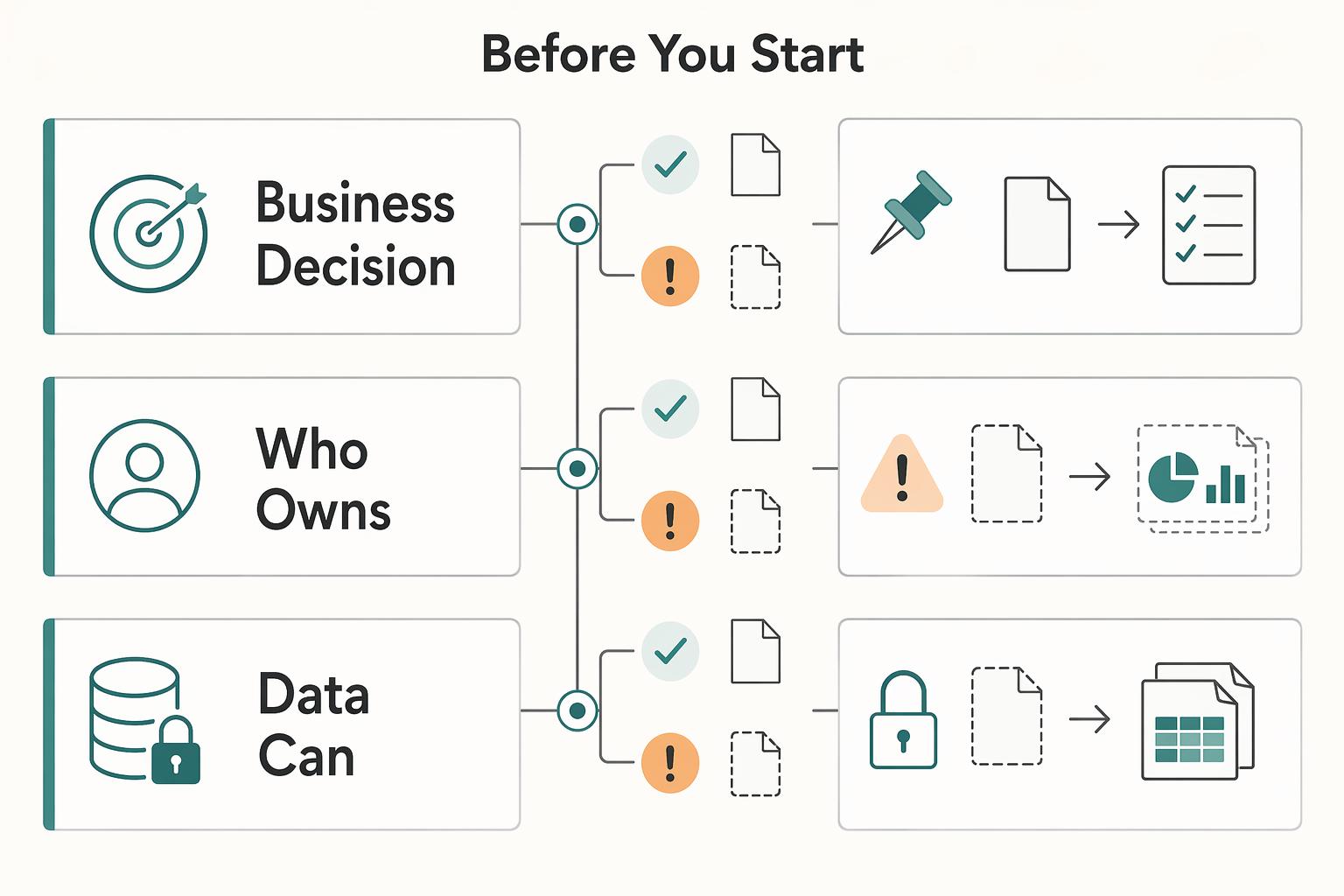
Before You Start#
Do not quote a full deployment if the client cannot answer three basic questions: what business decision will change, who owns the KPI, and what data you can actually access. If any of those are vague, sell a smaller discovery phase first.
| Basic question | Used in scoping | If vague |
|---|---|---|
| What business decision will change | Start with the decision, not the model | Sell a smaller discovery phase first |
| Who owns the KPI | Outcome statement should name the business owner | Sell a smaller discovery phase first |
| What data you can actually access | Scoping pack should include data-access status | Sell a smaller discovery phase first |
That smaller phase should not be framed as a placeholder. It should produce a concrete scoping pack: confirmed decision owner, baseline source, data-access status, major assumptions, main risks, and a written go or no-go review. If the client wants a firm number before any of that exists, your safer move is to narrow the promise, not guess harder.
Step 1. Define the business outcome in one sentence. “Help the pricing team make daily price recommendations using current sales and product data” is specific enough to scope. In Ferreira, Lee, and Simchi-Levi’s Rue La La study, demand forecasts fed a daily pricing decision-support tool. It selected prices for upcoming flash-sale events; it was not an example of continually changing prices within an event.
A good outcome sentence should be usable in the proposal, the kickoff, and the acceptance review without changing meaning. If you keep having to translate the project from technical language into business language, the scope is still loose. The sentence should make it obvious what the client will do differently if the work succeeds.
Checkpoint: your outcome statement should name the decision, business owner, review cadence, and current baseline source. If the client cannot point to where the baseline lives, you are not ready to estimate value.
Also watch for cadence mismatch early. If the decision is supposed to happen daily but the key data arrives late or is refreshed on a different rhythm, that is not a minor delivery detail. It changes what you can credibly scope, how you validate the work, and whether the client is buying analysis, recommendations, or something operational.
Step 2. Separate model acceptance from business impact. Link the technical metric to the intended decision, then test the business effect where feasible. The Rue La La study estimated lost sales, predicted demand for new products, and modeled competing-product price effects. A strong score for an isolated item can miss the constraints of the pricing decision.
Write the proposed chain as a hypothesis: lower forecast error may improve price recommendations, which may improve contribution. Verify each link rather than converting a percentage improvement in error into the same percentage revenue lift. Base fees can depend on agreed delivery and evaluation evidence; any contingent bonus needs a separate measurement rule.
For a hypothetical demand-forecast acceptance test, compare both models on the same locked, representative holdout set. Mean absolute error (MAE) of 10 units for the baseline versus 8 units for the candidate is a 20% relative reduction: (10 − 8) / 10. Specify the forecast horizon, data cutoff, included segments, baseline version, and the agreed threshold. Do not tune the model on the final test set or learn preprocessing from it; that can inflate reported performance.
An optional bonus might be $2,000 if the signed evaluation protocol shows MAE at or below 8 units and the agreed operational guardrails pass. This is an illustrative contract term, not a market standard or promised result. Set the bonus cap, verifier, evidence-delivery date, and invoice trigger. If the dataset or decision policy changes, use the agreed change-control process; do not silently rescore against easier data or absorb unlimited retraining.
That last link matters. You do not want your fee hanging on a vague future outcome that depends on people, timing, approvals, and execution choices outside your control. Tie business logic to the work, then tie payment to deliverables and acceptance events the client can actually approve.
An approved experiment can help test business impact. Specify the assignment unit, observation window, customer or product constraints, margin and service guardrails, and stop rules. Where prices affect competing products, an item-level comparison may be contaminated; scope an appropriate design before claiming causation.
It also helps to state what will count as evidence at each stage. In an early phase, evidence may be a feasibility memo, data review, baseline check, and recommendation on whether testing is justified. In a later phase, evidence may be a recommendation set, experiment design, or accepted deployment deliverable. When those proof points are named up front, it becomes easier to defend the fee and harder for the project to drift into endless "just one more analysis."
Step 3. Estimate a value range, not a promise. Build three cases: conservative, base, and upside. Use the client's own numbers for volume, average order value, profitability, or current pricing error cost. If a client wants certainty you cannot support, slow the sale down and move to a discovery phase.
The discipline here is not just building three scenarios. It is separating verified inputs from assumptions. Put the client-owned inputs in one place, label any unverified assumption clearly, and show which parts of the value logic still need to be tested. That keeps the commercial conversation honest and gives you a cleaner path to say, "This phase is priced around validating the assumptions that drive the larger estimate."
| Illustrative annual case | Incremental contribution before new operating costs | Additional operating cost | Available contribution before project fee |
|---|---|---|---|
| Conservative | $20,000 | $10,000 | $10,000 |
| Base | $50,000 | $10,000 | $40,000 |
| Upside | $100,000 | $10,000 | $90,000 |
These are hypothetical, unproven business-lift assumptions, not outputs derived from MAE. With a $12,500 base engagement fee, excluding any bonus, the conservative case would be $2,500 negative after that fee, before tax and other omitted costs. The base case would leave $27,500. Record the adoption assumptions, period, comparison method, and cost items without double counting costs already included in contribution.
A common risk is an offline model that looks strong while business value stays unclear once operational constraints or cross-product effects show up. In pricing work, cross-product effects are not a detail. They can break a neat single-product estimate.
Another common mistake is letting the client treat the upside case as the promised result. The fix is simple: anchor the proposal around the range, the assumptions log, and the validation steps. If the client later wants the larger implementation, you already have a shared record of what was known, what was uncertain, and why the pricing structure was chosen.
Choose the pricing structure that fits the uncertainty#
Once the outcome and value logic are clear enough to test, the next decision is how much uncertainty you and the client are each taking on.
| Discovery checkpoint | Evidence required to complete discovery |
|---|---|
| Data access | Document available datasets and access blockers |
| Baseline KPI | Reproduce the baseline where possible, or document why it cannot be established |
| Feasible method | Record the tested method, limitations, and feasibility finding |
| Go or no-go review | Written decision with named approver; a no-go completes paid discovery without obligating a build |
Step 4. Pick the fee model based on what is known today. Separate a value-informed fixed fee from a fee contingent on measured performance. The first still requires clear deliverables; the second also requires a reproducible result and agreed attribution.
| Pricing structure | Use it when | Main risk |
|---|---|---|
| Hourly or T&M | The task is genuinely open-ended and the client accepts spend uncertainty | Hard to budget, easy to question efficiency |
| Fixed-scope | Deliverables are clear, dependencies are known, and acceptance is definable | You absorb scope drift if terms are loose |
| Value-informed or performance-linked | Value-informed fixed fee uses agreed scope; a contingent component needs an agreed metric and attribution rule | Unclear measurement, payout timing, or control over the outcome |
| Hybrid | You need proof first, then a larger build if the evidence is good | Confusion if discovery exit criteria are not written down |
A staged approach can fit uncertain pricing engagements. For example, quote a two-week paid discovery for exploratory data analysis (EDA) and feasibility, followed by a separately approved six-week build. These are illustrative durations, not standard schedules. Define the discovery outputs and a written go/no-go decision; a no-go is a completed discovery outcome, not an unpaid failure. Revise the build scope and timetable if the evidence warrants it. A build can begin only when the required access, baseline, feasible method, and authorization are in place.
Treat that pre-sprint as a real commercial stage, not an informal warm-up. Write down what the client will get at the end of it. Include the baseline check, the confirmed scope, the data findings, the main assumptions, the recommended next phase, and the conditions required to continue. If the answer is no-go, that result is still valuable. It tells both sides not to spend more money pretending the project is ready when it is not.
Illustrative quote, all amounts in USD before tax: discovery includes 20 hours at an internal $100/hour cost plus $200 of tools, giving a $2,200 delivery estimate and a quoted $2,500 fee. The later build includes 60 total hours, including reviews, at the same internal cost, $1,200 of infrastructure, and a $1,800 risk reserve: a $9,000 planning floor before profit, collection fees, and tax. A $10,000 build quote brings the two-phase base fee to $12,500, with the optional $2,000 bonus separate. An example payment schedule is discovery paid before starting, then $4,000 at build kickoff, $4,000 after the defined evaluation milestone is accepted, and $2,000 after accepted handover, with milestone invoices due in 15 days. Agree these terms, required evidence, and delayed-approval handling before work begins. Quote production support separately.
Write change-order triggers into the proposal. Typical triggers are new data sources, added integrations, extra experiments, support for more business units, or additional review work that was not in the original scope.
This is also where many consultants underprice without realizing it. They quote the model build and forget the approval cycles, data clarification, stakeholder review, experiment planning, and revision rounds around the actual recommendation. If those steps are necessary for the client to use the work, scope, time, and price them instead of absorbing them silently.
Put the controls in the proposal before you send the fee#
A good fee structure still fails if the proposal leaves ownership, approvals, or payment timing vague. Step 5. Document assumptions, responsibilities, and payment protections. Use this checklist before you send a number:
| Proposal area | Include |
|---|---|
| Statement of work terms | Deliverables, acceptance checkpoints, out-of-scope items, change-order triggers, and the time box |
| Data-access dependencies | Exact datasets, owners, access method, refresh frequency, and what happens if data is late, incomplete, or unusable |
| Decision responsibilities | Who approves experiments, who owns production decisions, and who signs off on major updates |
| Payment terms | Milestone invoices, currency, due dates, review deadline, defects and correction process, delayed-approval handling, and any contingent-fee cap |
Make these items easy to scan. A proposal usually works better when assumptions, dependencies, and approval points are visible rather than buried in paragraphs. If a stakeholder can read the document and still not tell who is responsible for data access or experiment approval, you have left room for delay.
Make acceptance testable by the named approver. “Feasibility memo delivered” identifies an artifact but does not define its required contents. Specify the datasets reviewed, baseline reproduced, limitations documented, evaluation method, and decisions supported. Agree a review deadline, the process for specific written defects, included correction rounds, and what happens when the client does not respond. Do not leave an invoice dependent on unlimited discretionary approval.
State invoice milestones, currency, due dates, fee allocation, and the agreed payment route. Track approval separately from collection: an accepted deliverable or issued invoice is not settled cash. Match the receipt and any deduction to the invoice before closing the milestone.
If you want a deeper dive, read How to Price a Clinical Trial Data Analysis Project. Want a quick next step? Try the free invoice generator.
Before you send the proposal#
A usable proposal explains the decision, scope, evidence, price, and payment conditions in terms the approver can apply.
Confirm the business decision. Use Business Understanding to identify the objective, baseline, owner, and success criteria. CRISP-DM is an iterative process, not a rule that every phase can be settled once in advance. Keep the project plan current when data findings change feasibility.
Match scope to uncertainty. Quote paid validation when access, data quality, or decision rules remain unclear. Retain included and excluded datasets, observed quality problems, assumptions tested, and the go/no-go rationale. Price production integration and ongoing monitoring separately when they are outside the validation phase.
Write down authority and acceptance. Name the deliverable approver, data owner, experiment decision maker, and production owner. Bound review and correction work, and document a deadline and escalation path for unresolved acceptance disputes.
Before you send a proposal, check for five items:
- clear outcome statement
- assumptions log
- acceptance criteria
- payment terms tied to checkpoints
- risk and contingency review
If those five items are solid, your pricing conversation usually gets easier because the client is no longer reacting to a number in isolation. They can see the decision being bought, the conditions behind the fee, and the points where both sides will verify progress.
Set your internal delivery floor with the billable-rate guide, then compare the client’s value assumptions with the scope and commercial risk. For proposal structure, see value-based pricing for strategic consultants.
Frequently Asked Questions
How should you price a data science consulting project?
Start with the decision, data access, baseline, and KPI owner. CRISP-DM—Cross-Industry Standard Process for Data Mining—provides a useful scoping sequence, beginning with Business Understanding. If feasibility is unknown, quote paid discovery with explicit outputs. Then choose time and materials, a bounded fixed fee, or a performance component whose dataset, metric, window, and payout rule both sides can reproduce.
What should you include in your proposal?
Include outcomes, phase deliverables, objective acceptance criteria, approvers, data dependencies, payment milestones, and change-order triggers. List included and excluded datasets with reasons. Define what happens when access or approvals are late, what ends discovery, and who authorizes the next phase.
How do you estimate ROI for a pricing model without overpromising?
Use client-owned baseline figures and conservative, base, and upside assumptions. Separate revenue from contribution and subtract implementation and ongoing costs. Offline model gains do not establish causal business lift. Quote validation work on its agreed deliverables, and make any success fee depend on a defined measurement rather than a forecast.
What are the main business risks of pricing-model work?
The biggest risks are often not model error alone. They are unclear business objectives, poor data quality, incomplete data, and unmanaged changes to scope or pricing logic. Ask who owns the business objective, who can verify data quality, who approves tests, and who owns change-control once recommendations start affecting live decisions. If the client cannot name those stakeholders, keep the engagement at analysis or recommendation level and do not take deployment accountability.
What is the difference between price prediction and price optimization, and why does it matter?
Prediction estimates demand or another outcome at candidate prices; optimization selects an action subject to objectives and constraints. The Rue La La study linked new-product demand forecasts to multi-product pricing decisions. Ask whether the client wants a forecast, recommendation, or decision-support tool: the answer changes validation, integration, authority, and fee scope.
Try a related tool
Researched and edited by the Gruv editorial team. Gruv builds cross-border billing, payouts, and finance-operations software for global businesses.
Sources
Includes 2 external sources outside the trusted-domain allowlist.
Educational content only. Not legal, tax, or financial advice.
Related Posts
How to Calculate a Freelance Rate You Can Actually Get Paid On
A workable rate is not the neat number a calculator produces. It is the number that still works after you account for real billable capacity, non-client time, scope drift, and the gap between sending an invoice and receiving cleared cash. Start with hourly math even if you do not plan to bill hourly, then turn that number into a quote with clear `payment terms`.

Value-Based Pricing for Strategic Consultants Under Real Payment Risk
Value-based consulting fees reflect what solving a problem is worth to the buyer. The fee can still be fixed and paid in advance or by delivery milestones. Separate that pricing decision from a performance-linked bonus: a value-based fee does not automatically make payment conditional on the client achieving a future business result.

The Freelance Payment Penalty: A Modeled Audit of Platform Fees, FX Spreads, and Payout Delays
The money rarely disappears through a single, easy-to-spot fee. The real loss is stacked. A marketplace takes its commission, a processor adds a charge for international cards, a bank or payment company converts the currency at a spread, a platform holds the funds before release, and a wire sheds a little to intermediaries on the way in. Each layer looks defensible on its own, but the worker feels the combined result as a smaller deposit and a later payday.