
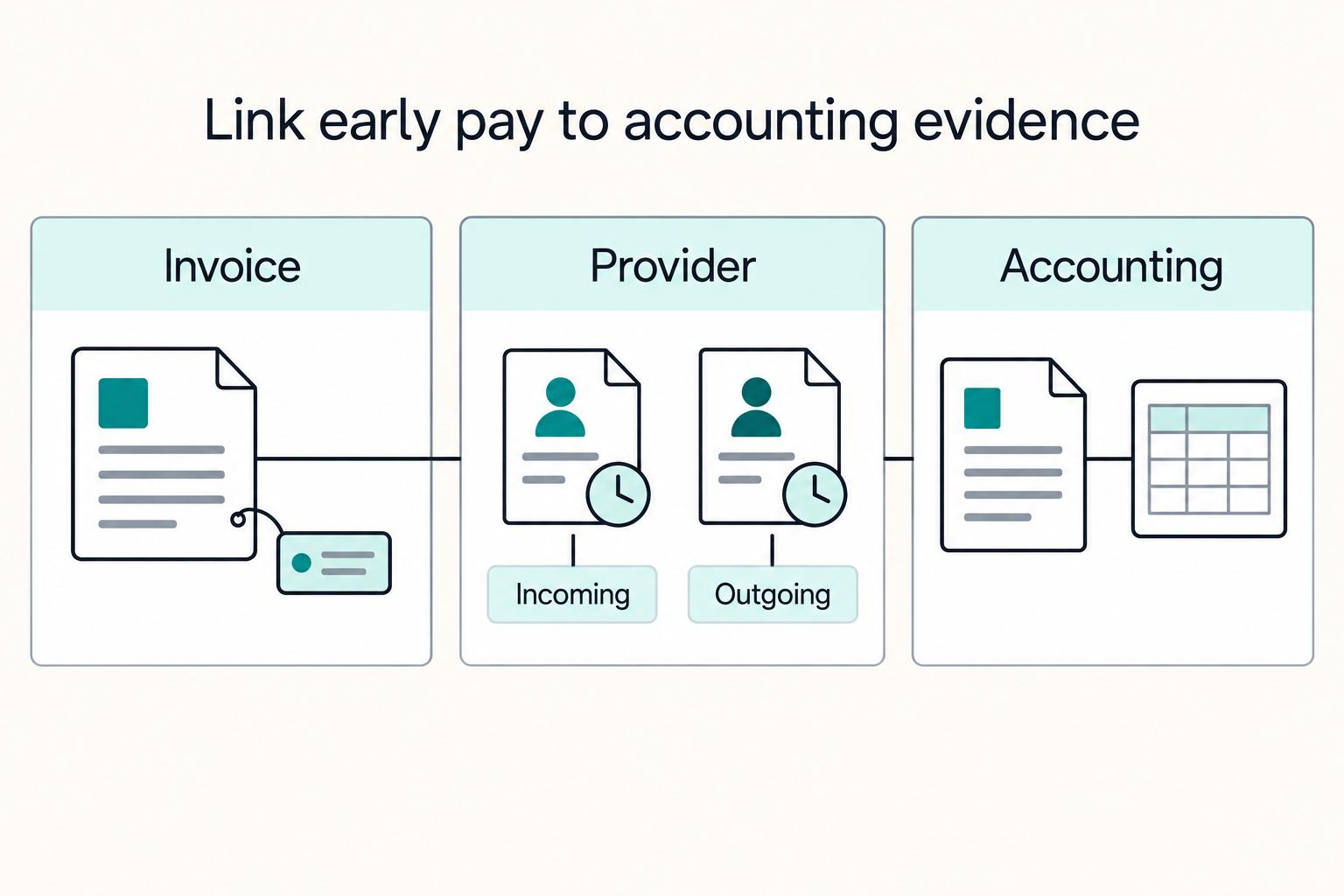
Quick Answer
Start by choosing the bottleneck: use Deposit or Full prepayment for trust risk, improve Direct deposit timing when invoices already close reliably, and pilot Invoice advance only after records are clean. For early pay for freelancers invoice advance, the first checkpoint is operational proof that each case links contract terms, invoice ID, payment reference, payout reference, and status outcomes like Held or Failed without manual guesswork.
Early pay for freelancers is a product decision, not just a payment preference#
If you are evaluating early pay for freelancers invoice advance options, start by naming the problem correctly. Are you trying to reduce non-payment risk, shorten the wait after payment is initiated, or give contractors access to cash earlier in the cycle? Those are different product jobs. If your team treats them as one feature, you can misprice risk and create avoidable ops work.
This guide is for platform owners building repeatable payout flows across many freelancers and many buyers. It is aimed at product, finance ops, and engineering teams that need something scalable, not a one-off negotiation between one freelancer and one client. The decision usually touches onboarding, invoicing, payment collection, reconciliation, and support, so it needs a product owner, not a billing preference buried in settings.
The cleanest place to start is Deposit and Full payment in advance, because they solve a specific trust problem. A deposit is a partial upfront payment that helps confirm a new client is serious, and one source describes it as a practical test of whether the client is willing to pay. Strong resistance to that ask is a warning sign. Full payment in advance pushes the same logic further by collecting the whole project amount before work begins. If your real risk is uncertainty about the buyer, that is a different problem from payout speed, and you should handle it that way.
Late payment pain is real: one source says small businesses and entrepreneurs wait an average of 30 days to get paid, and also notes that late payments can threaten business viability. So speed matters. Verify Direct deposit, Early direct deposit, and Invoice advance mechanics separately, and evaluate each in your own model rather than under one vague promise to "get paid faster."
This guide gives you:
- decision checkpoints so you can tell whether trust, timing, or funding is the real bottleneck
- a sensible launch order so you do not add operational complexity before you need it
- verification points that keep support, finance ops, and reconciliation from cleaning up preventable mistakes later
One recommendation up front: if your earliest cohorts are new buyers or custom project work, tighten upfront-payment or prepayment policy before you promise anything more complex. The checkpoint is simple and easy to miss. Your contract, invoice, or checkout record should clearly show the amount due before work starts, and your team should be able to verify that the funds received map to the right engagement. Skip that evidence trail, and "early pay" quickly turns into dispute handling, manual exceptions, and expensive rework.
For the freelancer-facing factoring angle, use A Guide to Invoice Factoring for Freelancers. If invoice hygiene is the blocker, try the free invoice generator.
Know the three early pay models before you design anything#
Treat these as three different product jobs before you ship: upfront payment terms, payout timing, and receivables financing are not interchangeable. If you merge them, you will price the wrong risk and write confusing UX for buyers, freelancers, and ops.
| Option | Primary job | Key check |
|---|---|---|
| Deposit | Upfront payment term used when non-payment risk is the core issue | Show what is due upfront, what that payment unlocks, and what remains due under net terms |
| Early direct deposit | Payout-timing option if faster access begins after payment is initiated or confirmed | Confirm what event starts payout timing |
| Invoice advance / Invoice factoring | Receivables financing path, not interchangeable with upfront payment or payout timing | Confirm documentation, dispute handling, and reconciliation evidence requirements |
Start with what is defined clearly: Deposit (Stripe's partial up-front payment). This is a billing term, not a payout feature. Use it when non-payment risk is the core issue, and make the record explicit in contract and invoice: what is due upfront, what that payment unlocks, and what remains due under net terms (for example, Net 30).
Handle Early direct deposit as a timing claim until product terms prove otherwise. The key check is what event starts payout timing. If faster access only begins after payment is initiated or confirmed, you are solving settlement speed, not buyer-risk exposure.
Treat Invoice advance and Invoice factoring as financing paths that need provider-level diligence before UX decisions. One standard structure, fee model, or eligibility rule is not established, so confirm documentation, dispute handling, and reconciliation evidence requirements before you label the feature promise.
If your copy uses one "get paid early" message for all three, users will hear one promise while your ops team manages three different money-flow moments.
For a step-by-step walkthrough, see Invoice Financing for Freelancers Who Need Cash Before Net-30.
Understand what invoice advance costs and who carries the risk#
Before you model pricing, answer two questions: who provides the early cash, and who carries the loss or dispute burden if the invoice is not paid as expected. Full prepayment moves cash collection earlier in the commercial flow, factoring shows visible fee signals in the public material, and invoice advance needs contract diligence before you can model true cost.
| Comparison point | Invoice advance | Invoice factoring | Full prepayment |
|---|---|---|---|
| Who funds the early cash | Not disclosed in the public material here. Verify whether funding comes from a provider, your platform balance sheet, or another contracted party. | A factoring provider; the material describes invoices being sold for immediate partial payout. | The client or buyer pays before work is completed. |
| Who absorbs default risk | Not safe to assume from excerpts alone. Confirm whether risk stays with the freelancer, moves to the platform, or is shared. | Not safe to assume from excerpts alone. Confirm recourse terms and clawback triggers. | Cash non-payment risk is largely reduced once funds clear because there is no unpaid receivable left to finance. |
| How repayment or settlement is collected | Contract-dependent. Verify whether recovery comes from buyer payment, seller remittance, offsets, or another path. | Contract-dependent. Covers sale of invoices, not full collection mechanics. | Buyer pays upfront, so there is no separate financing repayment step. |
| Where disputes land | Verify whether disputes pause release, reverse the advance, or create collections work for ops. | Verify whether the provider owns collections and dispute handling or your team remains first line. | Disputes stay in the commercial relationship around scope, delivery, and refund terms. |
| Publicly visible cost signal | No universal fee schedule is supported here; treat headline pricing as incomplete until full settlement math is disclosed. | One example: providers may pay 70 to 90 percent upfront and deduct 1,5% to 3,5%, reducing net income. | No financing fee by default, but cash timing shifts to the start of the engagement. |
| What is unknown until provider diligence | Eligibility rules, reserve use, dispute handling, failed collection treatment, release timing for remaining balance, and required evidence to mark an invoice financeable. | Recourse terms, reserve logic, collection ownership, dispute treatment, and remaining-balance release conditions. | Refund rules, chargeback exposure (if card-funded), milestone acceptance terms, and contract protections for scope changes. |
Model explicit fees and hidden cost drivers separately. Explicit fees are easy to price. Hidden drivers such as reserve holds, failed-collection handling, manual reviews, and delayed cash release are where margin assumptions usually break.
Do not write pricing copy from a marketing page alone. Ask for a sample settlement statement and dispute policy that show invoice ID, approved amount, holdback or reserve lines, fee lines, remainder-release timing, and the event that changes status from eligible to paid out.
A practical red flag is a rate card without the conditions that change actual cash timing. If disputed invoices, short payments, or missing approval evidence are not clearly handled, you do not yet know the real program cost.
For platform factoring mechanics, read What Is Invoice Factoring? How Platforms Can Offer Early Payment to Contractors in Cash Flow Crunch.
Choose the model with clear if-then rules#
Pick the model based on your bottleneck, not the label. If trust is weak, start with Deposit. If invoices are usually paid but cash lands too slowly, improve payout speed first. Test Invoice advance only when your invoice and contract process is already consistent enough to handle exceptions.
These options solve different problems. Upfront payment changes risk at the start. Faster payout changes when money arrives after payment initiation. Financing adds another layer that depends on clear contracts, reliable invoice tracking, and strong operational follow-through.
For new clients or custom scope, start with contract discipline before financing. The grounding material says clear expectations up front help prevent payment problems, and contracts should define payment amount and due timing. In the India-specific context cited, the contract is described as binding under the Indian Contract Act 1872. If acceptance is subjective, take upfront payment and set explicit terms first.
If invoices are getting paid and the pain is delay, fix operations before adding financing. The material describes late payments as harmful to cash flow, and it also points to process levers like reminders and invoice automation. One cited guide says automated reminders can improve payment speed by 5-7 days, and automation can reduce repetitive invoicing work after setup.
Use your own invoice-state history as the gate. Check how often invoices end as full, partial, or outstanding. If most reach full payment and the friction is timing, faster payout is usually the cleaner first move. If many remain partial or outstanding, financing will not fix the root issue.
Scenario guide#
| Scenario | Best starting model | Why this is the cleaner first choice | What to verify before rollout |
|---|---|---|---|
| New clients | Deposit | Low trust and unclear delivery risk are better handled in commercial terms first | Written contract, defined payment terms, upfront amount, and scope-change handling |
| Repeat enterprise buyers | Direct deposit or Early direct deposit | If payment is already reliable, speed is often an operations issue, not a financing issue | Your paid vs outstanding history, payout timing, and whether reminders or automation remove delay |
| Cross-border payouts | Direct deposit after funds clear, then evaluate advance carefully | Added payout complexity can make financing outcomes harder to operate cleanly | Whether your team can trace invoice status to payout status, including partial and outstanding balances |
| High-dispute categories | Deposit, often with milestones | Frequent disputes make financed receivables harder to run without exceptions | Contract clarity, milestone acceptance terms, and dispute patterns in your own ops data |
When invoice advance is worth testing#
Test invoice advance with narrow eligibility before broad rollout. Start where invoices come from repeat buyers, documentation is complete, and payment terms are clear. Keep the operating evidence tight: invoice record, contract terms, buyer identity, and status history across partial, full, and outstanding balances.
Do not scale advance if your team cannot quickly explain outstanding balances, partial payments, or which contract term controls timing. Tighten contracts, reminders, and payout operations first, then revisit financing. For GST-heavy invoice workflows, read The Best Invoicing Software for Indian Freelancers with GST Compliance.
Put compliance and tax gates in front of payout promises#
Define your compliance gate and tax-document gate in writing before you promise faster cash. For platform teams, the operating rule is simple: missing checks should block eligibility for an advance or accelerated payout before money moves, not after.
Keep country scope explicit#
Do not run cross-border programs with one global default document pack. Configure eligibility and document requirements by country-program path, and make sure ops can state what is missing and who owns the next action from the case record.
A quick quality check is your recent manual holds: if agents request the same tax evidence in every country, your policy is probably too broad. That pattern adds delay, increases user confusion, and makes exceptions harder to audit later.
Align tax readiness to payout timing#
Your first accelerated payout should wait until the required tax record is complete for that payee path. At minimum, define what must be on file for your policy, how completeness is verified, and how the case is tagged for year-end reporting.
For U.S.-connected cross-border cases, keep FEIE and FBAR handling separate from payout eligibility unless your policy explicitly connects them. FEIE applies only to qualifying individuals with foreign earned income, and excluded income still must be reported on a U.S. tax return. Under the physical presence test, the threshold is 330 full days in a 12-month period, those days do not need to be consecutive, and missing the 330-day threshold fails the test regardless of reason. For tax year 2026, the maximum FEIE is $132,900 per person.
FBAR is separate as well: a U.S. person with a financial interest in, or signature authority over, foreign financial accounts must file an FBAR. Your payout product should not imply that using a foreign payout account creates or resolves that filing duty.
Build a clean escalation path for holds#
When a case is held, give ops approved language that explains delay without exposing sensitive review logic. Clear statuses such as "verification pending," "additional documentation required," and "under review" are usually enough for customer communication.
Route sensitive holds to a restricted queue, separate customer-facing notes from internal review notes, and require a case ID plus reason code for every blocked payout. That keeps explanations consistent while preserving control of sensitive details.
Design the money movement path for traceability from day one#
Design for traceability early. Define how invoice records, payment-provider records, and accounting records connect before you scale payouts. If that mapping is unclear, exceptions and disputes turn into manual work.
A practical starting point is a short state map that your ops, finance, and engineering teams all use the same way. Focus on the core milestones in your flow, then confirm each one can be traced across systems.
Connect invoice data, PSP data, and accounting records#
The key launch decision is connectivity: how your invoicing source, PSP, and reconciliation layer tie together. The Powens reconciliation guide uses this exact lens with PSP connectivity and invoicing connectivity, and that is a useful way to scope implementation.
| Layer | Role in traceability | Launch check |
|---|---|---|
| Invoicing source | Invoice record used to start traceability | Test that an operator can move from invoice ID to provider reference |
| PSP | Provider reference and payment-provider records used in traceability | Keep incoming-funds status separate from payout-execution status |
| Accounting or reconciliation layer | Related accounting record; QuickBooks Online is described as including invoicing and bank reconciliation | Test that an operator can reach the accounting record without engineering help |
Your source of truth can sit in your product or in an accounting tool, but name it explicitly. QuickBooks Online is described as including invoicing and bank reconciliation, so it can be a workable back-office endpoint for some teams even when your user-facing product is elsewhere. Before launch, test traceability on real cases so an operator can move from invoice ID to provider reference to accounting record without engineering help.
If your stack supports separate visibility for incoming funds and payout execution, keep those statuses distinct. Clear status language reduces false positives in support and reconciliation.
Decide your reconciliation evidence pack before exceptions start#
Define, in writing, which records your team will use to resolve disputed movements. Keep it compact, but make sure invoice IDs, provider references, payout references (when separate), and related accounting records can be tied together consistently.
If you want a deeper look at matching logic, this is where payment reconciliation for freelancers becomes an implementation issue, not just an accounting task.
If early pay changes freelancer income timing, keep tax-adjacent edge cases visible with NIIT for High-Earning Freelancers: When It Applies and How to Calculate It.
Prepare for failure modes before they hit payouts#
Before launch, define what each payout failure means and who owns the next action. Without that, manual handling turns into compliance risk, cost volatility, and operational bottlenecks, especially in invoice-advance flows where one bad status can create both user friction and cash exposure.
Map each failure class to one default action#
Keep the list short, but make it operational: payment reversals, unmatched deposits, AML holds, stale status events, and partial failures in Payout batches.
| Failure class | What the operator verifies first | Default action | User-facing status |
|---|---|---|---|
| Payment reversal | Inbound payment reference, invoice ID, and whether payout already settled | Hold related payouts, route to manual review, start payer outreach if needed | Held |
| Unmatched deposit | Amount, currency, payer reference, and invoice match in ledger/accounting records | Hold release until matched; route to review if unresolved | Held |
| AML hold | Whether compliance review is actively blocking release and case owner | Hold and route to manual review | Held |
| Stale status event | Latest provider event timestamp, duplicate-event risk, and current money position | Retry status retrieval or route to review if state is unclear | Processing |
| Partial batch failure in Payout batches | Batch ID and payout-level line items, not only batch summary | Retry failed items only, or trigger compensation path when outcomes split across users | Failed for affected payouts |
The operating rule is simple: each failure class should map to one default first move, not multiple ad hoc choices.
Write statuses that match the actual money position#
Use status language as a control surface, not a placeholder. Processing means requested and not actively stopped. Held means intentionally paused for review, compliance, or missing match data. Failed means the attempt will not complete without a new action.
If unresolved payouts are all labeled Processing, users cannot distinguish delay from breakage, and support load rises.
Check item-level visibility before launch#
Run a pre-launch check on a recent batch and confirm an operator can identify, at payout level, which items succeeded, which are held, and which failed without engineering log review. Even if your stack uses a global payout solution or mass payment software that combines onboarding, tax compliance, and payout execution, you still need clear internal action rules and status wording.
If you cannot explain one failed payout in plain English from invoice ID, payment reference, payout reference, and current status, you are not ready to scale.
For marketplace-scale program design, read Supply Chain Finance for Marketplaces: How Early Payment Programs Can Attract and Retain Sellers.
Launch in phases with measurable checkpoints#
Launch by cohort, not all at once. Start with the segment that has the cleanest documentation and lowest dispute risk, which usually means invoices tied to client milestone billing or progressive billing before you expand to more ambiguous work.
Milestone and progressive billing are stronger first cohorts because payment is tied to completed checkpoints, not vague timing. In practice, that supports clearer terms, clearer calculations, and a cleaner paper trail. Hourly contracts can offer more flexibility, but they also bring more cost uncertainty, so they are usually a weaker proving ground for early-advance eligibility.
| Rollout segment | Why it is a better or worse first cohort | What to verify before expansion |
|---|---|---|
| Client milestone billing | Payment release is tied to defined checkpoints, which makes disputes easier to inspect | Confirm milestone completion evidence consistently matches the invoice and payout record |
| Progressive billing | Billed in phases, with a clearer paper trail and better forecasting when terms are clear | Check that phased invoices reconcile cleanly to each inbound payment and payout |
| Hourly contracts | Flexible, but more likely to create cost or scope disputes | Hold until you can prove review volume and dispute handling stay manageable |
Do not judge rollout health on payout speed alone. Track advance adoption, exception rate, manual review rate, reversal exposure, and reconciliation completion SLA every week, and treat any negative trend as a real warning.
Set expansion gates before launch. If unresolved exceptions breach your agreed threshold, reversal exposure rises beyond your internal limit, or reconciliation completion misses your SLA, pause expansion until controls are stable.
Make the weekly review evidence based#
Anchor each weekly review to three artifacts: the payout exception queue, the reconciliation report, and the policy override log. Together, they show repeat failure patterns, whether money movement is traceable from invoice to payment to payout, and whether teams are bypassing eligibility rules.
| Artifact | What it shows | Review use |
|---|---|---|
| Payout exception queue | Repeat failure patterns | Use it in the weekly review before expanding |
| Reconciliation report | Whether money movement is traceable from invoice to payment to payout | Use it to confirm traceability before expanding |
| Policy override log | Whether teams are bypassing eligibility rules | Use it to spot rule bypasses before expanding |
Keep one permanent operator check: sample cases from the newest cohort and confirm each one has invoice ID, payer or payment reference, payout reference, and final status in one place. If your team cannot explain why a payment was advanced, held, or reversed without engineering help, do not expand yet.
For the reverse-factoring version of the model, use What Is Reverse Factoring? How Supply Chain Finance Lets Platforms Pay Contractors Early at Low Cost.
The main takeaway for platform teams#
Choose the model based on the actual bottleneck, not a generic request for "faster pay." If the issue is payment certainty, collect payment before completion. If the issue is timing, reduce avoidable delay. If the issue is access to cash before settlement, then test invoice advance deliberately.
Match the fix to the real bottleneck#
Advance payment means collecting money before the project is completed. Use that when you need earlier payment certainty, not as a catch-all for every payment complaint.
If payers usually do pay but pay late, focus on time to cash first. Late payments hurt cash flow, and a cited average wait of 30 days is long enough to create strain. In that case, clearer expectations, fewer admin delays, and faster payment handling are often the more direct fix.
If users specifically need funds before settlement, evaluate Invoice advance as a financing path. Keep that distinct from basic payment-timing fixes.
Do the unglamorous launch work first#
Set clear expectations up front. The evidence here frames that as a primary prevention lever for payment problems.
Prioritize automation where possible, since it is presented as a practical way to get paid faster and reduce manual work. Offer multiple payment options to reduce delay excuses, but present them clearly so they actually remove friction.
Start narrow and let the evidence decide#
Start with a narrow rollout, then expand only if real cases show better outcomes. Look for practical signals: faster payment timing, fewer delay excuses, cleaner day-to-day operations, and controls that still hold under real volume.
For invoice formats that are easier to reconcile, use 15 Industry-Specific Invoice Templates Freelancers Can Reconcile.
Frequently Asked Questions
What is the practical difference between Deposit, Early direct deposit, and Invoice advance?
A deposit is upfront money paid before the work is fully complete, usually to confirm commitment. A freelance cash advance is short-term credit based on work expected to be completed later, so it is different from client-paid upfront money. Do not assume the mechanics of Early direct deposit are the same as either upfront payment or financing.
Which option usually reduces non-payment risk the most for new counterparties?
For a new client or buyer, a deposit or full prepayment is the clearest risk reducer supported here. The evidence is straightforward: asking for upfront money is a commitment test, and strong reluctance to pay is a red flag. If you are dealing with custom work and no prior payment history, use that test first.
Which option improves freelancer cash timing fastest with the least engineering work?
Asking for upfront partial payment (or full prepayment for some first projects) can move cash earlier than waiting on terms like Net 30.
Is Invoice factoring the same thing as an invoice advance for platform operators?
Do not assume they are the same. There is no settled one-to-one definition between invoice factoring and invoice advance, so keep them separate unless your provider documentation defines the relationship clearly.
What compliance checks should block early-pay access in cross-border programs?
Do not assume specific KYC, KYB, or AML gating rules apply, so you should not hard-code universal blockers from this article alone. Treat cross-border eligibility as unresolved until your compliance requirements are explicitly documented.
What should we verify first if payouts are fast but reconciliation keeps breaking?
If reconciliation keeps breaking, treat the issue as unresolved and avoid positioning payout speed alone as the fix; delayed payment materially harms small businesses and both problems deserve a fix.
Try a related tool
Researched and edited by the Gruv editorial team. Gruv builds cross-border billing, payouts, and finance-operations software for global businesses.
Sources
- files.consumerfinance.gov/f/documents/cfpb_sbrefa-final-report_consume...trusted
- fincen.gov/report-foreign-bank-and-financial-accountstrusted
- govinfo.gov/content/pkg/FR-2024-12-18/pdf/FR-2024-12-18.pdftrusted
- irs.gov/individuals/international-taxpayers/figuring...trusted
- irs.gov/individuals/international-taxpayers/foreign-...trusted
- rcc.edu/academics/courses/index.htmltrusted
- ripuc.ri.gov/sites/g/files/xkgbur841/files/2026-02/25-45-...trusted
- sec.gov/Archives/edgar/data/1836470/0001193125212660...trusted
Educational content only. Not legal, tax, or financial advice.
Related Posts
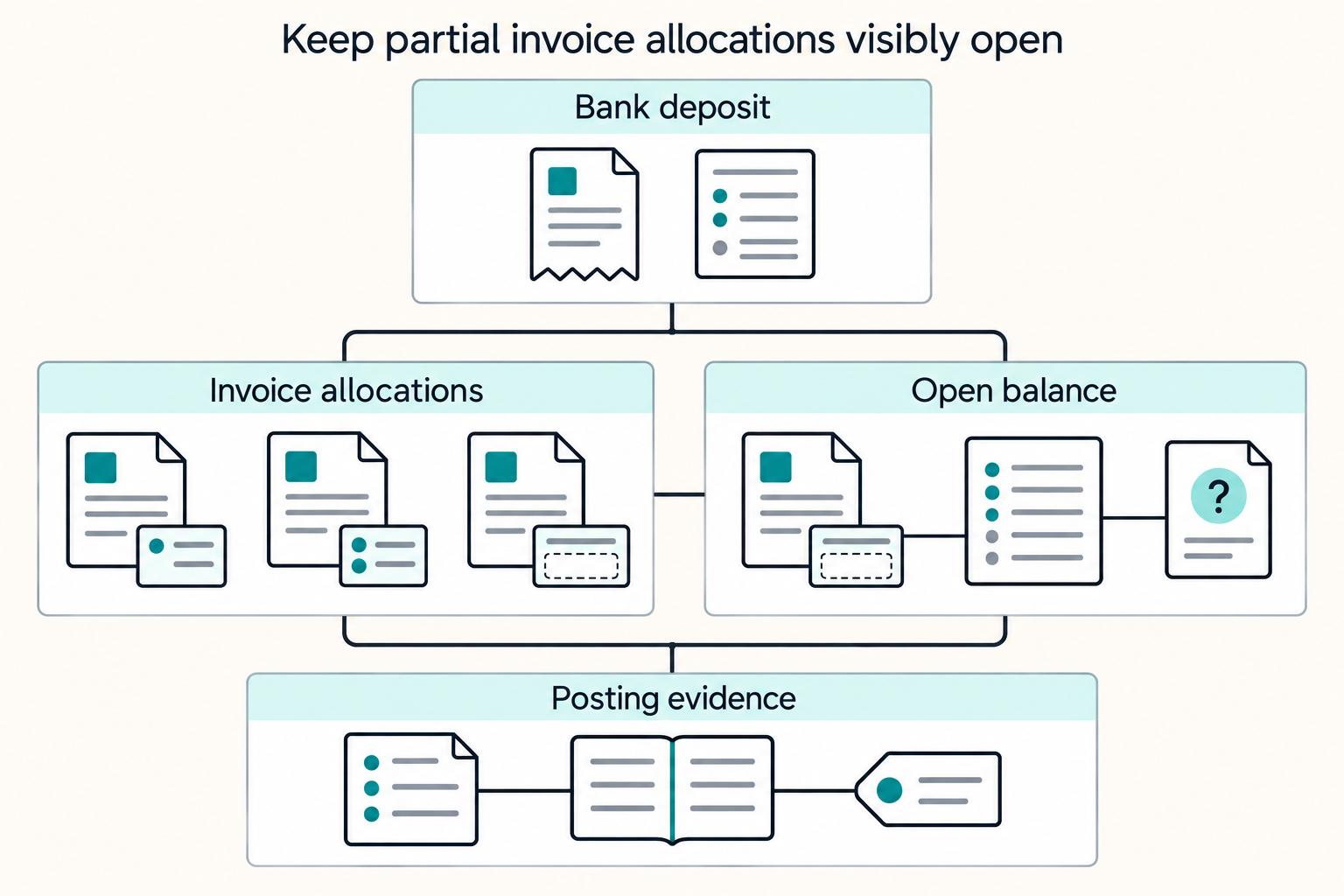
Payment Reconciliation for Freelancers: How to Match Invoices to Bank Deposits
Payment reconciliation on freelancer platforms breaks down when a bank deposit cannot be tied, with confidence, to the right internal transaction. Your operating goal is simple: route each deposit into the right path, auto-match, manual review, or exception handling, and keep a record that can be traced from bank transfer through GL posting.

Invoice Factoring for Contractors: How Platforms Offer Early Payment and Manage Risk
If you run a platform for contractors, early payment is a product and risk decision before it is a goodwill feature. Ask four things up front: Who funds the advance? Who collects from the payer? Who absorbs nonpayment risk? Do the unit economics still work once disputes and exceptions show up?
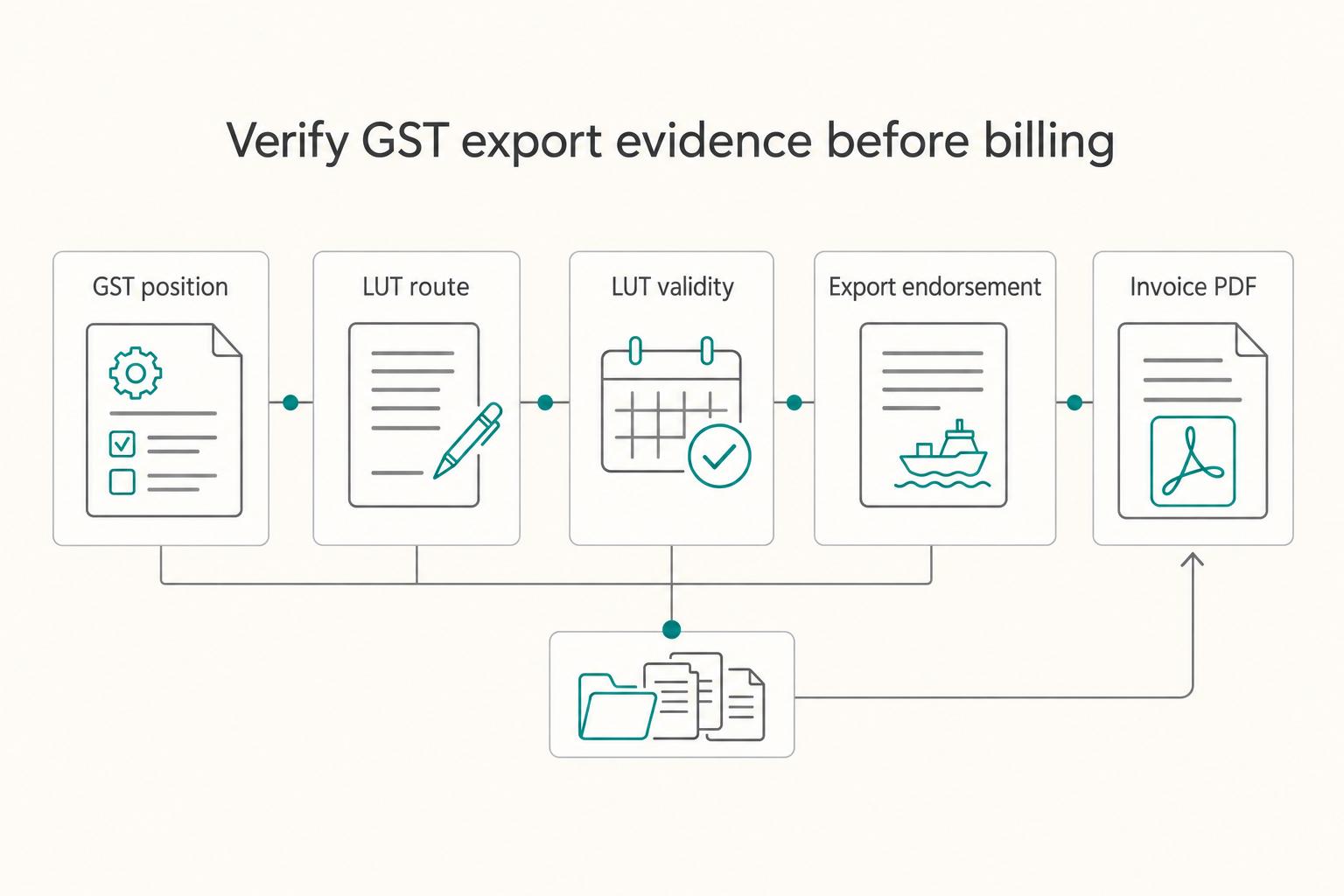
The Best Invoicing Software for Indian Freelancers with GST Compliance
If you invoice international clients from India, get three controls right before the first invoice goes out: your LUT status, your export invoice template, and your remittance evidence trail. If any one is weak, the cleanup and compliance risk usually show up later.