
Quick Answer
Freelancers owe NIIT only if they have net investment income and their MAGI is above the threshold for their filing status. High freelance income alone does not trigger the tax. NIIT is 3.8% of the lesser of net investment income or the amount MAGI exceeds the threshold, and Form 8960 is the main calculation form.
Start Here if You Earn Well as a Freelancer and Invest on the Side#
Start with the core rule: NIIT is not automatically applied to all high freelance income. It generally applies only when two things are true at the same time: you have net investment income and your MAGI is above the threshold for your filing status. This first pass should give you a likely yes-or-no answer, a rough exposure estimate, and a clearer sense of whether Form 8960 belongs with your Form 1040 filing.
The tension that trips people up#
High client income can push MAGI over the line, but that alone does not create NIIT.
| Filing status | MAGI threshold |
|---|---|
| Single | $200,000 |
| Head of household | $200,000 |
| Married filing jointly (and qualifying widow(er) with dependent child) | $250,000 |
| Married filing separately | $125,000 |
These thresholds are not indexed for inflation. The trigger is still two-part: threshold MAGI plus qualifying investment income.
What usually counts and what usually does not#
For NIIT, the IRS says it does not apply to wages, unemployment compensation, or income from an active business. The Form 8960 instructions also state that income included in self-employment income under section 1401(b) is specifically excluded from NIIT. But income excepted from NESE under section 1402(a)(1)-(17) can still be subject to NIIT.
What usually puts you in NIIT territory is investment-side income, including common portfolio categories like interest, dividends, certain annuities, royalties, and rents. A common mistake is blending all income together and assuming a strong freelance year means everything is exposed to the 3.8% tax. NIIT does not work that way.
If you use the foreign earned income exclusion, check this early. For NIIT, MAGI generally starts with AGI and adds back excluded foreign earned income, with related adjustments, so NIIT MAGI can be higher than expected.
The output you should aim for#
- Make a likely yes-or-no call.
Separate active business income from investment income, then compare MAGI to your threshold.
- Run the calculation in order.
Compute net investment income, compute MAGI above threshold, then apply NIIT at 3.8% to the lesser of those two amounts.
- Tie it to filing.
If your MAGI is above the applicable threshold, attach Form 8960 to your return. Individuals report NIIT on Form 1040 or Form 1040-SR.
Before you move on, pull a draft or prior-year Form 1040, your brokerage and bank tax statements, and records for rents, royalties, or other non-client income. That quick document check helps you classify income from forms, not memory.
If your case includes foreign exclusions, midyear residency changes, or income streams that blur business and investment treatment, continue with the framework and expect a likely escalation point later. The goal here is to get into the right lane quickly, with the right inputs for Form 8960.
You might also find this useful: A Deep Dive into the UAE's Corporate Tax for Freelancers and LLCs.
Make the NIIT Call in Four Checks#
Use this rule first: NIIT applies only if both are true at the same time: you have net investment income, and your Modified Adjusted Gross Income (MAGI) is above your filing-status threshold.
Start with the two terms that matter#
The Net Investment Income Tax is the federal tax under Internal Revenue Code Section 1411. The rate is 3.8%. For NIIT, MAGI starts with Adjusted Gross Income (AGI) and then includes specified adjustments. If you used section 911 foreign earned income exclusion rules or have other items that require AGI adjustments, do not assume NIIT MAGI equals your regular AGI.
Use this four-check sequence#
- Confirm filing status and threshold.
Single: $200,000; Head of household: $200,000; Married filing jointly: $250,000; Qualifying widow(er) with dependent child: $250,000; Married filing separately: $125,000. These thresholds are not indexed for inflation.
- Classify income into the right bucket.
Interest, dividends, annuities, royalties, and certain rents are typical NIIT-category items. Wages and nonpassive business income are not. If your year is mostly client fees from active self-employment work, focus the NIIT test on investment-side income rather than total receipts.
- Run the MAGI test.
Compare NIIT MAGI to your filing-status threshold. If MAGI is not over the threshold, NIIT does not apply. If MAGI is over the threshold but you have no net investment income, NIIT still does not apply.
- Apply the lesser-of calculation.
Compute two amounts: net investment income and the MAGI amount above threshold. NIIT is 3.8% of the lesser amount. This is the core calculation on Form 8960.
Quick check to avoid bad calls#
Do the classification from documents, not memory. Pull your draft Form 1040, brokerage and bank tax statements, plus rent or royalty records. Mark each line as investment-side or active business income before you calculate. That step helps you avoid false positives and overstated NIIT estimates.
This pairs well with our guide on A Deep Dive into the US-Israel Tax Treaty for Tech Freelancers.
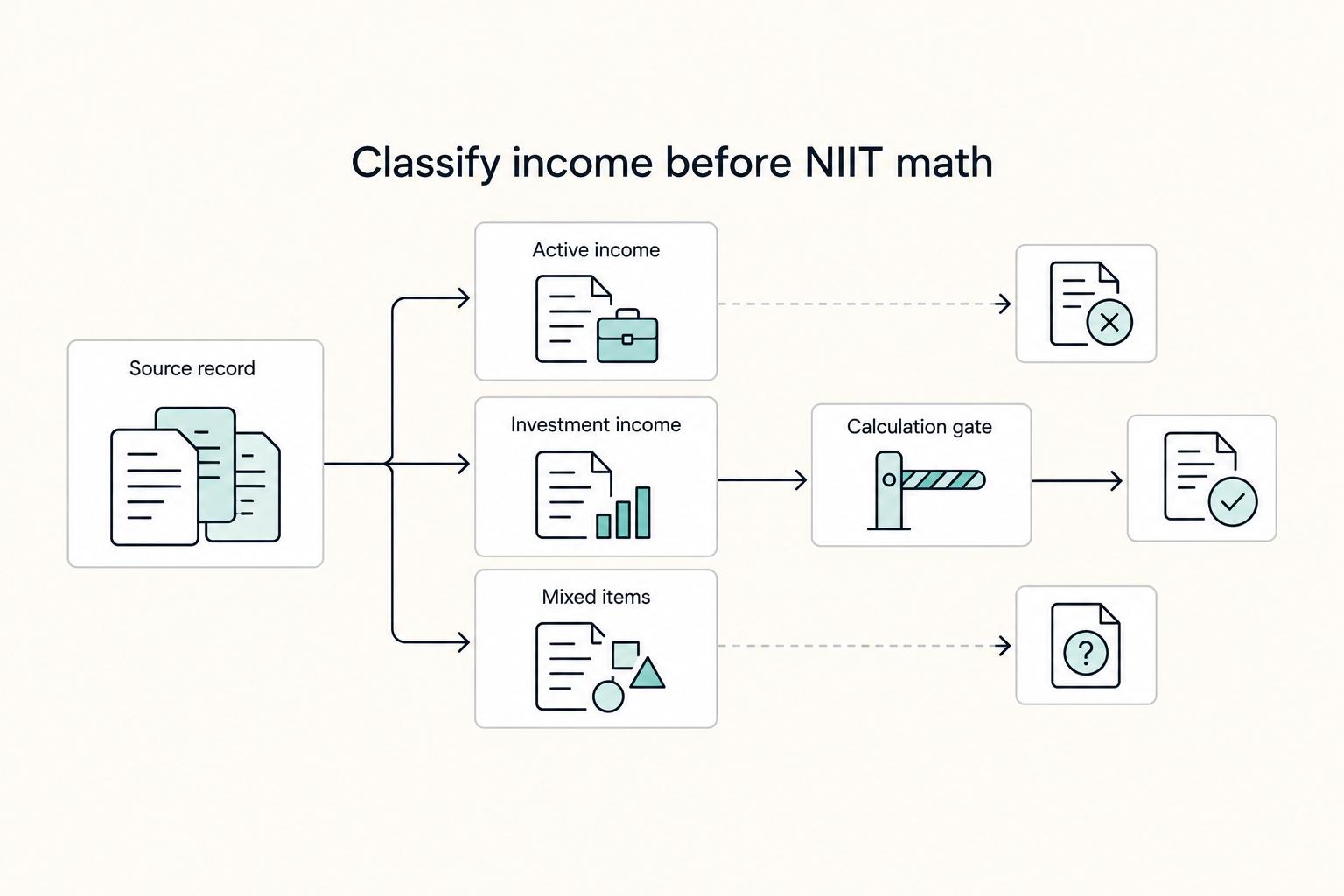
Classify Your Income Before You Calculate Anything#
Classify first, then calculate. NIIT errors usually start with mixed income types, not with the 3.8% math.
Keep one boundary clear from the start: income used to determine self-employment income for Schedule SE is generally excluded from NIIT, while investment-type income belongs in a Form 8960 review.
Quick reference table#
Use your draft Form 1040 income categories as your working lens, then sort each item before you run threshold or lesser-of calculations.
| Usually included in NIIT | Usually excluded from NIIT |
|---|---|
| Interest | Wages |
| Dividends | Most self-employment income |
| Capital gains and other disposition gains | Unemployment compensation |
| Rental and royalty income (subject to passive/active review) | Social Security benefits |
| Non-qualified annuities | Alimony |
This is a first-pass sorting tool, not a final ruling for every item.
Keep Schedule SE logic separate from NIIT logic#
For freelancers, this is a key control. Self-employment tax rules and NIIT rules are not the same test. Active client-service income that feeds Schedule SE is generally not NIIT income.
But do not treat Schedule C, E, or F labels as automatic answers. Form 8960 treats some amounts there as potentially subject to NIIT, so classification still depends on what the income actually is.
A practical default is simple: service fees you personally earn usually stay in the earned-income lane, while returns from money or property usually start in the investment-income lane.
Gray areas to review carefully#
Rental and royalty streams often need a second pass. They come up often in NIIT analysis, but passive-versus-active treatment can change classification.
Annuity income also needs explicit review. Non-qualified annuities are usually NIIT-category items, so do not assume they behave like earned compensation.
Disposition gains are another common mix-up. Even if a gain feels business-related, Form 8960 separately tracks net gain or loss from property dispositions, so review sale transactions on their own.
A common mistake is mixing separate rule sets and dropping an item into the wrong bucket.
Verification checkpoint#
Before you calculate NIIT, run a document-based bucket check:
- List each income stream from your draft Form 1040 categories.
- Tie each stream to your existing source records, for example bank and brokerage statements, annuity records, rental or royalty records, and property-sale records.
- Label each stream:
usually NIIT,usually not NIIT, orneeds review.
If you cannot explain in one sentence what an item is, where it came from, and why it is in or out of NIIT, treat it as needs review before moving to calculation.
If you want a deeper dive, read A Guide to the Qualified Business Income (QBI) Deduction for Freelancers.
Calculate NIIT with the Lesser-of Rule Without Spreadsheet Drift#
Use this order every time: compute net investment income, compute MAGI overage, then apply 3.8% to the lesser amount. NIIT estimate errors usually come from breaking that sequence or using gross investment receipts instead of net figures.
Follow the sequence exactly#
- Compute net investment income (NII). Start with your investment-side items, then reduce them by deductions properly allocable to that income where applicable. Do not use gross dividends, gross rents, or gross sale proceeds as the NIIT base.
- Compute MAGI overage. For NIIT, MAGI is generally AGI increased by foreign earned income exclusion-related amounts. Subtract your filing-status threshold from that MAGI.
- Apply 3.8% to the lesser amount. Compare NII with MAGI overage, use the smaller number, and multiply by 3.8%.
If NII is $20,000 and MAGI overage is $8,000, NIIT applies to $8,000. If MAGI overage is higher than NII, NIIT applies to NII.
Watch the threshold effect by filing status#
Thresholds depend on filing status and are not indexed for inflation. A quick way to see the effect is to hold MAGI and NII constant and compare outcomes by status.
| Filing status | Threshold | Sample MAGI | Sample NII | MAGI over threshold | NIIT base (lesser of NII or overage) | Estimated NIIT (3.8%) |
|---|---|---|---|---|---|---|
| Single | $200,000 | $240,000 | $60,000 | $40,000 | $40,000 | $1,520 |
| Head of Household | $200,000 | $240,000 | $60,000 | $40,000 | $40,000 | $1,520 |
| Married Filing Jointly | $250,000 | $240,000 | $60,000 | $0 | $0 | $0 |
| Married Filing Separately | $125,000 | $240,000 | $60,000 | $115,000 | $60,000 | $2,280 |
| Qualifying Widow(er) with Dependent Child | $250,000 | $240,000 | $60,000 | $0 | $0 | $0 |
Use the threshold that matches your status: $200,000 (Single or Head of Household), $250,000 (Married Filing Jointly), $125,000 (Married Filing Separately), or $250,000 (Qualifying Widow(er) with dependent child).
Avoid the easiest failure mode#
A common overestimate is treating gross investment receipts as NII. Your checkpoint is simple: every NII input should tie to a record and a net concept, including any deductions allocable to investment income.
Use the estimate to decide filing posture#
Use your estimate to decide whether Form 8960 is likely required.
IRS guidance says individuals who owe NIIT must file Form 8960, and the Form 8960 instructions also say to attach it when MAGI is above the applicable threshold. If your MAGI is over the threshold or your lesser-of result produces NIIT, treat Form 8960 as likely in scope.
Before filing, reconcile your final MAGI and NII inputs with your return assumptions. Related reading: A Guide to Form 1099-K for Freelancers Using Payment Apps.
If you want one place to keep timeline and residency notes organized, use the Tax Residency Tracker.
Handle Residency and Filing Elections Before Finalizing Your NIIT Position#
For cross-border freelancers, status comes before math. Residency and spouse elections can determine whether NIIT applies at all, and they can also change the MAGI inputs you should use.
| Situation | NIIT effect | Support or check |
|---|---|---|
| Nonresident Alien | Not subject to NIIT | Confirm NRA status is reflected consistently across the return |
| Dual-resident claiming treaty nonresident status under Regulation 301.7701(b)-7(a)(1) | Treated as an NRA for NIIT purposes | Keep the treaty position and return position consistent |
| Section 6013(g) election with an NRA spouse | Special NIIT rules and a corresponding NIIT election apply | Do not finalize NIIT until the election is reviewed |
| Section 6013(h) election with an NRA spouse | Special NIIT rules and a corresponding NIIT election apply | Do not finalize NIIT until the election is reviewed |
| Section 911 foreign earned income exclusion | Recompute NIIT MAGI | Keep the AGI starting point, Section 911(a)(1) support, and a note on Section 911(d)(6) adjustments |
Start by confirming whether you are in scope#
A Nonresident Alien is not subject to NIIT. If you are an NRA for the year, NIIT is out of scope, so start by confirming NRA status and making sure that status is reflected consistently across your return.
If you are a dual-resident individual claiming treaty nonresident status under Regulation 301.7701(b)-7(a)(1), you are treated as an NRA for NIIT purposes. A treaty-resident position can therefore change NIIT treatment even when the rest of your filing posture feels settled.
Before you finalize numbers, keep a short file note with:
- the status you are using for the year
- whether you are claiming a treaty position
- the return position that supports that conclusion
Treat spouse elections as NIIT-relevant decisions#
If one spouse is an NRA and you are considering a Section 6013(g) election or Section 6013(h) election, IRS NIIT guidance says special NIIT rules and a corresponding NIIT election apply in that context.
The practical point is simple: do not treat this as only an income tax filing choice. These elections can change filing posture and NIIT exposure at the same time, so your NIIT position is not final until that election piece is reviewed.
Rebuild MAGI when Section 911 is involved#
If Section 911 applies, recompute NIIT MAGI before you finalize your conclusion. IRS NIIT guidance describes MAGI as AGI, referenced there to Form 1040 line 37, increased by Section 911-related differences, including Section 911(a)(1) and Section 911(d)(6) items.
So if you excluded foreign earned income, do not assume lower AGI alone keeps you below the NIIT threshold. Recheck MAGI using the 911 adjustments first.
Keep this support in your workpapers:
- the AGI starting point used for NIIT
- any Section 911(a)(1) exclusion support
- a note on Section 911(d)(6) adjustments, if relevant
If your residency status changed during the year, consider getting a technical review before locking your NIIT calculation. Midyear status changes, treaty positions, and 6013 elections can require a fresh NIIT analysis before you finalize any Form 8960 math.
Related: The S-Corp Election for LLCs: A Tax-Saving Strategy for High-Earning Freelancers.
Keep NIIT Separate from Additional Medicare Tax#
Treat these as two separate taxes, even when both matter in a high-income year. NIIT, under IRC Section 1411, and Additional Medicare Tax apply to different income categories and are not computed on the same form.
| Aspect | NIIT | Additional Medicare Tax |
|---|---|---|
| Rate | 3.8% | 0.9% |
| Income tested | Net investment income when MAGI is over the applicable threshold | Certain earned income, including self-employment income above threshold amounts |
| Threshold question | Do you have net investment income, and is MAGI over the threshold? | Do you have Medicare wages or self-employment income over the applicable threshold? |
| Form | Form 8960 | Form 8959 |
You can owe both, but not on the same type of income. NIIT is generally 3.8% on net investment income when MAGI is over the applicable threshold. Additional Medicare Tax is 0.9% on certain earned income, including self-employment income above threshold amounts.
Do not use Schedule SE logic to infer NIIT exposure. Schedule SE is for self-employment tax, while NIIT is a separate test and generally does not include most self-employment income. Income levels can still affect whether you are over the MAGI threshold.
Use a two-check filing pass before you submit:
- NIIT check: Do you have net investment income, and is MAGI over the threshold? If yes, determine whether Form 8960 is required.
- Additional Medicare Tax check: Do you have Medicare wages or self-employment income over the applicable threshold? If yes, compute it on Form 8959.
As a final sanity check, match each income type to the right tax path so you do not miss one tax by over-focusing on the other.
For a separate freelancer tax topic, see A Guide to Provincial Sales Tax (PST) for Canadian Freelancers.
Decide Your Payment Timing After You Estimate NIIT#
Once NIIT looks likely, make a payment decision during the year instead of waiting until filing. U.S. taxes are pay-as-you-go, so the real choice is whether to cover the projected amount through withholding, estimated tax payments, or both.
Choose the payment channel that fits your setup#
You generally pay during the year through withholding or estimated tax payments. If you have W-2 wages or pension or annuity withholding, test a withholding update first. If you do not, plan estimated payments across the year's 4 payment periods.
Use the IRS Tax Withholding Estimator when withholding is an option. It can help you adjust withholding and reduce the risk of paying too little during the year. If you have nonresident U.S. tax status, do not use that tool. Use another projection method instead.
Recheck quickly after late-year gains#
If investment income is concentrated late in the year, update your estimate after the realization event. Dividends, interest, capital gains, rents, and royalties can all change what you need to pay.
Do not rely on an end-of-year catch-up. Underpayment penalties depend on what was paid during the year, and a penalty can still apply even if your return later shows a refund. If income is uneven, evaluate whether the annualized installment method is appropriate.
Keep an evidence checkpoint with your tax file#
Keep each payment-period estimate snapshot with the backup set you use for Form 1040 and Form 8960. Include the estimate, supporting income records, withholding-change records, and estimated-payment confirmations.
Use this as a verification trail: what changed, when it changed, and what you did. Act now if your projection shows you may owe $1,000 or more after withholding and refundable credits, or if you are slipping below the IRS 90% current-year / 100% prior-year tests.
Need the full breakdown? Read A Guide to Capital Gains Tax for UK Freelancers.
Build a Filing Packet That Survives Questions Later#
Build one reconciled packet now so you can show how your NIIT result was computed later. The goal is simple: a reviewer should be able to trace your draft Form 8960 to your Form 1040 inputs and back to source records without guessing.
| Packet item | When it belongs in the file | What to verify before filing |
|---|---|---|
| Draft Form 8960 | When your MAGI is above the applicable threshold and the form is required | Your numbers reconcile to the draft return, including the NIIT computation |
| Form 1040 support set | Always | Keep schedules and workpapers that feed NIIT, including reviewed amounts from Schedules C, E, and F |
| Income classification worksheet | When you have both business or client income and investment-side income | Label each stream as included, excluded, or reviewed, with the source document and a brief reason |
| Residency-status notes | When status changed, you lived abroad, or spouse elections may matter | Record whether you were a U.S. resident or Nonresident Alien, and whether section 6013(g) or 6013(h) elections may apply |
| Cross-border reporting file | If foreign-asset or account thresholds are met | Keep Form 8938, FBAR records, and account summaries consistent with the return |
That worksheet is what makes later questions easier to answer. For each income stream, note the source, treatment, and why. That matters most when amounts are only potentially subject to NIIT and need a real classification decision.
If cross-border reporting applies, keep it aligned with the NIIT file. Form 8938 is attached to the annual return when its threshold is met, while the FBAR is a separate FinCEN Form 114 filing. Filing one does not replace the other. Track the thresholds you tested, including the $10,000 aggregate FBAR test and the applicable Form 8938 thresholds, in the same packet.
Consider keeping a dated assumptions log as a workpaper. It is not an IRS filing requirement, but it can help you explain judgment calls later, for example residency posture, mixed-use income, or classification decisions.
Retain the packet long enough to cover real review windows. IRS recordkeeping is generally tied to a 3-year assessment period. It can extend to 6 years in certain foreign-asset underreporting cases, and FBAR records are generally kept for 5 years from the FBAR due date.
Know the Red Flags That Mean You Should Escalate#
If any red flag below applies, stop DIY and pay for a targeted pre-filing review before you file.
| Red flag | Why it matters | What to review |
|---|---|---|
| Foreign-entity complexity | CFC and PFIC income can require additional AGI adjustments | Whether foreign items changed AGI inputs or classification decisions feeding Form 8960 |
| Residency or treaty complexity | NRA status, treaty nonresident positions, midyear status changes, and section 6013(g) or 6013(h) elections can change NIIT treatment | How residency and treaty positions apply for the year |
| Mixed high-impact year | Large realized gains, major deductions, and cross-border elections create consistency risk | Whether any income excluded from net earnings from self-employment can still be subject to NIIT |
The first trigger is foreign-entity complexity. If you have Controlled Foreign Corporation ownership or any Passive Foreign Investment Company exposure, do not treat your return as done just because the basic 3.8% NIIT math looks right. NIIT guidance says CFC and PFIC income can require additional AGI adjustments, and the Form 8960 instructions define CFC ownership tests, including more than 50% ownership, and more than 25% for certain foreign insurance companies. Your check is whether those foreign items changed AGI inputs or classification decisions feeding Form 8960.
The second trigger is residency or treaty complexity. Nonresident Alien individuals are not subject to NIIT, and a dual-resident person claiming treaty benefits as a U.S. nonresident is treated as an NRA for NIIT purposes. If status changed midyear, NIIT treatment can depend on how residency and treaty positions apply. If you are using a section 6013(g) or 6013(h) election with an NRA spouse, special NIIT rules apply, so this is not a guess-and-file situation.
The third trigger is a mixed high-impact year: large realized gains, major deductions, and cross-border elections in one filing. That mix is not an IRS-defined automatic trigger, but it is a common consistency risk. A known failure mode is assuming income excluded from net earnings from self-employment is also excluded from NIIT. The Form 8960 instructions warn that some of that income can still be subject to NIIT.
If you escalate, hand over a tight review set:
- draft Form 8960, especially line 4a items sourced from Schedules C, E, and F
- residency and treaty memo, including any 6013(g)/(h) election
- foreign account or entity support tied back to AGI and the draft return
Cover Adjacent US Reporting So NIIT Work Does Not Break Elsewhere#
Treat this as one filing process with separate obligations: NIIT analysis is one layer, while FBAR (FinCEN Form 114) and FATCA reporting through Form 8938 are separate filings that still need to reconcile.
Keep the boundary clear#
FBAR and Form 8938 are not substitutes for each other. The Form 8938 instructions state that filing Form 8938 does not remove any requirement to file FinCEN Form 114.
Form 8938 also has its own filing mechanics: attach it to your annual return and file it by that return's due date, including extensions. For specified domestic entities, Form 8938 filing is triggered when total specified foreign financial assets exceed $50,000 on the last day of the tax year or $75,000 at any time during the year.
Also avoid shortcut assumptions. Other foreign-reporting relief does not cancel section 6038D obligations.
Work in this order#
- Build a complete foreign account and asset inventory.
- Run NIIT classification using that same inventory.
- Finalize Form 8938, FBAR, and the return only after values and tax-item links reconcile.
This order helps catch cases where NIIT math is complete but foreign account balances or asset activity are not yet consistent across filings.
Use one master ledger#
Use one master account ledger for every adjacent filing. Track account identity, ownership, year-end status, maximum reported value, whether assets were acquired or sold during the year, and the related tax items.
Before filing, match that ledger to Form 8938 checkpoints, including:
- maximum value fields, including deposit accounts
- acquired or sold during the tax year
- summary of tax items attributable to specified foreign financial assets
Then confirm the same account set and values flow into your FBAR data and return support. One ledger is a practical way to keep adjacent reporting from breaking otherwise solid NIIT work.
Address State Drag for Mobile Freelancers Before You File#
A correct federal NIIT calculation may not settle your state filing risk on its own. You can have the federal side done and still need a separate state residency or sourcing position, especially if you moved during the year or worked across multiple jurisdictions.
California is the clearest example lane#
Use California as a stress test. The FTB treats residency as a facts question. You can be a resident if you are in California for a non-temporary or non-transitory purpose, and domicile can still support resident treatment when you are outside California only temporarily.
Your state tax scope changes with that status:
- Residents are taxed on all income regardless of source.
- Nonresidents are taxed on California-source taxable income.
- If you lived inside and outside California in the same year, you may be a part-year resident and may need Form 540NR.
What to check before you trust your federal payment number#
If you changed states or worked from multiple jurisdictions, confirm your state filing posture before you finalize federal payment assumptions. For California, classify your status first, then confirm whether income allocation support is needed. For compensation allocation, California provides a workday ratio: CA Workdays / Total Workdays = % Ratio.
Failure mode to avoid#
One failure mode is treating state analysis as an afterthought once the federal return feels settled. That can break cash planning later if California treatment changes what is taxable or how it is allocated, including the effective-rate method used for nonresidents and part-year residents.
If your year involved moves or multi-location work, keep dated records of where you lived and where work was performed so your residency and sourcing position is supportable before filing. For deeper next steps, use our guide to a defensible 2026 filing plan and this state tax guide for digital nomads.
For a step-by-step walkthrough, see A Guide to 'Making Tax Digital' for UK Freelancers.
Final Takeaway and Your Next Move#
Use this order and let the math decide: classify income, test MAGI against your filing-status threshold, apply the lesser-of rule, then decide filing and payment actions. That is the safest way to handle NIIT without guesswork.
Keep your lanes clean. NIIT is a 3.8% tax on certain net investment income, and income counted for self-employment tax under section 1401(b) is excluded from NIIT. Avoid mixing active earnings into the investment bucket before running Form 8960 math.
Use thresholds as a hard gate. NIIT exposure for individuals requires both net investment income and MAGI above the applicable threshold: $200,000 for single or head of household, $250,000 for married filing jointly or qualifying widow(er) with dependent child, or $125,000 for married filing separately. Form 8960 is tied to MAGI above the applicable threshold.
Immediate checklist:
- Draft a classification table. Split each income stream into active or investment, and tie each line to return inputs or source records.
- Run the estimate in order. Compute net investment income, compute MAGI excess over threshold, then apply the lesser-of rule at 3.8%.
- Assemble your filing packet. Keep draft Form 8960, supporting Form 1040 inputs, your classification worksheet, and notes on any status or election issues together.
- Escalate only on real red flags. Get technical review for nonresident status questions, section 6013(g) or 6013(h) election issues, cross-border status complications, or CFC and PFIC items that can require additional AGI adjustments.
After estimating, make the payment call immediately. Taxes are pay-as-you-go through withholding or estimated payments, underpayment can trigger penalties, and if you expect to owe $1,000 or more at filing, review withholding or estimated payments now.
The goal is not aggressive minimization. The goal is a defensible return you can explain line by line, with Form 8960 used when the threshold and calculation require it, and support ready if anything is questioned later.
If your NIIT position involves nonresident status questions, CFC/PFIC exposure, or mixed cross-border elections, request a targeted pre-filing review through Gruv contact.
Frequently Asked Questions
Do freelancers pay NIIT, or only investors with portfolio income?
Freelancers can owe NIIT, but high freelance income alone is not enough. NIIT applies only if you have net investment income and your MAGI is above the threshold for your filing status. A strong client-income year can push MAGI over the line, but the tax still depends on investment-side income.
Is freelance self-employment income on **Schedule SE** subject to NIIT?
Generally, no. Income included in self-employment income under section 1401(b) is specifically excluded from NIIT, so Schedule SE and Form 8960 use different logic. But income excepted from NESE under section 1402(a)(1)-(17) can still be subject to NIIT.
What counts as net investment income for **Form 8960**?
Net investment income commonly includes interest, dividends, certain annuities, royalties, rents, and capital gains or other disposition gains. Use net figures, not gross receipts, and reduce investment-side items by deductions properly allocable to that income where applicable. Rentals, royalties, annuities, and sale transactions often need closer review before final classification.
How do I calculate NIIT quickly using **Modified Adjusted Gross Income** and the lesser-of rule?
Use a fixed order. First compute net investment income, then compute how much MAGI exceeds your filing-status threshold, then apply 3.8% to the lesser of those two amounts. If either amount is zero, NIIT is zero.
Do I need to file **Form 8960** if I am under the threshold but have investment income?
Usually no. If your MAGI is not over the applicable threshold, NIIT does not apply even if you have investment income. If you are over the threshold, or your estimate shows NIIT, treat Form 8960 as in scope and confirm the final filing requirement from the current instructions.
Is **Additional Medicare Tax** the same thing as NIIT?
No. NIIT is a 3.8% tax on certain net investment income when MAGI is over the threshold, while Additional Medicare Tax is a separate 0.9% tax on certain earned income and is computed on Form 8959. You can owe both in the same year, but not on the same type of income.
If I live abroad, how do **Nonresident Alien** status or spouse elections affect NIIT?
Start by confirming whether you are in scope. A Nonresident Alien is not subject to NIIT, and a dual-resident individual claiming treaty nonresident status under Regulation 301.7701(b)-7(a)(1) is treated as an NRA for NIIT purposes. If you are considering a section 6013(g) or 6013(h) election with an NRA spouse, review it before finalizing NIIT. If Section 911 applies, rebuild NIIT MAGI before deciding you are below the threshold.
Researched and edited by the Gruv editorial team. Gruv builds cross-border billing, payouts, and finance-operations software for global businesses.
Sources
Educational content only. Not legal, tax, or financial advice.
Related Posts

Digital Nomad Taxes in 2026 With a Defensible Filing Plan
With digital nomad taxes, the first move is not optimization. It is figuring out where you may be taxable, where filings may be required, and what proof supports that position.

Do I Have to Pay State Taxes While Living Abroad as a Digital Nomad?
Living abroad does not end `state income tax` exposure by itself. The first decision is practical: choose a filing position your facts can support, then build records that support the same story all year.

The Freelance Payment Penalty: A Modeled Audit of Platform Fees, FX Spreads, and Payout Delays
The money rarely disappears through a single, easy-to-spot fee. The real loss is stacked. A marketplace takes its commission, a processor adds a charge for international cards, a bank or payment company converts the currency at a spread, a platform holds the funds before release, and a wire sheds a little to intermediaries on the way in. Each layer looks defensible on its own, but the worker feels the combined result as a smaller deposit and a later payday.