
Quick Answer
Choose the structure that survives your downside month, not the one with the biggest approval amount. For capital advance platform sellers working capital decisions, compare repayment behavior across Revenue-Based Financing, Merchant Cash Advance (MCA), Term Loan, and Line of Credit (LOC), then verify the exact offer document. A usable decision requires written repayment triggers, deduction timing, and total payback; without those, you are comparing marketing claims rather than operating risk.
The hard part is rarely finding an offer#
The hard part is rarely finding an offer. It is choosing a funding structure that does not quietly eat margin or trap your payouts when sales soften. In seller working capital decisions, the right first question is not, "How much can we get?" but, "How does repayment behave in a weak month?"
That matters because seller cash flow often lags growth. You can be adding channels, buying more inventory, and still feel tighter on cash each cycle. In that environment, a large advance can look helpful on day one and still become the wrong choice if repayment starts too early, deducts too often, or draws from cash you still need for ads, suppliers, and returns.
A useful starting definition is simple: in seller-program language, working capital is often framed as on-demand funds for unexpected business needs. But that label tells you very little about the economics. One program may repay as a percentage of sales. Another may use fixed deductions. Another may approve a pool of funds that you can access for up to 12 months and repay only as you draw. Those differences matter more than the headline amount or the speed promise.
Speed is where many teams get distracted. Some lenders promote underwriting in days, not weeks, and at least one seller-capital program advertises funding as early as the next business day after approval. That can help when inventory timing is tight, but speed alone does not tell you cost or flexibility. If you do not verify the repayment trigger, deduction cadence, and whether repayment is fixed or percentage-based before accepting, you are not really evaluating risk.
This article uses a more operational lens. We compare Revenue-Based Financing, Merchant Cash Advance (MCA), Term Loan, and Line of Credit (LOC) by repayment drag: how cash exits the business, how sensitive the structure is to sales volatility, and where it can create a liquidity pinch. The practical checkpoint is whether the product still works when sales are below plan, not just when the forecast holds.
You should also assume that terms are program-specific and sometimes account-specific. Do not carry one provider's marketing language across the whole category. Ask for the actual offer terms, repayment logic, funding timing, and any document that shows whether repayment is fixed or percentage-based. If your team cannot explain those mechanics clearly to finance and operations, the offer is not ready for approval.
By the end, you should have a way to defend a decision across product, finance, and ops: choose the structure that preserves downside survivability first, then worry about headline size.
For a step-by-step walkthrough, see How to Model Working Capital Needs for a Fast-Growing Payment Platform.
Start with the terms that drive the economics#
Start by defining the operating baseline: working capital = current assets - current liabilities. It is related to cash flow, but it measures a different part of financial health, so a funding offer can ease near-term liquidity while still creating pressure elsewhere.
Use a terms-first check before comparing products:
- DSO (Days Sales Outstanding): how long it takes to collect invoices.
- DIO (Days Inventory Outstanding): how long inventory sits before sale.
- DPO (Days Payables Outstanding): how long you can wait to pay suppliers.
The practical test is fit, not labels. A single financing approach rarely fits every business, so align the structure to your supply chain dynamics, customer payment behavior, cash conversion cycle, and financial objectives.
For execution, pressure-test timing over your next operating window, not just headline access to funds. A useful operator rule is to shorten DSO and DIO while lengthening DPO responsibly, then check whether repayment timing supports that plan.
Before approval, get the actual offer document and confirm repayment trigger, deduction cadence, and total repayment obligation. If an option is not clearly available in current provider materials, verify current status before modeling it.
We covered this in detail in Working Capital Management for Payment Platforms: How to Optimize Cash Between Collection and Disbursement.
Compare funding products by operational fit not marketing labels#
Compare products by what you can model in your cash cycle, not by the headline label. Product-level mechanics are largely unverified, so use this as a diligence checklist and only finalize decisions from the actual offer document.
| Product | Repayment mechanism | Cost format | Speed to funds | Sensitivity to sales volatility | Best used when / avoid when |
|---|---|---|---|---|---|
| Revenue-Based Financing | Unverified in current sources; confirm repayment trigger and deduction cadence in writing | Unverified; confirm full repayment and estimated total cost of capital | Unverified | Unverified | Best used when: terms clearly show repayment behavior you can model under uneven sales. Avoid when: repayment rules are unclear or cannot be modeled against payout timing. |
| Merchant Cash Advance (MCA) | Unverified in current sources; confirm collection method in contract | Unverified; confirm total payback burden over actual window | Unverified | Unverified | Best used when: short-term need and complete terms are documented. Avoid when: terms are aggressive, unclear, or incompatible with margin. |
| Inventory Funding | Unverified in current sources; confirm when repayment starts versus inventory turn | Unverified | Unverified | Unverified | Best used when: need is tied to a defined inventory cycle you can model. Avoid when: sell-through timing is uncertain. |
| Term Loan | Unverified in current sources; confirm payment schedule and start date | Unverified | Unverified | Unverified | Best used when: forecast stability supports scheduled repayment. Avoid when: one weak period would pressure operations. |
| Line of Credit (LOC) | Unverified in current sources; confirm draw, limit, and repayment rules | Unverified | Unverified | Unverified | Best used when: need is timing-based and terms are clear per draw. Avoid when: the real need is long-cycle funding with uncertain payoff timing. |
| Accounts Receivable (A/R) Factoring | Unverified in current sources; confirm receivable ownership, collection flow, and dispute handling | Unverified | Unverified | Unverified | Best used when: receivable timing is the core constraint and terms are explicit. Avoid when: dispute/chargeback risk is high and consequences are unclear. |
Practical rule: if you cannot get repayment trigger, deduction timing, and estimated total cost of capital in writing, treat that option as unmodelable.
| Provider | Observed positioning | Repayment detail | Cost format | Speed to funds | Decision note |
|---|---|---|---|---|---|
| Payoneer | Verify current terms in the offer document | Unknown | Unknown | Unknown | Pull current terms before modeling. |
| Liquid Capital | Verify current terms in the offer document | Unknown | Unknown | Unknown | Do not assume comparability without documents. |
| SellersFi | Verify current terms in the offer document | Unknown | Unknown | Unknown | Require current agreement and fee disclosure. |
| CrediLinq | Verify current terms in the offer document | Unknown | Unknown | Unknown | Treat economics as unverified until documented. |
One comparison-oriented source here is a March 18, 2026 press release, and it explicitly says newsroom staff were not involved. Use that kind of source to shape diligence questions, not to treat terms as verified facts.
For the operating model behind this discipline, see Working Capital Management for Freelancers Who Invoice Clients.
Underwriting reality and eligibility constraints operators miss#
Underwriting still happens even when a product is framed as "no Credit Check." The common pattern is that eligibility, pricing, and repayment can be driven by platform data and revenue behavior, not just by a traditional personal-credit workflow.
Parafin's February 19, 2026 explainer makes that logic explicit: embedded capital decisions are informed by platform-provided data inside existing workflows. For operators, that means you should validate whether the provider can actually see enough business signal to assess repayment risk before treating approval speed as meaningful.
Turn positioning into a diligence checklist#
Because current sources do not provide provider-specific thresholds, treat eligibility language as a diligence prompt, not a decision input.
| Diligence area | What to verify |
|---|---|
| Sales-history logic | Which revenue history they evaluate and how volatility affects outcomes |
| Operating-history requirements | Any minimum history requirements in writing |
| Payout-flow dependency | What platform/account visibility is required to underwrite and collect |
| Application disclosures | Exact disclosure fields from the live application before internal rollout |
Use the application flow and offer documents as your checkpoint, not landing-page copy.
What "no Credit Check" does and does not tell you#
For Payoneer and Liquid Capital, the guidance here does not include verified underwriting excerpts you can compare directly. So "no Credit Check" should not be read as "no underwriting." The grounded distinction is narrower: embedded models may rely less on the traditional bank-loan process, while still underwriting business fundamentals.
Also, speed alone is not a quality signal. The same source guidance notes faster alternatives can still be rigid or high-cost.
Treat unknowns as decision-critical#
For SellersFi, CrediLinq, and similar providers, key approval and legal details should be confirmed directly with the provider. One legal page was inaccessible at time of research, and the dated paid press release warns that approvals, terms, and timelines vary by applicant and lender.
If criteria, required documents, or repayment dependencies are unclear, classify that provider as not yet comparable and pause selection until those gaps are resolved.
Related reading: Working Capital in M&A for Small Service Businesses.
Model repayment drag before you accept any offer#
Do not accept any offer until your model shows what happens to cash in a low-sales month, not just a base case. Keep it simple but operational: total repayment obligation, repayment trigger, deduction cadence, first deduction timing, and the account or payout path used for collection.
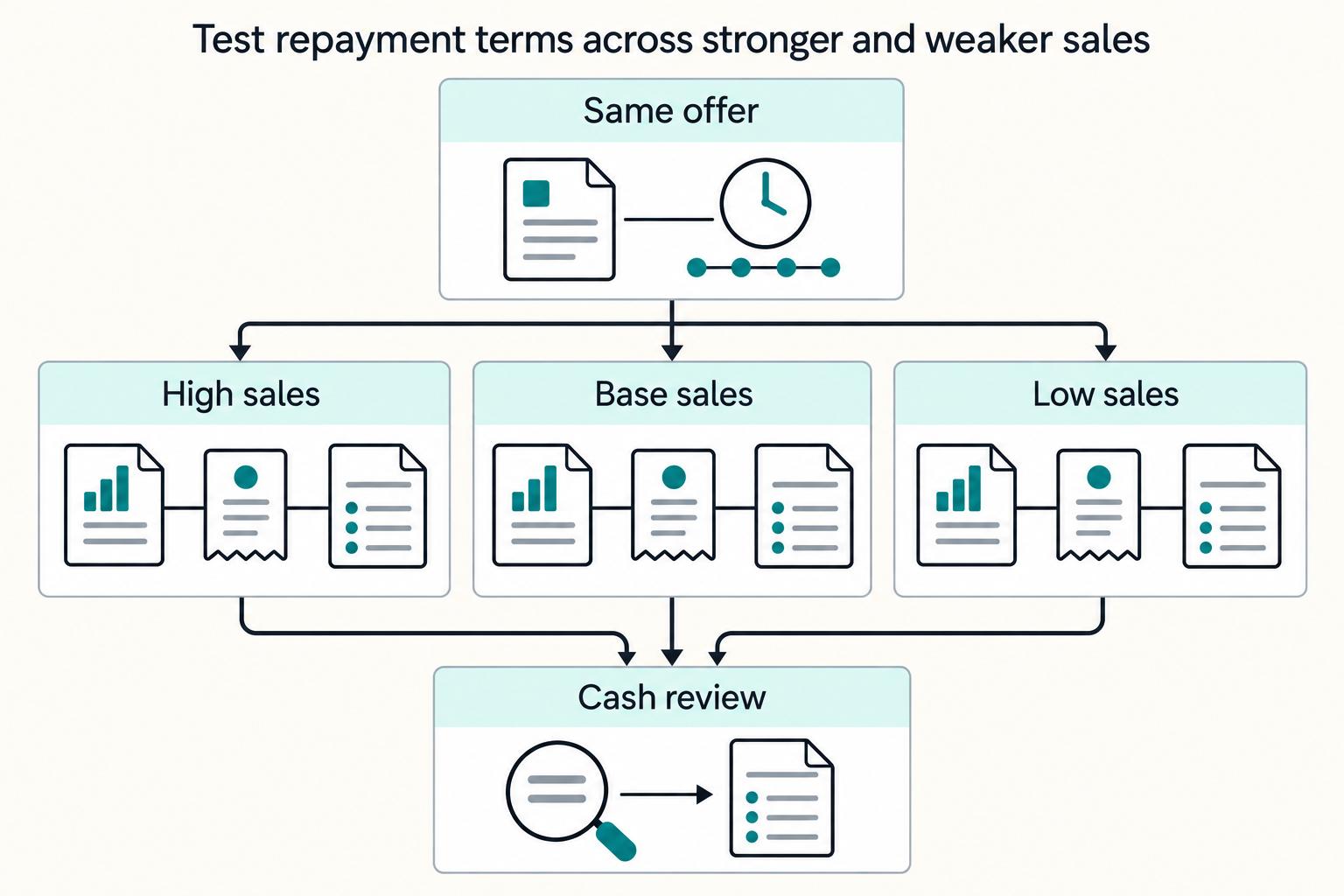
Run the same offer through three sales cases so finance and ops can compare like for like:
| Case | What to check first | What usually breaks |
|---|---|---|
| High sales month | Net cash after deductions still supports inventory and growth spend | Repayment looks easy, so cost risk gets ignored |
| Base month | Timing fit between deductions and normal payout rhythm | Hidden timing mismatch |
| Low sales month | Whether deductions still leave room for supplier payments and core operating costs | Liquidity pinch and forced tradeoffs |
For revenue-based financing, stress-testing weak weeks is non-negotiable. Repayment can stretch in slower periods, and effective APR can look far higher than the headline framing, including a reported 40%-350% range for fast-moving sellers in that context. Use that as a warning signal, not a universal benchmark.
Before approval, add two practical checks from the offer terms: whether early-repayment discounts apply if you can prepay, and whether cancellation terms create lock-in (for example, a cited 30-day notice for Instant Access in one reviewed product). If these terms are unclear, you do not yet have a decision-ready model.
At minimum, your file should include:
- dated offer terms
- total repayment obligation
- repayment trigger and deduction cadence
- first deduction timing
- collection path dependency
- low-month post-deduction cash view
If you cannot produce that package, you are still evaluating marketing, not operating reality.
Use practical decision rules for common seller situations#
Pick the product that keeps you solvent in a weak month, not the one with the biggest approval number. After modeling repayment drag, rank offers by the source of your cash gap.
| Situation | First move | Operational check |
|---|---|---|
| Demand is seasonal and inventory-led | Start with Inventory Funding or a flexible Revenue-Based Financing structure | Check supplier payment, inventory receipt, expected sell-through window, and marketplace payout |
| Margins are thin or ad spend moves around | Cap exposure and test a smaller Working Capital Advance for one cycle | Validate the low-month case, not just the base case |
| The gap is really payout timing | Confirm whether the issue is receivables timing versus a broader working-capital shortfall | Review payout-statement matching, reconciliation workload, dispute handling, and month-end close impact |
When demand is seasonal and inventory-led#
If the pressure is pre-season inventory, start with Inventory Funding or a flexible Revenue-Based Financing structure. Inventory financing is used to buy stock without tying up cash, and revenue-based structures can adjust repayments with sales when a season starts slower than expected.
Avoid rigid fixed deductions unless your buffer is clearly strong. Put four dates on one sheet: supplier payment, inventory receipt, expected sell-through window, and marketplace payout. If those dates do not line up, repayments can start before inventory converts back to cash.
When margins are thin or ad spend moves around#
If margins are tight or ad costs swing month to month, treat advance size as risk. Cap exposure and test a smaller Working Capital Advance for one cycle before renewals or stacking another facility.
Validate the low-month case, not just the base case. If weaker sales plus higher ad spend force cuts to replenishment, bids, or supplier payments, the tranche is too large even if approval is easy. Keep a simple file with total repayment obligation, remittance logic, renewal trigger, and your low-month model before signing.
When the gap is really payout timing#
If payouts can be delayed by up to 14 days, first confirm whether the issue is receivables timing versus a broader working-capital shortfall.
If you are comparing Accounts Receivable (A/R) Factoring and Merchant Cash Advance (MCA), decide based on operational fit in your own workflow. Review payout-statement matching, reconciliation workload, dispute handling, and month-end close impact before choosing.
Use the same final rule in every case: prefer the structure that preserves downside survivability in weak months, especially when offers look similar.
You might also find this useful: Working Capital Optimization for Platforms: How Payment Timing Affects Your Cash Position.
Red flags that should stop procurement and legal review#
Stop the process when the contract and diligence file are not clear enough to explain risk before signing. If your team cannot describe the repayment and risk path from the documents alone, legal and procurement should pause approval.
| Red flag | Detail |
|---|---|
| Review is not thorough | Across financial, legal, and operational records |
| Core diligence records are missing | Including a usable multi-year financial and tax history (for example, 3-5 years) |
| Known risk checks are skipped | Especially customer concentration, working capital, or contingent liabilities |
| Key agreement mechanics are not clearly defined | For example, a working-capital adjustment section without clear mechanics |
| Contract exhibits include omissions or placeholders | They block a complete legal and finance readout |
| Red-flag checks are after-the-fact | Instead of part of live approval controls |
Use these stop signs:
- the review is not thorough across financial, legal, and operational records
- core diligence records are missing, including a usable multi-year financial and tax history (for example, 3-5 years)
- known risk checks are skipped, especially customer concentration, working capital, or contingent liabilities
- key agreement mechanics are referenced but not clearly defined in the contract text (for example, a working-capital adjustment section without clear mechanics)
- contract exhibits include omissions or placeholders that block a complete legal and finance readout
- red-flag checks are treated as after-the-fact analysis instead of part of live approval controls
These are operating risks, not drafting details. If any item remains unresolved, stop review and return the package for clarification.
Operationalize capital products inside your platform controls#
Treat capital products as controlled money movement, not a growth perk. Formal controls should come first, because platforms have limited authority over independent sellers, and control gets harder when sellers operate across multiple platforms.
Set a clear order of operations and assign an owner at each step: underwriting intake, offer acceptance controls, payout-schedule checks, and a reconciliation checkpoint before funds release. Keep each decision recorded so finance and ops can trace what was approved, by whom, and under which provider-market-program version.
Use selective human judgment for exceptions, but keep the baseline process formal and auditable. That matches the control pattern reported in the March 2025 e-marketplace study: formal controls first, with selective informal controls where needed.
Create one evidence pack per provider (CrediLinq, Liquid Capital, SellersFi, Payoneer) and keep it complete each cycle: eligibility proof, repayment logic, fee disclosures, and exception notes. If key records are missing or unclear, hold release until they are resolved.
Run a recurring verification pass on expected vs actual deductions, seller cash impact, and net unit economics. If deductions or cash impact drift from plan, pause renewal and rework terms before the next draw.
If you want a deeper dive, read Embedded Working Capital for Platforms: Invoice Financing Factoring and Cash Advance Compared.
Conclusion#
The winning call is the product that still behaves well when your sales dip, not the one with the biggest approval screen. If a funding structure protects margin, leaves enough payout room for inventory and ads, and does not force ugly tradeoffs in a slow month, it is doing its job. If it compresses payouts right when cash gets tight, it is just an expensive way to hide liquidity risk.
That matters because many marketplace sellers are already operating inside payout delays. One source describes Amazon payouts being delayed by up to 14 days, and another notes Walmart's two-week payout cycle. When cash arrives on that schedule, repayment cadence becomes the real product. A fixed deduction can look fine in a headline comparison and still create strain once supplier terms, ad spend, and returns hit the same window.
Your last checkpoint should be simple and hard to argue with: model the offer in a high, base, and low sales month before you sign anything. For revenue-based financing, the grounded advantage is clear. Repayment can move with sales volume, which can ease strain in slower months. If the offer does not flex and your business has seasonal swings, thin contribution margins, or volatile ad spend, you should either reduce the amount, choose a more flexible structure, or walk away.
Keep one liquidity signal in the model, not just repayment totals. For Walmart sellers, one cited guide uses a working capital ratio target of 1.2-2.0 and flags below 1.0 as short-term risk. That is not a universal rule for every marketplace, but it is a useful stress test. If your modeled month pushes you into a zone where short-term obligations look hard to cover, the financing is probably misfit no matter how fast approval was.
The practical next step is not provider shopping first. Build your comparison table, map repayment drag against actual payout timing, and attach an evidence pack for any shortlisted offer: fee disclosure, total repayment obligation, first deduction timing, collection path, and exception handling if payouts are delayed or accounts are held. That is the point where a seller working capital decision becomes operationally credible instead of aspirational.
Used this way, disciplined working-capital management can help sellers stay competitive, reduce stockout risk, and fund growth with less financial stress. Used lazily, it becomes a hidden tax on scale. Start with economics and controls, then shortlist providers only after the structure proves it can survive your downside case.
This pairs well with our guide on Working Capital Loans for Freelancers to Bridge Cash Flow Gaps.
Frequently Asked Questions
What is a capital advance for platform sellers, and how is it different from a term loan?
A capital advance is usually presented as working capital tied to seller volume, with a stated offer cap, fee, and total payback shown in the offer flow. Payoneer, for example, shows a specific Settlement amount, which is the total payback amount. This guide does not detail term-loan mechanics, so you should not treat the two as interchangeable just because the headline funding amount looks similar.
How much funding can sellers typically access from products like `Capital Advance` or `Working Capital Advance`?
It depends on the provider and the seller's observed sales history. One concrete example is Payoneer, which markets up to 140% of monthly volume, capped at 750,000 USD. Do not carry that number over to other providers unless their current offer documents state the same cap and sizing rule.
Does no `Credit Check` mean there is no underwriting risk?
No. The grounded example here says funding is based on the earnings history of the ecommerce store, and Payoneer also ties eligibility to what is paid into the Payoneer account. If a provider says no credit check, ask what they are using instead: sales consistency, payout inflows, account history, or other business performance signals.
When should a seller choose `Merchant Cash Advance (MCA)` versus `Line of Credit (LOC)`?
Use the underlying offer terms, not just the label. Walmart Marketplace Capital explicitly presents MCA financing for eligible Marketplace businesses, and in this excerpt the offer amount is based on Marketplace sales for U.S.-based sellers only. For LOC comparisons, review real repayment terms side by side and confirm full pricing mechanics directly from each offer document.
How do repayment deductions affect cashflow during slow sales periods?
This guide does not provide detailed deduction formulas, so model this directly from the offer terms. Your practical check is simple: map the first deduction timing against the next meaningful disbursement and test a low-sales month, not just the base case.
What should operators verify before signing with providers like `Payoneer`, `SellersFi`, `Liquid Capital`, or `CrediLinq`?
Verify the exact provider-market-program version, current eligibility proof, repayment logic, fee disclosure, exception handling notes, expected funding amount, first deduction timing, and the collection account path. For Payoneer specifically, make sure the displayed Settlement amount matches your approved record before funds move. For Walmart Marketplace Capital, confirm current U.S.-seller eligibility and sales-based offer logic in the live program terms. If any provider leaves deduction triggers or market eligibility unclear, stop and send it back for exception review rather than assuming parity across programs.
Try a related tool
Researched and edited by the Gruv editorial team. Gruv builds cross-border billing, payouts, and finance-operations software for global businesses.
Sources
Includes 1 external source outside the trusted-domain allowlist.
- capitol.tn.gov/Archives/Joint/committees/fiscal-review/cont...trusted
- fdic.gov/resources/supervision-and-examinations/exami...trusted
- scholarship.law.duke.edu/cgi/viewcontent.cgitrusted
- scholarworks.waldenu.edu/cgi/viewcontent.cgitrusted
- sec.gov/Archives/edgar/data/1816125/0001680359230000...trusted
- sec.gov/Archives/edgar/data/1846832/0002070979260001...trusted
- tiffin.edu/wp-content/uploads/AI-Tools-with-Description...trusted
- business.org/finance/loans/payability-reviewexternal
Educational content only. Not legal, tax, or financial advice.
Related Posts
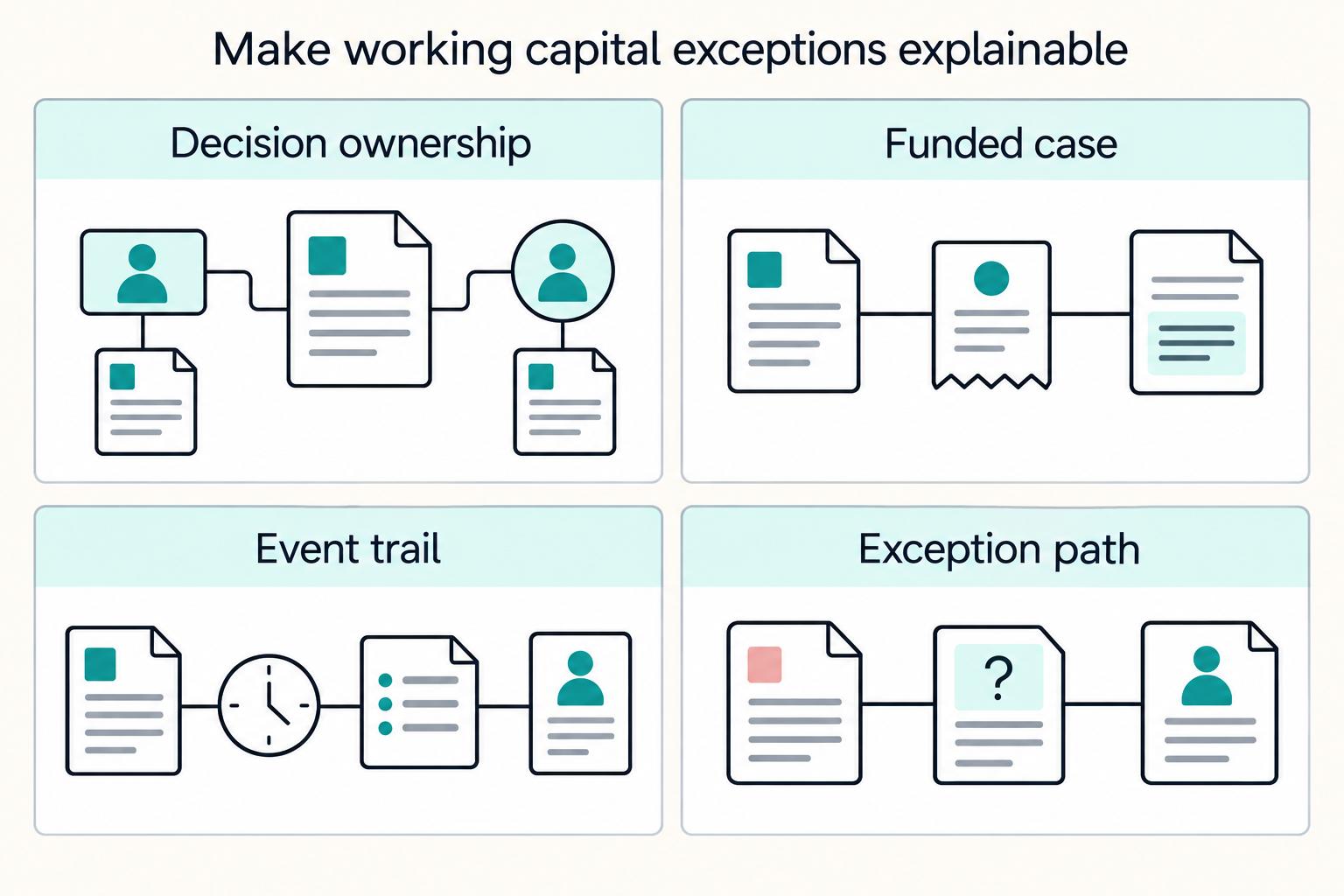
Embedded Working Capital: Factoring, Financing, or Cash Advance
Treat this as a product design choice first and a funding feature second. The model you pick changes who controls the invoice asset, who collects repayment, what your support team has to explain, and how the economics hold up once disputes and exceptions show up. That is the real lens for embedded working capital.
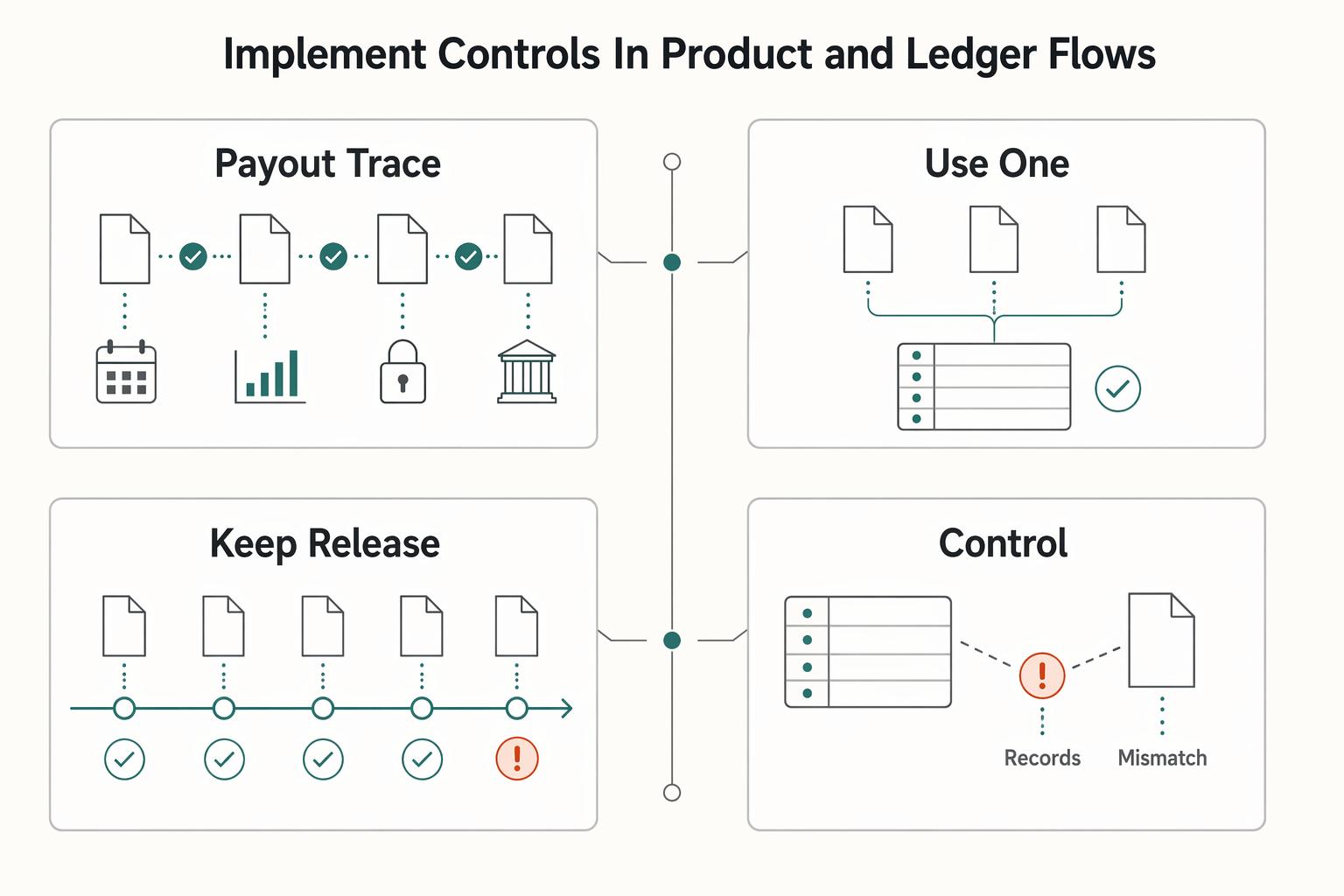
Days Payable Outstanding (DPO) for Marketplaces: How to Optimize Working Capital Without Hurting Sellers
Use Days Payable Outstanding as a timing tool, not a blanket instruction to pay later. You only get a real working-capital benefit if you can hold cash longer without creating operational problems.
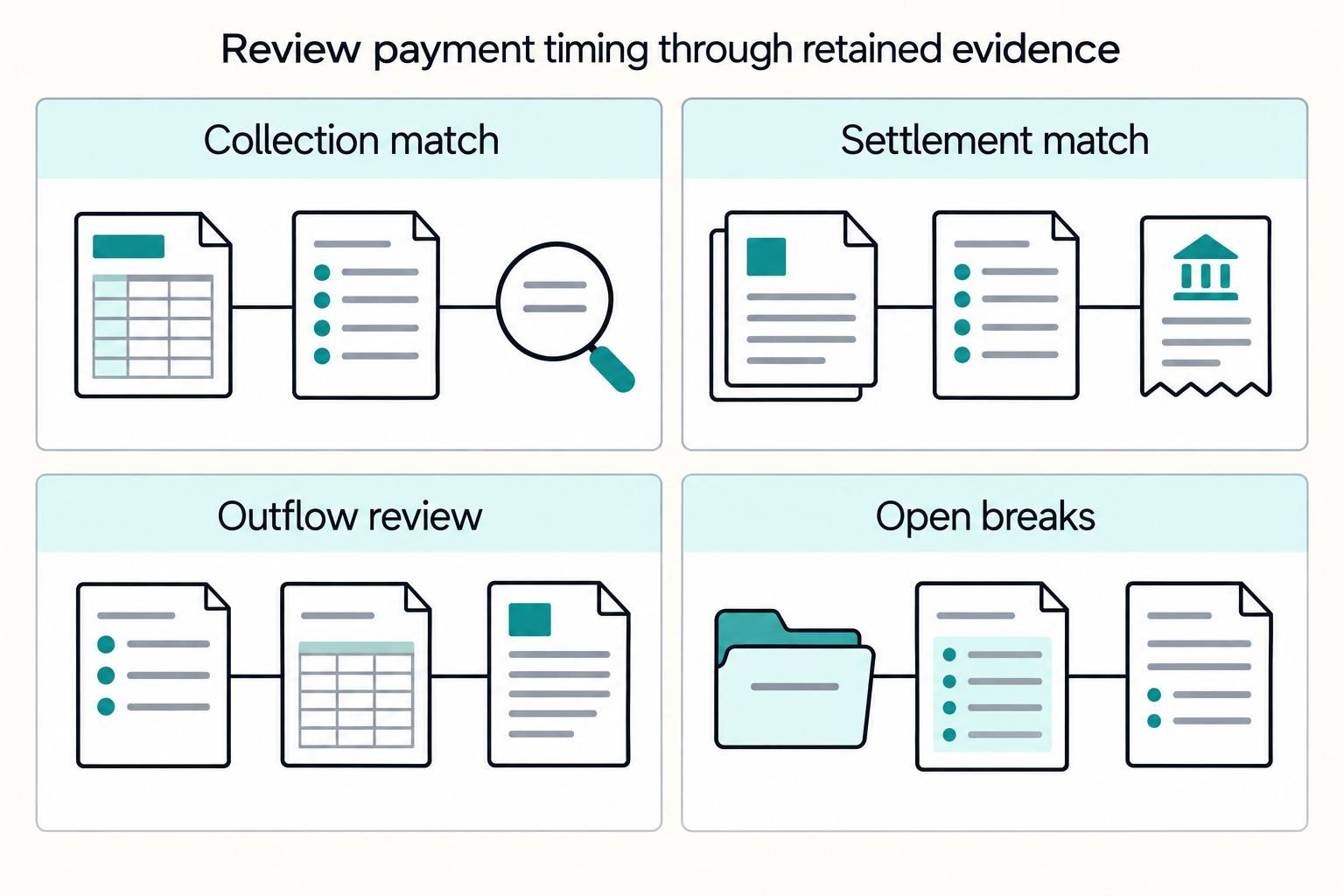
Working Capital Optimization for Platforms Through Payment Timing Control
Working capital is current assets minus current liabilities. In platform operations, timing controls are a practical lens you can verify: when collection data is posted, when funds are final, and when disbursements are released.