
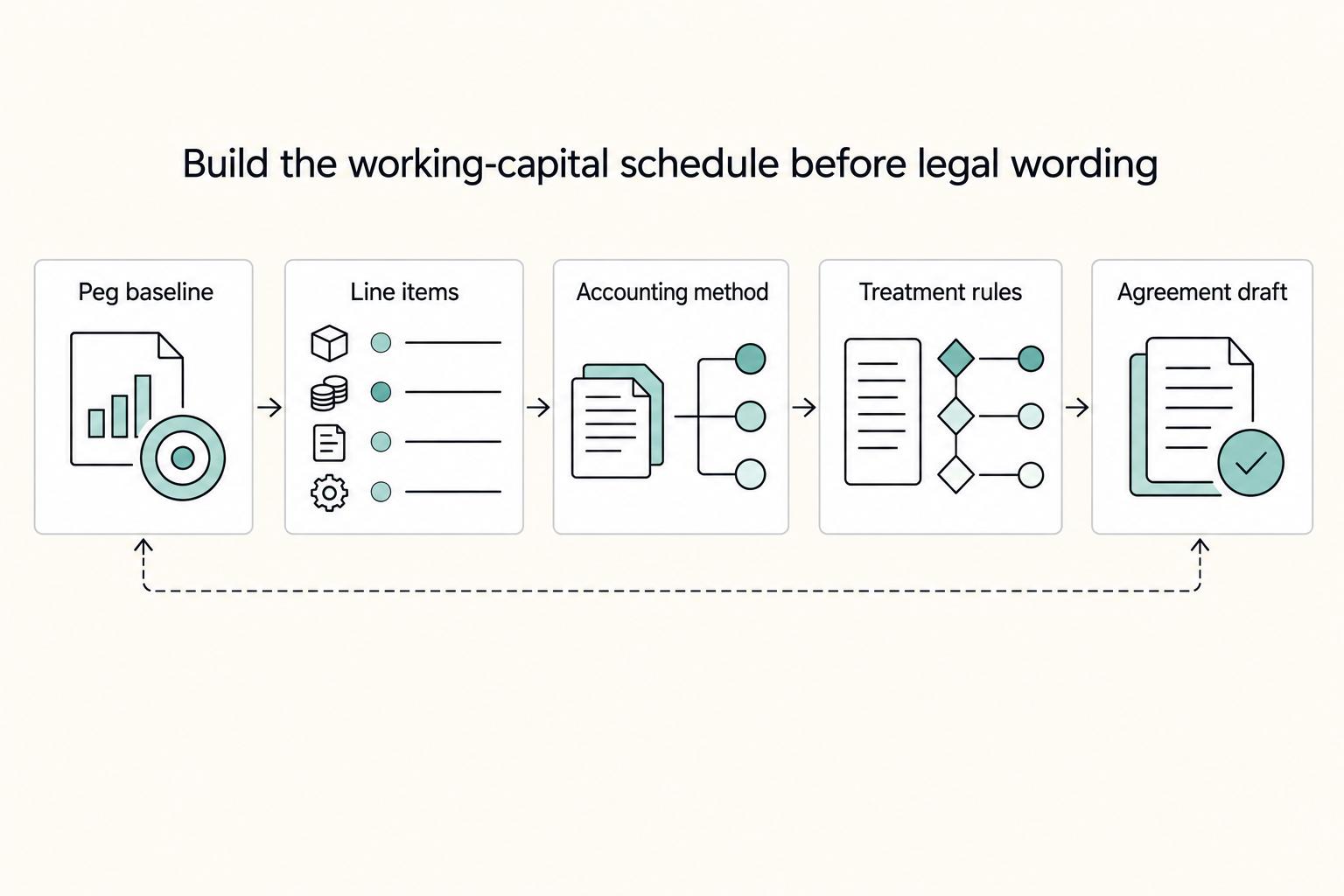
Quick Answer
In an M&A deal, it usually means the operating liquidity the buyer expects to receive at closing. In accounting, it is current assets minus current liabilities, but the deal definition is often narrower. In many private-company deals, net working capital excludes cash and debt, and the final price moves up or down based on closing net working capital versus the agreed peg.
Working Capital in M&A for Small Service Businesses#
If you are selling a small service business, define working capital early. It is one of the simplest ways to protect your proceeds before the Letter of Intent (LOI), during financial due diligence, and at closing. In many deals, these mechanics can still move what you take home in a meaningful way.
For small sellers and buyers, this is often where avoidable friction starts. A deal can look strong at the top line and still move against you if the parties never align on what operating liquidity has to transfer on Day 1.
Why small sellers get tripped up
In financial reporting, working capital is broadly current assets minus current liabilities. In private-company M&A, net working capital is often defined differently. It commonly excludes cash and debt and focuses on the operating balances expected at close.
That gap between accounting and deal mechanics is where late stress shows up. Net working capital details often get pushed aside until late, which can trigger renegotiation and put proceeds under pressure. Before you sign the LOI, or at least before buyer financial due diligence begins, get the buyer's draft net working capital definition and confirm what is in, what is out, and how it will be measured at closing.
What the buyer is really asking for
In many private-company deals, the buyer wants a business that can operate on Day 1 without an immediate capital injection. That is why deals commonly use a Working Capital Peg, which is the agreed baseline, and a Working Capital Adjustment, which increases or decreases price based on closing net working capital versus that peg.
These mechanics can work for both sides if the definitions are precise. Buyers get operating continuity, and sellers can be paid for excess working capital above the agreed baseline. Clear inclusion and exclusion terms in the purchase agreement are a practical way to reduce disputes.
What this article is focused on
This article stays focused on operating liquidity transferred at closing. It does not try to cover every tax, entity, or jurisdiction-specific legal issue.
It covers plain-language definitions, how the Working Capital Peg is set, how the adjustment moves price, the negotiation checkpoints that matter before documents are locked, and a pre-close execution checklist. Keep one rule in view from the start: do not let an undefined version of "normal" become the default. Define it with evidence before the closing mechanics are locked.
Related: How to Perform a Business Valuation for a Small Agency.
Define Working Capital and Net Working Capital Early#
Define these terms in writing early, or you risk a late dispute about what liquidity has to transfer at closing.
Working Capital is the accounting measure: Current Assets - Current Liabilities, where "current" generally means one year or less. In private-company M&A, Net Working Capital (NWC) is deal-specific and often treated as non-cash working capital, so it commonly excludes cash and debt and focuses on operating balances.
Your books can be right while your deal NWC schedule is still wrong for negotiation purposes. The accounting question is whether balances are recorded correctly. The deal question is whether the buyer receives what the business needs to keep operating at closing. If an item is needed for ongoing operations at closing, it is usually a stronger candidate for the NWC schedule.
Many deals are structured on a cash-free, debt-free basis. That usually means the seller keeps cash and pays off debt at closing, while the buyer expects adequate operating liquidity to transfer. But treat that as document-controlled, not assumed. Confirm exclusions and inclusions in the LOI and then in the purchase agreement.
Run an early checkpoint against the buyer's draft NWC methodology:
- Can each included balance be tied consistently to your close process and trial balance?
- Can you explain why each item belongs in operating liquidity rather than cash, debt, or a special item?
Do not leave this until late. NWC details are often postponed, and late-stage stress and disputes can surface. If you want a deeper dive, read Hiring Your First Subcontractor: Legal and Financial Steps.
Why Cash-Free Debt-Free Terms Change Your Outcome#
Cash-free, debt-free terms matter because they decide which balances transfer with the business and which are settled separately at closing. In this structure, the seller usually keeps cash and pays off debt, while the buyer expects sufficient operating working capital at closing.
That is why a balance can be correct in your books and still reduce proceeds if it lands in the wrong bucket. Under these mechanics, delivered working capital is typically adjusted to exclude cash, debt, and deal-related items, so classification directly affects price.
Debt-like items are often negotiated in the purchase price mechanics rather than assumed inside operating capital. The same debate can come up with items such as certain tax liabilities or bonuses. Because treatment is negotiated item by item, each contested balance needs explicit treatment in writing.
Use the LOI and final purchase agreement as control points. Cash-free, debt-free details are often incomplete at the LOI stage, so identify disputed balances during diligence, negotiate the treatment, and get it written into the final agreement. Defining key classifications early helps avoid late price erosion. Unresolved items can delay closing, create tension between the parties, and in some cases break the deal.
Need the full breakdown? Read How to Handle an 'Earn-Out' in a Business Sale Agreement.
How the Working Capital Adjustment Moves Purchase Price#
Once cash, debt, and other excluded items are handled, purchase price usually moves based on the operating working capital delivered at closing. In practice, the parties compare closing net working capital to the negotiated target. A higher delivered amount can support an upward adjustment, while a lower amount can support a downward adjustment.
The basic logic#
The target is meant to reflect the operating liquidity the buyer expects at closing so the business can run without an immediate funding gap. Buyers use the adjustment to avoid overpaying if that liquidity is short. Sellers use the same mechanism to get paid for stronger-than-expected operating performance between LOI and closing, which is often several months later.
That is why headline valuation and final proceeds are not always the same number. Performance between LOI and closing can still change what is paid in the end.
Same valuation, different proceeds#
Two deals can share the same LOI valuation and still end with different proceeds because of the working capital adjustment.
If key line items, such as accounts payable, accrued expenses, deferred revenue, and short-term debt, are defined and captured consistently, delivered liquidity is more likely to match expectations. If scope is inconsistent or liabilities are missed, the numbers can look better on paper than they are in practice. That can push the adjustment against the seller when the closing numbers are tested.
This is also why drafting quality matters. Private M&A studies often show negative working-capital price adjustments are more common than positive ones. That is not universal, but it is a useful warning that weak planning and loose definitions often create seller downside.
What to confirm in the Purchase and Sale Agreement#
Use the Purchase and Sale Agreement as the control point, but raise the topic before you sign the LOI. Confirm that net working capital is specifically defined and that the closing adjustment method is clearly drafted.
Then check consistency. If the deal is cash-free, debt-free, the closing working-capital test should follow that same logic and exclude cash, debt, and deal-related items as negotiated. If the target is built one way and the closing test is applied another way, the adjustment stops being a clean financial test and becomes a drafting problem.
For a step-by-step walkthrough, see What is 'Working Capital Management'?.
Pick a Peg Period That Matches How Your Business Actually Runs#
Choose a peg period that reflects normal operating liquidity at the expected close date, not just a convenient average. If the period is set badly, closing net working capital can look artificially high or low versus the peg, which can create an avoidable purchase price adjustment and a late-stage dispute.
A working capital peg is the negotiated target level of operating net working capital delivered at closing. One SMB approach is a normalized 12-month average to smooth seasonality and one-time events, but it is only a starting point.
| Peg method | What it tries to capture | When it is defensible | Main risk |
|---|---|---|---|
| Trailing average | Broad historical baseline, often normalized over 12 months | Monthly balances are relatively stable and anomalies are clearly normalized | Seasonality can get flattened and miss expected closing-period liquidity |
| Seasonally matched months (deal-specific) | Patterns from comparable months in prior periods | Both sides can document why the selected months reflect expected closing liquidity | Prior-period pattern may not fit if operations changed |
| Adjusted-period approach (deal-specific) | Historical period revised for clear one-off distortions | Distortions are specific, documented, and reviewable by both sides | Adjustments become subjective if support is thin |
If your revenue is lumpy, pressure-test whether a flat average peg reflects normal operating liquidity. A single unusual period can anchor an unrealistic working capital peg, and when results revert, that setup can increase adjustment risk at close.
To reduce argument risk, bring evidence, not preference:
- Monthly trends for Current Assets and Current Liabilities
- Monthly detail for key working-capital accounts
- Clear notes on anomalies and one-off events
Put the peg methodology on the table early, ideally during LOI-stage negotiation, so both sides are testing the same logic before the closing mechanics are finalized. The practical test is simple: can both parties trace why the proposed peg represents normal operating liquidity at closing?
Related reading: A guide to Stripe's 'Capital' for business financing.
Build the Line-Item Schedule Before Lawyers Finalize Language#
Build the line-item schedule before the purchase agreement language is finalized, or closing can turn into an argument about assumptions instead of a reproducible calculation. Once the peg is set, align on the components, the accounting method, and the treatment rule for each balance.
Lock the method and line definitions together#
In a cash-free, debt-free structure, net working capital is commonly framed as current assets excluding cash minus current liabilities excluding debt, but that formula is not enough on its own. The agreement should also state the accounting methodology, for example GAAP, GAAP consistent with historical practices, or another stated basis. It should also include a sample schedule so both sides calculate the same way at close.
| Line item | Typical starting treatment | Inclusion/exclusion rationale to document |
|---|---|---|
| Accounts Receivable | Often included | Core operating current asset; state how receivables at closing are treated, including disputed or related-party balances if relevant. |
| Inventory | Often included when inventory is operational | Operating current asset for ongoing delivery; define valuation and cutoff approach used at close. |
| Prepaid Expenses | Depends on deal terms | Specify which prepaids transfer post-close operating benefit and which are excluded. |
| Accounts Payable | Often included | Core operating current liability; define cutoff and consistency with the close process. |
| Accrued Expenses | Often included | Include recurring operating accruals only if treated consistently; state treatment for non-operating or deal-related accruals. |
| Deferred Revenue | May be included as a current liability | One common NWC breakdown includes deferred revenue; do not leave treatment implicit. |
| Taxes Payable | Varies by deal terms | Can be inside or outside working capital depending on agreement; specify exactly which taxes count. |
| Lines of Credit | Often excluded in cash-free, debt-free deals | Often treated as debt and handled through purchase-price mechanics, not working capital. |
Name gray zones explicitly#
Call out receivables treatment at closing, customer advances/deferred revenue, related-party balances, and deal-related accruals directly in the schedule. These are common dispute points when definitions are broad but line treatment is vague.
Apply one consistency rule before inclusion#
If a line item cannot be computed consistently from your normal close process, either tighten the accounting policy now or exclude it with written rationale. That rule helps reduce window-dressing risk, for example timing collections or payments before close, and keeps the adjustment tied to transferred operating liquidity rather than negotiation pressure.
Treatment can vary by deal terms, so confirm the draft schedule with your accountant and counsel before execution.
Put These Working Capital Checkpoints in the LOI#
The LOI should make the economics clear early, not leave room for a late price fight. After you build the draft line-item schedule, carry the core terms into the Letter of Intent. State how working capital adjustments will be handled, including any preliminary Working Capital Peg, and list the main inclusions and exclusions at a principle level. Most LOI terms are non-binding, but they still shape expectations, and vague language can create misunderstandings and disputes.
| LOI checkpoint | What to state | Article note |
|---|---|---|
| Purchase price mechanics | Tie them to the defined NWC concept | Do not rely on a "customary working capital adjustment" |
| Preliminary peg | Reference any preliminary peg, if used | Carry the core terms into the LOI early |
| Sensitive balances | Call out known sensitive balances | Do not defer all detail to the final Purchase and Sale Agreement |
| Closing statement process | State who prepares the first closing statement and who can object | Set process expectations in the LOI |
| Objection support | Require the disputed line item, the proposed calculation, and supporting records already shared in diligence | Keep objections tied to records rather than negotiation pressure |
| Exclusivity | 30-60 day no-shop is often treated as a workable range; a loose 6-month exclusivity period can reduce seller leverage | Review no-shop language closely |
Lock the commercial definition before exclusivity starts#
Do not rely on "subject to a customary working capital adjustment." If a balance was important enough to debate in the schedule, it is important enough to appear in the LOI.
At minimum, the LOI should:
- Tie purchase price mechanics to the defined NWC concept.
- Reference any preliminary peg, if used.
- Anchor the core treatment rules already agreed in discussion.
- Call out known sensitive balances instead of deferring all detail to the final Purchase and Sale Agreement.
A practical check before signing is to give the LOI and draft schedule to someone outside the negotiation and ask whether they can identify what operating liquidity is expected to transfer at close. If they cannot, the drafting is still too loose.
Write the process and evidence rules into the timeline#
Set process expectations in the LOI, not later. LOI review comes before due diligence, and due diligence often runs in a 30-90 day window.
Define the mechanics in writing:
- Who prepares the first closing statement.
- Who can object.
- What support an objection must include.
For objections, consider requiring the disputed line item, the proposed calculation, and supporting records already shared in diligence. Multi-year financial statements are common in diligence and help keep objections tied to records rather than negotiation pressure.
Stop scope creep before definitive drafts begin#
Debt-like items, taxes payable, and unusual accruals should be addressed directly in the LOI. Their treatment can vary by deal, so do not leave them in a broad "to be finalized" bucket. If an item is inside NWC, say that. If it is outside and handled through other price mechanics, say that instead.
Also set exclusivity terms carefully. A 30-60 day no-shop period is often treated as a workable range when paired with progress milestones, while a loose 6-month exclusivity period can reduce seller leverage if definitions keep reopening. Even when most LOI terms are non-binding, some clauses can still be binding, so review no-shop language closely.
If they want discretion later, ask for precision now#
If the buyer asks for broad discretion later, trade it for precision now. Ask for a clearer formula, a narrower list of adjustable accounts, a tighter objection mechanism, or milestone-based exclusivity.
The risk is simple. Broad discretion plus weak evidence rules can turn closing into a line-item fight. When the LOI makes economics, timeline, and proof standards explicit early, it can help keep definitive drafting narrower and reduce proceeds risk.
Related reading: The Tax Implications of Working Remotely from Hawaii for a Mainland Company.
Prepare a Diligence Evidence Pack That Defends Your Numbers#
Your LOI terms are easier to defend when your evidence pack makes each material balance easy to trace. In practice, many teams use monthly schedules that tie back to the ledger or trial balance, with clear support behind the numbers. Weak tie-outs are often treated as data risk and can lead to tougher deal terms.
| Evidence item | What to include | Purpose |
|---|---|---|
| Monthly schedules | Beginning balance, monthly movements, ending balance, tie-out to the same month's trial balance or ledger, supporting detail for material items | Make each material balance easy to trace |
| QoE and FDD alignment | Reconcile adjusted EBITDA normalizations and NWC treatment; document any differences in treatment | Keep the same economics from being handled inconsistently across workstreams |
| Policy notes | Classification decisions, treatment of adjustments, support for material movements, approval and review ownership | Reduce avoidable back-and-forth |
| VDR recordkeeping | Consistent indexing, clear naming conventions, a refresh cadence for latest financials, and an owner for each folder | Keep a centralized, auditable record copy |
| Reconciliation checklist | Beginning balance, movements, ending balance, supporting documents, reviewer sign-off | Leave a lightweight review trail |
Build monthly schedules that tie the same way every time#
A practical starting pack is monthly schedules for material balances, often including Accounts Receivable, Accounts Payable, Accrued Expenses, and Deferred Revenue. Keep the format consistent so review is fast and repeatable.
For each schedule, a common format is:
- beginning balance
- monthly movements
- ending balance
- tie-out to the same month's trial balance or ledger
- supporting detail for material items
Use a simple stress test: can someone outside finance follow the path in a few steps? A clear contracts-to-billing-to-cash-to-accounting reconciliation chain helps prevent late "surprise" metric disputes.
Keep Financial Due Diligence and QoE aligned#
Financial Due Diligence and Quality of Earnings (QoE) should tell one coherent story. Adjusted EBITDA normalizations and Net Working Capital treatment should be reconciled so the same economics are not handled inconsistently across workstreams.
Review QoE adjustments against your draft NWC schedule line by line, then document any differences in treatment. If an item is adjusted in earnings but remains in closing working capital, explain why.
Add policy notes and a review trail#
Short policy notes make judgment areas explicit and reduce avoidable back-and-forth. Focus on areas with material judgment and documentation risk:
- classification decisions
- treatment of adjustments
- support for material movements
- approval and review ownership
If you are using a Virtual Data Room (VDR), treat it as the record copy. Use consistent indexing, clear naming conventions, a refresh cadence for latest financials, and an owner for each folder. If the VDR includes a Q&A module, keep diligence questions there so you have a centralized, auditable log you can archive at close.
Finish with a lightweight reconciliation checklist tailored to your process, for example:
- beginning balance
- movements
- ending balance
- supporting documents
- reviewer sign-off
You might also find this useful: A M&A Consultant's Guide to Due Diligence Checklists.
Spot Red Flags Before They Turn Into Price Erosion#
Price erosion often starts with balances you cannot defend quickly, not exotic issues. Buyers test whether numbers are real, complete, and repeatable, and weak support can lead to tougher terms.
Start with cash-conversion and tie-out risk in receivables#
Accounts Receivable is a common pressure point because old receivables may be discounted when collection looks doubtful. Break out stale items, show collection status, and make sure the aging report ties to the ledger.
Before buyer review, prepare support for your largest aged invoices and any subsequent receipts. If the aging and ledger do not reconcile, buyers may treat that as data risk and harden terms.
Check liability completeness as aggressively as asset quality#
Missing liabilities can reduce value quickly. Unrecorded VAT, PAYE, or accruals can be treated as debt-like items and reduce sale value.
Review payroll cutoff, vendor invoices received after period end for pre-period services, and recurring costs versus booked accruals. Large swings in Current Liabilities are not automatically wrong, but unexplained swings can trigger deeper questions.
Treat payment behavior and weak support as diligence risk#
Consistent delays in paying vendors are a warning signal in diligence. Even when balances are fixable, patterns that make operations look stronger than day-to-day reality can increase buyer skepticism.
For Deferred Revenue and Prepaid Expenses, keep treatment consistent and retain clear support. Before Financial Due Diligence or a quality of earnings review, use a practical internal rule: if support is not easy to produce, treat it as unfinished and fix it before the buyer arrives.
A short pre-diligence pass across material working-capital lines, with a normalized target and evidence pack ready, helps you enter buyer review from a stronger position.
Execute a Practical 60-Day Pre-Close Checklist#
Treat the post-LOI 60-day window as a sequencing problem first. The order of work can change deal outcomes. Use this as a practical seller-side template, not a universal rule.
| Timing | Priority | What to do | What to verify |
|---|---|---|---|
| Days 1-7 | Start immediate actions | Start financing outreach immediately and set the due-diligence sequence | Confirm financing outreach is active and the first-pass workplan is in motion |
| Days 8-21 | Validate financials | Complete preliminary validation, then order a Quality of Earnings review | Confirm QoE scope, timing, and data access are clear |
| Days 22-35 | Start legal work | Engage M&A counsel once QoE confirms financials; map agreement and consent requirements | Confirm legal work is aligned to confirmed financial findings |
| Days 36-60 | Run the closing path | Drive the staged close sequence through purchase agreement, financing, compliance, consents, final tasks, adjustments, and integration planning | Confirm late blockers are surfaced early and handoffs are clear |
Lock sequencing before deep-dive work#
The post-LOI period is critical. Getting the order right early can materially reduce execution risk.
Complete financial validation before major legal pushes#
Use a defined financial-review phase, including QoE after preliminary validation, so legal drafting is anchored to confirmed numbers.
Align on Net Working Capital definitions early#
Working capital is current assets minus current liabilities, with "current" generally meaning one year or less. In many M&A deals, Net Working Capital excludes cash and debt, and cash-free, debt-free structures commonly assume the seller keeps cash and clears debt at closing.
Treat closing as a risk stage, not an admin step#
Closing is where late issues can disrupt months of work. Keep the closing workflow explicit and traceable from final agreement mechanics through integration readiness.
Before buyer review starts, align your close workflow to an audit-ready process using Gruv docs.
The Main Takeaway for Sellers#
Protecting proceeds is mostly a definition-and-execution job: define NWC clearly, set a supportable peg, and document your numbers before close.
What actually protects seller value#
In deal practice, Net Working Capital (NWC) is commonly framed as current assets excluding cash minus current liabilities excluding debt, often on a cash-free, debt-free basis. The risk sits in the account-by-account inclusions and exclusions, because that is where disputes often start.
Working Capital Peg quality is the next lever. Buyers often price the deal assuming a normal working-capital level at closing, and differences can move price dollar for dollar. A trailing 12-month average is a common starting point, but use it only if it reflects how the business actually runs.
The checks that matter before close#
Set the target first, then lock how delivery will be tested after close. In the Letter of Intent (LOI), ask for a mutually acceptable methodology for calculating the peg instead of generic adjustment language.
Before signing the Purchase and Sale Agreement, confirm in writing:
- the exact
NWCdefinition, including account-level inclusions and exclusions - the peg methodology and historical period used to support it
- the post-closing true-up mechanics, including the review window (often 30-90 days)
If these points stay vague, disagreements can create extra fees and operational distraction.
Evidence beats memory#
Pre-close NWC analysis can be one of the clearest ways to reduce dispute risk. When questions come up, you need support ready, not a reconstruction plan.
Your working file should show how the peg was derived and how the closing figure will be calculated using the same logic. If you cannot explain a balance quickly, tie it to your books, and justify why it is in or out of the schedule, that item is exposed to late adjustments or avoidable argument.
How to use this article from here#
Use this article as a repeat checklist for serious buyer calls, LOI drafts, and purchase-price mechanic reviews. If you hear "we can sort it out later," push to narrow the definition while terms are still negotiable.
That discipline protects seller economics in practice. Define NWC clearly, choose a realistic peg, and prepare evidence early. For payment operations and reconciliation controls in live workflows, review Gruv docs or request access to confirm coverage for your market or program.
If you want to confirm payout controls and reconciliation coverage for your market before signing terms, request access.
Frequently Asked Questions
What is working capital in M&A in one sentence?
It is the operating liquidity delivered at closing. In baseline accounting, working capital is current assets minus current liabilities, but the deal definition is negotiated.
What is the difference between `Working Capital` and `Net Working Capital (NWC)`?
Working Capital is the broad accounting measure of current assets less current liabilities. Net Working Capital in a deal is deal-specific and can differ materially from reported accounting working capital. In private-company M&A, it generally excludes cash and debt, subject to the signed agreement.
Why does the `Working Capital Adjustment` change purchase price?
Because it compares the agreed peg with what is actually delivered at closing. If closing NWC is above peg, price usually moves up. If it is below peg, price usually moves down, often dollar for dollar.
What does a `Cash-free, Debt-free Basis` change in practice?
It changes which balances transfer with the business and which are settled separately at closing. In many private-company deals, NWC is negotiated to exclude cash and debt. Rely on the agreement's inclusions and exclusions rather than assumptions.
Who should benefit from the adjustment if the deal is structured fairly?
Neither side should be structurally favored. A properly structured working capital adjustment is meant to keep the economics neutral. If the peg is mis-set, value can still shift unexpectedly.
What should a small seller ask for in the `Letter of Intent (LOI)` before signing?
Ask the LOI to state how NWC will be handled in the purchase agreement. Where possible, include a mutually acceptable methodology for calculating the peg and call out key inclusions and exclusions. Push for this detail before exclusivity starts.
How do I confirm terms safely when rules vary by deal, buyer type, or jurisdiction?
Use the signed documents as the source of truth and confirm the LOI approach carries through into the purchase agreement. If an inclusion, exclusion, or calculation method is unclear, get written clarification before close. Unresolved NWC disagreements can become post-transaction legal and accounting costs.
Researched and edited by the Gruv editorial team. Gruv builds cross-border billing, payouts, and finance-operations software for global businesses.
Sources
Includes 3 external sources outside the trusted-domain allowlist.
- congress.gov/congressional-report/111/senate-report/31trusted
- irs.gov/irm/part4/irm_04-046-003trusted
- sec.gov/Archives/edgar/data/1842498/0001193125210782...trusted
- sec.gov/Archives/edgar/data/1419275/0001185185260005...trusted
- duedilio.com/post-loi-due-diligence-timelineexternal
- rsmus.com/pdf/wp_tas_cash_free_debt-free_transactions.pdfexternal
- srsacquiom.com/our-insights/working-capital-purchase-price-...external
Educational content only. Not legal, tax, or financial advice.
Related Posts

Hiring a Subcontractor for the First Time Without Costly Surprises
**Start with a risk-control sequence, not an ad hoc handoff.** As the Contractor, your goal is simple: deliver cleanly, control scope, and release payment only when the work and file are complete.
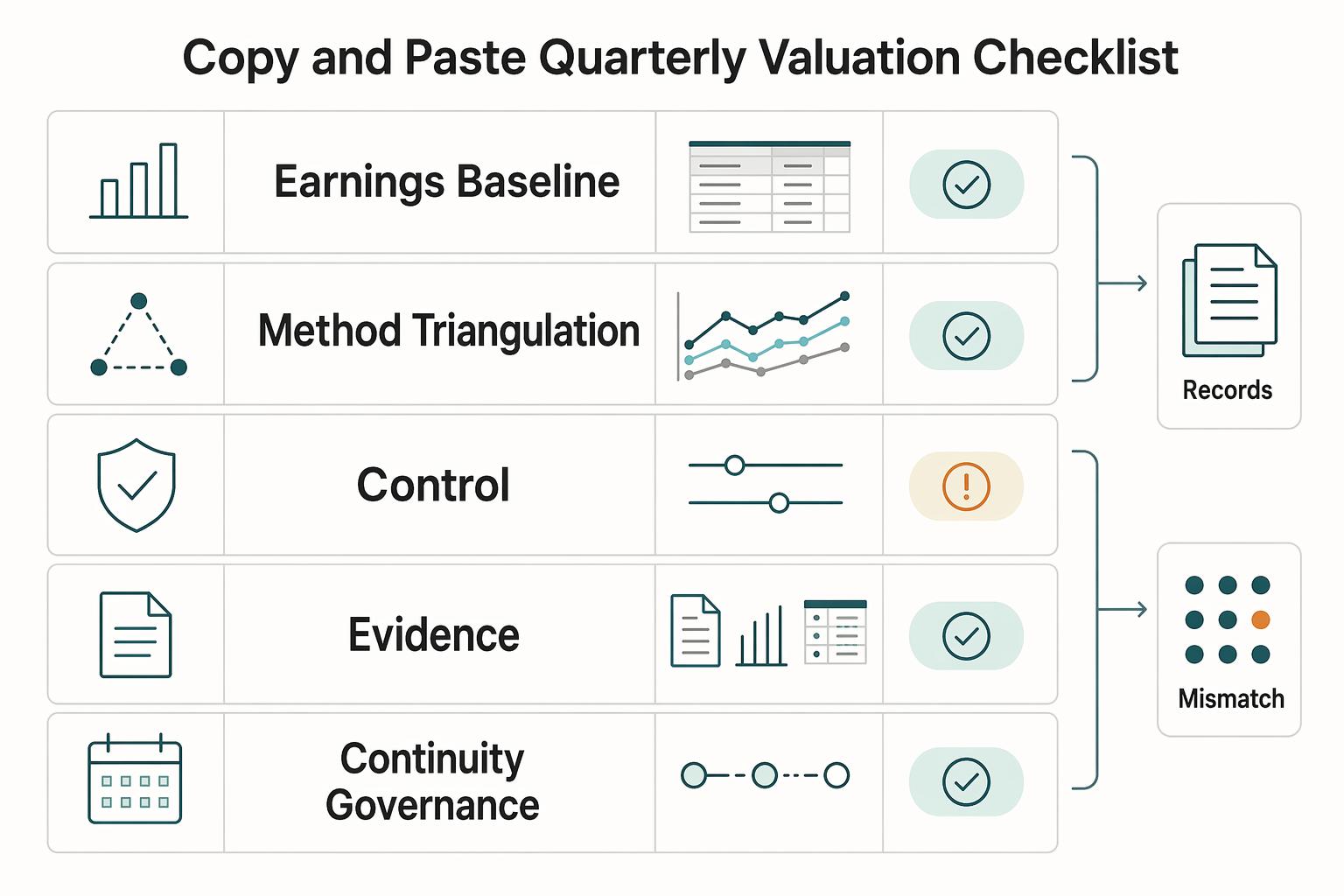
How to Perform a Business Valuation for a Small Agency
**Treat valuation for a small agency as a risk control system, not a headline multiple, and you are more likely to protect agency value before you ever start selling a business.**
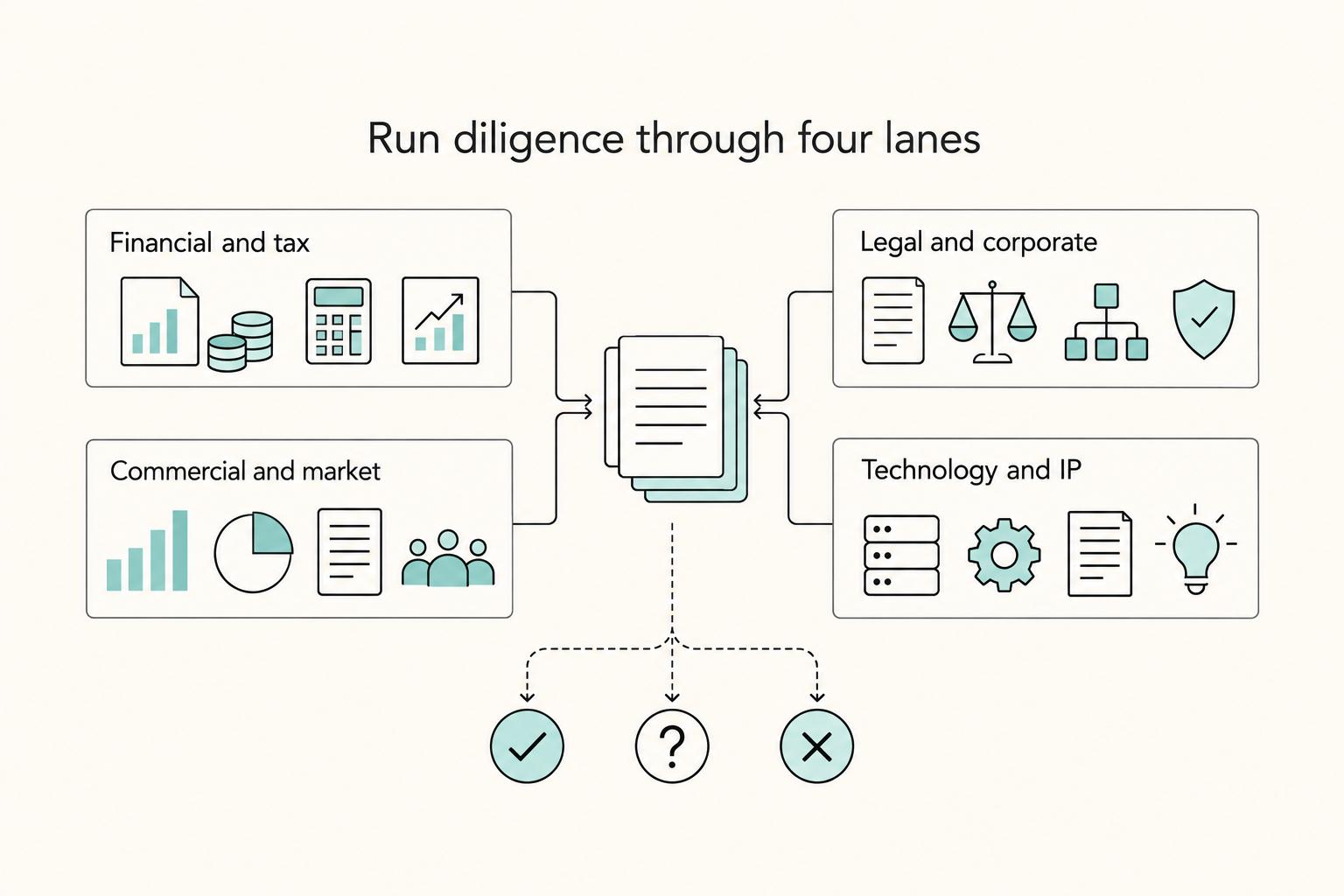
A M&A Consultant's Guide to Due Diligence Checklists
Most mergers and acquisitions fail, not in the negotiation room, but in the months after closing. The deal buckles under operational confusion, cultural friction, and liabilities that were not understood early enough. A common cause is bad due diligence, treated as a defensive box-checking exercise instead of a decision tool. That is the strategic mistake.