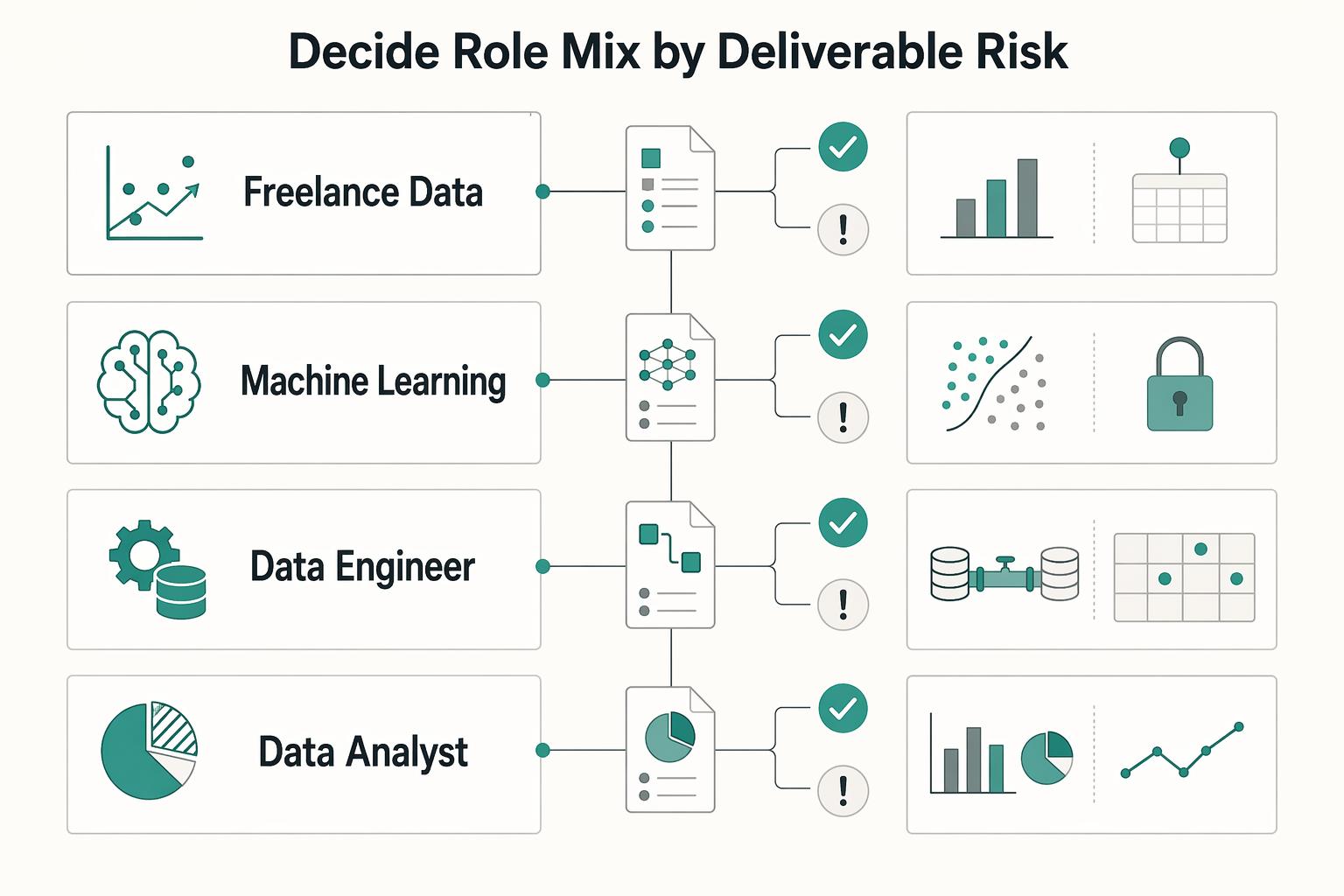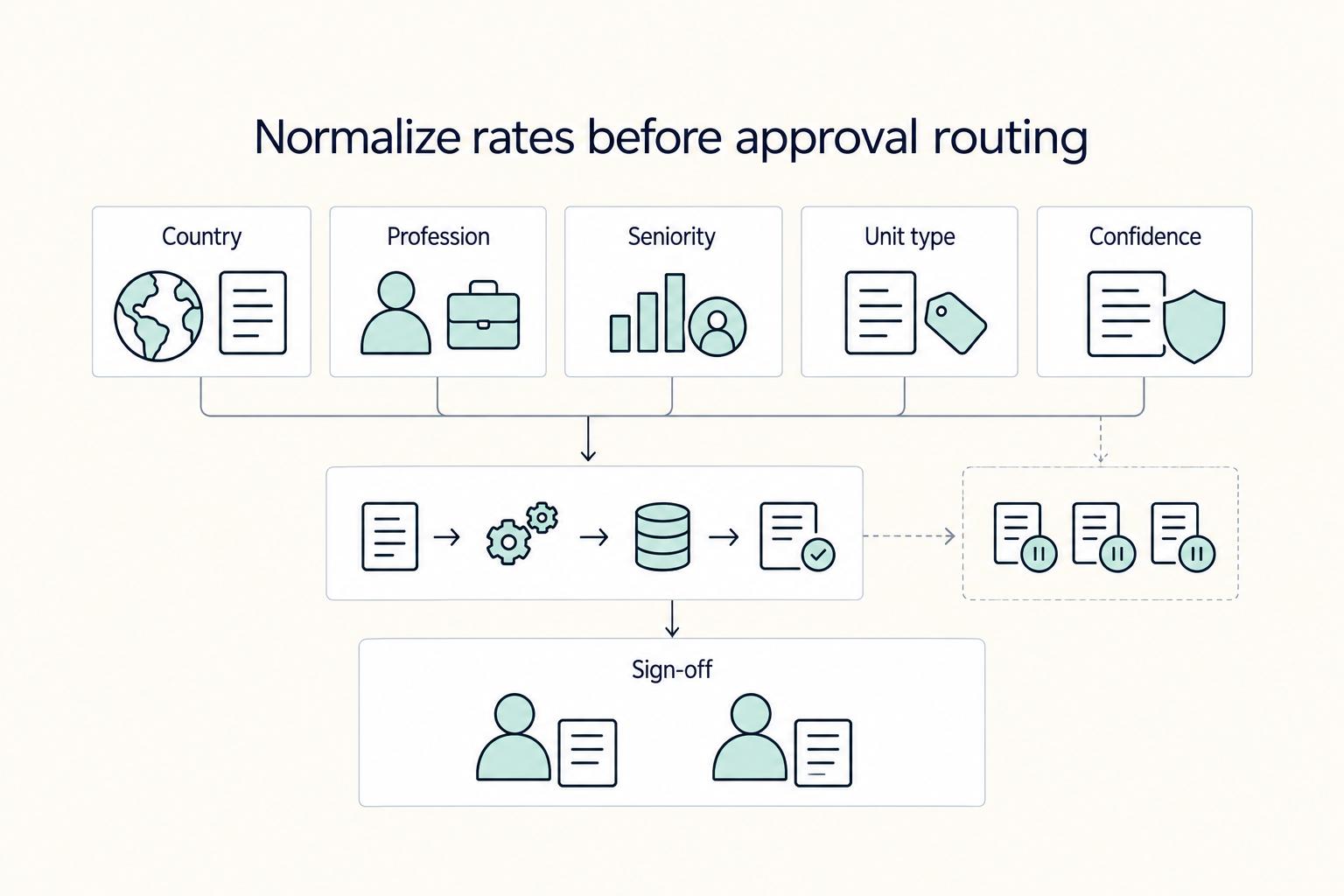
Normalize first: for average freelance rates country profession 2026, convert every input to your actual payout unit, then gate it by source confidence before approvals. Use structured datasets for policy intake, keep editorial summaries as context, and treat forum anecdotes as directional only. Build policy bands with country, profession, and seniority keys, and only automate decisions when each row has clear unit, coverage, and methodology fields.
If you are using average freelance rates country profession 2026 data for budgeting or payout approvals, start by normalizing the benchmarks into one payout unit, then gate them by source confidence and approval controls. This is not another prettier list of freelancer benchmarks. It is a practical way to turn fragmented 2026 rate inputs into a rate policy that finance and ops teams can actually run without constant exceptions.
The first problem to solve is unit mismatch. Hourly rates, day rates, and annual freelancer income are not interchangeable. Teams can pull a country average from one source, a profession day rate from another, and an income summary from somewhere else, then treat all three as if they describe the same payout unit. That leads to inflated approvals, noisy reconciliation breaks, and manual payout reviews that one intake rule could have prevented.
The evidence also needs a sober read. One 2026 source from Jobbers reports a global median freelance hourly rate of $58/hour, built from 487,000 verified freelance projects from January 2025 through December 2025, spanning 92 countries and 150+ skill categories. That is useful context, not a universal pricing truth. The same source says the average obscures enormous variation, and related benchmark reporting warns that earnings figures, ranges, and projections are approximations. Upwork makes the same basic point from another angle: freelancer income depends on expertise, location, industry demand, and client mix.
That is why scope discipline matters from the first spreadsheet row. Current source coverage is broad, but not complete enough to pretend you have every country by profession by seniority pinned down. Some inputs are strong for hourly comparisons. Some are only directional. Some countries or roles may still have weak granularity. When a data point lacks a clear unit, sample window, geography, or methodology, do not let it quietly become an approval threshold.
By the end, you should have a concrete method for turning partial benchmarks into something operational:
One rule should carry through the rest of this piece. If a benchmark cannot tell you what unit it represents and what population it covers, keep it out of automated decisions. That may feel conservative, but it is cheaper than approving out-of-band payouts and explaining them later.
For a step-by-step walkthrough, see How to Compare Freelance Hiring Paths by Trust, Evidence, and Control in 2026. Want a quick next step? Browse Gruv tools.
Use one rule before any benchmark enters budget or approvals: match the source unit to your payout planning unit, or convert it first.
| Unit | What it represents | How to treat it in policy |
|---|---|---|
| Hourly rate | Per billed hour | Direct input for hourly payout planning |
| Day rate | Bundled daily pricing, often tied to roughly 7 to 8 hours (not identical across industries) | Convert before comparing to hourly or other units |
| Annual freelancer income | Yearly earnings figure | Context signal, not a direct payout-unit benchmark |
Jobbers and RiseWorks are hourly-oriented inputs because they publish hourly comparisons. Jobbers reports a 2026 global median of $58/hour, and RiseWorks shows hourly role/location spreads, including $130/hour in the U.S. versus $25 to $50/hour in Eastern Europe for the cited AI specialist example. If your planning unit is hourly, these fit a first pass. If your policy unit is day-based or retainer-based, convert them before approval use.
Treat UK day-rate discussion, including forum threads like r/freelanceuk, as directional context. Even published day-rate guides frame these figures as a starting point for discussion, not hard policy truth. Keep comparability strict: a UK day-rate signal is not directly comparable to a U.S. annual income summary without normalization. U.S. annual summaries can still add context, such as $99,230/year with a listed hourly equivalent of $47.71/hour.
Keep a visible checkpoint on every benchmark row: source, as-of date, geography, profession, unit type, and conversion assumption. If you cannot explain the conversion in one line, exclude that row from approval thresholds.
If you want a deeper dive, read The Global Freelance Payment Report 2026: Rates Rails and Compliance Across 50 Countries.
After unit normalization, make source confidence your next gate: use structured indexes for policy, editorial summaries for context, and community anecdotes only for hypothesis generation. In this pack, that means Jobbers is suitable for benchmark intake, RiseWorks is useful for directional context, and Reddit or r/freelanceuk should not set approval thresholds.
The deciding factor is method visibility and operational usability. Jobbers discloses 487,000 verified projects (January 2025 to December 2025), 92 countries, and 150+ skill categories, so you can test it against your approval matrix. RiseWorks is still useful for directional checks, including the reported 5 to 10x location spread and the U.S. versus Eastern Europe AI rate example, but it is better for sense-checking than primary policy bands. Community threads can surface negotiation context, not policy-grade benchmarks.
| Source type | Example | Country coverage | Profession coverage | Methodology visibility | Operational usability |
|---|---|---|---|---|---|
| Structured index | Jobbers | Known: 92 countries | Known: 150+ skill categories | High: 487,000 verified projects with dated sample window | High for policy intake after unit normalization |
| Platform report dataset | YunoJuno | Not fully established in this excerpt | Rate outputs are published; full category depth is unclear here | Medium to high: 62,000+ bookings, applications, and approvals disclosed | Useful for cross-checks, especially where day and hourly outputs both matter |
| Editorial summary | RiseWorks | Directional geography examples are visible | Selected role examples are visible | Medium to low: summary insights, without the same method depth shown above | Good for context and exception review, not primary approval bands |
| Community anecdote | Reddit, r/freelanceuk | Thread-dependent and unvalidated | Thread-dependent and unvalidated | Low: no formal benchmark method | Use only as negotiation context or hypothesis input |
Require a confidence label on every benchmark line before approvals or forecasting: High, Medium, or Low. High means sample, date window, and coverage are visible; Medium means partial structure with limited depth; Low means anecdotal or opaque. If the method note or coverage note is blank, do not promote the line into a policy band.
The failure mode is false precision: a forum rate or a summary with unclear sampling gets copied into a budget sheet and treated like policy-grade truth. An 11k-member subreddit can signal what people are discussing, but it is not enough to set policy. Related: What to Pay Freelance Software Developers in 2026: Market Rate Benchmarks by Region.
A confidence label alone is not enough for approvals. Before routing, normalize every benchmark row by country, profession, and seniority, because broad averages are too blunt to use as approval policy.
| Seniority | Experience |
|---|---|
| Entry | 0 to 2 years |
| Mid | 3 to 5 years |
| Senior | 6 to 10 years |
| Expert | 11+ years |
Jobbers shows why: the 2026 global median is $58/hour, and that average obscures large variation. It also provides the structure you need for routing: 150+ skill categories and four experience tiers, Entry (0 to 2 years), Mid (3 to 5 years), Senior (6 to 10 years), and Expert (11+ years). With entry-level median at $35/hour and expert-level median at $135/hour, a profession-only average is not precise enough for approval decisions.
Keep the table auditable. At minimum, each row should include:
countryprofessionsenioritybenchmark_valueunit_type (hourly, day, annual)sourceconfidence_scorecoverage_noteuncertainty_bandconversion_notefinance_signoffops_signoffeffective_dateUse one simple gate: if source, unit, or confidence is missing, do not use the row for policy. If coverage_note is blank, you cannot tell whether the row is country-specific or only regional.
Use the geography signals you have, and label their limits. In this pack, Jobbers reports North America at $95/hour median, the United States at $105/hour, and the United Kingdom at $90/hour.
| Geography signal | Published benchmark | How to use it | Status |
|---|---|---|---|
| North America | $95/hour median | Regional baseline when country depth is missing | Unresolved for country truth |
| United States | $105/hour | Country reference when profession and seniority align | More usable |
| United Kingdom | $90/hour | Country reference when unit and role alignment are clear | More usable |
If you only have a regional benchmark, do not store it as country-level market truth. Keep it unresolved, then route with a profession-and-seniority baseline plus a visible uncertainty band.
RiseWorks also shows why this matters: U.S. director-level AI specialists at $130/hour versus equally skilled Eastern European contractors at $25 to $50/hour. Country and seniority must be in the key, not just profession.
Do not publish policy bands until units are aligned. Hourly, day-rate, and annual-income figures are not interchangeable without an explicit conversion note.
Upwork's figures, including approximately $99,230 annual income and a $50,500 to $128,500 middle band, are annual-income context, not direct payout-unit benchmarks. If your payout planning unit differs, convert first or keep the row out of automated routing.
Before you publish policy bands, require named signoff from both finance and operations. Finance confirms conversion logic and tolerance; operations confirms source, coverage, and routing behavior. That two-owner checkpoint keeps benchmark sheets from quietly becoming payout policy.
We covered this in detail in Future of Freelance Work in 2026 for Cross-Border Hiring Decisions.
After finance and ops sign off on normalized rows, convert them into explicit payout states so every request is handled against the same country + profession + seniority benchmark and evidence standard.
A single blended benchmark is not enough for routing. The 2026 benchmark spread shows why: entry-level median is $35/hour and expert-level median is $135/hour, based on a 487,000-project sample (Jan 2025 to Dec 2025). If seniority is missing from the policy key, approvals will drift into repeated exceptions.
Start from the normalized benchmark row. For each country, profession, seniority, and unit_type, define an internal policy band and map it to one state.
| Policy state | When to use it | Required control |
|---|---|---|
| Auto approve | Request fits the approved band and unit matches policy | Execute without manual handling, and store the benchmark reference used |
| Held for review | Request exceeds band, benchmark confidence is weak, or country depth is unresolved | Pause straight-through execution and require exception evidence |
| Block | No usable benchmark, unit mismatch not converted, or required context missing | Reject or return to requester until corrected |
Keep the review lane explicit. "Held for review" is a valid payment state model: neither accepted nor declined, but paused for decisioning. Without that middle state, teams usually fall back to one-off overrides outside the audit trail.
A practical check: a reviewer should be able to reconstruct the decision from the event record, including benchmark row version, unit_type, and effective date.
Send out-of-band requests to manual review with a compact evidence pack, not silent overrides. At minimum, capture:
| Evidence item | What to capture |
|---|---|
| Request context | Payee, role, country, profession, seniority, amount, and unit |
| Benchmark snapshot | The normalized row used at decision time |
| Approver decision | Who decided and the outcome |
| Remediation note | What changes next time if the exception exposed a policy gap |
This keeps exception handling aligned with core audit-record elements: what happened, when, where, source, outcome, and identity tied to the event.
Payout batches and Idempotency-Key#Policy approval is not enough if execution controls are weak. Payout batches are a high-impact control point because one call can include up to 15,000 payments.
Use Idempotency-Key on payout-create requests so retries do not create duplicate side effects. If a batch submission times out and is retried, the system should treat it as the same intent, not a second disbursement.
Treat policy bands, exception evidence, Payout batches, and Idempotency-Key as one control chain. If any link is missing, the policy is not production-ready.
You might also find this useful: What to Pay Freelance Data Scientists and ML Engineers in 2026.
After a payout clears policy, your source of truth is the Ledger journal, not a dashboard balance. Use the journal to record whether an item was approved, held, rejected, executed, or returned, and treat balances and ops views as derived outputs from that record.
Record each policy outcome in a journal entry you can reconstruct later. For each payout, tie the entry to the policy row version, decision state, amount, unit, effective date, and payout object (or block event). If you cannot trace a disbursement from journal to policy row, reconciliation is weaker than approval.
Link that journal trail to both Webhooks and API activity logs. Webhooks provide event-level state transitions; API logs provide auditable operation history. You need both, plus the journal update that posts the outcome, to investigate confidently.
A practical control check: sample one approved, one rejected, and one returned payout, and verify an end-to-end path across policy decision, journal record, API activity, and webhook receipt. This catches split-truth failures early.
Reconcile Payout batches to policy decisions before close, then isolate unmatched items for investigation. At minimum, verify:
| Check | Requirement |
|---|---|
| Batch item | Maps to an approved policy decision |
| Approved amount and unit | Still map to the policy band used at approval time |
| Execution state | Maps to journal state, including SUCCEEDED and RETURNED outcomes |
Do not net unmatched items into derived balances. Otherwise, a returned payout can look like a rate-policy variance when it is actually an execution reversal.
Where Virtual Accounts are used, keep provider status codes separate from your internal reconciliation buckets. Providers may emit statuses such as ACT, CLO, ERR, PEN, and REJ, plus compliance-driven rejection events. Map those deliberately into your credited, held, and returned views so pending or rejected funds do not inflate credited balances and create false variance alerts.
A benchmark-approved rate is not payout-ready until compliance and tax artifacts clear; if required artifacts are incomplete, hold execution even when rate-band and budget checks pass.
Use a second release gate after journal reconciliation for identity, business legitimacy, tax-form status, and market-specific validation. Without that gate, gross benchmark logic and usable payout amounts drift.
KYC verifies customer identity for financial-crime controls, and KYB verifies business ownership and legitimacy. So a freelancer or vendor can pass rate policy and still be blocked for payout when KYC, KYB, or AML checks are incomplete. Treat that as a hard hold, not a warning.
VAT validation is another common break point. For EU cross-border trade, VIES is used to verify VAT numbers of EU-registered businesses. Coverage is not universal: as of 01/01/2021, VIES validation for UK (GB) VAT numbers ceased. If you assume one VAT-validation path for all European payees, you create false exceptions and false clears.
Before releasing a payout batch, confirm each payee has current compliance status, the validation result used, and a timestamped verification or document reference. This keeps the release decision tied to evidence, not just the approved rate.
These dependencies are common, not universal across every country or program:
| Payee or reporting case | Artifact to track | Why it matters | Release rule |
|---|---|---|---|
| U.S. person paid by a payer filing IRS information returns | Form W-9 | Provides the correct TIN to the payer | Hold if required and missing or defective |
| Non-U.S. individual paid by a withholding agent or payer | Form W-8BEN | Submitted when requested by the payer or withholding agent | Hold if requested and not on file |
| U.S. nonemployee compensation reporting | Form 1099 tracking | IRS FAQ cites reporting at $600, and $2,000 for payments made after December 31, 2025 | Track once threshold exposure exists where enabled |
| U.S.-connected foreign account reporting case | FBAR relevance | Filing is triggered if aggregate foreign account balances exceed $10,000 during the year | Track separately; this is a reporting dependency, not a standard payout release form |
| EU business claiming cross-border VAT treatment | VAT validation via VIES where available | Confirms EU VAT registration for cross-border trade | Hold or route to review if validation is required and unresolved |
Store hold reasons as specific artifact states, not a generic compliance pending flag. Labels like W-9 missing, W-8BEN requested not received, VAT validation failed, or KYB unresolved make review and remediation faster.
Merchant of Record setups can change who handles parts of tax collection and compliance, but requirements still vary by country and state. Tie your document map to market, program, and Merchant of Record model, not one universal checklist. Need the full breakdown? Read How Global Inflation Changes Freelancer Rates and Real Earnings.
Treat checkpoints as product state, not just policy text. Use a clear operating sequence: ingest benchmark data, normalize it, publish policy bands, enforce those bands in approvals, then monitor payout and reconciliation outcomes.
Build the checkpoint flow from your API into Webhooks, and make each state change observable. For larger source refreshes, this becomes critical for traceability, including cases like the published 2026 dataset covering 487,000 transactions across 92 countries and 150+ skill categories.
At minimum, expose these webhook events:
Webhooks are event-driven HTTP notifications, but consumers should expect duplicate delivery. Log processed event IDs and skip repeats.
Require Idempotency for every policy update and payout trigger. The Idempotency-Key header makes POST/PATCH retries safer and helps prevent duplicate side effects. For money movement or approval-band changes, reject requests without a unique key. If your provider expires keys after 24 hours, retain your own request log longer.
Keep the monthly checklist compact:
Ledger journal variances after reconciliationRun monthly policy hygiene, but do not wait monthly for cash risk. High-risk cash reconciliation often needs daily or weekly review, while many other balance-sheet reconciliations can remain monthly with the ledger as the source of truth.
Benchmark data becomes useful for payout decisions only after you normalize it, label its confidence, and attach it to controls you can audit. A blended rate is not a policy. It is only an input, and sometimes a misleading one.
That matters because a benchmark in this set is useful for its structure, not because it gives you one magic number. Jobbers frames rates by skill, country, and experience level, and discloses a methodology based on 487,000 actual freelance transactions across 92 countries and 150+ skill categories. That is the right shape for policy design. If your approval logic is not keyed to at least country, profession, and seniority, you are still asking a generic average to do a job it cannot do well.
Keep execution priorities tightly grouped. Publish your country or region, profession, and seniority bands at the same time you define exception routing and reconciliation checks. If you launch approval bands without manual review rules, out-of-band requests can get handled ad hoc. If you launch rate policy without reconciliation checkpoints, it is harder to know whether the policy is actually being enforced in cash movement.
If you trigger payouts without idempotency, duplicate retries can create a fake policy breach when the real problem is repeated execution. The practical control here is straightforward: repeated requests with the same Idempotency-Key should return the same result.
Your first checkpoint should be evidence, not debate. Build one normalization table with fields for source, unit type, country, profession, seniority, confidence label, refresh date, and owner. Then build one approval-band matrix that maps those normalized rows to approve, review, or block states. Keep the matrix narrow at first. A smaller matrix that finance and operations can explain is more useful than a wide one full of guessed country detail.
Before you scale it, validate outcomes in two places. Start with the Ledger journal, because the general ledger is the authoritative book of record for financial activity. Then compare what actually settled in your Payout batches, since batch-level reconciliation is a practical way to see whether approved policy outcomes matched real disbursements. If your environment supports payout reconciliation reporting, confirm any availability conditions first. For example, Stripe notes that its payout reconciliation report is only available when automatic payouts are enabled.
One final recommendation: refresh benchmark inputs on a cadence that matches source reality. Jobbers discloses a quarterly update cycle with rolling 12 month averages, so do not treat a stale snapshot as current market truth. Normalize first, publish carefully, reconcile against recorded outcomes, and only then widen coverage. Want to confirm what's supported for your specific country/program? Talk to Gruv.
The strongest single reference in this set is Jobbers' reported global median freelance hourly rate of $58/hour for 2026. It is based on 487,000 verified projects from January 2025 to December 2025 across 92 countries, which makes it useful as a directional benchmark. The source itself warns that this number "obscures enormous variation," so you should not treat it as a universal pricing rule.
Experience is one of the clearest drivers of rate spread in the evidence here. Jobbers reports $35/hour for entry level freelancers with 0 to 2 years of experience and $135/hour for expert level freelancers with 11+ years. If your approval is tied to a named role or scope that clearly expects senior delivery, use seniority bands instead of a blended average.
Not on their own. Current sources support that outcomes vary by expertise, location, industry demand, and client type, so a blended global figure will hide country and market effects. Use it as a rough fallback only, and document the uncertainty instead of presenting it as country truth.
No, not without explicit conversion assumptions. One UK reference shows GBP390/day and GBP49/hour in the same report, and separate UK guidance notes that a day rate typically maps to 7 to 8 hours of work at the hourly rate. A U.S. annual income figure like $99,230/year is a different unit entirely, so direct comparison will distort approvals unless you normalize first.
Use the unit that matches how the payout will actually be approved and booked. If suppliers invoice by the hour, approve against hourly bands. If they price by the day, approve against day-rate bands. Treat annual income as context only, not as a payout control metric.
There is no proven single cadence for every source in scope, so do not hardcode one as if it were evidence-based. Set a regular internal review cadence, and re-check sooner when a key source updates or your observed outcomes start drifting from the benchmarks you rely on.
Start by checking the benchmark snapshot and unit type attached to the payout, then compare that with the policy band used at approval. Common failure modes include stale benchmark inputs, unit mismatch between hourly/day/annual figures, and using a blended global average where country or seniority-specific context was needed. If the basis is still unclear, pause approval until the unit and benchmark version are explicit.
Arun focuses on the systems layer: bookkeeping workflows, month-end checklists, and tool setups that prevent unpleasant surprises.
Includes 2 external sources outside the trusted-domain allowlist.
Educational content only. Not legal, tax, or financial advice.

A benchmark for **freelance developer rates 2026** is useful as a screening tool. It helps you narrow where to look. It does not tell you where to hire until you test how pricing is structured, what costs sit outside the headline rate, and how much operational drag the market adds.

Public pay data for data and ML freelancers is easy to misuse because the inputs do not measure the same thing. If you treat every published number as one clean market rate, you will end up trusting averages built from different role labels, scopes, and collection methods.

The hard part is not calculating a commission. It is proving you can pay the right person, in the right state, over the right rail, and explain every exception at month-end. If you cannot do that cleanly, your launch is not ready, even if the demo makes it look simple.