
Quick Answer
Inflation-adjusted earnings equal nominal earnings multiplied by the earlier price index divided by the later index. Separately calculate business contribution and available cash. Use these measures to propose a viable renewal price, scope and payment schedule rather than an automatic percentage increase.
Why inflation changes freelancer rates#
Protecting take-home earnings in a high-inflation cycle usually requires two moves at once: better pricing decisions and tighter cash timing. A higher quote alone can still leave you short when approvals lag, fees stack up, or disputes delay settlement.
This article is for freelancers, creators, and small teams that invoice clients directly and want fewer delays, fewer fees, and fewer payment surprises. The focus is practical: improve how work is priced, contracted, invoiced, and collected.
Earnings leakage often happens at handoff points, not just in headline pricing. Work starts before deposits clear, scope shifts without signed price updates, or invoices go out without a named approver. Tightening those moments is usually what turns a rate increase into usable income.
Inflation measures describe a basket of prices, not the cost of your particular business. The BLS CPI guide explains purchasing-power comparisons; use the relevant official index for your country and currency, alongside your own software, subcontracting and living-cost records.
This is not legal or tax advice. Requirements differ by jurisdiction, so verify legal interpretation against official publications before finalizing contract language.
By the end, you will have four practical deliverables:
- A rate-adjustment method tied to margin floor and review timing.
- A contract-term upgrade list for deposits, staged invoicing, and late-payment protection.
- A client triage method to separate stable accounts from high-friction accounts before repricing.
- A reusable pre-project checklist for clear go or no-go decisions.
Start with the terms that drive real earnings#
Rate changes only work when cash is collected and kept. Your quoted price can rise while take-home income falls once delays, disputes, and operating costs are factored in.
| Control | What it can do |
|---|---|
| Deposit policy | Lower exposure before work starts |
| Staged invoicing | Link collection to milestones instead of final delivery only |
| Late-fee clause | Set expectations when payment is delayed |
| Kill-fee clause | Clarify payment if work pauses or cancels mid-project |
Keep three measures separate:
- Nominal rate is the stated price for agreed work.
- Net earnings or contribution subtract specified business costs; state which costs, owner time and tax are included.
- Real earnings adjust a nominal earnings measure for the change in a relevant price index. Available cash is another separate measure.
For a hypothetical comparison, take an hourly rate of $100 and an index rising from 200 to 210 over the same period. The price level rose 5%. Keeping the rate at $100 leaves purchasing power equivalent to $95.24 at the earlier price level ($100 × 200 ÷ 210). Raising it to $105 preserves that purchasing power before expenses and tax. A $103 rate is a nominal increase but still represents only $98.10 in earlier-period purchasing power.
Treat payment terms as earnings mechanics, not admin details. Slow approvals, partial payments, or unresolved disputes can reduce the impact of a rate increase. If needed, rebuild your baseline first with How to Calculate Your Billable Rate as a Freelancer, then pair that baseline with clearer collection terms.
A simple weekly view helps prevent blind spots. Track invoiced amount, settled amount, outstanding by age, and disputed amount in one place. When those lines move in opposite directions, pricing may not be the immediate problem.
In practice, do not treat these controls as interchangeable:
- Deposit policy lowers exposure before work starts.
- Staged invoicing links collection to milestones instead of final delivery only.
- Late-fee clause sets expectations when payment is delayed.
- Kill-fee clause clarifies payment if work pauses or cancels mid-project.
Track reversal risk separately from late-payment risk. In some payment flows, funds that looked collected may still be reversed, so booked income and settled cash may differ. Plan spending from settled cash, not invoice totals.
Changing rates does not change worker classification or remove existing contractual obligations. Review the actual agreement, mandatory payment rules and applicable law before adding fees, suspension rights or cancellation charges.
Measure inflation, your cost floor and collection separately#
Use the same index series and reference basis for both dates. For a twelve-month comparison, compare the same month in successive years; annual-average inflation is a different measure. The BLS calculation guide explains that index point changes are not percentage changes.
| Measure | Calculation or record | Decision it supports |
|---|---|---|
| Price-level change | (Later index ÷ earlier index − 1) × 100, using the same series and base | Purchasing-power comparison |
| Real value in earlier-period money | Current nominal amount × earlier index ÷ later index | Whether nominal income keeps up with prices |
| Package contribution | Price less the explicitly included costs and fees | Whether this scope supports your cost floor |
| Available cash | Bank balance less commitments and reserves | What you can spend before more invoices are paid |
A national consumer index averages a population basket. Your rent, software subscriptions and subcontractor rates may move differently. Keep a short cost ledger with old amount, new amount, currency, effective date and whether the cost is fixed or varies with each project.
Compare equivalent work as well as equivalent periods. If the old package included two landing pages and the new package includes three, higher revenue alone does not show that your rate caught up with inflation. Track hours, included revisions and deliverables alongside price.
Foreign-exchange movements are another separate input. A dollar invoice may buy fewer goods in your local currency even if dollar inflation is modest. Record invoice currency, actual conversion rate, fees and bank amount; do not add an exchange-rate loss to an inflation percentage without checking what each measure includes.
Compound changes across periods. Two hypothetical years of 4% inflation raise the price level by 1.04 × 1.04 − 1 = 8.16%, not exactly 8%. A one-time 4% increase after those two years would therefore leave the rate behind that index.
None of these calculations guarantees client acceptance. They give you a defensible baseline, which you then test against your cost floor, demand, capacity and the value of the agreed deliverable.
Before deciding a rate, collect:
- The actual period and local currency being compared.
- Equivalent scope, billable hours and revision effort.
- A cost floor based on realistic billable capacity.
- Invoice-to-bank timing, partial payments and fees.
- Renewal rights, notice periods and whether an indexation clause exists.
Build a rate-adjustment rule before you talk to clients#
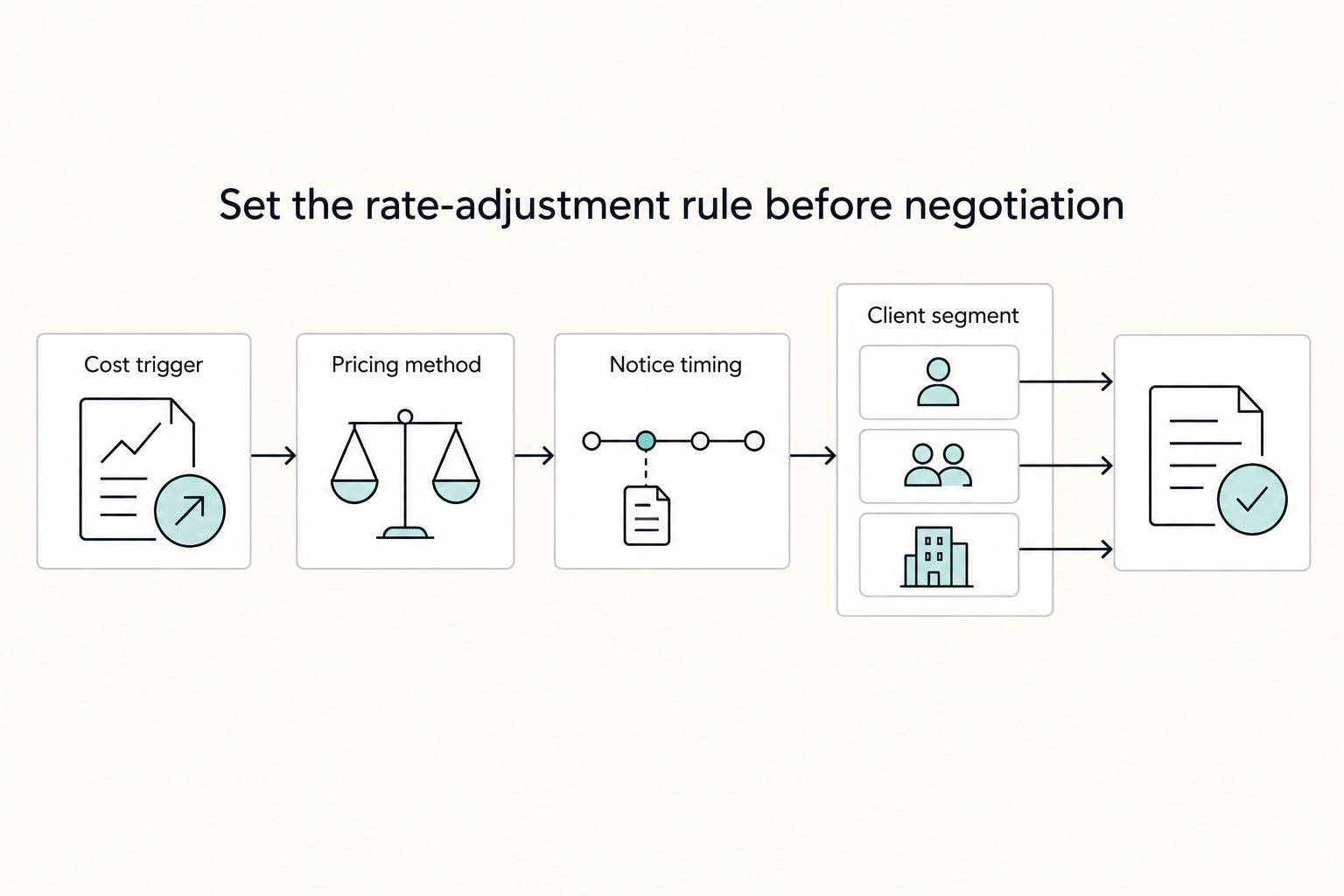
Set your rule before you start negotiating. Decide the trigger, the pricing method, and the notice sequence in advance, then apply it consistently.
Use a scheduled review, such as the annual renewal, and an earlier trigger for a material cost or scope change. A review can conclude that no increase is needed; an account staying flat for a year is a prompt to inspect the economics.
Calculate a candidate rate rather than defaulting to a 5–10% band. Start with realistic billable capacity, annual business costs and target compensation. Then check the contribution from each package and compare purchasing power over the relevant period. Inflation is one input, not an automatic entitlement to change an existing price.
If a contract uses indexation, specify the exact index series, base/reference period, review frequency, formula, publication lag, any floor or cap, and a replacement method if the series changes. BLS escalation guidance recommends unadjusted data for escalation; seasonally adjusted figures can be revised. Have the contractual wording checked for the governing jurisdiction.
Use the same communication sequence every cycle so exceptions do not creep in:
- Calculate a proposed rate and check the existing renewal or adjustment rights.
- Record the proposed amount, scope and effective date.
- Give the required notice with a brief rationale.
- Discuss the proposal and any scope alternative.
- Confirm agreed terms in writing before they apply.
Year-end can be a useful notice window because many clients are budgeting, but it is a timing choice, not a universal rule.
Keep a short decision log for each client with old rate, new rate, notice date, and final decision. That improves consistency over time.
Segment clients by margin and payment risk before repricing#
Segment clients before repricing so account actions follow evidence, not habit. A simple matrix keeps decisions consistent and limits one-off concessions.
| Segment | Typical signals | Action before repricing |
|---|---|---|
| High-margin, low-friction | Clear scope, smooth approvals, low dispute noise | Keep the account and apply gradual increases with clear notice. |
| High-margin, high-friction | Healthy contribution after costs, but repeated collection delays or scope churn | Propose clearer scope and payment terms at renewal; honor existing obligations. |
| Low-margin, low-friction | Easy delivery but limited room after costs | Calculate the increase needed for viability, reduce scope or standardize delivery. |
| Low-margin, high-friction | Thin margin plus late payment behavior and volatile scope | Propose a viable package or plan a lawful exit with required notice. |
Use it as a control tool, not a perfect formula. Broad pricing guidance can inform strategy, but your own account friction should determine how much you tighten terms.
If payment behavior and scope churn remain costly, propose stronger terms at renewal or plan a lawful exit. Honor current commitments, notice requirements and amounts already owed while you negotiate.
Review segment placement monthly so stable accounts do not drift into risk unnoticed. Track:
- Current segment versus prior segment
- Margin direction since last review
- Payment behavior changes
- Scope churn and exception requests
- Next repricing date and owner
When an account changes segment, decide which scope or billing changes to propose before promising the next engagement. Apply them by mutual agreement or under an existing valid adjustment clause; changing an internal risk tag does not change the contract.
Update contract terms at the same time as rate changes#
Update rates and terms in one package. If price changes but terms stay loose, real earnings can still erode through delayed cash flow, scope disputes, or cancellations.
For a hypothetical monthly package, an old $2,000 price less $300 direct costs and $40 collection fees leaves $1,660 before owner compensation, overhead and tax. A 5% increase to $2,100, with direct costs rising to $360 and fees to $42, leaves $1,698. That is only 2.29% more contribution. If the relevant price index also rose 5%, the contribution has purchasing power of $1,617.14 at the earlier price level ($1,698 ÷ 1.05), below the old $1,660. To preserve that contribution under these assumptions and a 2% fee, solve 0.98 × price − $360 = $1,743: about $2,145.92. This is a planning example, not a market rate or a guaranteed margin.
Send one written package that includes:
- Payment terms: invoice timing, due date, payment methods, and what counts as payment received.
- Late-payment terms: when overdue status begins, lawful charges if applicable, and the notice/remedy process.
- Cancellation terms: what is owed if the client cancels after capacity is booked or work has started.
- Deposit terms, if agreed: amount, due date, application to the price and whether funding is a kickoff condition.
- Staged invoicing, if used: each billing trigger, due date and the agreed condition for moving to the next stage.
Keep these terms in one approval thread and one contract version. Scattered approvals across email fragments are harder to track once a dispute starts.
Define included revisions, new scope and corrections already owed. A revision cap does not turn correction of your own nonconforming work into a paid change. If suspension is permitted, specify the overdue trigger, notice, cure period and effect on delivery dates; use those terms and applicable law before pausing.
Before each milestone starts, run three checks:
- Check balances against their actual due dates and any agreed funding condition.
- Check approval of prior output where the next stage depends on it; deposits and time bills have their own triggers.
- Confirm approved changes to scope, price and delivery dates.
Keep a record for each milestone with the signed agreement, approved scope, change requests, and acceptance messages. If a dispute appears, that evidence can help shorten resolution time and protect your calendar.
A client declining a deposit is not automatically high risk: procurement or agreed net terms may explain it. Assess credit, payment history and your exposure together. For a new engagement, decide whether shorter stages, a smaller commitment or a different price makes the accepted arrangement viable.
Choose billing structures that survive inflation and scope churn#
Choose billing structure by risk profile, not preference. When scope or payment behavior is unstable, use models that protect both margin and cash timing.
A fixed fee prices scope; a retainer reserves a defined service or capacity; milestone billing sets invoice timing. You can stage invoices under a fixed-price contract without transferring scope risk to the client. Retainers also need limits on capacity, deliverables and rollover.
Test an overrun separately from inflation. In the $2,100 package example, eight extra hours valued at $50 consume another $400 of planning contribution, leaving $1,298 before the other excluded costs. A price increase cannot absorb unlimited revisions. Track the actual cause and agree new scope before extra work, while correcting defects already within the original obligation.
| Billing structure | Where it fits | Main risk under cost pressure | Contract control to add |
|---|---|---|---|
| Fixed fee | Clear scope, low revision risk, short timeline | Hidden margin loss when revisions or delivery time expand | Defined scope, included revisions, owed corrections and agreed change process |
| Retainer | Ongoing demand with recurring deliverables | Capacity gets consumed if scope grows without reset | Monthly deliverables list, renewal reset clause, clear overage terms |
| Milestone billing | Defined stages under an appropriate pricing model | Timing alone does not protect against unknown scope | Actual billing triggers, stage criteria and agreed funding dependencies |
For uncertain work, start with a paid discovery stage, separately priced stages once defined, or a capped time-and-materials arrangement with approval points. Staging an unchanged fixed fee only changes cash timing. State each actual billing trigger: deposit, time worked or milestone acceptance, amount, due date and whether funding is required before the following stage.
For higher-risk new work, negotiate a smaller exposure limit, shorter billing intervals or an upfront amount. Do not retroactively require prepayment where the existing contract allows payment after delivery. Preserve evidence of the billing trigger actually agreed.
Use these red flags to decide when fixed-fee terms may no longer fit:
- Weak procurement discipline or unclear approver ownership
- Repeated urgent scope changes without budget confirmation
- Pressure to continue while overdue invoices remain open
- A client refusing a late-fee clause may still be creditworthy. Compare the enforceable terms, payment record and total financing cost rather than treating one refused clause as proof of misconduct.
Use the agreed notice and remedy process for overdue invoices. Negotiate changes for future scope and honor current delivery obligations unless a lawful suspension or termination right applies.
Prevent payment delays and reversals after invoicing#
Separate accounting revenue from available cash. Revenue may be recognized before payment under the applicable accounting method; a sent invoice is still not spendable money. Track receipt and bank availability, with returns and disputes as a separate risk overlay.
| Status | Meaning |
|---|---|
| Sent | Invoice delivered to the correct billing contact |
| Acknowledged | Receipt confirmed; approval may still be pending |
| Initiated | Client reports or provider records a payment instruction |
| Received | Payment applied against the client balance |
| Available and reconciled | Gross payment, fees and net available bank credit matched |
| Risk overlay | Track returns, refunds or disputes separately alongside all payment states |
Keep this status flow visible so delay points are easier to spot, especially when several invoices are open at once.
Plan near-term spending from available bank cash after fees, tax reserves and other commitments. Track gross invoices, payments applied, remaining receivables and net bank amounts separately. A processing fee reduces proceeds; it is not necessarily a client underpayment.
Run escalation at fixed checkpoints, not ad hoc follow-ups. Assign one owner for each unpaid invoice, move through a defined reminder sequence, and pause delivery when your contract allows.
Define who handles reconciliation and when exceptions are escalated. A clear owner model keeps reminders consistent and reduces missed follow-ups when several invoices age at once.
Keep an evidence pack for each invoice. Include:
- Authentic agreement evidence and approved scope or change record
- Evidence of the billing trigger: deposit terms, time records or milestone acceptance, as applicable
- Delivery proof with timestamps
- Invoice copy, transaction reference, and payment status history
- Full communication log
An approved $2,100 invoice paid $1,050 still leaves $1,050 receivable. If a 2% fee is deducted from that first payment, $1,029 reaches the bank; the $21 fee is an expense rather than an extra $21 debt owed by the client unless the agreement provides otherwise. Use the bank amount for cash planning and the gross payment for the client balance.
Keep reversal monitoring alongside reconciliation. Record actual refund, return or dispute notices and their deadlines; do not wait for an undefined risk-free point before recognizing that cash is currently available.
Handle country-specific compliance without slowing cashflow#
Handle compliance at deal setup, not after invoicing starts. Residency and sourcing treatment can reshape your cash plan even when billing operations look clean.
For U.S. engagements, consider federal rules and the relevant states. California is a useful example of why residence, work location and the type of income must be assessed separately.
| Compliance lever | What is grounded here | Why it affects cash timing |
|---|---|---|
| Residence | Resident, part-year and nonresident periods can affect taxable income | Unexpected tax obligations reduce disposable cash |
| Income type and sourcing | Employee wages and sole-proprietor service income can use different sourcing tests | Work outside a state does not always remove business-income exposure |
| Business allocation | Review applicable customer-benefit and apportionment rules | Avoid treating all gross receipts as the same tax base |
| Other jurisdictions | Check federal, state and country rules that actually apply | A bank location alone does not determine tax treatment |
Keep records of residence dates, travel, where work occurred and where the customer received the service benefit. The FTB nonresident guide distinguishes an employee working outside California from an independent contractor whose business services benefit a California customer.
Before you sign or renew, run this checkpoint:
- Confirm your residency position for the contract period and document the basis.
- Confirm where services will be performed, especially if location may change.
- Match contract, invoicing, and payout setup so records stay consistent.
- Save a dated evidence pack with guidance reviewed and advisor notes.
- Set a recheck trigger for travel, relocation, or entity changes.
For cross-border work, document residence, business form, income sourcing, indirect tax and invoice currency separately. Recheck when you move or change entity. Use qualified local advice for an unresolved tax position rather than treating payment through a foreign account as an answer.
Use a client communication sequence that protects relationships and margin#
Once compliance and terms are in order, the way you communicate the change strongly influences whether repricing sticks. Use one repeatable renewal sequence: clear notice, evidence-led rationale, bounded options, and prepared responses to pushback.
Lead with timing and a data-based reason#
Start with what changes and when, then explain why in plain language. Keep the rationale evidence-led: costs have moved, prior budgets stretch less, and pricing still needs to support reliable delivery.
Before you send notice, align your internal message so client-facing language stays consistent. Confirm current and proposed rates, affected scope, effective timing, and a short value frame tied to delivery quality. If this is fuzzy internally, the client conversation can drift.
Offer two bounded choices with updated payment terms#
Do not start with an open-ended negotiation. Present two options with clear boundaries:
| Option | Scope | Price | Payment terms |
|---|---|---|---|
| A | Adjusted scope | Old price | Proposed terms, subject to agreement |
| B | Same scope | New rate | Proposed terms, subject to agreement |
State the payment terms proposed with each option and obtain agreement. A proposal is not acceptance, and an internal effective date does not override an existing fixed price or notice requirement.
Script pushback before the first call#
Expect some pushback and possible client loss when rates increase. Consistency beats improvisation.
- Budget freeze: acknowledge limits, then move to reduced scope at old price with updated terms.
- Other freelancers are cheaper: refocus on deliverables and reliability, then return to the two options.
- Long net terms: explain the financing exposure and propose a viable renewal package; honor the current due dates.
After each conversation, log the notice date, selected option, accepted terms and renewal outcome. If both proposals are rejected, decide whether to retain the current arrangement, offer a smaller future engagement or end it under the agreed notice rules.
Run a pre-project risk checklist every time#
Before committing new work, confirm that the commercial terms and material legal or tax questions are resolved enough to price and deliver responsibly. Document ordinary commercial exceptions; do not use a checklist to waive mandatory obligations.
Lock the pricing and terms package first#
Record scope, price, billing triggers, due dates and payment method. Add deposits, late charges, cancellation terms or staged billing where appropriate and lawful; every engagement does not need every clause.
| Item | Verification checkpoint before start | Failure mode if skipped |
|---|---|---|
| Freelancer rates | Agreed project price and scope match the approved record | Unpaid extra work or forced discounting later |
| Deposit policy | If agreed, amount, due date and kickoff funding condition are recorded | Work starts before cash commitment |
| Late-fee clause | If used, charge and trigger are agreed and lawful | Unclear or unenforceable charges create disputes |
| Kill-fee clause | If used, lawful cancellation trigger and compensation basis are defined | Mid-project stop leaves sunk effort unpaid |
| Staged invoicing | If used, actual billing triggers, due dates and funding dependencies are defined | Cash arrives only at the end, after risk is already taken |
Check client quality and jurisdiction assumptions#
Check payment history, approval speed, scope clarity, and communication reliability before you commit capacity.
California residents generally report worldwide income; nonresidents report California-source income, and part-year residents combine the relevant periods. Employee wage sourcing commonly depends on where work is performed. For a nonresident sole proprietor providing services, business income can depend on where the customer receives the benefit, including work performed outside California. The FTB explains market-based sourcing and apportionment; do not apply the employee location test to every freelancer.
Other states and countries have their own residence, sourcing and registration rules. Verify those that actually apply to the engagement instead of importing California rules. Set aside tax based on the reviewed position, not simply the location of the bank account.
Set a go or no-go rule before work starts#
- Go only when terms are complete, jurisdiction assumptions are documented, and client signals are acceptable.
- Redesign when scope is accepted but core protections are resisted, by reducing scope, shortening term, or increasing upfront cash.
- No-go when basic protections are refused and the client still asks for immediate start.
Name who can approve a commercial exception and document the exposure, mitigation and review date. An internal approval cannot waive a mandatory legal duty.
Archive the final contract, checklist, approval trail, and dated jurisdiction notes for every signed deal. Then Try the free invoice generator for the next renewal cycle.
Conclusion#
Inflation resilience can depend on pairing defensible pricing with enforceable payment terms. Rate changes alone may not be enough when payment timing and risk controls stay loose.
A rate review succeeds when it improves sustainable economics, not simply when a client accepts a higher invoice. Compare contribution, actual hours, purchasing power and available cash before and after the renewal.
Keep the execution order simple: set your repricing rule, segment clients by margin and payment risk, update contract terms, run the pre-project checklist, then negotiate renewals. This sequence keeps decisions comparable across accounts and can limit ad hoc concessions.
Apply the sequence to your next three renewals before rolling changes portfolio-wide:
- Use the same renewal steps and timing for each client.
- Log old rate, new rate, notice date, accepted or rejected terms, and final outcome.
- Review the three outcomes and adjust only where your own data supports a change.
For teams scaling cross-border collections and payouts, evaluate tools that improve record traceability, policy gates, and payment-status visibility where supported. If you need a country-specific check, Talk to Gruv.
Frequently Asked Questions
How does inflation affect freelancer rates in practice?
Inflation lowers what an unchanged nominal rate can buy. Compare the same official price index over the relevant period, then check your own costs and billable capacity. In the hypothetical example, a $100 rate needs to reach $105 to preserve purchasing power when the price level rises 5%, before costs and tax.
How much should I raise rates if there is no reliable cross-industry benchmark?
Build a cost floor and compare equivalent scope. An inflation-matching increase may still be insufficient when your direct costs or unpaid hours rise faster. Calculate contribution and a realistic billable-capacity rate, then propose a viable price at renewal or under an agreed adjustment clause.
Can I raise rates without losing clients, and what predicts acceptance?
Client acceptance is uncertain. Explain the specific scope, new price and timing, and offer reduced scope at the old price where viable. Track acceptance and contribution across a few renewals; do not count retained revenue alone as success if the work remains unprofitable.
Should I change payment terms first or pricing first?
Review both together. Price addresses the economics of work; payment terms address when you can use the money and the exposure you carry. Obtain agreement before applying new terms, and follow the existing contract for work already committed.
What is the minimum contract package I need to reduce delay and dispute risk?
At minimum, document parties, scope, price, the actual billing trigger, due date, payment method and who can approve changes. Include delivery and acceptance criteria where relevant, and lawful remedies for delays. Deposits, late charges and cancellation fees are optional tools rather than universal requirements.
Watch
How Freelancers Should Raise Rates During Inflation
Try a related tool
Researched and edited by the Gruv editorial team. Gruv builds cross-border billing, payouts, and finance-operations software for global businesses.
Sources
Educational content only. Not legal, tax, or financial advice.
Related Posts
How to Calculate a Freelance Rate You Can Actually Get Paid On
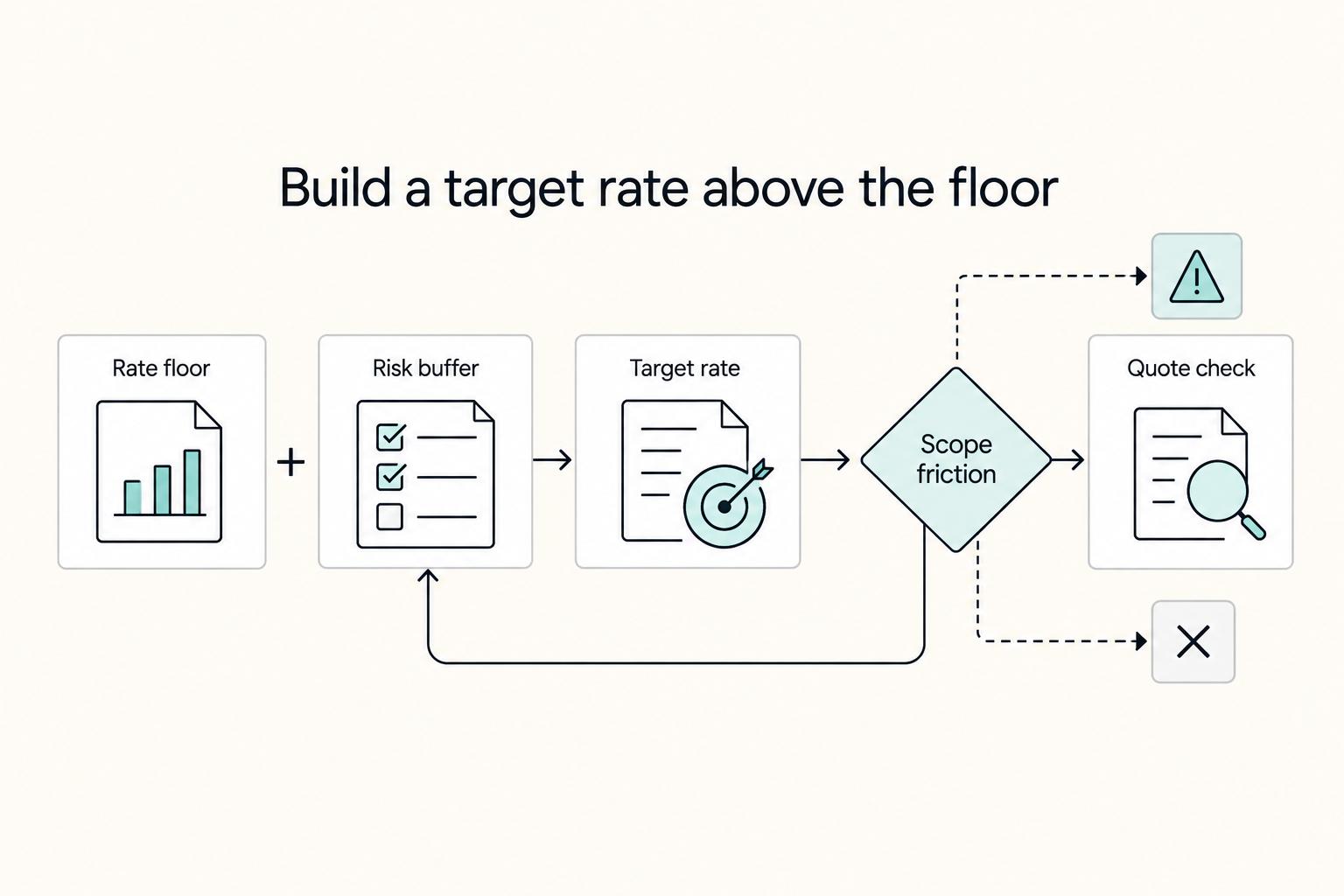
A workable rate is not the neat number a calculator produces. It is the number that still works after you account for real billable capacity, non-client time, scope drift, and the gap between sending an invoice and receiving cleared cash. Start with hourly math even if you do not plan to bill hourly, then turn that number into a quote with clear `payment terms`.
Tax Residency in the UAE Under the 90-Day and 183-Day Rules
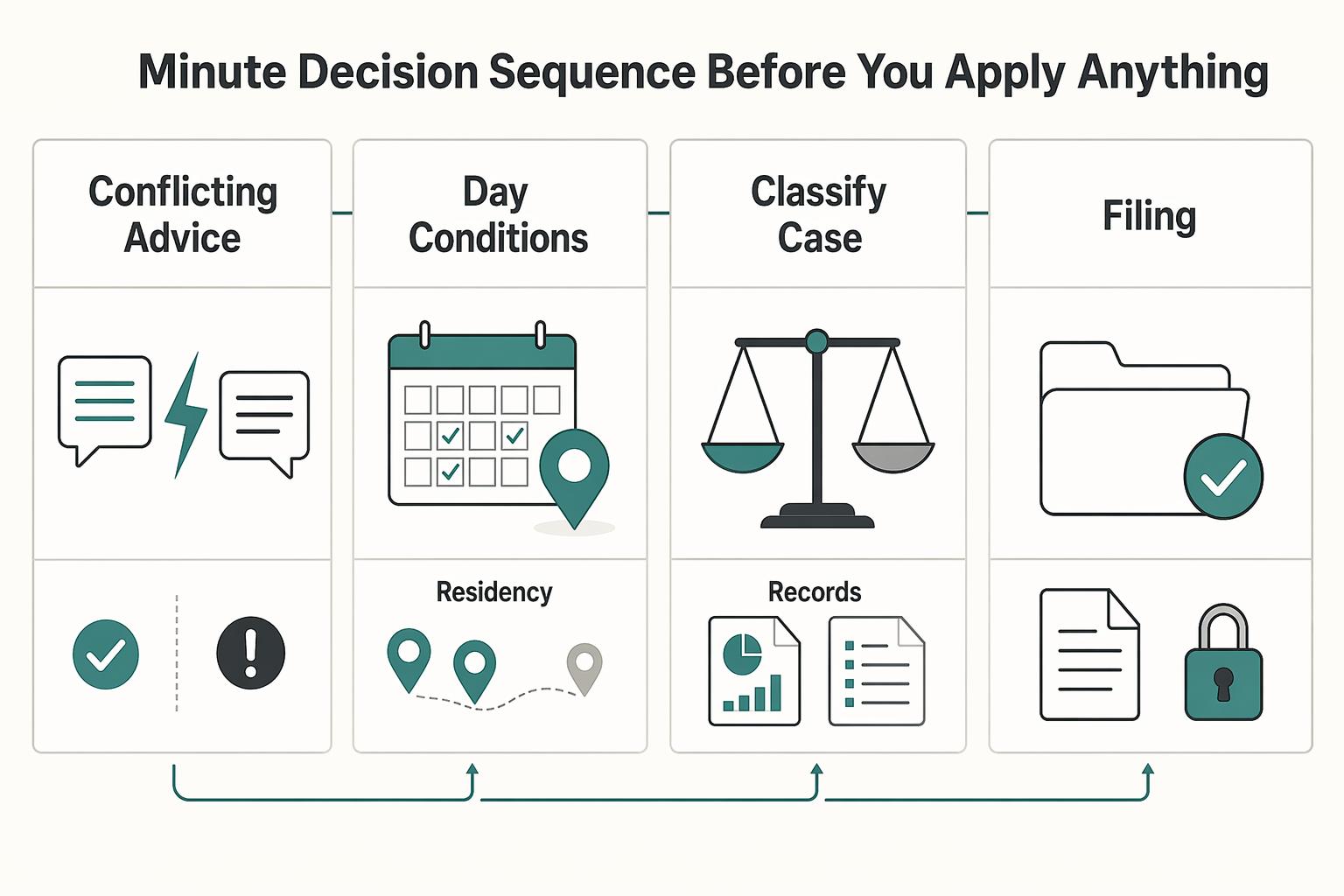
Choose your route before you collect documents. For UAE tax residency, this is a compliance decision, not a paperwork task: one route, one consecutive 12-month period, and one fact pattern you can prove. Use these terms as controls:

The Freelance Payment Penalty: A Modeled Audit of Platform Fees, FX Spreads, and Payout Delays
The money rarely disappears through a single, easy-to-spot fee. The real loss is stacked. A marketplace takes its commission, a processor adds a charge for international cards, a bank or payment company converts the currency at a spread, a platform holds the funds before release, and a wire sheds a little to intermediaries on the way in. Each layer looks defensible on its own, but the worker feels the combined result as a smaller deposit and a later payday.