
Quick Answer
Start by treating Thought Leadership as an operating system, not a posting habit. Document what is public versus proprietary, publish from one pillar-and-splinter source, and move prospects through a fixed handoff from intake to scoped proposal to contract and invoice. That sequence helps you attract right-fit buyers, reduce scope drift, and protect pre-existing methodology while still teaching useful ideas in public.
The Three Stages From Expertise to a Client Pipeline#
If you work alone or with a very small team, the question is not how to post more. It is how to share enough expertise to attract the right clients and turn audience growth into paid work.
For a business-of-one, authority only matters when it helps you become the go-to resource for a specific problem and turns that trust into a real pipeline. The goal is not broad reach. It is a small base of right-fit buyers who trust how you think, come back when the problem repeats, and refer peers who need the same kind of help.
Big-company content programs can optimize for reach, polish, and internal approvals. You need something narrower and more practical: clear ownership of your method, content that helps qualify leads, and a path from public insight to contract-ready delivery. This three-stage structure is built to give you that sequence, not to promise certainty.
- Stage 1: protect the asset.
Before you publish, you should be able to point to a defined method, point of view, or approach that is clearly yours. The checkpoint is simple. Can you describe what is proprietary, what you are willing to teach publicly, and what stays inside paid work? If not, posting more usually weakens your position.
- Stage 2: publish from one strong source.
Here the practical output is a single piece of pillar content that can be reused into smaller assets. The checkpoint is whether one anchor idea can produce several useful posts without drifting off niche. If every post sounds unrelated, your topic is still too broad or your perspective is not specific enough yet.
- Stage 3: convert without improvising.
The outcome is a clean handoff from audience attention to a serious buying conversation. A prospect should be able to understand what you do, why your method is distinct, and what working together looks like before you are deep in custom explanations. If every lead still needs a from-scratch sales conversation, your content is informing people but not qualifying them.
A common failure mode is not bad content. It is stalling between concept and execution. The fix is boring but effective: decide the niche problem first, then build outward. If you cannot finish the sentence "I help this kind of client solve this kind of problem with this specific perspective," do not move to Stage 2 yet.
Before Stage 1, prepare a small evidence pack: past proposals or scopes, repeated client questions, examples of deliverables, and notes on where projects usually go off track. Those materials help you separate your reusable method from custom client work, which is the core decision this article builds on. The next sections turn each stage into concrete choices you can adapt to your own practice.
You might also find this useful: The Best Paid Advertising Channels for Freelancers (Google Ads, LinkedIn Ads, Facebook Ads).
Stage 1: Before You Post Anything, Fortify Your Core Asset - Your IP#
Before you publish, decide exactly what you teach in public and what stays inside paid delivery. If you skip this step, your content can blur your boundaries instead of strengthening your position.
Your niche explains who you help. Your method explains how you solve the problem. Stage 1 is about documenting that method clearly enough that you can share insight without giving away the parts you monetize.
Defensibility Audit#
Run this mini-checklist before drafting:
- Define method boundaries. List what you will teach openly, what you will summarize only at a high level, and what stays private (for example: internal templates, decision logic, prompts, exception handling).
- Document the creation trail. Keep dated notes, draft diagrams, revision history, and sanitized examples that show how your method developed.
- Store version history. Keep versions in one place with clear dates or changelog entries so the timeline is easy to follow.
- Separate private and public assets. Maintain one private delivery playbook and one public teaching set for posts, talks, and lead magnets.
A useful structure is to separate terms and definitions, agreement artifacts, and forms into distinct buckets. That forces cleaner boundaries before you publish.
| Asset | Share publicly | Keep proprietary | Primary outcome |
|---|---|---|---|
| Point of view, principles, core definitions | Yes | No | Builds trust and helps right-fit people self-qualify |
| Sanitized examples and common mistakes | Yes | No | Demonstrates expertise without exposing full delivery logic |
| Diagnostic flow and decision criteria | Limited summary | Yes | Protects the judgment layer clients pay for |
| Internal templates, prompts, checklists, exception paths | No | Yes | Preserves reusable delivery assets |
Selective transparency is the practical version of the true-fans idea: share enough for the right people to trust your approach, while keeping your core method intact.
| Protection area | What to do now | Working note |
|---|---|---|
| Public assets | Add your method name and ownership notice to public diagrams/PDFs | Keep wording consistent across assets |
| Contract structure | Separate pre-existing materials from project deliverables | Confirm current clause wording with qualified legal counsel |
| Document handling | Share sensitive information only on official, secure websites | Confirm .gov and HTTPS before upload |
Before moving to Stage 2, confirm three answers: what your method is called, what stays private, and what records show how the method evolved. Once those are clear, publishing becomes a controlled lead-generation system instead of improvisation.
For a step-by-step walkthrough, see The Best Personal Productivity Systems for Freelancers (GTD, PARA).
Stage 2: The ROI-Driven Content System: Generate High-Value Leads in Four Hours a Month#
Once your method boundaries are set, your content system should optimize for business value, not output volume. Your goal is to publish clear proof that helps the right buyer, referrer, or collaborator recognize fit and take the next step.
That is the ROI test in practice: not whether content looks credible, but whether credibility turns into qualified opportunities. If you only track reach or impressions, you can miss weak-fit inquiries, low-quality calls, and stalled proposals.
Pick for fit, not for volume#
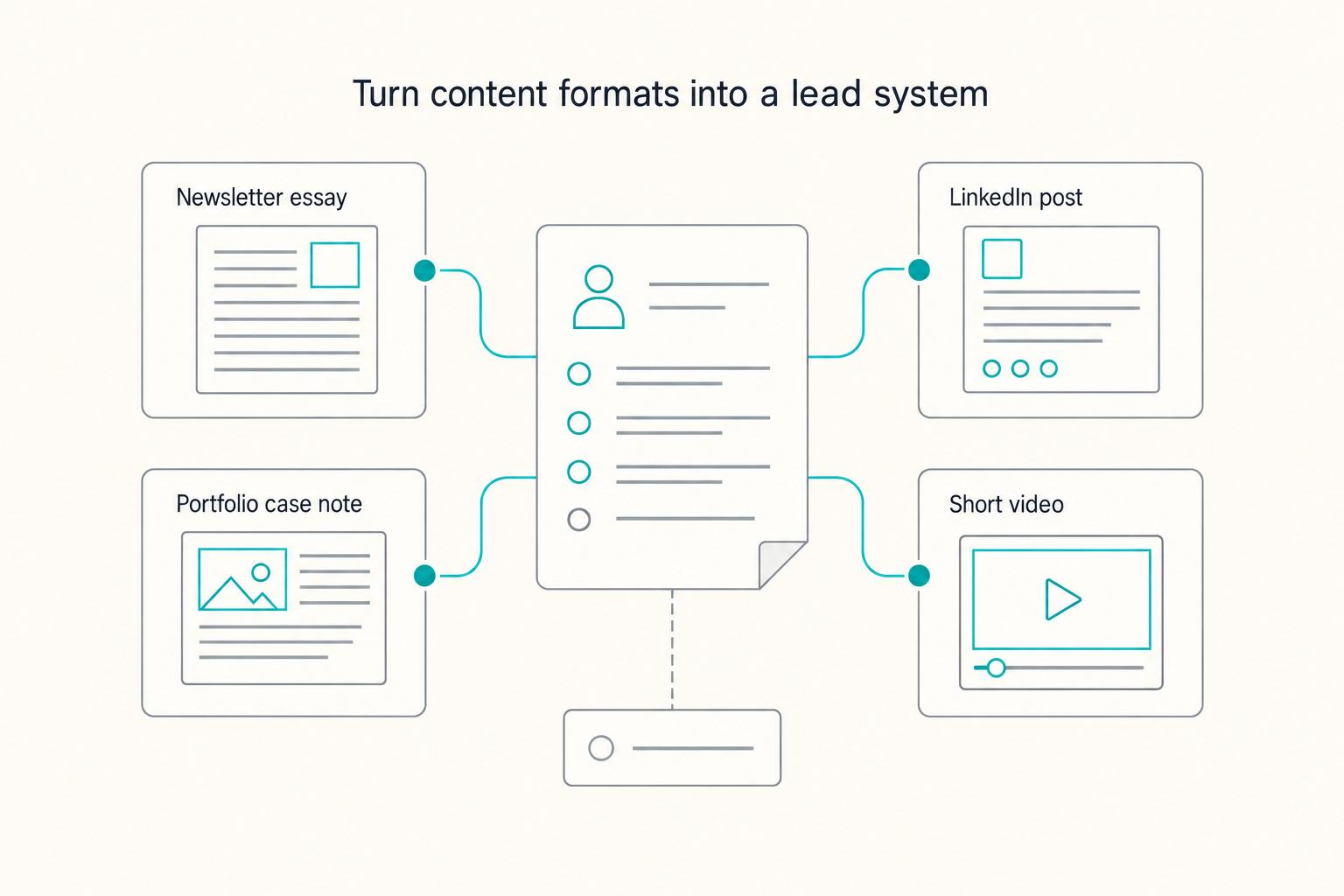
Use a capacity-based plan, not a rigid cadence. Keep one primary channel and one primary format, chosen for two things: where your buyers evaluate expertise, and what you can sustain alongside delivery work.
Use this as a planning table, then adapt it to your market and bandwidth:
| Channel and format | Buyer intent it supports | Production effort | Conversion path to watch |
|---|---|---|---|
| Newsletter essay | Deeper evaluation before contact | Medium | Reply or call request after reading |
| LinkedIn post or carousel | Fast credibility checks by buyers and referrers | Low to medium | Profile visit, DM, referral intro, then scoped call |
| Portfolio case note | Proof of process and judgment | Medium | Case-note read, related-work review, then inquiry |
| Short video | Quick trust signal through voice and explanation | Medium | Profile/site click, then inquiry or call |
Run a Pillar-and-Splinter workflow so you are not starting from zero each time. Build one substantial asset from a real client pattern, recurring objection, or repeated mistake in your niche, then split it into focused pieces. Keep each piece useful on its own while protecting the private parts of your method from Stage 1.
Measure what buyers do next#
Track outcomes that show informed decision-making and movement toward revenue, then review monthly or quarterly:
| Outcome | Benchmark note | Notes field |
|---|---|---|
| Qualified inquiries received | Current benchmark pending source/business-data verification | Where the inquiry came from, which asset they referenced, and whether they already understood your method before the call |
| Conversion from inquiry to scoped call | Current benchmark pending source/business-data verification | Where the inquiry came from, which asset they referenced, and whether they already understood your method before the call |
| Proposal acceptance trend | Current benchmark pending source/business-data verification | Where the inquiry came from, which asset they referenced, and whether they already understood your method before the call |
| Revenue quality (project size, margin, payment reliability, repeat work) | Current benchmark pending source/business-data verification | Where the inquiry came from, which asset they referenced, and whether they already understood your method before the call |
- Qualified inquiries received: current benchmark pending source/business-data verification
- Conversion from inquiry to scoped call: current benchmark pending source/business-data verification
- Proposal acceptance trend: current benchmark pending source/business-data verification
- Revenue quality (project size, margin, payment reliability, repeat work): current benchmark pending source/business-data verification
Add a notes field for source and context: where the inquiry came from, which asset they referenced, and whether they already understood your method before the call. This is how you separate useful trust-building assets from content that only generates attention.
This is the practical version of the 1,000 true fans idea for professional services: a small, niche-specific body of work can compound into repeat buyers, referrals, and collaborator introductions. Treat each published piece as an asset by logging topic, publish date, call to action, and resulting inquiry, then carry that record into Stage 3 to convert trust into contract-ready opportunities.
If you want a deeper dive, read A freelancer's guide to 'Thinking, Fast and Slow'.
Stage 3: From Public Insight to Paid Invoice: The Compliant Conversion Pathway#
Turn interest into revenue with a clear four-step path: vet fit, scope the work in your framework, protect your IP in the contract, and invoice in a way accounting can approve quickly. If any step is vague, you are more likely to see scope drift, unpaid advisory time, IP confusion, or payment delays.
This is the handoff from trust to transaction. People who find you through your ideas should meet the same clarity when they become buyers.
Vet before you book the call#
Use intake to qualify, not just to collect interest. A useful diligence standard is whether you understand the requirement well enough to produce a complete, responsive proposal instead of a generic pitch. AFARS Chapter 5 (effective 07/11/2025) frames due diligence this way; it is not private-sector contract law, but it is a practical discipline for your process.
| Intake area | Included items |
|---|---|
| Fit criteria | Clear business problem, affected team or audience, decision-maker, timeline, and the specific piece of your content that led them to you |
| Disqualifiers | Asks for free diagnosis before scope, wants to buy your method itself, cannot identify an approver, or keeps the brief too broad for a complete proposal |
| Readiness signals | References your framework accurately, explains what they already tried, and names the main internal constraint (time, approvals, or implementation capacity) |
Ask for a short intake pack before discovery:
- Fit criteria: clear business problem, affected team or audience, decision-maker, timeline, and the specific piece of your content that led them to you.
- Disqualifiers: asks for free diagnosis before scope, wants to buy your method itself, cannot identify an approver, or keeps the brief too broad for a complete proposal.
- Readiness signals: references your framework accurately, explains what they already tried, and names the main internal constraint (time, approvals, or implementation capacity).
Use one gating check: if you cannot restate the assignment in one tight paragraph after intake, do not quote yet.
Propose the work in a way that controls the work#
A framework-based proposal usually gives the buyer more confidence and gives you cleaner scope control than a generic service list.
| Proposal style | Buyer confidence | Scope control | Delivery accountability |
|---|---|---|---|
| Generic service list | Sees activities, but may not see decision logic | Extra requests can blur into baseline scope | Outputs and review points are often loosely defined |
| Framework-based scope | Sees sequence, purpose, and expected outcomes by stage | Out-of-scope requests are easier to flag against named stages | Checkpoints, approvals, and client inputs are explicit |
Keep the proposal concise but specific: problem, scope, exclusions, assumptions, client responsibilities, deliverables, timeline, price, and acceptance steps. If requirements are still unclear, run diligence checkpoints first (for example, a one-on-one working session, pre-proposal conference, or site-style review) before final pricing.
Protect your IP and invoice like a professional operation#
Separate contract components so ownership and use are unambiguous:
| Checkpoint | Details |
|---|---|
| Pre-existing methodology | Your process, naming, templates, and know-how from before the engagement, with clause wording to confirm with qualified legal counsel. |
| Client deliverables | The specific outputs the client is buying in this project. |
| Usage rights | What the client can use, where, for how long, and whether edits, sublicensing, or transfer are allowed, with clause wording to confirm with qualified legal counsel. |
| Escalation to legal review | Trigger review if terms request ownership of your pre-existing method, broad indemnities, or reuse rights beyond project scope. |
| Required invoice fields | Legal seller name, legal buyer name, billing address, invoice number, issue date, scope-matching service description, currency, and payment terms. Confirm any jurisdiction-specific tax fields or registration details with the relevant tax authority. |
| Tax-treatment checkpoint | Confirm whether tax applies, whether a special treatment or exemption is used, and what exact note is required on the invoice; confirm the specific requirement details with the relevant tax authority. |
| Documentation handoff | Attach or retain the signed proposal or SOW, any PO, vendor onboarding forms, relevant tax documents, and AP contact details. |
- Pre-existing methodology: your process, naming, templates, and know-how from before the engagement, with clause wording to confirm with qualified legal counsel.
- Client deliverables: the specific outputs the client is buying in this project.
- Usage rights: what the client can use, where, for how long, and whether edits, sublicensing, or transfer are allowed, with clause wording to confirm with qualified legal counsel.
- Escalation to legal review: trigger review if terms request ownership of your pre-existing method, broad indemnities, or reuse rights beyond project scope.
If you use AI to draft scopes, proposals, or clauses, verify every defined term and ownership line manually. NIST AI 600-1 (approved 07-25-2024) explicitly flags confabulation, information integrity, and intellectual property risk, so this is a control step, not a formatting step.
Run one repeatable invoicing workflow before sending:
- Required invoice fields: legal seller name, legal buyer name, billing address, invoice number, issue date, scope-matching service description, currency, and payment terms. Confirm any jurisdiction-specific tax fields or registration details with the relevant tax authority.
- Tax-treatment checkpoint: confirm whether tax applies, whether a special treatment or exemption is used, and what exact note is required on the invoice; confirm the specific requirement details with the relevant tax authority.
- Documentation handoff: attach or retain the signed proposal or SOW, any PO, vendor onboarding forms, relevant tax documents, and AP contact details.
This is where true-fans momentum becomes business durability. Your strongest audience members become repeat buyers and referrers when the path from "I trust your thinking" to "we approved and paid" is clear, professional, and compliant. Related: The Best Paid Advertising Channels for Freelancers (Google Ads, LinkedIn Ads, Facebook Ads).
Your Expertise Is Your Business - Treat It That Way#
Treat your expertise as an operating asset: define it, run it with oversight, and carry it consistently from content to commercial handoff.
| Area | Service Provider Mode | Asset Owner Mode |
|---|---|---|
| Control | Client largely defines the approach | You define the method and its boundaries |
| Pricing power | Mostly tied to hours and custom scope | Easier to price around a distinct approach and defined outcome |
| Client fit | More general inquiries, weaker filtering | Better filtering because your public ideas attract buyers who already fit |
| Reuse of methodology | Your process gets rebuilt or informally handed over | Your method stays pre-existing material you can reuse |
Fortify#
Action: document your method privately and mark what is pre-existing material versus client deliverables. Expected outcome: clearer ownership boundaries and a more consistent offer. Common mistake to avoid: publishing or proposing before those boundaries are written down.
Engineer#
Action: assign clear oversight across idea development, packaging, and audience attraction, then review programs as continue, initiate, or axe. Expected outcome: a repeatable workflow instead of ad hoc posting. Common mistake to avoid: spreading effort evenly across everything; weak performance in the most important roles will bottleneck results, even with more output. If capacity is tight, stack roles deliberately or use contractor support.
Convert#
Action: carry the same named method through proposal, contract, and invoice handoff. Expected outcome: cleaner execution from first interest to paid work. Common mistake to avoid: sending final commercial documents before core admin fields are confirmed.
Do this next:
- Name your method and write a one-page boundary note for pre-existing materials.
- Mark each active content program: continue, initiate, or axe.
- Add one plain-language proposal section that explains your method and boundaries.
- Add intake fields for legal name, billing contact, currency, and payment terms.
- Add a compliance-requirement verification line to your invoice checklist.
We covered this in detail in The Best Personal Productivity Systems for Freelancers (GTD, PARA).
Frequently Asked Questions
Do you need a completely original idea for Thought Leadership to work?
No. The practical test is whether you become an informed, trusted go-to person in a defined field, and that can include being uniquely helpful with ideas others already discuss. Before you publish, write three lines: your message, your methods, and what the audience will gain from that specific piece.
How much content do you need to publish before this starts helping the business?
There is no supported threshold here, so do not plan around a magic post count or timeline. What matters is regular visibility on one topic. If people do not hear from you consistently, they are unlikely to connect you with that problem. Keep a simple publishing log and check it against the 6 Ms: message, methods, masses, motive, messenger, movement.
Should you aim for broad audience attention or right-fit true fans?
Use audience fit as the checkpoint: be clear about who the content is for and what they gain from each piece, then judge success by whether that audience is the one engaging.
How do you share useful ideas without giving away your IP?
There are no settled legal rules here on IP ownership or contract boundaries. A practical middle ground is to share useful ideas publicly while keeping deeper internal process details private, then get qualified legal guidance on ownership terms before signing agreements.
What should you check before turning interest into a proposal or cross-border invoice?
There is no single specific proposal, invoicing, or cross-border compliance checklist to rely on here. Before sending either, confirm scope and administrative requirements with the buyer and verify any tax or legal requirements with the appropriate advisor.
Try a related tool
Researched and edited by the Gruv editorial team. Gruv builds cross-border billing, payouts, and finance-operations software for global businesses.
Sources
Includes 3 external sources outside the trusted-domain allowlist.
- acquisition.gov/afars/chapter-5-definitionstrusted
- govinfo.gov/content/pkg/CHRG-118hhrg53287/html/CHRG-118h...trusted
- nvlpubs.nist.gov/nistpubs/ai/NIST.AI.600-1.pdftrusted
- nvlpubs.nist.gov/nistpubs/SpecialPublications/NIST.SP.800-53r...trusted
- iresearchservices.com/blog/the-roi-of-thought-leadership-content-m...external
- postline.ai/blog/2/thought-leadership-content-examplesexternal
- scribetribe.media/dear-thought-leader-2-frequently-asked-quest...external
Educational content only. Not legal, tax, or financial advice.
Related Posts

The Freelance Payment Penalty: A Modeled Audit of Platform Fees, FX Spreads, and Payout Delays
The money rarely disappears through a single, easy-to-spot fee. The real loss is stacked. A marketplace takes its commission, a processor adds a charge for international cards, a bank or payment company converts the currency at a spread, a platform holds the funds before release, and a wire sheds a little to intermediaries on the way in. Each layer looks defensible on its own, but the worker feels the combined result as a smaller deposit and a later payday.

How to Respond to a Subpoena for Business Records
Move fast, but do not produce records on instinct. If you need to **respond to a subpoena for business records**, your immediate job is to control deadlines, preserve records, and make any later production defensible.

A US Expat's Guide to Investing in UCITS ETFs to Avoid PFIC Issues
The real problem is a two-system conflict. U.S. tax treatment can punish the wrong fund choice, while local product-access constraints can block the funds you want to buy in the first place. For **us expat ucits etfs**, the practical question is not "Which product is best?" It is "What can I access, report, and keep doing every year without guessing?" Use this four-part filter before any trade: