
Quick Answer
Choose one primary channel, assign one secondary test lane, and keep spend flat until a single conversion action passes a live test click. For freelancer paid advertising, launch readiness means the ad promise matches the landing headline and form ask, and one admin-level owner controls access, billing visibility, and approvals. If any of those controls are missing, fix them before tuning Google Ads, LinkedIn Ads, or Facebook Ads.
Before You Launch Paid Ads, Is Your Setup Complete?#
No. Do not launch paid ads yet if any of these are missing: one defined conversion action, a click path that keeps the same promise from ad to page, and a named owner for tracking, access, and approvals. Channel choice matters, but weak setup will make Google Ads, LinkedIn Ads, and Facebook Ads all look worse than they are.
| Area | Pre-launch checks you can verify now | Live learning signals you can judge only after spend starts |
|---|---|---|
| Audience fit | Google Ads: confirm the search intent you want to capture and choose keyword match settings based on how tightly queries should align. LinkedIn Ads: define the professional traits you want to target. Facebook Ads: set detailed targeting with explicit include or exclude rules for demographics, interests, or behaviors. | Are the people arriving the right buyers, and do qualified leads come in at an acceptable cost on that platform? |
| Conversion tracking | Google Ads: name one conversion action, meaning a business-valuable action such as a form submission or phone call. LinkedIn Ads: make sure the LinkedIn Insight Tag is installed if you need website conversion tracking. Facebook Ads: separate on-ad actions like clicks from downstream outcomes like website leads or conversions. | Which channel produces the best conversion rate, cost per conversion, and lead quality once real traffic hits the page? |
| Click to page continuity | Google Ads: your landing page and display URL must share the same domain, and the destination should be functional and easy to handle. LinkedIn Ads and Facebook Ads: the same offer, claim, and next step should appear on the page you send people to. | Does tighter message continuity improve conversion rate enough to justify more budget? |
| Governance | Name one admin-level owner, one approver for claims and creative, and one review point before launch. On LinkedIn, account permissions are role-based, so access should be auditable. | Does the account stay stable enough to learn, or are you making too many changes to tell what worked? |
Write one clear buyer sentence first#
Before you touch budgets, fill in this line: I help [specific audience] solve [specific problem] by getting them to [single next action]. Example: I help in-house SaaS marketers reduce wasted search spend by getting them to request a campaign teardown.
That sentence needs to hold up across platforms. Google Search can capture people actively searching for a service. LinkedIn can narrow by professional demographics. Facebook Ads can include or exclude by demographics, interests, and behaviors. If your sentence is vague, all three platforms will amplify the same vagueness.
Use a simple self-test. If someone reads your ad draft for five seconds, can they tell who it is for, what pain you solve, and what happens next? If not, stop there and tighten the offer before you buy clicks.
Keep the promise intact after the click#
Early underperformance often comes from continuity problems, not just targeting. Before you spend, check each ad and landing-page pair against the same standard:
- Ad promise: what exact result, offer, or next step did you mention?
- Landing headline: does the first headline repeat that same promise in plain language?
- Proof element: what evidence sits near the headline, such as a case example, result screenshot, a client logo you have permission to use, or a testimonial you are allowed to use?
- Form intent: does the form ask for the same commitment you advertised, not a bigger one?
- Next action: is the post-form step clear?
- Policy check: have you verified any performance claim, guarantee language, or comparative claim against platform policy and your own substantiation file?
One common failure mode is advertising a free audit, then sending the click to a generic services page with a broad contact form. That breaks trust fast. It also creates noise, because poor conversion rate may come from the page, not the channel.
Know which metrics diagnose and which metrics decide#
Do not confuse attention signals with business results. CTR is clicks ÷ impressions. A result like 5 clicks from 100 impressions equals 5% CTR, which can help you judge whether the ad is getting attention. Google Ads Quality Score is a 1 to 10 diagnostic at keyword level, and Google explicitly says it is not a KPI. Treat impressions, CTR, and Quality Score as hints, not business proof.
| Metric | Category | Article guidance |
|---|---|---|
| Impressions | Diagnostic | Treat as hints, not business proof |
| CTR | Diagnostic | Clicks ÷ impressions; can help you judge whether the ad is getting attention |
| Quality Score | Diagnostic | Google Ads 1 to 10 diagnostic at keyword level; not a KPI |
| Conversion rate | Decision | One of the stricter decision metrics |
| Cost per conversion | Decision | One of the stricter decision metrics |
| Qualified inquiry rate | Decision | One of the stricter decision metrics |
| Conversion value per cost | Decision | Belongs here if you can reliably assign value |
Your decision metrics are stricter: conversion rate, cost per conversion, and qualified inquiry rate. If you can reliably assign value, conversion value per cost also belongs here. If signals conflict, use this rule: When diagnostic metrics improve but qualified inquiries do not meet the threshold verified from ad account records, or cost per qualified inquiry rises above the verified ceiling, hold budget flat. Fix message match, targeting, or intake before scaling.
Before launch, make sure you can check every box below. If any line is blank, you are not ready for paid traffic yet.
- One conversion action is named and documented
- Tracking was tested live and the test owner is recorded
- One person owns account access, billing visibility, and pause authority
- Every ad claim has backup saved before launch
- Your team agrees on what counts as a qualified inquiry
- Approval flow for copy, claims, and page edits is written down
- Review date, spend checkpoint, and pause rule are set
If you want a deeper dive, read The Best Paid Advertising Channels for Freelancers.
Build an Acquisition Engine That Pre-Qualifies, Not Just Attracts#
Build your acquisition path to filter out bad-fit buyers before they reach your calendar. If you cannot name the first point where a low-fit lead should self-select out, hold launch. For paid acquisition, treat qualified inquiries at an acceptable cost-per-acquisition as the decision signal, not raw lead count.
Set channel choice as a test sequence, not a preference:
- Choose one primary channel for your strongest hypothesis.
- Choose one secondary test lane for a different hypothesis.
- Define one success event that matters to the business.
- Keep budget flat until you have a verified performance threshold from ad account records and results clear it.
| Platform | Intent type | Targeting precision | Creative burden | Sales-cycle fit | Earliest disqualifying signal |
|---|---|---|---|---|---|
| Google Ads | Write the exact intent you expect to capture | List the targeting controls you must verify before launch | Note what must be clear in the ad and page copy for this to work | State whether this fits your real buying timeline | Name the first low-fit pattern that pauses spend |
| LinkedIn Ads | Write the exact intent you expect to capture | List the targeting controls you must verify before launch | Note what must be clear in the ad and page copy for this to work | State whether this fits your real buying timeline | Name the first low-fit pattern that pauses spend |
| Facebook Ads | Write the exact intent you expect to capture | List the targeting controls you must verify before launch | Note what must be clear in the ad and page copy for this to work | State whether this fits your real buying timeline | Name the first low-fit pattern that pauses spend |
Run pre-qualification checks across the full path before spend:
- Ad (pass/fail): Pass if the right buyer can identify themselves and the wrong buyer can opt out quickly. Fail if the message invites broad curiosity.
- Page (pass/fail): Pass if the headline repeats the ad promise and places proof near it. Fail if the click lands on a generic services page.
- Form (pass/fail): Pass if questions screen for fit (need, timeline, decision role). Fail if anyone can submit without revealing fit.
- Handoff (pass/fail): Pass if one owner is named with clear outcomes (book, follow up, or decline). Fail if ownership or next step is unclear.
Protect your learning with basic operating discipline. If key work depends on one person and they are unavailable, lead flow can stall. Use written ownership, review points, and pause rules the same way you would use performance contracts and reporting structures.
Before launch, run a four-part substantiation check on every ad and landing-page claim: evidence source, permission status, approval owner, policy check. If any field is blank, remove the claim or rewrite it conservatively.
You might also find this useful: How to Get Paid in Crypto as a Freelancer (and Manage the Risks).
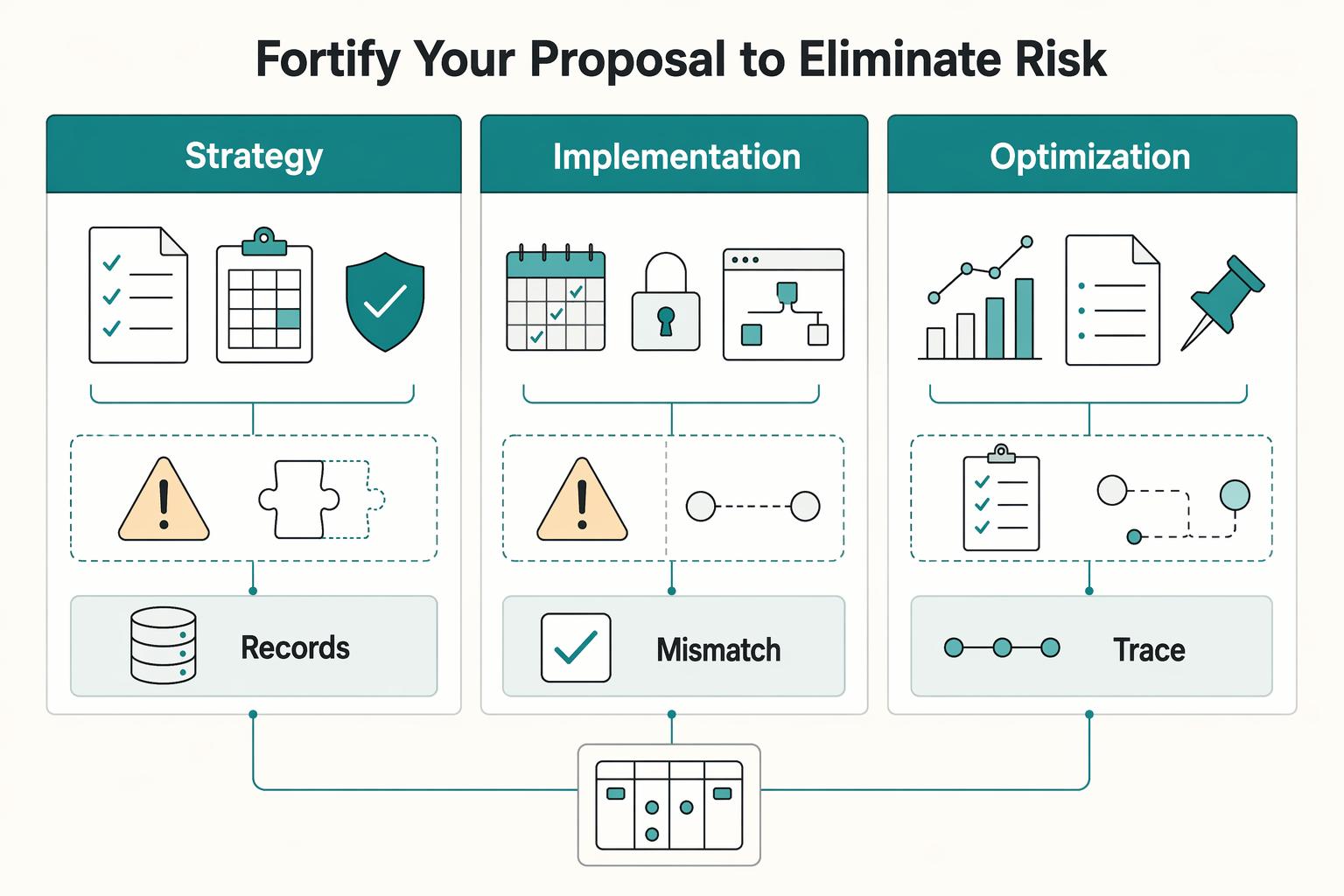
The Deal Shield: Fortify Your Proposal to Eliminate Risk#
If your proposal is vague, unpaid scope expansion can start before the first campaign. Treat the proposal as a risk-control document: define the work, the client dependencies, and the conditions that stop launch.
| Workstream | Owner | Required client dependency | Acceptance criteria | Launch gate |
|---|---|---|---|---|
| Strategy | You draft; client approves | Offer, audience, success event, named decision-maker | Brief approved in writing | No spend until the brief and approver are confirmed |
| Implementation | You build; client provides access and assets | Account/admin access, billing contact, landing page owner, creative files | Tracking, assets, and approvals are complete | No launch until access and approvals are in place |
| Optimization | You recommend; client decides | Reporting contact, decision cadence, budget-change authority | Review rhythm and decision rights are documented | No budget changes until the review path is agreed |
Run all scope changes through one central task system rather than email threads. Trello or Asana can handle this, and Asana's free plan is listed for up to 15 users. Use the same mini-workflow every time:
- Create an intake record for the request.
- Classify it as in-scope or out-of-scope.
- Add a short impact statement (timeline, budget, dependencies).
- Send a repricing path when needed.
- Start work only after written approval is attached to the record.
That workflow protects delivery quality and margin. Weak workflow control is where missed priorities, deadline slips, and scope creep usually start.
In your proposal, state ad-channel operating clauses in plain language so decisions stay traceable: account ownership, billing authorization, admin-access transfer, creative approval authority, pause/resume review triggers, and exit handoff artifacts.
Red-flag wording to tighten before launch:
- "ongoing optimization as needed"
- "reasonable revisions"
- "client will provide access promptly"
- "billing changes by mutual agreement"
- "pause if performance drops below the verified performance threshold"
- "handoff includes the verified required file list"
Conclusion: Your Best Marketing is Unquestionable Professionalism#
Once you compare channels, the real question is simpler: can you run one test that is measurable, supportable, and owned? That matters more than platform reputation. If your tracking, claims, or account authority are still fuzzy, you do not have a channel problem yet. You have a launch blocker.
| Channel | Rationale to test first | Primary success signal | Governance owner | Blocker before budget increases |
|---|---|---|---|---|
| Google Ads Search campaign | Use it when your buyer is actively searching for the service you offer | One primary conversion action grouped in Google Ads conversion goals | One named user with Admin or Billing access responsible for payments profile governance | Live test click fails, the success event does not record, or the performance threshold is still pending source-record verification |
| LinkedIn Ads | Use it when professional-network targeting is central and the selected campaign objective supports the action you want | One qualified lead action tied to the chosen objective and follow-up path | One named approver with account access verified in the current UI | The objective does not support the needed format or optimization in the current UI, or your intake cannot screen for fit |
| Meta Ads | Use it when message, creative, and retargeting matter, including website custom audience use from site visitors | One verified event in your measurement setup | One named account owner; verify the current permission label before launch | Pixel or Conversions API setup is unverified, or the landing page breaks the ad promise |
Run this checklist before you raise budget:
- Pick one primary channel and write one sentence explaining why it fits better than the other two.
- Define one success event only, such as a booked call or qualified form completion, then verify it with a live test click.
- Review your evidence pack so every claim is truthful, non-deceptive, and supported.
- Name the owner for access, billing, approvals, pause rights, and follow-up.
Your final readiness question is blunt: can you name your channel hypothesis, your single measurement target, and the person who owns decisions when results or compliance checks fail? For a step-by-step walkthrough, see Freelancer Productivity Systems That Reduce Admin Drag.
Frequently Asked Questions
How should you choose between Google Ads, LinkedIn Ads, and Facebook Ads?
Treat all three as options to verify, not defaults. Confirm current platform documentation, targeting constraints, and your own intake capacity before you choose a primary channel.
Which channel gives you the most control over budget and lead quality?
Do not rank the channels until you verify current budget controls, targeting options, and lead-quality signals in the platforms you plan to use. A ranking without those records would be speculative.
How fast should you expect ads to work?
Do not use a generic speed estimate here. Set the expected timing from your ad account history, current platform guidance, and the conversion cycle you can verify before launch.
What should you verify first after launch?
Do not use a universal launch-check order without verification. Confirm the current platform setup, then start with the success event, tracking test, and follow-up owner in your own account records.
What compliance basics matter before you spend?
Verify platform compliance details from current primary sources before spend. Until then, keep claims conservative and require an evidence source, permission status, approval owner, and policy check for each ad or landing-page claim.
Who should own the ad account, billing, and access?
Do not assign account ownership, billing authority, or access roles from this article alone. Verify role names and permissions in the current platform UI, then name the owner before launch.
Should you start paid advertising for freelancers before your intake path is finished?
Readiness is case-specific. Verify your intake path, measurement target, and follow-up ownership against current documentation and your own process details before you spend.
When should you pause campaigns instead of optimizing them?
Do not use a threshold-based pause rule until the cutoff is verified from ad account records and source records. If the cutoff is not defined, hold budget flat while you review message match, targeting, and intake quality.
Try a related tool
Researched and edited by the Gruv editorial team. Gruv builds cross-border billing, payouts, and finance-operations software for global businesses.
Sources
Includes 3 external sources outside the trusted-domain allowlist.
- coursecatalog.syracuse.edu/undergraduate/visual-performing-artstrusted
- ftc.gov/business-guidance/advertising-marketingtrusted
- ftc.gov/legal-library/browse/ftc-policy-statement-re...trusted
- osuit.edu/academics/files/25-26-catalog-osuit-11-13.pdftrusted
- waketech.edu/programs-courses/non-credit/workforce-traini...trusted
- askamanager.org/2026/03/open-thread-march-27-2026.htmlexternal
- facebook.com/business/help/717368264947302external
- facebook.com/business/help/350128498372094external
Educational content only. Not legal, tax, or financial advice.
Related Posts

The Freelance Payment Penalty: A Modeled Audit of Platform Fees, FX Spreads, and Payout Delays
The money rarely disappears through a single, easy-to-spot fee. The real loss is stacked. A marketplace takes its commission, a processor adds a charge for international cards, a bank or payment company converts the currency at a spread, a platform holds the funds before release, and a wire sheds a little to intermediaries on the way in. Each layer looks defensible on its own, but the worker feels the combined result as a smaller deposit and a later payday.

How to Respond to a Subpoena for Business Records
Move fast, but do not produce records on instinct. If you need to **respond to a subpoena for business records**, your immediate job is to control deadlines, preserve records, and make any later production defensible.

A US Expat's Guide to Investing in UCITS ETFs to Avoid PFIC Issues
The real problem is a two-system conflict. U.S. tax treatment can punish the wrong fund choice, while local product-access constraints can block the funds you want to buy in the first place. For **us expat ucits etfs**, the practical question is not "Which product is best?" It is "What can I access, report, and keep doing every year without guessing?" Use this four-part filter before any trade: