
Quick Answer
Payment compliance helps win enterprise marketplace clients when it gives buyers proof they can verify. The strongest approach is to separate live claims from roadmap items, map every claim to current evidence and a named owner, keep AML/KYC and payout controls in the real payment flow, and package a current evidence bundle that sales, product, and finance can defend consistently.
Why Enterprise Buyers Care About Payment Compliance#
Enterprise clients buy proof, not compliance slogans. Enterprise deals move through risk management, internal politics, cross-functional committees, and demanding procurement standards. Your message has to show maturity and credibility a buyer can verify.
That is the lens for this guide: treat compliance less as a badge and more as evidence that your team can operate reliably under scrutiny. Documented controls and current operating evidence are practical anchors for that proof, not standalone claims that close a deal. Most enterprise buyers care more about reduced risk, smoother operations, and fit with their existing stack than broad feature language.
Before you start. Separate what is live now from what is still planned. Credibility drops fast when procurement follow-ups outpace what your team can actually show, especially when reviewers ask for concrete checkpoints such as support expectations and SLA commitments. Before you position any claim, run a quick check:
- Can you show one current document or record for each major claim?
- Can one owner explain where each control lives and how it is maintained?
- Can sales repeat the claim without overstating scope?
If any answer is no, treat it as a gap to fix, not a message to push.
Reframe compliance as buying confidence. A common upmarket mistake is assuming product value alone wins the deal. In enterprise sales, you are often trading volume for value, which means more stakeholders and more scrutiny. Compliance matters commercially when it gives buyers confidence that your company is mature, credible, and ready for operational reality.
Connect controls to buyer questions. Tie each proof point to the question the buyer is actually trying to answer. A single proof point is rarely the whole decision. The practical goal is simpler: map each claim to clear proof, a named owner, and a current status.
Sequence the work. Start with the controls and evidence you can defend in a multi-stakeholder review, then prioritize the work that most increases buyer trust.
Related: A Guide to VAT MOSS for UK Freelancers Selling Digital Services to the EU.
What to prepare before you approach enterprise buyers#
Before you refine messaging, build the evidence behind it. Start with a current-state inventory that shows what exists now, where it lives, who owns it, and which market scope it actually covers.
Step 1 Inventory every claim you plan to make#
Create one source-of-truth list with three fields: claim, evidence, owner. Include every buyer-facing claim tied to controls, policies, product settings, and operational records. If a claim has no current artifact, mark it as not ready.
Verification point: each claim should point to one live document, setting, or record, not a slide or verbal summary. If proof is scattered across tools, reviewers may treat the claim as weaker.
Step 2 Define your European Union scope before you write copy#
If you make EU VAT claims, be explicit about your One Stop Shop (OSS) position. State whether you use OSS, which scheme applies (non-Union, Union, or import), and your Member State of identification if you are registered. OSS schemes are optional, and some Member State choices can bind you for the current calendar year plus the two following calendar years.
Your prep pack should also cover the core OSS operating points: registration status, declaration and payment process, and record-keeping and audit handling. Keep one clear note that OSS VAT returns are additional and do not replace domestic VAT returns.
Step 3 Separate current coverage from cross-border edge cases#
Cross-border VAT treatment gets messy at the edges, so document those cases separately from your live baseline. If treatment is complex, note whether you need a VAT Cross-border Ruling request. Requests are submitted in the participating EU country where you are VAT-registered, and national ruling conditions still apply.
If you operate a marketplace, keep record-keeping evidence even when you are not treated as the deemed supplier. Final check: confirm which supplies fall under your OSS scheme and that all such supplies are declared through the OSS return.
Step 4 Lock live claims away from roadmap language#
Mark each line item as "live today" or "roadmap." If scope, country coverage, or filing approach is still undecided, keep it out of buyer-facing claims until the supporting evidence exists.
SOC 2 often sits alongside the payment controls enterprise buyers review. SOC 2 for Payment Platforms covers the questions teams usually raise.
Separate table stakes from true differentiators#
Your matrix should make one judgment obvious: baseline security and governance expectations are table stakes, while differentiation comes from how clearly you can prove execution in live operations.
Step 1 Build the matrix around commercial weight, not badge count#
Enterprise buyers usually care more about risk reduction, compliance, and time savings than feature volume. In practice, separate minimum expectations from capabilities backed by inspectable operating proof.
| Capability | Put it in | Buyer-facing proof | Caveat |
|---|---|---|---|
| Core security and governance readiness | Table stakes | Scope summary, current control artifact, named owner | Do not overstate value if control scope does not match the buyer concern |
| Evaluation criteria and proposal requirements | Buyer-proof artifact | Published criteria, submission requirements, scoring approach, owner | If criteria are vague, proposal comparisons become weak |
| Performance metrics and active contract management | Execution differentiator | Current performance metrics, review cadence, improvement log, accountable owner | If metrics are stale, continuous-learning claims are weak |
| Payment hub architecture (where relevant) | Core capability | Architecture summary, routing/governance controls, operating owner | Without a hub, disconnected systems can duplicate effort and obscure risk |
Step 2 Require inspectable proof on every row#
For each row, require clear evaluation criteria, proposal requirements, current performance metrics, and a named owner. That keeps claims concrete by showing a buyer what is expected, what happened recently, and who is accountable.
Step 3 Keep differentiators tied to execution reality#
Deals often stall when stakeholders default to the status quo or avoid risk. Keep differentiators grounded in execution evidence you can produce now, not feature claims that depend on future validation.
Step 4 Label fit-specific architecture without overclaiming#
If you reference payment hubs, describe status precisely instead of leaning on broad labels: one cited survey reports 48% implemented, 13% implementing, and another 13% planning implementation within 36 months, with 98% adoption among banks over $100 billion in assets. Use current scope, owner, and operating evidence before making buyer-facing commitments.
| Group | Status | Figure |
|---|---|---|
| Cited survey | Implemented | 48% |
| Cited survey | Implementing | 13% |
| Cited survey | Planning implementation within 36 months | 13% |
| Banks over $100 billion in assets | Adoption | 98% |
Choose your licensing path early#
Choose your licensing route early, but anchor the decision in VAT operating ownership first. If you are weighing a Payment Institution (PI) license, an Electronic Money Institution (EMI) license, or partner-led infrastructure in the European Union, define who owns VAT scope, filings, and records before you finalize the path.
Step 1 Anchor the decision in EU operating facts#
Start from the VAT baseline that matches your operating model. Since 1 July 2021, EU VAT rules for cross-border B2C e-commerce changed. In some cases, marketplaces can be treated as a deemed supplier, and record-keeping duties can still apply even when the marketplace is not treated as the supplier.
Make your first checkpoint operational: what supplies you facilitate, where they occur, and who keeps the records. If relevant cross-border B2C activity may exceed the EUR 10 000 EU-wide threshold, flag it and assign an owner before you make country-level commitments.
Step 2 Decide whether OSS is in scope#
Use One Stop Shop (OSS) as a deliberate operating choice, not a default label. OSS is optional, but if you opt into a scheme, you must declare all supplies covered by that scheme through OSS returns.
| Path option | Minimum VAT decisions to lock before commit |
|---|---|
| Direct PI license | VAT scope, deemed-supplier assessment, filing owner, record-keeping owner |
| Direct EMI license | VAT scope, deemed-supplier assessment, filing owner, record-keeping owner |
| Partner-led infrastructure | VAT scope, deemed-supplier assessment, filing owner, record-keeping owner |
Also lock your Member State of identification decision early. OSS registration happens in one Member State. In some cases, that choice can bind you for the current calendar year plus the next two. Filing cadence is quarterly for Union and non-Union schemes, and monthly for the import scheme.
Step 3 Use CBR for genuinely complex cross-border treatment#
Use VAT Cross-border Rulings (CBR) when VAT treatment is genuinely complex and deal-critical. CBR can provide an advance ruling for complex cross-border transactions involving two or more participating EU countries.
Treat CBR as a formal path, not informal reassurance. Requests are filed in the participating EU country where the applicant is VAT-registered and must follow that country's national VAT ruling conditions.
Step 4 Finalize the licensing route with a proof-ready operating pack#
Choose the route you can support with clear operating evidence, and keep the licensing decision and VAT ownership model explicitly connected.
Before execution, keep one pack ready: VAT scope note, deemed-supplier assessment, OSS decision, Member State of identification, filing cadence, and a named owner for voluntary deregistration or exclusion handling.
Design compliance checks that do not slow payouts#
Design AML and KYC into the payout path so risk decisions happen early and manual review stays focused on true exceptions.
Step 1 Put checks before the money moves#
Run high-confidence checks at onboarding and pre-transaction, then define what blocks, what routes to review, and what can proceed. If checks happen only after settlement, the work shifts from prevention to recovery. For each payout-triggering event, define a repeatable decision path.
Step 2 Use staged gates instead of one blunt hold#
A practical operating model uses staged policy gates, not a single hold for every alert:
| Gate stage | Used for | Operational role |
|---|---|---|
| Pre-transaction gates | Onboarding and clear disqualifiers | Run before money moves |
| In-flight monitoring | Live risk signals | Monitor live risk signals |
| Post-event investigation queues | Exceptions that need human review | Queue cases for human review |
This structure matters because legacy AML monitoring is often described as generating high false-positive volumes, estimated at 85% to 99%. In cross-border programs, keep a market-by-market decision note so country-specific AML/KYC, data residency, and reporting differences are handled deliberately.
Step 3 Make async handling retry-safe and audit-ready#
Asynchronous checks need retry-safe handling. Treat idempotent handling and release tests as controls, but not as proof on their own that duplicates cannot occur. Verify remediation with audit-ready proof that includes before-and-after evidence, timestamps, approver, and control mapping.
That evidence is what keeps remediation traceable and auditor-friendly over a SOC 2 Type II period (3-12 months). Dashboards alone are not enough.
Step 4 Contain false-positive holds before they spread#
Repeated holds on good sellers can become a recurring issue. Put clear escalation ownership and release rules in place so teams know when to release, when to request more evidence, and when to escalate. Require reason codes for holds and releases, review hold patterns regularly, and tune or retire noisy rules that do not surface meaningful issues.
Enterprise teams will also ask how you handle sanctions screening. OFAC Compliance for Payment Platforms: How to Screen Every Payout Against the Sanctions List walks through the operational side.
Build the evidence pack enterprise procurement wants#
Once controls are in the payout path, package the proof so a buyer can verify it quickly. Keep the pack current, scoped, redacted where needed, and tied to a named owner.
Step 1 Standardize the core bundle#
Use one repeatable bundle for every enterprise review, then tailor only the cover note. For non-FBAR frameworks (such as SOC 2 Type II, PCI DSS, or ZTA), include only internally verified scope notes and treat detailed control requirements as out of scope for this pack.
For each document, state the environment it covers, issue date, owner, and exclusions. If something is planned but not live, label it as roadmap.
Step 2 Add payment-control proof from real payout cases#
Certifications alone may not answer every reviewer question. Show evidence from the money movement path: policy-gate records, exception-handling records, and redacted audit trails from recent payout scenarios.
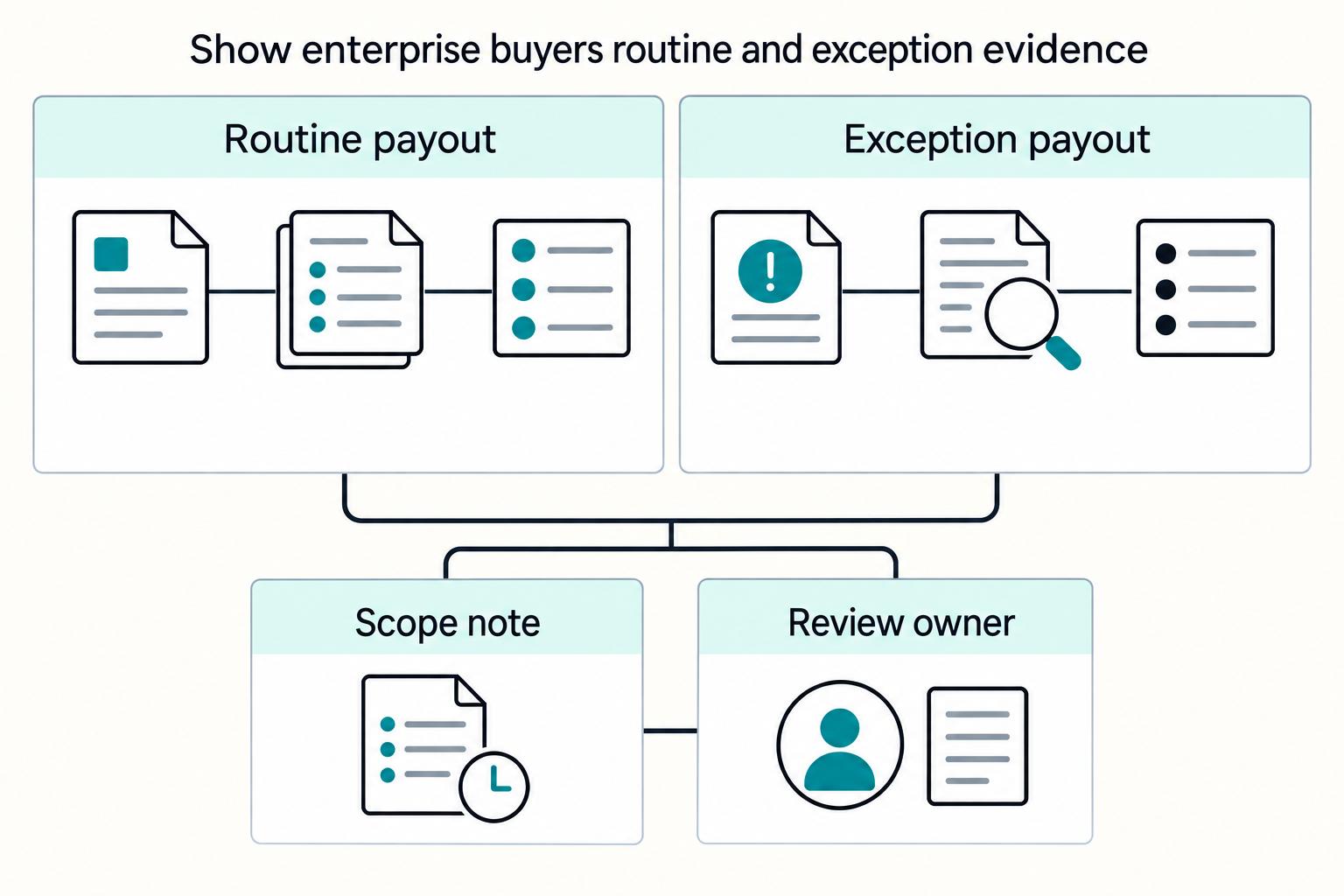
Use one routine payout and one exception payout so reviewers can see how controls behave in normal flow and under pressure. Make each trail readable on its own with stable event IDs, timestamps, decision-state changes, and final owner.
Step 3 Add tax and payout documents with process notes#
Keep tax-document claims narrow and operational. For W-8, W-9, and Form 1099, state what you collect, when you collect it, where it is stored, and who owns follow-up, and validate any filing thresholds or due dates separately. For FBAR, be explicit about the tracking process for FinCEN Form 114.
| Evidence item | What to include | What to verify |
|---|---|---|
| W-8 | Process note, collection point, storage owner | Internal scope is documented; external filing rules are verified separately |
| W-9 | Process note, collection point, storage owner | Version is current and ownership is named |
| Form 1099 | Process note, reconciliation owner, evidence location | Process note matches your payout/reporting setup; filing rules are verified separately |
| FBAR | Tracking method, valuation approach, amendment handling, notice tracking | Threshold logic, conversion method, and filing evidence are documented |
For FBAR, filing is required when the aggregate of maximum account values exceeds $10,000 during the calendar year. Value each account separately, using a reasonable approximation of its greatest value for the year. Periodic statements can be used if they fairly reflect that maximum.
Record amounts in U.S. dollars and round up to the next whole dollar, for example $15,265.25 -> $15,266. If the Treasury exchange rate is unavailable, use another verifiable rate and document its source. If a computed value is negative, enter 0 for item 15.
Also include filing operations detail. Instructions state an annual due date of April 15th with an automatic extension to October 15th, and FinCEN may publish event-specific extensions, so track current notices. If errors are found after filing, submit an amended FBAR by filing a new form, checking the Amend box, and providing the Prior Report BSA Identifier. Track submission rejects, including missing required XML elements.
Step 4 Show how controls stay current#
Close with a one-page note on how controls are maintained over time. Keep it practical: which checks or reviews run, where results are stored, who reviews failures, and how exceptions are approved.
Final check: pick one control and trace it from policy to check to evidence artifact to owner. If that path is hard to follow, the pack still needs tightening.
Tie compliance decisions to margin and win-rate economics#
Not every control deserves the same urgency. Prioritize the ones that reduce buyer friction and payout disruption at the same time, then expand from there.
Step 1 Map the economics chain to buyer and ops outcomes#
Use one rule across decisions: a control is commercially useful only when it reduces uncertainty without adding blunt friction. Enterprise buyers are looking for maturity, reliability, and credibility, not feature theater, so tie each control to a business outcome your team can actually observe.
Keep the tradeoff explicit. Too much friction can hurt conversion and approvals. Too little control can raise downstream fraud and dispute risk. 3D Secure (3DS) is the clearest example: it supports stronger security and Strong Customer Authentication (SCA) goals, but poorly tuned use can add checkout friction.
Verification point: review recent enterprise opportunities and payout exceptions, then tag delays by cause: evidence gap, manual review backlog, or blunt blocking. If those causes are mixed together, your sequencing decisions will be noisy.
Step 2 Quantify tradeoffs before sequencing spend#
Before you spend, run each candidate control through the same lens. Check implementation and tooling cost, current manual review load, onboarding delay added or removed, and business exposure if control handling fails.
| Candidate control | Economic upside to test | Common failure mode |
|---|---|---|
| KYC/KYB automation | Potentially less manual handling and a cleaner onboarding flow if exception paths are clear | Work shifts into unclear exception queues |
| Strong exception handling for held payouts | Potentially better payout reliability and fewer fire drills | Cases stall because release ownership is unclear |
| 3DS optimization (exemptions, TRA targeting, tokenization, issuer-performance analytics) | Lower repeat friction on relevant payment flows | Optimization is added before baseline control operations are stable |
Measure downside in business terms, not just incident mechanics: revenue interruption, operational suspension, contractual pressure, and liquidity strain. Check field signals weekly, review win/loss plus pricing or messaging deltas monthly, and reset priorities quarterly.
Step 3 Prioritize dual-impact controls first#
If capacity is limited, start with dual-impact controls: strong exception handling and stable baseline controls before finer optimization layers. That sequence can give enterprise buyers a clearer trust story while giving operations a more reliable release path when payouts need review. If teams still rely on inbox escalation or unclear handoffs, stabilize that layer before you expand advanced tuning.
Step 4 Package control depth into pricing, not one-off architecture#
Turn stricter control depth into named commercial options so buyers can choose higher rigor without a custom build every time. Keep a baseline package, then offer stricter configurations with tighter review settings and richer evidence output.
Where card flows are in scope, anchor new options on 3DS2 and targeted checks, for example exemptions and transaction risk analysis (TRA), rather than blanket step-up on every transaction. Do not design new options around 3DS1, which is effectively deprecated.
Verification point: if sales cannot explain what changes by package, or ops cannot show owner plus evidence artifacts for those changes, the pricing model is still hiding custom work.
If contractor payout experience is part of the client conversation, Invisible Payouts: How to Remove Payment Friction for Contractors Without Sacrificing Compliance shows how to cut friction without weakening controls.
Execute a 90-day cross-functional implementation plan#
Run this on a 90-day clock, but make the first decision the hardest one: define your EU cross-border VAT position, then assign owners and evidence paths around it.
| Phase | Primary outcome | Evidence to leave with | Red flag |
|---|---|---|---|
| Days 1 to 30 | Scope, owners, and jurisdiction choices are fixed | OSS applicability memo, owner list, current-state gap register | Teams discuss "EU compliance" without naming scheme, market, or owner |
| Days 31 to 60 | Legal choices are translated into product and reporting operations | Test records, reporting logic, control checks | Finance cannot reproduce covered transactions from production data |
| Days 61 to 90 | Buyer-facing proof is publishable and defensible | Evidence pack, mock Q&A answers, expansion scenarios | Sales claims live coverage that ops or finance cannot prove |
Step 1 Lock scope and ownership in days 1 to 30#
Name the workstreams exactly as they will appear in diligence: VAT scope and scheme selection, reporting operations, and record-keeping/audit readiness. In month one, you do not need every gap closed, but you do need an owner, current status, and evidence location for each workstream.
For EU VAT, move past "we support Europe." If your cross-border B2C flows are covered, OSS can let you declare and pay VAT through one Member State portal. OSS includes three schemes: non-Union, Union, and import. Your Member State of identification is the single Member State where you register for the chosen scheme. In some Union-scheme cases, that choice can bind you for the calendar year plus the two following calendar years.
By day 30, publish a short decision memo that answers:
- Which cross-border flows are in scope now
- Whether any flow could trigger deemed-supplier treatment
- Which OSS scheme, if any, fits those flows
- Which Member State of identification you choose, or why you defer
Step 2 Translate legal choices into product operations in days 31 to 60#
Month two should prove that your teams can identify reportable transactions and reproduce supporting records from production data. Use automated checks where practical to prevent regressions in required transaction attributes, destination-country handling, and finance data handoffs.
Keep filing cadence explicit in implementation: Union and non-Union OSS returns are quarterly, and import-scheme returns are monthly. OSS returns are additional to domestic VAT returns, not a replacement. Plan for both reporting lanes at the same time.
Step 3 Publish proof and rehearse buyer scrutiny in days 61 to 90#
In the final month, turn operations into buyer-facing proof. Your evidence pack should show how controls are run and where evidence lives, including your OSS decision memo, record-keeping approach, and a redacted covered transaction trail.
If VAT treatment is still unclear for complex cross-border transactions, use the EU Cross-border Rulings mechanism in participating countries instead of guessing. For expansion scenarios outside current OSS scope, keep statements limited to scope, ownership, and what is live versus roadmap.
Run monthly checkpoints on control effectiveness, reporting readiness, and procurement readiness together. If EU scope is unresolved after month one, pause broad claims and close the jurisdiction decision first.
Use this plan as your implementation baseline, then map each control to concrete integration and operations requirements in the Gruv docs.
Recover quickly from the mistakes that kill enterprise deals#
When a deal stalls in security or compliance review, recovery is usually operational: refresh evidence, move risk controls into flow, narrow jurisdiction claims, and unify documentation so answers are traceable.
| Recovery move | What to do | Check |
|---|---|---|
| Compliance evidence | Refresh current proof and reconfirm control owners | For each control, identify owner, evidence location, and latest test or review |
| AML and KYC in flow | Embed AML and KYC controls in flow with a clearly owned exception queue | Separate AML alerts from missing KYC or KYB documentation when false positives pile up |
| PSD2/PSD3 claims by jurisdiction | Use jurisdiction-specific coverage language and publish a coverage map by market | State what is live, what depends on partners or licensing, and what is roadmap |
| Auditable control registry | Map each control to owner, evidence location, current status, and approved claim language | Each questionnaire answer maps to one registry entry and one evidence source |
Step 1 Reopen compliance evidence as a live control set#
Under heightened supervisory scrutiny, evidence cannot be treated as a one-time milestone. The fix is to show controls are still operating, testing is current, and evidence can be refreshed without a scramble.
Reconfirm control owners, refresh current proof, and align teams on one version of each claim. Your checkpoint is simple: for each control, can the team answer who owns it, where evidence lives, and what the latest test or review showed?
Step 2 Move AML and KYC into the payment flow#
When checks sit outside the payment flow, exception handling gets harder to manage. Recovery means embedding AML and KYC controls in flow, with a clearly owned exception queue for cases that cannot be auto-cleared.
You need an operating model that shows embedded controls for AML/KYC, sanctions, and data residency, plus automated reporting, real-time risk handling, and clear reviewer ownership across teams and third parties. If false positives are piling up, assign a queue owner, define release evidence, and separate AML alerts from missing KYC or KYB documentation.
Step 3 Rewrite PSD2 and PSD3 claims by jurisdiction#
Generic "EU compliant" language is often too broad for enterprise review. The recovery move is jurisdiction-specific coverage language because expectations differ across markets, including AML/KYC, data residency, reporting, safeguarding/transparency, and beneficial ownership requirements.
Publish a coverage map by market: what is live, what depends on partners or licensing, and what is still roadmap. Keep sales language narrow enough that product, legal, and compliance all sign off on the same statement.
Step 4 Consolidate documents into one auditable control registry#
Scattered documents can slow procurement and create contradictory answers. The practical fix is one auditable control registry tied directly to buyer responses.
At minimum, map each control to owner, evidence location, current status, and approved claim language, including licensing coverage, embedded AML/KYC/KYB controls, and jurisdiction-specific PSD2/PSD3 statements. The test is traceability: each questionnaire answer should map to one registry entry and one evidence source.
Map Gruv capabilities to buyer requirements without overbuilding#
Once the control registry is clean, the next risk is scope creep. Add only what removes a live buyer blocker and can be operated with clear ownership and evidence.
Step 1 Name the blocker before you name the module#
Start with the buyer requirement, not the product label. If a prospect asks about Merchant of Record (MoR) or Virtual Bank Accounts (VBAs), clarify the exact gap first. Then map only the capability that answers that gap, with a named owner, scope boundary, and exception path.
Use a simple check before committing: for each requested capability, can your team name the buyer question, the internal owner, and the evidence source? If not, you are still discussing architecture in the abstract.
Step 2 Pressure-test tax and withholding data before you expand scope#
Field-level consistency should come before broader tax-document promises. In one IRS validation program for Form 1042-S, the process compared 18 fields, and any discrepancy, no matter how small, was grounds for rejection of a refund claim.
Run a field-level check on real cases and confirm values stay consistent from intake through reporting output. If fields are being re-keyed across systems, fix that mismatch risk before expanding document scope.
Step 3 Treat exception handling as part of the requirement#
Exception flow is part of the product, not an afterthought. The same IRS material notes that technology flaws were worsened because Form 1040NR had to be filed on paper, and refunds could be frozen for up to one year or longer.
So when scope expands, define exception ownership up front: who reviews mismatches, what evidence resolves them, and how case status is tracked. If those answers are unclear, broader scope will only add operational drag.
Step 4 Expand only after the first blocker is measurably reduced#
Keep the first rollout narrow and prove it works before you add more. The release packet should be concrete: approved claim language, named owner, sample output, and one redacted mismatch case with resolution steps.
That is a practical way to keep compliance scope grounded in enterprise marketplace deals: reduce one real blocker, verify the operating reality, then expand.
For a step-by-step walkthrough, see How to Build a Milestone-Based Payment System for a Project Marketplace.
Align sales, product, and finance on one enterprise narrative#
Use one cross-functional narrative or enterprise buyers will read inconsistency as risk. Deals can run across 6 to 10+ stakeholders over 6 to 18 months, so wording gaps can slow approvals.
Step 1 Write one defensible message per audience#
Create three evidence-first statements: sales, product, and finance/ops. If sales says you reduce compliance-related friction, tie that to named, current proof. If you reference SOC 2, be explicit about what is verifiable now versus planned.
Enterprise buying teams often include IT, finance, and executives at the same time, so vague questionnaire claims can fail under review.
Step 2 Describe product controls as behavior, not labels#
Explain what your controls do in practice: what checks run, what gets routed for review, and who owns the decision path. Keep the description in plain language that non-engineers can validate.
A short behavior note reviewed by product and engineering, plus the related checks in your CI/CD pipeline, gives sales repeatable language without improvisation.
Step 3 Make finance/ops show the record trail#
Avoid broad reconciliation claims unless finance and ops can walk through a concrete status history for a representative transaction. If buyers ask about tax-document handling, answer with ownership and where status changes are recorded.
A redacted case with clear status transitions is usually more credible than a generic "end-to-end reconciliation" claim.
Step 4 Centralize questionnaire responses#
Build and maintain an approved answer bank for security questionnaires, RFPs, and follow-ups. Each answer should include the claim, evidence source, owner, caveat, and last review date. If an answer cannot pass that check, narrow it or remove it before it reaches the buyer.
Conclusion#
Use this close-out checklist before your next enterprise cycle:
- [ ] Package proof, not just controls. If your buyer-facing baseline includes frameworks such as SOC 2, ISO 27001, or NIST 800-53, keep current artifacts, named owners, and clear scope summaries ready to send in one response.
- [ ] Make ownership boundaries explicit internally. For your chosen infrastructure model, align on who owns key compliance responsibilities, what control depth comes with that setup, and what you can state externally without overclaiming.
- [ ] Keep compliance checks in the real payment flow. Define exception ownership and payout-friction monitoring so stronger checks improve decision quality and customer-journey speed instead of creating opaque cleanup work.
- [ ] Centralize procurement evidence. Maintain one current evidence bundle mapped to buyer questions across risk, security, and procurement, and update it periodically so strong controls do not look weak because documentation is stale.
- [ ] Align claims across teams. Sales, product, and finance should use one approved answer set by market and program for what is live now versus what is still roadmap.
- [ ] Show impact with internal operating data. Judge the work by whether approval friction and manual effort are moving in the right direction and whether delayed or blocked deals put less revenue at risk.
Related reading: Payment Infrastructure Trends 2026: How Marketplace Operators Should Prioritize Real-Time Rails, Stablecoins, BNPL, and Embedded Checkout. If you want to validate market-specific compliance coverage and rollout sequencing before your next enterprise cycle, talk with Gruv.
Frequently Asked Questions
How does payment compliance actually help win enterprise marketplace clients faster?
Payment compliance helps when it reduces approval uncertainty with proof buyers can verify. Reviews can move faster when procurement sees current evidence, clear ownership, and defined scope instead of broad claims.
What compliance capabilities are table stakes, and which ones truly differentiate a platform?
Baseline security and governance readiness are table stakes. Differentiation comes from inspectable operating proof such as current artifacts, performance metrics, clear evaluation criteria, and named owners. When vendors sound similar, the one that proves execution quickly is often viewed as lower risk.
When should a marketplace pursue a PI or EMI license instead of partner-led infrastructure?
Consider a PI or EMI path when diligence is blocked by who owns the regulated payment layer and deeper control matters more than speed. Partner-led infrastructure can be the better route when speed is the priority, as long as VAT scope, filing ownership, record-keeping, and control boundaries are explicit.
How can we enforce stricter AML/KYC/KYB controls without slowing payouts?
Use staged gates instead of one blunt hold. Run high-confidence checks at onboarding and pre-transaction, assign clear exception and release ownership, and require reason codes plus audit-ready evidence. Review hold patterns regularly so noisy rules do not create avoidable payout friction.
Which compliance gaps most often block enterprise procurement and security approval?
Common blockers are unclear scope, stale evidence, scattered documents, and claims with no named owner. Deals also slow when infrastructure ownership is unclear, especially around the regulated payment layer, licensing boundaries, and what is live versus roadmap.
Is SOC 2 Type II enough on its own, or do buyers expect broader operational evidence?
This guide does not treat SOC 2 Type II as enough on its own. Enterprise buyers also want current operational evidence with clear scope, named owners, and proof from live processes such as payout controls and exception handling.
How should we prioritize PSD2/PSD3, PCI DSS 4.0.1, and tax-document workflows when resources are limited?
From this guide's grounding, the clearest priority is PSD3 and PSR readiness based on EU or EEA exposure and preparation lead time, since enforcement is described as not expected before 2027. It does not provide substantiated implementation guidance for PCI DSS 4.0.1 or tax-document workflows, so those should be prioritized using separate validated evidence.
Researched and edited by the Gruv editorial team. Gruv builds cross-border billing, payouts, and finance-operations software for global businesses.
Sources
- arpa-h.gov/explore-funding/programs/advocate/teamingtrusted
- bsaefiling.fincen.gov/docs/XMLUserGuide_FinCENFBAR.pdftrusted
- fincen.gov/reporting-maximum-account-valuetrusted
- fincen.gov/system/files/shared/FBAR%20Line%20Item%20Fil...trusted
- govlab.hks.harvard.edu/wp-content/uploads/2021/02/gpl_rfp_guidebook...trusted
- irs.gov/pub/irs-access/p2104_accessible.pdftrusted
- oecd.org/content/dam/oecd/en/publications/reports/201...trusted
- sec.gov/Archives/edgar/data/1846832/0000950170250581...trusted
Educational content only. Not legal, tax, or financial advice.
Related Posts

The Freelance Payment Penalty: A Modeled Audit of Platform Fees, FX Spreads, and Payout Delays
The money rarely disappears through a single, easy-to-spot fee. The real loss is stacked. A marketplace takes its commission, a processor adds a charge for international cards, a bank or payment company converts the currency at a spread, a platform holds the funds before release, and a wire sheds a little to intermediaries on the way in. Each layer looks defensible on its own, but the worker feels the combined result as a smaller deposit and a later payday.

How to Respond to a Subpoena for Business Records
Move fast, but do not produce records on instinct. If you need to **respond to a subpoena for business records**, your immediate job is to control deadlines, preserve records, and make any later production defensible.

A US Expat's Guide to Investing in UCITS ETFs to Avoid PFIC Issues
The real problem is a two-system conflict. U.S. tax treatment can punish the wrong fund choice, while local product-access constraints can block the funds you want to buy in the first place. For **us expat ucits etfs**, the practical question is not "Which product is best?" It is "What can I access, report, and keep doing every year without guessing?" Use this four-part filter before any trade: