
Quick Answer
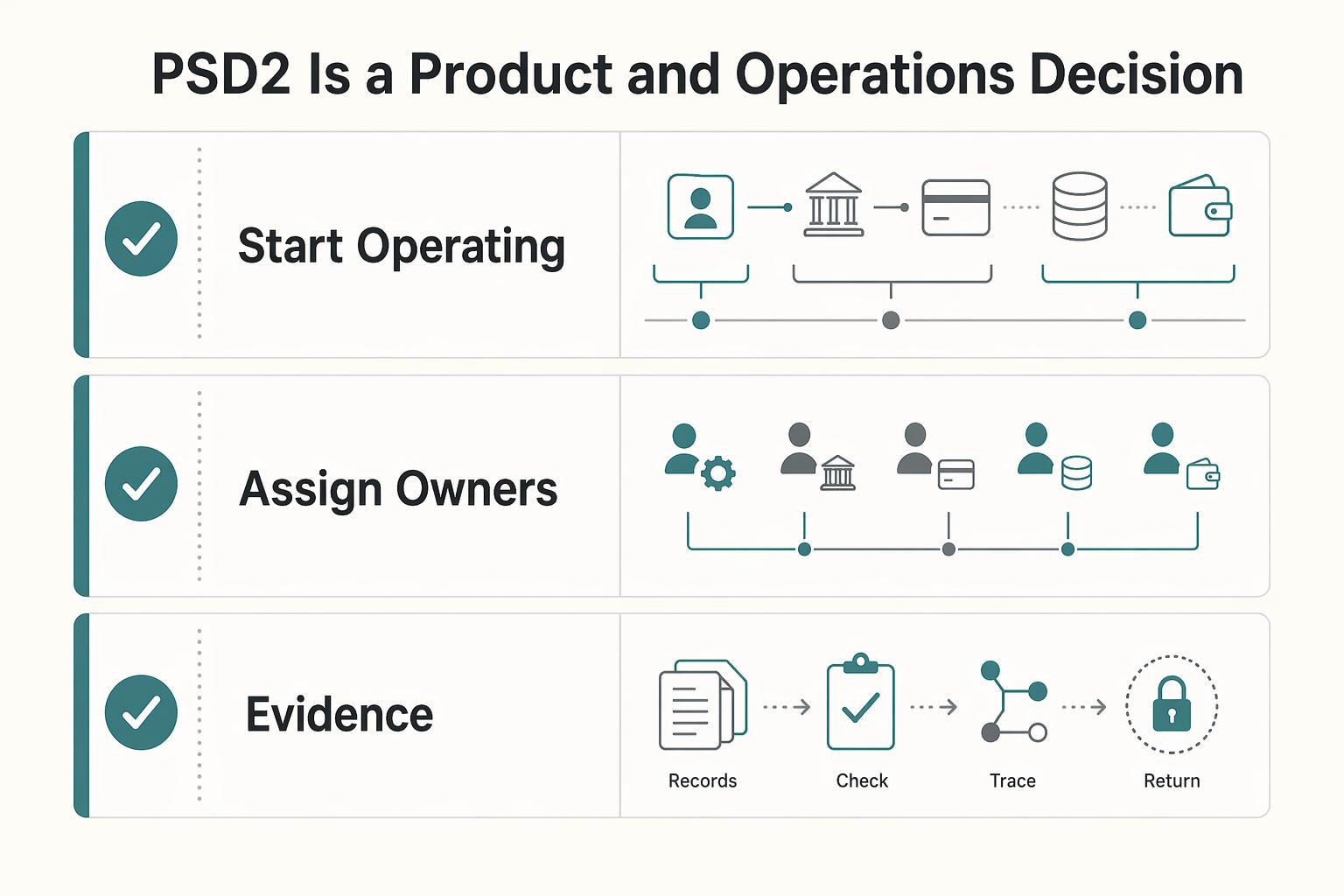
PSD2 is the EU’s revised payments directive, and for platform teams it is mainly an operating-model decision. The practical move is to choose your control boundary first, then assign owners for authentication, incident response, and reconciliation. This article frames implementation around clear accountability and transaction evidence, not glossary definitions, so teams can run EU payment flows with fewer handoff gaps and faster dispute resolution.
PSD2 is a product and operations decision, not just a legal definition#
If your team is asking how to implement an EU compliance requirement, treat it as an operating-model decision, not a glossary task. Start by deciding who owns each payment step, which systems are your source of truth, and what evidence you will retain when outcomes are disputed or reviewed. Keep it practical. Choose a path, assign owners, and define launch checkpoints your team can actually run.
- Start with the operating boundary, not the acronym
Map customer-visible steps, provider-controlled steps, and internal ledger or payout states first. A label does not resolve incidents. Ownership of control points does.
- Assign owners before you compare providers
Write down handoffs across product, engineering, and finance or ops before implementation starts. For each failure mode, name one decision owner.
- Define evidence retention before go-live
Keep a minimal evidence pack for each payment outcome: attempt ID, provider reference, internal status change, and change-approval record. If you cannot reconstruct the path, incident handling slows down.
An adjacent EU VAT example shows why this matters in practice. In OSS materials on official europa.eu pages, the work is broken into concrete checkpoints: registration, VAT declaration and payment, record keeping and audits, and leaving the scheme. Filing cadence also differs by scheme. It is quarterly for non-Union and Union, and monthly for import. OSS also does not replace domestic VAT returns. Different regime, same implementation lesson. Treat compliance as recurring operations, not one-time policy text.
Before you build, create a one-page ownership sheet for each flow. Include the controller of each customer step, the external response treated as the source of truth, how out-of-order messages are handled, and the sign-off owner for rule changes. If that page is still debated, you are not ready to compare implementation options. Related reading: Crypto Payouts for Contractors: USDC vs. USDT - What Platforms Must Know.
Who this list is for and how to choose the right PSD2 path#
This list is for EU platform teams choosing an operating model for payment flows with real compliance and evidence work, not for teams that need a country-by-country legal memo. Use it to choose a workable path based on ownership, operational capacity, and evidence readiness.
- EU platform teams with real operating ownership
This section is for founders, product, engineering, and finance or ops owners running marketplace and e-commerce flows in the European Union. It is most useful when one team owns the customer journey and another must reconcile records and explain outcomes later. Official OSS guidance is explicitly written for online sellers and marketplaces/platforms and treats record keeping and audits as ongoing operations.
- Not teams seeking full legal coverage across each country
This is not a substitute for formal legal advice on entity-specific and regulator-specific edge cases. If your blocker is which local interpretation controls a specific fact pattern, you are earlier than this list assumes. A practical EU example: in OSS, choosing a Member State of identification can bind you for the decision year plus the next two calendar years.
- Teams choosing on operational criteria, not provider preference
Use a short decision filter: Member State of identification, record-keeping and audit readiness, filing cadence, and return-scope discipline. A simple checkpoint is whether you can consistently declare all supplies that fall under your chosen OSS scheme. In OSS, record keeping and audits are explicit workstreams, and filing cadence can be quarterly or monthly depending on scheme.
- Teams balancing speed vs control with clear ownership
Use a simple tradeoff rule for the options in this list: if administrative simplicity matters most, prioritize a path your team can operate consistently through one Member State registration and ongoing OSS returns. If flexibility matters most, account for the multi-year commitment tied to your Member State choice and the possibility of scheme exclusion by a Member State. If your team cannot name the source of truth for VAT records and the owner for return operations, start with the simplest compliant path and revisit later.
We covered adjacent control-and-evidence themes in SOC 2 for Payment Platforms: What Your Enterprise Clients Will Ask For.
The six PSD2 decisions every platform should make before building#
Make these decisions before you connect a PSP. They set the boundary for scope, ownership, control, evidence, and escalation. One limit matters here. The EU sources behind this section cover OSS and VAT cross-border procedure, not PSD2 trigger rules. They do not tell you when SCA or 3D Secure is legally required. For auth-trigger detail, use a PSD2-specific source such as PSD2 Strong Customer Authentication: What Platform Operators Must Do for EU Transactions.
- Freeze your payment perimeter first.
Build one register of every payment event your product creates: pay-ins, wallet funding, payouts, refunds, reversals, retries, manual ops changes. Mark each one as confirmed in scope, needs legal review, or not decided. An adjacent EU lesson: VAT e-commerce rules changed on 1 July 2021, including an EU-wide EUR 10 000 threshold, and late scope decisions can create rework.
- Assign one owner for scope decisions.
Multiple teams can advise, but one person should own the current answer to whether a flow must go through PSD2 review. OSS uses a single Member State of identification for registration. Different regime, same operational pattern: one accountable decision point.
- Split ownership by failure class.
Treat this as an operating model, not just a legal reading: product can own journey design, engineering can own authentication implementation (including 3D Secure where used) and webhook reliability, and finance or ops can own reconciliation and exceptions. The CBR process uses a similar principle: where multiple companies are involved, one should submit on behalf of the others.
- Choose your control boundary once.
Decide early whether you run a more PSP-led model or a more platform-led orchestration model, then design around that choice. There is no established PSD2 cost or risk ranking between models. The same commitment dynamic shows up in OSS: schemes are optional, but once chosen, covered supplies must be declared through that scheme, with stated red-tape reduction potential of up to 95%.
- Set evidence standards before go-live.
Define the minimum transaction trail now: attempt record, provider reference, internal state changes, manual approval records, and final ledger effect. OSS cadence, quarterly for non-Union and Union, monthly for import, is a useful reminder that recurring control evidence matters more than launch-day snapshots.
- Define an ambiguity escalation path and keep the trail.
When interpretation is unclear, log the issue, source, date, approver, and review date. For official EU material, confirm the europa.eu domain. If the question is VAT treatment of complex cross-border transactions, CBR exists. An equivalent PSD2 path is not established. In a specified Union-scheme case, the Member State-of-identification choice can bind for the calendar year plus the next two years. That is why decision records need explicit review windows.
If you want a deeper dive, read What is a 'Permanent Home' in the Context of a Tax Treaty?.
Turn these six decisions into owners, deadlines, and launch gates, then map each one to webhook, ledger, and exception flows in the Gruv docs.
Comparison table of the five PSD2 implementation options for platforms#
Pick the option your team can operate under stress, not just at launch. In practice, implementing PSD2-compliant authentication means balancing security, performance, and user experience, with tradeoffs in control and evidence burden across SCA, 3D Secure 2.0, and consent-heavy flows. These are practical platform patterns, not regulator-defined categories.
| Option | Best for | Control level | Engineering lift | SCA style / Open Banking readiness | Conversion risk | Operational risk | Audit evidence burden under PSD2 | When this fails | Recommended when |
|---|---|---|---|---|---|---|---|---|---|
| Provider-managed checkout with built-in 3D Secure | Early launches, lean teams, and limited internal payments ops | Low to medium | Low | Provider-managed 3D Secure 2.0; Open Banking readiness depends on provider capabilities | Medium, redirect and challenge UX is mostly outside your control | Low to medium, provider dependency remains | Low to medium if you retain provider reference, auth result, challenge outcome, and payment-status history | Auth-step drop-off you cannot tune; limited visibility into challenge outcomes | Choose this when launch speed matters more than custom checkout control |
| Embedded checkout with platform-led SCA orchestration | Scaled platforms with dedicated payments engineers | High | High | Platform-managed SCA orchestration; Open Banking readiness medium | Medium, you can improve flow, but brittle auth hurts fast | High, you own retries, monitoring, and incident response | High: attempt logs, factor path, provider response, internal state changes, exception records | Authentication handling or retry logic becomes brittle without strong monitoring | Choose this only if you can staff ongoing authentication ownership |
| Marketplace split model with delegated controls | Two-sided platforms with different buyer and seller risk profiles | Medium | Medium | Mixed: provider-managed for some steps, platform-managed for others; Open Banking readiness medium | Medium, handoff points add friction risk | Medium to high, ownership gaps create failures | High: evidence mapped by party, flow, and provider handoff | Ownership ambiguity across parties delays investigation and resolution | Choose this when you can document exact responsibility per flow |
| Payout-first architecture with minimal card surface | Creator, contractor, or marketplace products where outbound movement is core | Medium on payout logic, lower on checkout | Medium | Limited 3D Secure exposure when inbound card use is narrow; Open Banking readiness medium | Medium, buyer auth friction can be lower, but funding fallback can feel clunky | Medium, payout exceptions and ledger accuracy dominate | Medium to high, weighted toward settlement, payout status, and balance trails | Payout exceptions and balance-state mismatches are hard to investigate quickly | Choose this when payouts are the product and card collection stays narrow |
| Open Banking payment initiation track | B2B collections, larger invoices, customers comfortable with bank-transfer behavior | Medium to high | High | Bank-managed auth and consent flows; Open Banking readiness high | Medium, bank redirects and consent steps can drop users | High, bank connectivity and consent lifecycle are central | High: consent records, payment status trail, bank reference, revocation handling | Consent lifecycle or bank-connection failures can leave payment state unclear | Choose this when account-to-account fit is strong and you can run consent and bank-status operations reliably |
The practical divider is evidence quality at each decision point. For any provider-managed path, confirm you can retrieve, for each attempt, the provider reference, auth outcome, challenge result if any, and your internal payment-status history.
If you choose a platform-led path, do not treat SCA as a generic prompt flow. Factor independence and dynamic linking are core design constraints. Two knowledge factors, for example password plus security question, are not a valid SCA combination, and SMS OTP has SIM-swap risk.
Do not confuse PCI DSS readiness with PSD2 readiness. PCI DSS is a contractually enforced card-scheme standard, while PSD2 is a legal payment-services regulation. PCI DSS v3.2.1 retired on 31 March 2024. Versions 4.0 and 4.0.1 are active, and additional requirements became mandatory from March 2025. Those updates do not replace PSD2 SCA design decisions and evidence requirements.
If you cannot investigate failed 3D Secure or consent issues quickly, avoid platform-led and Open Banking-heavy options for now. For deeper SCA design detail, see PSD2 Strong Customer Authentication: What Platform Operators Must Do for EU Transactions. Related: What Is ACH? The Automated Clearing House Explained for Platform Operators.
Option 1 provider-managed checkout with built-in 3D Secure#
Use this option as a boundary decision, not a full transfer of responsibility. Even with a centralized checkout setup, your team still needs a clear ownership map and an evidence trail you can review outside the provider UI.
For this section, the grounded EU material is VAT OSS guidance, not PSD2 authentication implementation detail. The practical lesson still holds: centralized administration can simplify coordination, but it does not remove registration, reporting, record-keeping, or audit responsibilities.
Where this option fits#
This can fit a marketplace that wants to keep its owned checkout surface narrow at first. Treat that as an operating choice for now, then confirm exactly which obligations stay with your legal entity as you scale.
What to verify before launch#
Before launch, make sure the simplification is real in your operating model, not just in the checkout UI.
- Map obligation ownership by legal entity, including whether your platform could be treated as a deemed supplier for VAT purposes in relevant flows.
- If you use OSS, confirm your Member State of identification and the Union-scheme switching constraint (current calendar year plus the two following calendar years), unless fixed-establishment conditions change.
- Make sure records are retained and audit-ready. In OSS guidance, record keeping and audits are core requirements, not cleanup tasks.
Red flags and failure modes#
The main risk is thinking you have delegated more than you actually have.
- False simplicity: centralized setup can look operationally lighter while leaving unresolved ownership and evidence gaps.
- Scheme risk: OSS participants can be excluded by a Member State.
- Growth drift: VAT e-commerce rules changed on 1 July 2021, including the EUR 10 000 threshold in that VAT context, so ownership gaps can surface quickly when geography or volume expands.
If you need the payment-authentication details for this decision, read PSD2 Strong Customer Authentication: What Platform Operators Must Do for EU Transactions. Need the full breakdown? Read What Is Strong Customer Authentication? EU Mandate Explained.
Option 2 embedded checkout with platform-led SCA orchestration#
Choose this path only when tighter checkout control is worth the added engineering and operations burden. Embedded checkout can preserve more control over the authentication experience, but it also moves more SCA flow design and incident handling onto your team.
- Best for: teams that need tight product control and can operate authentication flows across parties.
- Key pros: more checkout UX control and a better fit for complex payment journeys.
- Key cons: higher burden for SCA flow design, authentication failure handling, support escalation, and cross-party coordination.
- Concrete use case: a platform with dedicated payments engineering and active monitoring of authentication outcomes.
- Decision rule: if you cannot provide clear payments incident ownership and escalation, this model is usually too risky operationally.
Why teams pick it#
Teams pick this when checkout control materially affects the user journey. In PSD2 RTS consultation responses, stakeholders warned that blanket SCA can miss transaction-risk context, reduce checkout customization, and increase abandonment when simple transactions face high-friction authentication.
If your platform has multiple payment entry points or complex handoffs, embedded orchestration can make those transitions and failure paths more intentional. That benefit is real only if your team can actively operate and debug the flow.
What must be in place before launch#
Governance is the hard requirement here, not visual design. The same consultation material stresses clear allocation of roles, responsibilities, liabilities, and service levels across parties. Confirm in writing before go-live:
- who owns challenge-flow UX, customer messaging, and support escalation
- service levels and deliverables across your team, PSP, gateway, and any fraud or orchestration providers
- how you review successful and failed authentication journeys across parties
- how you handle scope differences raised in stakeholder feedback, including Article 97(1)(c) vs Article 97(1)(b) when transaction initiator differs
Where this option fails in practice#
A cited failure mode is friction from blanket or high-complexity authentication on simple transactions, which can reduce authentication completion and increase abandonment for digital merchants. This option also breaks down when roles, liabilities, and service levels are not clearly owned across parties.
Be clear about source confidence as well. Consultation responses are not final binding legal determinations. Use them as implementation warnings on friction, abandonment, customization limits, and liability clarity, then validate your legal interpretation separately.
For a step-by-step walkthrough, see What Is DAC7? EU Platform Reporting Directive Explained.
Option 3 marketplace split model with delegated controls#
Use this model when buyer checkout and seller onboarding or payout operations have different risk and compliance needs, and you can define ownership before launch.
- Best for: two-sided platforms with separate checkout and payout control surfaces.
- Key pros: you can delegate parts of SCA implementation to specialists while keeping marketplace policy logic in-house.
- Key cons: shared control can blur incident, audit, and support ownership if roles are not explicit.
- Concrete use case: for example, a contractor marketplace where a provider handles seller onboarding and parts of authentication, while your team owns payout timing, holds, and exception handling.
This split can work, but it does not move all PSD2 responsibility into a provider contract. Implementation guidance frames compliance obligations across payment service providers, merchants, and other parties, so delegated controls still require a clear platform ownership model.
Why teams choose it#
Teams choose this option to let each party operate the area it handles best. Delegated authentication is treated as a distinct control area in PSD2 SCA implementation guidance, which makes this a practical execution pattern.
The tradeoff is accountability complexity. A provider may own part of the authentication journey, while your team still owns order state, payout logic, customer messaging, and operational outcomes.
Where it breaks#
Failures often come from handoff ambiguity, not one obvious policy error. Common issues include mismatched auth and order state, unclear ownership of abandoned challenges, and payout holds that support teams cannot explain quickly.
SCA requirements are still being refined for some use cases, so provider documentation should inform your design, not act as a compliance guarantee by itself.
What to lock down before go-live#
Assign ownership by failure class, not just by team name.
| Failure class | Primary owner | Evidence to retain |
|---|---|---|
| SCA challenge fails or is abandoned | Product/payments engineering + PSP escalation contact | auth outcome, provider reference, user message shown, internal order state |
| Auth result and internal ledger or order state diverge | Engineering | webhook logs, retry history, reconciliation record, settlement status |
| Payout hold or exception | Finance or ops | reason code, approval trail, payout status history, user notification record |
Two checks are critical before launch:
- Confirm pre-auth handoffs in your PSP path (and post-auth where relevant), for example
checkpoint=pspBeforeAuth, including what recommendation data is available and fallback behavior if expected fields are missing. - Confirm who stores and retrieves audit evidence when TRA or exemption logic is used, including reporting ownership.
Also validate timing assumptions. If scoring or recommendation outputs are asynchronous and only available later, payout release and support workflows can fail unless that delay is documented, tested, and owned.
Option 4 payout-first architecture with minimal card surface#
Use this when your product is primarily money out and buyer checkout is limited or optional.
- Best for: platforms where outbound disbursements are the core workflow.
- Key pros: clearer operational focus on payout timing, ledger accuracy, and exception handling.
- Key cons: complexity shifts rather than disappears, especially into reconciliation and cross-border recordkeeping.
- Concrete use case: a creator platform focused on earnings withdrawals and batch disbursements across European Union markets.
This structure can shift where card-auth steps show up in your checkout UX. But PSD2, Strong Customer Authentication, or 3D Secure scope outcomes are not established. Treat PSD2 analysis as a separate workstream.
That separation matters because the operational burden moves. It does not vanish. For cross-border VAT operations, One Stop Shop can let a taxable person declare and pay VAT through one Member State portal. That comes with explicit operating duties: registration, VAT declaration and payment, record keeping, audits, and leaving the scheme.
Before launch, lock down two VAT checks:
- Confirm whether platform-facilitated supplies of goods fall under OSS and whether the platform can be treated as a deemed supplier. Record-keeping duties can still apply even when a platform is not the deemed supplier.
- Confirm the Member State of identification choice early if multiple fixed establishments exist, because in specified Union-scheme cases that choice can bind the current calendar year plus the two following calendar years.
Also plan for post-1 July 2021 VAT rules, including the EU-wide EUR 10 000 threshold for relevant supplies. Use VAT Cross-border Rulings (CBR) when cross-border treatment is genuinely unclear.
Option 5 Open Banking payment initiation track#
Pick this track only when account-to-account payment initiation is central to how your customers already pay, and your team can manage consent and bank-connection operations end to end. If consent tracking or exception handling is still weak, postpone it.
Under PSD2, open banking established regulated third-party access, including Payment Initiation Services (PIS). The operating burden shifts into consent lifecycle control and bank connectivity.
When it fits#
This path fits when you are aligning with existing customer behavior, not trying to create a new one.
- Best fit: payment journeys where bank-transfer behavior is already strong.
- Practical signal: you are not trying to force a new payment habit; you are supporting an existing one.
- Decision check: if your receivables and ledger flows depend on clear authorization evidence, this model can work.
What you need to control#
In a concrete ABN AMRO PIS flow, payment initiation can proceed only after account-holder authorization through the consent application. That consent journey has 3 steps: authenticate, check requested account access, then confirm and redirect back to the third party.
The same flow grants one-time payment execution plus one available balance check, so state tracking is critical. At minimum, track: consent created, consent completed, payment initiated, and payment status confirmed.
Where this option breaks#
Breakpoints are usually operational: consent-flow handling, status-call handling, and scope mismatches between your use case and the selected API version.
Example scope constraint: in the ABN AMRO version referenced here, standing orders and bulk payments are out of scope and routed to v1. If your model depends on bulk initiation, confirm API scope before finalizing UX and invoice logic.
Minimum launch checks#
Before launch, make sure you can reconstruct authorization and investigate exceptions without guesswork. Keep:
- consent timestamp and requested access details
- redirect completion status and provider reference
- payment initiation result and later status response
- internal ledger link to the payment attempt
For that same consent context, status-call tokens are valid for 30 days, so build follow-up and investigation workflows inside that window.
The minimum evidence pack finance and ops should have before go-live#
Do not go live until finance and ops can reconstruct what happened on a payment from authentication through final status without engineering doing manual forensics. The minimum standard is simple: one evidence pack that shows the outcome, the exceptions, and the approval trail behind your authentication-risk decisions.
| Evidence area | What to keep | Operating use |
|---|---|---|
| One record per payment attempt | Internal payment ID, provider reference, SCA outcome, customer-facing status, relevant ledger state, step timestamps, and challenge result if step-up authentication is used | Operators should be able to move from provider reference to the internal ledger entry quickly |
| Exception path for known breaks | Trigger, owner, interim customer status, reconciliation treatment, webhook receipt time, settlement line item, and case-close note | Helps explain timing gaps, pending states, and settlement mismatches |
| Approval records for changes that affect authentication risk | Dated approvals, named approvers, the reason for change, the exact rule changed, and a clear before-and-after decision record | Supports stricter review when a change can increase risk, including password reset, PIN changes, parameter updates, whitelist updates, and notification-channel changes |
1. Keep one record per payment attempt#
Keep a single investigation view for each payment attempt, even if data sits across your PSP, app logs, and ledger. At minimum, include your internal payment ID, provider reference, SCA outcome, customer-facing status, relevant ledger state, and step timestamps. If step-up authentication is part of the flow, record whether the challenge completed, failed, or was abandoned.
Prioritize joinability over volume. Your operators should be able to move from provider reference to the internal ledger entry quickly, without digging across tools.
2. Write an exception path for known breaks#
Document the failures you already expect: failed authentication challenges, delayed webhooks, and mismatched settlement records. For each, define the trigger, owner, interim customer status, reconciliation treatment, and retained evidence, for example webhook receipt time, settlement line item, and case-close note.
Keep the legal line clear: it is not established that PSD2 explicitly mandates webhook-delay logging or ledger-link records. Treat these as operating controls so your team can explain timing gaps, pending states, and settlement mismatches.
3. Keep approval records for changes that affect authentication risk#
Treat changes to Strong Customer Authentication logic and related risk tolerances as approval-required decisions, not informal config edits. The EBA PSD2 authorization guidelines are separated into four sets, and one set explicitly addresses application completeness. Keep dated approvals, named approvers, the reason for change, and the exact rule changed.
Apply stricter review when a change can increase risk. In EBA RTS consultation-response material (non-binding), actions like password reset, PIN changes, parameter updates, whitelist updates, and notification-channel changes are highlighted as potentially increasing security risk. Differentiate risk-increasing and risk-reducing actions when deciding SCA review intensity, and keep a clear before-and-after decision record for those paths.
This pairs well with our guide on What Is KYB? Know Your Business Verification for Marketplace Onboarding.
Common PSD2 mistakes that create avoidable launch risk#
Much PSD2 launch risk is preventable. A common pattern is unclear ownership, copied provider assumptions, stale timeline references, and no defined SCA failure path.
| Mistake | Why risky | Check |
|---|---|---|
| Treating PSD2 as counsel-only work | PSD2 is the EU legal framework for retail payments, but execution gaps can show up at product and engineering handoffs | Take one failed payment attempt and confirm who owns the next action when SCA fails, when a provider reference exists without a ledger entry, or when settlement arrives late |
| Copying provider guidance without adapting it to your platform | Provider docs are a starting point, not your operating model; fees can change, and country or program pricing can override generic pages | Test your own flow end to end: provider reference, internal ledger state, and final settlement outcome |
| Mixing PSD1, PSD2, and PSD3 references as if the timeline is static | PSD1 was adopted in 2007; most PSD2 rules have applied since January 2018; SCA-related rules applied from September 2019; and the Commission's 2022 review led to proposed PSD2 amendments | Treat any PSD3 mention as a prompt to verify current EU materials before making build decisions |
| Launching without an explicit SCA failure branch | The PSD2 RTS work covers SCA requirements, exemptions, and secure communication, and implementation involves real tradeoffs | Define what happens when authentication fails, is abandoned, or remains incomplete: customer status, retry behavior, timeout handling, and recorded auth outcome |
- Treating PSD2 as counsel-only work. PSD2 is the EU legal framework for retail payments, but execution gaps can show up at product and engineering handoffs. Assign clear owners for checkout and authentication, provider and webhook reliability, and ledger reconciliation.
Verification check: take one failed payment attempt and confirm who owns the next action when SCA fails, when a provider reference exists without a ledger entry, or when settlement arrives late.
- Copying provider guidance without adapting it to your platform. Provider docs are a starting point, not your operating model. Stripe's own materials state that fees can change, country or program pricing can override generic pages, and Managed Payments includes a 3.5% fee per successful transaction in addition to standard processing fees.
Before launch, test your own flow end to end: provider reference, internal ledger state, and final settlement outcome.
- Mixing PSD1, PSD2, and PSD3 references as if the timeline is static. PSD1 was adopted in 2007; most PSD2 rules have applied since January 2018; SCA-related rules applied from September 2019; and the Commission's 2022 review led to proposed PSD2 amendments.
Treat any PSD3 mention as a prompt to verify current EU materials before making build decisions, or cross-check with a focused PSD2 and PSD3 guide.
- Launching without an explicit SCA failure branch. The PSD2 RTS work covers SCA requirements, exemptions, and secure communication, and implementation involves real tradeoffs. Define what happens when authentication fails, is abandoned, or remains incomplete: customer status, retry behavior, timeout handling, and recorded auth outcome.
Red flag: the product shows "submitted" while ops has no rule for the next step when authentication never completes.
What to do next if PSD2 is on your roadmap this quarter#
If PSD2 is on this quarter's roadmap, decide your control boundary first, then run a short internal execution cycle against it. Do not start with checkout design before you agree who owns SCA, exception handling, and the evidence you may need if an outcome is challenged later.
| Step | Focus | Deliverable or check |
|---|---|---|
| 1. Pick the control level your team can actually support | Decide your control boundary first | If you cannot clearly name the owner of an authentication failure, do not choose the higher-control model yet |
| 2. Use days 1 to 10 to scope real flows, not just the happy path | Map each launch flow, then mark where SCA may trigger and where exemptions may be used | Produce a launch flow inventory, an SCA trigger map, a clear owner map across product, engineering, finance or ops, and compliance, and a draft evidence list for each payment event |
| 3. Use days 11 to 20 to force a joint compliance-engineering review | Do not allow single-team sign-off | Have engineering show how authentication failures and status updates appear in your product and internal records, and have compliance confirm that responsibility splits match the flow you are actually shipping |
| 4. Use days 21 to 30 as a launch gate | Treat the last phase as a go-live decision, not cleanup | Confirm provider status reconciles to your internal records, authentication and communication exceptions have defined user outcomes and internal owners, and your evidence pack can reconstruct disputed payment or account-access events |
1. Pick the control level your team can actually support#
If your team is thin, a more provider-managed or delegated setup may reduce your internal operational load. If you want more product control, plan for more ownership when authentication or communication fails.
Why this matters: Under Directive (EU) 2015/2366 (PSD2), the Article 98 RTS covers SCA, exemptions, and common and secure communication. If your flow includes third-party access, for example PISPs and ASPSPs, review both customer steps and the information exchanged between parties. If you cannot clearly name the owner of an authentication failure, do not choose the higher-control model yet.
2. Use days 1 to 10 to scope real flows, not just the happy path#
Map each launch flow, then mark where SCA may trigger and where exemptions may be used. Do this at the journey level, not from provider marketing language. The RTS scope includes SCA, SCA exemptions, and common and secure communication requirements, so default settings alone may not be enough.
By day 10, produce:
- A launch flow inventory
- An SCA trigger map, where auth happens, who presents it, fallback state
- A clear owner map across product, engineering, finance or ops, and compliance
- A draft evidence list for each payment event
If your SCA map is still unclear, review PSD2 Strong Customer Authentication: What Platform Operators Must Do for EU Transactions.
3. Use days 11 to 20 to force a joint compliance-engineering review#
Do not allow single-team sign-off. EBA consultation feedback on the RTS surfaced high issue volume, including scope, technology-neutral requirements, and exemptions. That is a practical signal that assumptions can diverge across teams.
Have engineering show how authentication failures and status updates appear in your product and internal records. Have compliance confirm that responsibility splits match the flow you are actually shipping. Also verify credential handling paths where relevant, since the RTS emphasizes protecting the confidentiality and integrity of personalized security credentials.
4. Use days 21 to 30 as a launch gate#
Treat the last phase as a go-live decision, not cleanup. Launch only after reconciliation and exception handling pass real checks, including manual review paths.
Confirm before release:
- Provider status reconciles to your internal records without unexplained gaps
- Authentication and communication exceptions have defined user outcomes and internal owners
- Your evidence pack can reconstruct disputed payment or account-access events
If you need outside support, match the next step to your intent. Read docs to assess fit, book a demo to test a specific flow, and talk to sales when you need market or program coverage confirmed. Bring your target EU markets, payment methods, and chosen model so the discussion stays implementation-specific.
You might also find this useful: What Is Churn Rate? Measuring Subscriber Loss for Subscription Platforms.
If your team wants a quick implementation sanity check on control boundaries, payout ops, and audit readiness before go-live, talk to Gruv.
Frequently Asked Questions
What is PSD2 in one sentence for a platform operator?
PSD2 is the EU’s revised payments directive, formally Directive (EU) 2015/2366/EU, designed to modernize payment services with stronger security, better consumer protection, and coverage for newer payment providers. For platform teams, it is an operating constraint for EU payment flows, not just legal text.
Who must comply with PSD2 in a marketplace or embedded-payments setup?
PSD2 is not limited to banks. EU materials state that the rules apply to traditional banks and to innovative payment services and new providers, including third-party payment service providers. In practice, map which entity provides each payment service in your flow, then verify against contracts and local transposition law rather than assuming your PSP carries every obligation.
What is Strong Customer Authentication under PSD2, and when is it triggered?
Under PSD2, electronic payments are subject to stronger security requirements often discussed as Strong Customer Authentication. In product terms, that often means an added authentication step beyond basic payment entry. Teams should validate each path with their payment provider or legal adviser instead of applying one provider assumption everywhere.
How is PSD2 related to Open Banking in practical product terms?
In product terms, PSD2 enables regulated participation by third-party providers in account-based payment flows. A Payment Initiation Service Provider can help a customer initiate an online credit transfer and notify the merchant immediately that initiation has started, which can be an alternative to card payments for some online journeys. Keep “payment initiated” separate from “funds received” in internal states unless your provider documentation explicitly treats them as the same event.
What changed from PSD1 to PSD2, and what is still uncertain without deeper legal text?
PSD1 was adopted in 2007, and PSD2 updates and complements that base by bringing newer providers into scope and introducing stronger security requirements. Many PSD2 elements applied across the EU from 13 January 2018, with additional improvements applying from September 14 (2019 in the cited context). Deeper legal review is still needed at the national implementation layer and for role-specific obligations, because local transposition text, for example Ireland’s S.I. No.6 of 2018, governs how rules apply in practice.
How should teams think about PSD2 vs PSD3 when planning roadmap priorities?
This guide does not establish PSD3 requirements or timelines, so treat PSD3 as a monitoring item rather than a basis for specific compliance assumptions. Prioritize current PSD2 work such as payment-flow scoping, authentication handling, provider responsibility mapping, and reconciliation evidence. When PSD3 appears in planning, use it as a prompt to recheck current EU materials or review a focused PSD2 and PSD3 guide.
Try a related tool
Researched and edited by the Gruv editorial team. Gruv builds cross-border billing, payouts, and finance-operations software for global businesses.
Sources
- eba.europa.eu/sites/default/files/documents/10180/1761863/...trusted
- eba.europa.eu/documents/10180/1904583/f0e94433-f59b-4c24-9...trusted
- ec.europa.eu/commission/presscorner/detail/it/qanda_19_5555trusted
- ecb.europa.eu/press/pubbydate/2026/html/ecb.eurosystemcomp...trusted
- europarl.europa.eu/RegData/docs_autres_institutions/commission_...trusted
- finance.ec.europa.eu/system/files/2023-06/110222-faq-transpositio...trusted
- ocp.dc.gov/sites/default/files/dc/sites/ocp/publication...trusted
- oecd.org/content/dam/oecd/en/topics/policy-sub-issues...trusted
Educational content only. Not legal, tax, or financial advice.
Related Posts
PSD2 Strong Customer Authentication for EU Platforms
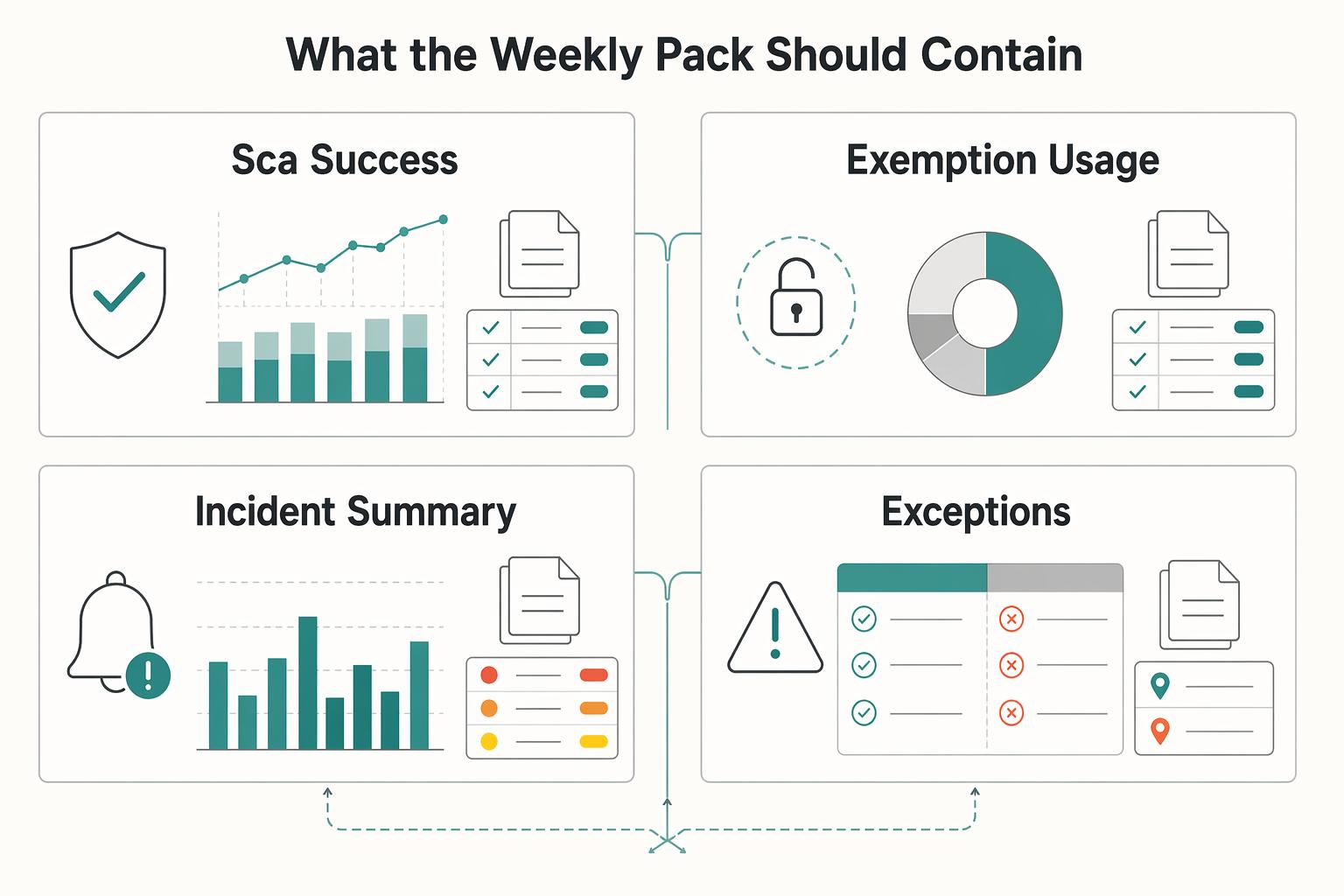
Platform operators need a stricter PSD2 SCA operating model now because failures show up first as declined payments, abandoned checkouts, support load, and missed revenue, not just as legal findings. If you cannot show who owns each SCA decision and how it was implemented, you have a payments control gap. Teams tracking that fallout should compare SCA-specific friction against a [payment decline benchmark view](/blog/payment-decline-rate-benchmarks-platform-industry-standards) so they do not treat every approval-rate problem as the same issue.
PSD2 to PSD3 for Platform Operators: What to Implement Now, Stage for Later, and Escalate Early
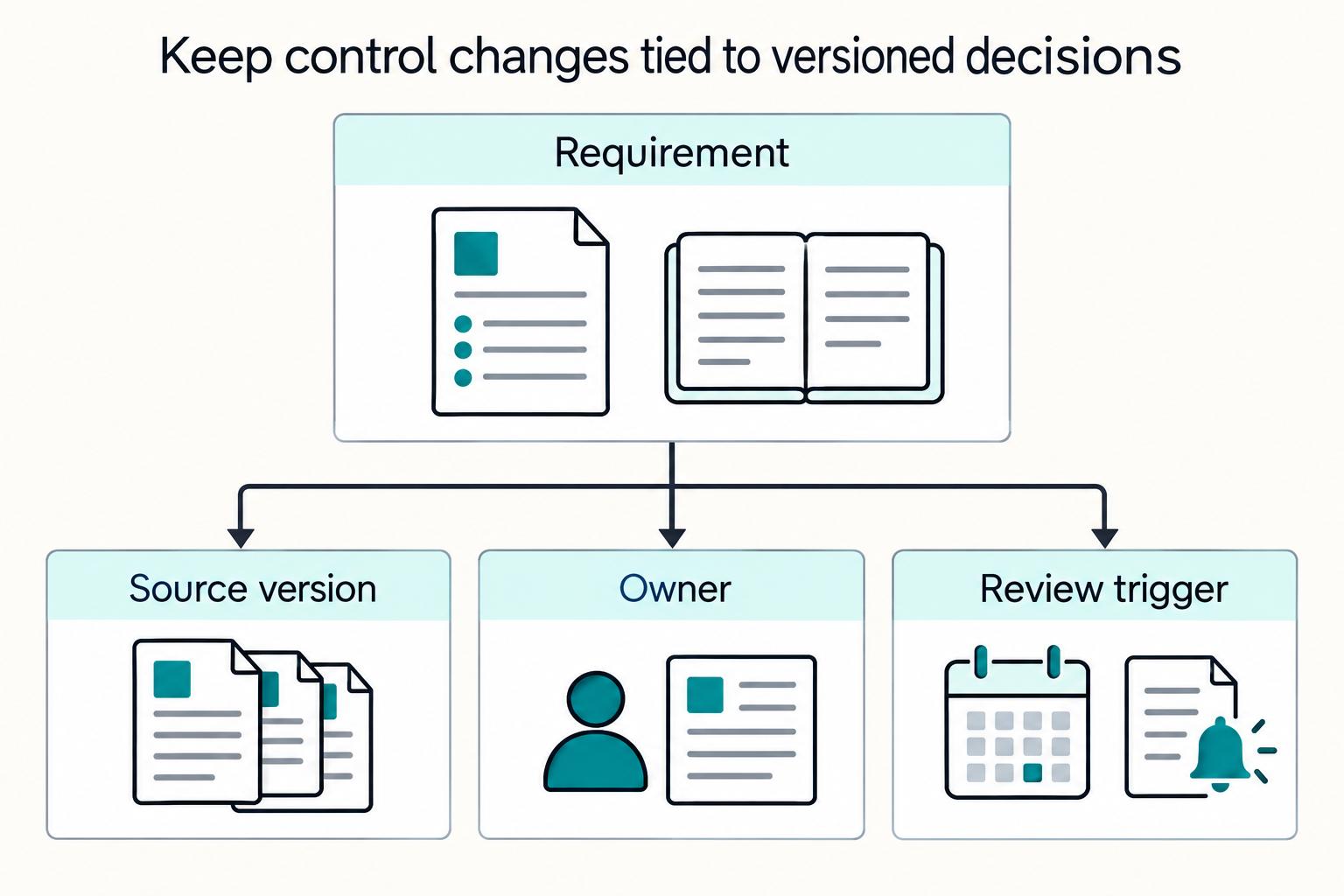
If you run a platform and need decisions now, start with one split. Decide what to implement immediately, what to keep reversible while PSD3 and the Payment Services Regulation (PSR) details are still unsettled, and what to escalate to specialist review before it hardens into product or policy.

Permanent Home Test in a Tax Treaty: Meaning, Evidence, and Tie-Breaker Rules
For the elite global professional, "permanent home" is not a term of comfort; it is a high-stakes legal definition that can trigger crippling double taxation. While other guides offer academic theory, this is a strategic playbook. We will transform your compliance anxiety into agency with a clear, three-step framework to audit your footprint, build your evidence, and early control your tax residency.