
Quick Answer
Delaware C-corp formation is one step toward payment readiness. Compare package inclusions and renewals, complete corporate and founder-stock records, track any 83(b) deadline from the actual transfer, and confirm bank and payment approval before live collections or payouts.
Choose the entity path that protects first payments#
The key decision is not filing speed. It is choosing the entity and setup path that gets you to first compliant payment with the least rework. For platform founders, that means deciding company form first, then validating the legal, tax, banking, and payment steps that follow.
If a priced venture round is likely soon, confirm prospective investors’ entity requirements before filing. A Delaware corporation offers a familiar structure for preferred stock and negotiated investor rights; that can justify the extra administration even when the founders live elsewhere.
A privately held business should also compare formation where it actually operates. Delaware incorporation does not replace registration, taxes, employment rules, or licensing in other applicable jurisdictions. Ask a tax adviser to compare the founders’ residence, operating footprint, funding plans, and expected distributions.
This guide follows that sequence from entity choice to payment readiness. A C corp is an IRS Subchapter C tax status, while a Delaware corporation is a state-law entity registered in Delaware. Filing is only one milestone. Tax identity, banking access, payment onboarding, internal approvals, and compliance records may not all become ready at the same time.
Plan the EIN application alongside the post-formation work. An EIN is a separate IRS tax identifier; it is not proof of payment-provider approval. Some eligible Atlas companies can apply for financial services before it arrives, but each provider controls eligibility and activation. Stripe’s bank-account guidance describes this conditional path.
The goal here is not a faster filing confirmation. It is a decision-ready path from incorporation to first live payment that can hold up under bank review, payment activation, and early diligence.
Start with the entity decision before you pick a platform#
Choose the entity before you choose the platform. Start by mapping what a Delaware C corporation setup includes, then compare that path against alternatives before you buy an all-in-one setup product.
Investor preference and operating need overlap, but they are not the same decision. A Delaware setup is not just filing paperwork. It includes choosing a unique name, appointing a registered agent, issuing stock, and handling regulatory requirements, and those steps require due diligence. Legal Nodes also frames the work in 2 stages: incorporation and post-incorporation.
Use these gates before any vendor demo:
- which incorporation tasks the provider handles versus what stays with you
- what the provider handles after formation in the post-incorporation stage
- how cap table setup and stock issuance will be completed and approved
Then verify the split between formation and post-incorporation. The failure mode to avoid is a company that is formed on paper but still incomplete in practice, including founder equity that was promised but never actually issued. If you want the entity comparison, see Delaware C-Corp vs. Wyoming LLC: Choosing a US Business Entity.
Define the legal pieces founders confuse in week one#
Formation and organization are separate steps. The certificate can name initial directors; otherwise, the incorporator elects them during organization. Keep the incorporator action and subsequent board approvals in the company records. Filing the certificate alone does not document founder stock issuance. Delaware §§107–108 set out these organizational steps.
Do not treat the EIN, 83(b) election, founder equity paperwork, board resolutions, and Delaware franchise tax as one "done at formation" bucket. Treat each item as a separate workstream with a clear owner and status.
What is clear on day one#
- Identify who performs the incorporator action and who serves on the initial board.
- Record the applicable bylaws, officer appointments, and founder-stock approvals through the proper corporate actions.
- Treat investor board seats as negotiated financing terms, rather than an automatic legal requirement triggered by fundraising.
What to verify instead of assuming#
Assign a named owner to each task and a due date tied to the relevant event. For restricted stock transferred for services, an optional section 83(b) election must generally be filed within 30 days after the property transfer—not 30 days after incorporation or EIN arrival. Have the founder and tax adviser decide whether an election is appropriate, then retain filing evidence. IRS Form 15620 instructions explain the election and deadline.
Compare what Stripe Atlas, Clerky, Every.io, and Capbase actually include#
Choose based on the delay you most need to remove, not a speed headline. The main gap across platforms is unclear ownership for EIN, equity paperwork, 83(b), and post-formation follow-through.
Compare the current package scope below, then obtain a written answer for any eligibility or service boundary that affects your launch. Prices and features were checked in October 2026; provider turnaround claims describe particular steps, rather than a guaranteed date for the first payment.
| Platform | Formation and EIN | Founder equity and 83(b) | Ongoing work |
|---|---|---|---|
| Stripe Atlas | $500 package: Delaware formation, EIN and first-year registered agent | Founder share issuance and 83(b) filing included | Registered agent renews at $100/year; taxes and bespoke legal work remain separate |
| Clerky | $427 incorporation includes state fees and first-year agent; EIN application support available | Separate $299 post-incorporation product includes founder documents and prefilled 83(b) forms/instructions; founder files the election | $819 Company Lifetime Package includes specified legal-document products; third-party charges and agent renewals remain separate |
| Every | Advertises free Delaware incorporation, agent and EIN retrieval | Lists startup legal documents and automated 83(b) support; confirm actual submission and proof | Confirm agent renewal, service eligibility and charges for bookkeeping, payroll or tax work |
| Capbase | Advertises Delaware formation; annual subscription $999 until a priced round | Founder stock, cap-table and 83(b)-related workflows | Confirm EIN handling, election filing evidence, agent renewal and post-round pricing |
These entries come from Atlas, Clerky’s pricing, Every’s incorporation page, and Capbase’s FAQ. An election generated in a dashboard is not evidence that it was filed. Ask who submits it, how the deadline is tracked, and what dated proof the founder receives.
Standardized templates vs specialist involvement#
Template provenance and access to advisers are different benefits. A law firm’s work on standard documents does not itself create an attorney-client relationship for your company. Determine whether your facts fit the standard workflow before relying on it.
| Platform | Document and support approach | What to clarify |
|---|---|---|
| Atlas | Self-service incorporation using Cooley-developed templates; Atlas is not a law firm | Whether your ownership, vesting and IP arrangements fit the standard flow |
| Clerky | Online legal-document workflow covering formation and post-incorporation actions | Which package covers each action and where bespoke counsel is needed |
| Every | Integrated incorporation and back-office service with specialist-assisted formation | What legal advice, if any, your engagement includes |
| Capbase | Digital corporate records, equity and fundraising workflows | Who reviews unusual terms and what subscription changes after financing |
Keep an adviser available for nonstandard founder arrangements, regulated activities, cross-border tax exposure, existing IP transfers, and a conversion from another entity. A convenient workflow can organize the paperwork without resolving those substantive choices.
What to verify before you buy#
Before you buy, pin down the handoff points that usually create rework:
| Area | Verify |
|---|---|
| EIN support | Whether EIN support is included as hands-on help, filing, or instructions only |
| Founder stock documents | Whether founder stock documents are included and finalized, or still require separate counsel |
| 83(b) support | Whether 83(b) support exists, and if so, whether it is template-only or includes tracked completion |
| Post-incorporation tasks | Which post-incorporation tasks are covered, such as compliance reminders or cap table changes |
| Pricing terms | Final pricing terms, renewal fees, and eligibility caveats |
Recommendation#
Atlas fits founders seeking a bundled standard formation path. Clerky lets founders buy formation and post-formation document work separately or in a larger package. Every combines formation with back-office services; Capbase emphasizes continuing equity and fundraising administration. Choose on your actual missing tasks, eligibility and renewal costs, rather than a universal ranking.
Map first-year cost reality beyond the signup price#
Build the first-year budget from the selected package plus unbundled obligations. Count state filing and first-year agent charges once when they are included. Keep a reserve for tax preparation, registrations where you operate, legal advice and later corporate actions.
| Cost line | Current planning basis | Budget action |
|---|---|---|
| Formation package | Atlas $500; Clerky incorporation $427 or lifetime package $819; Every advertises $0; Capbase $999/year until a priced round | Compare equivalent included tasks; Clerky post-incorporation separately costs $299 |
| State filing | Included in the cited Atlas and Clerky formation prices | Obtain itemization for the chosen service; account separately for amendments or extra expedited services |
| Registered agent | Atlas first year included, then $100/year; Clerky first year included | Ask other providers for renewal amount, date and cancellation terms |
| Delaware annual report and franchise tax | Non-exempt domestic corporation: $50 report fee; tax minimum $175 by authorized shares or $400 by assumed par value | Compute the applicable tax rather than budgeting the minimum automatically |
| Tax and operational compliance | Tax preparation, other-state registrations, payroll, sales-tax work and bespoke advice vary | Obtain quotes for the obligations your operations actually trigger |
| Mercury core banking | $0 monthly subscription | Check usage, international-transfer and foreign-exchange fees separately |
| Mercury Plus / Pro | Annual-plan equivalents shown as $29.90 / $299 per month | Annual plans are charged yearly; compare current monthly-plan quote before purchase |
| Accounting software and extra users | Separate subscription, add-ons or a time-limited promotion may apply | Confirm included users, post-promotion price and whether a separate accounting plan is needed |
For franchise-tax budgeting, compare both Delaware calculation methods using the actual authorized shares, issued shares and gross assets. The minimum is not a quote for every startup. The annual report and tax for the prior calendar year are due March 1, including corporations with no revenue. Delaware’s annual-tax guidance gives the rules and calculation links.
Budget recurring banking costs#
Banking fees matter once operations start, but they do not replace incorporation or tax costs. Mercury’s current pricing separates free core banking from paid operational features. Include the tools required for invoicing, approvals and reconciliation rather than selecting the highest tier by default.
Annual-plan equivalents can make a subscription look cheaper than its month-to-month option. Record the actual amount due at signup, the renewal date, any applicable sales tax, and transaction fees. Evaluate accounting promotions over a full year instead of assuming the promotional period continues.
Mercury’s monthly subscriptions renew on the first of the month; upgrades during a billing cycle are prorated. Its help page describes a seven-day payment grace period before paid features are lost. Assign a billing owner so a failed subscription charge does not interrupt recurring workflows. Mercury billing guidance.
The pricing page lists ACH debit pricing by transaction, while the help page uses different shorthand. Obtain the applicable fee schedule for your account and planned volume before forecasting collection costs; keep the confirmed schedule with the budget.
Cheap now, expensive later#
If timeline risk is higher than pure budget pressure, prioritize options that reduce manual handoffs and rework in your incorporation and operations process.
Remediation costs for incorporation or compliance gaps are not quantified here, so keep those as explicit risk lines instead of assuming they are zero.
Ask for a written inclusion list and a quote for excluded tasks. An unanswered question is a budget uncertainty to resolve, rather than proof that a service is included or excluded.
For a related walkthrough, see The Global SaaS Founder Blueprint for Delaware C-Corp and Stripe Atlas.
Plan the order from Delaware filing to first live payment#
Some steps depend on earlier evidence; others can proceed together. Form the corporation before requesting its EIN. After formation, coordinate governance, founder equity, tax-deadline tracking and eligible bank applications in parallel. Do not let a slower EIN or bank review push an 83(b) election beyond its deadline.
The IRS instructs founders to register the entity before applying for an EIN. Atlas and Clerky offer formation and post-formation workflows, but you still need to verify the completed records and the payment account’s status. IRS EIN application guidance explains the eligibility rules.
The sequence that keeps launch risk low#
Use the table to track dependencies and unresolved work. It is an operating checklist, not a rule that every task must finish before any other task starts.
| Stage | Evidence to retain | Dependency or risk |
|---|---|---|
| Delaware formation | Filed certificate and effective date | Use the formed company’s identity for subsequent applications |
| EIN | IRS confirmation, application record, and any documented pre-EIN provider route | Entity forms first; account activation depends on the provider’s requirements |
| Organization and founder equity | Incorporator/board actions, signed purchase documents, payment evidence and issued-share ledger | Complete the corporate approvals and record the actual stock transfer |
| 83(b), when appropriate | Founder’s election, submission/postmark evidence and copies required by the instructions | Track the 30-day transfer-based deadline independently of bank and EIN timing |
| Bank and payment onboarding | Approved account, permitted activity and aligned company/ownership details | Application acceptance is different from approval or live functionality |
| Collection and payout | Approved rails, transaction/settlement records and approval/status ownership | Receiving funds does not itself enable every payout corridor |
Clerky currently describes a typical two-to-three-business-day return of the filed certificate. Atlas advertises expedited formation. These estimates concern the formation leg; IRS processing, corrections, beneficial-owner checks and provider review can take additional time. Set the launch date using confirmed account readiness.
Readiness gates worth being strict about#
EIN completion is often a separate milestone from formation, even when one provider bundles both steps. Some provider flows advertise bank-account application before EIN, so confirm the exact path you are using.
Complete founder-stock approvals and signed purchase documents, record payment and the actual transfer date, and keep the issued-share ledger consistent. Where an 83(b) election is appropriate, schedule submission immediately; the separate 30-day deadline cannot wait for a bank account or EIN.
Store each completed record as it becomes available. A missing document should hold up the task that depends on it; unrelated permitted work can proceed with a named owner and an accurate status.
The failure pattern to watch for#
A stale assumption is that "incorporated" means "ready to charge customers." It confirms entity formation, not full onboarding readiness in every scenario.
Uncoordinated parallel work causes trouble when legal names, owner details or addresses drift across applications. Parallel work itself is useful: use one control sheet for the company identity and track dependencies, owners and evidence across all services.
Clerky also advertises a bank-account application flow labeled "No EIN Needed." Treat that as path-specific, not a general rule across all banks, payment providers, or payout programs.
Verify the first money movement before you scale#
Before you scale traffic, run a launch checkpoint and keep the evidence:
- Exercise collection, reconciliation and payout states in a supported test environment first, including a failure and retry.
- For the first authorized live transaction under the provider’s rules, retain the collection and settlement records; do not treat a collection success alone as settled cash.
- Reconcile gross amount, fees and net settlement, then retain the approved payout instruction and final or exception status.
Where your Gruv configuration supports the relevant markets and program, check retry behavior, authorization and transaction records before expanding volume. Ask the provider which features are enabled for the account; use the same business obligation reference to avoid creating a second payout when retrying a failed request.
Before launch, map your readiness gates to an operational payout flow so each milestone has evidence and owners: Review payout workflow requirements.
Build the post-incorporation document pack investors and banks expect#
Start the document pack during formation and add completed records as they arrive. Keep formation, governance, ownership and tax identity aligned. Distinguish an outstanding application from an issued identifier, and a prepared election from a submitted one.
The minimum pack to assemble and store now#
Keep final signed versions, not drafts, and assemble at least:
| Document area | Include |
|---|---|
| Formation | Filed certificate, amendments, bylaws and organization records |
| Governance | Incorporator/director-election records and applicable board approvals for officers and stock issuance |
| Founder equity | Signed purchase/vesting and IP documents, consideration/payment evidence, stock ledger and matching cap table |
| EIN | IRS confirmation and any outstanding application record clearly marked as pending |
| 83(b), if elected | Election copy and dated submission/mailing evidence; a draft alone does not demonstrate filing |
Run a simple consistency check across the full pack. Names, dates, share counts, officer titles, and signer identities should match across legal docs, cap table, EIN record, and banking or payment profiles.
Two common failure modes are easy to avoid: equity treated as "agreed" but not formally issued, and missing the 83(b) timing window.
Change events that can force document maintenance#
Certain changes can trigger record updates and downstream account changes, including:
- Company name changes
- Authorized share updates
- Officer or director changes
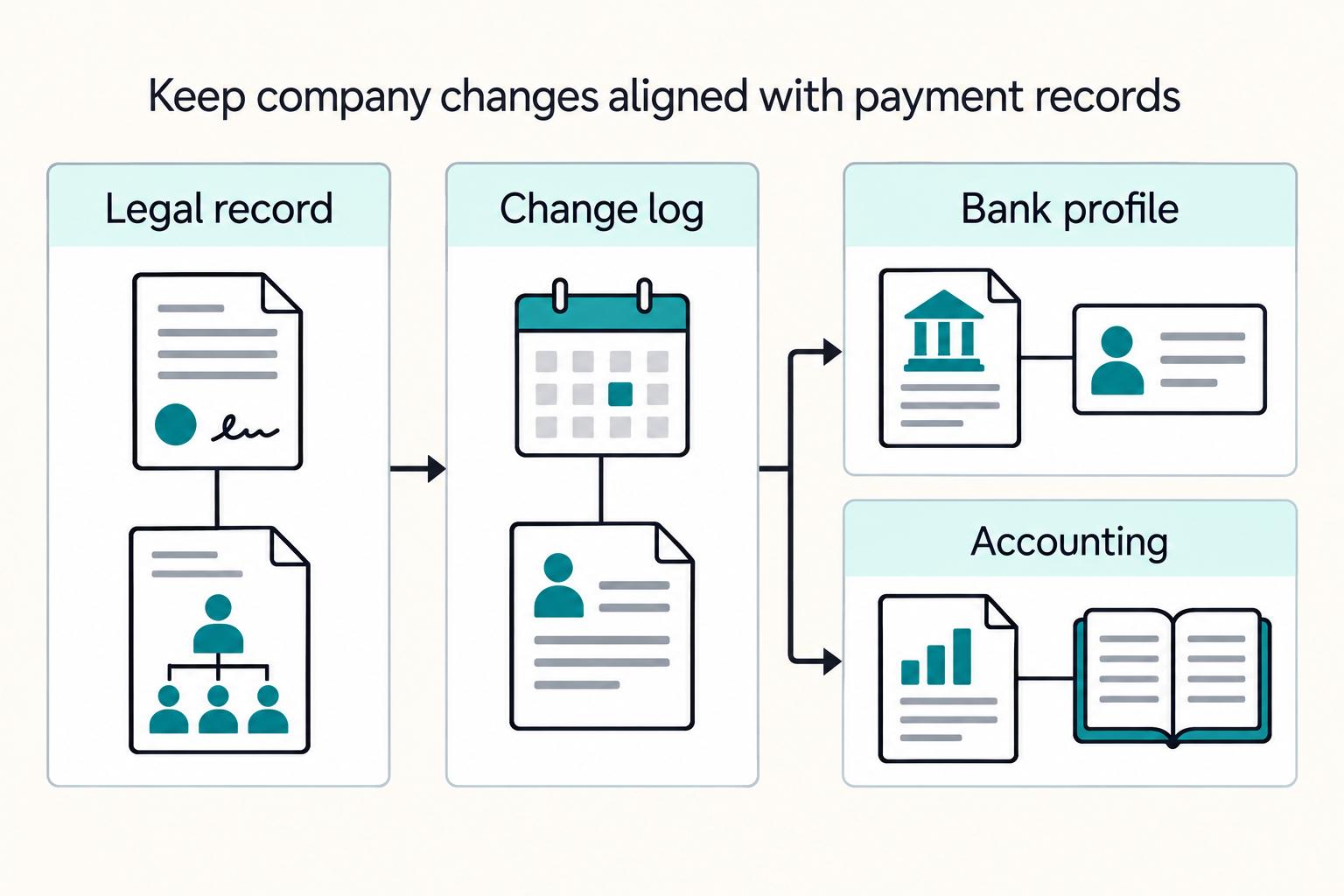
The exact maintenance path varies by provider and situation. Treat changes to legal identity, governance, or ownership as legal-record updates first, then mirror them in banking, payment, and accounting systems.
Set a clean handoff between founders and finance ops#
This handoff matters because legal records and money-movement records can drift if no one owns the join. Founders often create the initial records; finance ops often maintains operational alignment. Make that transition explicit.
Use one shared folder for final signed files, labeled by document type and effective date. Maintain a simple control sheet for each change: what changed, which document proves it, and which downstream accounts were updated.
The founder owns the decision and filing obligation for their individual 83(b) election, with tax advice where needed. If a service submits it, retain proof and confirm the deadline; the company’s document owner should store the permitted copy without treating dashboard preparation as completion.
If you want a deeper dive, read A Guide to Board Resolutions for a Delaware C-Corp.
Handle cross-border founder friction before it delays launch#
For non-US founders, filing a Delaware C corporation is only the first milestone. Incorporation and post-incorporation are separate stages, so plan onboarding work accordingly.
A Delaware C corporation is still the standard path for VC-track startups, but entity choice alone does not make operational setup automatic. If you start elsewhere and move later, reincorporation can add legal work, approvals, and contract risk, so sequence matters.
Do not overread "global support"#
Founders outside the U.S. can form a Delaware corporation, but formation-service eligibility and financial-account eligibility are separate. Check the actual founder residence, business location, identity documents, permitted industry and target markets for each provider.
Use a simple rule: if your near-term launch depends on multi-country payouts, confirm coverage and compliance requirements before you finalize platform choice. Get that confirmation in writing, and re-check assumptions because laws and practices change.
Evidence checklist before onboarding#
Before applications start, prepare a compact evidence pack:
- Planned authorized shares, classes, par value and founder allocation before filing; actual issued-share records after the approved transfer
- Filed incorporation records and a tracked post-incorporation task list
- Existing contracts and IP ownership for adviser review if changing entities; identify consent or assignment requirements
- Written eligibility assumptions, responsible owners and dates for rechecking rules or provider coverage
Keep this documentation consistent across internal notes and provider conversations so requirements are easier to reconcile.
Choose payment rails based on your platform model and countries#
Choose rails from your money flow outward, not from feature lists. A Delaware C corporation may satisfy an entity prerequisite, but it does not by itself confirm that your launch-country collection or payout paths are available.
The first cut is still your platform model. Subscription SaaS, marketplace split flows, and global contractor payouts create different control needs. Evaluate rails against the operating outcome you need most: traceable settlement, payout visibility, manageable reconciliation, and clear exception handling.
Match the rail to the operating model#
| Operating model | Rail priority |
|---|---|
| Subscription SaaS | Favor rails you can reconcile cleanly from charge to settlement |
| Marketplace or split-flow products | Prioritize visibility into gross amounts, platform fees, payee amounts, and exceptions |
| Cross-border contractor payouts | Start with target corridors and how failures are surfaced, then evaluate batch tooling only where it is enabled for your account and markets |
Incorporation helps, but onboarding gates still win#
Check whether your EIN applicant qualifies for the IRS online route: the principal place of business must be in the U.S. or its territories and the responsible party must have an SSN or ITIN. For a principal business outside the U.S., IRS guidance describes phone, fax and mail applications. A vendor’s ‘instant’ claim is not a guarantee for every international founder.
Use a simple operator rule: incorporated is not the same as payment-ready. Confirm your entity status, account onboarding state, and target-country support on the same account before launch.
Use explicit support language#
For Virtual Accounts, payout batches, and market-specific rails, keep reviews explicit about:
- Where supported: whether the rail is available for your countries, entity profile, and use case.
- When enabled: whether your specific account has access after review.
- How exceptions appear: what you will see when a payment or payout is delayed, fails, or needs intervention.
Before traffic cutover, run an end-to-end test and verify you can trace charge status, settlement references, payout status, and failure states in the tools your team will actually use.
Set compliance and reconciliation controls before first payout#
Before first payout, treat compliance and reconciliation as core operations, not cleanup after launch. Incorporation is just the beginning, and these tasks are not optional if you want audit-ready records and fewer penalty risks.
Set the minimum control layer#
Use a dedicated company bank account to separate business transactions from personal spending. If the company uses a card, keep that activity separate too; a credit-card product is not a legal prerequisite to formation. Define transaction review and record retention for your model and markets.
Keep the first version simple. Assign an owner for each check, store evidence in one place, and make sure each transaction has detailed supporting records.
Before going live, run one verification pass: can your team produce complete records without rebuilding the story from inbox threads?
Make reconciliation artifacts non-negotiable#
Keep detailed records from day one, even at low volume. At minimum, maintain transaction-level detail and complete, timely statements.
Keep detailed transaction records from the first live activity. If a bank statement arrives later, reconcile against the available transaction and settlement reports, then reconcile the statement when issued. Record who handles differences and how unresolved items are escalated.
Tie finance cadence to legal records#
Calendar the Delaware annual report and franchise tax for March 1, plus the federal corporate return and applicable operating-state filings. Most domestic corporations must file Form 1120 even without taxable income; it is generally due on the 15th day of the fourth month after year-end, with exceptions. A Delaware corporation does not automatically owe Delaware gross-receipts tax merely because it incorporated there. Screen the actual business activity with your adviser. IRS Form 1120 instructions.
For foreign ownership, ask the tax preparer whether Form 5472 applies: a 25%-foreign-owned U.S. corporation with reportable related-party transactions can have additional reporting duties. Separately, U.S.-created companies are currently exempt from FinCEN BOI reporting; that exemption does not remove bank ownership checks or tax filings. See IRS Form 5472 instructions and FinCEN’s current BOI guidance.
Retain supporting records for filings and transactions, and keep ownership clear for filing cadence and transaction records.
Conclusion#
Choose the incorporation path that gets you to first compliant payment with the fewest unresolved dependencies, not the fastest filing confirmation. For many near-term VC or institutional fundraising paths, that can mean a Delaware C-corp, but only if the setup also supports funding, banking, payments, and ongoing compliance.
Use the same decision order each time, especially when two providers look similar:
- Entity fit: agree the financing requirements and compare C-corporation taxation with alternatives for the actual owners and operating footprint.
- Inclusion gaps: obtain the filed certificate, corporate approvals and completed ownership records; distinguish prepared forms from submitted filings.
- Full-year cost and timing: budget renewals, tax preparation and calculated franchise tax, and track transfer-based deadlines separately from account review.
- Payment readiness: verify the approved collection and payout paths, reconcile the first authorized activity and retain exception records.
QSBS benefits require more than choosing a C corporation: original issuance, eligible business activity, asset limits and other requirements matter. For qualifying stock acquired after July 4, 2025, federal law provides potential exclusions of 50% after three years, 75% after four, and 100% after five; older stock follows its applicable rules. Have a tax adviser assess the actual stock acquisition and any conversion rather than counting from an LLC’s start date. Public Law 119-21, §70431.
Next step: shortlist two providers, run the same readiness checklist against both, and choose the option with fewer operational unknowns for your target markets.
If you want a practical check on coverage, compliance gates, and rollout sequencing for your model, discuss your launch plan with Gruv.
Frequently Asked Questions
Do I need a Delaware C Corporation before I can accept payments for a new platform?
No. Choose the entity based on ownership, taxes, operating location and financing plans, then meet the payment provider’s eligibility and verification requirements. Delaware incorporation can fit venture financing, but it is not a universal prerequisite to accepting payments.
What do incorporation platforms usually include, and what still needs manual setup after filing?
Scope varies by package. Atlas bundles formation, EIN and founder-equity work; Clerky separates incorporation and post-incorporation products unless you buy a broader package. Confirm agent renewal, actual 83(b) submission, tax preparation and bespoke advice. Filing a certificate does not complete every downstream task.
How long does it take to go from Delaware Secretary of State filing to first live payment in practice?
There is no universal end-to-end timeline. Published formation estimates cover the state-filing step. EIN processing, document corrections and bank or payment review can take longer. Use confirmed approval and enabled rails to set the first-payment date.
Which platform is usually better for non-US founders who need a fast Employer Identification Number (EIN) path?
Compare the route that fits the company’s principal business location and responsible party, rather than choosing by a blanket speed claim. The IRS online route has U.S.-location and SSN/ITIN requirements; international applicants have phone, fax and mail routes. Confirm whether any advertised pre-EIN financial service is available to your company.
What are the real first-year costs beyond the advertised incorporation fee?
Budget the package, unbundled filing costs, agent renewal, Delaware annual report and calculated franchise tax, tax preparation, operating-state obligations, banking usage and accounting tools. Avoid counting bundled filing fees twice. Review Delaware franchise-tax planning alongside the official calculation rules.
What should founders complete immediately after incorporation: 83(b) election, founder equity setup, bank onboarding, or compliance controls?
After formation, coordinate organization, stock issuance, EIN and eligible bank applications in parallel where dependencies permit. For restricted stock, decide whether an 83(b) election is appropriate and track its generally 30-day deadline from the transfer. Keep tax deadlines independent of account approval.
When should a founder choose Wyoming LLC first and convert later instead of starting as a Delaware C-corp?
An LLC-first path deserves a separate legal and tax comparison when venture financing is not imminent. Wyoming does not eliminate obligations where the business operates. Before converting, review taxes, ownership, IP and contract transfers, financing requirements and any QSBS eligibility or holding-period consequences with advisers.
Try a related tool
Researched and edited by the Gruv editorial team. Gruv builds cross-border billing, payouts, and finance-operations software for global businesses.
Sources
- corp.delaware.gov/howtoformtrusted
- corp.delaware.gov/paytaxestrusted
- delcode.delaware.gov/title8/c001/sc01/index.htmltrusted
- docs.stripe.com/atlas/payments-business-banktrusted
- fincen.gov/boitrusted
- govinfo.gov/content/pkg/PLAW-119publ21/html/PLAW-119publ...trusted
- irs.gov/businesses/small-businesses-self-employed/ge...trusted
- irs.gov/businesses/employer-identification-numbertrusted
Educational content only. Not legal, tax, or financial advice.
Related Posts
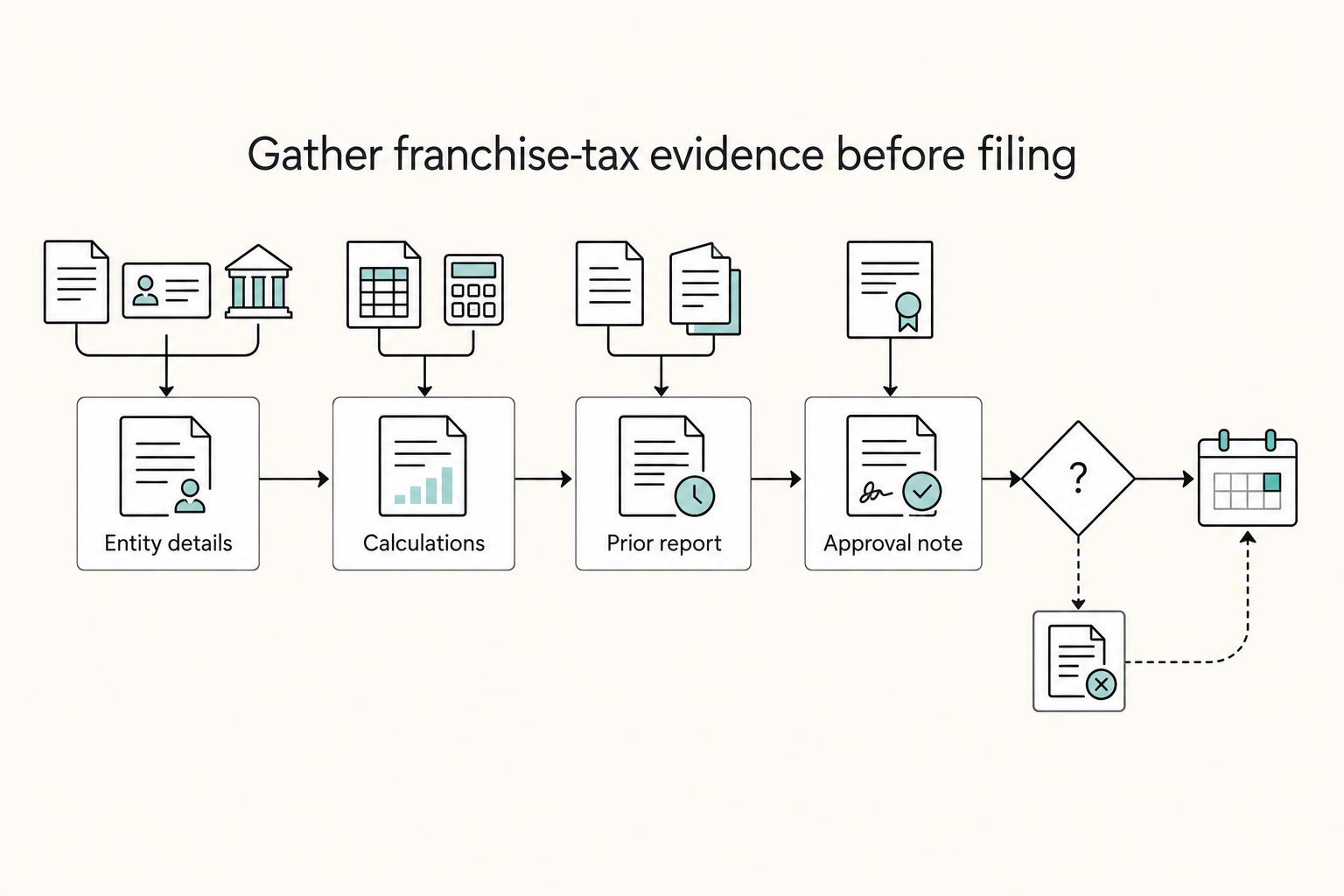
Delaware C-Corp Franchise Tax: Filing Methods, Deadline, and Annual Checklist
If your company is a Delaware C corporation, treat franchise tax as a recurring compliance obligation, not a one-time admin task. The goal is not to file once. It is to file accurately every year using the same decision logic, the same checks, and the same proof package.
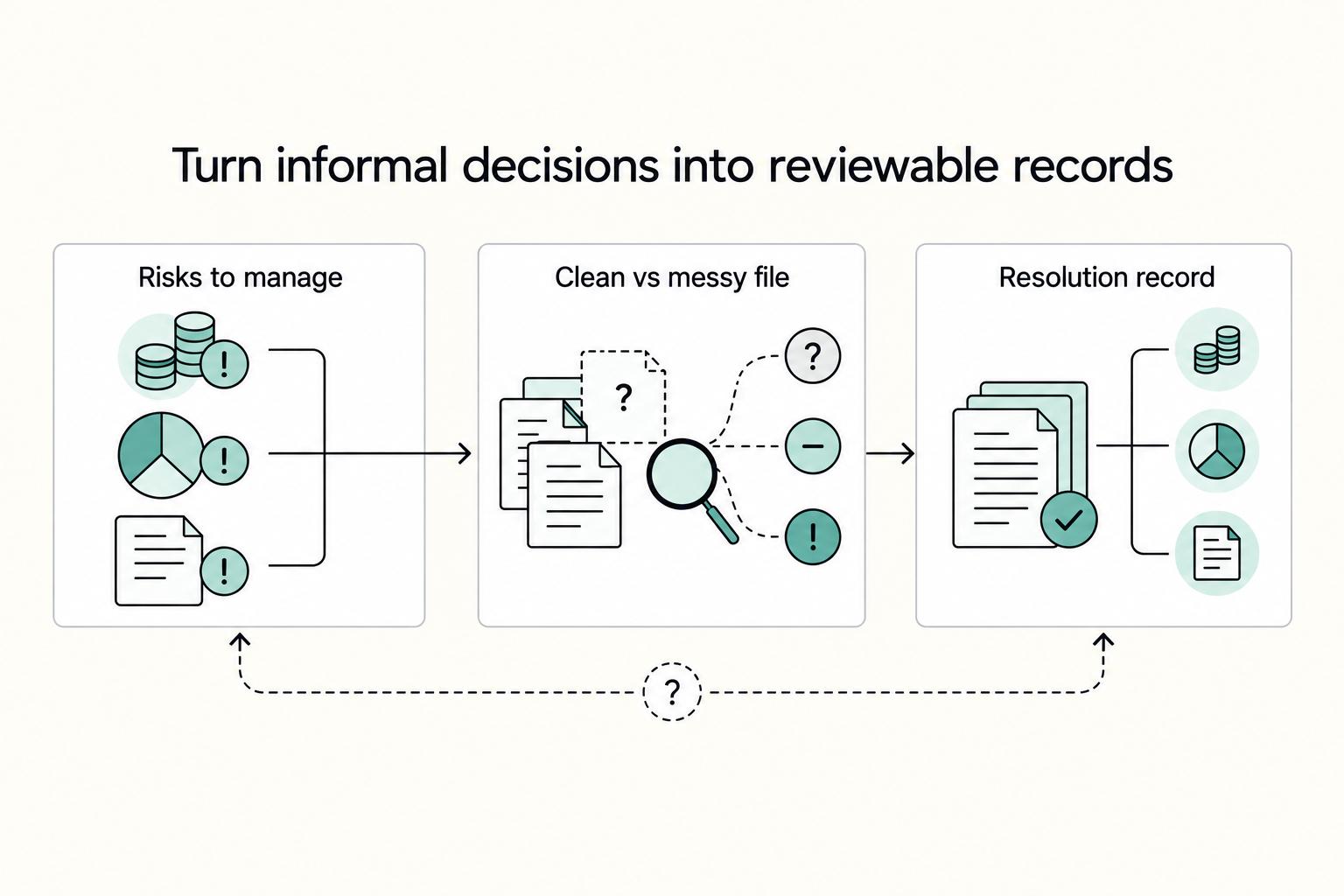
Board Resolutions for a Delaware C-Corp That Stand Up to Review
Your filing is done, but the company still needs the meeting mechanics it will run on. In practice, your **bylaws** and **certificate of incorporation** can set where stockholder meetings happen, and if they do not, the board sets that under § 211(a)(1).

Delaware C-Corp vs Wyoming LLC for Your Next Growth Stage
Choosing between a Delaware C-Corp and a Wyoming LLC is a stage-fit decision, not a state popularity contest. For `delaware c corp vs wyoming llc`, the real question is which structure you can run cleanly over the next 12-24 months while keeping room to scale.