
Quick Answer
A Delaware C-corp must file an Annual Franchise Tax Report and pay franchise tax each year, even if it does business outside Delaware. Use the corporate filing path, compare the Authorized Shares Method with the Assumed Par Value Capital Method, and file the lower lawful result by March 1. Keep one reconciled evidence packet and rerun calculations if inputs change before submission.
What Delaware C-Corps Need to File Each Year#
If your company is a Delaware C corporation, treat franchise tax as a recurring compliance obligation, not a one-time admin task. The goal is not to file once. It is to file accurately every year using the same decision logic, the same checks, and the same proof package.
Preventable errors often start before any tax calculation. Teams can mix tax categories, confuse entity lanes, or rely on old assumptions from a prior cycle. Delaware materials reference corporate income tax separately from the corporate franchise filing path, so keep those tracks separate from day one and in your notes.
The scope here is intentionally narrow. This article focuses on State of Delaware franchise compliance for a C corporation. It does not replace federal planning or non-US tax advice.
Start with two checks before you pull numbers:
- Use the Delaware Division of Corporations portal to confirm entity status and verify the exact legal entity.
- Stay in the corporate path
File Annual Franchise Tax Reportand avoidPay LLC/LP/GP Tax.
Then add one simple control that saves time later: write a dated note with the entity-status result, the filing lane selected, and the person who confirmed it. That single note can cut down repeat debates with accounting, legal, or your registered agent when filing week gets crowded.
Use this guide in a practical way: read each section once, then run the annual checklist line by line against your current-year records. Any mismatch is a stop signal to resolve before payment.
Define the Terms Before You File Anything#
Set your filing lane first. The corporate franchise tax is tied to keeping a Delaware charter active.
| Method | Range or rate | Stated amount |
|---|---|---|
| Authorized shares schedule | Up to 5,000 authorized shares | $175 minimum |
| Authorized shares schedule | 5,001 to 10,000 authorized shares | $250 |
| Authorized shares schedule | Above 10,000 authorized shares | $250 plus $85 per additional 10,000 shares or part, capped at $200,000 |
| Assumed par value capital method | Per $1 million or portion | $400 rate, $400 minimum |
Filing labels can blur together in day-to-day conversation. If your team uses them loosely, keep a one-page glossary in the filing folder so everyone is working from the same labels.
Agency roles matter. The Secretary of State administers the corporate franchise tax. The Delaware Division of Revenue publishes other tax guidance, including employer withholding duties. That guidance is useful, but it is separate from corporate franchise tax administration.
Method terms matter because each method uses a different calculation and a different minimum. Under the authorized shares schedule, domestic stock corporations are at a $175 minimum up to 5,000 authorized shares and $250 for 5,001 to 10,000. Above that, the amount is $250 plus $85 per additional 10,000 shares or part, capped at $200,000. Under the assumed par value capital method, the rate is $400 per $1 million or portion, with a $400 minimum.
So the method choice is not cosmetic. It directly affects what you pay.
If someone cites 30 Del.C. Section 1902(b)(6) for your position, treat it as a legal-review item and get written support before relying on it. This section does not interpret that citation.
Use this checkpoint before your first filing pass:
- Confirm the legal entity is a Delaware domestic corporation.
- Confirm you are preparing the corporate franchise tax path, not a non-corporate path.
- Confirm which calculation method you are using and what minimum applies.
- Confirm any exemption position is supported before action.
Do You Owe Delaware Franchise Tax If You Live and Work Outside the US#
Start with entity type, then confirm the Delaware service lane that matches it. If your records show a Delaware C corporation, start in the corporate franchise path and deviate only with written, fact-specific professional advice.
The most common mistake is collapsing two separate questions into one. This article supports filing and payment paths and entity verification; it does not establish Delaware corporate income-tax treatment or nonresident exemption outcomes.
Run this verification pass before you file or pay:
- Confirm in formation records that the entity is a corporation, not an LLC or LP.
- Use Delaware
Check Entity Statusto confirm the record matches your legal entity. - Use
File Annual Franchise Tax Reportfor the corporate lane, notPay LLC/LP/GP Tax. - Review
Registered Agentsinformation and confirm your registered-agent details are current.
If the entity type is unclear in your records, pause and resolve that first.
One common scenario: a founder lives outside the US and assumes non-US operations alone answer the Delaware filing question. Do not assume that conclusion holds. The right move is boring and reliable: classify the entity first, then follow the lane tied to that entity.
If the structure decision is still open, settle it before you file and use Delaware C-Corp vs. Wyoming LLC: Choosing a US Business Entity as a side reference. Related context: The Rise of 'Fractional' Work: A New Model for Senior Freelancers.
Stop Mixing C-Corp Rules With LLC LP and GP Rules#
Keep the lanes separate. Third-party Delaware compliance summaries describe a C corporation as using the Annual Franchise Tax Report plus franchise-tax payment lane, while LLCs, LPs, and GPs typically use an alternative-entity annual tax lane. For Delaware income tax, the Division of Revenue says LLC classification follows federal classification.
Mix-ups usually happen when teams reuse a prior checklist built for a different entity type. An LLC checklist can be perfectly accurate for an LLC and still be wrong for a corporation. If your entity is a corporation, use corporate filing rules and corporate checks from start to finish.
| If your entity is... | Primary annual lane to verify | Common mix-up to avoid |
|---|---|---|
| C corporation | Annual Franchise Tax Report plus franchise payment (per third-party summaries) | Assuming LLC/LP/GP payment instructions cover corporate filing requirements |
| LLC | Typically an alternative-entity annual tax path | Treating an LLC like it owes the corporate franchise report |
| LP or GP | Typically an alternative-entity annual tax path | Copying corporate checklist items without confirming entity type |
Use a red-flag rule when a franchise-tax message or checklist arrives: do not treat it as final until you confirm entity type and filing lane. Short instructions are easy to misread under deadline pressure.
Another guardrail is clear ownership. Assign one person to confirm entity type and one person to confirm filing lane. If those checks are done by the same person without review, a single wrong assumption can flow through the whole filing packet.
If filing instructions and your records do not line up, stop and verify before you pay. Paying in the wrong lane does not fix classification errors and can create reconciliation work after the deadline.
Choose the Lower Tax Method Without Guessing#
Run both calculation methods first, then file using the lower lawful result. Do not treat the first number in a reminder notice as final.
Most Delaware corporations owe annual franchise tax unless exempt, so the real decision is method selection, not filing speed. Teams that skip this comparison can pay more than needed or struggle to explain their choice later.
| Method | What it uses | Practical tradeoff |
|---|---|---|
| Authorized Shares Method | Authorized share count from corporate records | Simpler and faster, but can look expensive when authorized shares are high |
| Assumed Par Value Capital Method | Additional company financial inputs from the same reporting period | More prep work, but can produce a lower result in some cases |
A commonly cited Delaware-focused guide lists a $175 minimum for the Authorized Shares Method and a $400 minimum for the Assumed Par Value Capital Method. Use those as planning anchors, then confirm the current figures in the state filing flow before submission.
The method decision should be reproducible from one record set. If two team members run the same inputs and get different outputs, pause and reconcile before moving forward.
Use this sequence before final payment:
- Pull authorized share count from the same records used for annual filing.
- Build both method calculations for the same entity and tax year.
- Compare results side by side and document why the selected method is lower and lawful.
- If using the Assumed Par Value Capital Method, tie inputs to the same internal financial records for that filing period.
A useful control is a short decision memo in the filing folder. Include the method chosen, the alternate method result, the input snapshot date, and the reviewer name. That memo keeps future-year reviews fast and reduces repeated debate about why a method was selected.
The failure mode to avoid is late input drift. If authorized shares or financial inputs change near submission, rerun both methods with the updated data before filing.
Gather the Evidence Pack Before You Start the Filing#
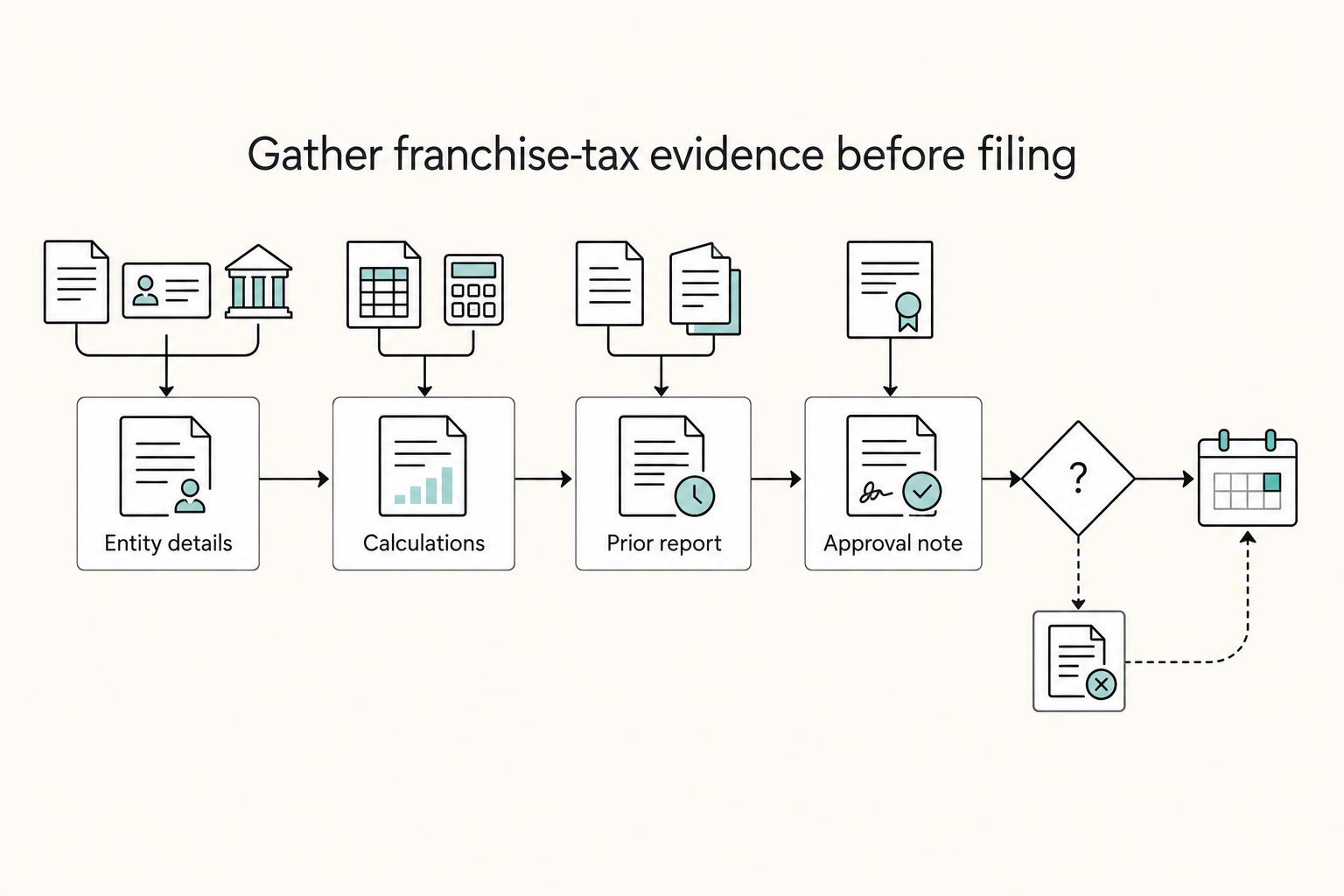
Before you file, make sure one evidence packet is complete and internally consistent. It should tie your submission to the correct entity and the filing path you intend to use.
| Evidence item | What to keep |
|---|---|
| Entity details | Exact legal name and status |
| Calculations and notes | Records used to reach final filing inputs |
| Prior franchise tax report | A copy used for continuity checks, if relevant |
| Approval note | Legal entity name and selected filing approach |
Create one filing-year folder and keep only the inputs used for the final submission:
- Entity details you will file under, including exact legal name and status.
- The calculations and notes used to reach final filing inputs.
- A copy of the prior franchise tax report, if used for continuity checks.
- A short approval note with the legal entity name and selected filing approach.
This packet is not paperwork for its own sake. It lets you answer basic review questions quickly: which inputs were used, who approved them, and how the final filing approach was chosen.
Then run the Delaware path checks in order:
- Use
Check Entity Statusto confirm exact legal name and status. - Confirm you are in
File Annual Franchise Tax Report, notPay LLC/LP/GP Tax. - Review
Registered Agentsand confirm your records are aligned before submission.
A useful sequencing detail is to freeze the packet before final filing input. Once the packet is frozen, avoid pulling fresh numbers unless a real change is confirmed. This prevents accidental version drift between calculation files and the report you submit.
Add one independent verification before submission: have a second person review the same packet and confirm the chosen filing approach still matches the supporting inputs. If names, dates, or core inputs do not match across the draft and checks, stop and resolve before filing.
For exemption positions, keep supporting paperwork in the same folder as the rest of the filing set. Delaware law states corporations incorporated under Delaware law pay an annual tax, with listed exemptions, so exemption support should be easy to retrieve.
File in the Right Order to Avoid Last-Minute Errors#
Use a fixed internal sequence each year: confirm the corporation path, complete the Annual Franchise Tax Report, then submit through the Delaware Division of Corporations channel.
This is an annual corporate obligation with separate treatment for exempt corporations, so entity classification remains your first control point each cycle.
- Confirm entity type and filing channel first: use
File Annual Franchise Tax Report, notPay LLC/LP/GP Tax. - Run your tax calculation from one locked input set.
- Prepare the Annual Franchise Tax Report using the same legal name and core figures used in your calculation.
- Submit only after a final consistency check across report fields, calculation output, and submission details.
The order matters because each step supports the next. If you start with report input, you can discover mismatches late and end up patching numbers under deadline.
Set internal deadlines ahead of your filing target so you have room to correct mismatches before submission. Build in enough space for a recalculation and an independent review when needed.
Keep one dated filing log for the year:
- Timestamp key steps such as calculations, report finalization, and submission.
- Record who verified entity type and filing channel.
- Note the calculation approach used and the decision basis.
- Save submission confirmations.
- Store the exact input snapshot used for final numbers.
A filing log works best when it is short and factual. Date, action, owner, and result are enough. Avoid long narrative entries that bury the key decision points.
Failure-mode rule: if a material number changes late, rerun the calculation before submission, update the report and log, and submit only after everything reconciles. When you follow this order every year, the process becomes predictable, and predictability is what reduces late errors.
Use the Calculator Correctly and Escalate Edge Cases Fast#
Use the calculator as a check, not as a substitute for judgment. Proceed only when your inputs are stable and fully reconciled to the report you plan to file.
| Triage | When it applies |
|---|---|
| Proceed | Structure is straightforward, inputs are complete, and nothing changed after the run |
| Escalate | Structure or field mapping is unclear, records changed late, or results are not reproducible |
| Verify | A second reviewer reruns the same inputs and reaches the same result |
| Document | Save dated notes, exact inputs used, and who validated them |
Inconsistent inputs can produce output you cannot reproduce later. If one value comes from an old worksheet and another from a revised cap table, lock one input snapshot, run from that snapshot, and confirm the same figures carry into report fields before payment.
Use this triage before accepting any output:
- Proceed: structure is straightforward, inputs are complete, and nothing changed after the run.
- Escalate: structure or field mapping is unclear, records changed late, or results are not reproducible.
- Verify: a second reviewer reruns the same inputs and reaches the same result.
- Document: save dated notes, exact inputs used, and who validated them.
A practical check is reproducibility. If the same inputs do not produce the same result twice, do not submit. Resolve the discrepancy first and capture what changed.
Another useful habit is to tie every run to a dated input file. Without that link, later reviews turn into guesswork and corrections get slower.
Final rule: if your inputs are clear and stable, file. If anything is unclear or changed late, rerun and confirm before final submission.
Penalties Interest and the Most Common Failure Modes#
This is an annual filing obligation, so any late or incomplete filing is a risk event that needs immediate cleanup. Move quickly, but only with numbers you can trace back to records.
The risk profile is straightforward. Late or incomplete corporate Annual Franchise Tax Report filing may involve penalties or interest, along with extra remediation work. Those costs usually come from process misses, not hard tax analysis.
Most failures come from three preventable mistakes:
- Using the wrong entity path. Delaware separates the corporate Annual Franchise Tax Report flow from the LLC/LP/GP tax flow, so confirm the corporate route for a Delaware corporation.
- Skipping recalculation after inputs change. If filing inputs change late, rerun calculations from the updated set before submission.
- Treating a franchise-tax notice as informational only. Treat it as an action trigger, assign an owner, and tie it to the filing record.
If you suspect a late or incomplete filing, use this rescue sequence:
- File as soon as possible using reconciled figures.
- Preserve workpapers, including the dated input snapshot and final calculation records.
- Confirm next actions directly with the Delaware Division of Corporations when status or correction steps are unclear.
- Log what changed, when it changed, and who approved the update.
In practice, cleanup quality depends on documentation quality. If your packet is complete, cleanup is usually direct. If records are scattered, each correction takes longer and creates more uncertainty.
Set one hard escalation rule: if you cannot clearly defend method inputs from your records, pause and escalate to a qualified advisor.
Global Mobility Guardrails and When to Bring In a Pro#
Keep Delaware compliance and residence-country tax analysis on separate tracks. Delaware revenue categories are separate too, including Corporate Franchise Tax, Corporate Income Tax, and Limited Partnership/ Limited Liability Tax. Do not blend assumptions across tax types or jurisdictions.
Treat Delaware filing work as one track and cross-border review as another. If your filing assumptions depend on another jurisdiction, confirm those assumptions with legal or tax counsel before you file.
The practical risk is cross-border drift. Ownership, residency, and reporting facts can change during the year while your filing checklist stays static. The checklist is useful only if you refresh it when those facts change.
Escalate early if any of these appears:
- A cross-border ownership change, including adding or removing a non-US shareholder.
- Unclear share classification in records or approvals.
- A mismatch between finance workpapers and legal records.
- Prior-year filing logic that no longer matches current facts.
For statute interpretation, use one hard rule: stop and ask counsel instead of relying on memory from a prior cycle. Delaware materials note that corporate-law amendments are considered and passed annually, so prior-year approaches can go stale.
Keep an audit-ready handoff packet each cycle: filed report copy, payment confirmations, calculation workpapers, dated input snapshots, and a short note on what changed versus last year. This packet matters when advisors hand off work across firms, when team ownership changes, or when you need to defend a filing decision months later.
A short handoff memo helps too. Include what changed this year, what stayed the same, and what still needs legal or tax review. That memo prevents rework and keeps cross-border discussions focused on unresolved issues.
Annual Checklist You Can Reuse Every Year#
Use the same checklist every cycle so the filing stays accurate, easy to review, and easy to defend. Consistency is the point: each step should leave evidence the next reviewer can follow.
- Confirm entity and service path. Use
Check Entity Statusto verify the exact entity, then reviewRegistered Agentsdetails. - Confirm you are in the right filing lane. Use
File Annual Franchise Tax Reportfor the corporate path, andPay LLC/LP/GP Taxfor LLC/LP/GP entities. - Reconcile your current records. Build one dated input packet you will use for filing and review.
- Prepare and file from those same inputs. Complete the Annual Franchise Tax Report in one pass.
- Validate before submission. Confirm filing fields match documented inputs.
- Archive proof immediately. Store confirmations, payment proof, and your final worksheet with your Delaware Division of Corporations filing record.
To make this checklist practical, assign an owner to each step before filing. One owner can handle entity and lane checks, another can validate filing inputs, and a final reviewer can confirm the submitted report matches the filing packet.
Keep the checklist with your yearly filing folder, not in a separate knowledge base. When teams switch roles, the checklist should travel with the records it references.
If anything is unclear, stop and escalate before filing. A short pause can be easier than correcting a filing after submission.
At the end of each cycle, capture one short improvement note. Record what caused friction this year and what you will change next year. Small improvements each cycle can reduce recurring errors without changing the whole process, and you can use Browse Gruv tools as a quick next step.
Conclusion#
Delaware franchise compliance is manageable when you separate entity type first, apply the corporate calculation rules carefully, and work from a fixed annual calendar instead of memory. A practical way to reduce risk is to confirm the filing lane and inputs before you pay.
Start with the controlling decision: are you dealing with a Delaware corporation or an LLC/LP/GP under the Alternative Entity Tax? Corporations have an annual report plus franchise tax based on one of two methods, and the source describes this as an annual obligation even when operations are outside Delaware. LLCs, LPs, and general partnerships follow a flat annual amount of $300 (as of 2025 in the source material), with a June 1 payment date. For corporations, treat March 1 as the annual deadline and plan backward.
Build your evidence packet now. Then do a dry run before deadline pressure hits:
- Entity classification and incorporation date, since the obligation starts in the incorporation year and continues until formal dissolution or conversion.
- Annual report draft and the supporting inputs for the corporate method you plan to use.
- A short note on which method result you selected and why.
- Filing and payment confirmations, plus any paperwork needed to maintain exempt status.
Use one final decision rule at submission time. If your records are clear, reconciled, and reviewed, file. If entity lane, method inputs, or cross-border facts are unclear, pause and escalate before payment.
Poor compliance can lead to penalties, loss of good standing, or administrative dissolution. Early escalation and complete records keep those risks manageable. The objective is simple: one complete filing package, filed on time, with decisions that are easy to explain and defend next year. If you need help confirming what is supported for your specific country or program, Talk to Gruv.
Frequently Asked Questions
Do Delaware corporations owe franchise tax if they do business outside Delaware?
Yes. If a corporation is incorporated in Delaware, it must file an Annual Franchise Tax Report and pay franchise tax even if it does business outside Delaware. The article also notes that a corporation may not be subject to Delaware corporate income tax under 30 Del. C. 1902(b)(6) and still owe franchise tax.
What is the filing deadline for a Delaware C-corp franchise tax report?
The deadline is March 1 each year for both the report and the payment. Treat March 1 as a hard filing date. Delaware sends the annual notification to the corporation's registered agent, but the corporation is still responsible for filing on time.
What is the difference between the Authorized Shares Method and the Assumed Par Value Capital Method?
They are two different allowed calculation methods. The Authorized Shares Method has a $175 minimum tax, while the Assumed Par Value Capital Method has a $400 minimum tax. Because they can produce different results, run both before filing.
What is included in a Delaware C-corp annual payment besides the tax itself?
For non-exempt domestic corporations, the Annual Report filing fee is $50 plus the tax due at filing. If tax owed is $5,000 or more, estimated payments are due in installments: 40% on June 1, 20% on September 1, 20% on December 1, and the remainder on March 1. Exempt domestic corporations do not pay franchise tax, but they still must file an Annual Report.
Do Delaware LLCs file an annual report for franchise tax purposes?
No. Delaware LLCs, LPs, and GPs do not file an Annual Report for this purpose. They pay an annual tax of $300 instead.
What should I do if the Delaware Franchise Tax Calculator does not fit my stock structure?
Do not guess. Pause filing and confirm the correct approach before you submit, and keep the calculation records with the filing support documents. If output cannot be reproduced from a locked input packet, reconcile inputs, rerun both methods, and document what changed.
What happens if I file late or pay late?
Late or incomplete corporate Annual Report filing can trigger a $200 penalty. Unpaid tax balances accrue interest at 1.5% per month until paid. If you miss the deadline, file and pay as soon as possible and document the corrected inputs, the cause of delay, and who approved the final numbers.
Try a related tool
Researched and edited by the Gruv editorial team. Gruv builds cross-border billing, payouts, and finance-operations software for global businesses.
Sources
- corp.delaware.gov/paytaxestrusted
- financefiles.delaware.gov/docs/corp_franchise.pdftrusted
- financefiles.delaware.gov/Reports/TaxPref/Tax_Preference_Report_2025_F...trusted
- revenue.delaware.gov/business-tax-forms/franchise-taxestrusted
- revenue.delaware.gov/frequently-asked-questions/limited-liability...trusted
Educational content only. Not legal, tax, or financial advice.
Related Posts

Sole Proprietorship vs LLC for Global Freelancers in 2026
For most freelancers in 2026, the practical default is still simple: use the simplest structure you can run cleanly, then formalize when risk actually rises. If your work is still in validation mode and the downside is contained, a sole proprietorship is often the practical starting point. When contract exposure, delivery stakes, or dispute risk starts climbing, forming an LLC deserves earlier attention.

Delaware C-Corp vs Wyoming LLC for Your Next Growth Stage
Choosing between a Delaware C-Corp and a Wyoming LLC is a stage-fit decision, not a state popularity contest. For `delaware c corp vs wyoming llc`, the real question is which structure you can run cleanly over the next 12-24 months while keeping room to scale.

How Senior Freelancers Make Fractional Work Stable and Accountable
A lot of fractional advice focuses on winning the first engagement and leaves delivery risk under-addressed. Profiles, marketplaces, and pitch decks can get you a yes. They do not automatically solve the hard part: clear ownership, scoped authority, predictable payment, and clean records as client count grows.