
Quick Answer
Clear eligibility, coverage, recovery and reconciliation gates before comparing demand. An unknown critical gate blocks production even when demand is high. Pilot the best-supported corridor under documented limits and measure outcomes for a defined cohort, including pending and returned payments.
Use an SMB payments barometer to choose what to test first#
A cross-border payments survey can suggest demand; it cannot establish that your company can operate a particular corridor. Use this barometer as a launch-order method: clear feasibility gates, assess evidence quality, then compare the opportunity among corridors that pass.
Use it to rank markets by execution risk as much as demand. The signal is mixed. Many SMBs show expansion ambition, but many also report barriers such as managing cross-border payments, cultural and language friction, inflation, and geopolitical events. Cash-flow pressure can still shut down otherwise viable businesses, so demand alone is not enough to justify a launch.
For a step-by-step walkthrough, see Tariff Pressure and Cross-Border Payment Choices for Platforms.
Define the barometer terms before making decisions#
Treat this barometer as a decision lens, not an official industry benchmark. Strong demand does not make up for weak payment execution.
| Input | Use | Cannot establish |
|---|---|---|
| Current edition-specific survey | Demand hypothesis for its sampled segment | Your current corridor eligibility or completion rate |
| Current provider terms and role-specific advice | Legal and commercial feasibility for the selected flow | Reliable operations without an integration test |
| Observed pilot transactions | Outcome, cost, timing and exception performance | Unlimited scale or a different corridor |
Before using a survey, verify its edition, fieldwork dates, sample, segment and geography. Record those alongside the claim. A historical cross-market survey cannot establish current provider coverage, legal eligibility or settlement reliability for your exact customer type.
Use "retail cross-border payments market" and TAM language as upside context, not as proof that a market is feasible to launch. Those figures do not tell you whether your team can run the corridor with acceptable speed, cost visibility, and exception handling.
Keep demand signals separate from readiness proof. Buyer interviews and survey responses can justify a test; provider contracts, current role-specific advice and observed transactions determine whether the test can move money safely.
If intent looks strong but your payment-path test is incomplete, treat the market as unproven, not launch-ready. You might also find this useful: Intercompany Payments for Multi-Entity Platforms in Cross-Border Transfers.
Separate strong evidence from marketing claims#
The quickest way to make a weak launch decision is to treat a headline as evidence. If a claim does not show method, segment definition, and scope, keep it in the hypothesis bucket.
Before you move any claim into planning, confirm four things:
- the sample and segment are named, including SMB relevance
- fieldwork timing, geography scope, and question framing are visible
- the document type is clear, whether benchmark study, scenario piece, or insight post
- the claim traces to a named primary document, not a summary page
Build a regional readiness scorecard before you pick markets#
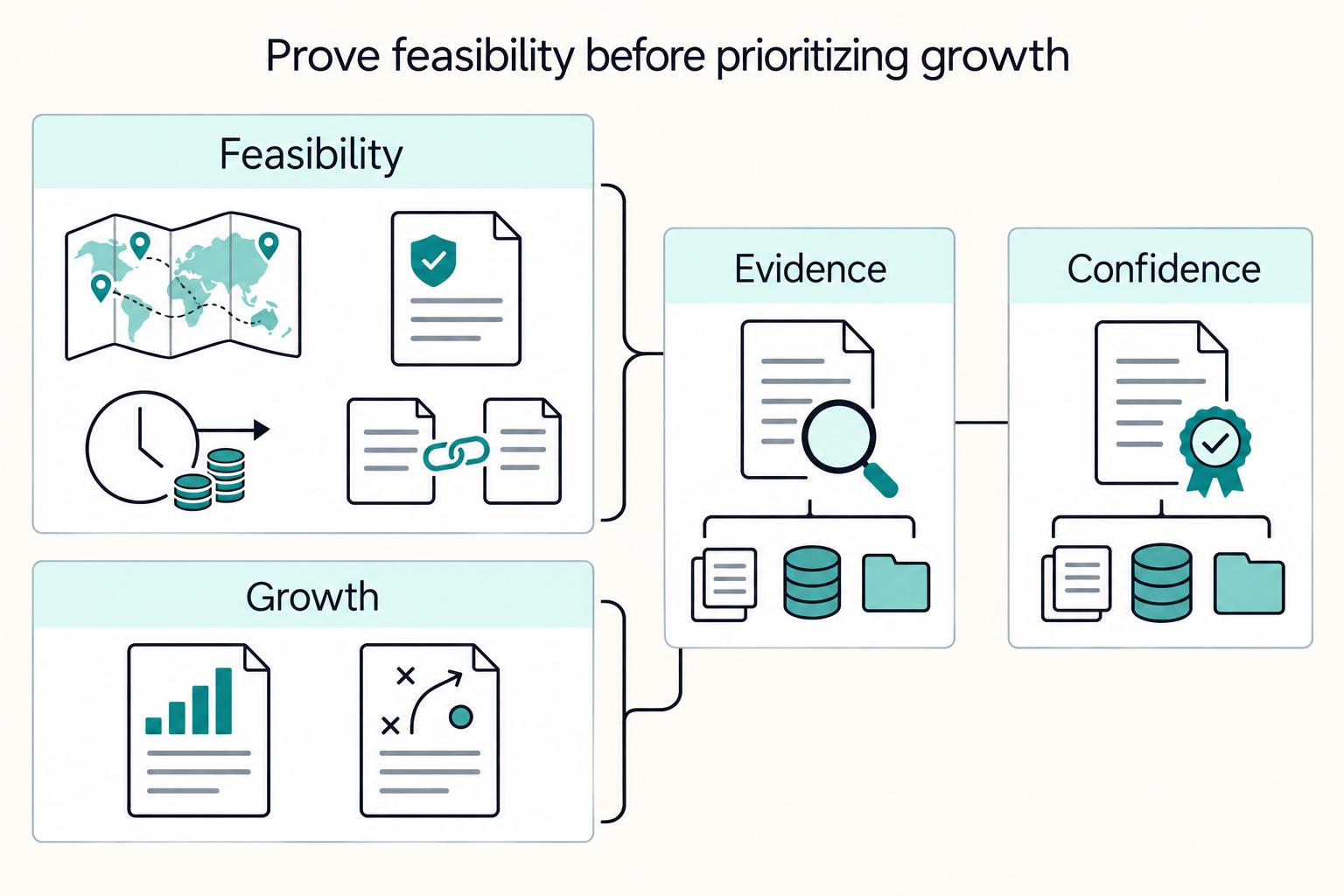
Build the scorecard before you choose markets, and treat missing evidence as risk. Feasibility should stay ahead of growth until payouts, compliance handling, and settlement operability are verified for each target region.
Use a gated model, not an averaged one#
Do not average a strong market story over operational unknowns. If payout coverage is unknown, the compliance path is unclear, or bank interoperability is still speculative, keep the region in hold or monitor status even if growth narratives look attractive.
Use two scoring layers:
- Feasibility first: payout rail coverage, compliance burden, cash-flow risk exposure, and technical operability
- Growth second: demand momentum and commercial upside
If any critical feasibility input is red or unverified, growth should not average it out.
Define the gate and the evidence needed to clear it#
Evaluate the full corridor: sending and receiving country, currency, legal entity, customer type, use case and selected provider. The same country can support one flow and exclude another. The examples below are invented operating cases, not country rankings.
| Gate | Evidence to retain | If unresolved |
|---|---|---|
| Eligibility and legal roles | Current entity, use-case and corridor permissions; duty owners | Hold production |
| Coverage and cash timing | Contracted currencies, limits, FX/fee treatment and pending/return path | Hold production |
| Technical operability | Payout trace, unknown-outcome recovery and safe event replay | Hold production |
| Finance and support | Gross-to-net bank bridge, exception owner and investigation records | Hold expansion until proven |
Keep technical operability separate#
Test the actual message and money path, including beneficiary validation, rejection, return and bank receipt. A statement that a bank supports ISO 20022 does not show that your provider can complete and report your particular payout.
Make confidence part of the scoring model#
Use three evidence states. Confirmed means current documentation and a relevant test support the exact entity and flow. Partial means documentation supports only some conditions or the required test has not finished. Unknown means proof is absent, stale or contradictory. A critical partial or unknown gate blocks production; label every assumption and record who can clear it.
Use this operating rule: a region is not launch-ready until every feasibility cell is backed by readable evidence and every assumption is labeled as an assumption, not a fact.
Map payment preferences to product choices#
Interview buyers in the target segment about how they pay, receive funds and recover failures. Compare that with the actual supported methods, prices and eligibility for your entity; familiar card or bank preferences from another market are hypotheses.
| Illustrative corridor | Demand | Critical evidence | Decision |
|---|---|---|---|
| A | 40 interested buyers | Sending-entity eligibility unknown | Monitor; demand cannot override the unknown |
| B | 20 interested buyers | Eligibility confirmed, payout and bank bridge tested | Limited pilot within documented constraints |
If preference signals and available payout rails do not match, treat that mismatch as an operations risk first. The practical check is simple: run live checkout and payout traces before you call any of these markets launch-ready.
Identify pain points that become launch blockers#
The clearest blocker is operational readiness. The strongest supported issue is whether your security controls and team coordination can support live SMB operations without creating avoidable risk.
Treat broad barriers as test hypotheses, not proven corridor facts. Language friction and payout-capability gaps may create onboarding or payout issues, but corridor-level activation delays, payout failure rates, and settlement outcomes should be verified through direct testing.
Turn abstract risk into go-live checks#
Translate that risk into concrete prelaunch checks. Before opening a corridor, require evidence that core controls are in place:
- MFA for admin, finance, and payout-ops roles
- Current patch status for systems touching onboarding or payout instructions
- Documented access policy for creating, approving, and editing payout data
- Backup and restore evidence for payout and ledger systems
- Recent security assessment, plus insurance posture if your risk policy requires it
If you cannot produce this quickly, launch friction is likely.
Watch the gaps between teams#
Name the owner of each gate and exception queue. Growth, payments, compliance and finance need one decision record so an unresolved issue does not vanish at a handoff.
Test failure modes explicitly before scale#
Test timeouts, delayed and reordered events, expired FX quotes and returns. Query an unknown original before a new attempt; provider idempotency keys work only within their documented scope and retention. Keep durable local business-action deduplication beyond that window, and represent returns as distinct reversals rather than deleting the successful history.
Decision rule: if payouts are not observable end to end, do not scale GTM spend in that corridor. Need the full breakdown? Read How Graphic Designers Protect Cross-Border Payments and Cash Flow.
Choose market entry order with explicit if-then rules#
Choose your first market by operational confidence, not headline demand. Use this section as a launch filter: if policy, settlement, and control evidence is weak, keep the market in monitor until it is revalidated.
Put demand-strong but evidence-weak markets in monitor#
If demand looks strong but payout or compliance feasibility depends on stale or non-authoritative inputs, classify the market as monitor, not launch.
A broad market-opening headline cannot clear your exact role and use case. Require current entity-specific evidence for the applicable permissions and provider coverage.
Break growth ties with settlement and policy clarity#
When two markets look similar on growth, launch the one with fewer open operational and policy questions first.
You can use payment-message flow checks as an internal ambiguity test, but do not treat this evidence pack as proof of region-by-region readiness. Ask for clear evidence of message flow, return and rejection handling into your ledger, and ownership of policy exceptions. If those points still require interpretation, sequence that market later.
Sequence launches by confidence bands#
| Launch band | Decision rule | Launch only when | Hold if |
|---|---|---|---|
| First market | Process proof | Current policy checks are complete and payout states are observable end to end | Core exceptions or policy ownership are still unclear |
| Second market | Stress test | First-market controls are repeatable with limited variation | Exception handling expands faster than resolution capacity |
| Third market | Scale step | Performance is stable across the first two markets | Returns, approvals, or reconciliation remain unstable |
Why moderate-growth, lower-friction often goes first#
If one corridor has stronger demand but unresolved policy or settlement ambiguity, and another has moderate demand with clearer operations, launch the clearer corridor first. It gives you reusable operating proof, reduces avoidable uncertainty, and creates a stronger base before you take on higher-friction expansion.
Decide build vs partner with compliance and ops in view#
Choose the path you can prove in production, not the one that reads best in a vendor narrative. If your team cannot reliably run market-level policy gates, audit trails, and exception ownership, treat partner-first as a starting hypothesis to test before committing to a build-heavy path.
Compare the decision points directly#
| Decision point | Partner-first hypothesis to test | Selective build hypothesis to test |
|---|---|---|
| Compliance ownership | You need clearer single-thread ownership with fewer internal handoffs | You can sustain policy updates and controls by market |
| Ops burden | Reconciliation and exception handling capacity is limited | You can operate returns, rejects, and pending states without manual reconstruction |
| Implementation pace | Timeline pressure is high and you want less internal system surface area at first | You need deeper developer control in specific components |
| Coverage strategy | Broad coverage matters more than custom control per corridor | You can justify owning core corridors and outsourcing non-core ones |
Verify before committing#
Use corridor flow checks, not forecast commentary, as the gate. Confirm that you can trace each sample payout from initiation through provider response, status and event updates, ledger linkage, and final exception outcome.
This pairs well with our guide on Cross-Border Payment Compliance: GDPR CCPA and Data Localization Requirements.
Set minimum control gates before first production payout#
Set launch gates before the first live payout, and treat them as pass-or-fail criteria for initial pilot corridors. The goal is a short, testable control set with clear pause rules, not a broad policy document.
| Gate | Required check | Limit noted in the article |
|---|---|---|
| KYC or KYB policy checks | Start with a written gate area with named owners and test evidence | Confirm with the relevant authority |
| AML hold logic | Start with a written gate area with named owners and test evidence | Confirm with the relevant authority |
| Sanctions screening coverage | Start with a written gate area with named owners and test evidence | Confirm with the relevant authority |
| Payout retry control | Durable business-action record plus provider-scoped idempotency keys | Query unknown originals before replacements; separate business obligation from attempt. |
| Corridor traceability | Instruction, provider history, distinct ledger effects and net-delivery evidence | Local ledger posting alone is not recipient receipt. |
| Controlled API key access | Set an explicit security gate for payout operations | Define rotation frequency internally |
| Webhook signature validation | Set an explicit security gate for payout operations | Follow the provider signing and replay contract |
| Role-based access for payout actions | Set an explicit security gate for payout operations | Define role matrix requirements internally |
| Stop conditions | Define automatic pause conditions for failed payouts and unresolved investigation backlog | Set numeric thresholds internally |
Define the non-negotiable launch gates#
Map KYC/KYB, AML and sanctions responsibilities to the regulated entities, contracts and jurisdictions involved. Obtain current advice for applicable duties, including holds and customer communication. Payout deduplication is an engineering control, separate from those legal duties.
Record the applicable lawful basis, privacy notice, retention and access rules for onboarding and screening data. Consent is not automatically the correct basis for every processing purpose. Test the chosen flow with relevant sample cases and restricted access.
Require corridor-level traceability before launch#
For each payout, retain the durable business ID, attempt ID, instruction amount and currency, beneficiary version, provider reference and status history. Track provider completion, recipient receipt where observable and each local ledger effect separately; a posted entry is not proof the beneficiary received funds.
If traceability depends on manual reconstruction, treat that as a launch blocker. Apply the same discipline to expansion timing: planning commentary is useful context, but not launch evidence, and short-window signals should not be treated as durable trends.
Add core security gates before production access#
Restrict production API credentials and payout privileges. Validate webhook signatures using the provider’s documented algorithm, secret and replay rules; your team cannot independently choose a different signing contract. Persist receipt and its local state or ledger effect atomically, reject repeat effects, and prevent old events from regressing current state.
Set stop conditions before you scale#
Choose stop and resume conditions before the pilot. For an invented policy, pause new instructions for a duplicate economic effect, a critical compliance gap or an unresolved attempt older than the provider-specific investigation window. Name the incident owner and require corrected evidence plus finance and payments approval before resuming; continue investigating and resolving existing obligations.
When a trigger is hit, expansion pauses until the cause is understood and controls are updated. That keeps rollout decisions tied to operating evidence, not schedule pressure.
If your launch checklist centers on payout observability, idempotent retries, and policy gates, review Gruv Payouts before pilot go-live.
Prepare the market entry evidence pack for go and no-go#
Use one decision file per region, and make it the only place a go or no-go decision is recorded. Include the current scorecard output, core assumptions, a confidence tier, and unresolved unknowns from your current evidence set, with clear labels where inputs are incomplete or unavailable.
Be strict about source quality in that file. Treat sources marked as not formally reviewed, informational-only, or not to be relied on by third parties as directional context, not final decision evidence. If a compliance conclusion depends on interpretation, mark it for advisor confirmation against your specific legal and regulatory circumstances.
- Compliance artifacts: documented compliance assumptions, advisor-review checkpoints, and audit logging checks
- Finance artifacts: reconciliation sample, documented settlement assumptions, and tracked exception notes from pilot transactions
Watch for false confidence. If method, segment coverage, or regional depth is unclear in your working inputs, label that uncertainty directly instead of smoothing it into the score. Also note that projected costs, savings, and benefits may vary in practice.
End each region file with one recommendation only: launch now, launch with constraints, or defer. If legal applicability, auditability, or reconciliation integrity is still unresolved, record the blocker, assign an owner, and define the evidence required to clear it. Related reading: Cross-Border Invoicing: VAT, GST, and Withholding Tax.
Run a 90-day pilot that proves operations before scale#
A 90-day pilot is an illustrative planning window, not a survey-backed standard. Choose a duration and volume sufficient to observe ordinary cycles, failures, returns and finance close in your corridor. Start only after the critical feasibility gates are confirmed.
Start narrow, then expand only on internal evidence#
As an internal pilot policy, start with a limited corridor and a controlled merchant set, and treat exceptions as primary data. Keep expansion tied to what your own transactions show, not to market enthusiasm alone.
Measure success for a defined initiation cohort and observation window: confirmed completed payouts divided by all valid initiated business payouts. Report pending, unknown, failed and returned outcomes separately; never improve the percentage by dropping unresolved attempts or counting retries as new successful payouts.
Use exception handling and reconciliation as decision gates#
Report completion latency from instruction acceptance to the defined completion milestone, plus oldest pending age and investigation backlog age. Use currency-specific amounts and show gross instructions, FX and fees, net delivery and returned funds. Compare promises to observable outcomes rather than treating ledger posting as delivery.
Use direct operating questions to decide whether to expand:
- Can finance reconcile a pilot sample without a growing manual backlog?
- Are returns and investigations assigned to named owners with documented resolution reasons?
- Did the pilot surface onboarding or policy gaps that should be fixed before adding merchants or corridors?
Keep country context attached to execution#
When your pilot spans multiple countries or corridors, keep operator notes attached to the relevant workflow so teams are not interpreting a generic launch file differently. If a corridor-specific playbook exists, keep notes alongside that playbook, such as How to Pay US Subcontractors from Canada when relevant.
For an invented comparison, corridor A has 40 interested buyers but unknown provider eligibility for the sending entity: monitor it. Corridor B has 20 interested buyers, confirmed eligibility, retrievable payout states and a tested bank-to-ledger bridge: pilot B first under the agreed limits. The smaller demand signal clears the gates; A cannot win by averaging its unknown away.
Frequently Asked Questions
What is the SMB cross-border payments barometer and is there a single official version?
This article offers an operating method rather than an official regional ranking. Named surveys such as Payoneer’s SMB Ambitions Barometer have their own editions and samples; verify the exact primary edition before using a statistic.
Which pain points matter most when SMBs send and receive cross-border payments?
Test the costs and causes your buyers encounter: FX and fees, pending payments, missing references, returns, onboarding delay and unclear support ownership. Use interviews and pilot records for your segment instead of assigning an all-SMB benchmark.
How should operators compare regions before entering a new market?
Compare regions by evidence quality before drawing conclusions. Confirm each source's sample, segment, geography, and fieldwork window, then check whether it matches your use case. A segment-specific report can be useful, but it should not be treated as a full all-SMB benchmark.
Why do SMBs report expansion optimism but still feel unprepared operationally?
Interest in expanding and readiness to operate a corridor answer different questions. Buyers can want cross-border growth while the provider, compliance and finance workflow remains unproven.
How reliable are big market-size claims when methodology details are missing?
Use them as directional context, not planning truth. If methodology is unclear, you cannot verify whether the claim fits your sector or corridor. Prefer sources that disclose concrete details such as sample size, segment, geography, and dates.
Which regions are usually easier to launch first for payouts and reconciliation?
There isn't enough evidence to support a universal ranking of launch ease by region. The safer move is to avoid broad "easiest market" claims from barometer excerpts alone and choose based on the markets where your evidence is strongest and most relevant to your operating model.
How do payment delays affect SMB cash flow and retention risk?
Measure the waiting period and net amounts in your pilot. Pending or returned funds can create working-capital pressure, but the effect on retention needs your own customer evidence; do not assign a universal causal percentage.
Try a related tool
Researched and edited by the Gruv editorial team. Gruv builds cross-border billing, payouts, and finance-operations software for global businesses.
Educational content only. Not legal, tax, or financial advice.
Related Posts

A Canadian Freelancer's Guide to Setting Up a US Stripe Account
Start with your Canadian Stripe account if your goal is to protect margin without adding U.S.-entity complexity. It is often the simpler path, and with the right payout setup you can receive USD without forcing immediate conversion.

Pay US Subcontractors From Canada: Tax, FX and Records
To pay a US subcontractor from Canada, identify the legal supplier, confirm where the services are performed, agree the invoice currency and establish the applicable withholding/reporting path. Then approve the work, fund the payment and reconcile the result. US tax status, Canadian tax residence and physical work location are separate facts.

How to Pay US-Based Freelancers from the UK
Your ability to attract and keep strong US freelance talent depends less on budget than on how you operate. Strong freelancers often work like serious one-person businesses, and they start evaluating you from the first interaction. Compliance and payment handling are not back-office details. They are early proof that you will be easy to work with, careful with details, and worth prioritizing.