
What Series A Investors Need to See in Your Revenue Model#
Series A investors underwrite durability, not just growth. This article shows how to explain a revenue model they can actually underwrite, including expansion scenarios where launches slow down or operating risk rises.
The standard changes because Series A funding is the first priced round, where a company sells preferred equity to raise institutional capital and set a formal valuation. Earlier SAFE or convertible-note rounds are typically less formal on valuation. At a priced round, operating discipline through diligence matters more.
In that context, your model is not judged on spreadsheet structure alone. Investors pressure-test take rates, payment volume mechanics, margin layering, credit exposure, regulatory pressure, and scenario logic. Revenue quality carries more weight than raw growth speed, and margin structure can signal risk before revenue does.
This goes beyond a pitch meeting. The same logic gets reviewed through fundraising, board discussions, and M&A diligence. The model has to hold up across audiences and over time.
To keep it practical, the article follows a sequence aligned to what investors test first:
- revenue engine
- margin engine
- risk engine
- capital engine
- prep checklist before investor meetings and term sheet discussions
If you are preparing for a first priced round, start with operating discipline in how you present the model. Keep core definitions consistent across your deck, model, and diligence materials, and make expansion scenarios explicit about what changes operationally and financially when conditions are less favorable than the headline case.
What investors actually underwrite in a Series A payment model#
Investors are not underwriting a headline growth chart alone. They are underwriting whether your model is coherent across revenue durability, margin layering, downside risk, and capital efficiency. If one lens is unclear, confidence in the rest can weaken.
The four-engine lens#
Make the four engines explicit up front:
- Revenue durability: Is revenue repeatable, clearly defined, and tied to behavior that can persist beyond a strong quarter?
- Margin layering: How does top-line revenue translate after direct costs and operating burden?
- Downside risk: What happens when assumptions miss, and have you shown that downside plainly?
- Capital efficiency: What burn, runway pressure, and cash consumption sit behind growth?
That is usually how professional investors review a company. They look at a mix of performance, efficiency, and risk metrics, not a single growth line.
Why round context changes the standard#
If earlier fundraising came from friends-and-family capital, treat Series A prep as a discipline step for a professional investor audience. In practice, the standard is consistency. Use the same definition for each financial metric across your deck, model, and diligence materials. If terms shift between files, trust falls quickly.
Build it to survive diligence, not just the pitch#
Build the model so it holds up under repeated diligence questions, not just the pitch. A simple operator check is to trace one metric, for example burn rate or runway, across every artifact you share. If the number does not reconcile cleanly, fix it before the meeting.
The cash-flow trust check#
When growth and cash flow move in different directions, explain the tradeoff immediately in plain language. That pattern can be rational, but only if metric definitions stay consistent across materials and downside risks are communicated clearly. Otherwise, diligence gets harder and confidence in reported numbers can weaken.
Define the revenue terms before you forecast anything#
Define your revenue terms in writing before you forecast. Financial forecasting helps investors and lenders judge viability and likely payback, and it is strongest when assumptions are realistic and grounded in solid research.
Start by defining, in your own model language, take rate, payment volume mechanics, gross revenue, net revenue, recurring revenue, and one-time revenue. Do not assume there is a universal definition for these terms, so do not imply one. What matters is that you use the same definitions across your deck, model, and diligence materials.
To keep the model auditable, separate monetization lines instead of blending revenue into one bucket:
- subscription fees
- payment processing fees
- API connection fees
If these lines are bundled, it becomes hard to test what is actually driving growth. For any month, a reviewer should be able to trace each line item to a clear driver and verify the underlying checks before relying on the output. Do not assume default percentages for these fee lines.
Because forecasting is assumption-based, confidence comes from structure, not fake precision. Be explicit about how you classify recurring vs one-time and gross vs net in your model, and keep those definitions consistent across revenue projections, expense estimates, and cash flow statements.
Be explicit about what is still unknown. Do not claim universal thresholds for retention, fraud loss, or valuation multiples. The 5x to over 17x revenue range is a niche reference, not a broad fintech benchmark.
If you want a deeper dive, read Subscription Revenue Forecasting: How Platforms Model MRR Growth Churn and Expansion.
Pick a monetization mix that fits your market constraints#
Choose the monetization mix you can launch and defend in your current markets, not the full set you might support later. This aligns with current investor focus on profitability, recurring revenue, and regulatory stability, with less appetite for high-growth, high-burn stories. If your country coverage is fragmented, start with simpler fee lines and phase in rail-dependent lines only after market and program confirmation.
| Monetization line | Regulatory burden | Integration complexity | Revenue predictability | Operational failure sensitivity | Base-case use rule |
|---|---|---|---|---|---|
| Interchange fees | Varies by country/program | Varies by country/program | Varies by coverage and usage mix | Varies by rail/program operations | Include only where coverage and program support are confirmed |
| Funds transfer fees | Varies by rail/country/program | Varies by rail/country/program | Varies by transfer behavior and market availability | Varies by rail/program operations | Include only where the rail is live and operationally supported |
| Subscription fees | Market/program dependent | Product/contract dependent | Can support recurring revenue when clearly contracted | Product/support dependent | Use when ongoing customer value and billing terms are clear |
| API connection fees | Market/program dependent | Integration/contract dependent | Depends on contract structure and implementation timing | Integration/support dependent | Use when implementation scope and revenue recognition are explicit |
| Referral fees | Partner/program dependent | Partner-integration dependent | Depends on partner terms and partner performance | Partner/operational dependent | Keep as separate, conservative upside unless predictability is proven |
These are decision filters, not universal ratings. Coverage, economics, and availability differ across markets, programs, and fintech segments, so avoid presenting any fee line as globally portable by default.
Use four filters before you add any line to the base case:
- Regulatory burden: confirm market and program fit instead of assuming one setup travels everywhere.
- Integration complexity: include only when scope, ownership, and timing are clear.
- Revenue predictability: separate recurring lines from event-driven lines so forecast confidence is explicit.
- Operational failure sensitivity: discount lines that can shut off when one rail, partner, or market fails.
Do not frame the mix through only one investor lens. Investors may assess value with revenue multiples, EBITDA multiples, and DCF, so your mix has to hold up on durability and operating reality, not just top-line narrative. A practical checkpoint is a market-by-program matrix for each fee line: commercially available, contractually confirmed, integration-ready, and compliance-reviewed. Only put in the base case what is confirmed end to end. For a quick stress test before locking assumptions, use the Platform Payment Infrastructure Audit.
Build country expansion scenarios before committing GTM spend#
Expansion assumptions can break trust, sometimes faster than pricing assumptions. Model country rollout as scenarios before you commit GTM budget. At Series A, expectations shift from potential to expected performance. Put expansion assumptions in a base case, a constrained case, and a delayed-launch case tied to onboarding friction, operational readiness, and cash timing.
| Scenario | What you assume | What must be true operationally | What it means for the model |
|---|---|---|---|
| Base | Planned launch timing holds in priority countries | Core operational and onboarding steps are defined internally and owned | Revenue starts on the planned date and GTM spend has a clearer payback path |
| Constrained | Launch happens, but onboarding is slower or narrower than planned | Key internal reviews take longer or activation is staggered | Revenue ramps later, while support costs can arrive earlier |
| Delayed launch | Country go-live slips until key issues are cleared | Material operational, contracting, or launch assumptions are still open | Defer or reduce GTM spend to protect capital efficiency |
If you cannot show how a country moves from a signed customer to active onboarding to live service, keep it out of the base case. Your projections should cover income, expenses, cash flow, and scenario variants, not only market size.
Tie the scenario to actual gates#
Put operational gates directly into the model: key internal reviews, launch-readiness milestones, and the point where revenue can be recognized under your commercial plan. If one of those gates is still directional, move the country to constrained or delayed.
Keep a simple assumption register for each target market with an owner, last-verified date, status, and current evidence. If evidence is missing or stale, treat the launch assumption as open.
Protect capital efficiency when timing slips#
One failure mode is spending GTM budget before a country can convert demand into live volume. That is a capital-efficiency risk first, then a revenue risk.
If critical launch assumptions are still unclear, consider phasing the rollout to get cleaner operating signal before scaling spend.
Mark legal-review assumptions before negotiations#
You do not need to present country-by-country legal detail in the deck. You should clearly label assumptions that may require legal review before they are treated as committed in commercial planning. If a material assumption has not been reviewed, keep it marked as open and out of the committed launch case.
Show margin layering with transparent cost and risk logic#
Margin layering is a credibility test, not a formatting choice. Show how payment volume mechanics become net contribution, with cost and risk lines visible in between. Investors look for clear links between volume, pricing, margins, and risk, so if those links are hidden, margin quality can look overstated.
A Series A model should move from volume mechanics to take rate, then through explicit cost and risk layers before landing on net contribution. At minimum, keep credit exposure visible in that chain. If losses or servicing costs sit outside that chain, the top line can look strong while underlying contribution is weak.
Build the margin stack from top to bottom#
Use a layered table so each line has a clear driver and review path.
| Margin layer | What belongs here | What investors will ask |
|---|---|---|
| Payment volume mechanics | Volume base, transaction or product mix, and timing assumptions for when volume becomes billable | Is this grounded in observed usage, or stretched from early momentum? |
| Take rate | Revenue earned on that volume, split by fee type where needed | Does pricing reconcile to contracts and billing? |
| Direct processing costs | Costs directly tied to transacting volume | Do these costs move with mix, or are they held flat while assumptions change? |
| Support and compliance overhead | Operating work required to deliver, review, and monitor service | Are these treated as required delivery costs or pushed outside margin logic? |
| Credit exposure | Losses, reserves, or other economics from timing and settlement risk | What happens to contribution if loss behavior worsens at scale? |
| Other risk adjustments | Where relevant, returns or disputes and resolution costs | Are these explicit drags or hidden in blended assumptions? |
| Net contribution | Revenue after direct costs, operating overhead tied to delivery, and risk lines | Does contribution support scale without masking risk? |
Keep risk inside the base case#
Give credit exposure and other material risk adjustments their own lines. Do not hide them in "other costs."
Use a clear rule. If margin improvement depends on optimistic loss, dispute, or return assumptions that are not supported by operating evidence, treat that improvement as speculative upside, not the base plan. A common failure mode is annualizing an early strong usage period. That can make contribution look durable until usage normalizes.
Compare infrastructure-led and application-led profiles without forcing a winner#
Use the same stack to compare where margin expansion is expected for each profile. The goal is not to claim one model is always better. It is to show exactly which layer is expected to improve and why that improvement is credible.
If the story is only "volume grows, so margins improve," it is weak. If the story ties improvement to specific layers with observed operating behavior, it is stronger and easier to defend.
Reconcile the model to operating records#
Before you present the margin story, reconcile contracts, billing, cash, and accounting so pricing and contribution logic match recorded outcomes. Keep a one-page metric policy for definitions that affect the stack: what is counted as revenue, what is netted from take rate, where overhead sits, and how risk lines are treated. If the margin slide still needs three minutes of verbal caveats to explain basic definitions, investors will usually discount the result.
Turn operating data into an investor-ready evidence pack#
Once the model is internally consistent, make each claim easy to inspect. In Series A, investors are testing execution capacity, not slide design, and they will look for a clear chain from activity to retained revenue.
An effective evidence pack is a focused set of documents that lets someone move from claim to proof with consistent definitions. A practical pack might include cohort retention views, clear metric-definition notes, and operating context that explains changes in revenue quality, segmentation, payback, and forecasting. The goal is not a universal file list. It is a case that is explainable from inputs, through operations, to outcomes.
What should be in your investor package#
Make causal links explicit. If retention is improving, show cohorts by start period and segment. If revenue quality is improving, define what is recurring, usage-based, one-time, gross, or net, and keep those definitions stable over time. If downside is manageable, show where pressure appears first and how the team responds.
| Artifact (example) | What it should prove | Possible owner | Refresh trigger (example) |
|---|---|---|---|
| Cohort retention table | Retention is improving by cohort or segment, not only in blended views | Finance or RevOps with product input | Before meetings where growth or retention is discussed |
| Metric definitions sheet | Numerator, denominator, and time window are explicit for key metrics | Finance lead with GTM/product input | When KPI definitions, scope, or reporting windows change |
| Revenue definition bridge | Revenue components are consistently classified across materials | Finance lead | When billing logic, metric definitions, or reporting periods change |
| Segmentation and forecasting trend view | Operational learning is visible over time, not just point-in-time results | Finance and GTM leadership | With each forecast revision |
Add proof from the payment layer#
For payment businesses, pair deck metrics with underlying operating records when those records help explain causality. The key is consistency: metric definitions and time windows should match across the deck, data room, and follow-ups.
A common failure mode is clean top-line charts backed by stale or differently defined records. If key metric definitions change across the deck, data room, and follow-ups, investors may not just correct the math. They may downgrade trust.
Put an owner and date on every claim#
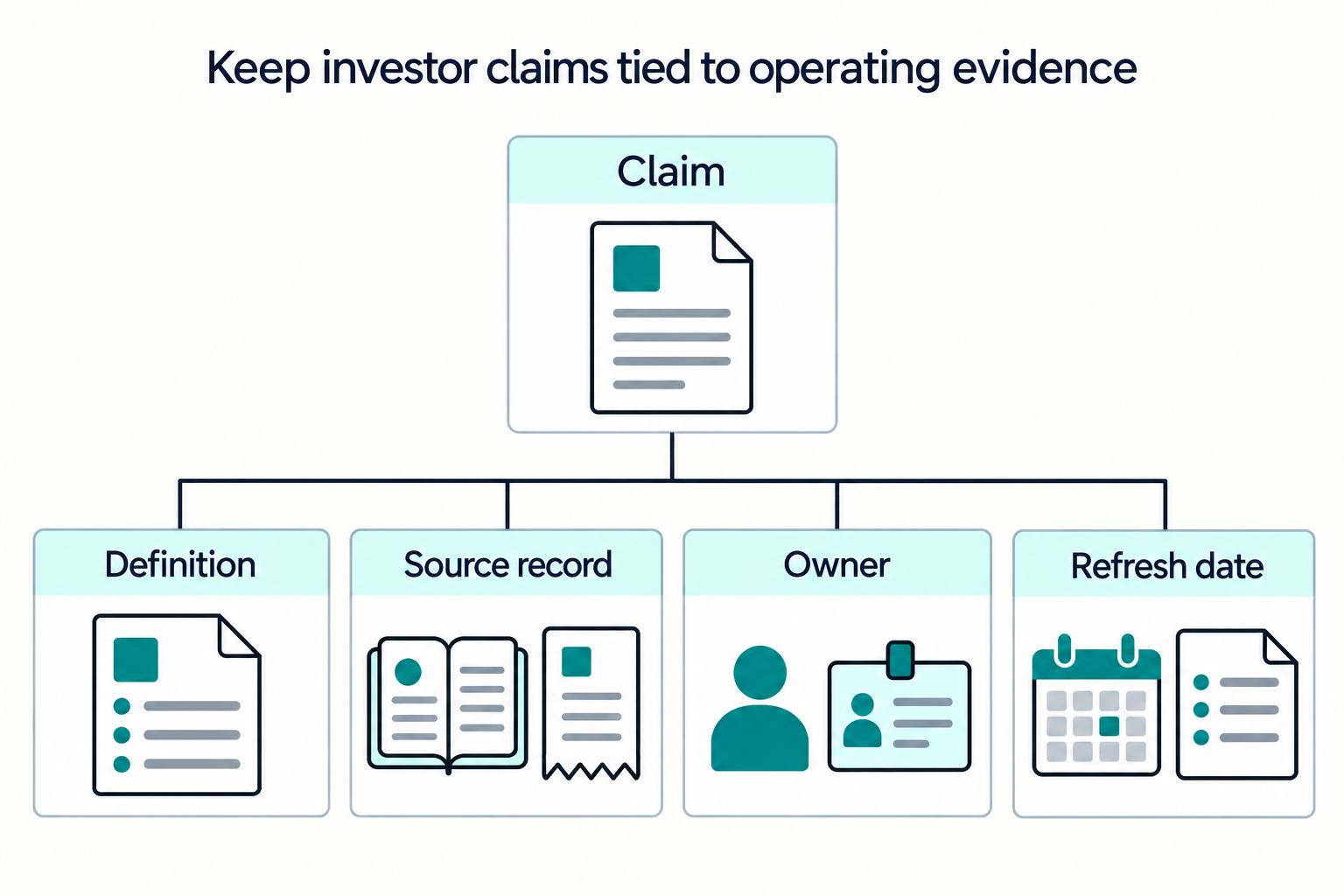
A practical way to run diligence is to give each key metric a named owner, last refresh date, and one-line definition. Keep numerator, denominator, and time window explicit, and keep those definitions consistent across deck, data room, and follow-ups.
You do not need one universal cadence. You need a clear rule for each metric. Label whether a number is weekly operational data or a quarter-end figure so diligence discussions stay focused on the business, not snapshot confusion.
Keep one meeting slide that survives pressure#
Keep one summary slide that lists:
- core assumptions
- main sensitivities
- downside case
- mitigation owner for each major risk
Make sure this slide reconciles to the rest of the pack. If growth improves while cash flow worsens, say that directly and explain why. The objective is not a frictionless story. It is evidence that is current, owned, and defensible under diligence.
Related reading: Accounts Payable KPIs: The 15 Metrics Every Payment Platform Finance Team Should Track.
Pressure-test the model before investor meetings#
If your growth, margin, and cash story only works in one clean case, it is not ready for Series A conversations. Pressure-test the model before the meeting, not in it. Series A investors are testing whether growth is repeatable and whether unit economics hold under pressure, so your downside work needs to be explicit.
Focus stress tests on pressure points that directly affect growth durability, capital efficiency, compliance readiness, and fundraising execution.
Stress the assumptions that can change the story fastest#
Build a base case and a small set of downside paths. The goal is not fake precision. It is to show what breaks first, what slows down, and who owns the response.
| Pressure point | What to change in the model | What to verify before the meeting | Likely investor concern |
|---|---|---|---|
| Growth durability | Model slower month-over-month growth or a flattening curve | Multi-month growth trends and the assumptions behind them | Is early growth repeatable, or already flattening? |
| Capital efficiency | Stress CAC payback and margin assumptions in downside cases | CAC payback math, margin trends, and cash-use implications | Do unit economics still hold under pressure? |
| Compliance readiness | Add timing risk around regulatory or legal process dependencies | Compliance readiness status and required legal documents | Is the timeline realistic given process constraints? |
| Fundraising execution readiness | Model a longer fundraising cycle with fewer meaningful outcomes | A secure deal room with cap tables and legal documents, plus a clear narrative | Can the team run an efficient process in a selective market? |
Keep the model traceable across artifacts. If growth or payback assumptions change, the revenue bridge, cash flow analysis, and hiring plan should move with it.
Separate proven inputs from directional ones#
Label major assumptions by confidence level: proven from historical performance versus directional and still being validated. That separation makes challenge questions easier to answer in board and partner discussions.
| Checkpoint | Why it matters |
|---|---|
| 15-20% month-over-month growth over 6+ consecutive months | Stronger evidence than a short spike |
| CAC payback under 18 months | Signals capital efficiency |
| $1M-$3M ARR range | Context, not a universal pass/fail rule |
Use concrete checkpoints where you have them, and present them as context rather than as automatic proof.
Pre-write the management response#
For each downside path, pre-write a short response covering:
- what changed
- what it means for capital efficiency and runway
- what management will do next
Store these responses in the same secure deal room as cap tables, legal documents, and operating support files. If your stress test shows a flattening growth curve while cash flow worsens, address it directly. Experienced investors will ask, and clear answers build more trust than a polished but fragile narrative. For a step-by-step walkthrough, see How to Hire a CFO for Your Payment Platform.
Red flags that damage trust during term sheet negotiations#
Trust usually breaks when your story stops matching your records. A term sheet signals serious investor interest, not a finished raise, so diligence pressure increases at this stage.
| Red flag | Why it matters |
|---|---|
| Overstated revenue quality | If your revenue narrative is unclear or overstated, investors will read unit economics as weaker than presented. In Series A, weak unit economics is a direct confidence risk. |
| Definition drift on take rate and net revenue | If your deck, model, and data room use different definitions, every downstream assumption becomes less credible. Keep one definition and make sure it ties cleanly to your P&L, balance sheet, and cash flow records. |
| Late treatment of legal and compliance work | Some term-sheet terms are binding before final agreements, including confidentiality, no-shop, and legal-fee arrangements. Legal readiness cannot wait until after signature. |
| Missing diligence artifacts | Messy cap tables, missing IP assignments, unclear contract terms, and stale legal-status documents can delay or derail a deal. Your diligence pack should be complete, including a Good Standing Certificate dated within the last 30 days. |
| Hand-waved downside recovery | If asked about downside scenarios, you need a concrete response tied to updated financial statements and clear ownership or authority details. Vague scenario logic quickly weakens trust. |
Tie financing mechanics to model credibility#
By the time you raise Series A funding, your model typically has to carry more than a financing instrument story. Earlier rounds can rely on convertible notes or SAFEs. Series A is a priced round. It sets a formal valuation, sells preferred equity, and introduces formal investor relationships and board oversight. That shift raises the credibility bar for your assumptions.
Move from instrument logic to business logic#
At this stage, investors are testing whether the model structure reflects risk, margins, and capital efficiency. So the model cannot stop at top-line targets alone. It should show driver-level mechanics like payment volume behavior, take rate behavior, margin layering, and credit exposure.
Show what this round funds and why the next round becomes credible#
Use the current raise to show milestone-driven execution, not vague momentum. You do not need to claim exact Series B thresholds. You do need to show how this round builds evidence for the next one. A practical test is whether projected growth improves capital efficiency or just masks risk.
What investors typically look for here is clear assumptions, concrete milestones, and execution evidence they can verify. That is what makes the financing mechanics and the operating story hold together.
Use this 30-day prep checklist before institutional fundraising#
Use the month before outreach as a diligence sprint. Series A review is typically more rigorous than seed, and institutional investors often run formal investment-committee processes. This four-week sequence is a practical prep structure, not a universal standard for every raise.
| Week | Focus | Checkpoint |
|---|---|---|
| Week 1 | Lock metric definitions and lineage for core financial and operating metrics | Each number should trace cleanly from source report or ledger to model to investor materials without changing meaning |
| Week 2 | Finalize your monetization comparison and market-scenario table | Show where assumptions and economics differ across scenarios, and mark which assumptions are validated versus still pending confirmation with counsel or partners |
| Week 3 | Run downside stress tests on major financial, operational, and compliance risks, then assign mitigation owners | Document what breaks first, the signal that flags it, and who owns the response |
| Week 4 | Rehearse investor Q&A, align counsel on likely term sheet pressure points, and clean the diligence evidence pack | Keep the data room organized, current, and read-only, and resolve known legal or financial issues before outreach |
Week 1. Lock metric definitions and lineage#
Lock metric definitions and lineage for your core financial and operating metrics. Your checkpoint is consistency: each number should trace cleanly from source report or ledger to model to investor materials without changing meaning.
Week 2. Finalize your monetization comparison and market-scenario table#
Finalize your monetization comparison and market-scenario table. Show where assumptions and economics differ across scenarios, and mark which assumptions are already validated versus still pending confirmation with counsel or partners.
Week 3. Run downside stress tests and assign mitigation owners#
Run downside stress tests on major financial, operational, and compliance risks, then assign mitigation owners. Keep this risk-based: higher-risk product lines, counterparties, or markets get deeper review, and you document what breaks first, the signal that flags it, and who owns the response.
Week 4. Rehearse investor Q&A and clean the diligence evidence pack#
Rehearse investor Q&A, align counsel on likely term sheet pressure points, and clean the diligence evidence pack. Since Series A can run 3-9 months from first pitch to close and can consume 50%+ of founder/CEO time during active fundraising, unresolved inconsistencies tend to repeat throughout the process.
Keep the fundraising data room organized, current, and read-only, with clear sections such as Financials, Legal, Product & Tech, Team, Traction & Metrics, and Compliance. Resolve known legal or financial issues before outreach, because unresolved issues can materially derail a round.
If you want a concrete starting point for Week 1 cleanup, use Platform Payment Infrastructure Audit: A 50-Point Checklist for Pre-Series A Startups. For Week 3 leakage and failed-payment pressure testing, keep this implementation piece handy. Related: Choosing a Fintech Platform for Consumer Subscription Billing and Recurring Revenue. Pressure-test fee-line assumptions and margin sensitivity before you lock the deck: Compare payment fee structures.
Conclusion#
Series A trust comes from a model that holds up on revenue quality, margin structure, and risk, not from a bigger story.
Because Series A is typically the first priced round, investors are underwriting durability as volume scales, how margins evolve, and whether growth improves capital efficiency instead of masking risk. If your case depends on optimistic assumptions around take rate or credit exposure, frame it as directional, not the base case.
Keep the story anchored in mechanics: how payment volume converts to revenue, how take-rate behavior and margin layering evolve, and where credit exposure sits. That can be more defensible than headline growth claims, and it holds up when review moves from fundraising conversations into diligence, board discussions, and M&A diligence.
Execution discipline is what makes that story credible. Keep definitions consistent across deck, model, and data room. If you use ARR, treat it as a convention, document it clearly, and use a one-page policy to avoid drift. Reconcile contracts to billing, billing to cash, and cash to accounting, and prepare diligence schedules that answer likely questions early.
Two failure signals to watch for are annualizing one unusually strong month as if it were committed revenue, and relying on metrics that need verbal caveats to survive questions. The practical next step is to build the evidence pack and fix anything that cannot be tied back to contracts, billing, cash, and accounting records. Use an audit checklist like Platform Payment Infrastructure Audit Checklist for Pre-Series A Startups.
Before final investor meetings, validate coverage and compliance-gating assumptions against your rollout plan: Talk to Gruv.
Frequently Asked Questions
What do Series A investors look for first in a payment platform revenue model?
They usually start with revenue durability, margin evolution as volume scales, and whether growth improves capital efficiency rather than masking risk. Early pressure testing often focuses on take rates, payment volume mechanics, margin layering, credit exposure, regulatory pressure, and scenario logic. Models framed around transaction mechanics are usually easier to defend than models framed around headline revenue targets.
How should we present take rate versus payment volume mechanics without sounding defensive?
Lead with payment volume mechanics, then show how take rate converts that volume into revenue with consistent assumptions throughout. Use a simple bridge so the same numbers tie from model to deck. If take rate could change, state that directly and show the sensitivity.
Why does margin layering matter more than top-line growth in fintech fundraising?
Because investors are not underwriting volume alone. They are testing how margins evolve across business layers as scale increases and whether growth improves capital efficiency. A model with clear margin progression and scenario logic is usually more credible than one that only emphasizes top-line expansion.
Which revenue models are most credible at Series A for payment platforms?
The most credible models are the ones you can explain through transaction mechanics, take-rate behavior, and explicit risk assumptions. Clear fee logic is generally easier to defend than a complex stack of lightly supported charges. If complexity is part of the strategy, separate what is validated from what is still under test.
How is a first priced round expectation different from a seed round built on SAFEs?
A first priced round is typically the first major institutional round where investors receive equity based on an agreed valuation. That usually raises the bar on model precision and diligence because risk, ownership, and rights are being priced now. In practice, the process becomes more formal, with more documentation and deeper review.
What belongs in a one-slide summary of revenue, cash flow analysis, and risk assessment?
Show one clear bridge from payment volume mechanics to take rate to revenue and margins, then connect that to cash use. Separate proven drivers from directional assumptions. Include the core sensitivities investors test first, such as credit exposure, regulatory pressure, and scenario outcomes.
How should we handle country-specific uncertainty when coverage varies by market or program?
Do not blend uncertainty into a single averaged narrative. Present clear scenarios and label which assumptions are validated versus still pending. If coverage or regulatory pressure is unclear in a target market, treat that uncertainty explicitly in scope and timing.
Researched and edited by the Gruv editorial team. Gruv builds cross-border billing, payouts, and finance-operations software for global businesses.
Sources
Includes 5 external sources outside the trusted-domain allowlist.
- pmc.ncbi.nlm.nih.gov/articles/PMC10172731trusted
- pmc.ncbi.nlm.nih.gov/articles/PMC7134304trusted
- sec.gov/Archives/edgar/data/1846832/0002070979260001...trusted
- accion.org/report/win-from-within-how-fintech-startups-...external
- alexclug.com/beyond-the-pitch-deck-the-unspoken-realities...external
- burklandassociates.com/2026/02/24/ai-arr-you-can-defendexternal
- cambridge.org/core/elements/fintech-regulation-in-the-unit...external
- finrofca.com/news/fintech-financial-model-investor-frameworkexternal
Educational content only. Not legal, tax, or financial advice.
Related Posts

The Freelance Payment Penalty: A Modeled Audit of Platform Fees, FX Spreads, and Payout Delays
The money rarely disappears through a single, easy-to-spot fee. The real loss is stacked. A marketplace takes its commission, a processor adds a charge for international cards, a bank or payment company converts the currency at a spread, a platform holds the funds before release, and a wire sheds a little to intermediaries on the way in. Each layer looks defensible on its own, but the worker feels the combined result as a smaller deposit and a later payday.

How to Respond to a Subpoena for Business Records
Move fast, but do not produce records on instinct. If you need to **respond to a subpoena for business records**, your immediate job is to control deadlines, preserve records, and make any later production defensible.

A US Expat's Guide to Investing in UCITS ETFs to Avoid PFIC Issues
The real problem is a two-system conflict. U.S. tax treatment can punish the wrong fund choice, while local product-access constraints can block the funds you want to buy in the first place. For **us expat ucits etfs**, the practical question is not "Which product is best?" It is "What can I access, report, and keep doing every year without guessing?" Use this four-part filter before any trade: